

Samsung Electronics and SK hynix on August 10: Why the Two Chip Stocks Could Move Differently
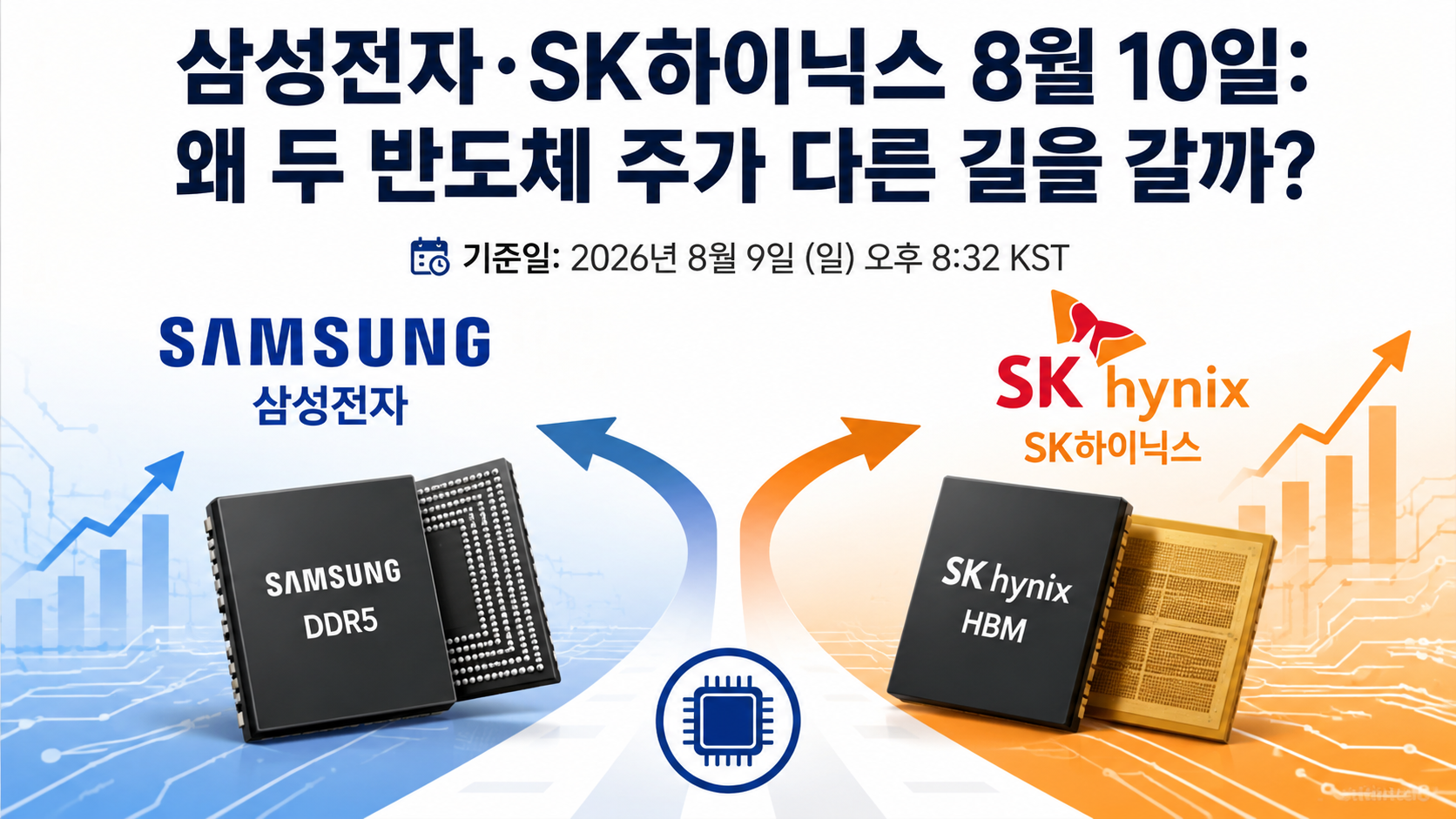
Verification date: August 9, 2026, 8:32 PM KST
Selected platform: Website
Search intent: Investors want to know what could move Samsung Electronics and SK hynix when the Korean market reopens on Monday, August 10, after a volatile week for semiconductor stocks.
Differentiation: Separates confirmed facts from Monday scenarios, compares Samsung Electronics with SK hynix instead of treating them as one semiconductor trade, and focuses on the variables that can actually change the August 10 session.
The structure follows the supplied website format, financial-risk wording, direct-comparison rule, and publication separation requirements.
Core keywords: Samsung Electronics stock, SK hynix stock, August 10 2026, Korean semiconductor stocks, KOSPI, HBM, memory chip stocks, Samsung stock outlook, SK hynix stock outlook
1. Search-focused: Samsung Electronics and SK hynix Stock Outlook for August 10, 2026
2. Homepage-focused: Samsung Held Up While SK hynix Fell — What Changes When Korea Reopens Monday?
3. Search + homepage:Samsung Electronics and SK hynix on August 10: Why the Two Chip Stocks Could Move Differently
4. Alternative angle: Samsung Electronics vs. SK hynix: Three Signals to Watch Before the August 10 Open
5. Alternative angle: Samsung Electronics and SK hynix Face Monday Test After a Volatile Week for Korean Chips
Recommended title:Samsung Electronics and SK hynix on August 10: Why the Two Chip Stocks Could Move Differently
---
Samsung Electronics and SK hynix enter Monday, August 10, 2026 with the same broad advantage—strong AI-driven memory demand—but very different short-term stock momentum. The key question is not simply whether semiconductor shares will rebound. Investors need to watch whether Samsung Electronics can preserve its relative strength while SK hynix stabilizes after another sharp pullback.
As of Sunday evening in Korea, the August 10 session has not started. Any specific closing price or percentage move for Monday is therefore unknown. The useful approach is to separate what has already happened from the variables that could determine the next session.
The divergence between the two stocks became visible during Friday trading.
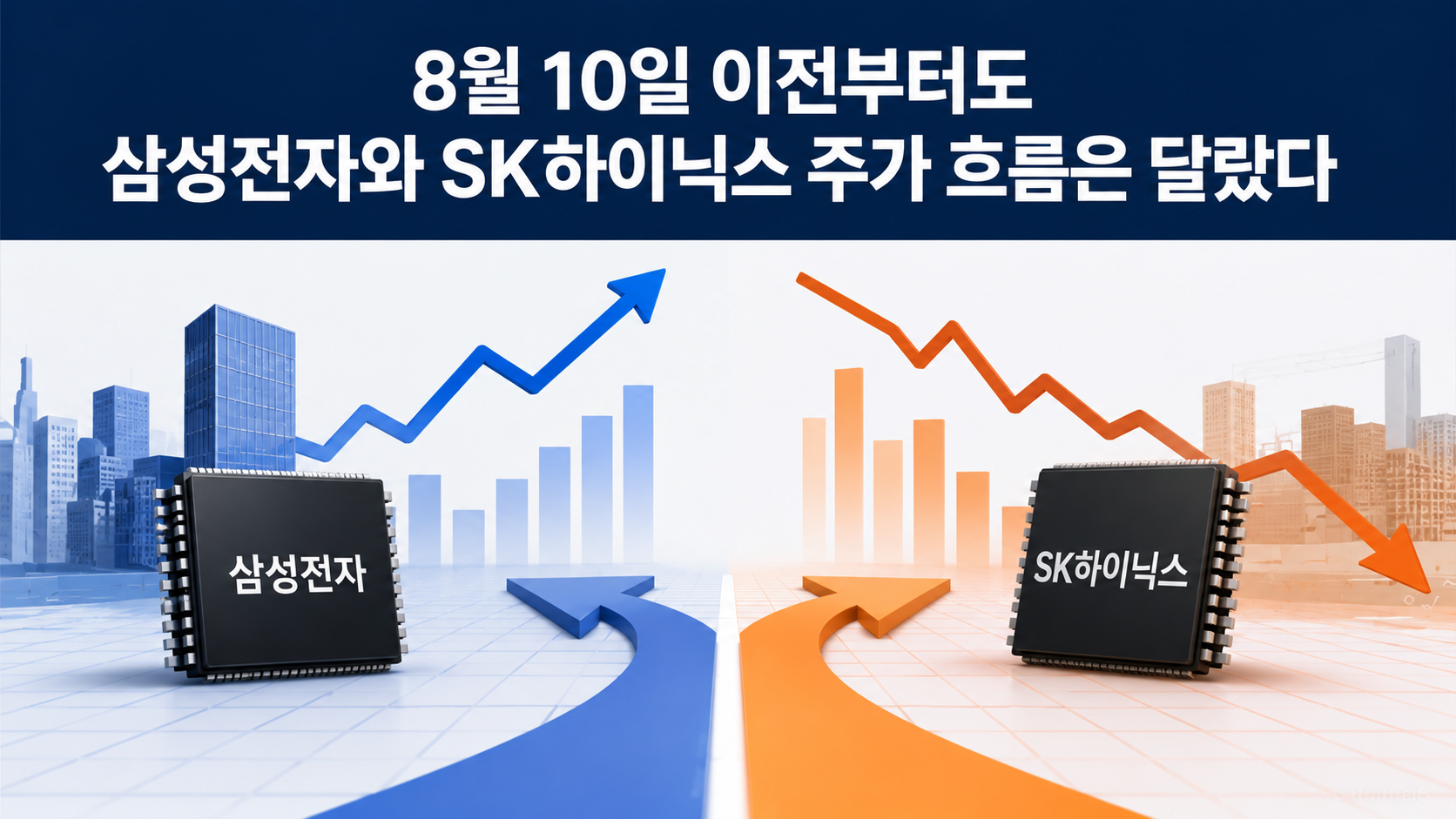
At 11:20 a.m. KST on August 7, Samsung Electronics was up 0.98%, while SK hynix was down 4.01%. The KOSPI itself had reversed an early gain and was down 0.57% at that point.
That difference matters.
Samsung Electronics and SK hynix are both major memory manufacturers, but their share prices do not have to move together every day. Their exposure to HBM, conventional DRAM and NAND, capital spending, valuation, positioning and company-specific news can produce very different reactions even when the long-term memory-market backdrop is similar.
For August 10, the first question is therefore whether investors return to semiconductor stocks as a group or continue distinguishing between individual chipmakers.
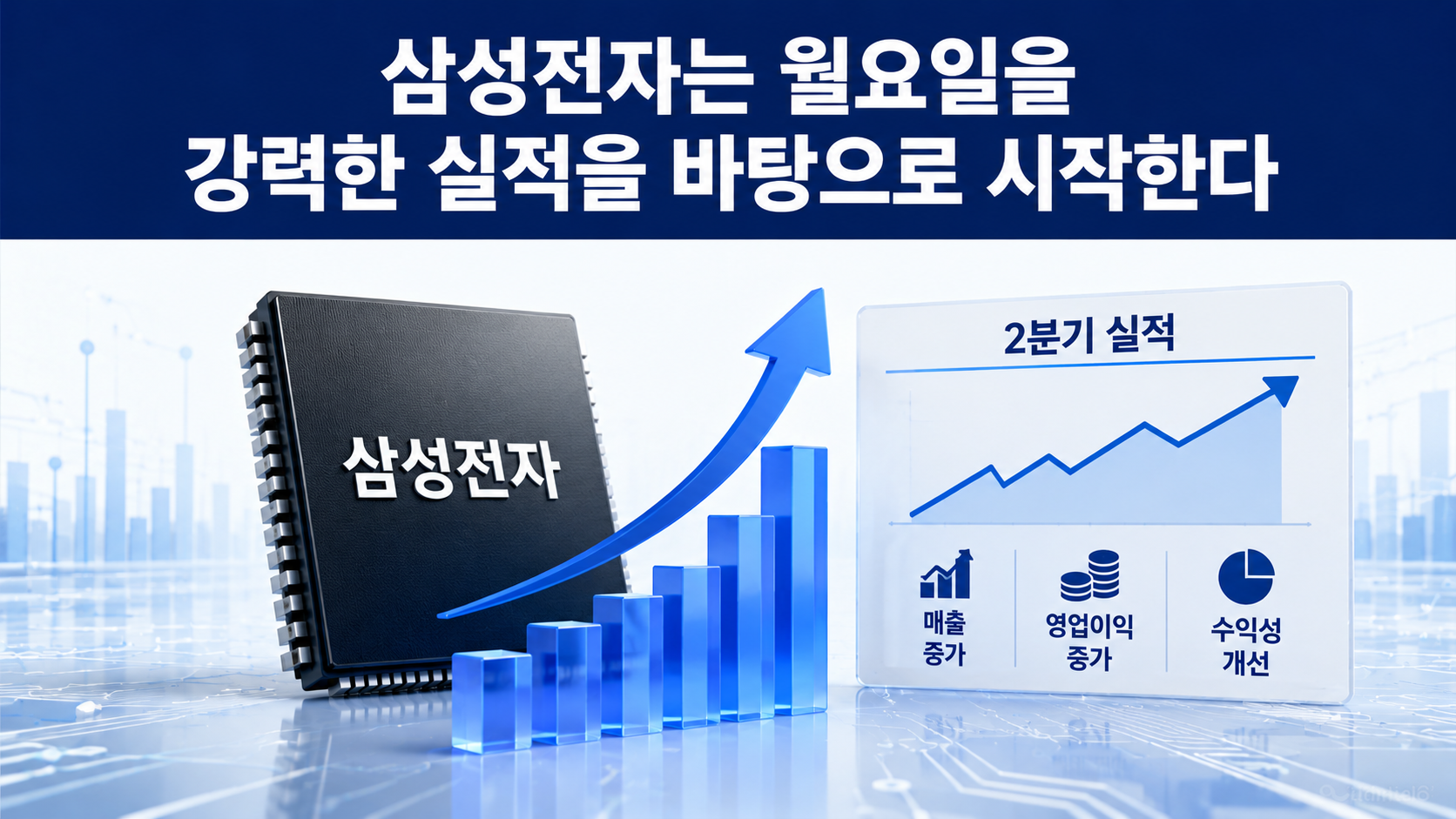
Samsung Electronics has a powerful fundamental argument supporting the stock: its second-quarter earnings were exceptionally strong.
For the second quarter of 2026, Samsung Electronics reported consolidated revenue of KRW 171.5 trillion and operating profit of KRW 89.5 trillion. Revenue increased 28% from the previous quarter, and both revenue and operating profit reached new quarterly records.
The semiconductor business was the main engine.
Samsung's Device Solutions division generated KRW 127.5 trillion in revenue and KRW 89.2 trillion in operating profit during the quarter. The company said its memory business benefited from strong AI-related demand, limited industry capacity and higher memory prices.
Samsung also expanded HBM4 sales and shipped HBM4E samples to major customers.
That gives the stock an important support point for Monday: the underlying memory business remains strong even though semiconductor shares have recently experienced heavy selling.
The difficulty is that strong earnings do not automatically produce a rising share price.
When expectations and valuations have already risen substantially, investors can take profits even after record results. That pattern has already appeared in Korean technology shares during 2026.
For Samsung Electronics, Monday's reaction will therefore depend partly on whether investors begin treating the recent decline as a buying opportunity or remain focused on valuation and macroeconomic risk.
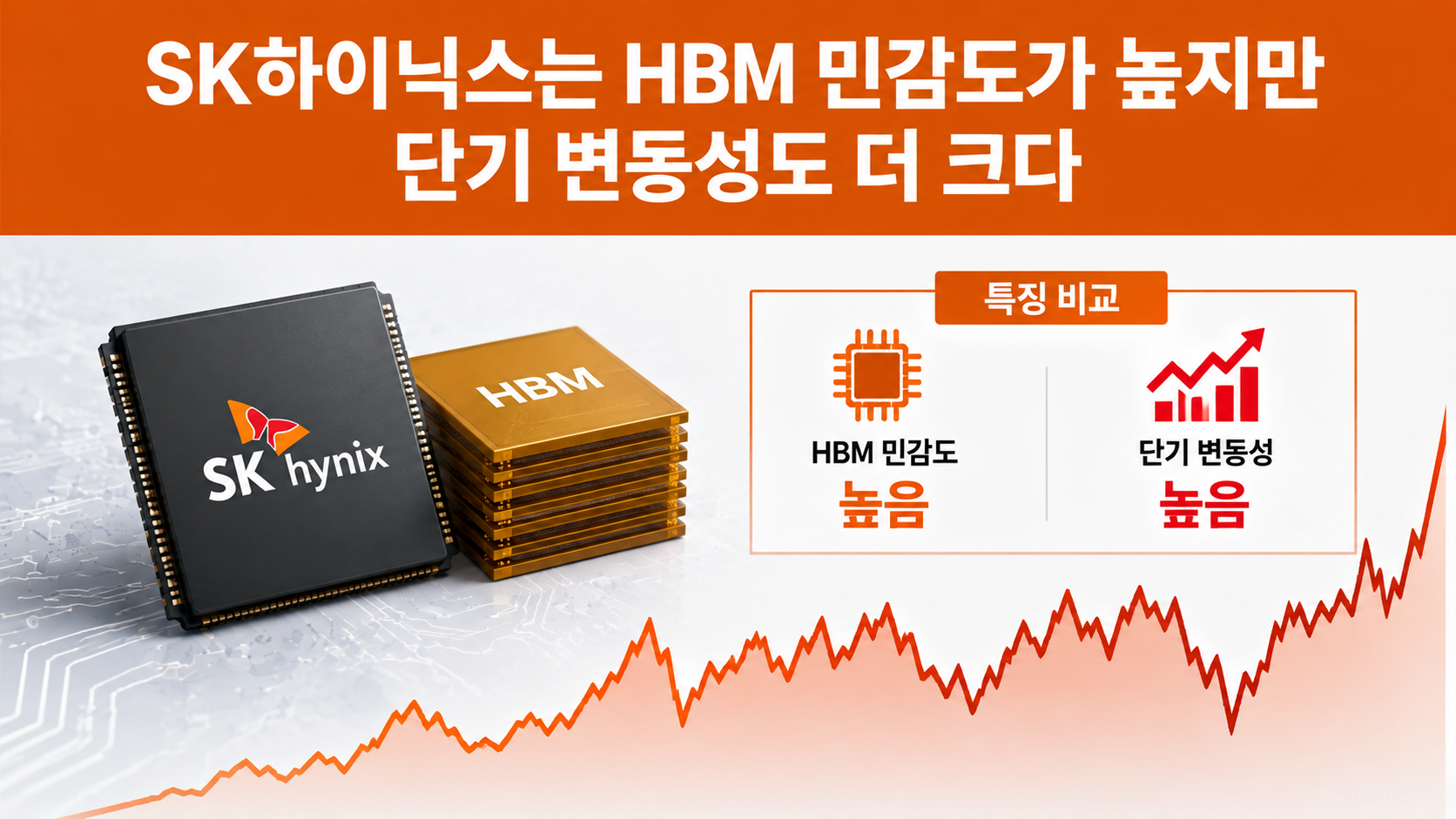
SK hynix presents a different setup.
The company is closely associated with the AI memory and HBM investment theme, which means its shares can react more aggressively when investors change their view of AI capital spending, memory pricing or semiconductor valuations.
On August 7, SK hynix also announced that it was reviewing additional shareholder-return measures and expected to finalize details during the third quarter of 2026. The company announced a dividend of KRW 375 per share.
The shareholder-return announcement is potentially supportive, but it does not remove the larger issue facing the stock: recent price volatility has been much greater than the stability suggested by the memory industry's current operating conditions.
SK hynix is also continuing large-scale capacity investment. That reflects confidence in long-term memory demand, but investors can interpret capital expenditure in two ways.
If AI infrastructure spending remains strong and memory supply stays tight, additional capacity can support future revenue growth.
If investors become concerned that aggressive industry expansion will eventually create excess supply, the same capital expenditure can become a valuation concern.
This is why SK hynix may remain more sensitive than Samsung Electronics to changes in global AI sentiment.
The most important distinction for August 10 is the difference between semiconductor fundamentals and semiconductor share prices.
Samsung Electronics has said it expects robust server-related demand in the second half of 2026 as AI infrastructure investment continues. Demand for server DRAM, enterprise SSDs and HBM is expected to remain strong, while supply constraints are expected to persist despite efforts to increase production.
Those conditions are favorable for memory producers.
Yet stock prices discount future conditions rather than simply reporting current earnings. Investors are asking whether today's exceptional profitability can continue, whether AI infrastructure spending can justify elevated semiconductor valuations, and whether future capacity expansion could eventually weaken memory pricing.
This explains an otherwise confusing situation: semiconductor companies can report record earnings while their stocks fall.
A strong operating quarter and a strong trading session are not the same thing.
For August 10, investors should watch whether the market begins pricing current earnings strength again or remains focused on the risk that profitability is near a cyclical peak.
The opening price alone will not provide enough information.
The first signal is the relationship between Samsung Electronics and SK hynix.
If both stocks rise together, the move would suggest broader semiconductor risk appetite is improving. If Samsung remains relatively firm while SK hynix continues to fall, investors may still be reducing exposure to the more volatile AI-memory trade rather than abandoning Korean semiconductors completely.
The second signal is foreign investor activity.
Recent KOSPI volatility has coincided with substantial foreign selling. Because Samsung Electronics and SK hynix carry enormous weight in the Korean equity market, changes in foreign positioning can influence both the individual stocks and the index itself.
A rebound accompanied by foreign buying would be more informative than an early rise driven only by short-term bargain hunting.
The third signal is the global technology backdrop.
Investors should therefore avoid interpreting a Monday gap higher or lower as a complete change in the semiconductor cycle without checking what happened in global markets first.
Samsung Electronics offers broader business diversification.
Its earnings are not limited to memory. The company also operates foundry, system semiconductor, smartphone, display and other businesses. That diversification can sometimes reduce the stock's direct sensitivity to a single semiconductor theme, although memory remains extremely important to earnings.
SK hynix is a more concentrated memory investment case.
That concentration can be an advantage when HBM and server-memory expectations are rising quickly. It can also amplify share-price movements when investors reduce exposure to the AI-memory theme.
For Monday, this distinction may be more useful than asking which company is simply "better."
Samsung Electronics may attract investors looking for semiconductor exposure with broader business diversification. SK hynix may remain the higher-sensitivity choice for investors focused specifically on HBM and AI memory.
Neither characteristic guarantees better performance on August 10.
A rebound is possible, but it cannot be confirmed before trading begins.
Samsung has several fundamental factors in its favor: record second-quarter earnings, strong memory profitability, growing HBM4 sales and expectations for continued server-memory demand.
The stock also showed relative strength compared with SK hynix during Friday morning trading on August 7.
The more useful question is whether Samsung can continue outperforming the broader semiconductor trade rather than whether the stock simply opens higher.
SK hynix has potential rebound catalysts, but its volatility makes a one-day prediction particularly unreliable.
The company's exposure to HBM and AI infrastructure remains a major long-term earnings driver. Additional shareholder-return measures expected during the third quarter may also become an important valuation factor.
At the same time, recent trading shows that strong memory fundamentals alone have not been enough to prevent sharp share-price declines.
A more convincing stabilization signal would be a session in which SK hynix recovers while foreign selling eases and the broader memory-stock group also improves.
A brief opening rebound without those conditions would provide much weaker evidence that the recent correction has ended.
The most useful review will be the comparison between price action and investor flows.
Check whether Samsung Electronics outperformed SK hynix again, whether foreign investors were net buyers or sellers, and whether the KOSPI's direction matched the two semiconductor heavyweights.
Then compare the Korean session with the broader global semiconductor trend.
If Samsung and SK hynix recover together while foreign demand improves, the market may be starting to refocus on strong memory fundamentals.
If SK hynix remains significantly weaker despite a stable Samsung share price, the market may still be reducing exposure specifically to high-beta AI and HBM positions.
If both fall with heavy foreign selling, the issue is likely broader than company-specific fundamentals.
That distinction will be more useful than trying to predict an exact Monday closing price in advance.
Samsung Electronics enters August 10 with stronger recent relative price momentum, while SK hynix remains more exposed to both the upside and downside of the AI-memory trade.
The underlying memory cycle remains supported by strong AI infrastructure demand and constrained supply, but recent trading demonstrates that record earnings do not eliminate valuation, positioning or macroeconomic risks.
For that reason, August 10 should be treated as a confirmation session rather than a predetermined rebound day. Watch the relative performance of Samsung Electronics and SK hynix, foreign investor flows and the global semiconductor backdrop before drawing conclusions from the opening move.
This article is for informational purposes only and does not constitute investment advice. Stock prices can change rapidly, and past earnings or price performance does not guarantee future returns.
---
Meta description:
Samsung Electronics and SK hynix enter August 10, 2026 with different short-term momentum despite strong AI memory demand. See the key signals to watch, including HBM, foreign flows and semiconductor sentiment.
URL slug:
`samsung-electronics-sk-hynix-stock-august-10-2026`
Internal link suggestion:
Korean semiconductor outlook | After the section on memory fundamentals | 2026 memory chip outlook: HBM, DRAM and NAND | Gives readers the industry background needed to understand why earnings and stock prices can move differently.
Tags / labels:
Samsung Electronics, SK hynix, Samsung stock, SK hynix stock, Korean stocks, KOSPI, semiconductor stocks, HBM, memory chips, AI stocks, August 10 2026
Thumbnail text:SAMSUNG vs SK HYNIX — AUG. 10Thumbnail composition:
Two-column comparison using Samsung Electronics and SK hynix labels, with an upward/flat directional marker for Samsung's recent relative strength and a volatility marker for SK hynix. Avoid predicting Monday's actual price direction. The supplied visual guidelines prioritize informative comparison graphics over decorative imagery.
Image alt:
Comparison graphic showing Samsung Electronics and SK hynix ahead of the Korean stock market session on August 10, 2026.
Follow-up content:Samsung Electronics vs. SK hynix After the August 10 Close: Foreign Flows, Closing Prices and What ChangedUpdate trigger:
Update this article after the August 10 market close with confirmed closing prices, daily percentage changes, foreign investor flows and KOSPI performance. Do not replace the pre-market outlook with hindsight; add the confirmed result as a clearly dated update. This follows the supplied rule to update time-sensitive stock content when new market results become available.
The market facts used for the pre-session framing were checked through August 9 KST. Samsung Electronics reported Q2 2026 revenue of KRW 171.5 trillion and operating profit of KRW 89.5 trillion, while its semiconductor division reported KRW 127.5 trillion in revenue and KRW 89.2 trillion in operating profit. On August 7 at 11:20 a.m. KST, Samsung Electronics was up 0.98% while SK hynix was down 4.01%; these are explicitly intraday figures, not August 7 closing prices. SK hynix also confirmed it was reviewing additional shareholder returns for announcement in the third quarter and declared a KRW 375-per-share dividend. [reuters.com](
※ 이 글은 시장 흐름을 이해하기 위한 참고용 정보이며 특정 종목이나 자산에 대한 투자 권유가 아닙니다. 최종 판단과 투자 책임은 본인에게 있습니다.