

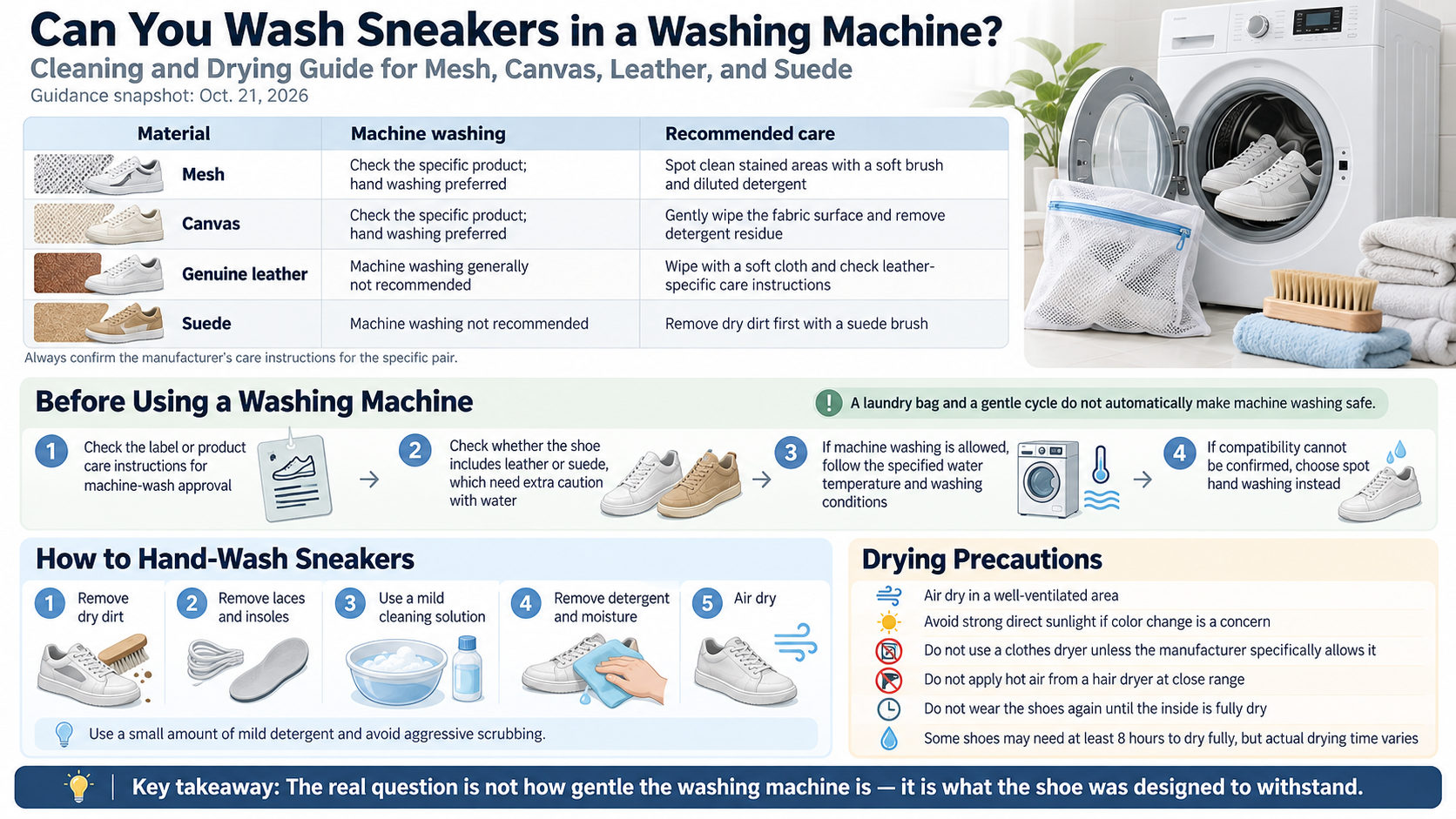
Do not automatically put dirty sneakers in a washing machine.mesh and canvas sneakers may be suitable for hand washing depending on the material and product, while leather and suede require extra caution around water. Before using a washing machine, first confirm that the manufacturer allows machine washing, and after cleaning, it is important to let the shoes dry thoroughly without applying heat.
Even sneakers that look similar can require different care depending on the upper, sole, and bonding method. This is especially important for shoes such as running shoes, which often combine several materials. Do not choose a washing method based only on the visible upper material.
The appropriate cleaning method depends on the sneaker's primary material. For mesh and canvas, spot cleaning with a soft cleaning tool and mild detergent may be considered. Leather and suede require separate care suited to the characteristics of their surfaces.
| Sneaker material | Washing machine guidance | Recommended care method |
|---|---|---|
| Mesh | Check the specific product; hand washing preferred | Clean stained areas with a soft brush and diluted detergent |
| Canvas | Check the specific product; hand washing preferred | Gently wipe the fabric surface and remove detergent residue |
| Genuine leather | Machine washing generally not recommended | Wipe with a soft cloth and check leather-specific care instructions |
| Suede | Machine washing not recommended | Remove dry dirt first with a suede brush |
This table provides general material-care guidance. Whether a specific pair can actually be washed should be determined first by the manufacturer's instructions for that product.
Mesh is a net-like fabric with small openings and is commonly used on the upper portion of running shoes. A suitable approach is to apply a small amount of mild cleaning solution to stained areas and wipe them with a soft brush or cloth.
Rather than scrubbing the surface aggressively, wipe it lightly several times. It is better to avoid rough brushes that could snag or damage the mesh structure.
Running shoes may include foam midsoles and multiple bonded sections in addition to the mesh upper. The fact that the mesh itself can tolerate contact with water does not mean the entire shoe can safely be submerged or placed in a washing machine.
Canvas is used for shoe uppers made from cotton or blended fabrics. Some canvas shoes can be cleaned with water, but spot hand washing is a more cautious choice when the sole bonding and lining are also taken into account.
First remove dirt and dust, then apply a mild detergent diluted with water to a cloth or brush and wipe the shoe. After cleaning, remove any remaining detergent with a clean damp cloth.
For colored canvas, it is advisable to test an inconspicuous area first for possible discoloration.
Genuine leather sneakers should be cared for by gently removing surface dirt rather than soaking them in water for an extended period. Leather reacts differently to water and cleaning products depending on its characteristics, so it should not be treated in the same way as ordinary fabric.
After removing dust, use a soft cloth and, if necessary, a cleaning product suitable for that particular leather.
Synthetic leather also cannot always be cleaned using one universal method. Surface coatings and product construction can differ, so check the care instructions for the specific product rather than assuming it should be treated exactly like genuine leather.
Suede is a leather material with a short, soft nap on the surface. Instead of scrubbing it with detergent or soaking it in water as you might with ordinary sneakers, suede is better maintained with a dedicated suede brush.
Carefully remove dust or dried mud with a suede brush. If stains remain, check for a cleaning method specifically approved for suede.
For shoes where water marks or color changes are a concern, avoid mixing and applying cleaning agents on your own.
Using a laundry bag and a gentle washing cycle does not automatically make machine washing safe for sneakers. A laundry bag may help reduce direct contact between the shoes and the washing machine drum, but it does not prevent water-related material changes or damage to bonded areas.
When deciding whether to use a washing machine, the following order is appropriate.
1. Check the label inside the shoe or the product care instructions to see whether machine washing is permitted.
2. Check whether the shoe contains materials such as leather or suede that require caution with water washing.
3. If the manufacturer allows machine washing, follow the specified water temperature and washing conditions.
4. If washing compatibility cannot be confirmed, choose spot hand washing instead of machine washing.
For example, mesh running shoes and canvas sneakers may both look like fabric shoes from the outside. However, their internal construction may differ, so applying the same washing cycle to both is not appropriate.
If the manufacturer does not recommend machine washing, using a laundry bag or a wool/gentle cycle does not override that recommendation.
For materials that can be washed with water, a good approach is to begin by removing dry dust, then spot clean, remove detergent residue, and finish with air drying. Rather than soaking the entire shoe from the start, focus on wiping the areas with the heaviest dirt.
How to Hand-Wash Sneakers
Step 1. Remove dry dirt
Use a soft brush to remove soil and dust from the sole and upper.
Step 2. Remove the laces and insoles
Take out any removable parts and check the cleaning instructions for each one separately.
Step 3. Use a mild cleaning solution
Dilute a small amount of mild detergent in water and wipe the stained areas.
Step 4. Remove detergent and moisture
Wipe away residue with a clean cloth, then press with a dry towel to absorb moisture.
Step 5. Air dry
Allow the shoes and any removed parts to dry thoroughly in a well-ventilated area.
Shoelaces can be hand-washed separately if their material permits it. Even if insoles are removable, cleaning methods vary by product, so check the applicable instructions before washing or wiping them.
When using a cleaning solution, it is important not to use excessive detergent. If too much detergent remains, additional wiping will be required, and on some materials a concentrated cleaning solution may cause discoloration or surface changes.
For ordinary sneakers, air drying at room temperature should generally be considered first. After cleaning, remove as much moisture as possible and place the shoes in a well-ventilated area. Do not wear them again until the inside is completely dry.
During drying, check the following points.
Direct sunlight: Avoid strong sunlight for materials where color changes are a concern.
Hair dryer: Do not direct hot air at close range onto the shoes.
Clothes dryer: Do not place sneakers in a dryer unless the manufacturer specifically allows it.
Inside the shoe: Support the shape appropriately and allow enough time for the interior to dry fully.
Even if the outside of the shoe looks dry, moisture may still remain in the insole area or toe box.
Nike's general sneaker-care guidance recommends air drying at room temperature and notes that, depending on the shoe, it may take at least 8 hours to dry completely. This does not mean every pair of sneakers will dry in exactly 8 hours.
Drying time varies according to weather, humidity, shoe thickness, and how wet the shoes are. Rather than wearing them after a fixed amount of time, it is important to check their actual dryness.
White sneakers are not automatically compatible with every type of cleaning product. The appropriate cleaning method varies depending on the material, color, and surface treatment.
Nike describes a cleaning method using baking soda mixed with water for some white or light-colored shoes. However, this should not be understood as a method that can be applied universally to leather, suede, or every type of mesh sneaker.
Whether chlorine bleach can be used should also be checked in the product's care instructions. Do not decide to use bleach simply because the shoes are white.
If a stain is difficult to remove, it is safer to check for a cleaning product appropriate for that specific material rather than gradually switching to stronger detergents.
Before cleaning sneakers, check all of the shoe's materials as well as the product-specific care instructions. In particular, when the upper and decorative sections are made from different materials, a cautious approach is to choose a cleaning method based on the part that requires the most delicate care.
If you are not sure whether the shoes can be machine washed, do not begin by soaking the entire pair.
For everyday dirt, simply brushing away dust, gently wiping the stained areas, and allowing the shoes to air dry thoroughly may be enough.
The key question in sneaker cleaning is not how gently you can run the washing machine, but what type of cleaning the shoe was actually designed to withstand.