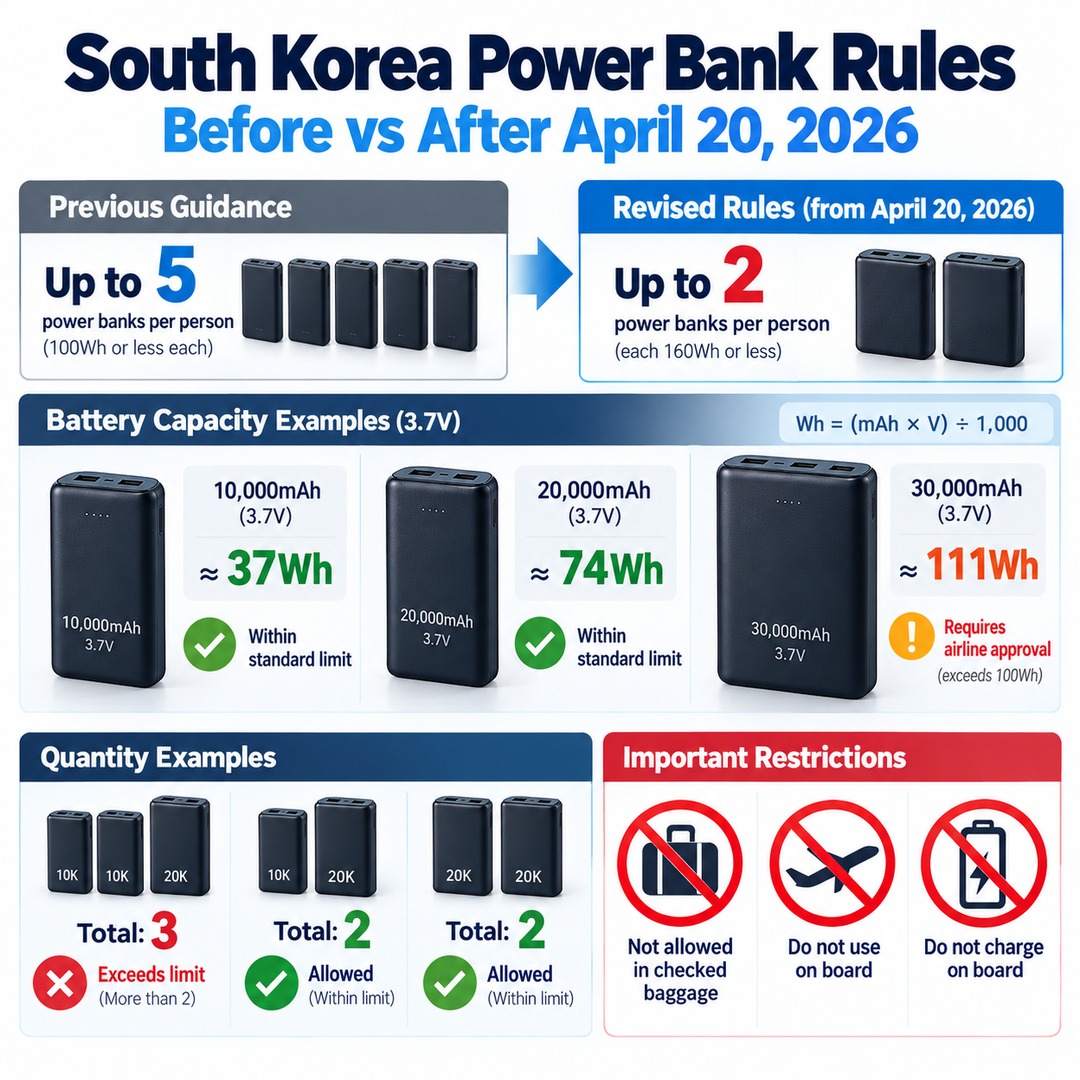

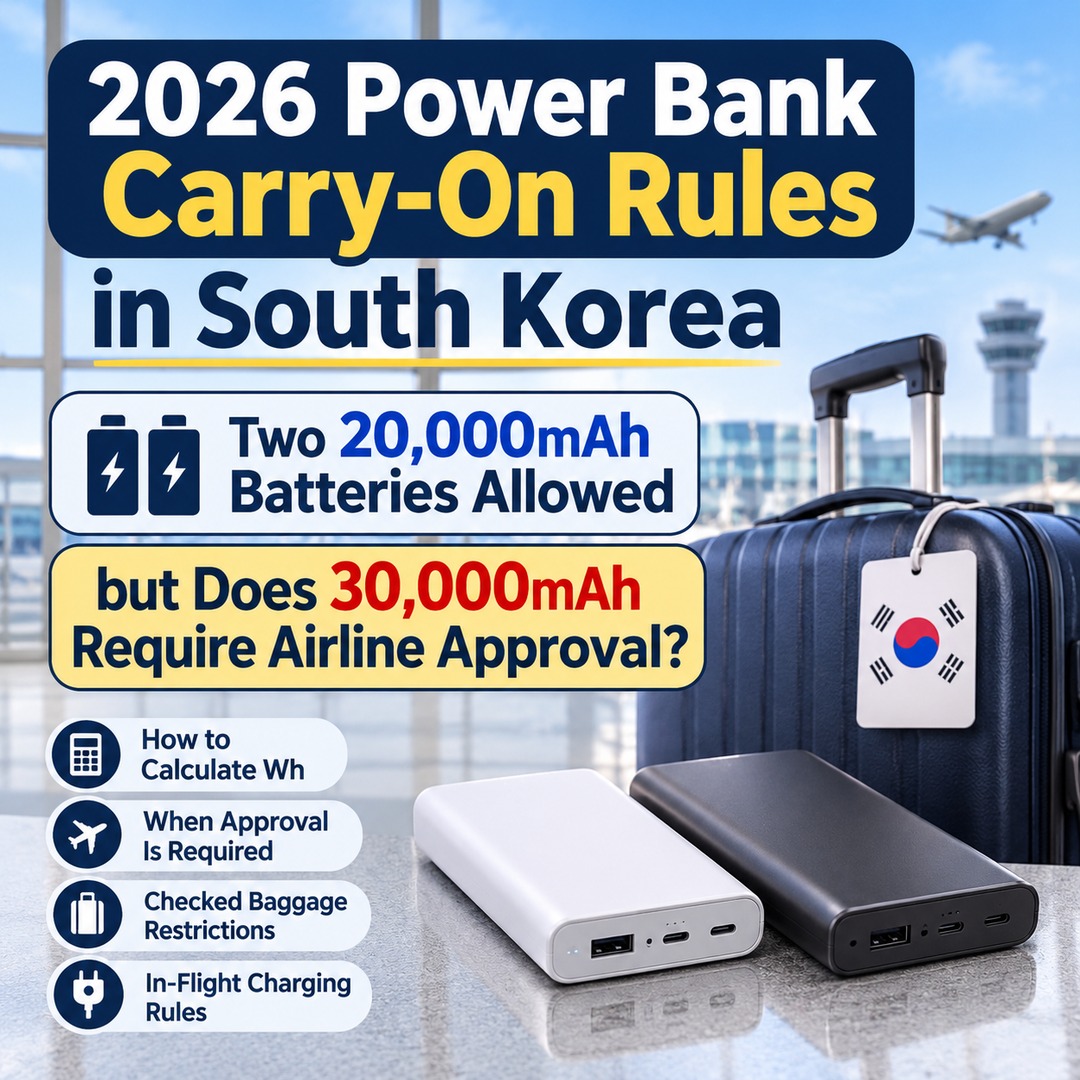
If you are preparing for an international trip and have packed several 20,000mAh power banks, the first thing to check is how many you are carrying. Under the aviation rules implemented in South Korea on April 20, 2026, each passenger may carry a maximum of two power banks, each rated at no more than 160Wh. Even 20,000mAh power banks are limited to two per person, and high-capacity batteries exceeding 100Wh require airline approval.
Power banks cannot be placed in checked baggage, and using or charging them during a flight is also prohibited under these rules.
Previous guidance in South Korea allowed up to five power banks rated at 100Wh or less, but the rules have changed. In particular, the capacity of 20,000mAh and 30,000mAh products must be converted into watt-hours (Wh) to determine the applicable carry-on requirements accurately.
How Did the Power Bank Carry-On Quantity Limit Change in 2026?
Starting April 20, 2026, the total number of power banks a passenger may carry is limited to two, regardless of battery capacity. This does not mean passengers can bring two batteries rated at 100Wh or less plus another two rated above 100Wh.
The restrictions on the number of batteries and their use on board were strengthened after a safety-management proposal submitted by South Korea's Ministry of Land, Infrastructure and Transport to the International Civil Aviation Organization (ICAO) was adopted as an international standard.
The following table compares the previous South Korean guidance with the revised requirements.
| Category | Previous South Korean Rules | From April 20, 2026 |
|---|---|---|
| 100Wh or less | Up to 5 batteries | Up to 2 batteries |
| Over 100Wh to 160Wh | Up to 2 with airline approval | Airline approval required; maximum of 2 in total |
| Over 160Wh | Not permitted | Not permitted |
| Checked baggage | Not permitted | Not permitted |
| In-flight use and charging | Separate safety restrictions applied | Completely prohibited |
For example, if you pack two 10,000mAh power banks and one 20,000mAh power bank, you have three batteries in total and exceed the quantity limit.
By contrast, one 10,000mAh battery and one 20,000mAh battery make a total of two. If both are rated at 100Wh or less and meet the other carry-on requirements, they fall within the standard capacity and quantity limits.
The important distinction is that the Wh rating of each individual battery and the total number of batteries are assessed separately, rather than adding their capacities together.
Can You Bring Two 20,000mAh Power Banks on a Plane?
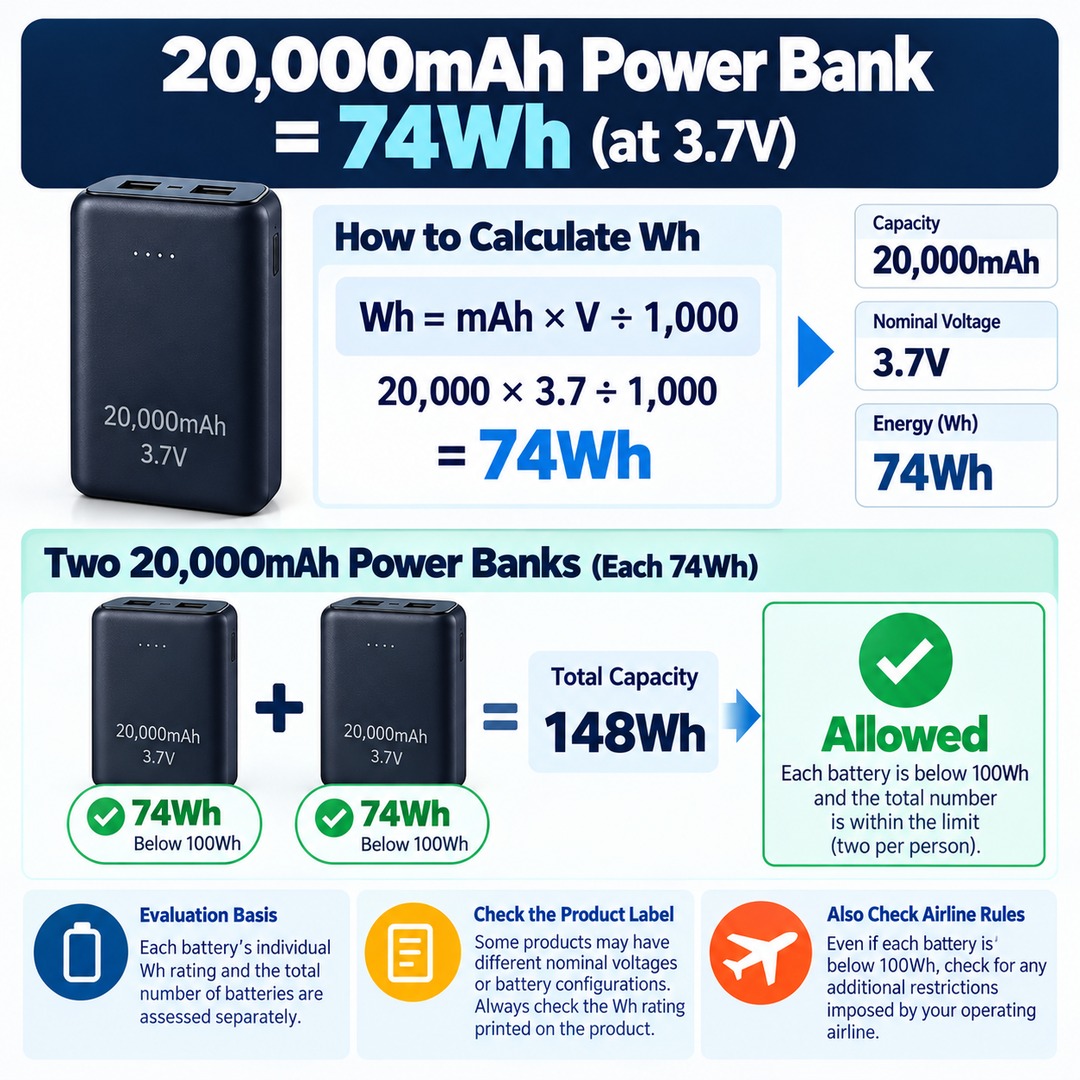
A 20,000mAh power bank with a nominal voltage of 3.7V has a capacity of 74Wh. Carrying two such batteries therefore meets the general capacity and quantity requirements. However, you should check the rated energy printed on the actual products and any restrictions imposed by the operating airline.
Watt-hours (Wh), the unit used in aviation battery regulations, measure the amount of energy a battery stores.
Milliampere-hours (mAh) measure electric charge capacity, so the battery's voltage is needed to convert mAh into Wh.
The calculation is:
Wh = mAh × Nominal Voltage (V) ÷ 1,000
Using 3.7V, the calculation is:
20,000 × 3.7 ÷ 1,000 = 74Wh
If two 20,000mAh power banks are each rated at 74Wh, both individual batteries fall below the 100Wh threshold.
Their combined capacity of 148Wh does not automatically place them in the category requiring airline approval for batteries exceeding 100Wh. The decision is based on each battery's individual rated energy and the number of batteries carried.
However, some products may have different nominal voltages or battery configurations, so always check the Wh rating printed on the product first.
Do 30,000mAh and 40,000mAh Power Banks Require Airline Approval?
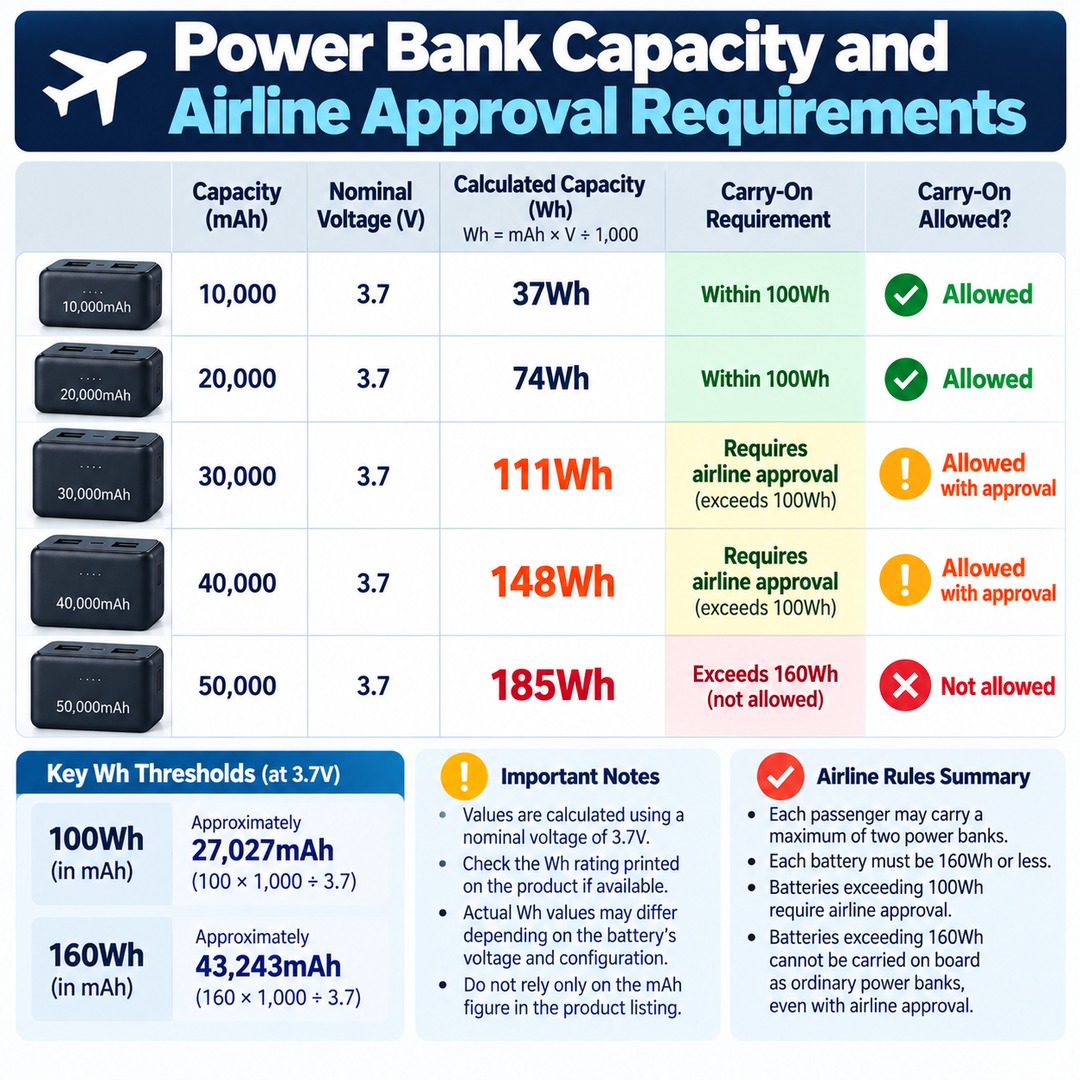
A 30,000mAh power bank rated at 3.7V has a calculated capacity of 111Wh, so airline approval is required. A 40,000mAh battery at the same voltage has a calculated capacity of 148Wh and also requires approval.
Power banks exceeding 160Wh cannot be carried on board as ordinary power banks, even if the passenger obtains airline approval.
All values in the following table are calculated using an assumed nominal voltage of 3.7V.
| Advertised Capacity | Calculated Wh | Carry-On Assessment |
|---|---|---|
| 10,000mAh | 37Wh | Meets the standard capacity requirement |
| 20,000mAh | 74Wh | Meets the standard capacity requirement |
| 25,000mAh | 92.5Wh | Meets the standard capacity requirement |
| 27,000mAh | 99.9Wh | Meets the standard capacity requirement |
| 30,000mAh | 111Wh | Airline approval required |
| 40,000mAh | 148Wh | Airline approval required |
| 50,000mAh | 185Wh | Not permitted |
At 3.7V, converting the watt-hour thresholds back into milliampere-hours gives approximately 27,027mAh for 100Wh and 43,243mAh for 160Wh.
However, these figures cannot be applied to every product without checking its specifications.
For example, a 20,000mAh battery with a nominal voltage other than 3.7V will produce a different Wh value. If the product has a Wh rating printed on its casing, that is the figure you should check first.
For high-capacity batteries close to the 100Wh or 160Wh thresholds, do not rely solely on the mAh figure in the product listing. Check the rated energy specified by the manufacturer.
Can You Use a Power Bank to Charge Your Phone During a Flight?
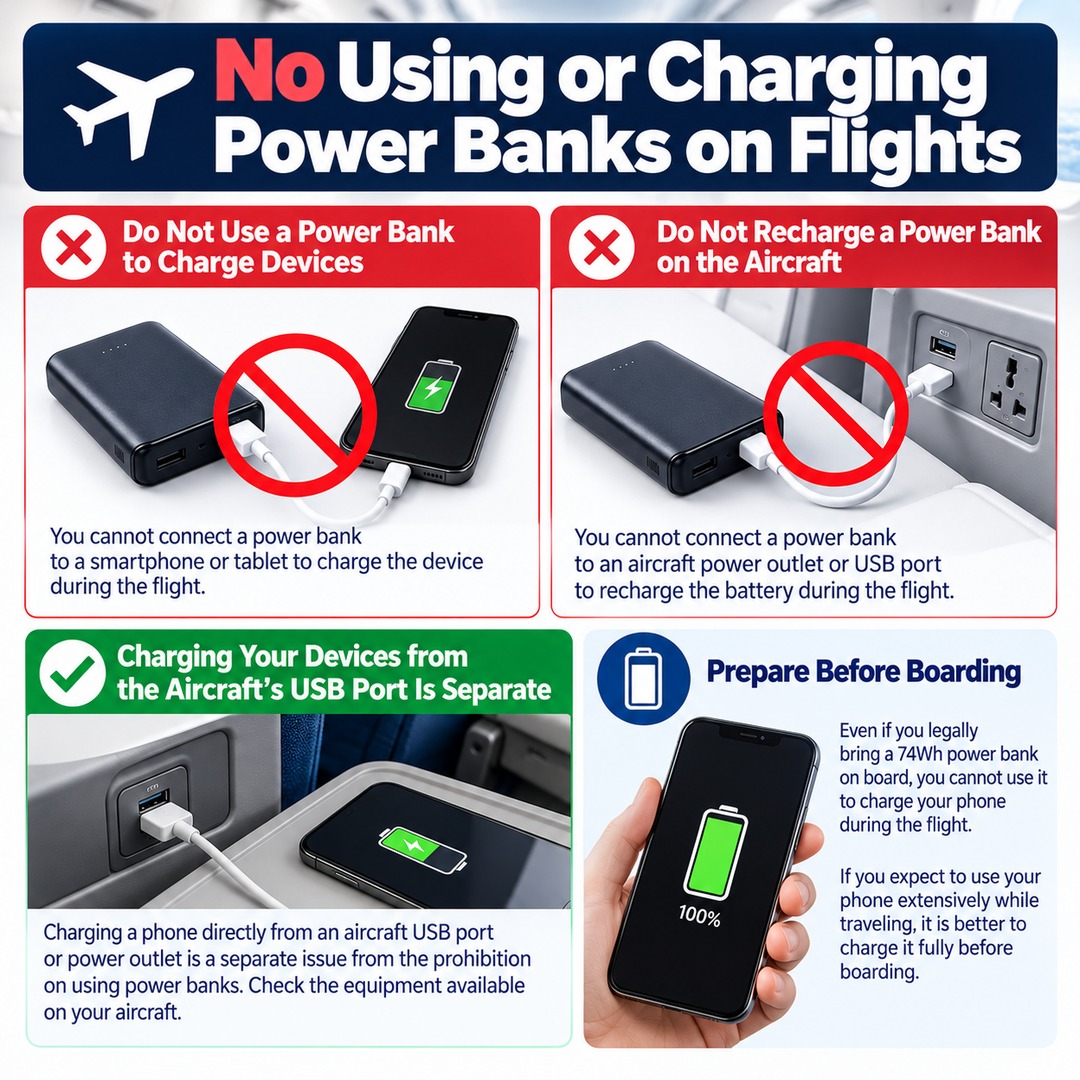
Under the rules implemented on April 20, 2026, using or charging a power bank during a flight is prohibited. Permission to carry a battery on board does not mean it can be used to charge devices in flight.
The restrictions cover two main situations:
Connecting a power bank to a smartphone or tablet to charge the device.
Connecting a power bank to an aircraft power outlet or USB port to recharge the battery itself.
For example, even if you legally bring a 74Wh power bank on board, you cannot use it to charge your phone during the flight.
If you expect to use your phone extensively while traveling, it is better to charge it fully before boarding.
Charging a phone directly from a USB port or power outlet installed at an aircraft seat is a separate issue from the prohibition on using power banks. Check the equipment available on your aircraft and the instructions provided by the operating airline.
Where Should You Store Power Banks in Your Luggage and on the Plane?
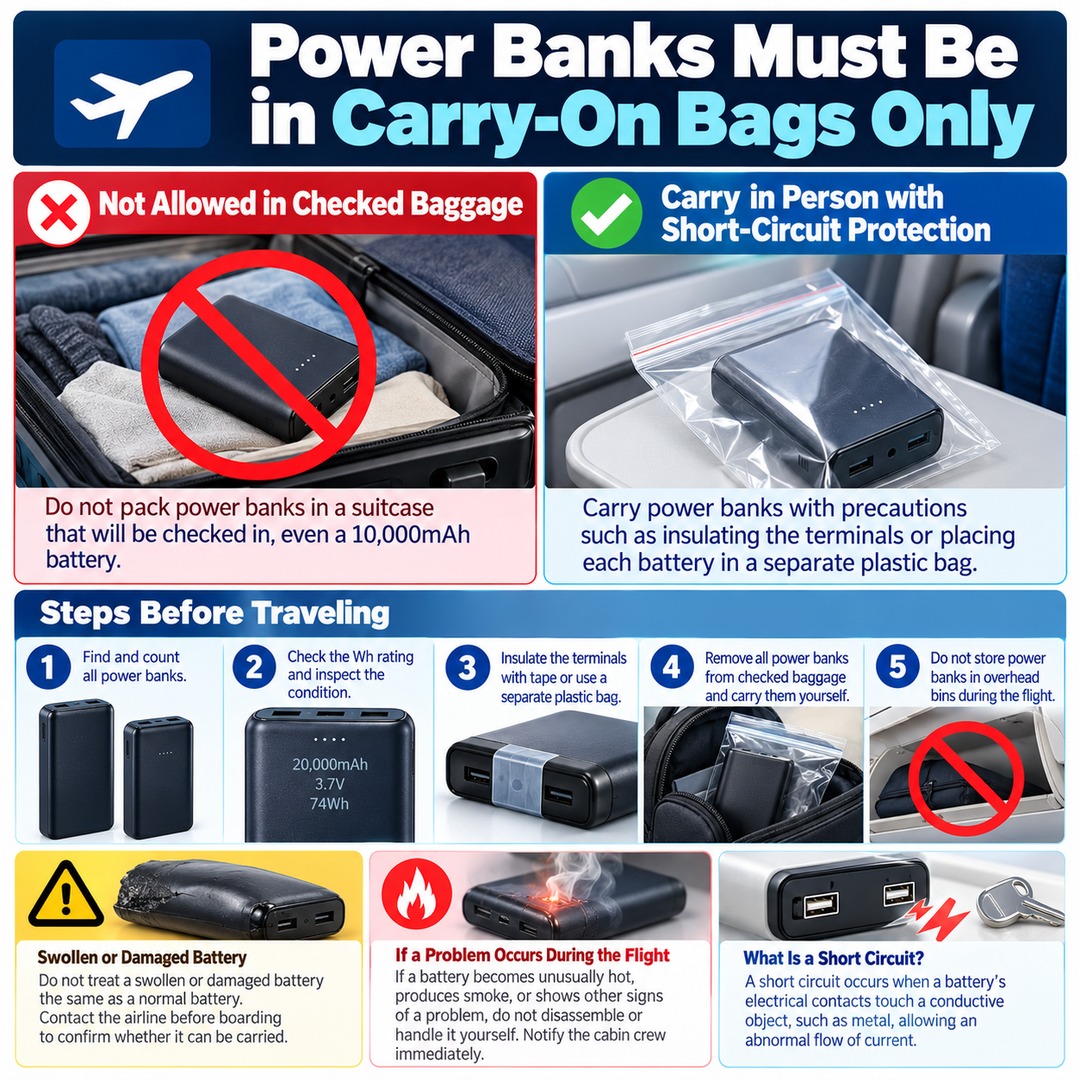
Power banks cannot be placed in checked baggage. They must be carried personally with precautions to prevent short circuits. Even a small 10,000mAh battery must not be packed in a suitcase that will be checked in.
A short circuit occurs when a battery's electrical contacts touch a conductive object, such as metal, allowing an abnormal flow of current. To prevent this, protect the terminals from contact with other objects.
Before traveling, follow these steps:
1. Find all power banks in both your checked suitcase and carry-on bags, and count them.
2. Check the Wh rating printed on each battery and inspect its physical condition.
3. Apply insulating tape to exposed battery terminals or place each battery in a separate plastic bag to prevent short circuits.
4. Remove all power banks from checked baggage and prepare to carry them personally.
5. Do not store power banks in the overhead compartment. Follow the cabin crew's instructions on how to carry and store them.
A swollen or damaged battery should not be treated in the same way as a battery in normal condition. Contact the airline before boarding to confirm whether it can be carried.
If a battery becomes unusually hot, produces smoke, or shows other signs of a problem during the flight, do not attempt to disassemble or handle the problem yourself. Notify the cabin crew immediately.
Do the Same Rules Apply to International and Connecting Flights?
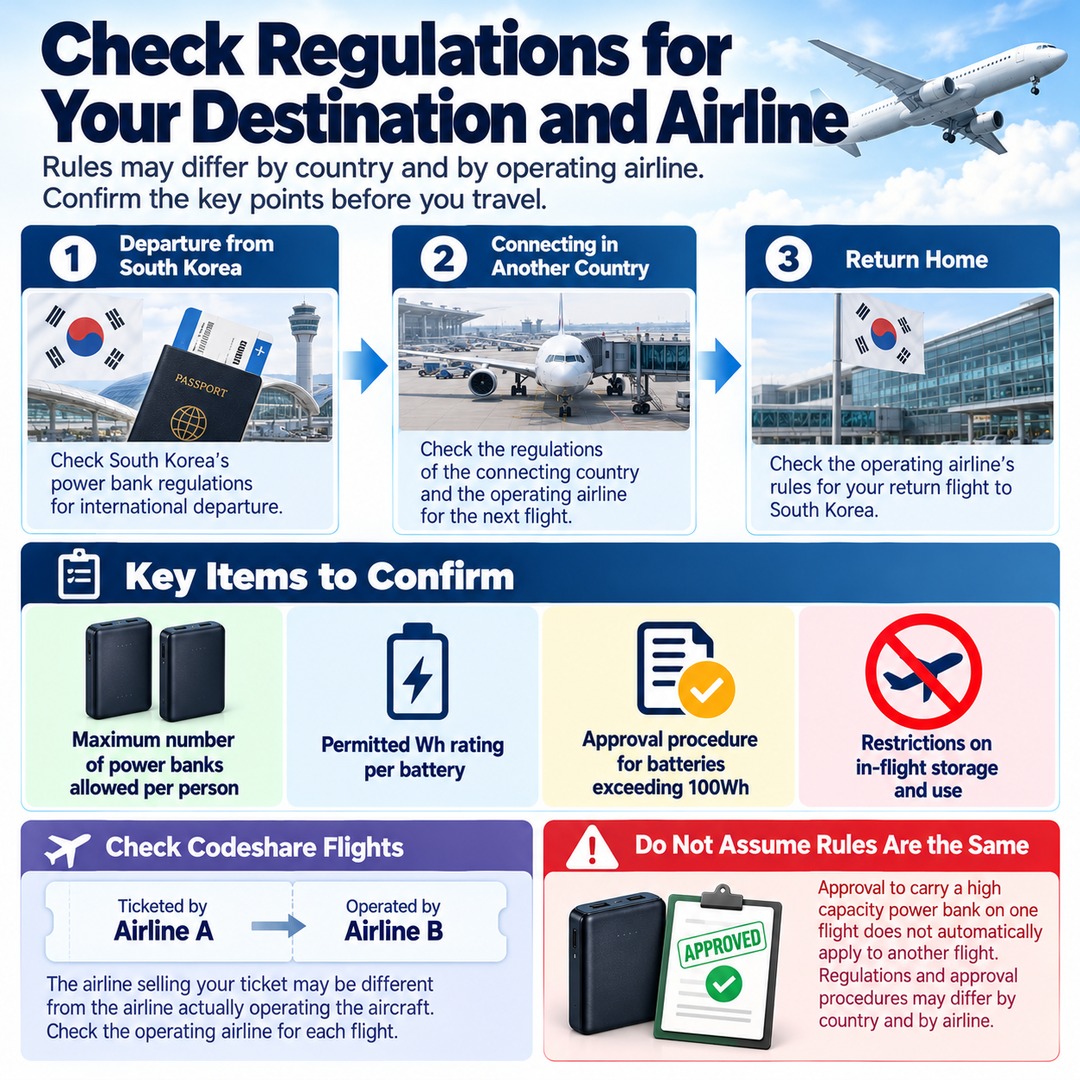
For international travel, you should check both the power bank regulations of the departure country and those of the airline actually operating your flight. Even where international standards have been established, airline approval procedures and operational requirements may differ.
This is particularly important for power banks exceeding 100Wh, because prior airline approval is required for this capacity category.
Codeshare flights also require attention. The airline selling your ticket may be different from the airline actually operating the aircraft.
If your itinerary involves departing South Korea, connecting through another country, and returning home, check the operating airline for each outbound, connecting, and return flight.
The key items to confirm are the maximum number of power banks allowed, the permitted Wh rating per battery, the approval procedure for batteries exceeding 100Wh, and the restrictions on in-flight storage and use.
Do not assume that approval to carry a high-capacity power bank on one flight automatically applies to another flight.
How Can You Check a Power Bank's Capacity If No Wh Rating Is Printed?
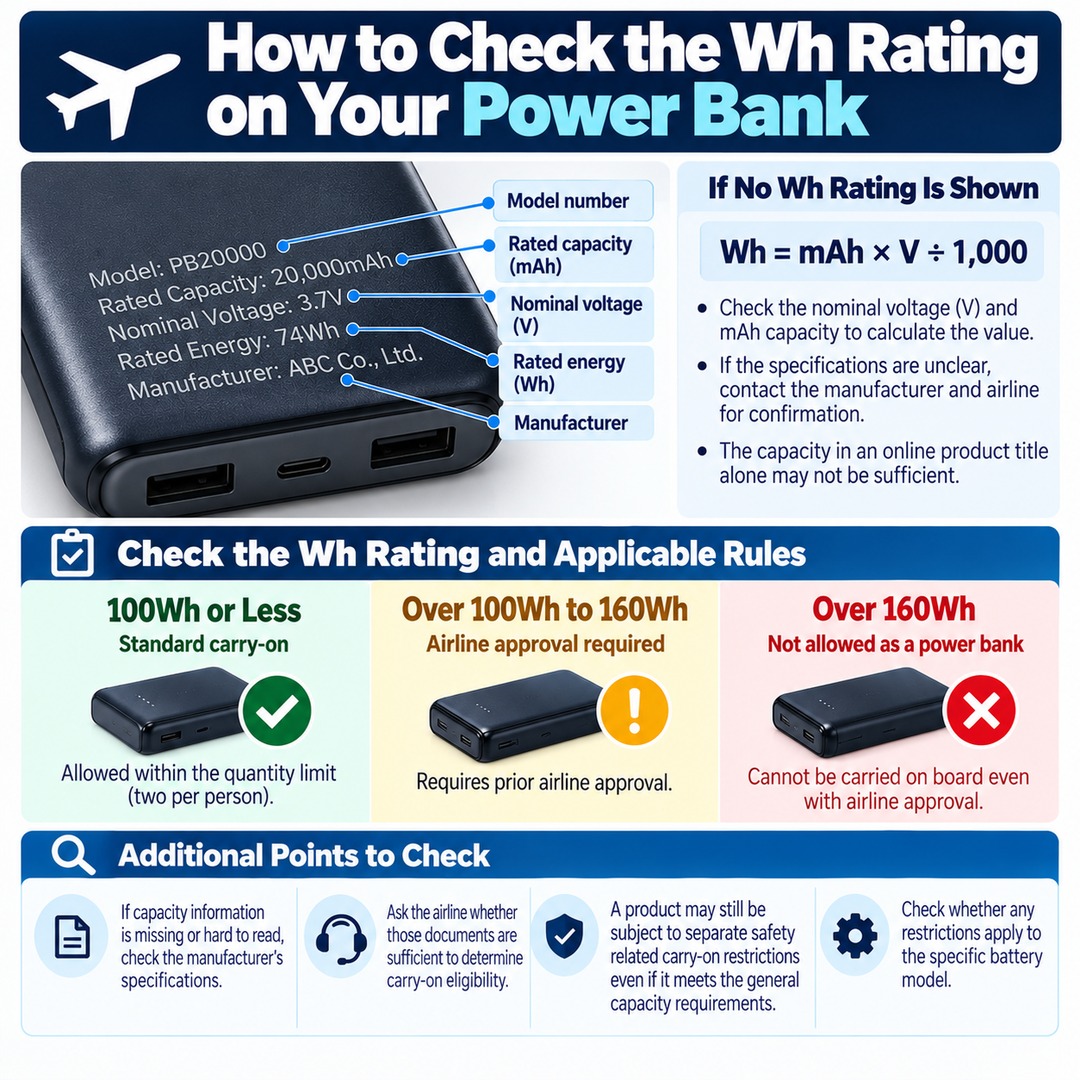
If your power bank does not display a Wh rating, check its nominal voltage and mAh capacity to calculate the value. If the specifications are unclear, contact the manufacturer and airline for confirmation. The capacity stated in an online product title alone may not be sufficient to establish whether the battery is permitted on board.
Look for the following information on the back or side of the product:
Rated capacity: mAh
Nominal voltage: V
Rated energy: Wh
Manufacturer and model number
If a Wh rating is displayed, use it to determine whether the battery falls into one of three categories: 100Wh or less, over 100Wh to 160Wh, or over 160Wh.
If the capacity information is missing or difficult to read, consult the manufacturer's product specifications. If necessary, ask the airline whether those documents are sufficient to determine carry-on eligibility.
A product may still be subject to separate safety-related carry-on restrictions even if it meets the general capacity requirements.
It is also worth checking whether any restrictions apply to the specific battery model.
What Should You Check Before Leaving for the Airport?
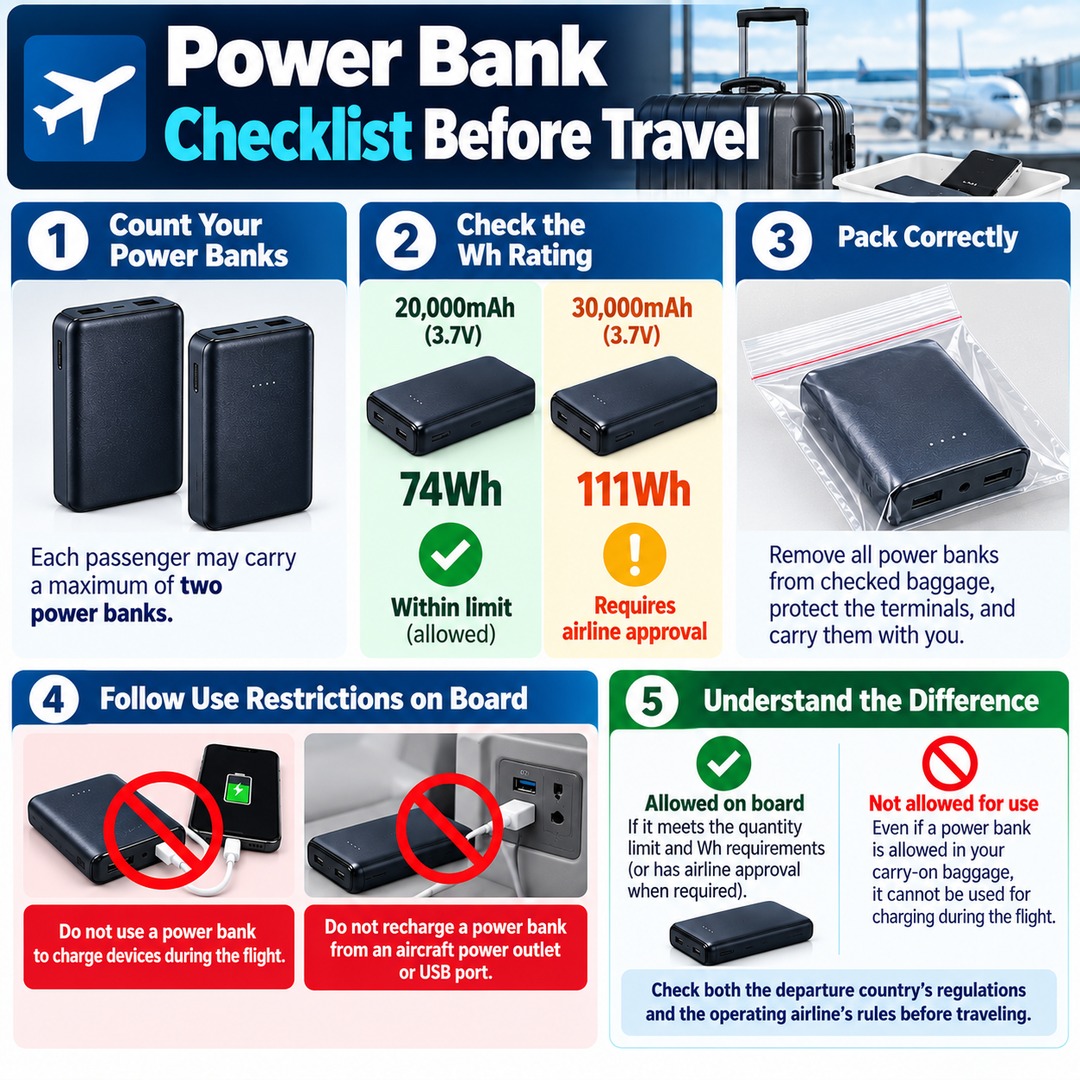
Before heading to the airport, first count your power banks and check their Wh ratings. If any battery exceeds 100Wh, confirm whether airline approval is required and whether it has been obtained.
Two 20,000mAh batteries are each rated at 74Wh when calculated using the common nominal voltage of 3.7V, so they meet the general quantity and capacity requirements. By contrast, a 30,000mAh battery at the same voltage is rated at 111Wh, making advance airline approval an important consideration.
Finally, remove all power banks from checked suitcases, protect their terminals, and prepare to carry them personally.
Whether a power bank is permitted on board and whether it can be used during the flight are two separate questions. Even a battery that is allowed in carry-on baggage cannot be used for charging during the flight under these rules. Make sure you understand both restrictions before traveling.