

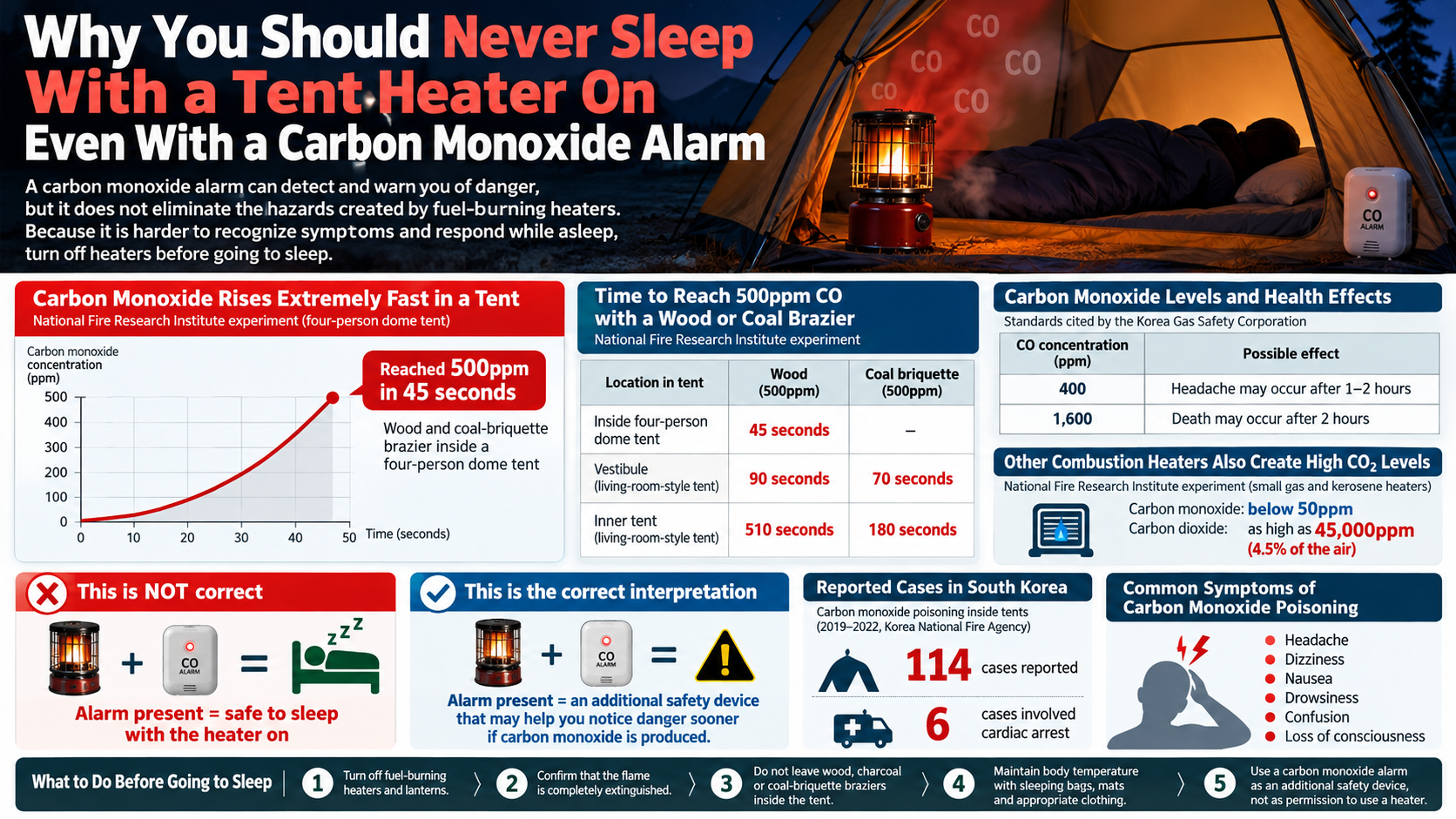
you should avoid sleeping with a fuel-burning heater or lantern running inside a tent even if you have a carbon monoxide alarm. An alarm is only an additional safety device that detects and warns of carbon monoxide; it does not eliminate the hazards created by combustion appliances. Because it is harder to recognize abnormal symptoms and respond while asleep, the safer standard is to turn off heating equipment before going to sleep.
South Korean fire authorities also advise campers to avoid using heating equipment in enclosed spaces such as tents. In an experiment conducted by Korea's National Fire Research Institute in a four-person tent, carbon monoxide inside a dome tent reached the meter's upper measurement limit of 500ppm in just 45 seconds when a wood and coal-briquette brazier was used.
The role of a carbon monoxide alarm is not to prevent an accident, but to detect carbon monoxide that has already been produced and warn you about it.
The U.S. Consumer Product Safety Commission explains that carbon monoxide alarms can provide additional protection, but they are not a substitute for the proper use of devices that can produce carbon monoxide. The same agency advises against using portable fuel-burning heaters or lanterns while sleeping in enclosed spaces such as tents, recreational vehicles, and vehicles.
A simple way to understand the role of an alarm is this.
Alarm present = safe to sleep with the heater on
is not the correct interpretation.
It is closer to:
Alarm present = an additional safety device that may help you notice danger sooner if carbon monoxide is produced
The Korea National Fire Agency's 2026 campsite safety guidance also advises against using heating equipment in enclosed spaces such as inside a tent while recommending that campers keep a carbon monoxide alarm available. In other words, restrictions on heater use and preparing an alarm are not interchangeable safety measures.
In the National Fire Research Institute experiment, a wood and coal-briquette brazier inside a four-person dome tent reached 500ppm of carbon monoxide in 45 seconds.
Carbon monoxide levels also rose quickly when a brazier was placed in the vestibule of a living-room-style tent.
Wood: 500ppm in 90 seconds in the vestibule and 510 seconds in the inner tent
Coal briquette: 500ppm in 70 seconds in the vestibule and 180 seconds in the inner tent
500ppm was the maximum concentration measurable by the instrument used in that experiment.
Materials from the Korea National Fire Agency also cite standards from the Korea Gas Safety Corporation stating that at 400ppm of carbon monoxide, a headache may occur after 1–2 hours, while at 1,600ppm, death may occur after 2 hours.
This experiment cannot be applied identically to every tent, weather condition, or heating appliance. Tent size, ventilation, fuel, and appliance type all vary. However, neither a carbon monoxide alarm nor a small ventilation opening should be treated as a reason that makes it acceptable to use a wood- or coal-briquette-burning brazier inside a tent.
Based on the experiment, the Korea National Fire Agency advises campers to refrain from using braziers fueled by wood or coal-type fuels inside tents.
That does not mean other fuel-burning heaters are automatically safe. In the National Fire Research Institute experiment, small gas and kerosene heating appliances produced carbon monoxide readings below 50ppm, but carbon dioxide concentrations rose as high as 45,000ppm, or 4.5% of the air.
You therefore should not assume that “as long as it is not wood or charcoal, it is fine to keep it running inside a tent.”
The Korea National Fire Agency's September 2026 campsite safety guidance advises against using heating equipment in enclosed spaces such as inside tents. If the use of heating equipment is unavoidable, it advises opening ventilation windows and preparing a carbon monoxide alarm, but this does not mean use while sleeping is permitted.
When sleeping, it is safer to switch from continuously operating a combustion heater to heat-retention methods that do not require combustion.
Ventilation is a necessary safety measure, but opening a vent does not make it safe to use a fuel-burning heater while sleeping.
The Korea National Fire Agency advises opening ventilation windows if heating equipment must be used. At the same time, the U.S. Consumer Product Safety Commission explicitly advises against using portable fuel-burning heaters or lanterns while sleeping in enclosed spaces such as tents, recreational vehicles, and vehicles.
Taken together, these two sets of guidance make the practical standard clear.
Using a heater while awake, after checking the manufacturer's operating conditions and providing necessary ventilation, is not the same situation as leaving a combustion appliance running for several hours while you are asleep.
Plan to turn off the heater before sleeping, confirm that the flame or combustion source is completely extinguished, and only then go to bed.
Carbon monoxide is a gas that is difficult to detect by color or smell. Early symptoms can include headache, dizziness, and nausea, while more severe exposure can lead to confusion or loss of consciousness.
The Korea National Fire Agency advises that when carbon monoxide poisoning becomes severe, a person may keep trying to sleep even when others attempt to wake them, or may lose consciousness.
The U.S. Consumer Product Safety Commission also lists drowsiness and confusion, in addition to headache, dizziness, weakness, nausea, and vomiting, among the symptoms of carbon monoxide poisoning.
That is why sleeping with a combustion appliance running should not rely on the assumption that “if the alarm sounds, I can wake up and ventilate the tent.” The first priority should be to reduce exposure in the first place.
If, after using a combustion appliance in a tent or vehicle, you experience symptoms such as headache, dizziness, nausea, severe drowsiness, or confusion, consider the possibility of carbon monoxide exposure.
The Korea National Fire Agency advises that if symptoms of poisoning appear, you should ventilate the area immediately, move to a place where you can breathe fresh air, and call 119, South Korea's emergency number.
If an alarm sounds, you should also avoid remaining inside the tent while trying to find the cause. The first priority is to move people out of the hazardous space.
Even if symptoms seem to disappear, you should not respond by going back to sleep inside the space that may have been dangerous.
For the sleeping period itself, the most important point is not to plan on continuously burning fuel for heat, but to prepare ways to maintain body temperature after the heater has been turned off.
Prepare non-combustion insulation equipment first, such as a sleeping bag, sleeping mat, and appropriate clothing, and follow the camping heater manufacturer's specified location and ventilation requirements whenever the heater is used.
Prepare a carbon monoxide alarm as well. Check the battery condition, the product's service life, and the manufacturer's specified installation location and inspection method. Depending on the product, the alarm's test button may only confirm that the circuitry is operating, so it should not be interpreted as a test of the sensor's accuracy itself.
And before going to sleep, it is best not to change the following sequence.
1. Turn off fuel-burning heating equipment and lanterns.
2. Confirm that the flame or combustion source is completely extinguished.
3. Do not leave wood, charcoal, or coal-briquette braziers inside the tent.
4. Maintain body temperature with non-combustion insulation such as sleeping bags, mats, and clothing.
5. Use a carbon monoxide alarm as an additional safety device, not as permission to use a heater.
From 2019 through 2022, 114 cases of carbon monoxide poisoning inside tents were reported to the Korea National Fire Agency, including 6 cases involving cardiac arrest. For winter camping, it is safer to plan your heating around the rule “turn off the flame before going to sleep” rather than assuming, “it should be fine because there is an alarm.”