

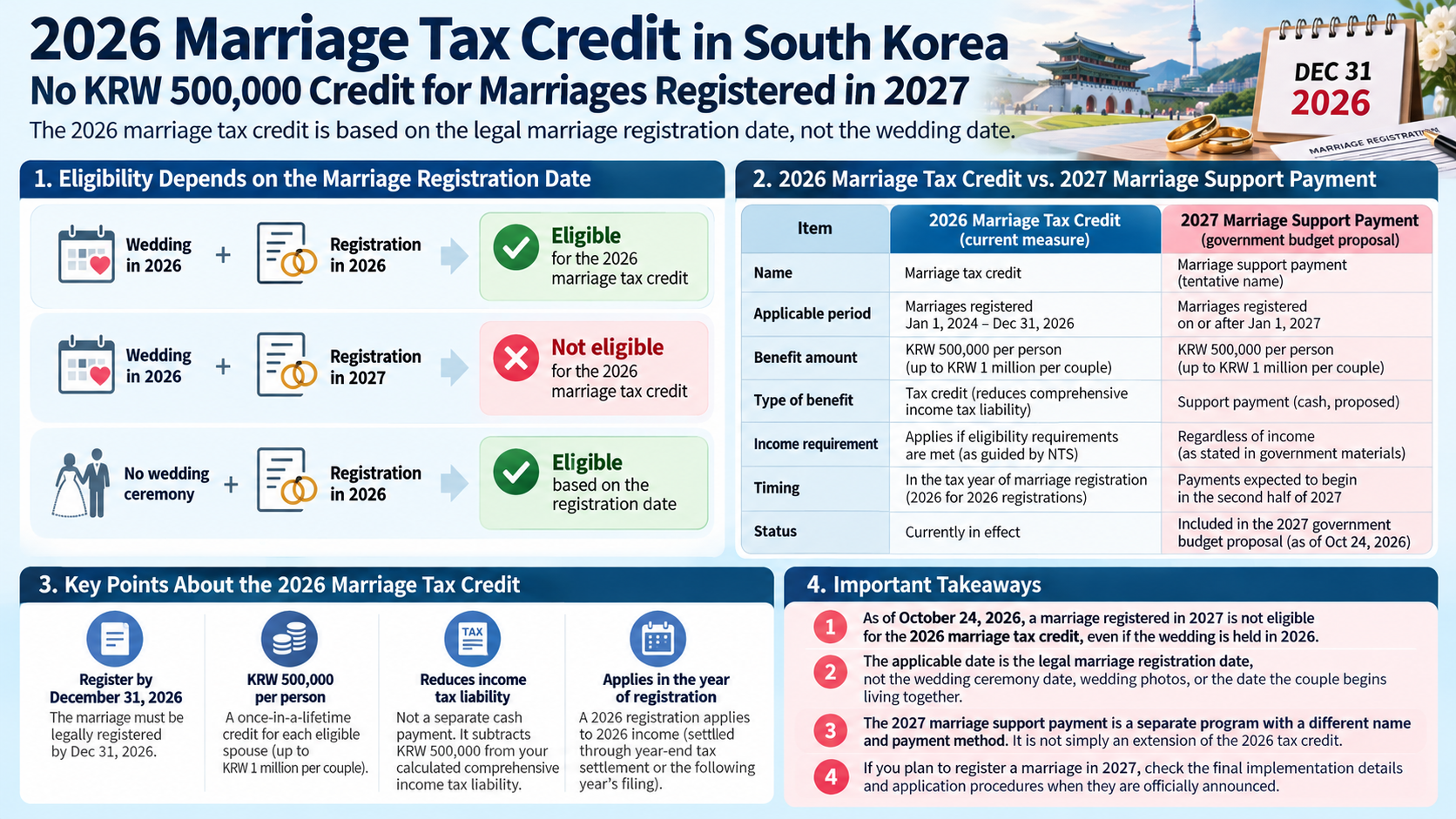
even if you held your wedding in 2026, you are not eligible for the current marriage tax credit if your legal marriage registration is completed in 2027. The applicable date is not the wedding ceremony date but the date on which the marriage is legally registered, and the current eligibility period covers marriages registered from 2024 through 2026.
The marriage tax credit is a South Korean tax credit under which a resident who registers a marriage may receive a once-in-a-lifetime KRW 500,000 credit in the year of marriage registration against their calculated comprehensive income tax liability. If both spouses separately meet the requirements, each may receive a KRW 500,000 credit.
To qualify for the current marriage tax credit, the marriage must be legally registered by December 31, 2026. Instructions for completing South Korea's income tax return also state that the measure applies to marriages registered from January 1, 2024, through December 31, 2026.
The distinction becomes simple when the dates are separated.
Wedding in 2026 + marriage registration in 2026 → eligible for the current marriage tax credit
Wedding in 2026 + marriage registration in 2027 → not eligible for the current marriage tax credit
No wedding ceremony, but a legally valid marriage registration completed in 2026 → eligibility is determined based on the marriage registration date
In other words, the date of the wedding ceremony, the date wedding photos were taken, or the date the couple began living together does not determine the tax year in which the credit applies. According to guidance from South Korea's National Tax Service, the relevant standard is the year in which the marriage was legally registered.
If both spouses separately meet the eligibility requirements, the credit may be KRW 500,000 each, or KRW 1 million for the couple in total. The South Korean government's 2026 tax guidance also describes the measure as a once-in-a-lifetime KRW 500,000 credit for each spouse upon marriage registration.
However, this is not a support payment that separately pays KRW 500,000 in cash. It is a tax credit that subtracts KRW 500,000 from the calculated comprehensive income tax liability for the relevant tax period. It is also important that the credit applies in the year the marriage is registered.
For example, if a marriage is registered in December 2026, the relevant tax year is income attributable to 2026. Wage earners would settle the credit through the year-end tax settlement process for 2026 income, while those required to file a comprehensive income tax return would settle the tax for that period in the following year's filing process.
South Korea's National Tax Service states that individuals with comprehensive income must file their comprehensive income tax return in May of the year following the applicable tax period.
Under the eligibility rules currently confirmed, this would be difficult. Because the marriage tax credit is based on the year in which the marriage is actually registered, a marriage registered in 2027 is not treated retroactively as a 2026 marriage. National Tax Service guidance also sets the applicable period as marriages registered from 2024 through 2026.
Therefore, the fact that a wedding ceremony was completed in 2026 does not by itself mean that the 2026 marriage tax credit can be claimed.
If you are considering the timing of your marriage registration because of the tax credit, the first date to check is not the wedding date but the date on which the marriage registration is actually completed.
This should be considered separately from the current marriage tax credit. The South Korean government's 2027 budget proposal for the Ministry of Gender Equality and Family includes funding for a tentatively named “marriage support payment” that would pay KRW 500,000 per person, or KRW 1 million per couple, to couples who register their marriage on or after January 1, 2027. Government materials state that the support would be provided regardless of income and that payments would begin in the second half of 2027.
The important distinction is that this does not mean the existing marriage tax credit is simply being extended through 2027. Government materials distinguish between the 2026 tax credit and the 2027 marriage support payment as different forms of support.
Also,the publicly announced measure is a tentatively named program included in the 2027 government budget proposal. Therefore, if you plan to register a marriage in 2027, it is prudent to check the final implementation details and payment procedures again when applications actually open.
From a tax perspective, the standard is clear.
To qualify for the current marriage tax credit, the marriage must be legally registered by December 31, 2026.
Even if the wedding takes place in 2026, a marriage registration completed in January 2027 does not qualify for the 2026 marriage tax credit. Conversely, if the marriage registration is completed within 2026, the rule is a once-in-a-lifetime KRW 500,000 credit per person in the year of marriage registration.
The marriage support payment announced for 2027 is a separate program with a different name and payment method, so the key point is not to calculate the two benefits as if one were simply an extension of the other.
※ This article is for reference to help readers understand market trends and is not an investment recommendation regarding any specific stock or asset. All final decisions and investment responsibility remain with the individual.