

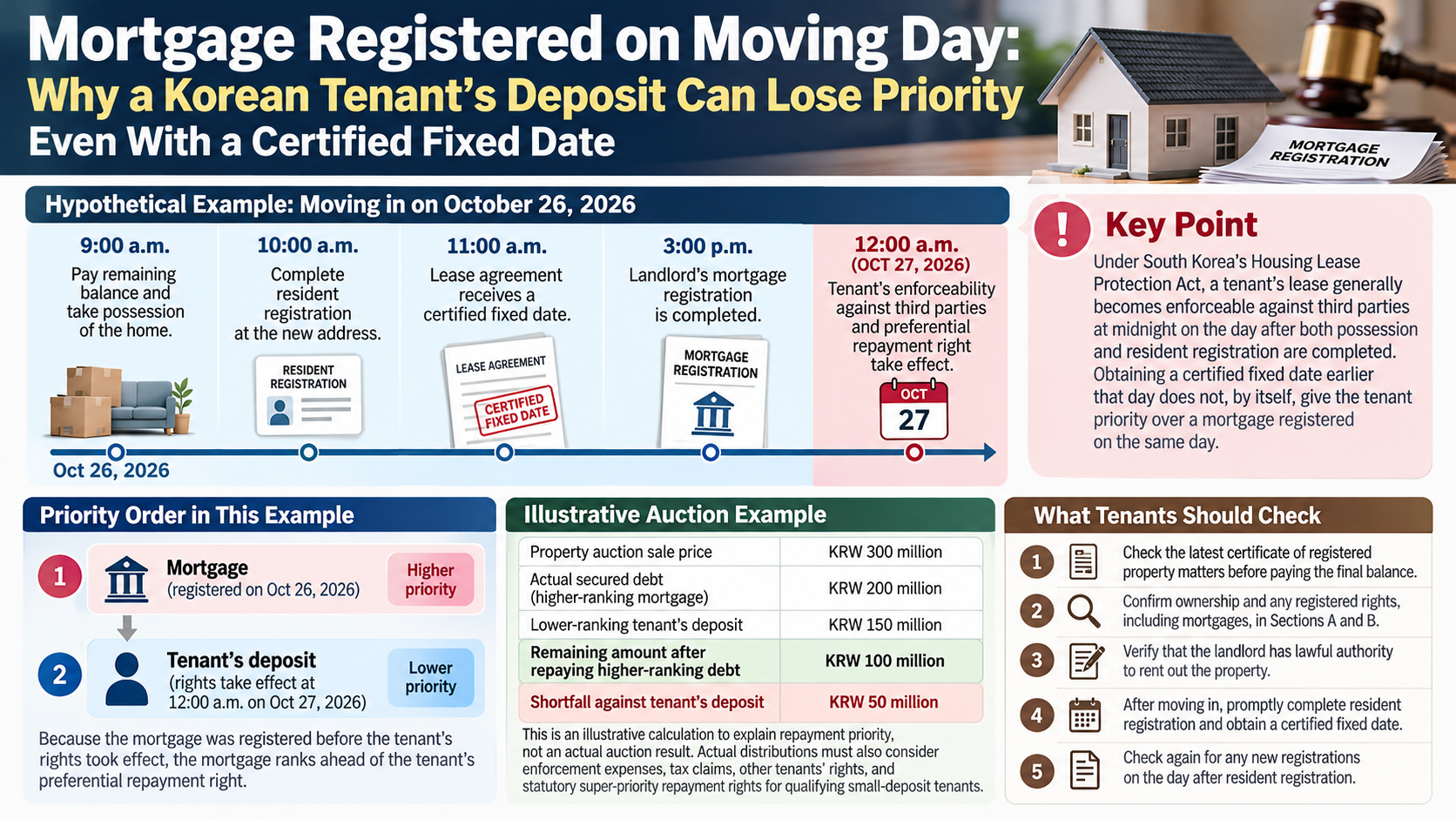
Even if a tenant under a jeonse or monthly rental agreement moves in, registers their residence, and obtains a certified fixed date for the lease on the same day, the tenant's deposit may rank behind a mortgage registered by the landlord that day. under South Korea's Housing Lease Protection Act, a tenant's lease becomes enforceable against third parties at midnight on the day after both possession of the home and resident registration are completed. Obtaining a certified fixed date earlier does not, by itself, establish priority over a mortgage registered that day.
If a mortgage registration is completed on the day a tenant takes possession and registers their residence, the mortgage may rank ahead of the tenant's preferential repayment right in an ordinary residential lease. This is because the time resident registration is completed differs from the time the lease becomes enforceable against third parties.
Article 3(1) of South Korea's Housing Lease Protection Act provides that a tenant who has taken possession of a dwelling and completed resident registration may assert the lease against third parties beginning the following day.
In this context, enforceability against third parties means the legal effect that allows a tenant, subject to statutory requirements, to assert their tenancy rights against a new owner or other third parties, including when ownership of the property changes.
Consider the following example.
Hypothetical example: Moving in on October 26, 2026
9:00 a.m.: The tenant pays the remaining balance and takes possession of the home.
10:00 a.m.: The tenant completes resident registration at the new address.
11:00 a.m.: The lease agreement receives a certified fixed date.
3:00 p.m.: Registration of the landlord's mortgage is completed.
12:00 a.m. on October 27: The tenant's enforceability against third parties and preferential repayment right take effect.
In this example, the tenant completed all the necessary procedures in the morning, but the mortgage registration was completed before the tenant's rights took effect.
Therefore, unless special circumstances apply, the mortgage takes priority over the tenant's preferential repayment right.
The important factors are not the exact hour when resident registration was submitted, but the date on which both possession and resident registration were completed, and the date on which the mortgage registration was completed.
Conversely, if the mortgage is registered after the tenant's enforceability against third parties and preferential repayment right have already taken effect, the ordinary priority assessment will be different.
However, actual cases also require examination of existing property rights, the landlord's legal authority to lease the property, and the contents of the property register.
Why a Certified Fixed Date Alone Does Not Guarantee Deposit Priority
A certified fixed date is an official procedure confirming that a lease agreement existed on a particular date. Obtaining that certification alone does not establish a preferential repayment right for the deposit.
Under Article 3-2 of South Korea's Housing Lease Protection Act, the following three requirements must generally be satisfied to obtain preferential repayment rights:
1. Possession of the dwelling: The tenant must receive possession of and occupy the property.
2. Resident registration: The tenant must complete registration of their residence at the property.
3. Certified fixed date: The tenant must obtain official certification of the date on the lease agreement.
Even when all three requirements are satisfied, the preferential repayment right does not necessarily arise at the exact moment the final procedure is completed.
If possession and resident registration are completed on the same day, and the certified fixed date is obtained on that day or earlier, the preferential repayment right takes effect at midnight at the beginning of the following day.
By contrast, if the tenant has already satisfied the requirements for enforceability against third parties and that enforceability has taken effect before obtaining the certified fixed date, the preferential repayment right is acquired when the certified fixed date is obtained.
Enforceability against third parties and preferential repayment rights also serve different purposes.
Enforceability against third parties allows the tenant to assert the lease against third parties. A preferential repayment right allows the tenant to receive repayment of the deposit ahead of lower-ranking creditors and other relevant rights holders when the property is sold through a court auction or public auction.
Therefore, obtaining a certified fixed date should not be confused with a guarantee that the entire deposit will be recovered in an actual auction.
Does a Higher-Priority Mortgage Mean Losing the Entire Deposit?
A mortgage ranking ahead of the tenant does not automatically mean the tenant will lose the entire deposit. The amount recoverable depends on the auction sale proceeds, higher-ranking claims, other rights holders, and the tenant's legal status.
Consider a hypothetical auction.
Property auction sale price: KRW 300 million
Actual secured debt under the higher-ranking mortgage: KRW 200 million
Lower-ranking tenant's deposit: KRW 150 million
Assuming, for simplicity, that there are no other priority claimants or enforcement expenses, the calculation is:
KRW 300 million − KRW 200 million = KRW 100 million
Under these assumptions, KRW 100 million remains after repayment of the higher-ranking secured debt. This leaves a shortfall of KRW 50 million against the lower-ranking tenant's KRW 150 million deposit.
This is an illustrative calculation by the author intended to explain repayment priority, not an actual auction distribution result.
Actual distributions must also account for additional factors, including enforcement expenses, tax claims, other tenants' rights, and statutory super-priority repayment rights for qualifying small-deposit tenants.
Furthermore, the maximum secured claim amount recorded in the property register is not the same as the outstanding loan balance. The registered maximum amount alone should not be used to determine how much a financial institution will actually receive from an auction distribution.
Can Small-Deposit Tenants Receive Priority Over an Earlier Mortgage?
Tenants who meet South Korea's statutory small-deposit tenant requirements may qualify for a super-priority repayment right, allowing a specified portion of their deposit to be repaid ahead of other secured creditors.
This is a separate protection from the ordinary preferential repayment right associated with obtaining a certified fixed date.
However, being classified as a small-deposit tenant does not mean the entire deposit is automatically protected.
To receive super-priority repayment under Article 8 of South Korea's Housing Lease Protection Act, the tenant must meet statutory requirements. The qualifying deposit thresholds and maximum amounts eligible for super-priority repayment vary according to the applicable region and reference date.
In particular, it is necessary to check the standards applicable when the earlier-ranking security interest was established. Applying only today's small-deposit tenant thresholds to a mortgage registered in the past may lead to an incorrect conclusion.
It is also necessary to determine whether the tenant satisfied the relevant requirements for enforceability before registration of the auction application and whether a formal request for distribution is required.
Therefore, if a tenant discovers that a mortgage was registered on moving day, they should examine not only the ranking of their ordinary preferential repayment right but also whether they qualify for small-deposit tenant super-priority protection.
What to Check Before Paying the Final Balance
Immediately before paying the remaining balance, obtain an updated certificate of registered property matters and confirm that the ownership and other registered rights remain unchanged from those reviewed when the lease was signed. A property that appeared free of problems on the contract date should not automatically be assumed safe on the final payment date.
During the actual contracting process, the following checks are advisable.
First, review Section A of the certificate of registered property matters to verify ownership and any registered attachments, provisional attachments, or other restrictions on rights.
Next, examine Section B for mortgages, registered jeonse rights, and other security-related interests. A registered jeonse right is a property right recognized under South Korean law and should be distinguished from an ordinary contractual jeonse lease.
Also verify that the person entering into the lease has lawful authority to rent out the property.
The parties may consider clearly defining the landlord's contractual obligation not to create new security interests or otherwise make unfavorable changes to existing property rights around the time the final balance is paid.
For example, they may agree that the landlord will not register a new mortgage until the day after the final payment date and specifically negotiate how contract termination or compensation for damages will be handled if that obligation is breached.
However, including a special contractual clause does not automatically move an already registered mortgage to a lower priority.
A special clause establishes contractual responsibilities between the landlord and tenant. It does not directly alter the legal priority of a secured creditor who is a third party to the lease.
Immediately before transferring the remaining balance, check the latest certificate of registered property matters.
If a previously undisclosed mortgage or another restriction on property rights appears, review the contractual terms and legal rights again before proceeding with the transfer.
After paying the remaining balance, promptly complete actual possession of the dwelling and resident registration, and confirm that the lease agreement has received a certified fixed date.
Obtain another copy of the certificate of registered property matters to check whether a new security interest was registered on the final payment date.
If a new mortgage is identified, compare the date its registration was completed with the times when the tenant's enforceability against third parties and preferential repayment right took effect.
Even after checking the property register on the final payment date, not every risk can be considered eliminated, because a registration application may have been submitted but not yet reflected in the certificate.
What to Do If a Mortgage Was Registered on Moving Day
First, verify whether the mortgage registration was actually completed, then compare its registration date with the time the tenant's rights took effect. A report that the landlord applied for a loan is not the same as confirmation that registration of the security interest was completed.
Use the certificate of registered property matters to check the rights holder, application receipt date, receipt number, and maximum secured claim amount. Keep copies of the lease agreement and records of the final payment.
Next, review whether the landlord breached any special provisions in the lease agreement, what the landlord disclosed about the property's legal status when the contract was signed, and the likelihood of recovering the deposit.
Even when a contractual breach is established, termination of the contract or compensation for damages is not necessarily granted automatically. The outcome may depend on the wording of the special provisions and how the contract was actually performed.
If repayment of the deposit is in doubt, consider seeking assistance through a residential lease dispute mediation process or legal consultation in South Korea.
In addition, moving out or transferring resident registration before recovering the deposit may jeopardize the continued enforceability of the tenant's rights against third parties. If the lease has ended but the deposit has not been returned, the tenant should examine the requirements and procedures for obtaining a court order to register the tenant's leasehold right, known in South Korea as a leasehold registration order.
Legal Position: The Next-Day Rule Still Applies
Under the statutory provisions and official Korean legal guidance reviewedthe principle remains that a residential lease becomes enforceable against third parties beginning the day after possession of the dwelling and resident registration have both been completed.
Discussions about legal reforms intended to reduce the gap in deposit protection when a mortgage is registered on the same day as resident registration must be distinguished from the effective-date rules under current law.
The existence of proposed amendments does not mean that enforceability has already been changed to begin on the day resident registration is completed.
For an actual lease transaction, tenants should verify the legislation in force on the final payment date.
Protecting a jeonse or monthly rental deposit requires more than completing resident registration and obtaining a certified fixed date. Tenants must also establish exactly when their legal rights take effect and whether any security interests were registered before that time.
In particular, when final payment and moving in take place on the same day, comparing the property's registered rights before signing the contract, immediately before final payment, and on the day after resident registration is an important preventive measure.
*Note: This article is provided for reference purposes to help readers understand market developments. It is not an investment recommendation concerning any particular security or asset. Final investment decisions and responsibility rest with the individual.*