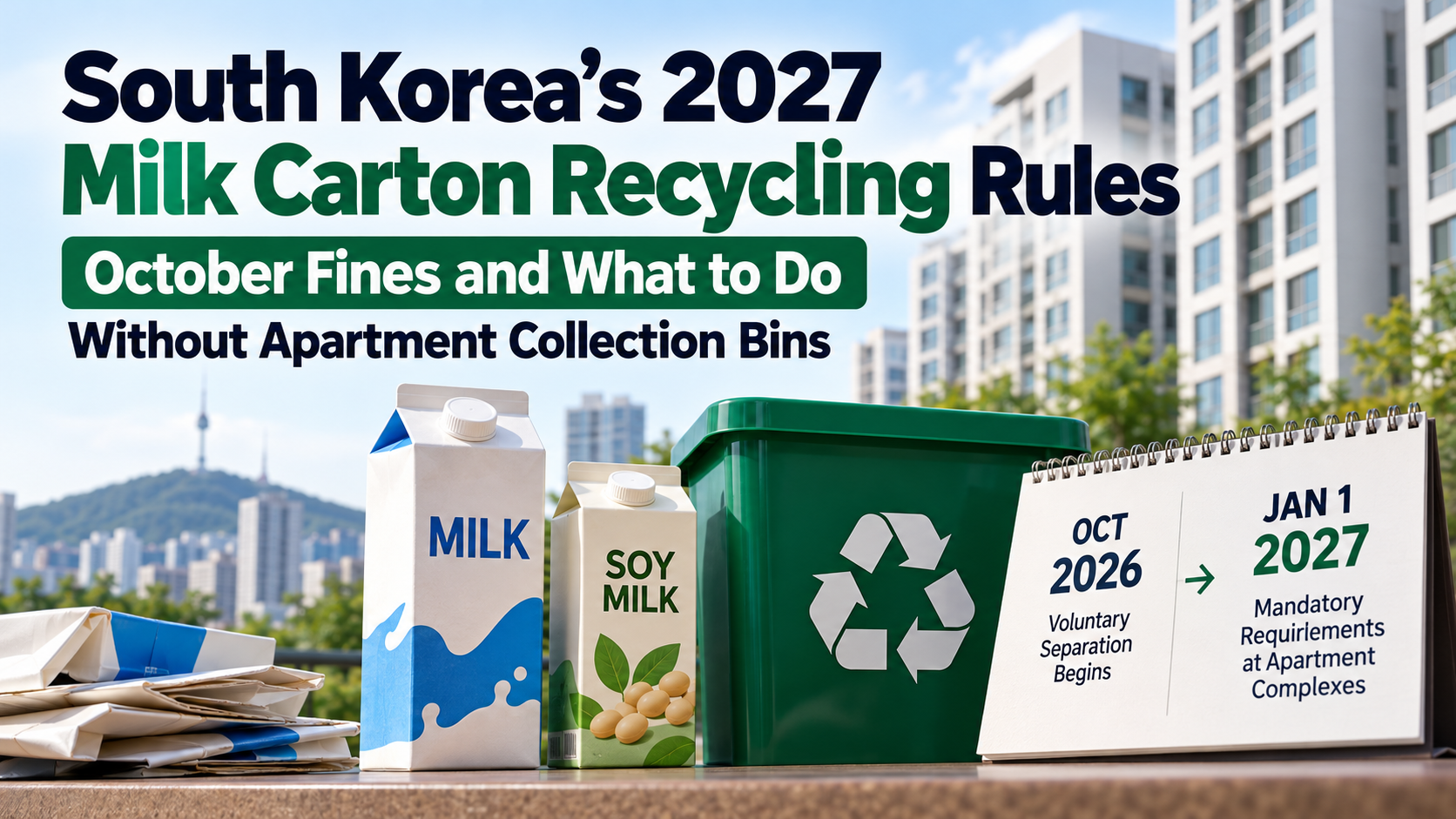
separate recycling collection of milk and soy milk cartons has been implemented voluntarily since October 1. It is scheduled to become mandatory on January 1, 2027, at residential complexes subject to mandatory management throughout South Korea. During the current voluntary implementation period, residents are not subject to fines under the new system simply for placing beverage cartons with ordinary wastepaper. Even after the mandatory rules take effect, potential fines must be assessed according to local government ordinances and the specific conditions constituting a violation.
The problem is that some apartment complexes still do not have dedicated collection bins for beverage cartons. Residents who want to follow the rules may not know where to put their cartons. The first step is therefore to ask the apartment management office how the complex handles collection.
1. October 2026 vs. January 2027: What Changes?
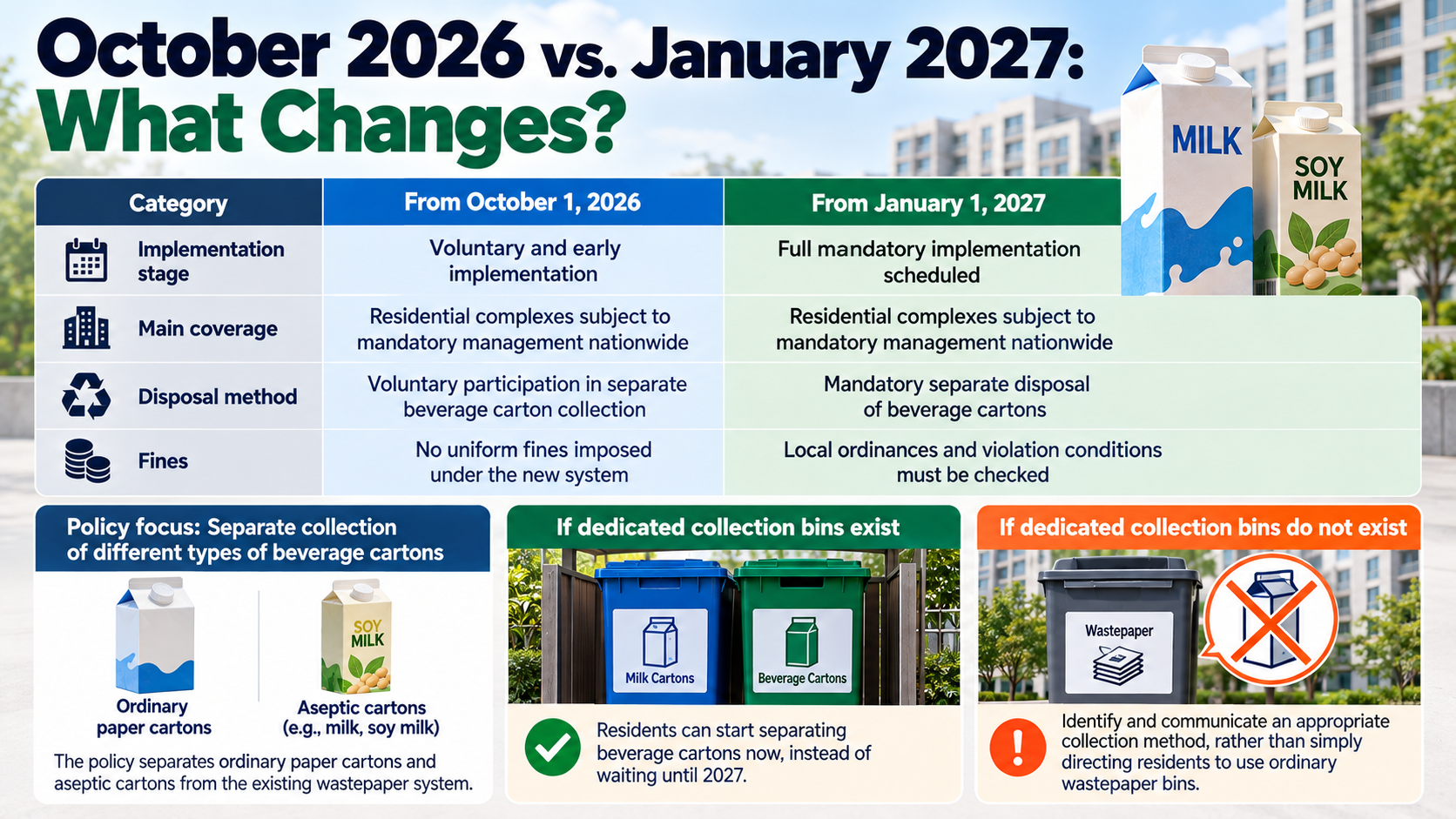
The difference between the two dates is whether participation is voluntary or mandatory. October 1, 2026, marks the beginning of the period during which residential complexes can operate separate beverage carton collection systems in advance. January 1, 2027, is the scheduled date for full mandatory implementation at residential complexes subject to mandatory management.
| Category | From October 1, 2026 | From January 1, 2027 |
|---|---|---|
| Implementation stage | Voluntary and early implementation | Full mandatory implementation scheduled |
| Main coverage | Residential complexes subject to mandatory management nationwide | Residential complexes subject to mandatory management nationwide |
| Disposal method | Voluntary participation in separate beverage carton collection | Mandatory separate disposal of beverage cartons |
| Fines | No uniform fines imposed under the new system | Local ordinances and violation conditions must be checked |
The South Korean government's beverage carton recycling policy focuses on separating ordinary paper cartons and aseptic cartons from the existing wastepaper collection system.
If an apartment complex already provides dedicated collection bins or collection bags, residents can begin separating cartons now rather than waiting until 2027.
Conversely, apartment complexes that have not yet established a separate collection system need to identify and communicate an appropriate collection method instead of simply directing residents to use ordinary wastepaper bins.
2. Will You Be Fined KRW 300,000 for Throwing Away Milk Cartons in October 2026?
Placing milk cartons together with ordinary wastepaper during the voluntary implementation period in October 2026 does not automatically result in a KRW 300,000 fine.
The question of fines after mandatory implementation in 2027 also cannot be determined solely by the effective date.
The standards for separately disposing of beverage cartons must be distinguished from the legal grounds for imposing fines on residents. It is necessary to check whether the relevant local government has established a legal basis for fines in its ordinances and which specific disposal practices constitute violations.
Some news reports have discussed the possibility of fines of up to KRW 300,000 in the future. However, this should not be interpreted as an amount that will automatically apply to every apartment resident throughout South Korea starting in 2027.
For example, even when the same type of milk carton is disposed of incorrectly, the following matters must be examined separately:
Whether the resident's local government has established an ordinance authorizing relevant fines
When that ordinance takes effect
Which specific disposal practices constitute violations
Who may actually be fined and how the amount is determined
The immediate priority is to confirm the separate collection arrangements where you live rather than worry about fines without knowing the applicable rules. Responsibilities under existing waste disposal regulations should also not be confused with responsibilities arising from the new mandatory beverage carton separation system.
3. Which Apartment Buildings Will Be Covered by the 2027 Requirement?
The separate disposal requirement scheduled for 2027 is not intended to apply identically to every type of housing. Its primary coverage is residential complexes subject to mandatory management.
In South Korea, these are multifamily residential buildings that meet specified size and facility conditions and must maintain a formal management system under the Multi-Family Housing Management Act.
The main criteria are as follows.
| Residential building conditions | Coverage |
|---|---|
| Residential complexes with 300 or more households | Main category covered |
| Residential complexes with 150 or more households and installed elevators | Main category covered |
| Residential complexes with 150 or more households using central heating or district heating | Main category covered |
| Mixed-use residential and commercial buildings meeting specified conditions | May be included |
| Small multifamily villas and ordinary detached houses | Must be distinguished from residential complexes subject to mandatory management under this requirement |
An important point is that a residential complex is not automatically subject to identical rules simply because its name includes the word apartment.
Even for complexes with 150 or more households, conditions such as elevator installation and heating systems must be considered.
A complex is also not automatically excluded merely because it has fewer than 300 households.
The easiest way to determine whether your residential complex is covered is to ask its management office whether it is classified as a residential complex subject to mandatory management.
4. What If Your Apartment Complex Has No Dedicated Beverage Carton Collection Bin?
If a dedicated beverage carton collection bin has not yet been installed, start by asking the management office about designated disposal locations and whether special collection bags are available.
The government's recommended collection methods include not only dedicated bins but also collection bags specifically intended for beverage cartons.
Therefore, a separate plastic collection bin does not necessarily have to be installed for residents to dispose of beverage cartons separately.
However, if a complex has not yet decided how to collect cartons, residents should not independently pile them up in shared spaces.
The following steps can help avoid confusion.
1. Check the apartment recycling collection area for a dedicated beverage carton bin or separate collection signs.
2. Ask the management office whether dedicated beverage carton collection bags or a shared collection location are available.
3. If separate collection has not started, confirm the planned implementation date and temporary disposal instructions.
4. If the management office cannot provide guidance, contact the resource circulation or sanitation department of the relevant city, county, or district local government to ask about available collection arrangements.
In practice, the South Korean city of Chuncheon published a notice on October 8, 2026, surveying residential complexes within its jurisdiction about their current implementation of separate beverage carton collection and future plans.
This illustrates why residents should not assume that every residential complex across South Korea has installed the same type of collection bin at the same time.
In particular, checking notices from the apartment management office is a practical approach between now and the scheduled mandatory implementation in 2027.
5. Milk Cartons vs. Soy Milk Cartons: How Should They Be Separated?
Both milk cartons and soy milk cartons fall within the scope of separate beverage carton collection. However, they should be kept separate from ordinary newspapers and cardboard shipping boxes.
The South Korean government's guidance broadly divides beverage cartons into ordinary paper cartons and aseptic cartons.
Ordinary Paper Cartons
These include cartons commonly used for refrigerated milk. Empty the contents, rinse the carton, flatten it, and dispose of it separately.
Aseptic Cartons
These include cartons used for shelf-stable soy milk and some juice and bottled-water products. Their structure includes an inner aluminum layer or other materials. Cut the carton open, empty its contents, rinse it, flatten it, and dispose of it separately.
Separate collection is important because beverage cartons undergo a different recycling process from ordinary wastepaper.
Even when a beverage container appears to be made of paper, placing it in the same collection bin as newspapers or corrugated cardboard boxes does not align with the purpose of the new system.
Government guidance identifies both ordinary paper cartons and aseptic cartons as materials for separate beverage carton collection. If an apartment complex collects these two categories separately, residents should follow the classification instructions displayed at the collection site.
6. How to Prepare Beverage Cartons for Recycling
Empty the carton, rinse it with water, flatten it, and place it in a dedicated collection bin or bag.
Under the South Korean government's October 2026 guidance, the basic procedure for ordinary paper cartons is to empty, rinse, flatten, and separately dispose of them.
For aseptic cartons, an additional cutting step helps make the inside easier to clean.
When disposing of cartons, it is also advisable to remove attached items made from different materials, such as straws and plastic caps.
Opening cartons and allowing them to dry can help with hygienic storage. However, it would be inaccurate to describe complete drying of every beverage carton as an absolute requirement under the revised 2026 standards.
Rinse the carton with water, flatten it, and follow the disposal instructions provided by your residential complex.
7. What Apartment Management Offices Should Prepare Before 2027
Residential complexes subject to mandatory management need to confirm arrangements for collecting beverage cartons separately from ordinary wastepaper in preparation for the requirement scheduled to take effect on January 1, 2027.
Management offices should check more than whether collection bins have been installed.
First, they need to determine how the local government collects beverage cartons and decide how dedicated bins or bags will be operated.
Next, residents should be informed of the designated disposal locations and procedures.
Some local governments, including Chuncheon, have been surveying residential complexes about their current implementation status and future plans. Management offices therefore need to check local guidance and requests for cooperation.
From a resident's perspective, the absence of a visible collection bin does not necessarily mean that no separate collection system exists. It is more accurate to check whether dedicated bags or designated collection areas are being used.
8. Frequently Asked Questions
Are fines already being imposed for milk carton disposal in October 2026?
No. October 2026 is the voluntary implementation period for separate beverage carton collection. Fines under the new system are not being imposed immediately nationwide. However, existing waste disposal regulations remain a separate matter.
Does the 2027 requirement apply to detached houses and small villas?
The main coverage of the announced mandatory implementation is residential complexes subject to mandatory management throughout South Korea. It cannot be assumed that identical requirements automatically apply to ordinary detached houses and small multifamily villas. Residents should also check the existing recycling rules in their local area.
Can milk cartons and aseptic soy milk cartons be placed together?
Government guidance identifies both ordinary paper cartons and aseptic cartons as materials subject to separate beverage carton collection. However, if a residential complex collects ordinary paper cartons and aseptic cartons in different containers, residents should follow the displayed sorting instructions.
Should residents store milk cartons at home until collection bins are installed?
It cannot be assumed that residents need to store cartons at home for an extended period. The first step is to ask the apartment management office or local government whether dedicated collection bags, designated disposal locations, or temporary disposal arrangements are available. Before receiving confirmation, it is better to check on-site instructions than to automatically mix the cartons with ordinary wastepaper.
9. What Residents Should Check Before January 2027
During the remaining period before mandatory implementation in 2027, residents do not need to focus on complicated preparations. The two most important things to check are whether their apartment complex is covered by the requirement and where beverage cartons should be collected.
Emptying, rinsing, and flattening used milk and soy milk cartons will also make it easier to dispose of them according to the separate collection arrangements established by the residential complex.