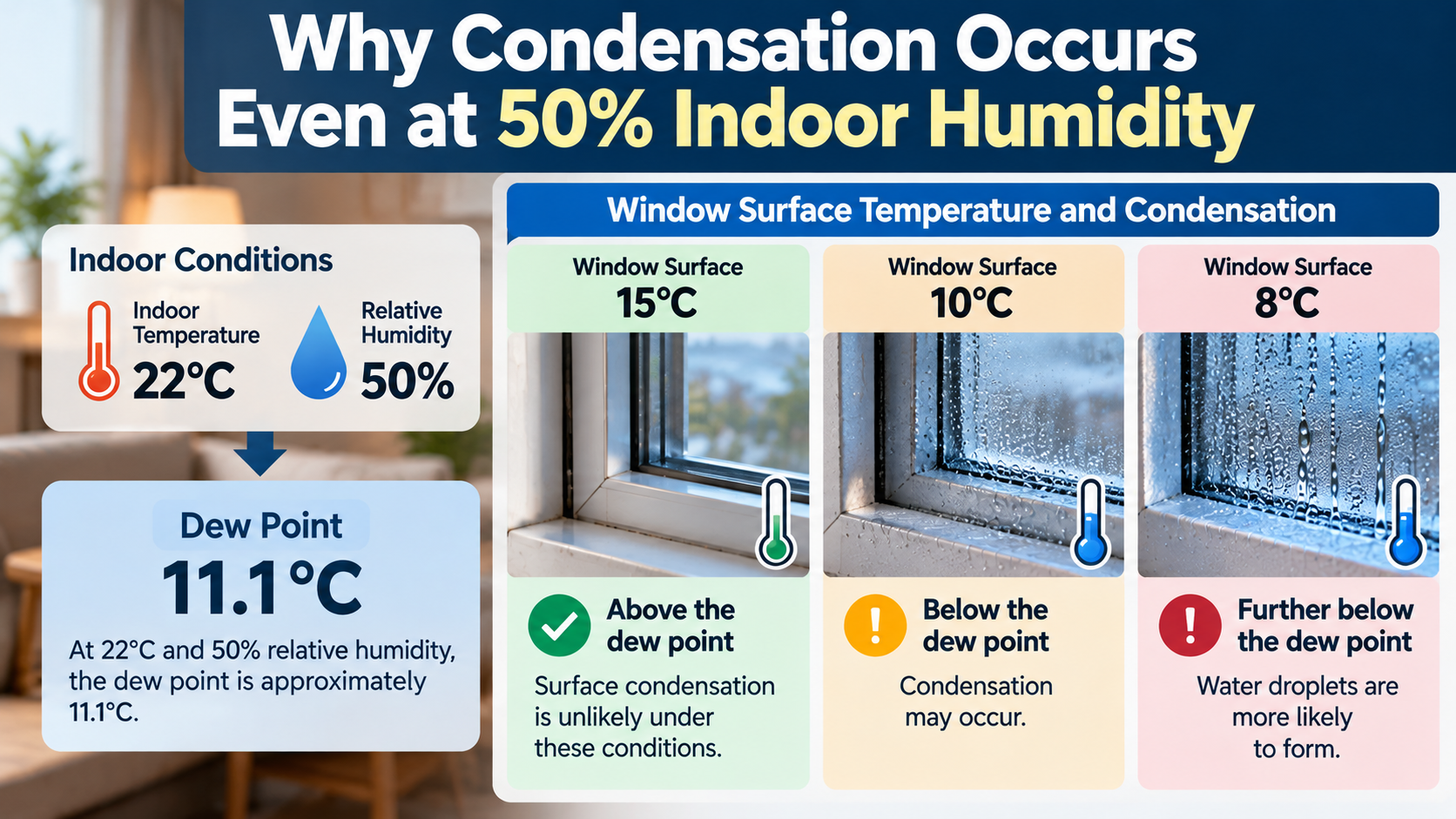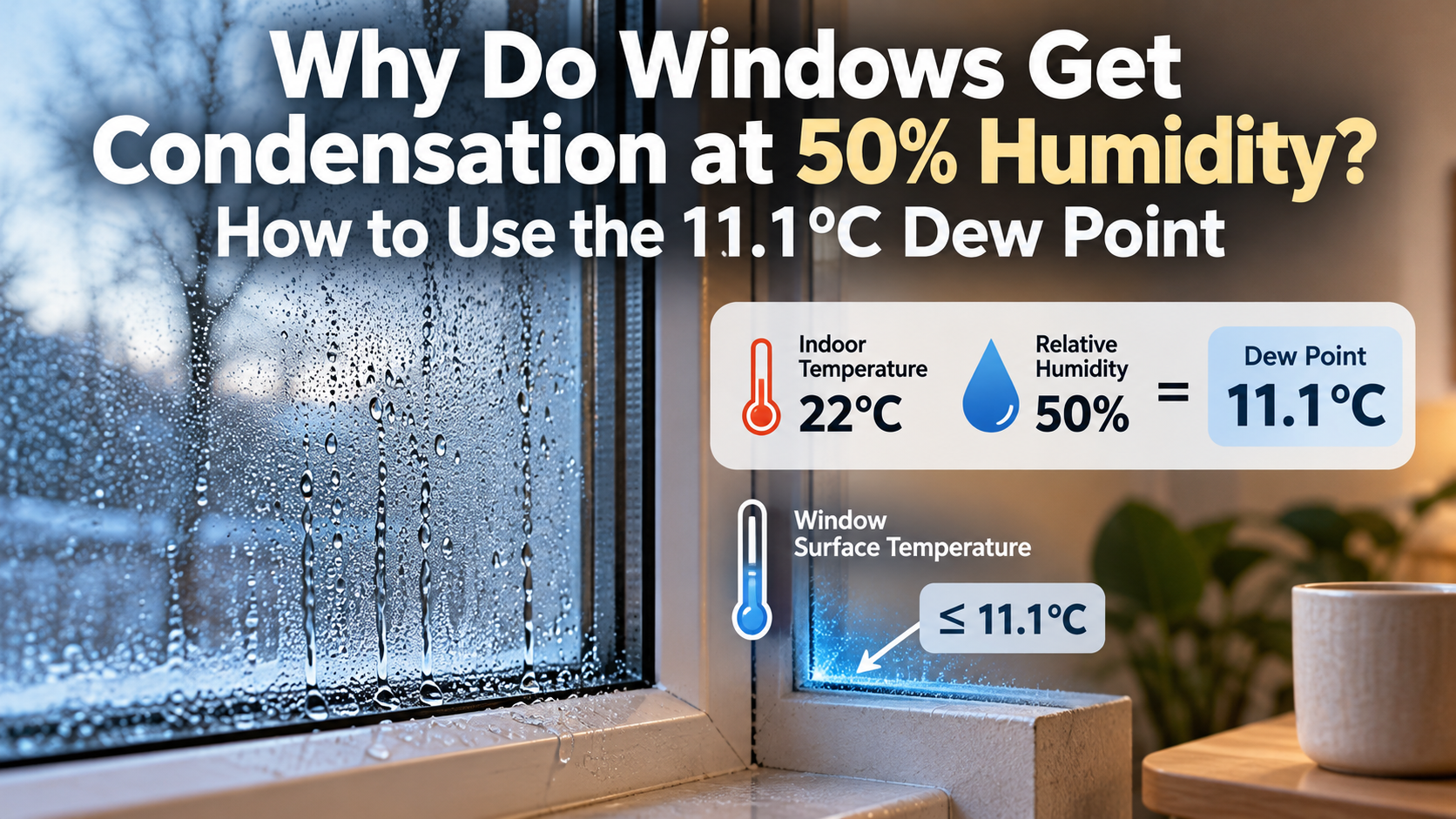
Water droplets can form on windows even when indoor humidity is 50%. This is because at an indoor temperature of 22°C and a relative humidity of 50%, the dew point is approximately 11.1°C. Condensation can occur when the surface temperature of the window glass or frame falls below this threshold. To assess winter window condensation, you need to consider both the humidity reading and the actual window surface temperature.
If water repeatedly collects on the same window frame even after ventilation, it may be necessary to examine not only indoor moisture levels but also the window's insulation performance and the condition of its seals and gaps.
Why Condensation Occurs Even at 50% Indoor Humidity
Condensation occurs when water vapor in the air encounters a cold surface and changes into liquid water. The key concept is the dew point, which is the temperature at which water vapor begins to condense as air cools.
During winter, indoor air may remain warm while windows and frames exposed to cold outdoor conditions become considerably colder.
For example, when the indoor temperature is 22°C and relative humidity is 50%, the dew point is approximately 11.1°C.
Window frame surface at 15°C: Above the dew point, so surface condensation would not occur under these conditions.
Window frame surface at 10°C: Below the dew point, meaning condensation may occur.
Window frame surface at 8°C: Further below the dew point, making water droplets more likely to form.
These figures are calculated examples that assume constant indoor temperature and humidity.
Therefore, a humidity meter showing 50% does not guarantee that windows will remain free of condensation. The temperature of the window surface is equally important.
How the Dew Point Changes with Indoor Temperature
Even at the same 50% relative humidity, the dew point changes with indoor temperature. This is because warmer air at the same relative humidity can contain more water vapor.
The following table compares dew points calculated at different indoor temperatures.
| Indoor temperature | Relative humidity | Dew point |
|---|---|---|
| 18°C | 50% | Approximately 7.4°C |
| 20°C | 50% | Approximately 9.3°C |
| 22°C | 50% | Approximately 11.1°C |
| 24°C | 50% | Approximately 12.9°C |
The values in this table represent separate conditions in which relative humidity is maintained at 50% at each temperature. They do not represent what happens when the same air is simply heated without adding moisture.
For example, consider one room at 20°C and 50% relative humidity and another at 24°C and 50% relative humidity. Both humidity meters display the same reading of 50%.
However, in the 24°C room, condensation may form on cold surfaces at approximately 12.9°C or below.
This is why assessing condensation risk based on relative humidity alone is inaccurate.
How to Compare Window Surface Temperature with the Dew Point
Checking the actual surface temperature of a window can help determine whether indoor humidity management should be the priority or whether the window's insulation condition requires closer examination.
The process is straightforward.
1. Measure the indoor temperature and relative humidity when condensation occurs.
2. Calculate the dew point using these two values.
3. Use a surface temperature measuring device to check the center of the glass, the glass edges, and the window frame separately.
4. Compare the temperature at the location where droplets actually form with the calculated dew point.
5. Check whether a particular area is unusually cold compared with surrounding areas under the same conditions.
When using an infrared surface thermometer, the reflective properties of glass can cause measurement errors. Rather than automatically treating the displayed reading as the actual glass surface temperature, check the device's measurement requirements and operating conditions.
Indoor temperature and humidity readings taken at only one point immediately beside a window may also differ from conditions elsewhere in the room.
Humidity readings can vary depending on where the humidity meter is positioned, so its placement should also be considered.
What the Location of Window Condensation Can Tell You
The location of condensation can help narrow down which parts of a window need inspection. However, the position of water droplets alone cannot establish that a window is defective or improperly installed.
When Water Droplets Form in the Center of the Glass
Check whether the glass surface temperature has fallen to or below the dew point. The glass's insulation performance, indoor humidity, and outdoor temperature should all be considered.
When Condensation Concentrates Along the Bottom of the Glass or Frame
Compare the temperatures of the glass edges and the window frame. Heat transfer through window frames can vary depending on their materials and construction, making the frame's insulation condition an important inspection point.
When Condensation Appears Where the Window Frame Meets the Wall
Inspect the connection between the window and the wall, the condition of insulation installed around the joint, and any gaps that may allow cold air to enter.
A localized area where insulation is less effective and heat escapes more readily is known as a thermal bridge.
Surfaces affected by thermal bridging may become colder than surrounding areas.
However, moisture around a window frame does not necessarily mean thermal bridging is responsible. It is also important to distinguish between rainwater leakage and condensation caused by indoor water vapor.
How to Reduce Window Condensation: Humidity Control and Insulation
When condensation occurs, a reasonable first step is to examine indoor moisture generation and ventilation conditions. However, if condensation repeatedly develops in the same location even after humidity has been reduced, the window's insulation and airtightness should also be checked to determine whether its surface temperature can be increased.
The following measures may help.
If you use a humidifier, check its operating level and the actual indoor humidity.
Ventilate after cooking or showering so that the resulting moisture does not remain indoors for an extended period.
Check whether curtains or blinds are restricting indoor air circulation around the windows.
Wipe away water collected on window frames and record the locations that repeatedly become wet.
An important point is that lowering indoor humidity as much as possible is not necessarily the solution.
At an indoor temperature of 22°C and relative humidity of 50%, condensation may occur if the window frame is at 10°C. Reducing humidity lowers the dew point, but condensation may return if the window frame remains sufficiently cold.
Conversely, raising the window frame's surface temperature enough can prevent condensation under the same indoor humidity conditions.
If droplets repeatedly form across an entire window, the overall condensation pattern should also be examined.
When Should You Have Your Windows Inspected?
Repeated condensation does not automatically mean that an entire window needs replacement. First, distinguish between problems involving window insulation, cold air entering through gaps, installation conditions, and indoor humidity management.
A window inspection becomes particularly important in the following situations.
Water repeatedly collects on one particular window frame but not on other windows.
Cold drafts can be felt around the frame or where the window meets the wall, even when the window is closed.
The same area continues to become wet despite ventilation and indoor moisture management.
Condensation continues to occur in approximately the same location even after the windows have been replaced.
When inspecting a window, consider more than the type of glass. Check the frame's thermal insulation structure, how tightly the movable window panels close, and the installation conditions between the window and the surrounding wall.
Even if the window itself has good insulation performance, condensation may remain in certain areas when the joints are not adequately insulated or sealed against air leakage.
Frequently Asked Questions About Window Condensation
Is 50% Indoor Humidity Safe from Window Condensation?
A relative humidity of 50% is generally a useful reference level for managing indoor humidity, but it is not an absolute threshold that prevents condensation on every window. Whether condensation occurs depends on the combination of indoor temperature, relative humidity, and window surface temperature.
Does Heating a Room Prevent Window Condensation?
Heating may help reduce condensation if it also raises the window surface temperature. However, condensation may persist if the indoor air becomes warmer while the window frame remains cold.
Can Condensation Occur on Well-Insulated Windows?
Yes. Even windows with good insulation performance can experience condensation depending on outdoor temperature, indoor humidity, and actual surface temperature. Condensation alone does not establish that a product is defective or that installation work was faulty.
What Should You Do First When Window Condensation Appears?
First, check the indoor temperature, relative humidity, and location of the condensation, then remove any accumulated moisture. If the same area repeatedly becomes wet, particularly when accompanied by drafts or damp walls, inspect the condition of the window and its connections to the surrounding structure.
Conclusion: Compare the Dew Point with the Window Surface Temperature
When evaluating window condensation, the most important comparison is not the 50% humidity reading itself, but the relationship between the dew point and the window surface temperature.
At an indoor temperature of 22°C and relative humidity of 50%, use the approximate dew point of 11.1°C as a reference and check how cold the actual window frame becomes.