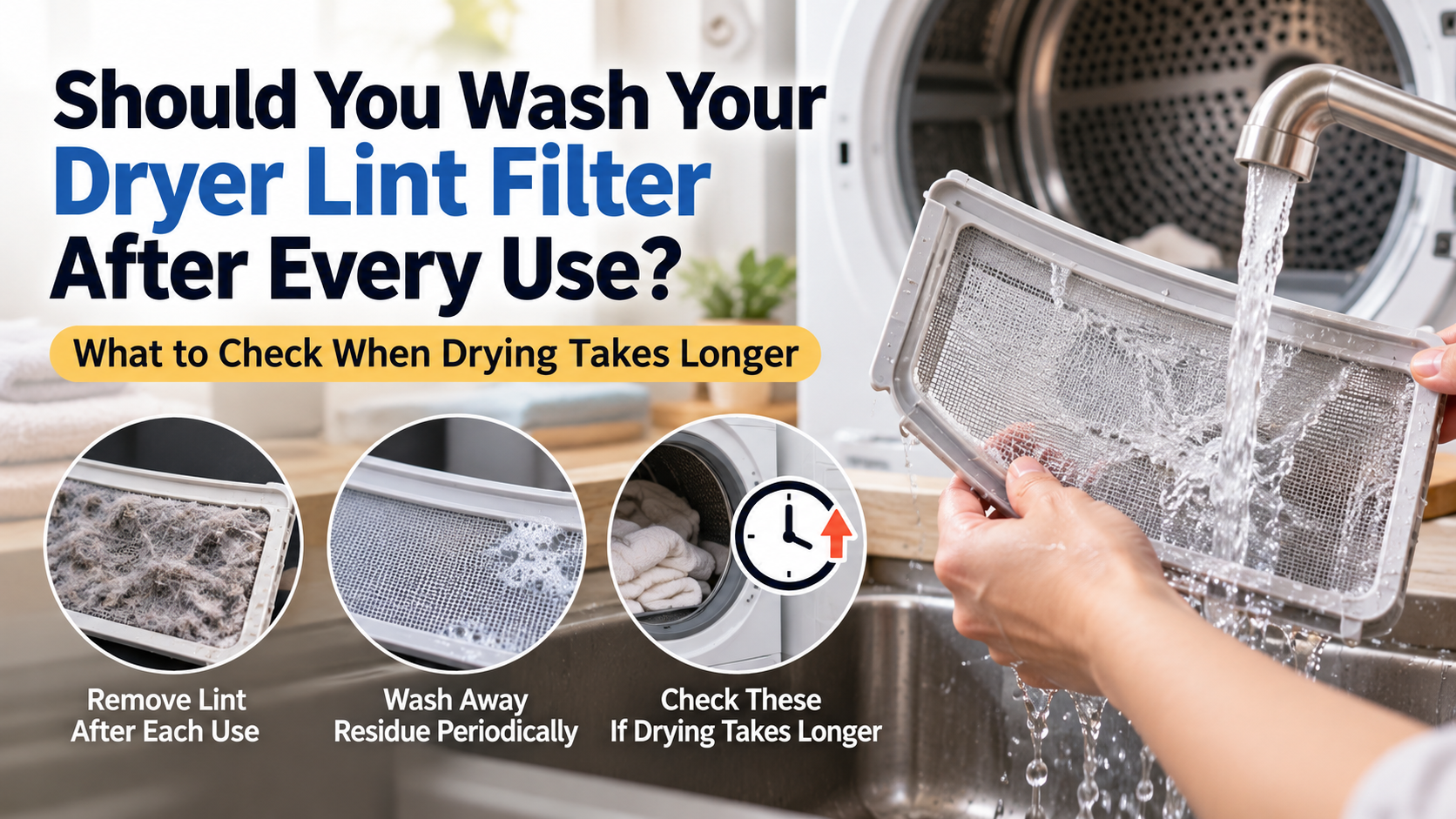
Removing lint from your dryer filter after every use is essential, but washing it with water every time is not necessary. If detergent or fabric softener residue builds up on the filter mesh, washing may be required according to your dryer's specific maintenance instructions. The key is to distinguish routine lint removal from residue cleaning and to ensure that a washed filter is sufficiently dry before reinstalling it.
If your dryer takes longer to dry clothes even after you have cleaned the lint filter, checking only the visible lint may not solve the problem. You should also inspect the filter mesh for blockages and consider whether airflow through the dryer is restricted.
1. Remove Lint After Every Use, but You Do Not Need to Wash the Filter Every Time
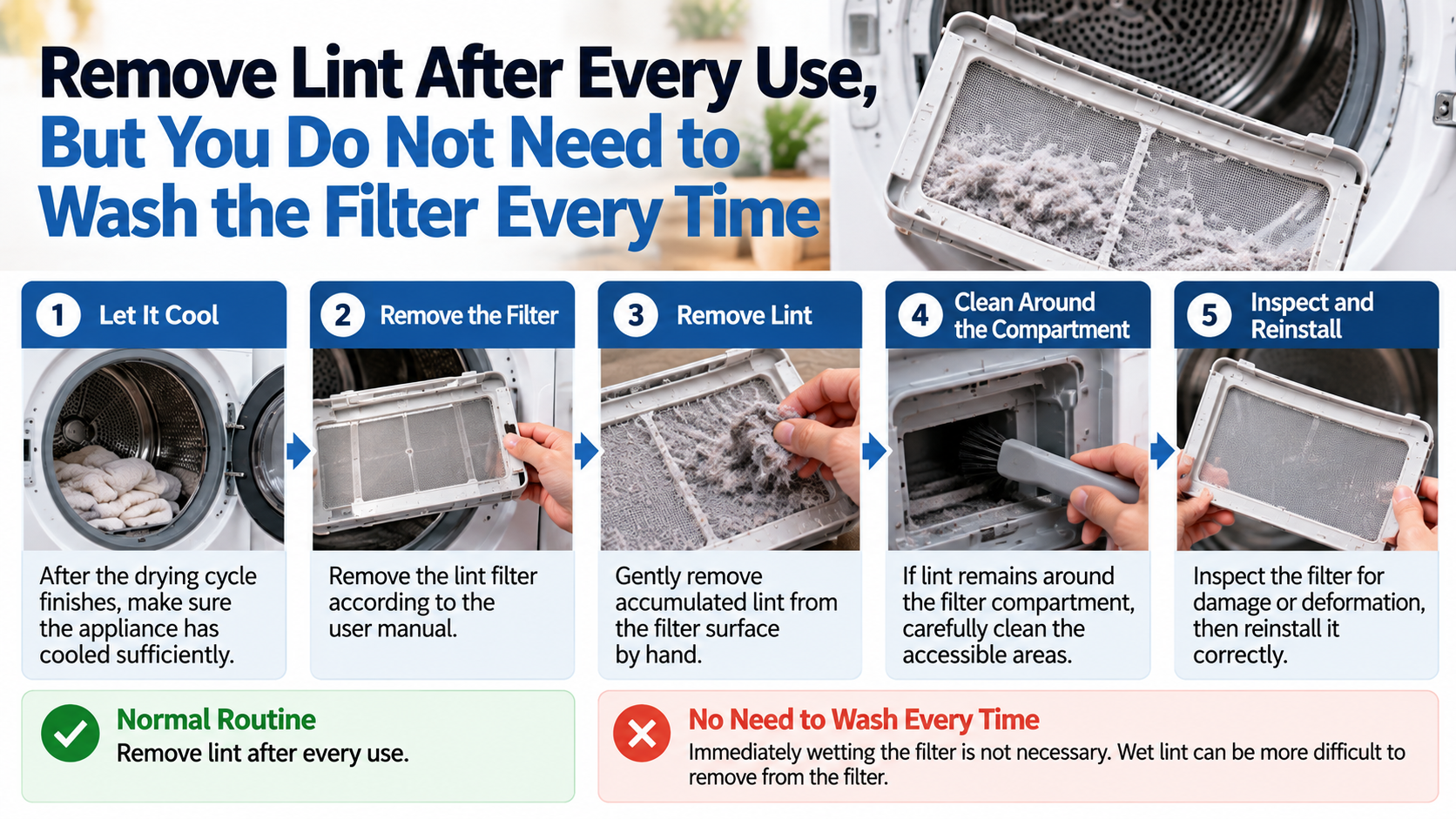
The routine task is removing lint, not washing the filter with water. After a drying cycle finishes, remove the lint collected on the filter and make sure the filter is properly installed.
As a dryer removes moisture from laundry, the drying process also produces lint. The lint filter collects this material and helps maintain airflow inside the appliance.
A typical cleaning procedure is as follows:
1. After the drying cycle finishes, check that the appliance has cooled sufficiently.
2. Remove the lint filter according to the user manual.
3. Gently remove accumulated lint from the filter surface by hand.
4. If lint remains around the filter compartment, carefully clean the accessible areas.
5. Inspect the filter for damage or deformation, then reinstall it correctly.
Dryers with multiple filter layers may have different removal and cleaning procedures for each filter.
Immediately wetting the filter to remove lint is not necessarily a good approach. Wet lint can actually be more difficult to remove from the filter.
2. Why Detergent and Fabric Softener Residue May Require Washing
Unlike ordinary lint, detergent and fabric softener residue can adhere to the filter mesh. When this residue accumulates and blocks airflow, simply removing visible lint by hand may not be sufficient.
A filter can appear clean on the outside while residue remains trapped between the fine openings in its mesh.
In this situation, remove the surface lint first and then clean the filter using a method approved by its manufacturer.
Some Whirlpool dryer maintenance instructions distinguish between routine lint removal and cleaning accumulated residue. When residue builds up, Whirlpool recommends cleaning the filter with a nylon brush, warm water, and liquid detergent.
However, this procedure does not apply universally to every dryer.
For appliances commonly used in South Korea, including models manufactured by LG Electronics and Samsung Electronics, filter construction and maintenance procedures may differ depending on the exact model. Always follow the instructions for your specific appliance.
If water washing is permitted, remove the lint first, wash away residue using the manufacturer's specified method, and allow the filter to dry sufficiently. Checking the condition of the filter after cleaning is more important than simply having washed it.
3. How to Wash a Dryer Lint Filter When the Manufacturer Allows It
Whirlpool provides the following procedure for removing accumulated residue:
1. Remove any remaining lint from the filter.
2. Wet both sides of the filter mesh with warm water.
3. Apply warm water and liquid detergent to a nylon brush.
4. Gently scrub the mesh to remove accumulated residue.
5. Rinse thoroughly with clean water.
6. Remove excess moisture thoroughly with a clean towel.
7. Reinstall the filter in its proper position.
These steps reflect the manufacturer's cleaning instructions for applicable products. Before using them on another dryer, confirm whether water washing and detergent use are permitted.
Even when a filter is washable, take care not to use it while moisture remains immediately after cleaning.
If the appliance manual requires complete drying, wait until the filter is fully dry before reinstalling it. Avoid using improvised heating methods to speed up drying.
4. Can a Clogged Lint Filter Make Drying Take Longer?
A clogged lint filter can increase drying time. Detergent or fabric softener residue trapped in the mesh can also restrict airflow and affect drying performance.
If drying remains slow after you remove visible lint, use the following distinctions to identify what to inspect next.
| Observed condition | What to inspect | Recommended action |
|---|---|---|
| Heavy lint accumulation | Lint on the filter surface | Remove lint using dry cleaning methods |
| Filter looks clean, but the mesh is blocked | Detergent or fabric softener residue | Clean using an approved method |
| Filter is loose or damaged | Filter installation and physical condition | Reinstall correctly or inspect the component |
| Drying remains slow after filter cleaning | Blockages elsewhere in the airflow system | Check model-specific maintenance items |
There is an important limitation to remember.
Longer drying times do not automatically mean the lint filter is responsible.
If the problem continues after cleaning the filter, other maintenance areas, such as the exhaust pathway or heat exchanger, may need inspection depending on the appliance's construction.
For vented dryers, the condition of the exhaust outlet and duct is particularly important. For condenser and heat pump dryers, consult the model-specific instructions for maintaining the heat exchanger and related filters.
Do not apply the same cleaning procedure to dryers with different operating systems.
5. Why Proper Filter Installation Matters for Dryer Safety
Avoid operating a dryer with a clogged or damaged lint filter. Restricted airflow can increase drying time and, depending on the appliance, may also create overheating or damage risks.
The U.S. Fire Administration recommends keeping dryer lint filters and exhaust pathways clean to help prevent dryer fires.
Its safety guidance also advises against operating a dryer without its filter or when the filter is not properly installed.
During use, check the following conditions:
Whether the filter is correctly seated in its designated position.
Whether the filter mesh is torn or otherwise damaged.
Whether excessive lint has accumulated.
Whether the appliance shows unusual overheating or other abnormal symptoms.
If the filter is damaged, check for a replacement component compatible with your specific model rather than attempting an improvised repair and continuing to use it.
If you notice warning signs such as a burning smell or smoke, stop using the dryer, safely disconnect the power, and arrange any necessary inspection.
6. How Often Should You Wash a Dryer Lint Filter?
Check and remove lint after every use. Whether water washing is necessary should depend on residue accumulation and the manufacturer's instructions.
For some products, Whirlpool recommends cleaning accumulated residue with a nylon brush approximately every six months, or more frequently if clogging occurs.
However, this six-month interval should not be treated as a universal washing schedule for all dryers.
It helps to distinguish three types of maintenance.
First: Lint Produced During Every Drying Cycle
Lint generated while drying laundry should be removed regularly after use.
Second: Residue Accumulating in the Filter Mesh
Detergent and fabric softener residue may require a different cleaning method from ordinary lint removal.
Third: Other Dryer Components Requiring Maintenance
Depending on the model, additional filters and airflow pathways may need separate maintenance beyond the main lint filter.
Understanding these three categories helps prevent unnecessary washing while ensuring that important maintenance tasks are not overlooked.
7. Can You Reinstall a Dryer Filter While It Is Still Wet?
If moisture remains on the filter, meet the drying requirements specified in the user manual before reinstalling it. Permission to wash a filter does not necessarily mean it can be reused while wet.
Some dryers include a spare filter that can be used while another filter is being cleaned.
However, having a spare filter does not mean that interchangeable filter use is supported by every appliance. Always use a filter compatible with the specific model.
Do not operate the dryer without the filter properly installed.
8. What If Drying Still Takes Too Long After Cleaning the Filter?
If drying time continues to increase despite proper lint filter cleaning, repeatedly washing the filter is unlikely to be the best approach. Instead, check the maintenance requirements for your specific appliance.
First, confirm that the filter is clean and correctly installed. Next, inspect the airflow pathways and related components identified in the user manual.
For vented dryers in particular, check whether the exhaust duct has been crushed or blocked, restricting airflow.
Avoid independently disassembling or washing internal components that are not intended to be accessed by users.
If the problem persists despite proper filter cleaning and the manufacturer's recommended maintenance, arrange a professional appliance inspection.
If detergent residue repeatedly remains on laundry during washing, it may also be worth separately checking how detergent is being dispensed in the washing machine rather than focusing exclusively on the dryer.
Related information can be found in the relevant guide.
9. Frequently Asked Questions About Dryer Lint Filters
Should I Check the Lint Filter Even When There Is Very Little Lint?
Yes. It is advisable to check the filter after use even when only a small amount of lint is visible. The amount of lint collected can vary depending on how the dryer is used.
Will Washing the Filter Always Make the Dryer Work Faster?
No. Properly cleaning a filter clogged with residue can improve that particular blockage problem. However, if longer drying times are caused by something else, washing the filter alone will not resolve the issue.
Can I Use Detergent and a Brush on Any Dryer Filter?
Follow the cleaning method approved by the manufacturer. Some products recommend liquid detergent and a brush for removing residue, but the same method is not suitable for every filter.
Can I Use the Dryer Without a Lint Filter?
No. Do not operate a dryer when its filter is missing, damaged, or improperly installed.
10. Final Checklist: What Matters Most When Cleaning a Dryer Lint Filter
The most important part of dryer lint filter maintenance is identifying the type of contamination you need to remove, rather than simply increasing how often you clean the filter.
Remove lint accumulated after each drying cycle using dry cleaning methods. If detergent or fabric softener residue blocks the mesh, use a cleaning method approved by the manufacturer.
After washing, ensure that the filter is sufficiently dry and correctly reinstalled.
If drying takes longer than usual, check not only the visible filter surface but also mesh blockages, filter installation, and the airflow pathways appropriate for the dryer's design.
The best first step is to identify your dryer model and consult its user manual for the correct lint filter cleaning procedure.