
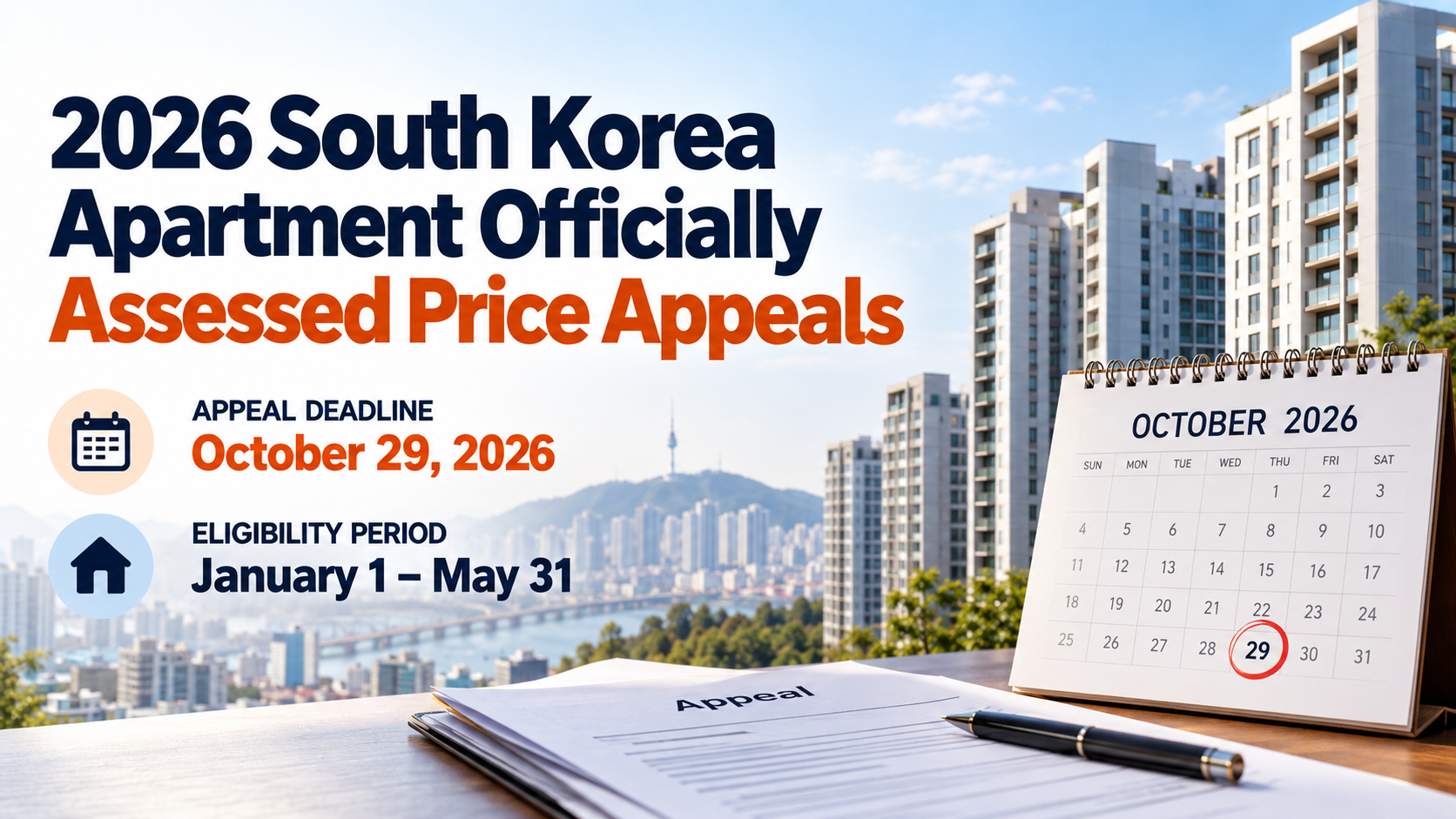
Homeowners and parties with a legally recognized interest in a jointly owned or multi-unit residential property in South Korea may file an objection to its officially assessed price until October 29, 2026. The application period runs from September 30 to October 29. However, not every apartment is eligible. The first step is to determine whether the property underwent a qualifying change, such as new construction, major renovation, or a change of use, between January and May 2026.
This appeal procedure concerns the officially assessed prices of multi-unit residential properties determined on September 30. Eligible properties may include apartments, row houses, and low-rise multi-family residential buildings. Owners can check the assessed price and access the objection submission section through South Korea's Real Estate Official Price Information Service.
The supplementary assessment applies to multi-unit residential properties that experienced qualifying changes specified by law between January 1 and May 31. Simply owning an existing apartment does not automatically make it subject to this additional assessment.
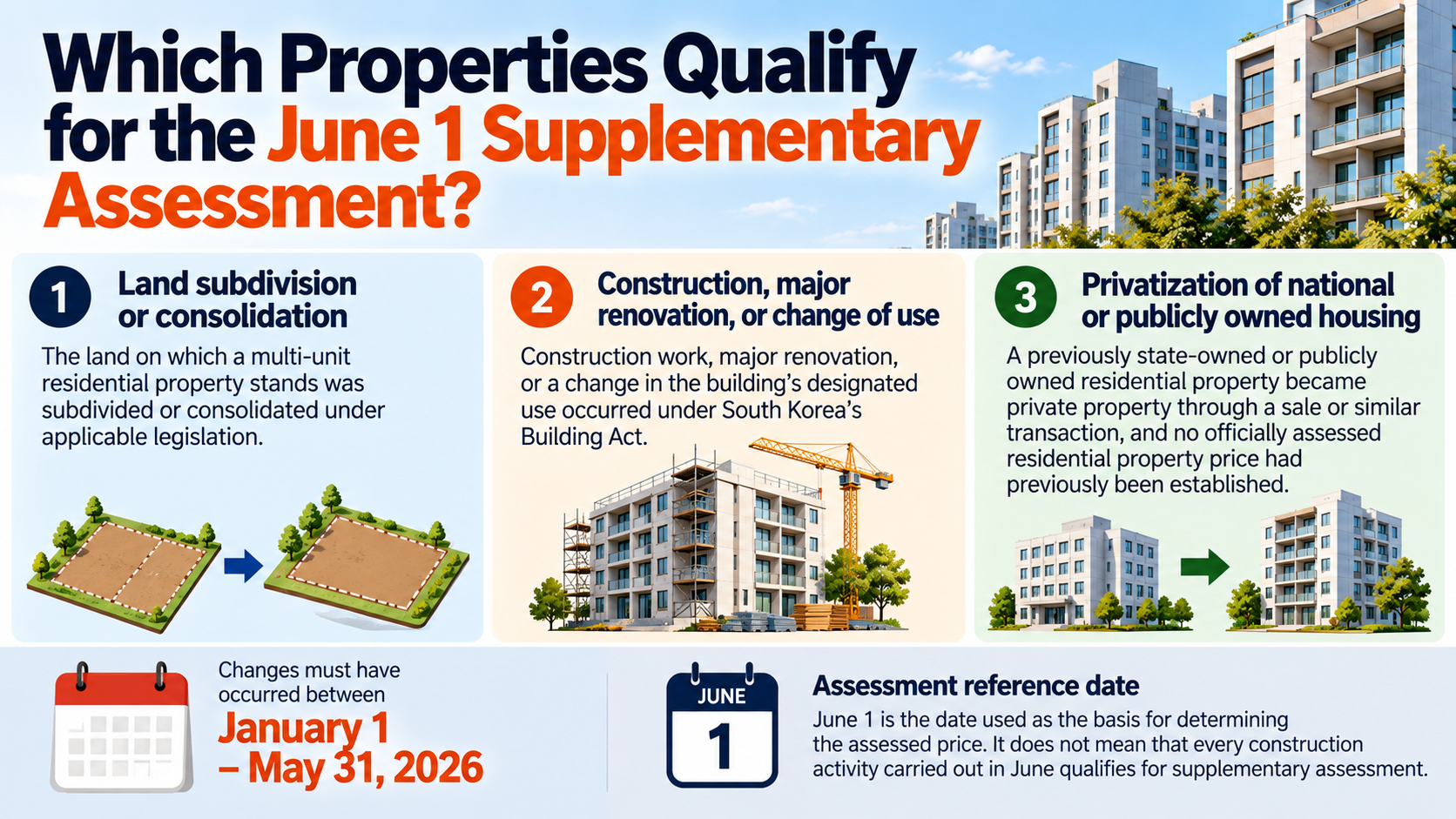
Which Properties Qualify for the June 1 Supplementary Assessment?
The supplementary assessment covers multi-unit residential properties affected by legally specified changes between January 1 and May 31, 2026. The main qualifying circumstances are as follows:
Land subdivision or consolidation: The land on which a multi-unit residential property stands was subdivided or consolidated under applicable legislation.
Construction, major renovation, or change of use: Construction work, major renovation, or a change in the building's designated use occurred under South Korea's Building Act.
Privatization of national or publicly owned housing: A previously state-owned or publicly owned residential property became private property through a sale or similar transaction, and no officially assessed residential property price had previously been established.
In this context, major renovation refers to repairs or alterations involving major structural components or other elements specified under South Korea's Building Act. Ordinary interior work, such as replacing wallpaper or flooring, should not automatically be treated as a qualifying major renovation.
It is also important to distinguish the assessment reference date from the period in which qualifying changes must have occurred. June 1 is the date used as the basis for determining the assessed price. It does not mean that every construction activity carried out in June qualifies for supplementary assessment.
For this assessment, the relevant changes must have occurred between January 1 and May 31.
January 1 vs. June 1 Assessments: What Is the Difference?
The regular January 1 assessment and the supplementary June 1 assessment have different reference dates, eligibility requirements, and objection schedules.
The January 1 assessment is the regular annual assessment that includes existing multi-unit residential properties. The June 1 assessment is an additional procedure covering properties that underwent qualifying changes during the specified period.
| Category | January 1 Assessment | June 1 Assessment |
|---|---|---|
| Type of assessment | Regular annual assessment | Supplementary assessment for properties with qualifying changes |
| Valuation reference date | January 1, 2026 | June 1, 2026 |
| Period for submitting opinions | March 18–April 6 | August 5–August 24 |
| Price determination and public announcement | April 30 | September 30 |
| Objection filing period | April 30–May 29 | September 30–October 29 |
| Scheduled adjustment and announcement | June 26 | November 20 |
Therefore, an owner cannot automatically reopen an objection to an apartment's regular assessed price announced on April 30 simply because the supplementary assessment objection period remains open until October 29.
The owner must first confirm whether a separate assessed price was determined for the property under the supplementary assessment.
An officially assessed residential property price is also different from an advertised asking price or an actual transaction price. It is calculated using an appropriate value considered achievable in a normal market transaction. It does not simply reproduce an individual seller's asking price or reflect every unusual circumstance of a particular transaction.
Who Can File an Objection to an Officially Assessed Apartment Price?
Owners of eligible multi-unit residential properties and parties with a legally recognized interest in the assessed property price may submit objections.
A distinction must be made between someone who is merely curious about an apartment's value and someone who has a legally recognized interest in the officially assessed price.
A homeowner may review the officially assessed price of their own multi-unit residential property and submit an objection if they disagree with it.
For someone who does not own the property, the important question is whether they have a legally recognized interest relating to that property's assessed price.
Simply living in the apartment or being interested in nearby market prices does not necessarily establish eligibility to file an objection.
If eligibility is unclear, the applicant should explain their legal relationship to the property and confirm their status with the authority responsible for officially assessed multi-unit residential property prices.
How to Check the Assessed Price and Submit an Objection Online
The officially assessed price of a multi-unit residential property can be viewed through the multi-unit residential property price inquiry section of South Korea's Real Estate Official Price Information Service.
If an eligible applicant disagrees with the announced price, the objection submission section of the same service can be used.
The online procedure is as follows:
1. Access the Real Estate Official Price Information Service.
2. Select the section for viewing officially assessed multi-unit residential property prices.
3. Check the assessed price of the relevant apartment, row house, or multi-family residential building.
4. Confirm whether the property is covered by the supplementary assessment.
5. Open the multi-unit residential property objection section and review the application instructions and submission methods.
6. Prepare the reasons for disputing the assessed price and submit the objection by October 29.
When preparing an objection, it is advisable to explain specifically which aspects of the valuation should be reviewed rather than simply stating that the assessed price is too high or too low.
For example, if there are questions about the property's floor area, characteristics, or other factors reflected in the valuation, the applicant can examine the relevant information and clearly describe those concerns in the objection.
Applicants who cannot use the online service may contact the relevant regional office of the Korea Real Estate Board to ask about submitting a written objection.
Multi-unit residential properties and individually assessed residential properties may have different responsible authorities and application procedures. Applicants should therefore identify the property category before proceeding.
For inquiries about officially assessed multi-unit residential property prices, call 1644-2828 in South Korea.
Submitting an Opinion vs. Filing an Objection: Key Dates
Submitting an opinion and filing an objection are two different stages of South Korea's official property assessment process.
An opinion is submitted before the assessed price is formally determined. An objection requests a review after the price has been determined and publicly announced.
The opinion submission period for the supplementary multi-unit residential property assessment ran from August 5 to August 24. After the prices were determined and announced on September 30, the formal objection procedure began.
The relevant schedule is as follows:
August 5–August 24
Review of proposed assessed prices and submission of opinions.
September 30
Determination and public announcement of officially assessed multi-unit residential property prices.
October 29
Deadline for filing objections.
November 20
Scheduled announcement of adjusted multi-unit residential property prices.
Even if an eligible owner missed the August opinion submission period, an objection may still be filed by October 29 if the property is covered by the supplementary assessment.
Conversely, October 29 should not be understood as the universal objection deadline for every apartment officially assessed in South Korea in 2026. This deadline specifically relates to the supplementary assessment using June 1 as its reference date.
What Happens After an Objection Is Submitted?
Submitting an objection does not automatically result in a change to the officially assessed price.
The responsible authority reviews the objection, including whether the original valuation was appropriate. A decision on whether to adjust the assessed price is made following that review.
The scheduled date for the adjustment and public announcement of multi-unit residential property prices is November 20.
It is also important to understand how officially assessed prices are used in South Korea's tax and administrative systems.
Officially assessed multi-unit residential property prices may be used in property-related taxation, including local property tax and the comprehensive real estate holding tax. However, an officially assessed price is not the same as the property's actual selling price or its valuation for mortgage collateral purposes.
A higher officially assessed price also does not necessarily mean that the owner's tax liability will increase by the same percentage. The actual tax amount depends on the applicable tax laws and assessment rules.
For this reason, the decision to file an objection should be based on more than a comparison with nearby asking prices. Applicants should first examine whether their property is covered by the assessment, the announced assessed price, and the property characteristics used in calculating that price.
Final Checklist Before the October 29 Deadline
The first thing to check is not the objection form but whether the property is eligible for the supplementary assessment.
Review whether a qualifying change occurred between January and May 2026, then look up the property's officially assessed price through the Real Estate Official Price Information Service.
Three distinctions are particularly important:
Regular assessment vs. supplementary assessment: Is the concern about the price established through the regular annual assessment, or about the price announced under the supplementary assessment?
Opinion submission vs. formal objection: Is the applicant commenting on a proposed price before determination, or challenging a price that has already been determined and announced?
Multi-unit vs. individually assessed residential property: Does the property fall under the multi-unit residential property assessment system for apartments, row houses, and multi-family residential buildings, or under the individual residential property assessment system for detached houses and other applicable housing types?
If the June 1 assessment information does not appear when checking a property's officially assessed price, it is advisable to contact the responsible authority to confirm whether the property is included in the supplementary assessment.
The objection deadline is October 29. Anyone planning to apply should first check the assessed price and review the submission instructions on the relevant application page.