
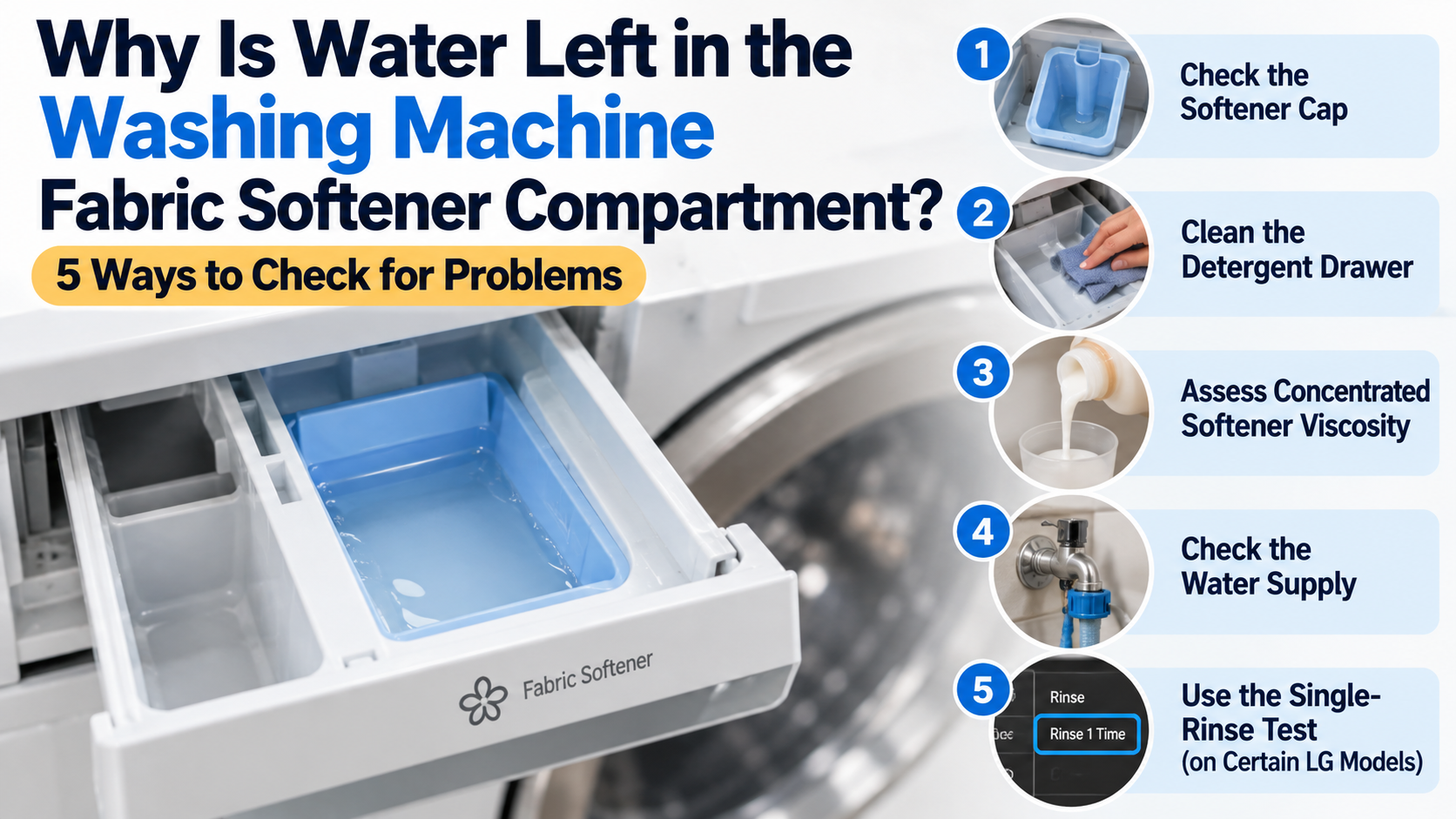
A small amount of water left in the fabric softener compartment after a wash does not necessarily mean your washing machine is broken. With both front-loading and top-loading washing machines, it is important to distinguish between residual water and fabric softener that was not dispensed properly. If undiluted fabric softener remains in the compartment or water repeatedly accumulates, you should check the softener cap, detergent drawer for blockages, softener viscosity, and water supply.
LG Electronics and Samsung Electronics also recommend removing residue from the fabric softener dispenser, cleaning the detergent drawer, and checking the water supply as key troubleshooting measures in their product guidance.
If fabric softener was dispensed properly during the final rinse, a small amount of remaining water alone is not enough to conclude that the washing machine is faulty. The important question is whether the liquid left in the compartment is water or the fabric softener originally added.
A manual fabric softener dispenser uses water during the wash cycle to carry fabric softener into the washing drum. The dispensing mechanism and the amount of water remaining after washing may differ depending on the model.
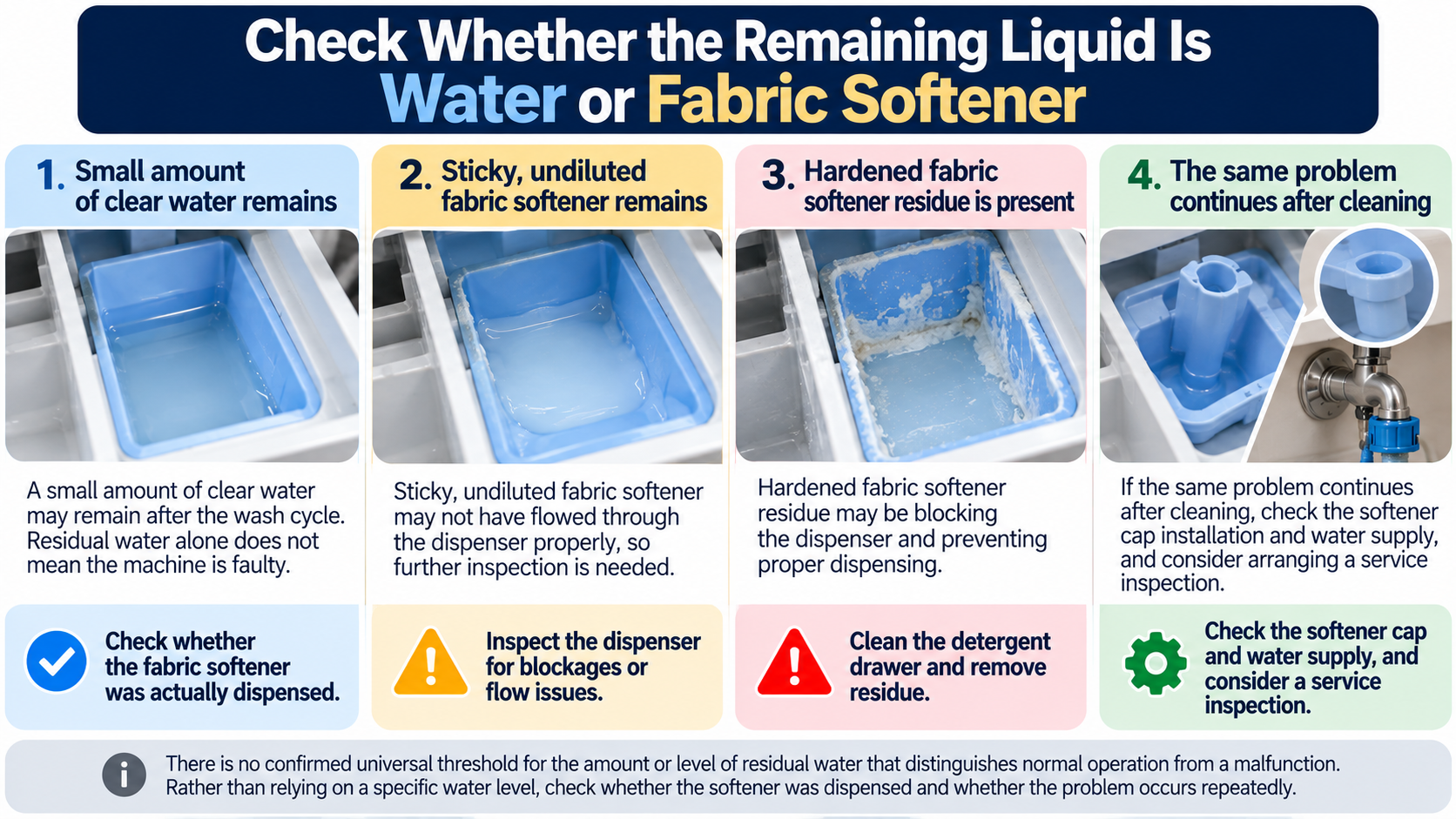
1. Check Whether the Remaining Liquid Is Water or Fabric Softener
After the wash cycle finishes, look for the following conditions.
A small amount of clear water remains: Check whether the fabric softener was actually dispensed. Residual water alone does not establish that the machine is faulty.
Sticky, undiluted fabric softener remains: The softener may not have flowed through the dispenser properly, so further inspection is needed.
Hardened fabric softener residue is present: Deposits may be blocking the dispenser and preventing proper dispensing.
The same problem continues after cleaning: Check the softener cap installation and water supply, and consider arranging a service inspection.
There is no confirmed universal threshold for the amount or level of residual water that distinguishes normal operation from a malfunction. Rather than relying on a specific water level, check whether the softener was dispensed and whether the problem occurs repeatedly.
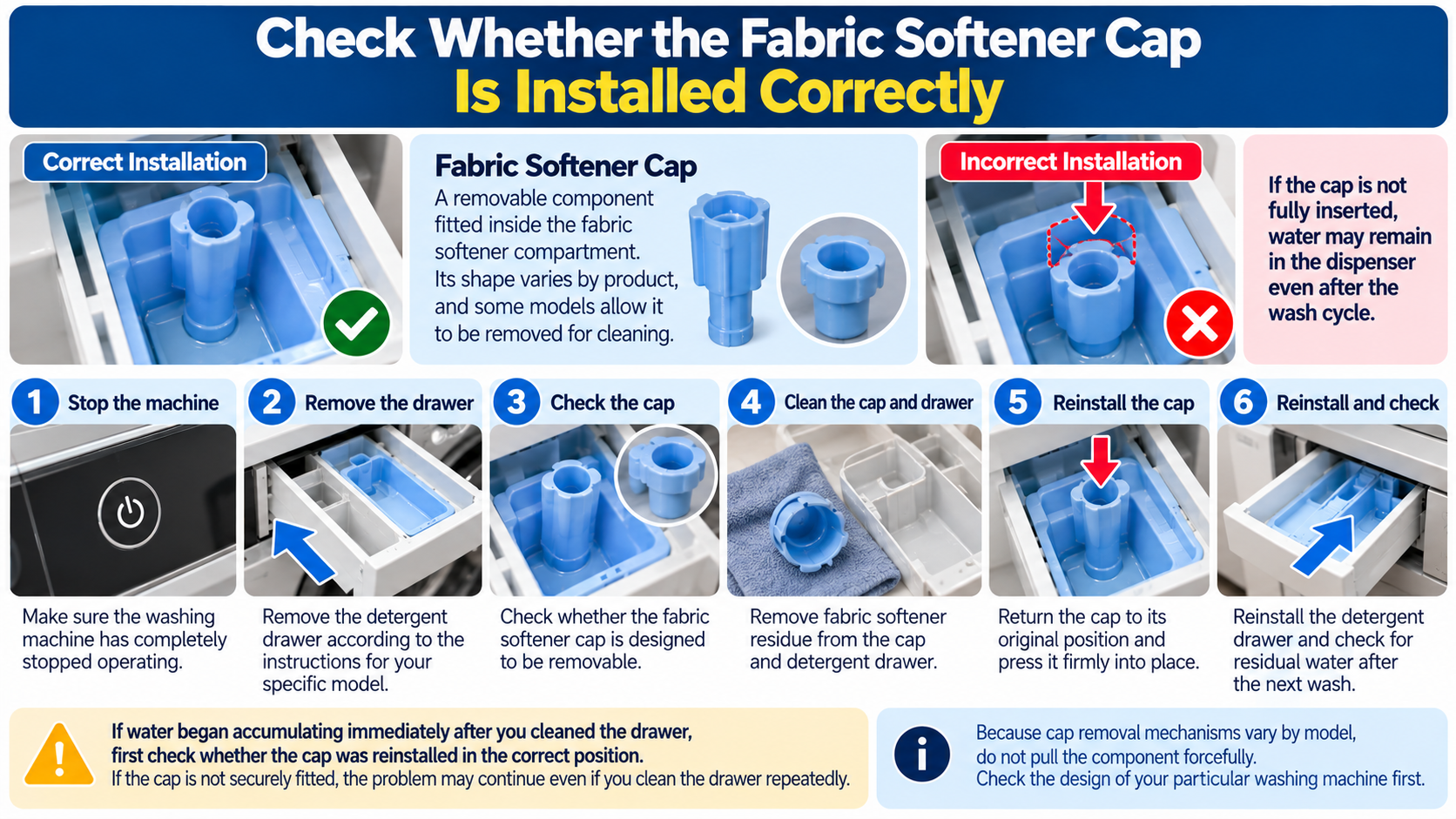
2. Check Whether the Fabric Softener Cap Is Installed Correctly
If the fabric softener cap is not fully inserted, water may remain in the dispenser. LG Electronics explains that residual water can occur when the softener cap has not been reassembled correctly after cleaning the detergent drawer.
The fabric softener cap is a removable component fitted inside the fabric softener compartment. Its shape varies by product, and some models allow it to be removed for cleaning.
If water began accumulating immediately after you cleaned the detergent drawer, first check whether the cap was reinstalled in the correct position.
Follow these steps:
1. Make sure the washing machine has completely stopped operating.
2. Remove the detergent drawer according to the instructions for your specific model.
3. Check whether the fabric softener cap is designed to be removable.
4. Remove fabric softener residue from the cap and detergent drawer.
5. Return the cap to its original position and press it firmly into place.
6. Reinstall the detergent drawer and check for residual water after the next wash.
If the cap is not securely fitted, the problem may continue even if you clean the drawer repeatedly.
Because cap removal mechanisms vary by model, do not pull the component forcefully. Check the design of your particular washing machine first.
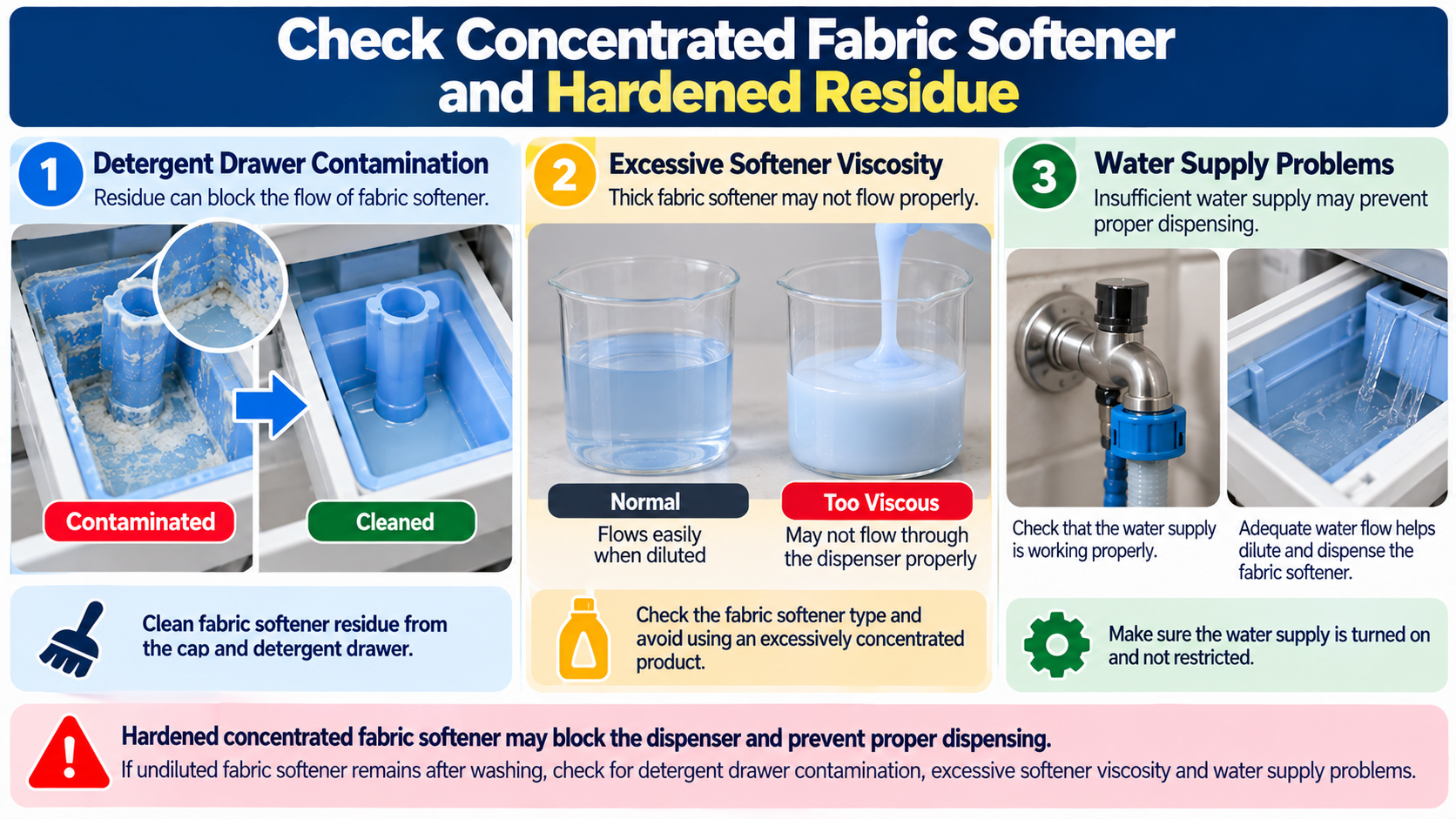
3. Check Concentrated Fabric Softener and Hardened Residue
If undiluted fabric softener remains in the compartment after washing, check for detergent drawer contamination, excessive softener viscosity, and water supply problems. Hardened concentrated fabric softener, in particular, may prevent proper dispensing.
Fabric Softener Left in the Drawer for Too Long
Fabric softener may become sticky or harden if it is left in the detergent drawer for an extended period.
For certain products, LG Electronics advises against leaving fabric softener in the detergent drawer for 2 days or longer. Hardened residue can obstruct the passages through which water flows.
It is advisable to add fabric softener immediately before starting the wash and clean the detergent drawer regularly.
Concentrated Fabric Softener That Is Too Thick
Concentrated fabric softener may have a thicker consistency than ordinary liquids.
If its viscosity is too high, it may not flow smoothly through the detergent drawer. Use fabric softener that meets the requirements specified in your washing machine's user manual.
For some LG washing machines with manual dispensers, the manufacturer's guidance includes mixing water with thick fabric softener. However, this method should not automatically be applied to every washing machine or automatic dispensing system.
Detergent and Softener Residue Inside the Drawer
Detergent or fabric softener residue can accumulate inside the washing machine's detergent drawer.
Because accumulated debris may interfere with water flow and softener dispensing, inspect not only the removable drawer but also the compartment into which it fits.
If regular laundry detergent also remains in its dispenser, check that compartment for residue and blockages as well.
4. Clean the Detergent Drawer and Fabric Softener Dispenser
Remove the fabric softener dispenser according to your model's instructions, then clean it with lukewarm water and a soft brush. LG Electronics recommends cleaning the detergent drawer approximately once a week and ensuring that the softener cap is correctly reassembled afterward.
Follow this cleaning procedure:
1. Remove the detergent drawer: Make sure the washing machine is stopped, locate the release button or removal mechanism, and carefully pull out the drawer.
2. Remove the fabric softener cap: If the cap is removable, take it out and check for hardened residue inside.
3. Wash with lukewarm water: Use a soft toothbrush or cleaning brush to remove fabric softener deposits.
4. Inspect the drawer housing: Check the space where the drawer is installed for remaining debris and clean it as necessary.
5. Reassemble the components: Press the softener cap firmly into place and reinstall the detergent drawer in its original position.
Detergent drawer removal mechanisms vary not only by manufacturer but also by model.
Some LG TROMM models use a PUSH button to release the detergent drawer, while TROMM Plus products have a different removal mechanism.
Samsung Electronics likewise recommends removing detergent and fabric softener residue from both the detergent drawer and the compartment where it is inserted.
Test Softener Dispensing With a Single-Rinse Cycle on Certain LG Models
Some LG front-loading washing machines allow you to check fabric softener dispensing using the Single Rinse function, labeled 'Rinse 1 Time' on certain models. This involves adding the prescribed amount of softener, running the function, and checking whether the softener remains in the dispenser.
LG Electronics provides the following procedure:
1. Reinstall the cleaned detergent drawer and fabric softener cap correctly.
2. Add the prescribed amount of fabric softener to the softener compartment.
3. Select the Single Rinse function.
4. Press the Start button to operate the washing machine.
5. Check whether fabric softener remains at the dispensing inspection point specified by the manufacturer.
For products that support this test, LG Electronics indicates that if no fabric softener remains in the detergent drawer when checked after water has entered the washing drum, the dispensing system is operating normally.
However, the same test does not apply to every front-loading or top-loading washing machine. Opening the detergent drawer while water is being supplied may interfere with proper fabric softener dispensing. Follow this procedure only on models for which the manufacturer specifically recommends it.
5. Check the Water Supply and Water Pressure
If the washing machine does not receive enough water, fabric softener may not be dispensed properly.
Check whether the water tap connected to the washing machine's inlet hose is sufficiently open.
Samsung Electronics also recommends checking the water supply pressure and inspecting the inlet connection and hose for debris when troubleshooting fabric softener dispensing problems.
LG Electronics explains that excessively high water pressure may cause fabric softener to be released earlier than intended on certain models. Conversely, low water pressure may prevent the necessary amount of water from entering the machine.
Rather than arbitrarily increasing water pressure, consider the specific symptoms and follow the manufacturer's instructions.
What If Fabric Softener Dispenses Too Early or the Problem Continues?
If fabric softener enters the wash before the final rinse or continues to remain in the compartment after cleaning, recheck the amount of softener used and the water supply conditions. If basic troubleshooting does not resolve the issue, a professional service inspection may be needed to assess the machine's actual operation.
Keep the following precautions in mind when using fabric softener:
Exceeding the MAX fill line: Adding too much fabric softener may cause it to dispense earlier than intended.
Closing the detergent drawer forcefully: Fabric softener may slosh inside the compartment and dispense prematurely.
Opening the drawer during water intake: This may interfere with proper fabric softener dispensing.
Using fabric softener that has been left in the drawer too long: Hardened softener may remain inside the dispenser.
If the same problem continues after correcting these usage conditions and cleaning the detergent drawer, contact the manufacturer's service center.
In South Korea, LG Electronics customer support is available at 1544-7777, and Samsung Electronics service support is available at 1588-3366.
Frequently Asked Questions
Q. Do I Need to Clean the Drawer Every Time a Little Water Remains After Washing?
Not necessarily. A small amount of water alone does not mean you must disassemble and clean the detergent drawer after every wash. First check whether the fabric softener was dispensed properly, and clean the drawer regularly to prevent residue buildup.
Q. Will Adding More Fabric Softener Help It Dispense Better?
No. Filling the compartment above the MAX line may cause fabric softener to dispense before the intended rinse stage. Always keep the amount at or below the fill line specified for your machine.
Q. If My Laundry Does Not Smell Like Fabric Softener, Does That Mean It Was Not Dispensed?
A weak fragrance alone does not prove that fabric softener was not dispensed. LG Electronics notes that softener left standing for too long may lose its fragrance. To check dispensing more reliably, inspect the detergent drawer for undiluted fabric softener left behind.
Q. Are the Troubleshooting Steps the Same for Front-Loading and Top-Loading Washing Machines?
Cleaning the detergent drawer and checking the amount of fabric softener are useful steps for both types. However, drawer removal methods, cap designs, and procedures for confirming normal dispensing vary by model.
Final Checklist: What to Do When Water Remains in the Fabric Softener Compartment
If water keeps collecting in the fabric softener compartment, check the machine in this order: verify that the softener cap is installed correctly → clean the detergent drawer → confirm that fabric softener is being dispensed → inspect the water supply.
If the problem continues, locate your washing machine's model number and contact the manufacturer's service center for a model-specific inspection.