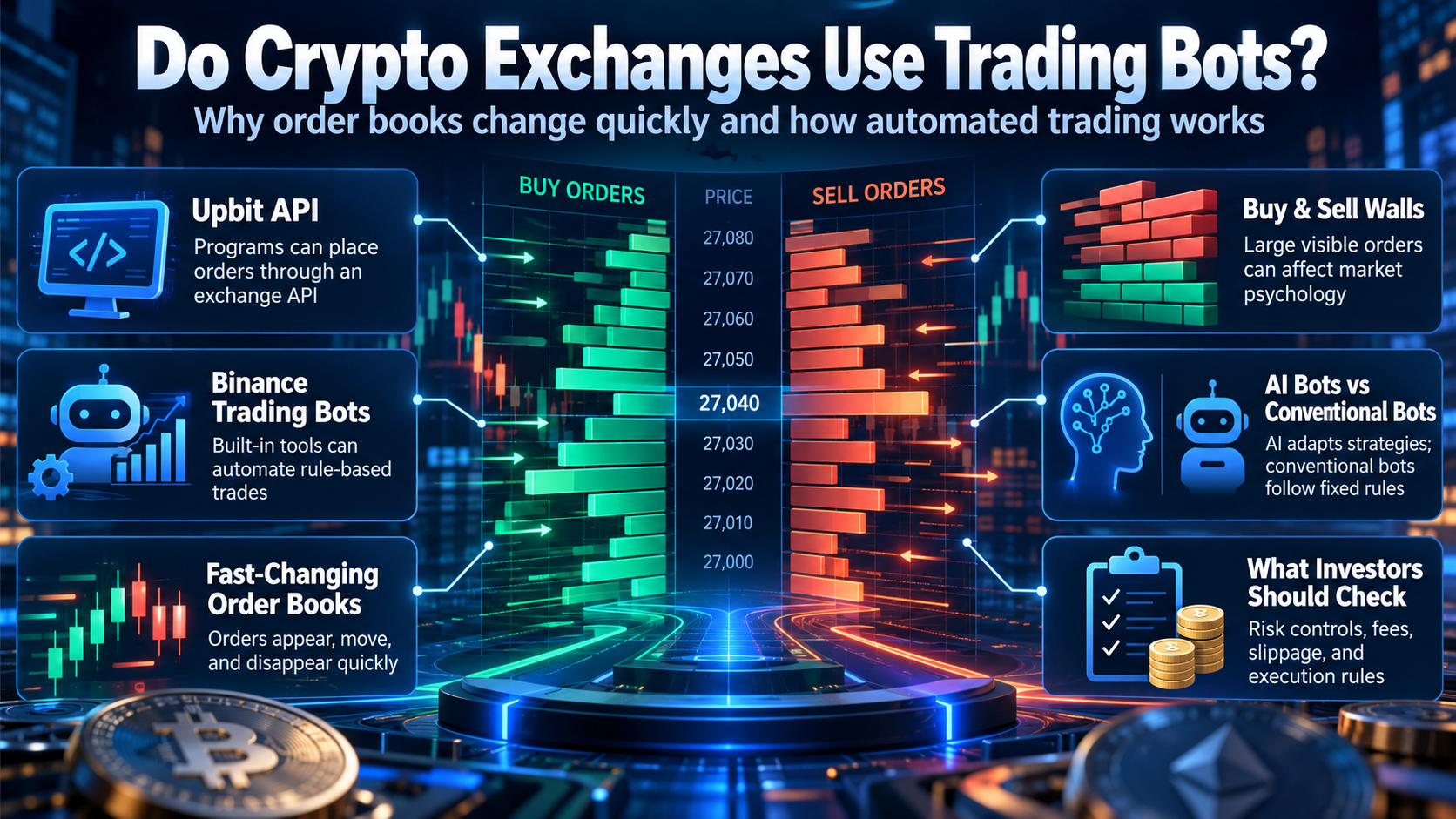
When buy and sell orders appear and disappear rapidly on a cryptocurrency exchange, it can look as though a computer program is controlling the trades. Automated trading bots do exist in cryptocurrency markets. Upbit provides an API that allows programs to execute orders, while Binance also offers automated trading tools within its exchange. However, order book movements alone cannot establish whether a particular order came from a bot or involved market manipulation.
Understanding how transactions can take place without someone manually placing each order makes it easier to interpret movements in the cryptocurrency market.
Do Cryptocurrency Exchanges Really Have Automated Trading Bots?
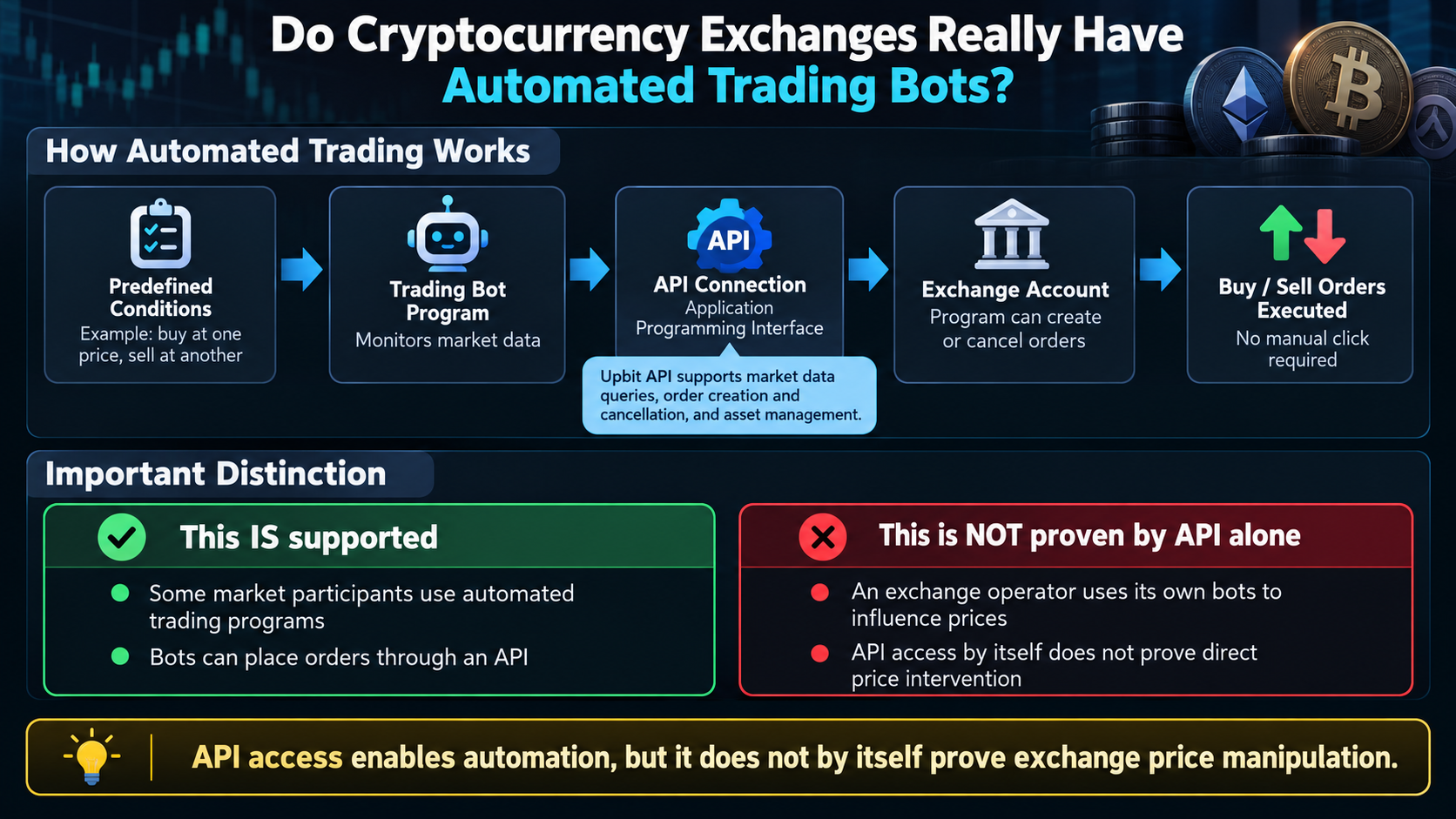
Yes. A cryptocurrency trading bot is a program that monitors market data and executes buy or sell orders according to predefined conditions.
For example, a bot can be programmed to buy Bitcoin when its price falls to a specified level and sell it when the price rises to another predetermined level.
One of the main technologies used to execute these orders is an API.
An API, or Application Programming Interface, allows an external program to exchange data with an exchange's systems. Upbit provides APIs that support market price queries, order creation and cancellation, and asset management.
In other words, a program connected to an exchange account can submit orders without a person manually clicking the buy button on the exchange's trading screen.
However, an important distinction must be made.
The fact that some market participants use automated trading programs is entirely different from the claim that an exchange operator uses its own bots to influence prices.
The existence of an API does not, by itself, prove that an exchange directly intervenes in market prices.
Why Do Orders Appear and Disappear So Quickly in the Order Book?
An order book displays buy and sell orders that have not yet been executed, organized by price level.
The quantities shown on the screen change continuously as new orders are submitted, existing orders are canceled, and orders are partially or fully executed.
Automated trading programs can participate in this process.
For example, imagine a program that places buy and sell orders at several price levels around the current market price.
When the market price changes, the program may cancel existing orders or submit new orders at different prices according to its configured strategy.
As a result, orders may appear to disappear suddenly from one price level and reappear at another in the order book.
However, not every such movement is caused by automated trading. The order book also changes when people manually modify their orders or when executed trades reduce the quantity of outstanding orders.
Therefore, the appearance of a large buy wall or sell wall at a particular price does not establish that a bot is responsible or reveal the order placer's intentions.
What Types of Cryptocurrency Trading Bots Are There?
Automated trading is not a single strategy. How a bot operates depends on the conditions it has been programmed to follow.
Common types include the following.
| Automated Trading Type | How It Works | Main Characteristics |
|---|---|---|
| Grid bot | Distributes orders across a predefined price range | Attempts to take advantage of price fluctuations within a particular range |
| Dollar-cost averaging (DCA) bot | Makes purchases in installments at predetermined times or under specified conditions | Spreads entry points instead of making a single purchase |
| Trend-following bot | Analyzes price movements and trend conditions to place orders | Performance varies depending on changes in market trends |
| Arbitrage bot | Attempts to take advantage of price differences between markets | Trading fees and execution conditions are important |
| Rebalancing bot | Adjusts holdings when asset allocations deviate from target levels | Helps maintain predefined portfolio allocations |
Binance provides information about several automated trading features, including Spot Grid, Futures Grid, Arbitrage, Rebalancing, and Spot DCA.
The important point is that automated trading technology does not generate profits by itself.
Even when buying and selling are automated, unfavorable market movements can still cause losses.
Futures trading bots require particular caution because leverage may be used, potentially magnifying gains and losses substantially compared with spot trading.
Are Trading Bots Faster Than Human Investors?
Automated trading programs can be designed to process market data and execute orders faster than people manually monitoring trading screens.
A human trader must check the price, decide whether to buy, and then click the order button.
By contrast, an automated trading program can submit an order without additional manual input once its predefined conditions are satisfied.
However, order submission speed and actual execution results are two different things.
Even if an order is submitted quickly, it may not execute at the desired price. Orders may also fail because of exchange connectivity problems or software errors.
Therefore, a faster program does not necessarily trade at better prices or generate higher returns than an individual investor.
Are Buy Walls and Sell Walls Created by Bots?
Because automated trading programs can place orders at multiple price levels, they may contribute to the buy and sell quantities displayed in an order book.
However, it is difficult to determine which market participant created a particular buy wall or sell wall using publicly available order book data alone.
Consider the following hypothetical situation.
Suppose a cryptocurrency is currently trading at KRW 1,000, and a large buy order is displayed at KRW 990.
That buy order might have been placed by an investor who genuinely wants to buy the asset, or it might have been submitted by an automated trading program.
Even if the order is canceled before the price reaches KRW 990, its cancellation does not reveal the order placer's intentions.
What an ordinary investor can observe includes displayed prices and quantities, changes in outstanding orders, and actual trade execution data.
Orders displayed in the order book must be distinguished from trades that have actually been executed.
Assuming that a large displayed order represents an equally large completed transaction can lead to a misunderstanding of market conditions.
Does Automated Trading Mean Market Manipulation?
Automated trading is a technology for executing transactions. Whether conduct constitutes market manipulation is a separate question that must be assessed under the applicable laws and regulations and the specific trading activity involved.
Legitimate automated trading programs may submit and cancel orders rapidly.
Conversely, the fact that an order was executed automatically does not necessarily mean that every aspect of the trading activity was legitimate.
For individual investors, the relationship between actual executions and changes in the order book is more useful to observe than order speed alone.
For example, if displayed buy orders continue to increase while actual executed trading volume remains relatively small, it is worth distinguishing between orders appearing on the screen and orders that lead to completed trades.
However, this observation alone is insufficient to conclude that the orders are deceptive or constitute market manipulation.
Additional information would be needed, including the identities of the parties placing orders, trading records, repeated patterns of conduct, and the relevant regulations.
Can Individual Investors Create Their Own Trading Bots?
Individual investors can develop automated trading programs or connect third-party trading tools to cryptocurrency exchanges that support API access.
Upbit provides developer documentation covering functions such as retrieving market data and executing orders.
The basic operation of an automated trading program can be understood through the following sequence.
1. Retrieve market data
Obtain information about prices, executed trades, and the order book.
2. Evaluate predefined trading conditions
Decide whether to buy, sell, or wait.
3. Submit an order to the exchange
Send an order request through the API.
4. Check order and execution results
Review account balances, unfilled orders, and profits or losses.
An API key is an important piece of security information.
When an automated trading program receives permission to access an account, it can use the exchange account's functions within the scope of the permissions granted.
When connecting an API key to an external program, it is safer to grant only the permissions required and avoid enabling withdrawal permissions.
Before using automated trading features, investors should also check trading fees, exchange API usage limits, and procedures for responding to software failures.
What Is the Difference Between AI Trading Bots and Conventional Trading Bots?
Conventional rule-based trading programs execute conditions predefined by a human. AI trading systems may add data analysis or pattern recognition capabilities based on machine learning.
For example, a conventional trading bot can be programmed to buy when an asset reaches a particular price.
An AI-based system may analyze various inputs, such as historical prices and trading volumes, to develop a decision-making model and incorporate its output into a trading strategy.
However, this does not mean that AI can accurately predict future prices.
A model that performed well using historical data is not guaranteed to deliver the same results under new market conditions.
Nor should a system be considered safer or more profitable than conventional automated trading simply because it is labeled as AI.
Can Automated Trading Bots Guarantee Profits?
The advantage of automated trading is that a predefined strategy can be executed without a person continuously monitoring the market.
However, a computer program cannot automatically eliminate the risk of losses simply because its user wants to avoid them.
For example, a program configured to buy more whenever prices fall may accumulate larger positions and increase the amount of capital exposed to the market if prices continue to decline.
Trading fees generated by repeated transactions must also be included when calculating actual returns.
Because the strategy return displayed by a program may differ from the actual net profit or loss in an exchange account, it is important to examine execution records, trading fees, and unrealized gains or losses together.
Investors should also be cautious about promotions claiming that AI bots guarantee profits or allow trading without losses.
The U.S. Securities and Exchange Commission (SEC) has warned that cryptocurrency investment scams involving AI may misuse claims about automated trading technology and high returns.
Four Things to Check When Reading a Cryptocurrency Order Book
Rather than guessing whether a bot is operating, it is more useful to examine how displayed orders relate to actual transactions.
The following four indicators should be considered separately.
1. Outstanding order quantities: How many unexecuted buy and sell orders remain at particular price levels.
2. Actual trade executions: Whether transactions have actually taken place, rather than merely appearing as orders on the screen.
3. Changes in order quantities: Whether displayed order sizes are increasing or decreasing.
4. Trading volume and price: How prices and trading volumes change as transactions are executed.
These indicators help investors observe market conditions. They do not identify a specific trading bot or prove who placed an order.
Even when a large buy order appears in the order book, it may be canceled or affected by changing market conditions. It is therefore unwise to treat the displayed quantity as a guaranteed support level that will prevent the price from falling.
Conclusion: Rapid Order Book Changes Do Not Prove Market Manipulation
Cryptocurrency markets have the technical infrastructure that allows automated trading bots to operate. However, rapid changes in orders are not, by themselves, evidence of manipulation. The presence of many bots also does not predict whether a particular cryptocurrency will rise or fall.
The key distinction for individual investors is straightforward: orders displayed on the screen, transactions that have actually been executed, and the intentions of the people or programs placing those orders are three different types of information.
*Disclaimer: This article is provided for informational purposes to help readers understand market activity. It does not constitute a recommendation to invest in any particular cryptocurrency or other asset. Investors are responsible for their own decisions and the associated investment risks.*