
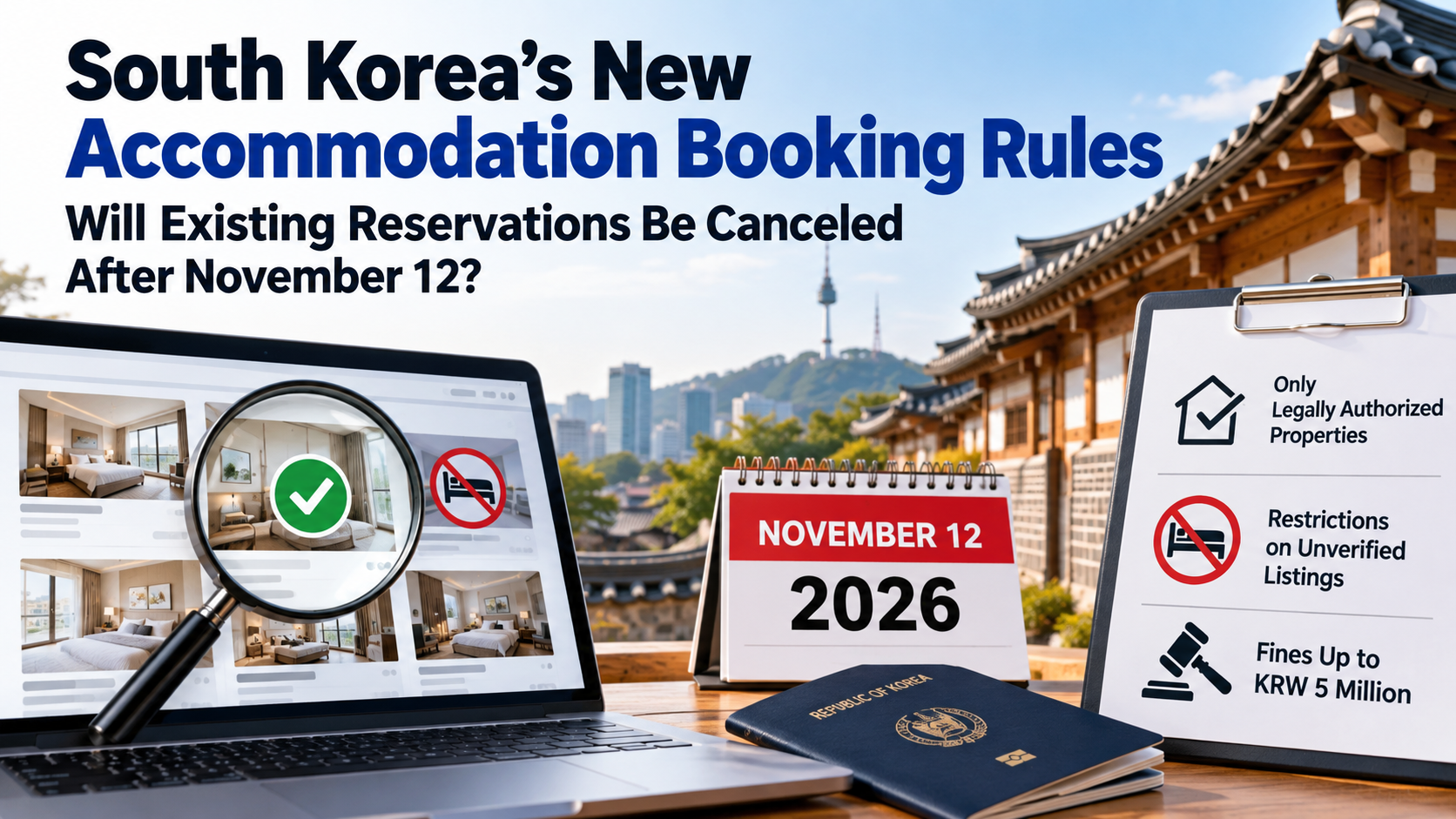
Starting November 12, 2026, accommodation booking platforms in South Korea must verify whether listed properties are legally authorized to operate. Accommodation listings whose business registration certificates or other required documents cannot be verified may no longer be offered through these platforms. The requirement also applies to properties listed before the rules take effect. However, whether an existing paid reservation will be automatically canceled or fully refunded is a separate issue. Travelers should check their reservation status and cancellation and refund conditions directly with the platform they used.
If your travel date is approaching and the accommodation you booked suddenly disappears from a booking app's search results, it can be alarming. However, a property disappearing from search results does not necessarily mean that an existing confirmed reservation has been canceled.
Here is what changes under the new rules and what travelers with existing reservations should check.
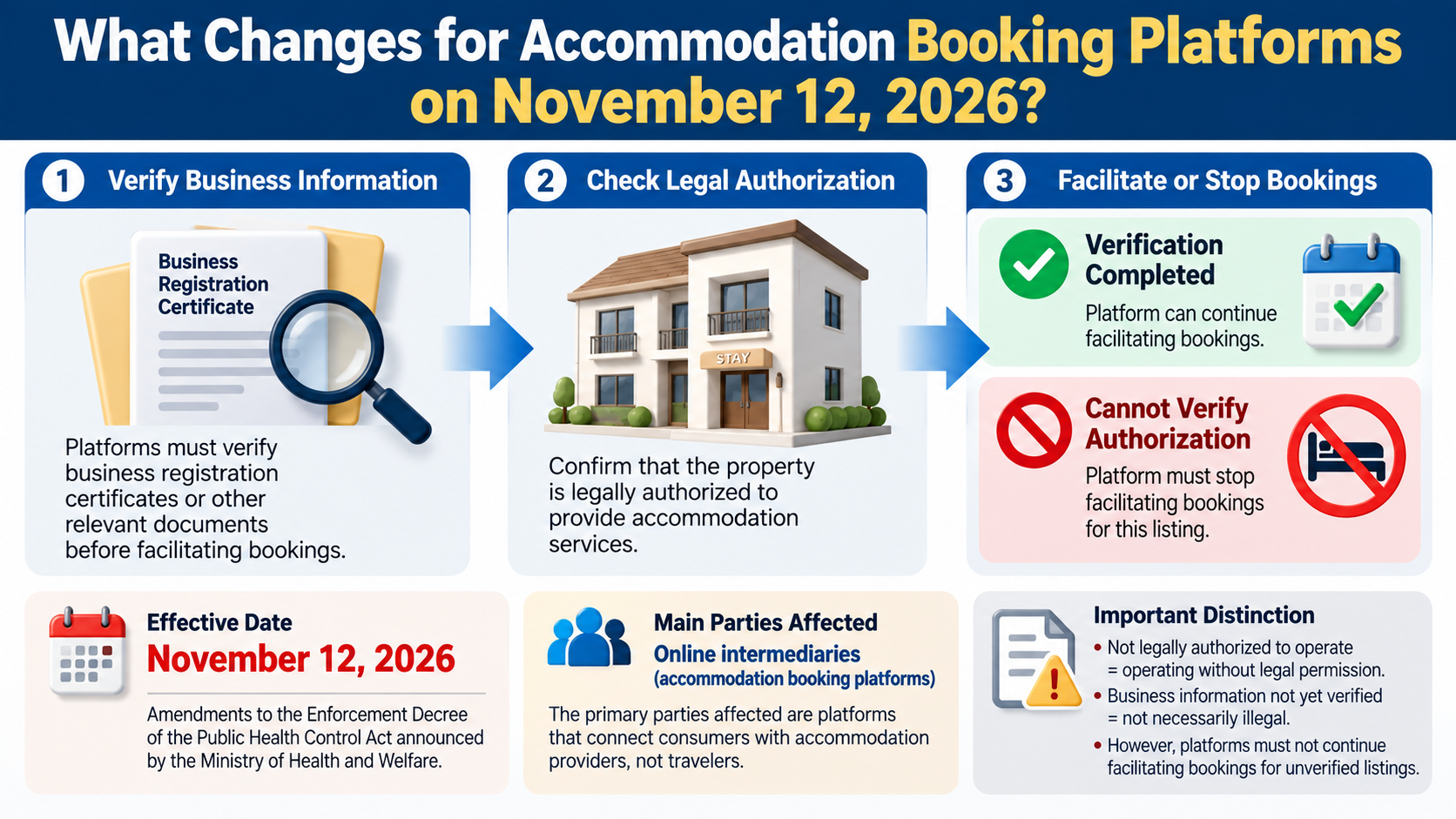
What Changes for Accommodation Booking Platforms on November 12, 2026?
Platforms that facilitate accommodation bookings must verify business registration certificates or other relevant documents. If a property's legal authorization to provide accommodation services cannot be confirmed, the platform must stop facilitating bookings for that listing.
According to amendments to the Enforcement Decree of South Korea's Public Health Control Act announced by the Ministry of Health and Welfare, the new requirements take effect on November 12, 2026.
The primary parties affected by this change are not travelers booking accommodation but online intermediaries that connect consumers with accommodation providers.
Previously, South Korea's Public Health Control Act did not separately establish a requirement for businesses intermediating online accommodation bookings to verify accommodation business registration certificates.
Under the amended rules, these intermediaries must verify the relevant business information before facilitating accommodation bookings.
An important distinction must be made between a property that is not legally authorized to operate and one whose business information has not yet been verified by the platform.
A lack of verification does not, by itself, conclusively establish that an individual property is operating illegally. Nevertheless, platforms must not continue facilitating bookings for listings that have not completed the required verification.
Do the New Rules Apply to Accommodation Listings Registered Before November 12?
Yes. Accommodation listings registered before the new rules take effect must also have their legal operating status verified if platforms intend to continue facilitating bookings for them after November 12.
A property is not exempt simply because it has been listed on a booking app for years or has previously accepted reservations without problems.
The treatment of accommodation listings can be summarized as follows.
| Accommodation listing status | Booking intermediation after November 12 |
|---|---|
| Legal authorization to operate has been verified | Bookings may be facilitated once the relevant verification requirements have been satisfied. |
| Business registration certificate or other required documents cannot be verified | The listing is subject to restrictions on booking intermediation. |
| Listed before the effective date but still unverified | The platform must take action to prevent continued booking intermediation. |
Here, restrictions on booking intermediation mean restrictions on a platform's ability to connect consumers with and facilitate the sale of the accommodation listing.
The rules do not prescribe a single uniform method for handling every unverified listing, such as removing it from search results or temporarily suspending sales.
The way listings appear in the app and how reservations are handled will depend on the platform's operational measures.
Will Existing Accommodation Reservations Be Automatically Canceled?
The restrictions taking effect on November 12 do not, by themselves, establish that existing reservations will be automatically canceled.
The amendments announced by South Korea's Ministry of Health and Welfare focus on platforms' obligation to verify accommodation business registrations, restrictions on facilitating bookings for unverified properties, and administrative fines for violations.
However, the announcement does not establish a blanket requirement to cancel all reservations paid for before the effective date or to issue full refunds automatically to every affected traveler.
Consider a hypothetical example: you book accommodation on November 5 for a stay beginning November 20.
Even if the platform is restricted from accepting new bookings for that property after November 12, the status of your existing reservation must be checked separately.
Travelers should distinguish between the following situations:
Your reservation remains active: Do not assume that accommodation is guaranteed simply because the reservation still appears in your booking history. Confirm whether the property can actually honor your stay.
You receive a cancellation notice: Check who initiated the cancellation, why it occurred, the refund amount, and the applicable processing conditions.
In particular, travelers should be cautious about immediately pressing the cancellation button simply because a property has disappeared from the app's search results.
Cancellation conditions may differ depending on whether the traveler voluntarily cancels or the accommodation provider or platform cannot fulfill the reservation.
Does the New Rule Guarantee a Full Refund for Existing Bookings?
No. The introduction of the business registration verification requirement does not automatically guarantee a full refund for every existing reservation.
Whether a refund is available depends on the booking contract, the reason for cancellation, the platform's terms and conditions, and applicable consumer protection rules.
It is important to distinguish between a traveler changing their plans and an accommodation provider being unable to deliver the booked service.
For example, if a property informs you that it cannot honor your reservation because of a business authorization issue, you should first check whether the same cancellation conditions would apply as in a voluntary cancellation.
When contacting the platform's customer service team, ask about the following:
1. Whether your booked accommodation will remain available after November 12.
2. Whether your reservation is affected by the business registration verification requirements.
3. Who will process the cancellation if one becomes necessary.
4. The actual refund amount and the refund procedure for your payment method.
5. Whether alternative accommodation or a reservation change is available.
The announced amendments do not establish a requirement for platforms to provide alternative accommodation to every affected traveler or pay additional compensation in all cases.
Rather than assuming a particular refund or compensation is guaranteed, check the conditions that apply to your individual reservation.
Who Is Subject to the KRW 5 Million Fine?
The KRW 5 million administrative fine applies to online intermediaries and other covered businesses that violate the obligation to restrict booking intermediation for unverified accommodation listings. It is not a fine imposed on ordinary travelers simply for booking accommodation.
The amendment to the Enforcement Decree establishes standards for imposing administrative fines on accommodation booking intermediaries that fail to meet their obligations.
Continuing to facilitate bookings for accommodation listings that cannot be verified is subject to these administrative penalties.
Covered businesses include online travel agencies (OTAs) that receive accommodation listings directly from accommodation operators and facilitate reservations.
The requirements also cover businesses that obtain accommodation products from other online travel agencies or accommodation suppliers and then connect, display, and facilitate sales of those products through their own platforms.
In other words, whether a platform has a direct contract with an accommodation provider is not the sole factor determining whether the verification obligation applies.
For consumers, the immediate priority is not necessarily understanding every part of the booking distribution chain. It is checking what information and assistance the platform that accepted their reservation provides.
How Can Travelers Check Whether an Accommodation Business Is Legally Registered?
Travelers can consider contacting their booking platform or the relevant local government authority responsible for overseeing accommodation businesses in the area where the property operates.
However, it has not been established that every booking app provides the same menu or feature allowing consumers to directly view an original accommodation business registration certificate.
Likewise, the absence of business registration information on an app's listing page does not necessarily mean that the property is operating without the required registration.
First, confirm the exact name and address of the property you booked. If necessary, ask the platform whether the accommodation listing has been verified as legally authorized to operate.
Accommodation businesses may also be subject to different laws and verification requirements depending on their operating category.
Therefore, rather than assuming that every accommodation provider must use one identical business registration certificate format, the applicable requirements should be considered in relation to the property's business type and relevant South Korean laws.
What Should Travelers With Existing Reservations Check First?
If you have already booked accommodation, check whether your reservation remains valid and whether the property can actually accommodate you before searching for a replacement.
This is especially important if you have also booked flights or other transportation, because confirming your accommodation status first may help you avoid unnecessary changes to your itinerary.
The process is straightforward.
First, open your booking app and review the reservation details showing your reservation number, property name, stay dates, and payment amount.
Next, check whether the property's listing page is still accessible. If the property no longer appears in search results, contact the platform about the reservation's status rather than canceling immediately.
You can ask customer service the following:
Whenever possible, keep the response in a form you can refer to later, such as a text message or customer service conversation record.
This can help establish what information you were given if a problem arises with the reservation.
Should You Book Another Hotel if Your Original Property Disappears From Search Results?
You do not necessarily need to abandon your existing reservation or pay for another property simply because your original accommodation no longer appears in search results.
First, determine whether the platform has only restricted new bookings or whether its policy for handling existing reservations has also changed.
Booking another property while your original reservation remains valid could result in duplicate reservations.
On the other hand, if the original accommodation is confirmed to be unavailable, you should compare alternative properties that fit your remaining travel schedule.
When choosing a replacement, check not only the room price but also the free cancellation deadline, refund restrictions, available check-in times, and location.
What Is the Most Important Thing to Remember About the November 12 Rules?
The key point of the rules taking effect on November 12 is not that every accommodation reservation will change status automatically. Rather, platforms facilitating accommodation bookings in South Korea must verify whether the properties they offer are legally authorized to operate.
If you already have an accommodation reservation, start by preserving your booking details and asking the platform to confirm whether your stay can still be honored.