If you received a vaccination but cannot find it on the Korea Disease Control and Prevention Agency (KDCA) Immunization Assistance website, you can request electronic registration from the medical institution or public health center where the vaccination was administered. If the clinic has closed, you will need to check whether its records are held by the public health center with jurisdiction over its former location. Vaccinations administered overseas require official supporting documentation. A missing electronic record does not necessarily mean that you were never vaccinated.
This distinction is particularly important when preparing a child for elementary or middle school enrollment or obtaining an official vaccination certificate. Even if you still have your child's baby health booklet, entries that have not been authenticated by the vaccination provider may not qualify as acceptable evidence for registration.
Checking Vaccination Records in South Korea and Retrieving Records from Closed Medical Facilities
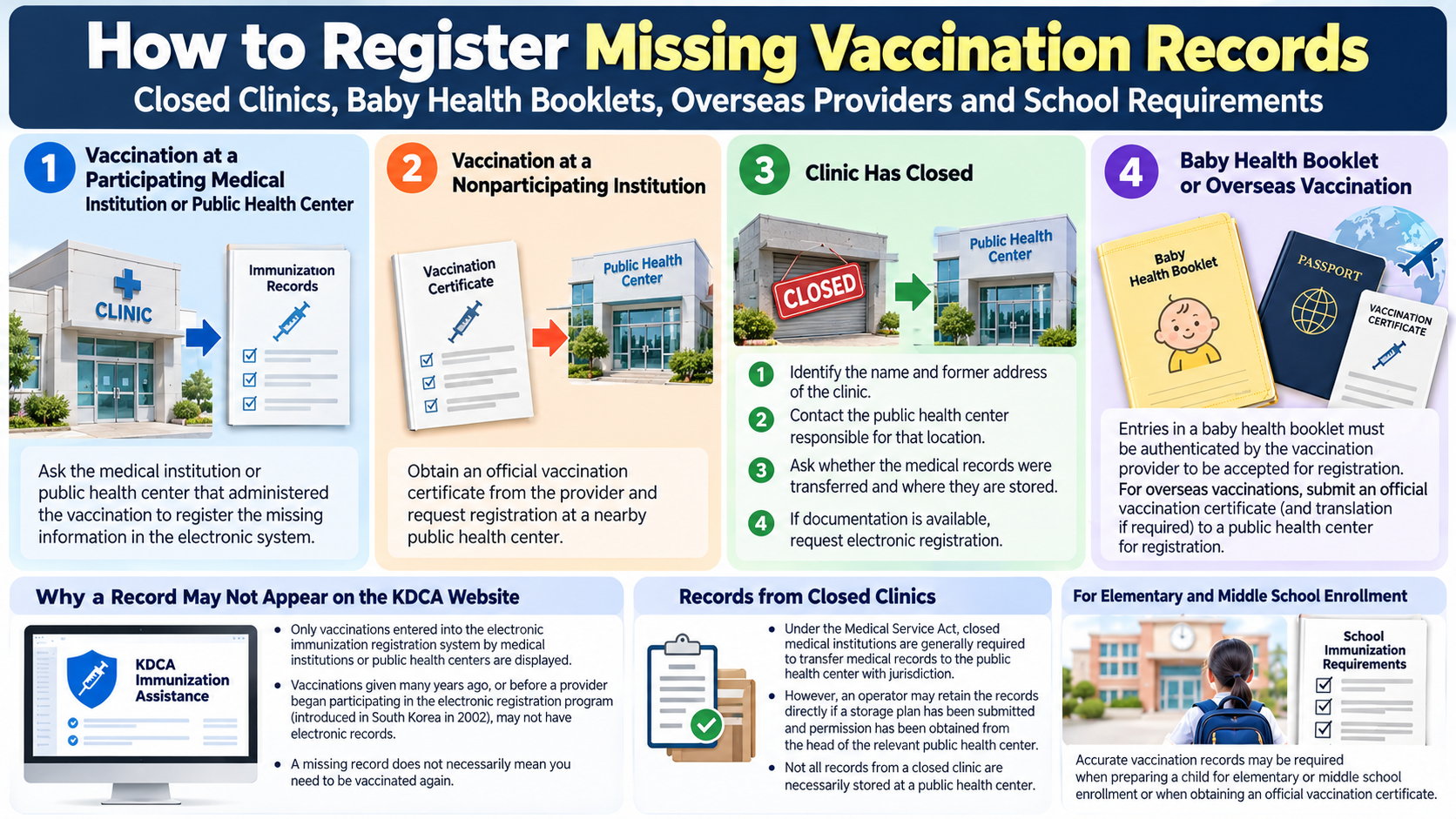
The records displayed on the KDCA Immunization Assistance website are vaccinations entered into South Korea's electronic immunization registration system by medical institutions or public health centers. Even if a vaccination was administered, it may not appear in search results if the provider did not register it electronically.
South Korea introduced its electronic immunization record registration program in 2002. Consequently, vaccinations administered many years ago, or before a medical institution began participating in the electronic registration program, may not have an electronic record.
The appropriate verification procedure depends on the type of institution where the vaccination was administered.
Vaccination at a participating medical institution or public health center: Ask that institution to register the missing vaccination information.
Vaccination at an institution that did not participate in the electronic registration program: Obtain an official vaccination certificate from the provider and request registration at a nearby public health center.
Older vaccinations without electronic records: Check whether the original provider retains medical records or whether other official supporting documentation is available.
There is no need to immediately decide on repeat vaccination simply because a record cannot be found. The first step is to determine whether documentation confirming the original vaccination still exists.
If the hospital or clinic where you received the vaccination has closed, contact the public health center responsible for the area where the facility was located. You will need to determine whether the closed institution transferred its medical records to the public health center or whether the person who operated the institution retained them separately.
Under Article 40 of South Korea's Medical Service Act, medical institutions are generally required to transfer medical records and related documents to the public health center with jurisdiction when they close. However, the operator of a medical institution may retain the records directly if a storage plan has been submitted and permission has been obtained from the head of the relevant public health center.
Therefore, you should not assume that every record from a closed hospital or clinic is necessarily stored at a public health center.
Follow these steps to locate the records:
1. Identify the name and former address of the hospital or clinic where the vaccination was administered.
2. Contact the public health center responsible for that location.
3. Ask whether the medical records or vaccination administration records were transferred and where they are currently stored.
4. If documentation confirming the vaccination is available, ask whether it can be entered into the electronic immunization registration system.
5. Once registration is complete, check the vaccination record again on the Immunization Assistance website.
For children entering elementary or middle school, the official guidance also describes a procedure through which the public health center responsible for the incoming student can verify vaccination records with the public health center responsible for the closed medical institution or with the person retaining its records.
The statutory retention period for medical treatment records in South Korea is 10 years. However, this retention period does not guarantee that every historical record still exists or that electronic registration will be successful.
If the medical institution closed a long time ago or the records cannot be located, ask the public health center whether any additional forms of supporting evidence can be checked.
Using a Baby Health Booklet and Other Evidence of Vaccination in South Korea
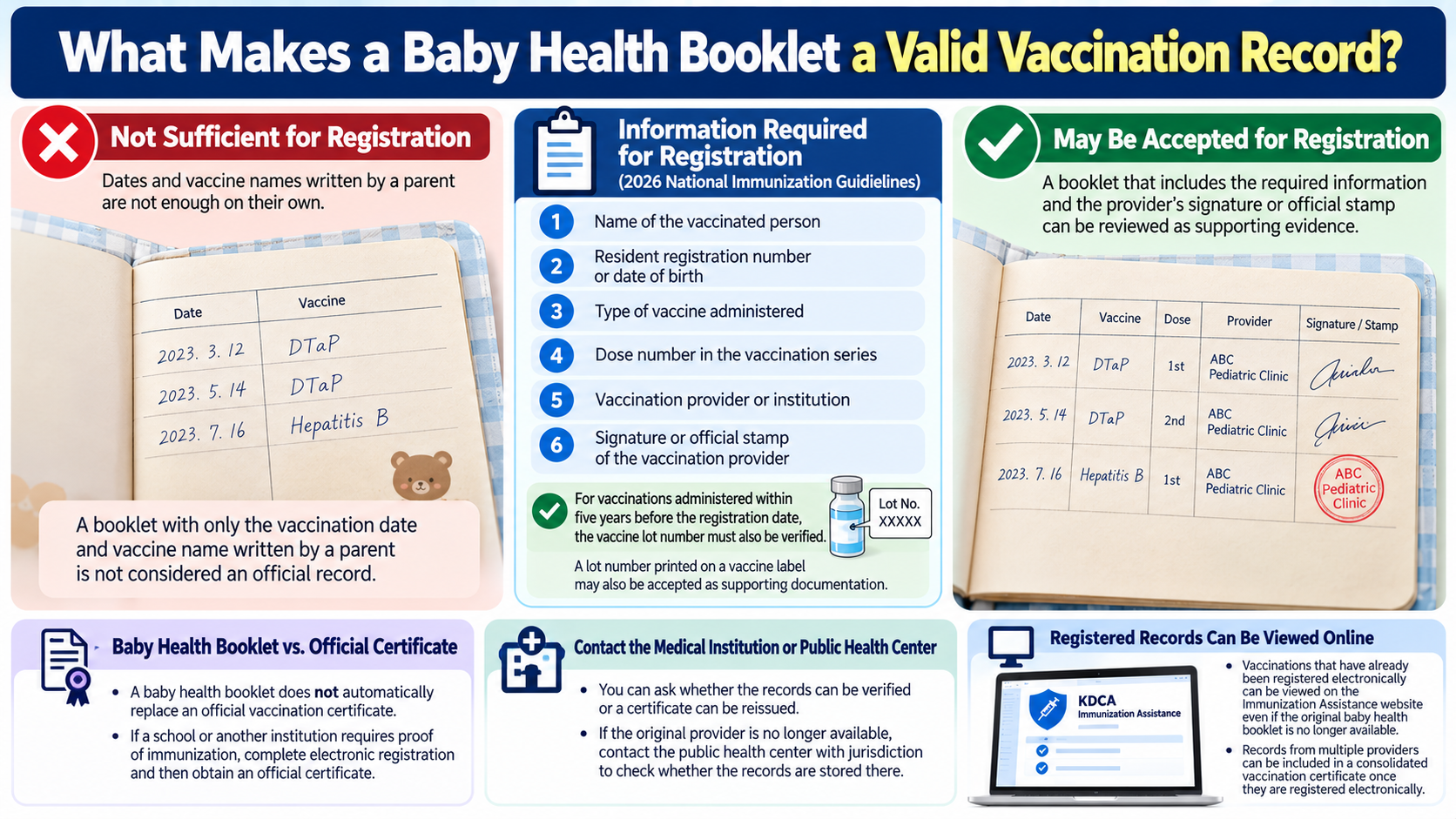
A vaccination date written in a baby health booklet is not, by itself, sufficient for electronic registration. The booklet must contain the information required to verify that the vaccination was actually administered, including the vaccination provider's signature or official stamp.
South Korea's 2026 national immunization guidelines specify that the following information should be checked when registering historical vaccinations administered domestically:
Name of the vaccinated person
Resident registration number or date of birth
Type of vaccine administered
Dose number in the vaccination series
Vaccination provider or institution
Signature or official stamp of the vaccination provider
In particular, for vaccination records from within the five years preceding the registration date, the vaccine lot number must also be verified. A lot number printed on a vaccine label may also be accepted as supporting documentation.
For example, a baby health booklet in which a parent has personally written only the vaccination date and vaccine name is different from an official record authenticated by the provider that administered the vaccine.
By contrast, if the booklet clearly contains the required vaccination information and the provider's signature or official stamp, it may be reviewed as supporting evidence of a previous vaccination.
A baby health booklet does not automatically replace an official vaccination certificate. If a school or another institution requires proof of immunization, the appropriate approach is to complete electronic registration and then obtain an official certificate.
You can contact the medical institution or public health center where the vaccination was administered to ask whether the records can be verified or a certificate can be reissued.
Vaccinations that have already been registered electronically can be viewed on the Immunization Assistance website even if the original baby health booklet is no longer available. Records from multiple providers can also be included in a consolidated vaccination certificate, provided they have been registered electronically.
Registering Overseas Vaccinations in South Korea
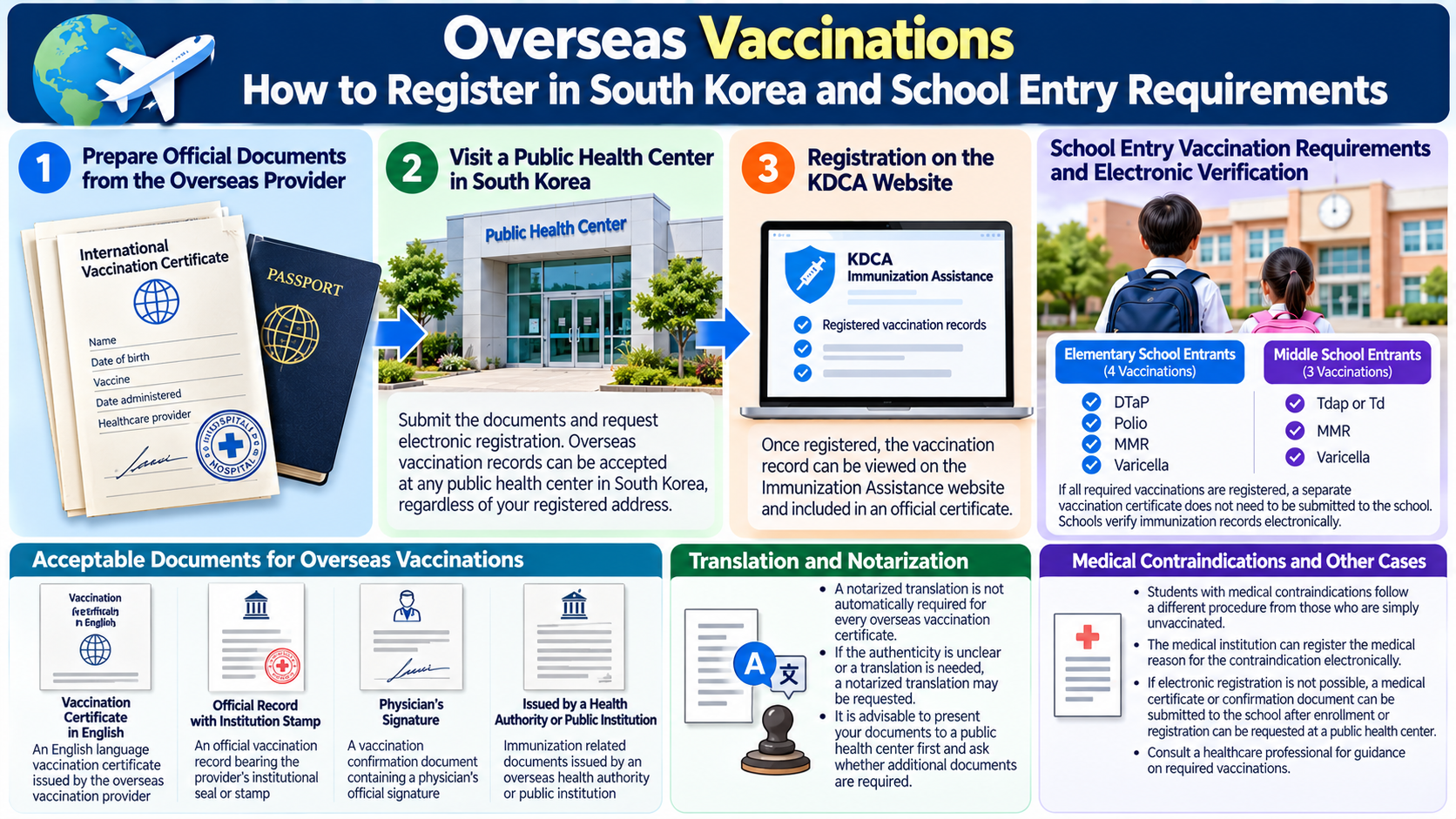
Vaccinations administered by medical institutions overseas may also be registered electronically through a public health center in South Korea if appropriate official documentation is available. Overseas vaccination records are treated differently from records that can be verified automatically through South Korea's domestic medical system, so documentation issued by the foreign vaccination provider must be prepared.
The key consideration is whether the documents constitute official records that can establish that the vaccination was administered.
The following types of documents are identified as acceptable forms of supporting evidence for overseas vaccinations:
An English-language vaccination certificate issued by the overseas vaccination provider
An official vaccination record bearing the provider's institutional seal or stamp
A vaccination confirmation document containing a physician's official signature
Immunization-related documents issued by an overseas health authority or public institution
After obtaining the documentation from the overseas provider, you can request electronic registration at a nearby public health center in South Korea. The guidance indicates that public health centers can accept overseas vaccination records regardless of the applicant's registered residential address within South Korea.
A notarized translation is not automatically required for every overseas vaccination certificate.
However, if the authenticity of the documentation is unclear or its contents need to be translated, the responsible official may request notarization or a notarized translation.
Therefore, if you already have vaccination documents issued overseas, it is advisable to present them to a public health center first and ask whether any additional documentation is required.
Immunization Requirements for Elementary and Middle School Enrollment in South Korea
For children entering elementary or middle school in South Korea in 2026, a separate vaccination certificate does not need to be submitted to the school if all vaccinations covered by the school-entry verification program have been registered on the KDCA Immunization Assistance website.
The KDCA and South Korea's Ministry of Education operate a program that electronically verifies whether incoming students have completed the required vaccinations.
The verification program covers four vaccinations for elementary school entrants and three for middle school entrants.
| School level | Vaccination subject to verification |
|---|---|
| Elementary school | DTaP, fifth dose |
| Elementary school | Polio, fourth dose |
| Elementary school | MMR, second dose |
| Elementary school | Japanese encephalitis, fourth dose of inactivated vaccine or second dose of live attenuated vaccine |
| Middle school | Tdap, sixth dose |
| Middle school | Japanese encephalitis, fifth dose of inactivated vaccine or second dose of live attenuated vaccine |
| Middle school | HPV, first dose, for female students |
For children who cannot receive a vaccine containing a pertussis component, a Td vaccine may be administered as a substitute after consultation with a healthcare professional.
If a student has already received a required vaccination but the electronic record is missing, the vaccination provider should be asked to register it.
If the student has not actually received the vaccination, a healthcare professional should be consulted to determine which vaccinations are needed.
Students with medical contraindications to vaccination are subject to a different procedure from students who are simply unvaccinated.
The medical institution that administered the vaccination or diagnosed the contraindication can be asked to register the medical reason for the contraindication electronically.
If the medical institution cannot register the information, a medical certificate or confirmation document specifying the contraindication may be obtained and submitted to the school after enrollment. Alternatively, electronic registration can be requested at a nearby public health center.
Parents and guardians should not independently determine whether a vaccination is medically contraindicated. This determination must be based on a healthcare professional's diagnosis.
How to Check and Register Missing Vaccination Records
Vaccination records can be checked through the personal or family immunization management section of the KDCA Immunization Assistance website. To view a child's records, a parent or guardian must first register the child's information under the guardian's account.
Follow this procedure:
1. Sign in to the KDCA Immunization Assistance website.
2. Open the immunization management section and view your own or your family members' vaccination records.
3. If you need your child's records, register the child's information through the family information registration function.
4. Compare the vaccines you believe were administered with the vaccinations displayed in the electronic system.
5. If any vaccinations are missing, determine whether the original vaccination provider is still operating.
6. Ask an operating provider to register the missing records. If the provider has closed or the vaccination was administered overseas, gather the relevant supporting documentation and contact a public health center.
7. After electronic registration is completed, check the vaccination records again and obtain any required official vaccination certificates.
Official vaccination certificates can be issued through the electronic civil services section of the Immunization Assistance website.
Once vaccinations have been registered electronically, records from different medical institutions can be verified through a single consolidated vaccination certificate.
What If No Official Vaccination Records Can Be Found?
If neither the original vaccination provider's records nor other official supporting documentation can be obtained, consult a public health center or healthcare professional about the next steps.
Electronic registration is based on documentation that can verify that a vaccination actually took place. It is therefore difficult to have a previous vaccination officially recognized based solely on personal recollection or a parent's or guardian's statement.
Adults who received vaccinations many years ago may have particular difficulty locating their records because of the date South Korea introduced electronic immunization registration and the statutory retention periods for medical records.
If supporting documentation cannot be obtained, you can ask the institution requiring the vaccination certificate whether it accepts alternative verification methods, such as repeat vaccination or antibody testing.
However, antibody testing cannot substitute for documented vaccination history for every vaccine. Whether testing or additional vaccination is necessary may depend on the vaccine type, the person's age and health status, and the requirements of the institution requesting the documentation.
If your vaccination record is missing, start by checking the KDCA Immunization Assistance website. Then determine whether the original vaccination provider is still operating and whether official supporting evidence remains available. These two findings will help you decide whether to request registration directly from a medical institution or seek assistance from a public health center in verifying historical vaccination records.