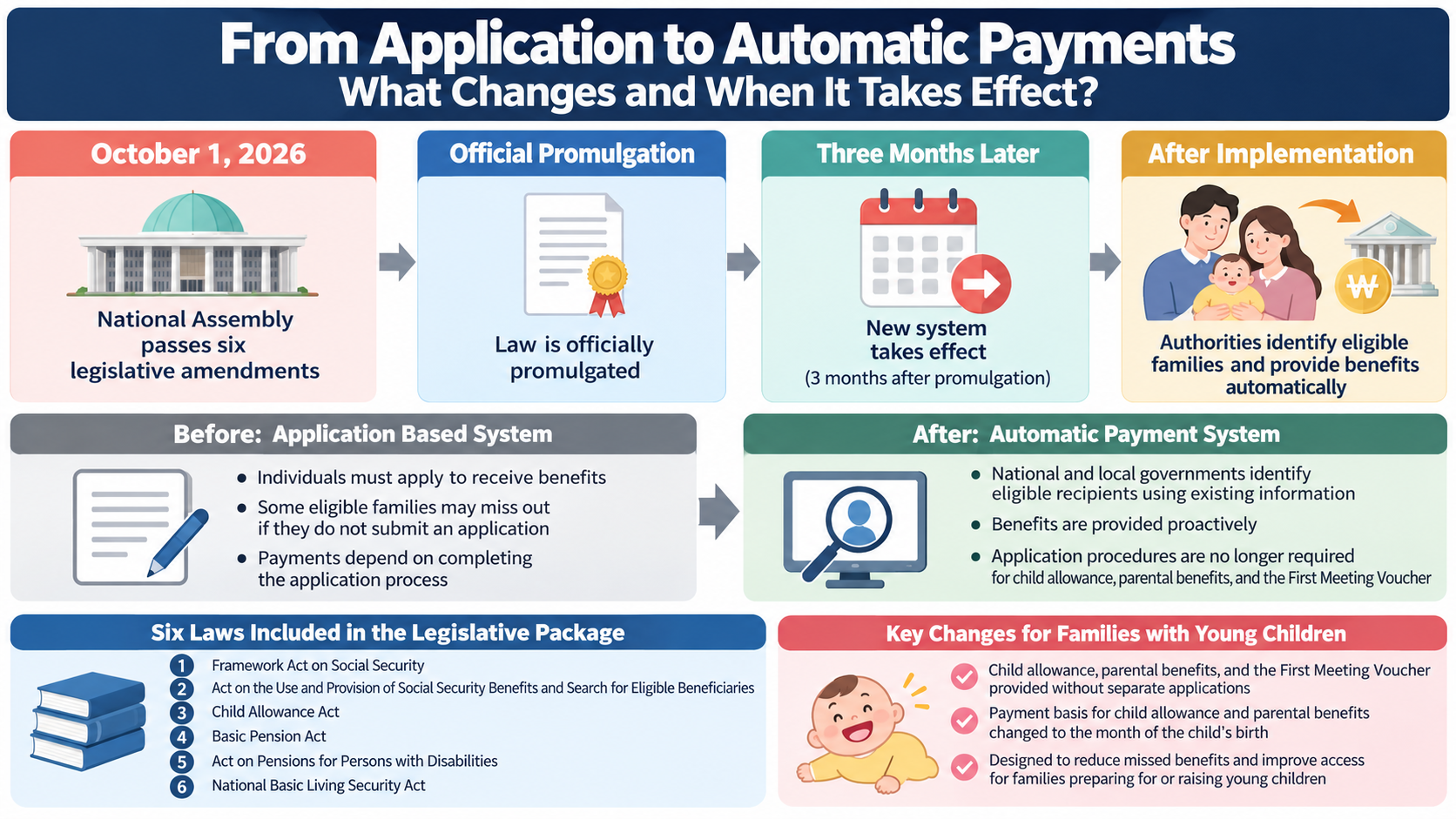
On October 1, 2026, South Korea's National Assembly passed legislative amendments designed to provide child allowance, parental benefits, and the First Meeting Voucher without requiring separate applications. However, parliamentary passage does not mean the new system has taken effect. The amended legislation is scheduled to take effect three months after its official promulgation. Until then, families must follow the existing application procedures.
This distinction is particularly important for expectant parents and caregivers of newborn babies. Hearing that benefits will become automatic and postponing an application could disrupt payments that a family would otherwise be entitled to receive under the existing system.
The central purpose of the amendments goes beyond eliminating application forms. The changes establish a system in which the national and local governments identify eligible recipients and arrange payments. They also revise the payment basis for child allowance and parental benefits to the month of the child's birth.
1. What Legislation Was Passed to Introduce Automatic Child Allowance and Parental Benefits?
On October 1, 2026, the plenary session of South Korea's National Assembly approved a package of six legislative amendments under the Ministry of Health and Welfare, intended to improve the country's application-based social benefit system.
The amendments address the existing principle that individuals must first apply to receive welfare benefits. They establish a legal basis for government authorities to determine eligibility using information already held by the state and provide benefits accordingly.
Under the previous application-based system, people could miss out on benefits even when they qualified, simply because they had not submitted an application.
The amendments seek to change this process by allowing national and local government authorities to identify eligible individuals and provide welfare benefits proactively.
The legislative package passed by the National Assembly concerns six South Korean laws:
Framework Act on Social Security
Act on the Use and Provision of Social Security Benefits and Search for Eligible Beneficiaries
Child Allowance Act
Basic Pension Act
Act on Pensions for Persons with Disabilities
National Basic Living Security Act
Among these amendments, changes to the Child Allowance Act have the most direct implications for families preparing for childbirth or raising young children.
The amendments cover not only child allowance but also the application and payment procedures for parental benefits and the First Meeting Voucher, a South Korean childbirth support benefit.
2. Automatic Payments Do Not Begin on October 1, 2026
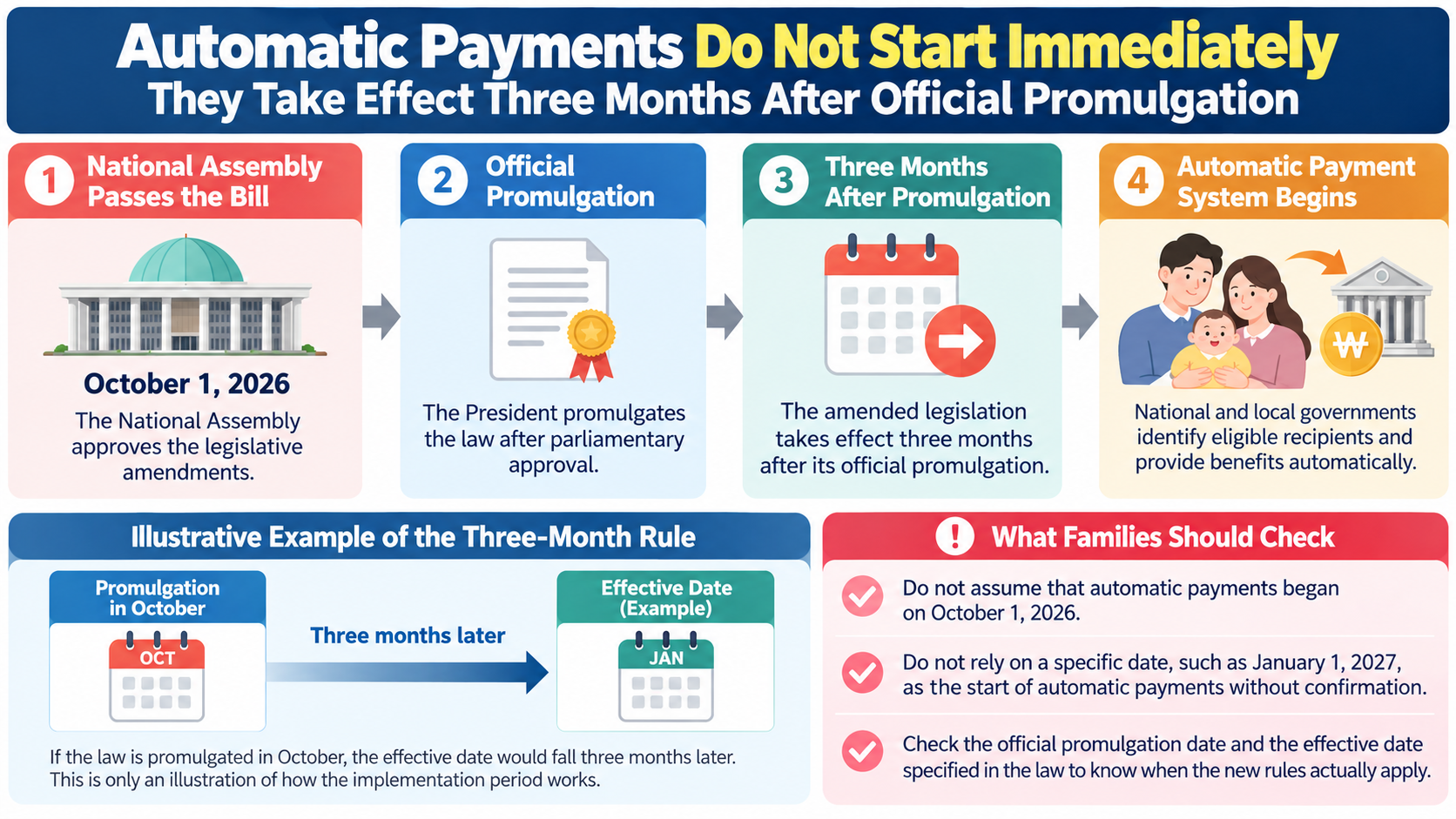
The automatic payment system does not take effect immediately upon passage by the National Assembly. According to the government's announced implementation rule, the amended legislation will take effect three months after its official promulgation.
After legislation passes the National Assembly, it must go through the promulgation process. To determine when the new rules actually apply, families need to check the official promulgation date and the effective date specified in the law, rather than relying on the date of parliamentary approval.
For example, if the legislation were promulgated in October, its effective date would fall three months later. This is only an illustration of how the implementation period works, not a statement of the actual effective date.
Therefore, families should not assume that automatic payments began on October 1, 2026.
It would also be incorrect to identify a specific date, such as January 1, 2027, as the definite start of automatic payments without confirmation. The actual promulgation date and final effective date must be established before the precise implementation date can be determined.
3. How Will Child Allowance, Parental Benefits, and the First Meeting Voucher Change?
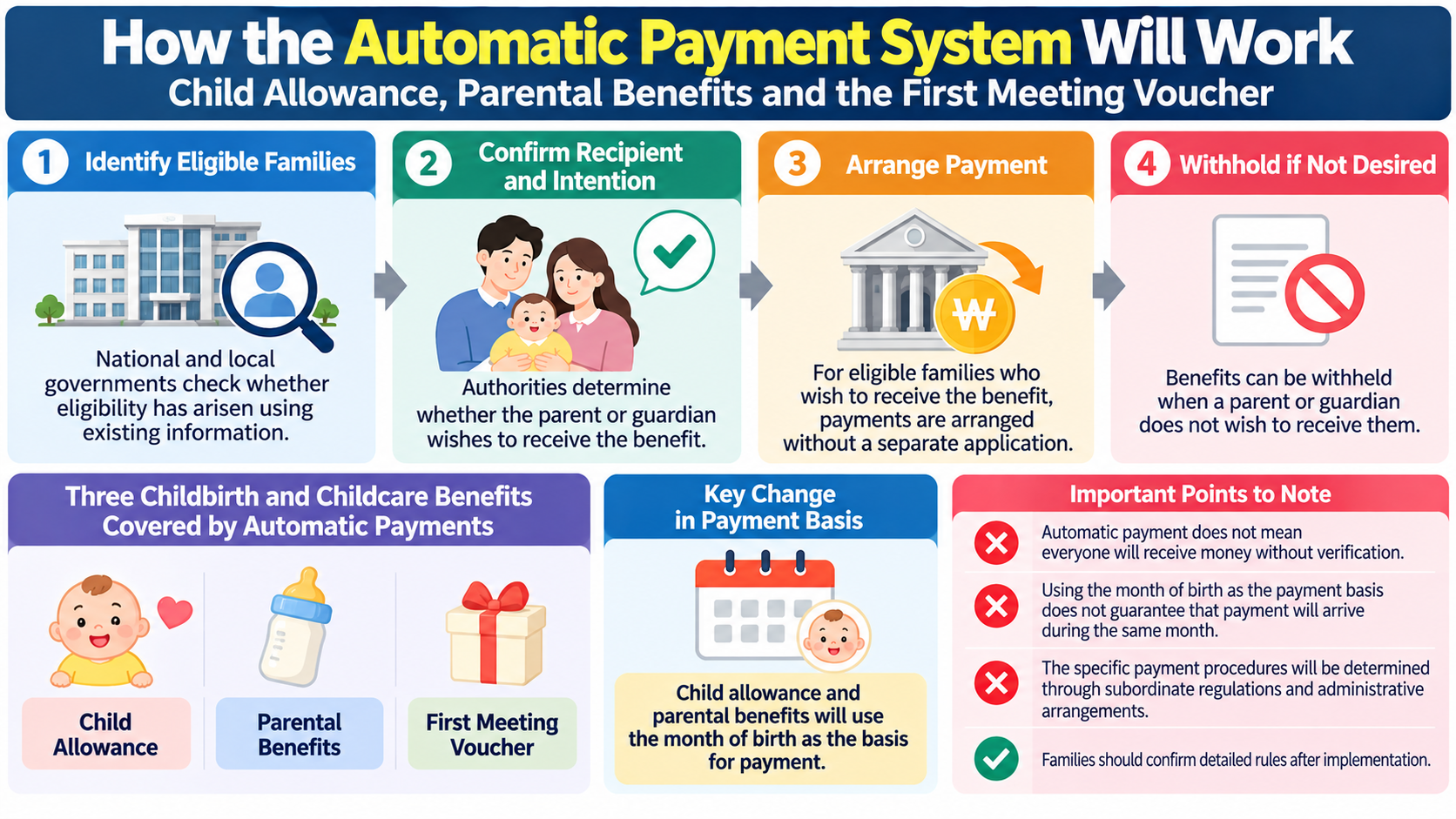
The amendments establish a framework for removing separate applications for three childbirth and childcare benefits. Instead, national and local government authorities will determine whether entitlement to each benefit has arisen and arrange payment accordingly.
One particularly important change is that child allowance and parental benefits will use the month of birth as the basis for payment.
| Benefit or Procedure | Existing System | System After the Amendments |
|---|---|---|
| Child allowance | A parent or guardian applies; payments generally begin from the month of application | Payment without a separate application, based on the month of birth |
| Parental benefits | A parent or guardian applies; payments generally begin from the month of application | Payment without a separate application, based on the month of birth |
| First Meeting Voucher | A parent or guardian applies; payment is governed by discretionary provisions | Separate application procedure abolished; payment becomes mandatory |
| Eligibility verification | Primarily initiated through an application from a parent or guardian | National and local governments verify entitlement and the recipient's intention to receive benefits |
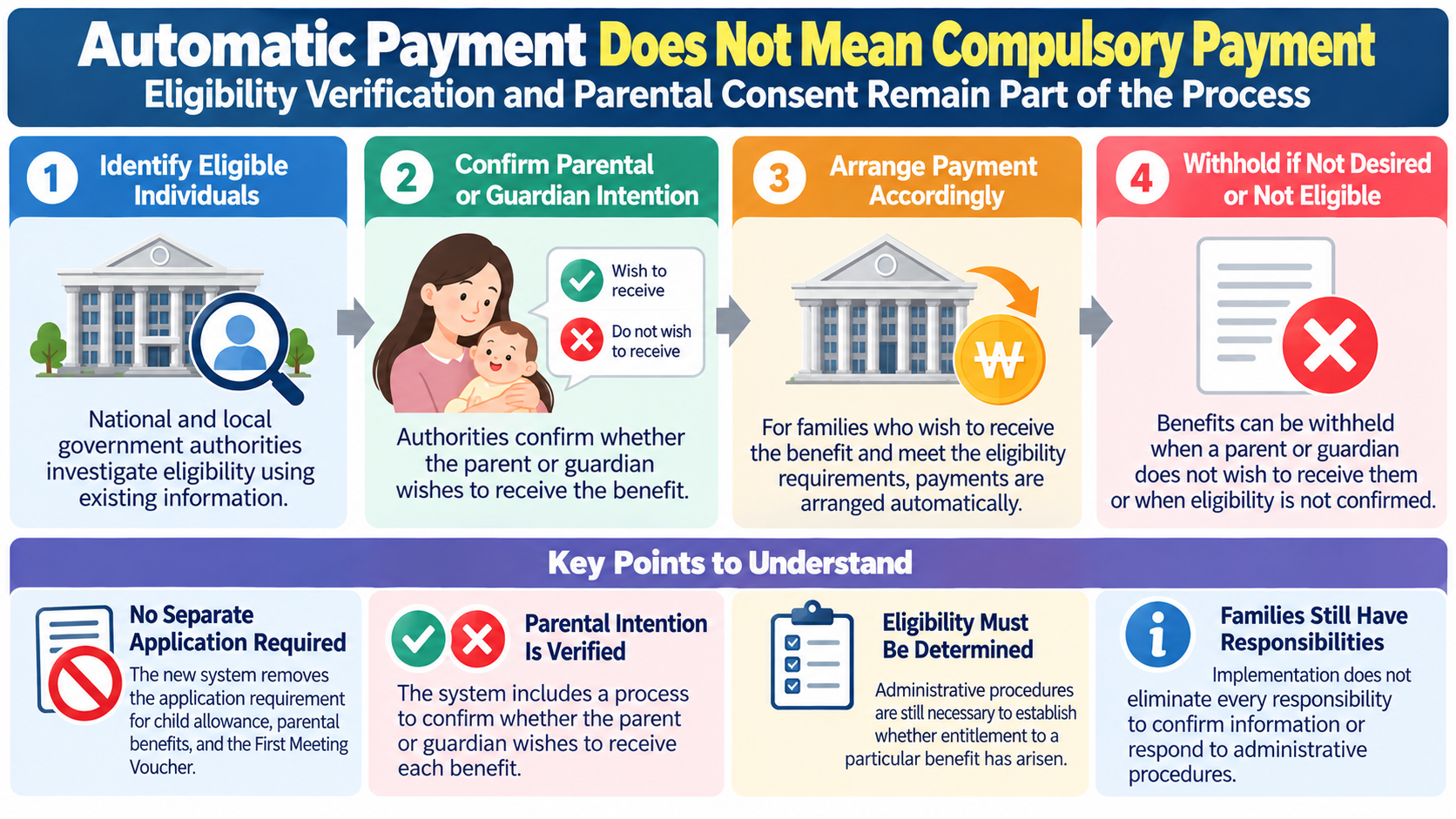
The term automatic payment does not mean that money will be deposited into everyone's account without any verification.
Under the revised system, national and local authorities must establish whether a person is entitled to a benefit and determine whether the parent or guardian wishes to receive it.
The amendments also allow benefits to be withheld when a parent or guardian does not wish to receive them.
Why Is the Child Allowance Payment Basis Changing to the Month of Birth?
Under the existing system, the timing of an application plays an important role in determining benefit payments. The reforms aim to reduce situations in which entitlement to support depends on whether someone has completed an application.
Under the amended rules, child allowance payments will be based on the month in which the child was born.
Parental benefits will likewise move toward payment from the month of birth without a separate application.
However, using the month of birth as the basis for payment is not the same as guaranteeing that every family's payment will actually arrive during that month. The specific payment procedures will need to be determined through subordinate regulations and administrative arrangements introduced alongside implementation.
4. If Your Baby Has Just Been Born, Can You Skip the Application?
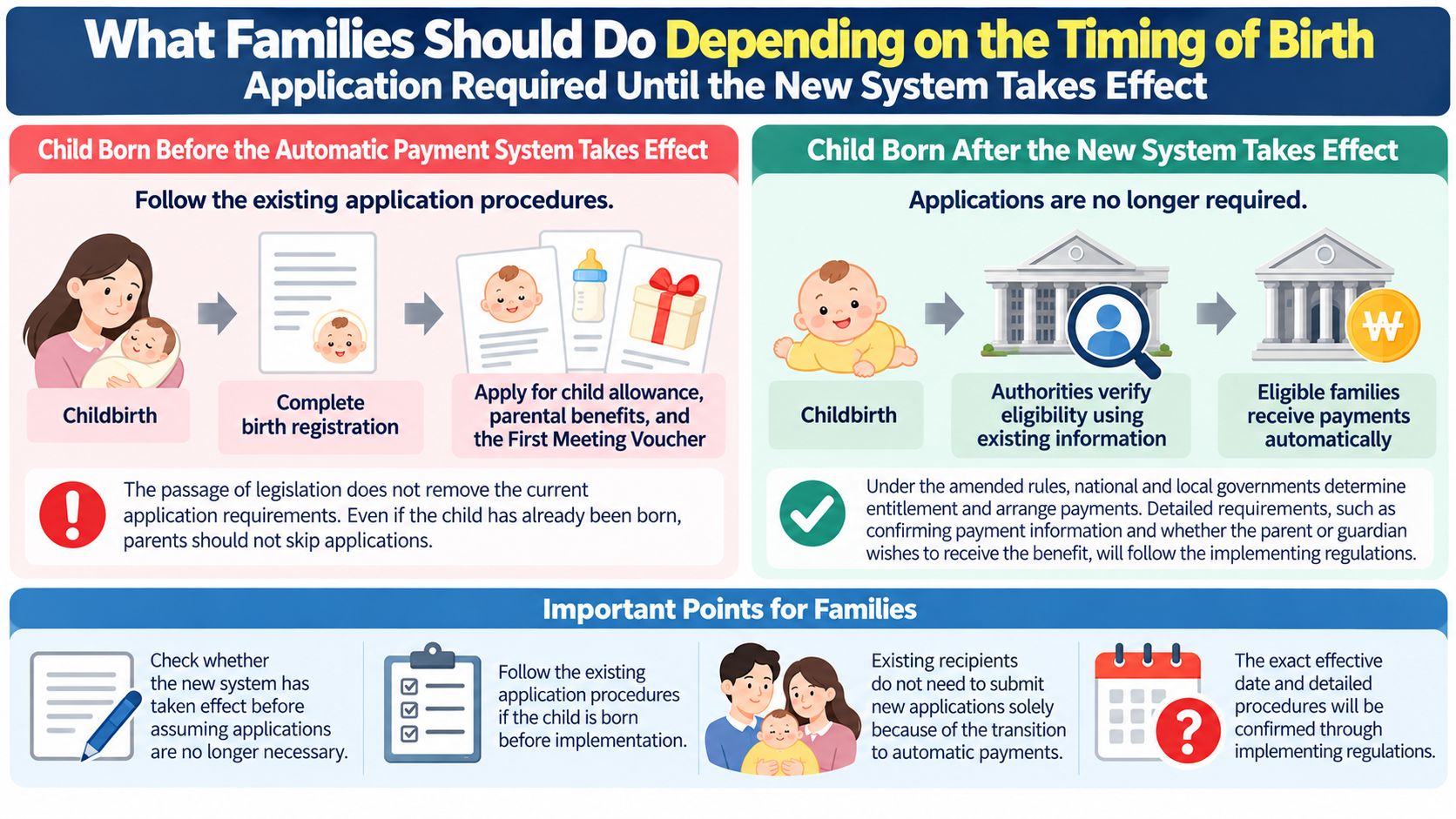
If a child is born before the automatic payment system takes effect, the family must apply for child allowance, parental benefits, and the First Meeting Voucher under the existing procedures.
The passage of legislation alone does not eliminate the current application requirements.
Immediately after childbirth, families often need to complete birth registration and apply for several forms of childcare support.
Rather than assuming applications are no longer necessary because of reports about automatic payments, parents should first establish whether the new system has actually taken effect.
The appropriate approach depends on the family's circumstances.
If the Child Is Born Before Automatic Payments Begin
Follow the existing application procedures. Even if the child has already been born, parents should not skip applications on the assumption that benefits will be paid automatically when the amended system has not yet taken effect.
If the Child Is Born After Automatic Payments Begin
The revised procedures will apply, allowing national and local government authorities to verify entitlement and arrange payments under the amended legislation.
However, the detailed requirements for confirming payment information and determining whether a parent or guardian wishes to receive the benefit must follow the implementing regulations.
If You Are Already Receiving Child Allowance or Parental Benefits
The announcement accompanying these amendments did not establish that existing recipients must submit new applications solely because of the transition to automatic payments.
Families should distinguish between their existing payment status and the question of how the amended system applies to them.
5. Why Must Parents Confirm Their Intentions If Payments Are Automatic?
Even though the application requirement will be removed, the system will still include verification of whether a parent or guardian wishes to receive benefits.
The amendments authorize national and local government authorities to investigate eligibility while allowing them to withhold benefits that a parent or guardian does not want.
Automatic payment therefore does not mean compulsory payment.
Administrative procedures are also necessary to determine whether entitlement to a particular benefit has arisen. The fundamental structure of the new system is to identify eligible recipients using information held by the government.
Consequently, parents should not assume that implementation will eliminate every responsibility to confirm information or respond to administrative procedures.
6. What Should Families Check Before Automatic Payments Begin?
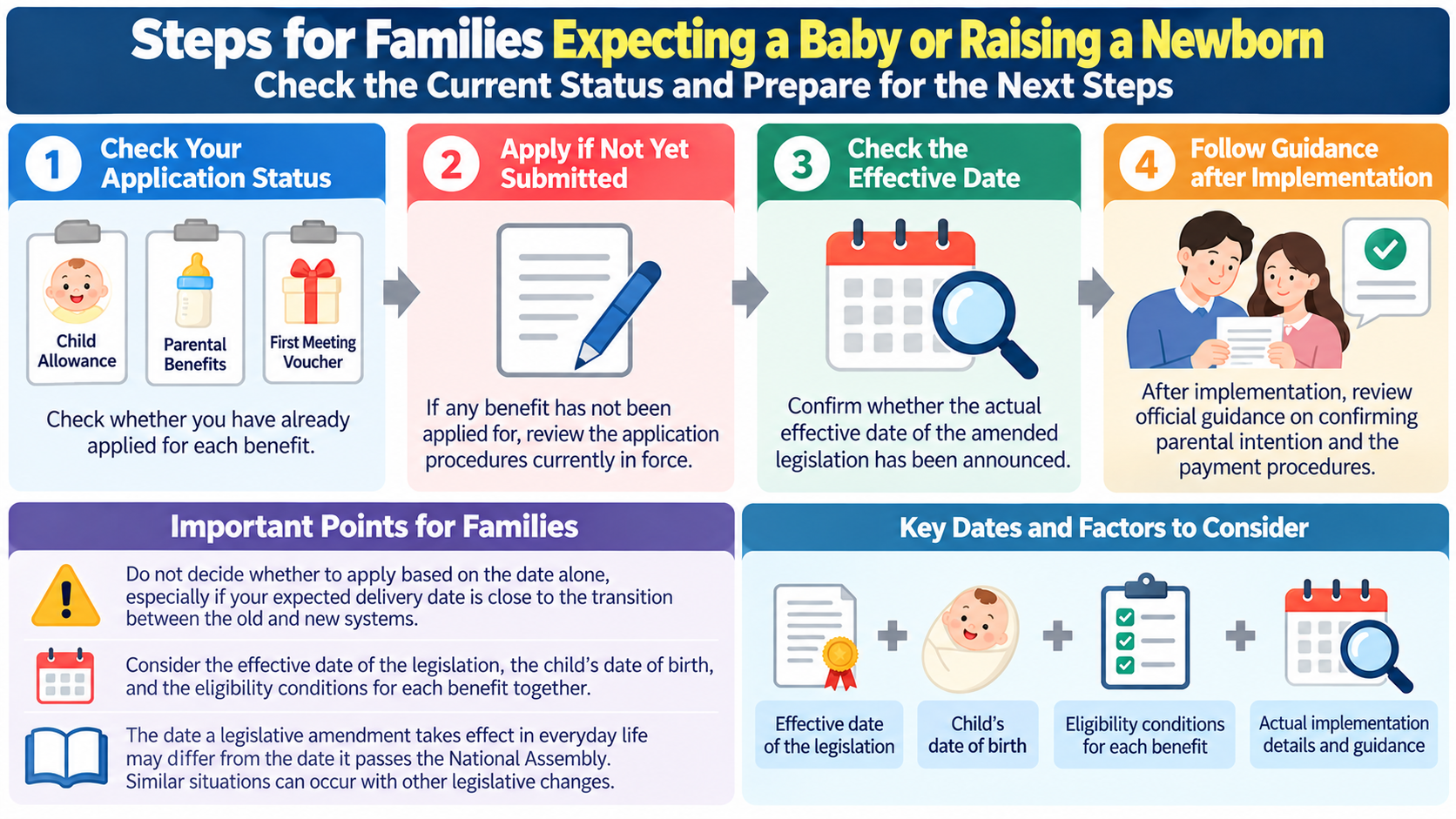
Families expecting a baby or caring for a newborn should prioritize confirming whether the new system has taken effect and checking the status of their existing benefit applications.
The steps are straightforward:
1. Check whether you have applied for child allowance, parental benefits, and the First Meeting Voucher.
2. If any benefit has not been applied for, review the application procedures currently in force.
3. Check whether the actual effective date of the amended legislation has been announced.
4. After implementation, review official guidance concerning confirmation of a parent or guardian's intention to receive benefits and the payment procedures.
Families whose expected delivery date falls close to the transition between the old and new systems should be especially careful not to decide whether to apply based on the date alone.
The effective date of the legislation, the child's date of birth, and the eligibility conditions for each benefit must all be considered together.
The date on which a legislative amendment begins affecting everyday life may differ from the date it passes the National Assembly. Similar situations can arise with other legislative changes.
7. Frequently Asked Questions
Can Parents Stop Applying for Child Allowance Starting in October 2026?
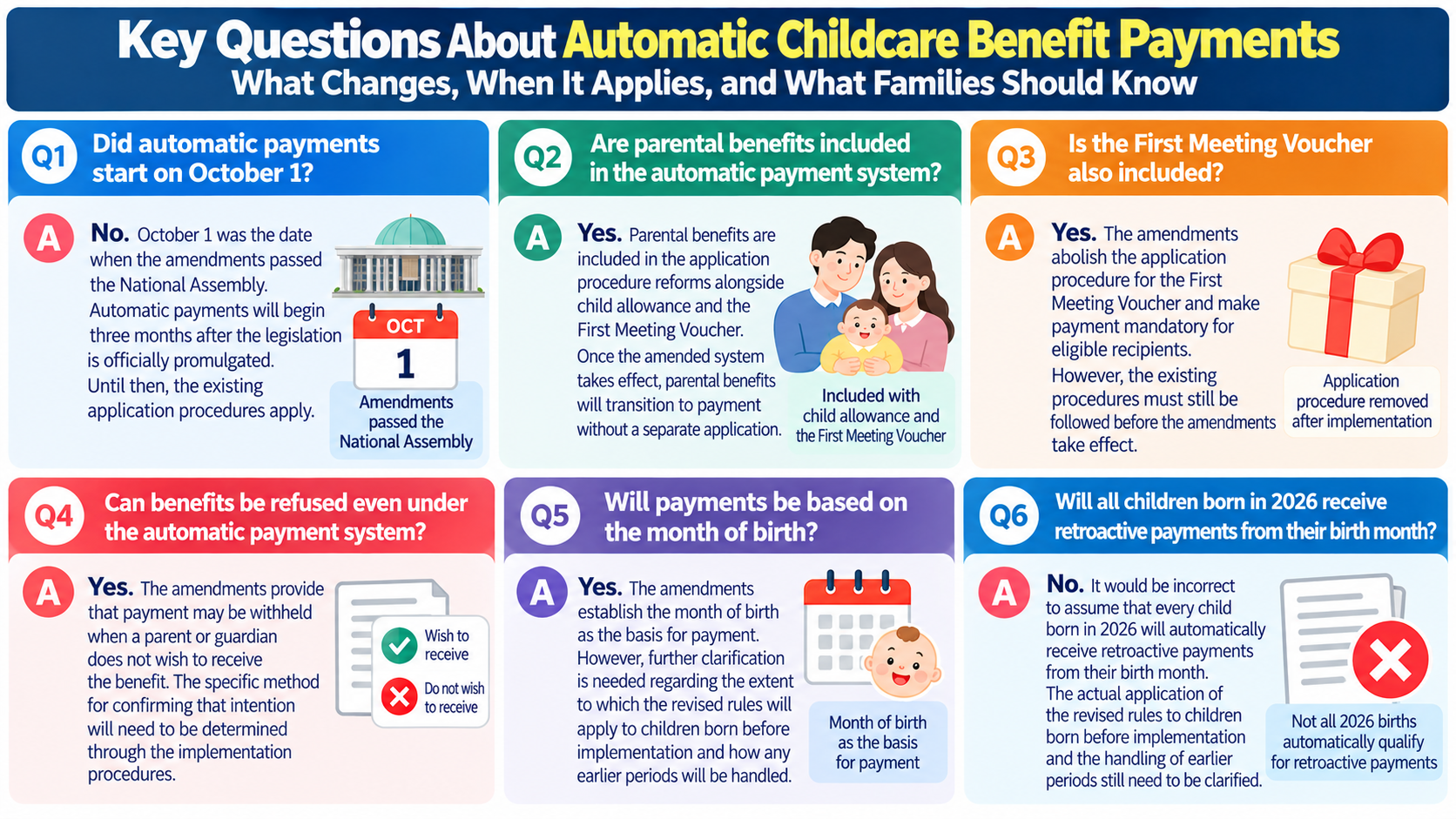
No. October 1 was the date on which the relevant amendments passed South Korea's National Assembly. Automatic payments are scheduled to begin three months after the legislation is officially promulgated. Until the new system takes effect, the existing application procedures continue to apply.
Are Parental Benefits Also Covered by Automatic Payments?
Yes. Parental benefits are included in the application procedure reforms alongside child allowance and the First Meeting Voucher. Once the amended system takes effect, parental benefits will transition to payment without a separate application.
Will Applications for the First Meeting Voucher Also Be Eliminated?
The amendments include provisions abolishing the application procedure for the First Meeting Voucher and making payment mandatory for eligible recipients. However, the existing procedures must still be followed before the amendments take effect.
What Happens If a Parent Does Not Want to Receive an Automatically Paid Benefit?
The amendments provide that payment may be withheld when a parent or guardian does not wish to receive the benefit. The specific method for confirming that intention will need to be determined through the implementation procedures.
Will Children Born in 2026 Receive Retroactive Payments Starting From Their Birth Month?
The amendments establish the month of birth as the basis for payment. However, further clarification is needed regarding the extent to which the revised rules will apply to children born before implementation and how any earlier periods will be handled.
It would therefore be incorrect to assume that every child born in 2026 will automatically receive retroactive payments from their birth month.
8. Even After the Law Changes, Families Must Confirm Their Actual Payment Status
The reforms to South Korea's application-based welfare system will change how child allowance, parental benefits, and the First Meeting Voucher are administered. Instead of requiring parents and guardians to initiate every application, the government will take responsibility for identifying eligible recipients.
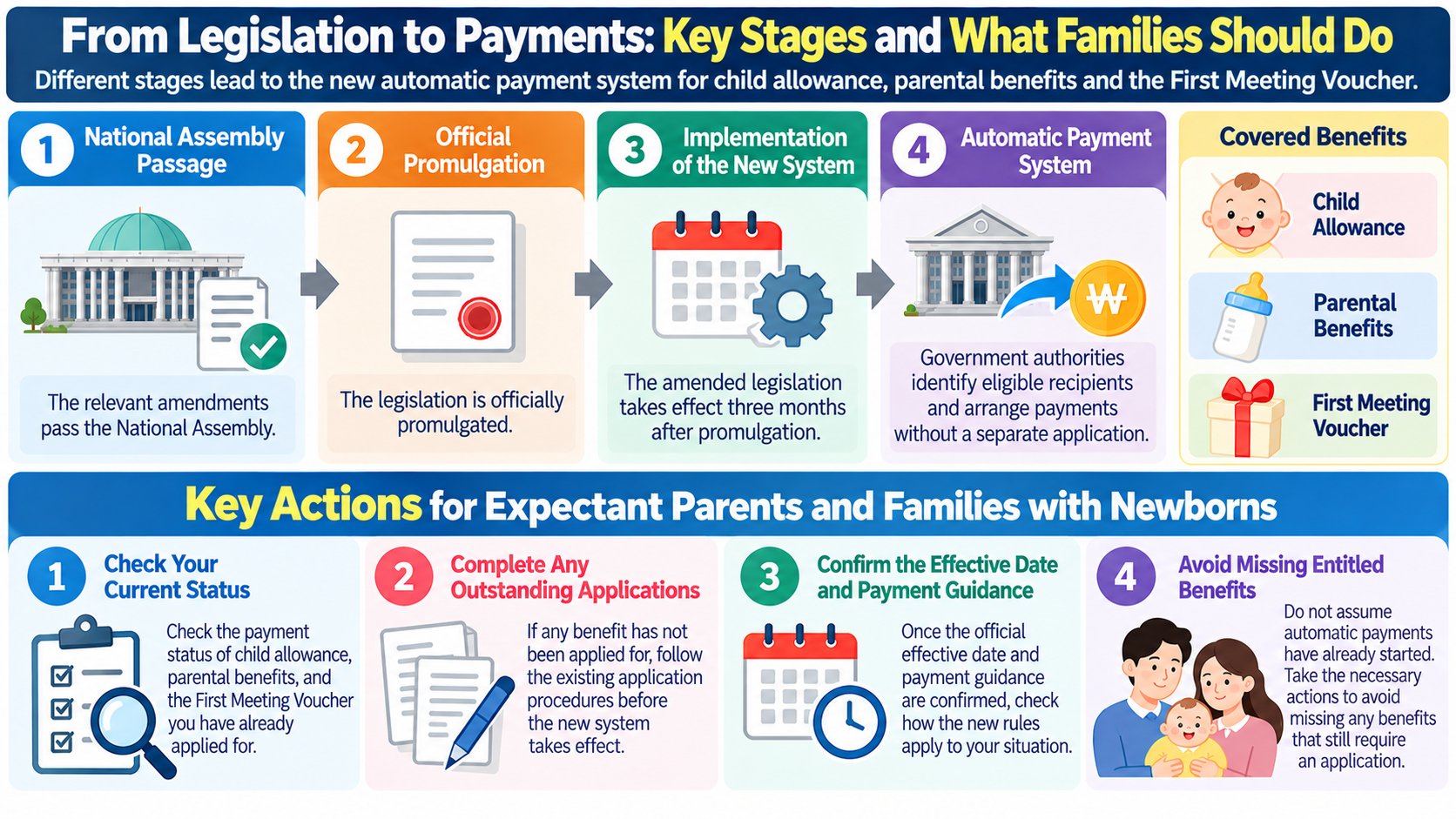
However, passage by the National Assembly, official promulgation, implementation of the new system, and actual payment of benefits are separate stages.
For expectant parents and caregivers of newborns, the most important priority is to avoid missing any benefits that still require an application before the amended system takes effect.
Families should check the payment status of benefits they have already applied for and complete any outstanding applications under the existing procedures. Once the effective date and payment guidance for the amended legislation are confirmed, they can determine how the new rules apply to their circumstances.