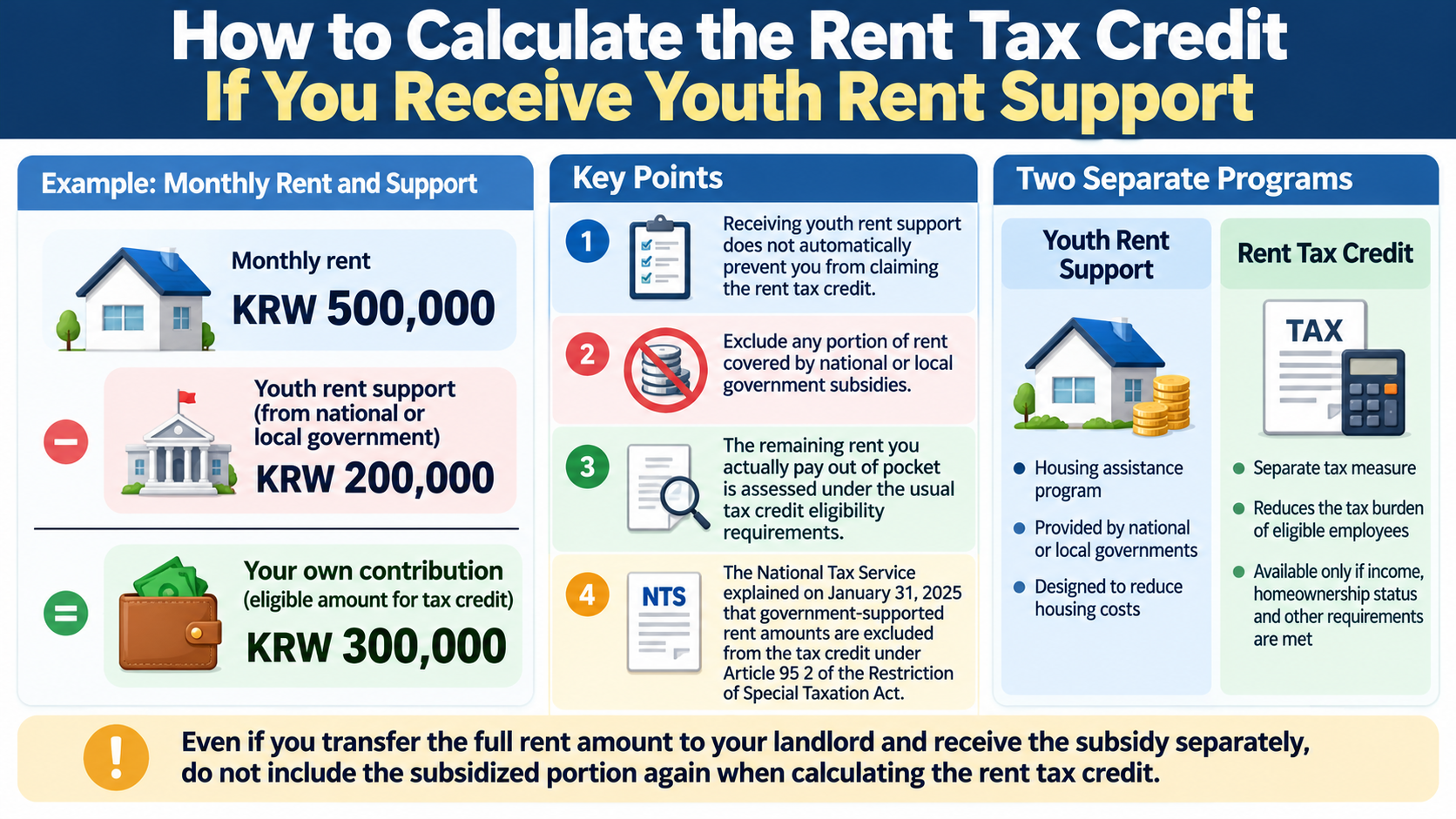
Receiving youth rent support does not automatically prevent you from claiming South Korea's rent tax credit through the year-end tax settlement process. However, any portion of rent covered by national or local government subsidies must be excluded from the eligible amount. For 2026, the rent tax credit is available only to taxpayers who meet requirements concerning income, homeownership status, and other conditions. The annual limit on qualifying rent expenses is KRW 10 million.
For example, if monthly rent is KRW 500,000 and government support covers KRW 200,000, the starting point for calculating the tax credit is not KRW 500,000 but the tenant's own contribution of KRW 300,000.
Even if you transfer the full rent amount to your landlord and receive the subsidy separately, you must not include the subsidized portion again when calculating the tax credit.
Can You Claim the Rent Tax Credit While Receiving Youth Rent Support?
Receiving youth rent support does not, by itself, eliminate your eligibility for the rent tax credit. The amount covered by the subsidy must be excluded, while the remaining rent paid out of pocket is assessed under the ordinary tax credit eligibility requirements.
In a written tax inquiry response issued on January 31, 2025, South Korea's National Tax Service (NTS) explained that rent amounts supported by the national government or local governments are excluded from the tax credit under Article 95-2 of the Restriction of Special Taxation Act.
The inquiry included a case involving a person who received KRW 200,000 per month through a local government's youth rent support program.
The important question is not simply whether someone can benefit from both programs. It is whether the same rent expense is being counted twice, once through government support and again through a tax credit.
Youth rent support is a housing assistance program designed to reduce housing costs. The rent tax credit is a separate tax measure that reduces the tax burden of employees who satisfy specified conditions.
Therefore, it is necessary to distinguish the amount covered by government assistance from the amount actually borne by the employee.
Example: KRW 500,000 Monthly Rent With KRW 200,000 in Government Support
If your monthly rent is KRW 500,000 and you receive KRW 200,000 in monthly support, your personal contribution is KRW 300,000 per month. Assuming these conditions remain unchanged for 12 months and all rent payments during that period satisfy the tax credit requirements, the annual qualifying rent amount is KRW 3.6 million.
The calculation is as follows.
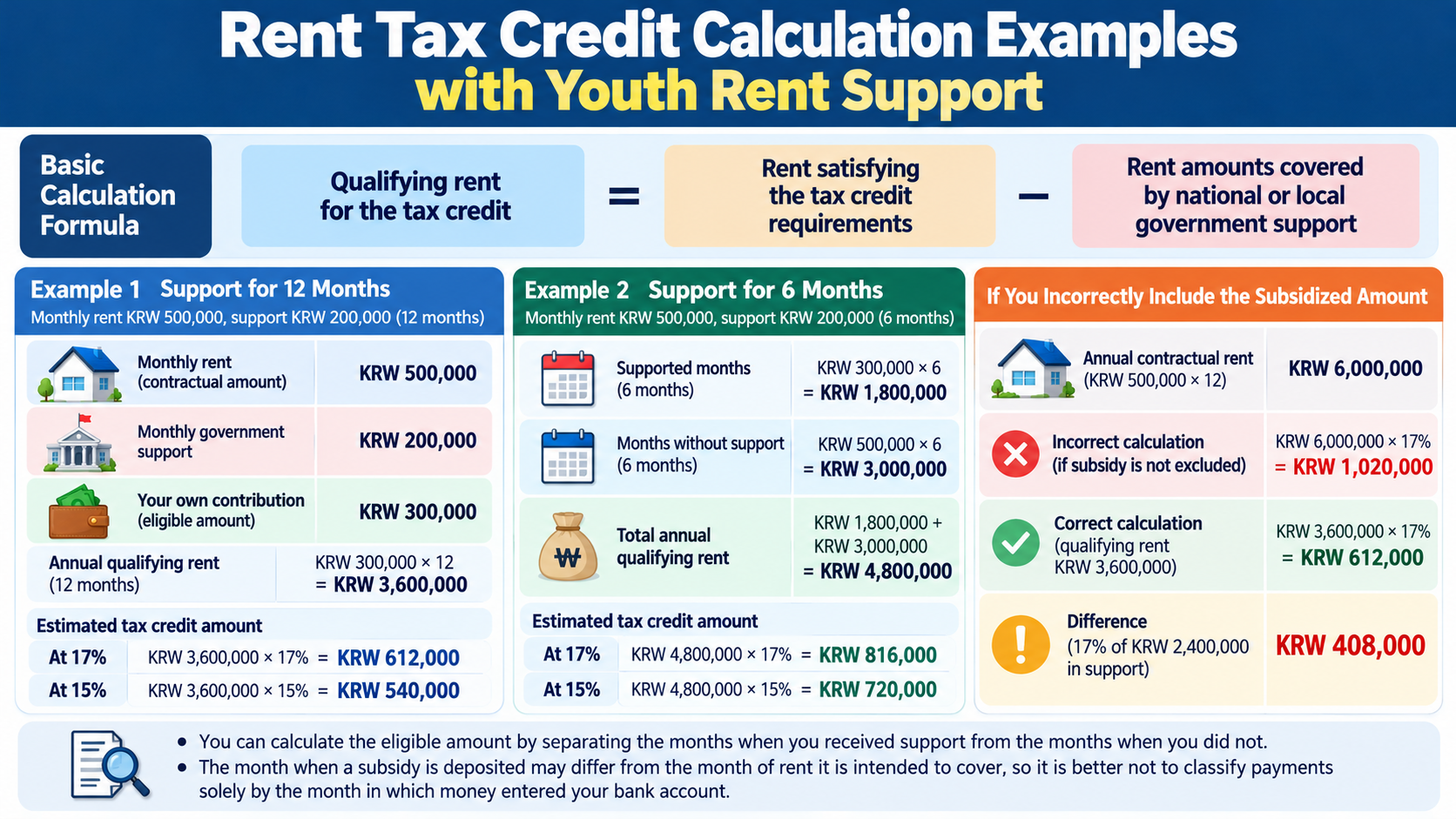
Qualifying rent for the tax credit = Rent satisfying the tax credit requirements − Rent amounts covered by national or local government support
The following is an illustrative calculation based on paying KRW 500,000 in monthly rent for 12 months while receiving KRW 200,000 in monthly government support.
| Category | Monthly Amount | Annual Amount |
|---|---|---|
| Contractual rent | KRW 500,000 | KRW 6,000,000 |
| National or local government support | KRW 200,000 | KRW 2,400,000 |
| Rent paid out of pocket | KRW 300,000 | KRW 3,600,000 |
Applying the relevant tax credit rates gives the following results.
Eligible for the 17% rate: KRW 3,600,000 × 17% = KRW 612,000
Eligible for the 15% rate: KRW 3,600,000 × 15% = KRW 540,000
If you incorrectly applied the 17% rate to the full contractual annual rent of KRW 6 million without deducting government support, the calculated credit would be KRW 1,020,000.
However, if the actual qualifying rent is KRW 3.6 million, the calculated credit at 17% is KRW 612,000. The difference between the two calculations is KRW 408,000.
That difference equals 17% of the KRW 2.4 million in government support.
These figures represent the qualifying rent amount multiplied by the statutory tax credit rate. The actual refund received through year-end tax settlement may differ depending on the employee's calculated tax liability and other applicable deductions or tax credits.
What If You Received Rent Support for Only Part of the Year?
You can calculate the eligible amount by separating the months when you received support from the months when you did not.
For example, assume you paid KRW 500,000 in monthly rent for 12 months but received KRW 200,000 in monthly support for only six months.
Rent paid out of pocket during the six supported months: KRW 300,000 × 6 = KRW 1,800,000
Rent during the six months without support: KRW 500,000 × 6 = KRW 3,000,000
Total annual qualifying rent: KRW 4,800,000
Under this illustrative calculation, the tax credit would be KRW 816,000 at the 17% rate or KRW 720,000 at the 15% rate.
When filing your taxes, you should compare the periods covered by your rent payments with the periods covered by government support. Because the month when a subsidy is deposited may differ from the month of rent it is intended to cover, it is better not to classify payments solely by the month in which money entered your bank account.
Who Qualifies for South Korea's 2026 Rent Tax Credit, and What Are the Rates?
Even if you have rent expenses remaining after excluding government support, you must satisfy the requirements concerning employment income, homeownership status, and the rented property to claim the tax credit.
The main eligibility requirements explained by South Korea's National Tax Service are outlined below.
Tax Credit Rates by Employment Income
| Employee's Annual Gross Salary | Tax Credit Rate |
|---|---|
| KRW 55 million or less | 17% |
| More than KRW 55 million and up to KRW 80 million | 15% |
| More than KRW 80 million | Not eligible |
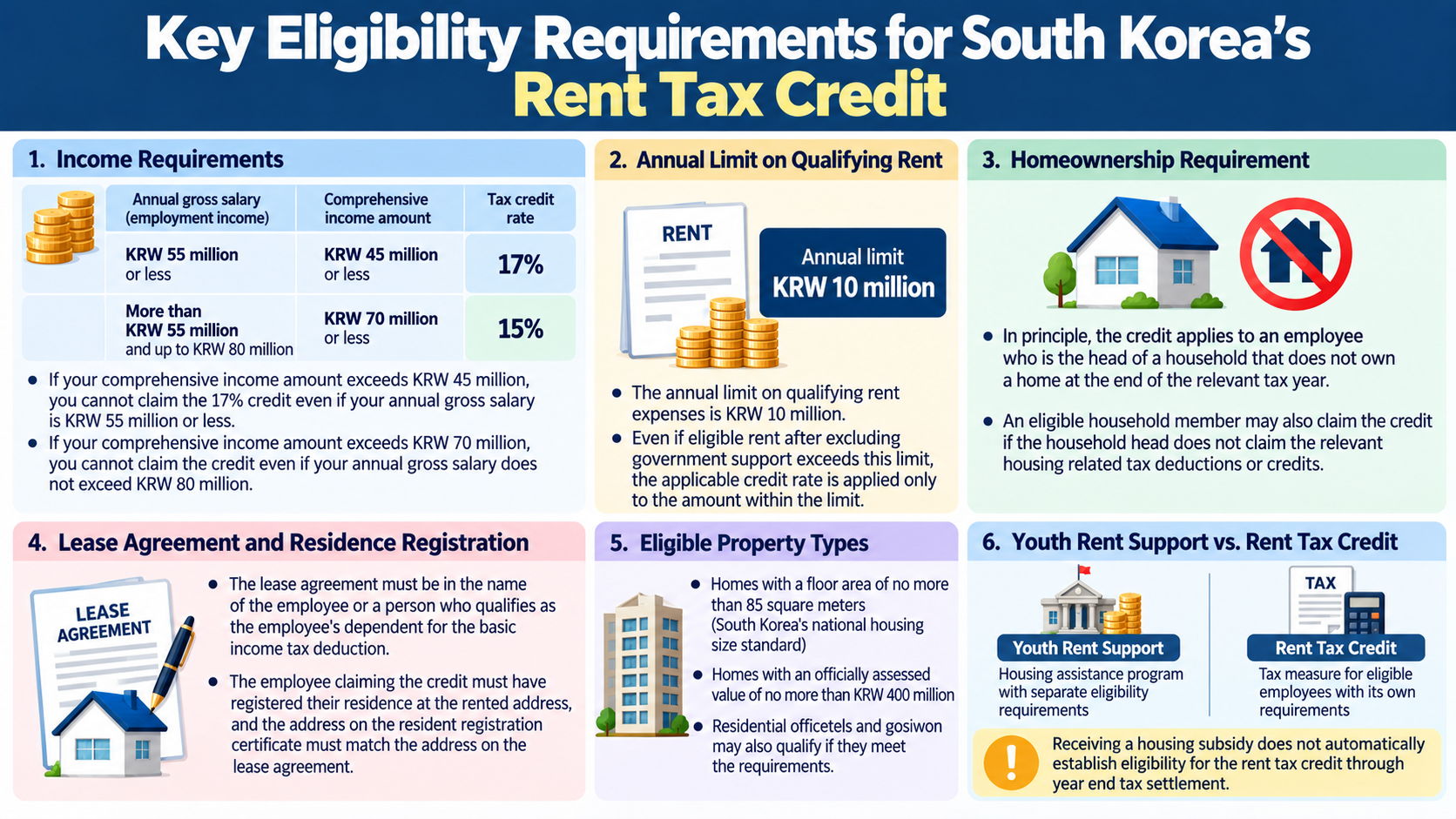
Even if an employee's annual gross salary is KRW 55 million or less, the employee is excluded from the 17% credit category if their comprehensive income amount exceeds KRW 45 million.
Employees whose annual gross salary does not exceed KRW 80 million also cannot claim the rent tax credit if their comprehensive income amount exceeds KRW 70 million.
The annual limit on qualifying rent expenses is KRW 10 million. Even if eligible rent after excluding government support exceeds this limit, the applicable credit rate is applied only to the amount within the limit.
Homeownership and Rental Property Requirements
In principle, South Korea's rent tax credit applies to an employee who is the head of a household that does not own a home at the end of the relevant tax year.
An eligible household member may also claim the credit if the household head does not claim the relevant housing-related tax deductions or credits.
The lease agreement must be in the name of the employee or a person who qualifies as the employee's dependent for the basic income tax deduction. The employee claiming the credit must have registered their residence at the rented address, and the address on the resident registration certificate must match the address on the lease agreement.
Eligible properties generally include homes with a floor area of no more than 85 square meters, corresponding to South Korea's national housing size standard, or homes with an officially assessed value of no more than KRW 400 million. Residential officetels, a Korean property type combining office and residential uses, and gosiwon, a type of small-room accommodation in South Korea, may also qualify if they meet the applicable requirements.
The eligibility requirements for youth rent support programs are different from those for the rent tax credit. Receiving a housing subsidy does not automatically establish eligibility for a tax credit through year-end tax settlement.
Can You Report the Full Rent Amount If the Subsidy Was Deposited Into Your Bank Account?
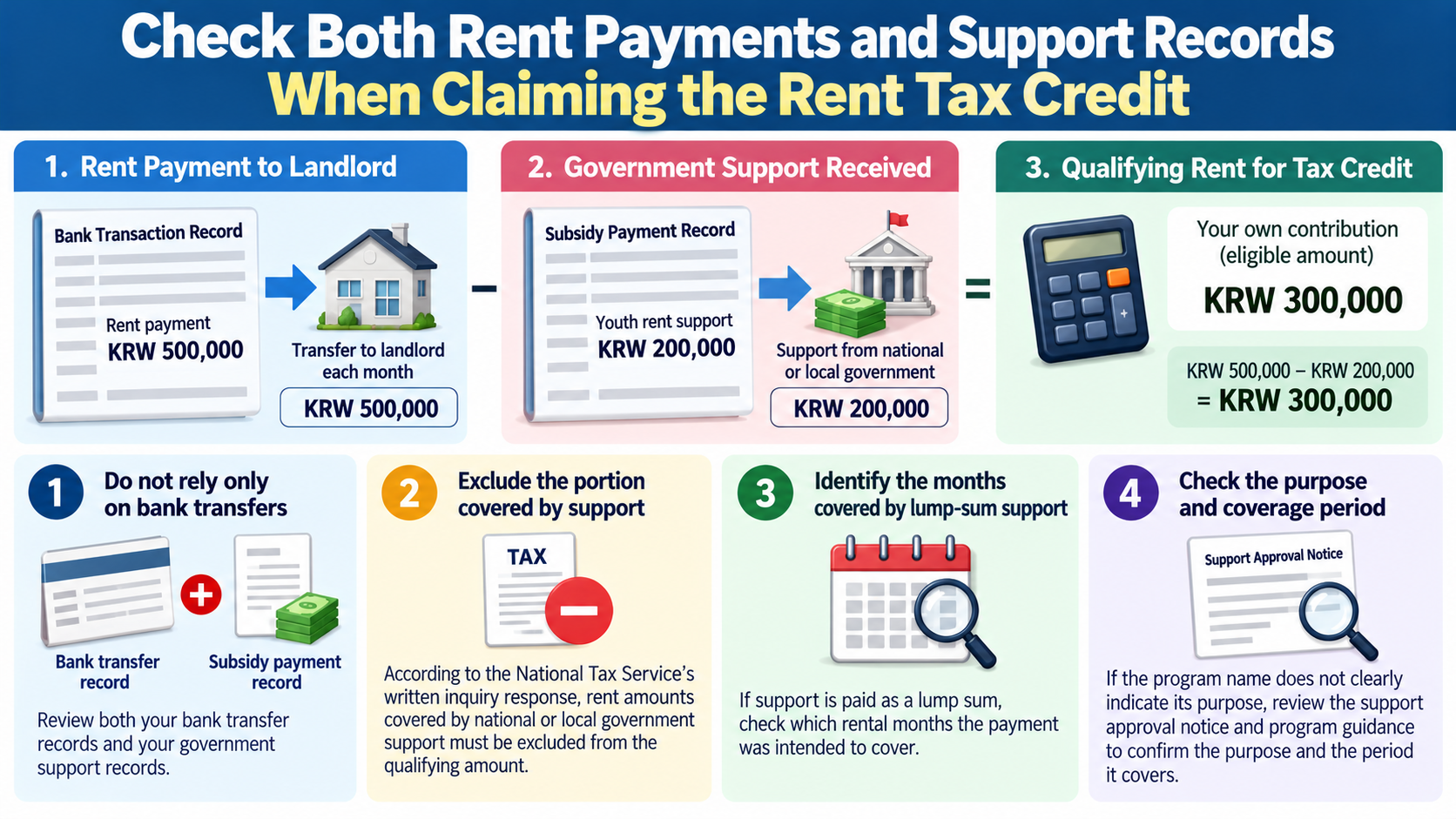
The fact that you transferred the full rent amount from your own bank account does not necessarily mean that the entire payment qualifies for the tax credit.
For example, suppose you transfer KRW 500,000 to your landlord each month and subsequently receive KRW 200,000 in support from a local government. Your bank transaction records will show a rent payment of KRW 500,000.
However, according to the National Tax Service's written inquiry response, the portion of rent covered by national or local government support must be excluded from the qualifying amount.
You should therefore review both your bank transfer records and your subsidy payment records.
If you add up only the amounts transferred to your landlord without accounting for the support received, you could report a higher qualifying rent amount than the amount actually eligible for the credit.
This is particularly important if your support payments were made as a lump sum. You should identify which rental months the payment was intended to cover.
If the name of a subsidy program does not clearly indicate its purpose, review the support approval notice and program guidance to determine the purpose of the payment and the period it covers.
What Documents Do You Need for Year-End Tax Settlement?
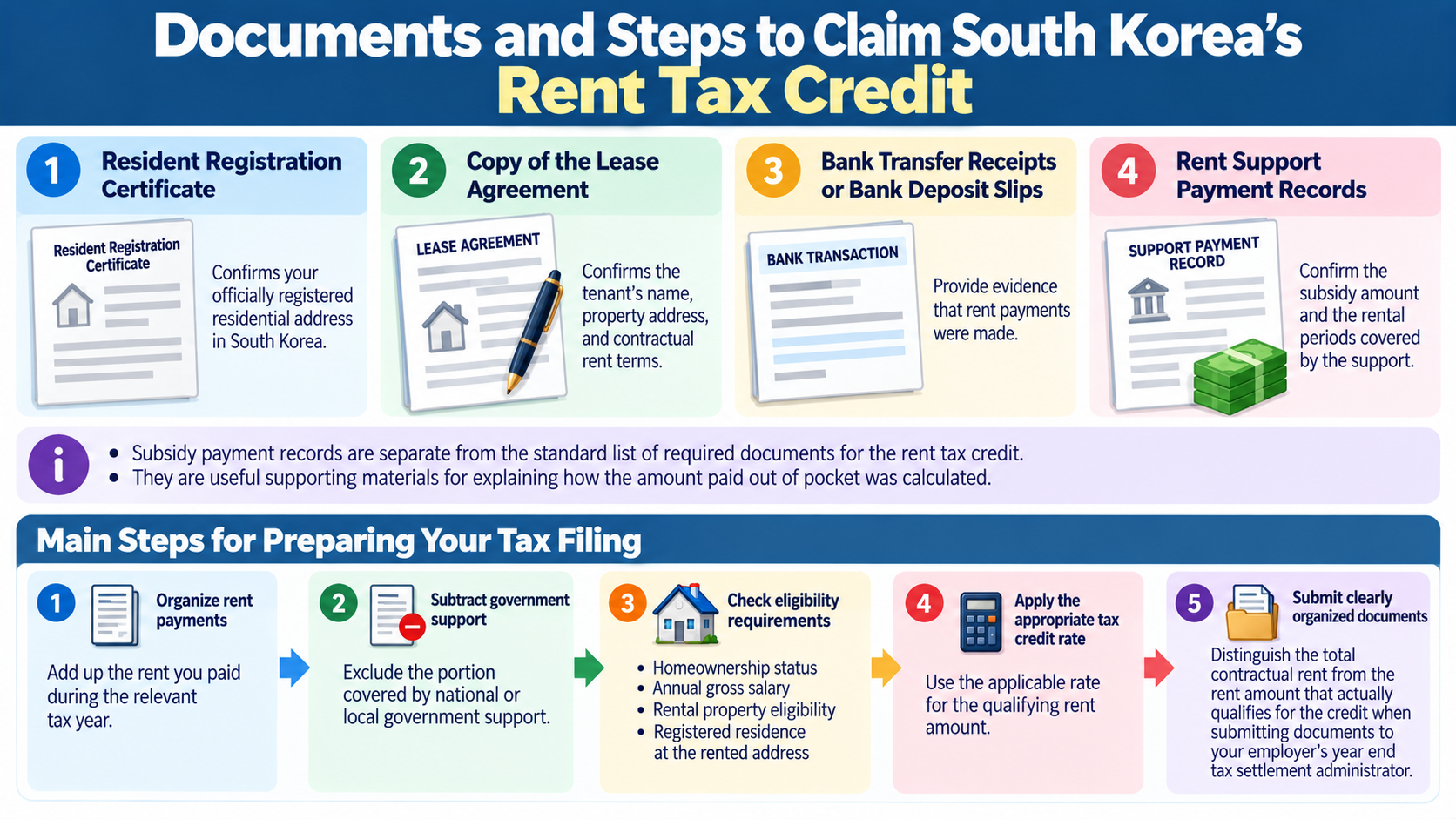
To claim the rent tax credit in South Korea, you need a lease agreement, a resident registration certificate, and proof of rent payments. If you received youth rent support, it is also advisable to prepare records of the subsidy payments so you can distinguish the qualifying rent amount from the subsidized portion.
The basic documents to prepare are as follows.
1. Resident registration certificate: Confirms your officially registered residential address in South Korea.
2. Copy of the lease agreement: Confirms the tenant's name, property address, and contractual rent terms.
3. Bank transfer receipts or bank deposit slips: Provide evidence that rent payments were made.
4. Rent support payment records: Confirm the subsidy amount and the rental periods covered by the support.
Subsidy payment records are separate from the standard list of required documents for the rent tax credit. They are useful supporting materials for explaining how the amount paid out of pocket was calculated.
When preparing your tax filing, first organize the rent paid during the relevant tax year and then subtract the portion covered by national or local government support.
Next, confirm your homeownership status, annual gross salary, rental property eligibility, and registered residence requirements before applying the appropriate tax credit rate.
When submitting documents to your employer's year-end tax settlement administrator, it is clearer to distinguish the total contractual rent from the rent amount that actually qualifies for the credit.
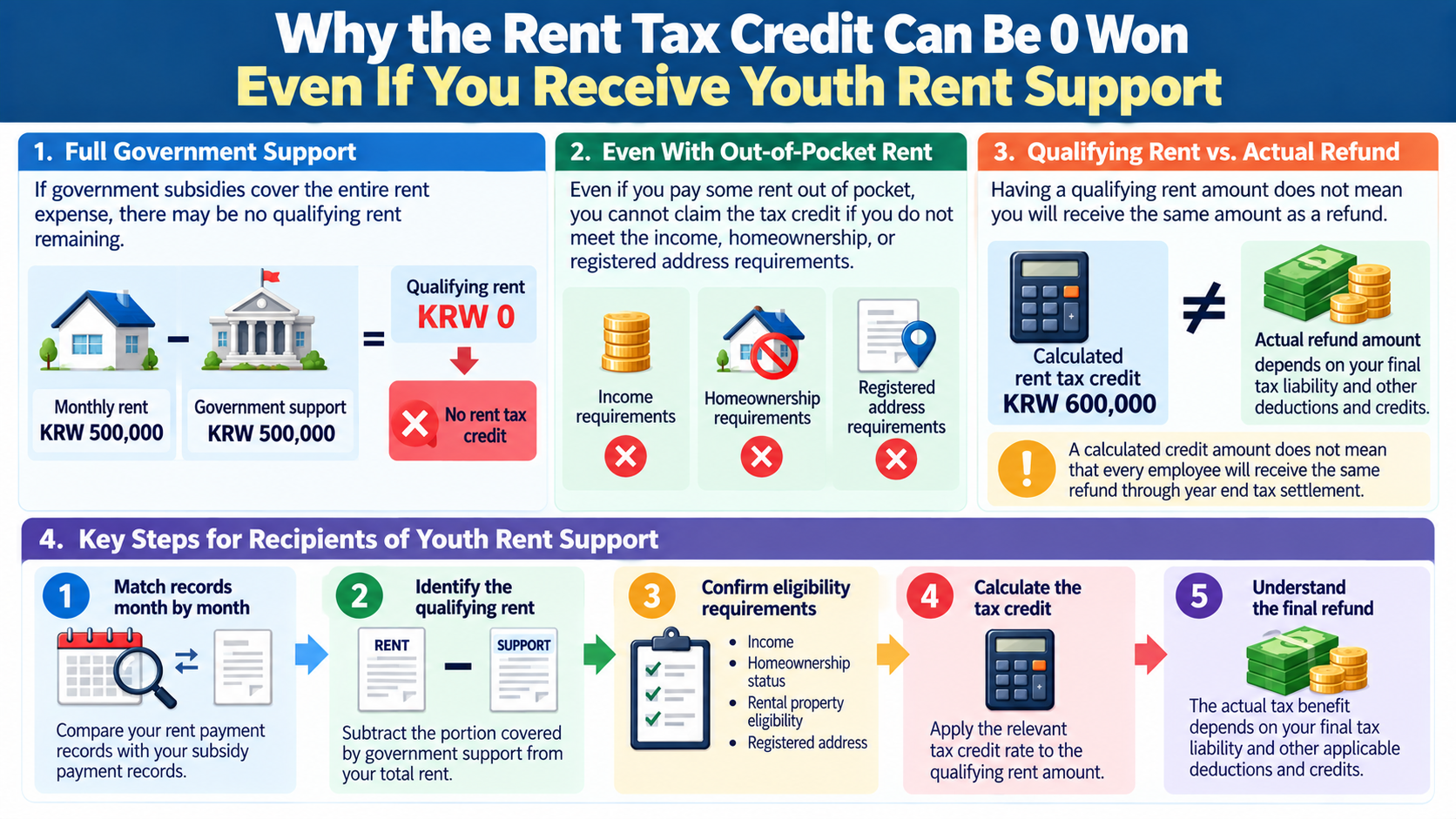
Can Your Rent Tax Credit Be Zero Even If You Receive Youth Rent Support?
Yes. If national or local government subsidies cover your entire rent expense, there may be no qualifying rent remaining after the subsidized amount is excluded.
Conversely, even if you pay some rent out of pocket, you cannot claim the tax credit if you fail to satisfy the income, homeownership, or registered address requirements.
It is also important to distinguish between having qualifying rent expenses and actually receiving a tax refund.
For example, a calculated rent tax credit of KRW 600,000 does not mean that every employee will receive an additional KRW 600,000 refund through year-end tax settlement. The actual tax benefit depends on other deductions and credits already applied and the employee's final tax liability.
Ultimately, for recipients of youth rent support in South Korea, the most important first step in year-end tax settlement is to identify the qualifying rent remaining after government support has been excluded, rather than relying on the total rent stated in the lease agreement.
By matching rent payment records with subsidy payment records month by month, you can avoid overstating your eligible expenses and calculate the tax credit you may be entitled to claim.