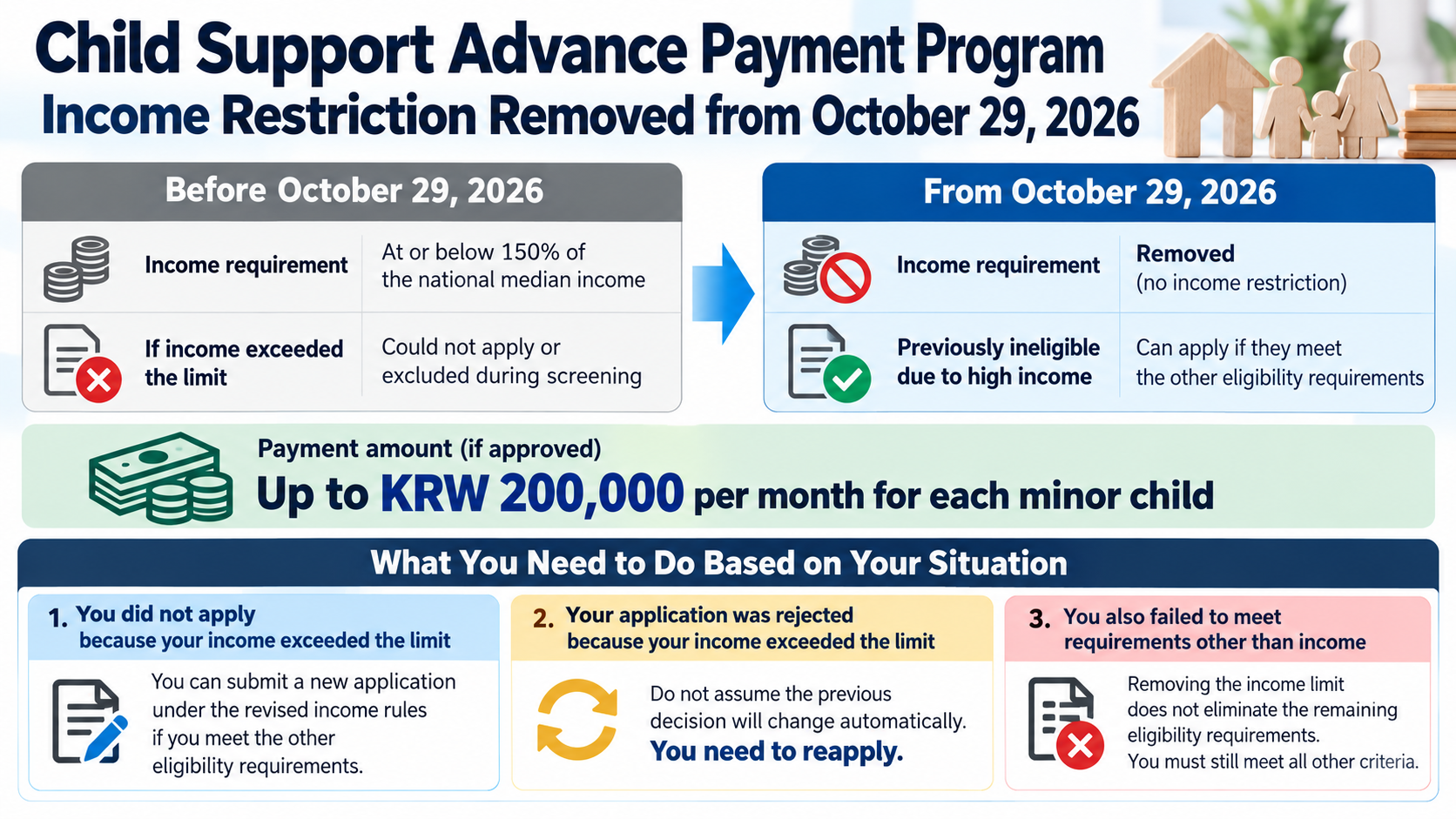
South Korea's Child Support Advance Payment Program will eliminate its income restriction starting October 29, 2026. Single parents who were previously ineligible because their income exceeded 150% of the national median income will be able to apply under the revised rules. However, removing the income threshold does not mean automatic payments. Applicants must still meet the remaining requirements, including having a legally enforceable child support claim and satisfying the nonpayment criteria.
If your application was previously rejected because your income was too high, you should prepare to reapply through South Korea's Child Support Agency. A previous application record does not automatically convert into an approved payment entitlement.
If approved, an eligible family can receive up to KRW 200,000 per month for each minor child.
Do You Need to Reapply If You Were Previously Rejected for Exceeding the Income Limit?
If the previous income requirement prevented you from receiving support, you can submit a new application under the revised eligibility rules. Expanding eligibility by removing the income threshold is not the same as automatically approving previously rejected applicants.
Until now, South Korea's Child Support Advance Payment Program has required applicants to have an income at or below 150% of the national median income.
This restriction will be removed starting October 29, 2026.
As a result, single parents who hold child support claims but previously could not apply or were excluded during screening because their income was too high may apply if they satisfy the other eligibility requirements.
What you need to do depends on your circumstances.
You did not apply because your income exceeded the limit: You can submit a new application under the revised income rules.
Your application was rejected because your income exceeded the limit: Do not assume the previous decision will change automatically. You need to reapply.
You also failed to meet requirements other than income: Removing the income limit does not eliminate the remaining eligibility requirements.
You have already applied and are awaiting a decision: Contact the Child Support Agency to determine whether your existing application can proceed or whether additional procedures are required under the revised rules.
It is particularly important to distinguish between applications rejected solely because of income and those that also had problems involving the legal child support claim or the nonpayment requirements.
What Changes on October 29, and What Requirements Remain?
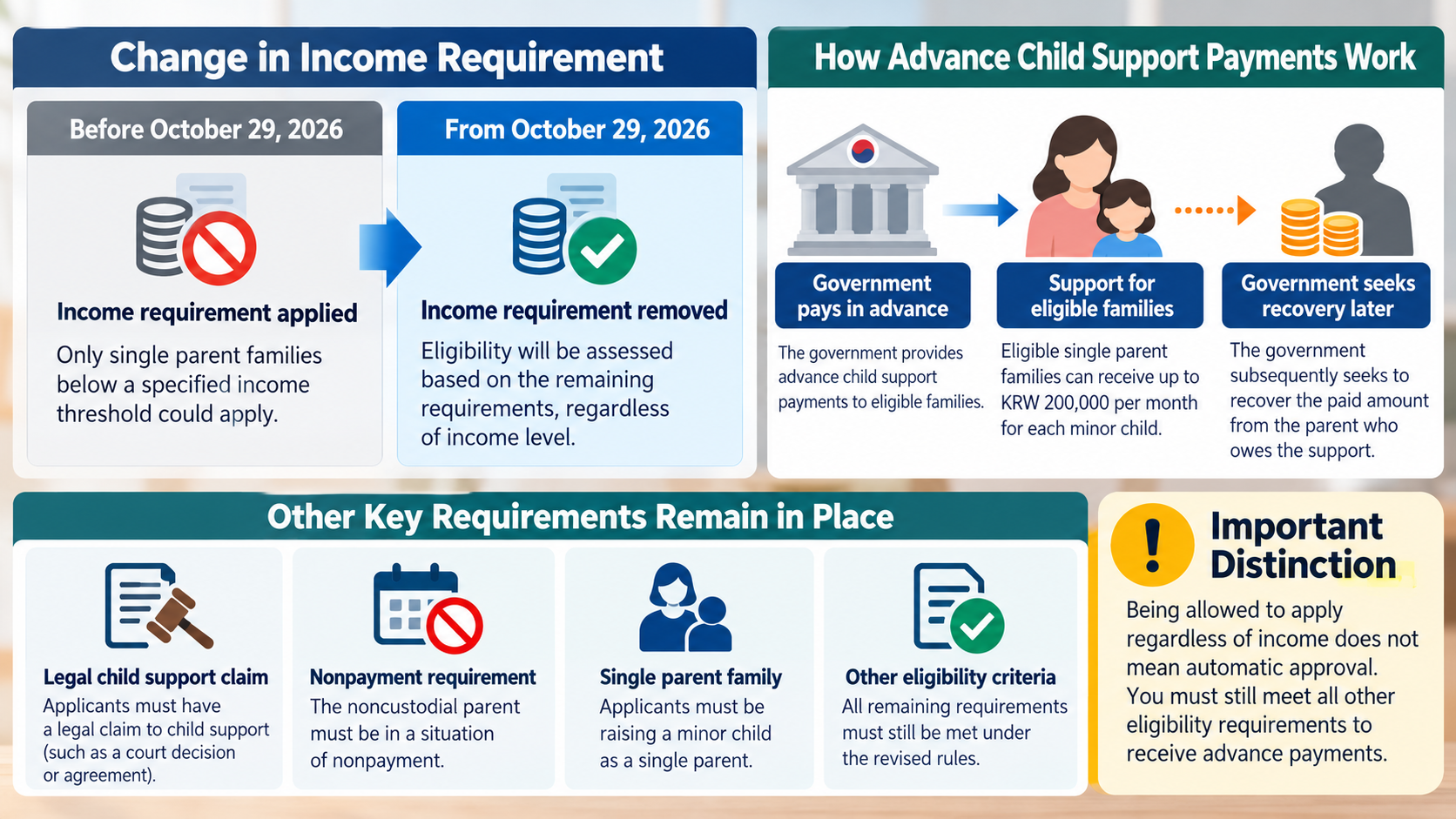
The income requirement is changing, but the other conditions for receiving advance child support payments will remain in place.
Previously, only single-parent families below a specified income threshold could apply. After the change, eligibility will be assessed based on the remaining requirements, regardless of income level.
| Category | Previous Rules | From October 29 |
|---|---|---|
| Income requirement | Income at or below 150% of the national median income | Income restriction abolished |
| Legal child support claim | Required | Still required |
| Child support nonpayment requirement | Applied | Still applies |
| Child support enforcement procedures | Required | Still required |
| Advance payment amount | Up to KRW 200,000 per month per child | Unchanged |
| Eligible children | Minor children | Unchanged |
South Korea's Child Support Advance Payment Program is not a system in which the government permanently assumes the noncustodial parent's financial obligation.
Instead, the government pays child support in advance and subsequently seeks to recover the amount from the parent who owes the support.
Therefore, being allowed to apply regardless of income must be distinguished from actually qualifying to receive payments.
Can You Apply If You Already Receive Some Child Support?
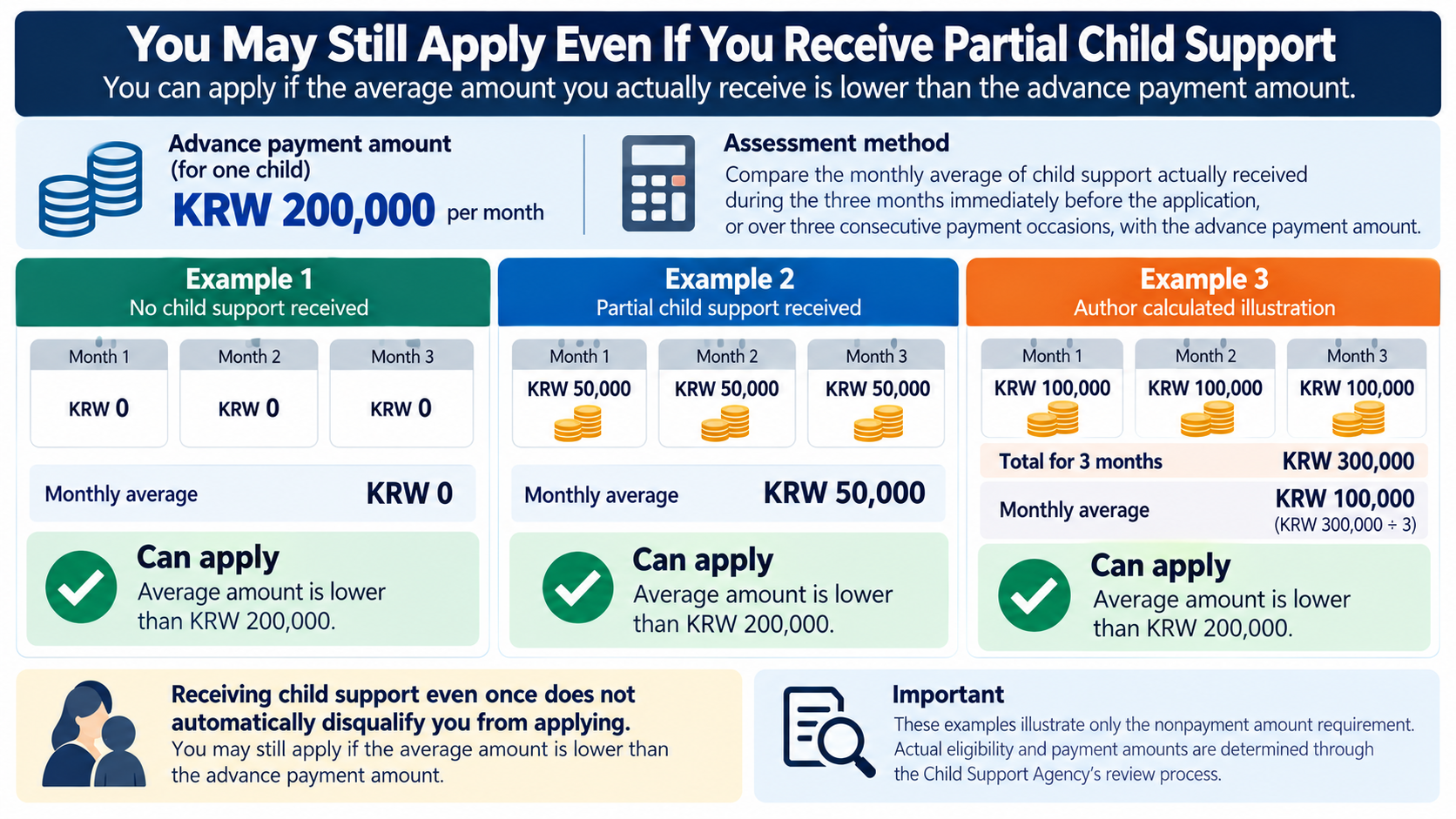
You may still apply if you receive partial child support, provided the amount you actually receive is lower than the advance payment amount.
The assessment considers whether the monthly average of child support actually received during the three months immediately before the application, or over three consecutive payment occasions, is lower than the advance payment amount.
Using an advance payment of KRW 200,000 for one child, the following examples illustrate how the amount-based requirement works.
| Actual Child Support Received | Monthly Average Received | Assessment of Nonpayment Amount Requirement |
|---|---|---|
| No payments received in any of the last three months | KRW 0 | Meets the amount requirement |
| KRW 100,000 received each month for the last three months | KRW 100,000 | Meets the amount requirement |
| KRW 100,000, KRW 0, and KRW 200,000 received over the last three months | KRW 100,000 | Meets the amount requirement |
| KRW 200,000 received each month for the last three months | KRW 200,000 | Does not meet the requirement of receiving less than KRW 200,000 |
The third example is an author-calculated illustration. Total child support received over three months is KRW 300,000. Dividing that amount by three produces a monthly average of KRW 100,000.
The important distinction is that receiving child support even once does not automatically disqualify an applicant.
However, these calculations illustrate only the nonpayment amount requirement. Actual eligibility and payment amounts are determined through the Child Support Agency's review process.
How Can You Confirm Your Legal Child Support Claim and Enforcement Procedures?
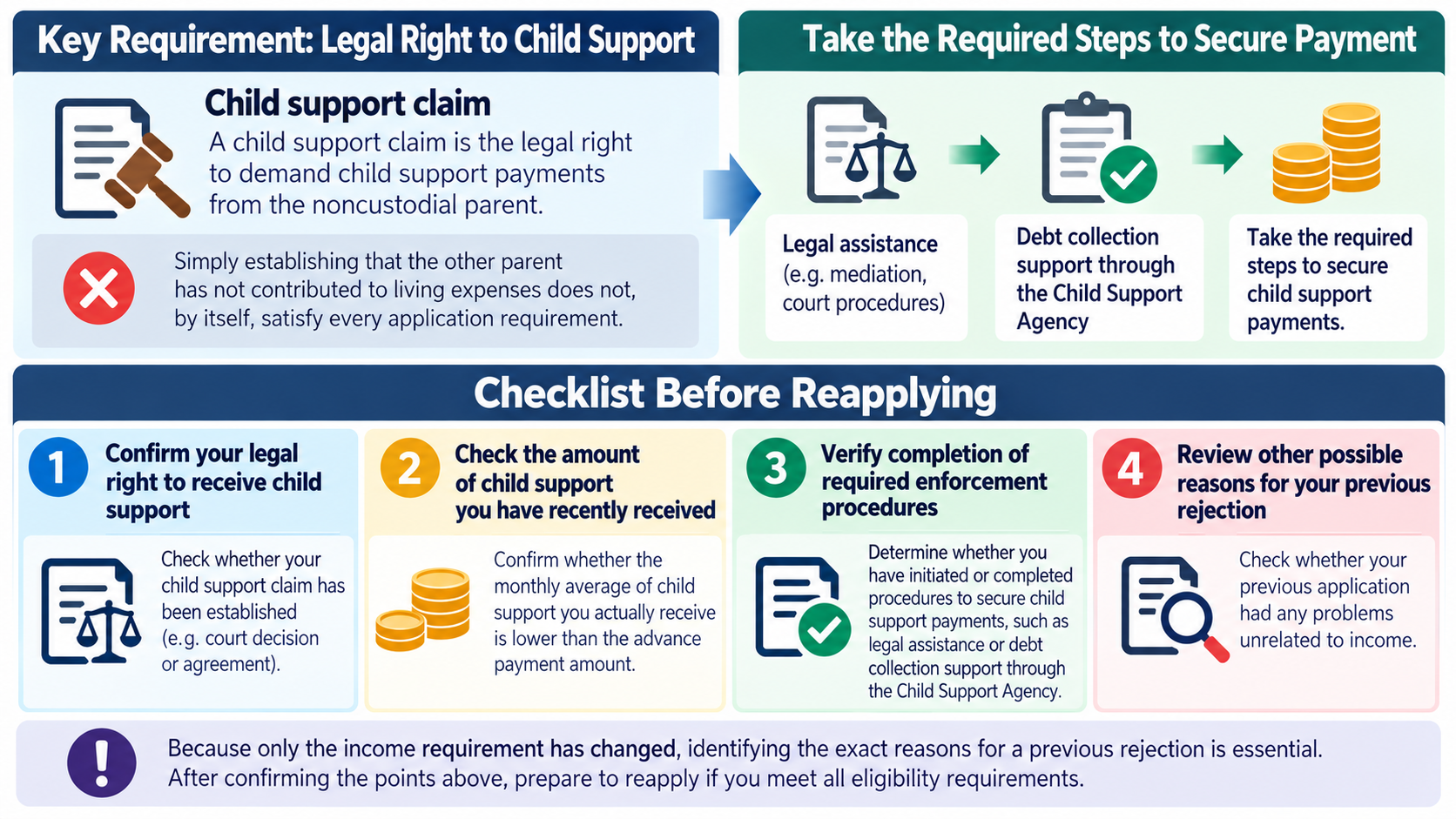
Applicants must have a legal right to receive child support and must also have taken the required steps to secure payment.
A child support claim is the legal right to demand child support payments from the noncustodial parent.
Simply establishing that the other parent has not contributed to living expenses does not, by itself, satisfy every application requirement.
Applicants must also determine whether they have initiated or completed procedures intended to secure child support payments, such as legal assistance or debt collection support through South Korea's Child Support Agency.
If you were previously rejected because of the income requirement, it is advisable to review the following points.
1. Confirm whether your legal right to receive child support has been established.
2. Check whether the child support you have recently received is lower than the advance payment amount.
3. Verify whether you have initiated or completed the required child support enforcement procedures.
4. Review whether your previous application had any problems unrelated to income.
Because only the income requirement has changed, identifying the exact reasons for a previous rejection is essential.
If You Apply After October 29, Can You Receive the October Payment?
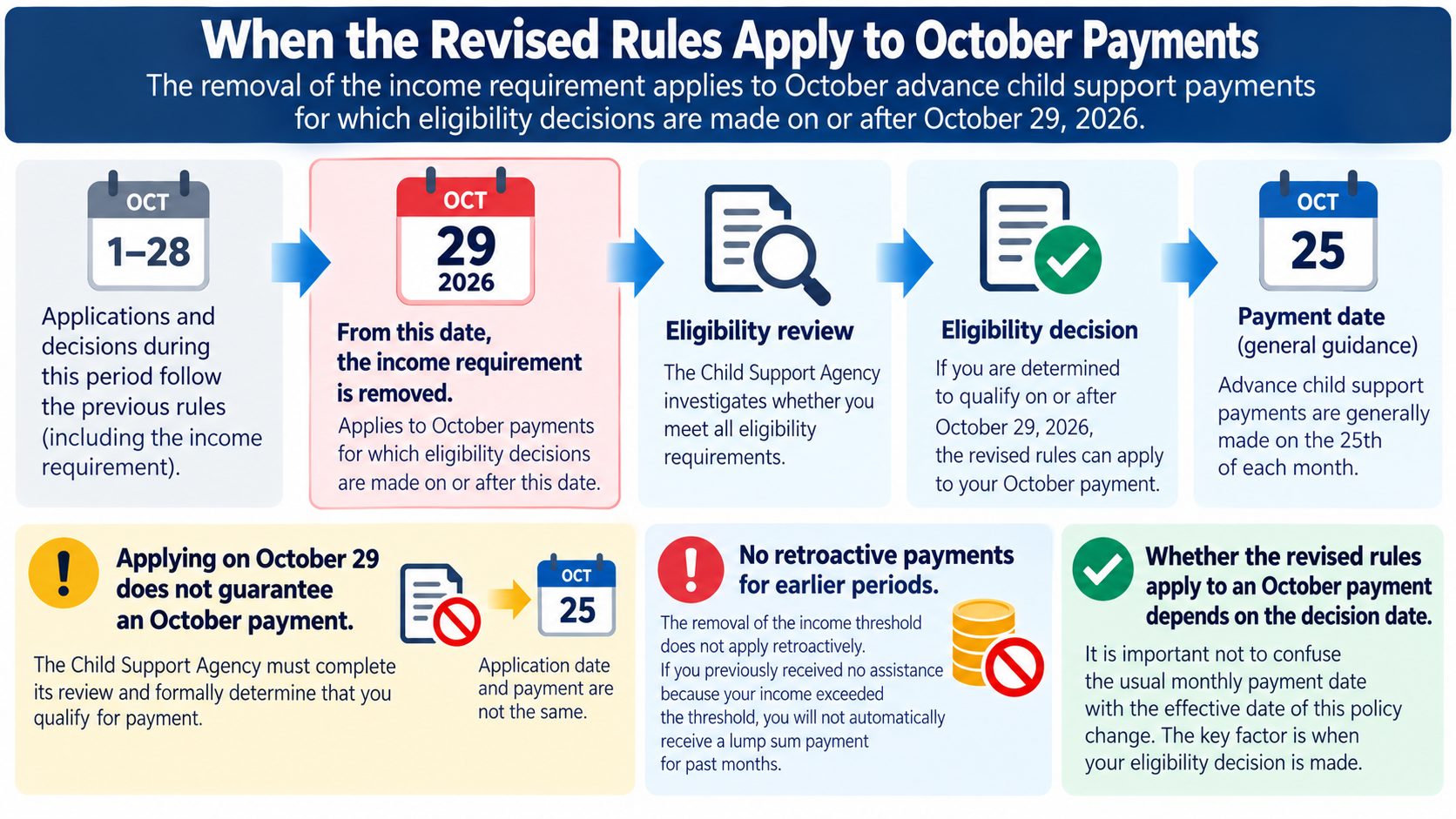
The removal of the income requirement applies to October advance child support payments for which eligibility decisions are made on or after October 29, 2026.
However, submitting an application on October 29 does not guarantee that you will receive an October payment.
The Child Support Agency must investigate whether you meet the eligibility requirements and formally determine that you qualify for payment.
According to the existing program guidance, advance child support payments are generally made on the 25th of each month. However, the revised rules have been announced as applying to October advance payments approved on or after October 29.
It is therefore important not to confuse the usual monthly payment date with the effective date of this policy change.
The removal of the income threshold will also not apply retroactively to earlier periods.
For example, someone who previously received no assistance because their income exceeded the threshold will not automatically receive a lump-sum payment covering several past months.
Whether the revised rules apply to an October payment depends not only on the application date but also on the actual review and eligibility decision date.
Where and How Can You Reapply?
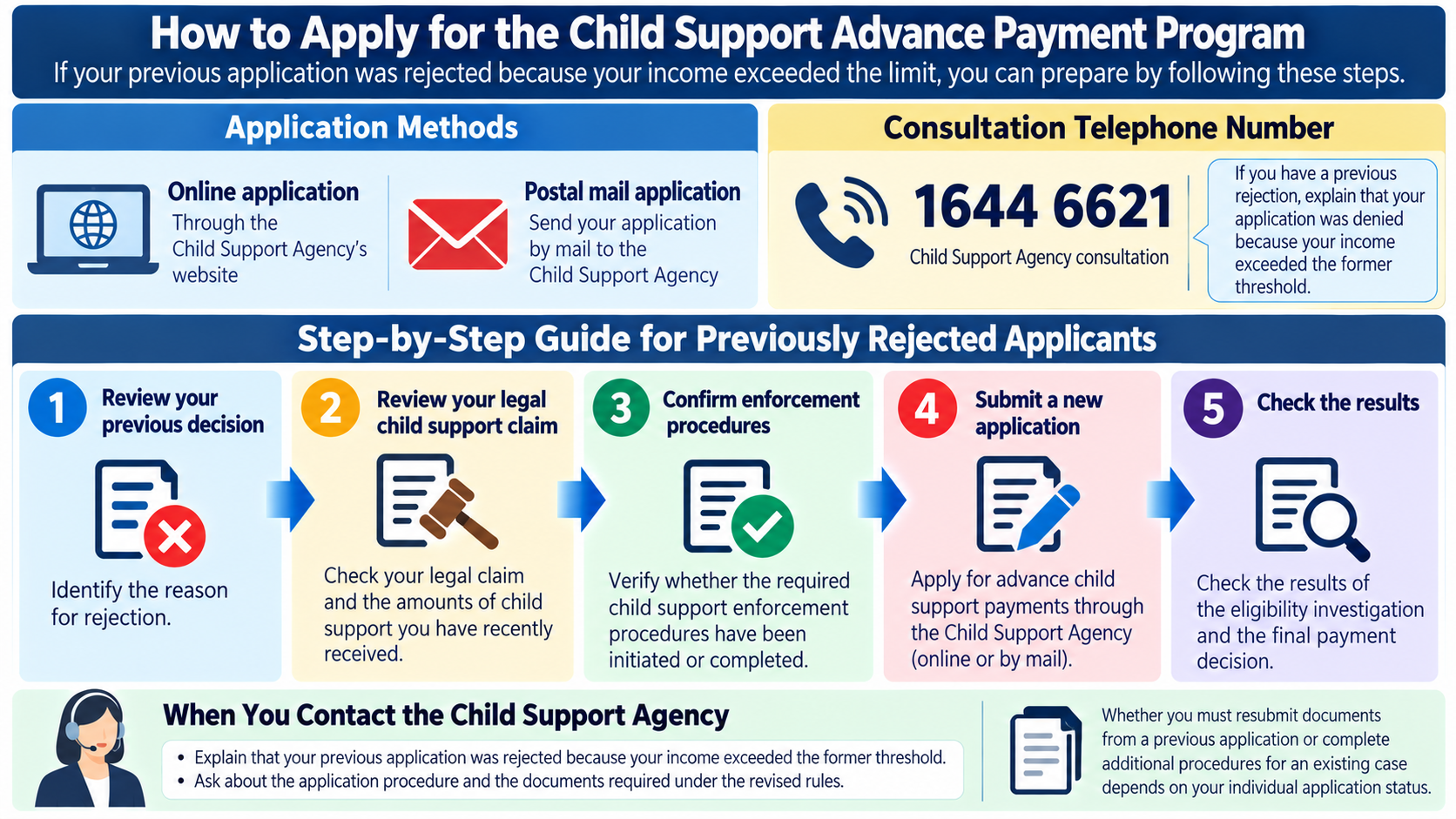
Applications for South Korea's Child Support Advance Payment Program can be submitted through the Child Support Agency's website or by postal mail.
If your previous application was rejected because your income exceeded the limit, you can prepare by following these steps.
1. Review your previous application decision and identify the reason for rejection.
2. Review your legal child support claim and the amounts of child support you have recently received.
3. Confirm whether the required child support enforcement procedures have been initiated or completed.
4. Submit an application for advance child support payments through the Child Support Agency.
5. Check the results of the eligibility investigation and the final payment decision.
The Child Support Agency's consultation telephone number in South Korea is 1644-6621.
If you have a previous rejection on record, explain during your consultation that your application was denied because your income exceeded the former threshold. Ask about the application procedure and documents required under the revised rules.
In particular, whether you must resubmit documents from a previous application or complete additional procedures for an existing case depends on your individual application status.
Can You Receive KRW 400,000 per Month If You Have Two Children?
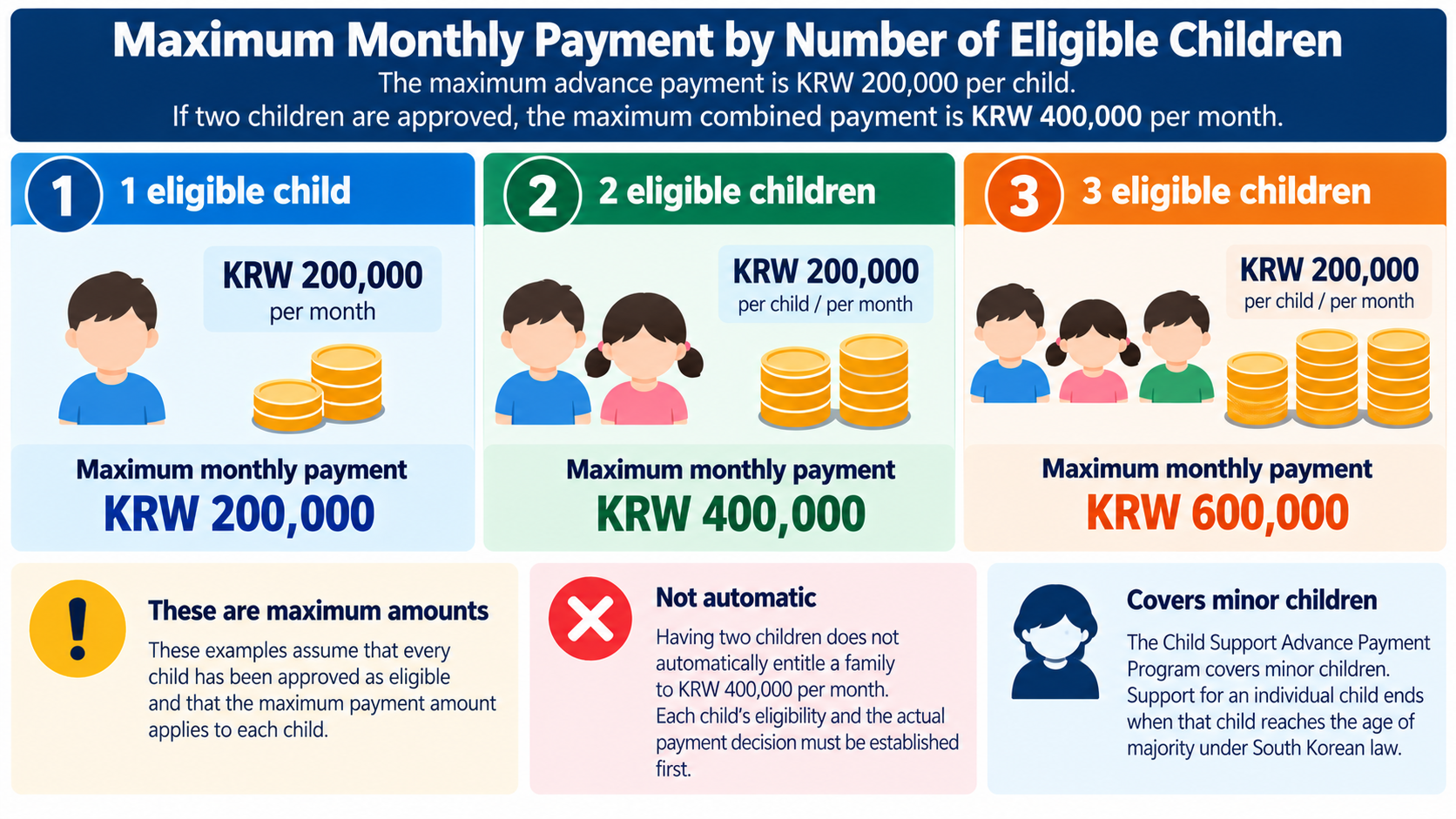
If two minor children are each approved for advance child support payments, the maximum combined payment is KRW 400,000 per month, based on a maximum of KRW 200,000 per child.
The following author-calculated examples show the maximum monthly payment based on the number of eligible children.
| Number of Eligible Children | Maximum Monthly Payment |
|---|---|
| 1 child | KRW 200,000 |
| 2 children | KRW 400,000 |
| 3 children | KRW 600,000 |
These calculations assume that every child has been approved as eligible and that the maximum payment amount applies to each child.
Having two children does not automatically entitle a family to KRW 400,000 per month. Each child's eligibility and the actual payment decision must be established first.
The Child Support Advance Payment Program covers minor children. Support for an individual child ends when that child reaches the age of majority under South Korean law.
What Should Previously Rejected Applicants Check First?
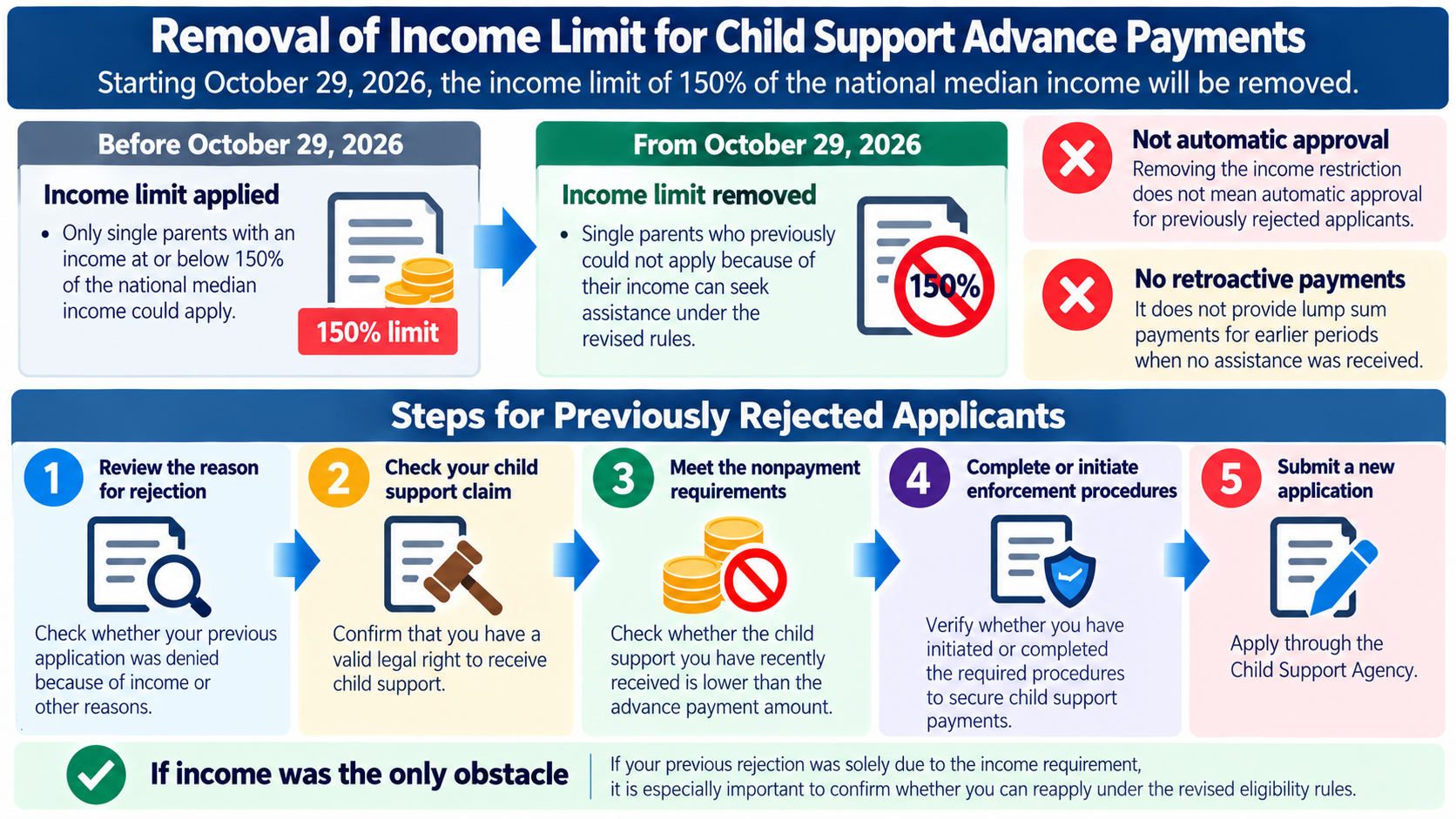
Starting October 29, 2026, South Korea's Child Support Advance Payment Program will remove its income limit of 150% of the national median income. This will allow single parents who previously could not apply because of their income to seek assistance under the revised rules.
However, abolishing the income restriction does not mean automatic approval for previously rejected applicants or retroactive payment of amounts from earlier periods.
Previously rejected applicants should first review why their earlier applications were denied. They should then check whether they have a valid child support claim, meet the nonpayment requirements, and have completed or initiated the necessary enforcement procedures before applying through the Child Support Agency.
If income was the only obstacle in the previous application, it is especially important to confirm whether you can reapply under the revised eligibility rules.