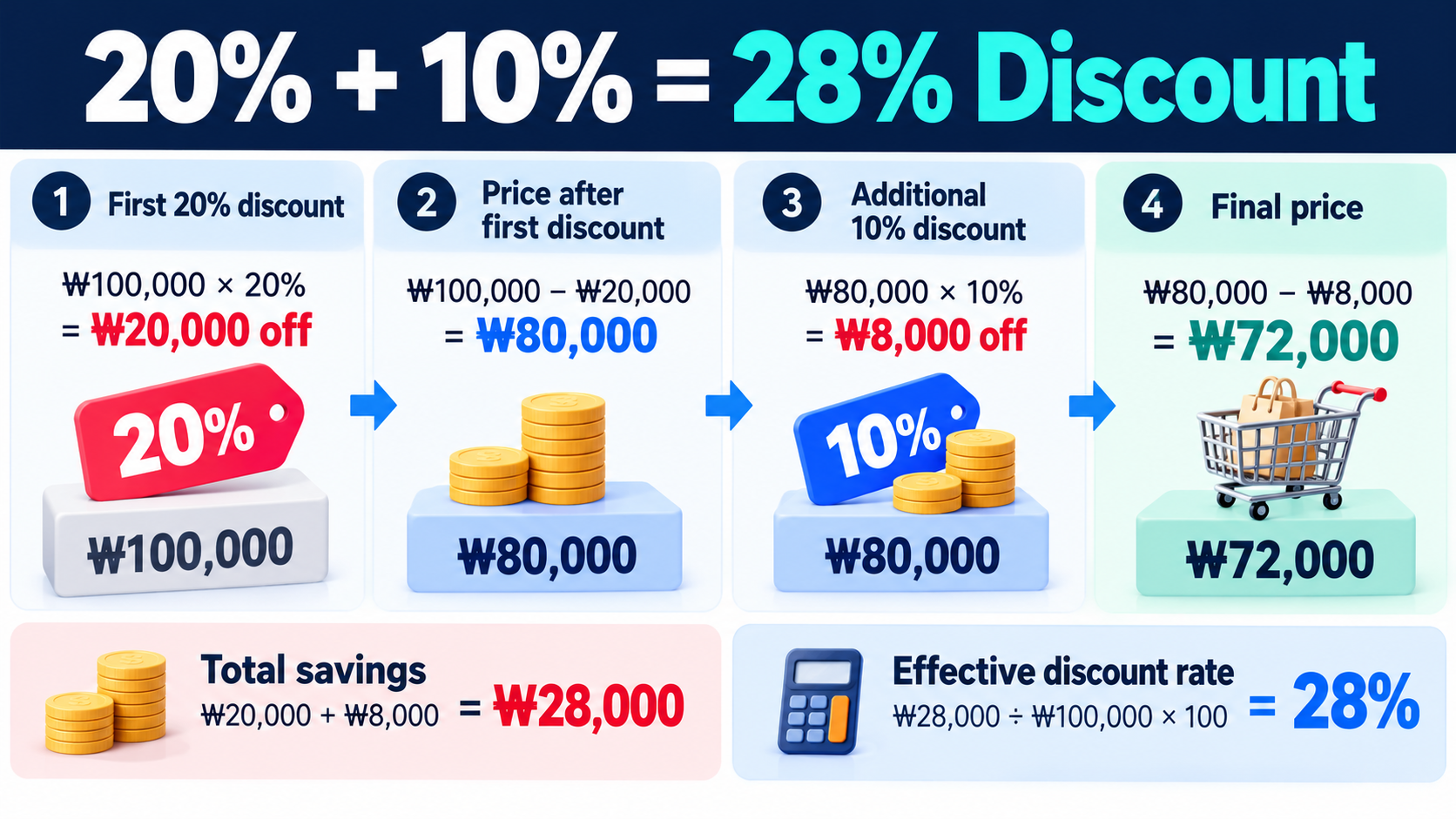
If an item originally priced at ₩100,000 is discounted by 20% and then receives an additional 10% discount, the final price is ₩72,000. Rather than a combined 30% discount, the effective discount is 28%. This is because the additional 10% is calculated using the price remaining after the first discount. However, the final amount may differ if the additional discount uses a different calculation basis or has a maximum discount limit.
How Much Do You Pay After a 20% Discount Plus an Extra 10%?
Applying the first 20% discount to the original price of ₩100,000 leaves ₩80,000. When applying the additional 10% discount, the calculation is based on the discounted price of ₩80,000, not the original ₩100,000.
Here is the calculation step by step:
1. First discount: ₩100,000 × 20% = ₩20,000 off
2. Price after the first discount: ₩100,000 − ₩20,000 = ₩80,000
3. Second discount: ₩80,000 × 10% = ₩8,000 off
4. Final price: ₩80,000 − ₩8,000 = ₩72,000
You save ₩20,000 with the first discount and another ₩8,000 with the additional discount, for total savings of ₩28,000.
The effective discount rate relative to the original price is calculated as follows:
₩28,000 ÷ ₩100,000 × 100 = 28%
In other words, applying a 20% discount followed by an additional 10% discount is equivalent to a 28% discount on the original price.
How Is This Different From a Flat 30% Discount?
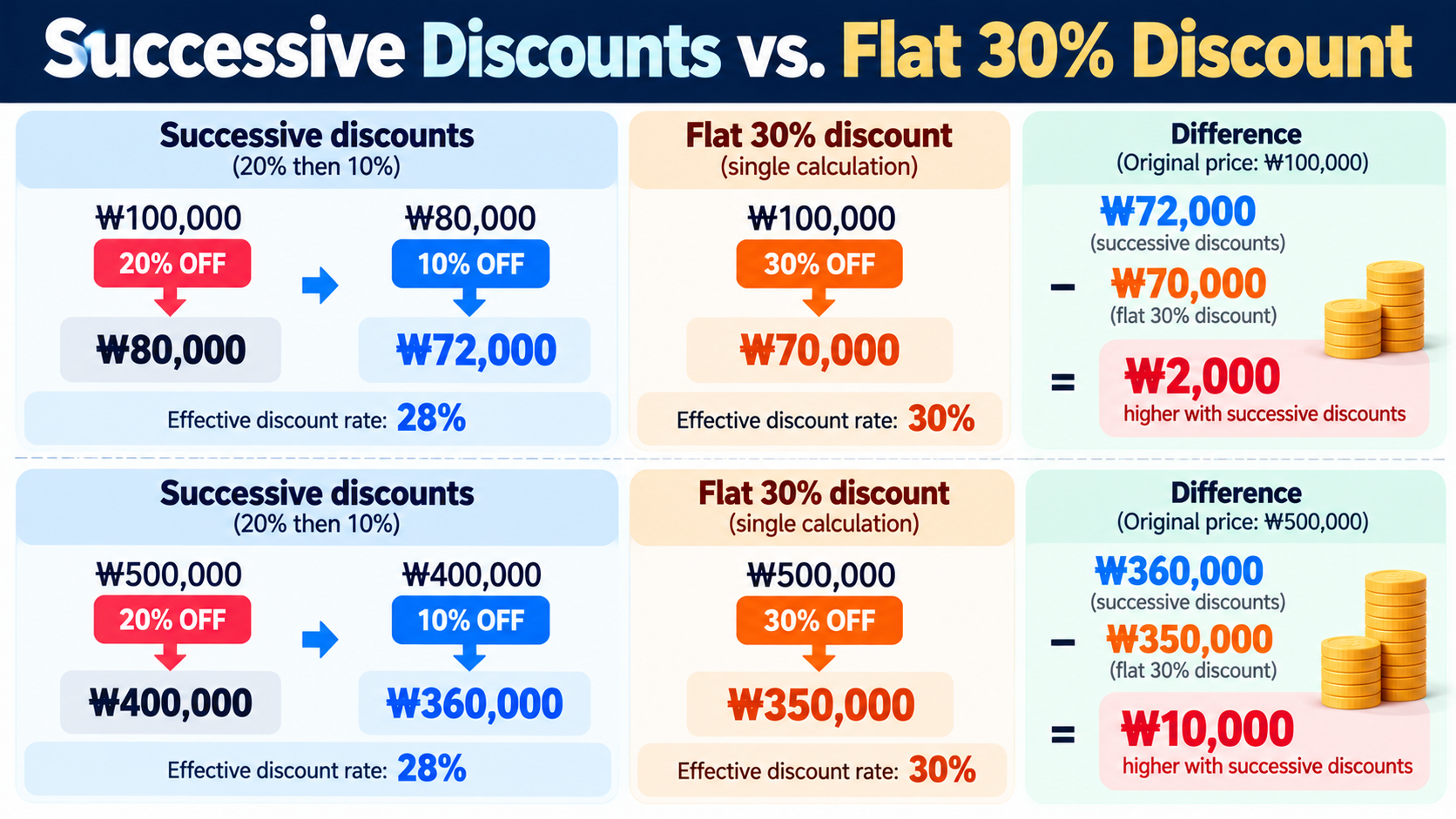
The difference between the two methods comes down to which amount the second discount applies to. Successive discounts reduce an already discounted price, while a flat 30% discount subtracts 30% directly from the original price in a single calculation.
Here is a comparison using an original price of ₩100,000.
| Item | 20% Off, Then an Extra 10% | Flat 30% Off the Original Price |
|---|---|---|
| Original price | ₩100,000 | ₩100,000 |
| First discount amount | ₩20,000 | ₩30,000 |
| Additional discount amount | ₩8,000 | None |
| Total discount | ₩28,000 | ₩30,000 |
| Effective discount rate | 28% | 30% |
| Final price | ₩72,000 | ₩70,000 |
The difference in the final price is ₩2,000.
Although the discount rates differ by only 2 percentage points, the monetary difference increases as the original price rises.
For example, if an item originally costs ₩500,000, the final price after successive discounts is ₩360,000, while a flat 30% discount reduces the price to ₩350,000. The difference between the two methods increases to ₩10,000.
What Is the Formula for Calculating Successive Discounts?
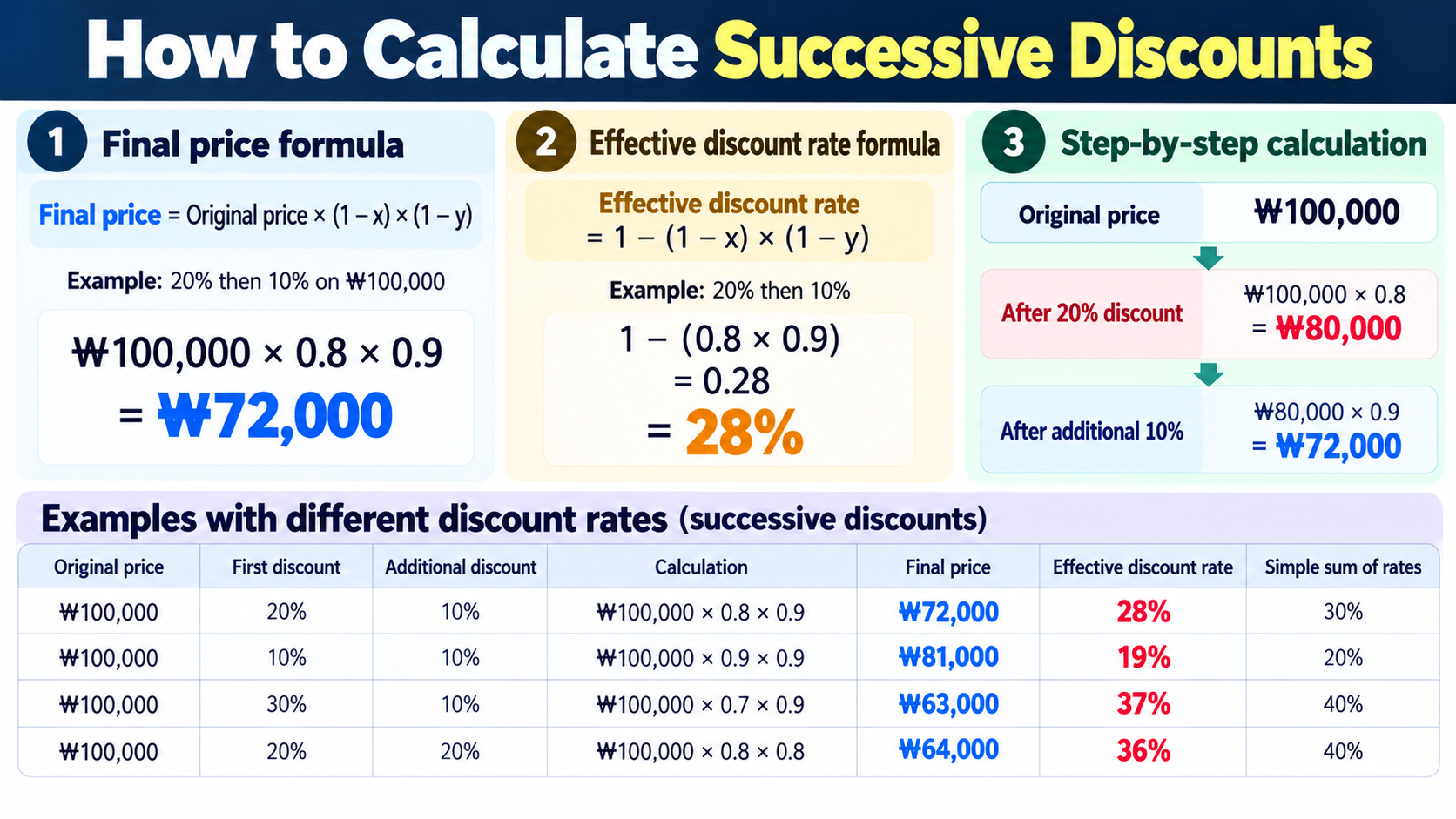
You can calculate successive discounts by multiplying the proportions of the original price that remain after each discount.
If the first discount is 20% and the second discount is 10%, the formula is:
Final price = Original price × (1 − 0.20) × (1 − 0.10)
Substituting an original price of ₩100,000 gives:
₩100,000 × 0.8 × 0.9 = ₩72,000
The effective discount rate can be calculated using the following formula:
Effective discount rate = 1 − (1 − First discount rate) × (1 − Additional discount rate)
1 − (0.8 × 0.9) = 0.28 = 28%
This formula applies when the second discount is calculated using the price remaining after the first discount.
The same method works with other discount percentages.
| Successive Discount Combination | Effective Discount Rate |
|---|---|
| 10% + additional 10% | 19% |
| 20% + additional 10% | 28% |
| 20% + additional 20% | 36% |
| 30% + additional 10% | 37% |
| 50% + additional 10% | 55% |
The effective discount rates in this table are calculated on the assumption that each discount is applied sequentially to the price remaining after the previous discount.
The effective discount rate is lower than the simple sum of the advertised percentages because each additional discount applies to an amount that has already been reduced.
Does Changing the Order of Discounts Change the Final Price?
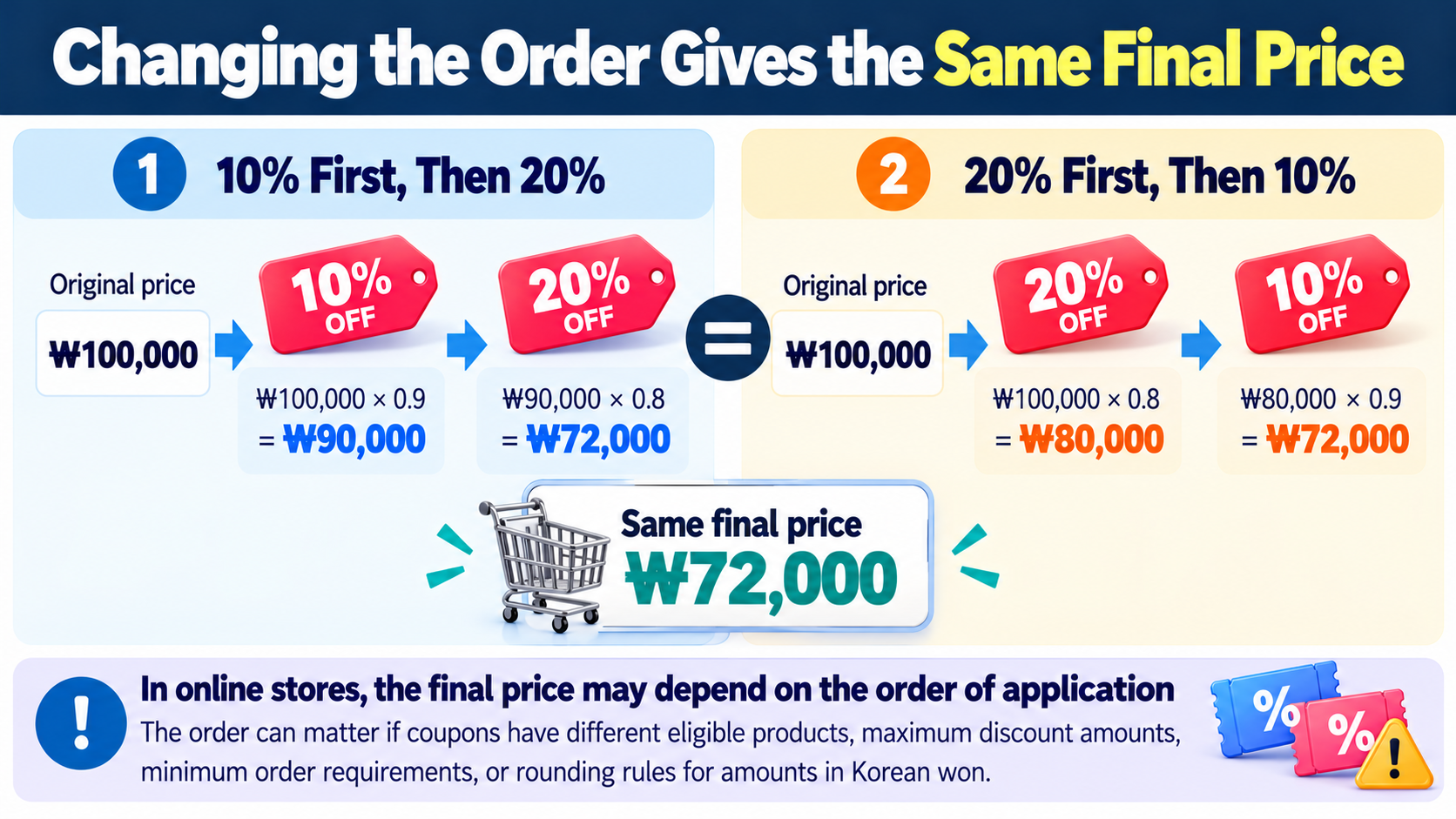
If the same two percentage discounts are applied successively without restrictions, changing their order does not change the final price.
Consider an item originally priced at ₩100,000. This time, apply the 10% discount first, followed by the 20% discount.
₩100,000 × 0.9 × 0.8 = ₩72,000
Applying the 20% discount first and then the 10% discount also produces a final price of ₩72,000.
This is because changing the order of multiplication does not change the result.
However, in an actual online store, the final price may depend on the order of application if coupons have different eligible products, maximum discount amounts, minimum order requirements, or rounding rules for amounts in Korean won.
Therefore, you should not assume that discount order is irrelevant for every coupon combination.
Why Is the Checkout Price Different After Applying an Additional Discount Coupon?
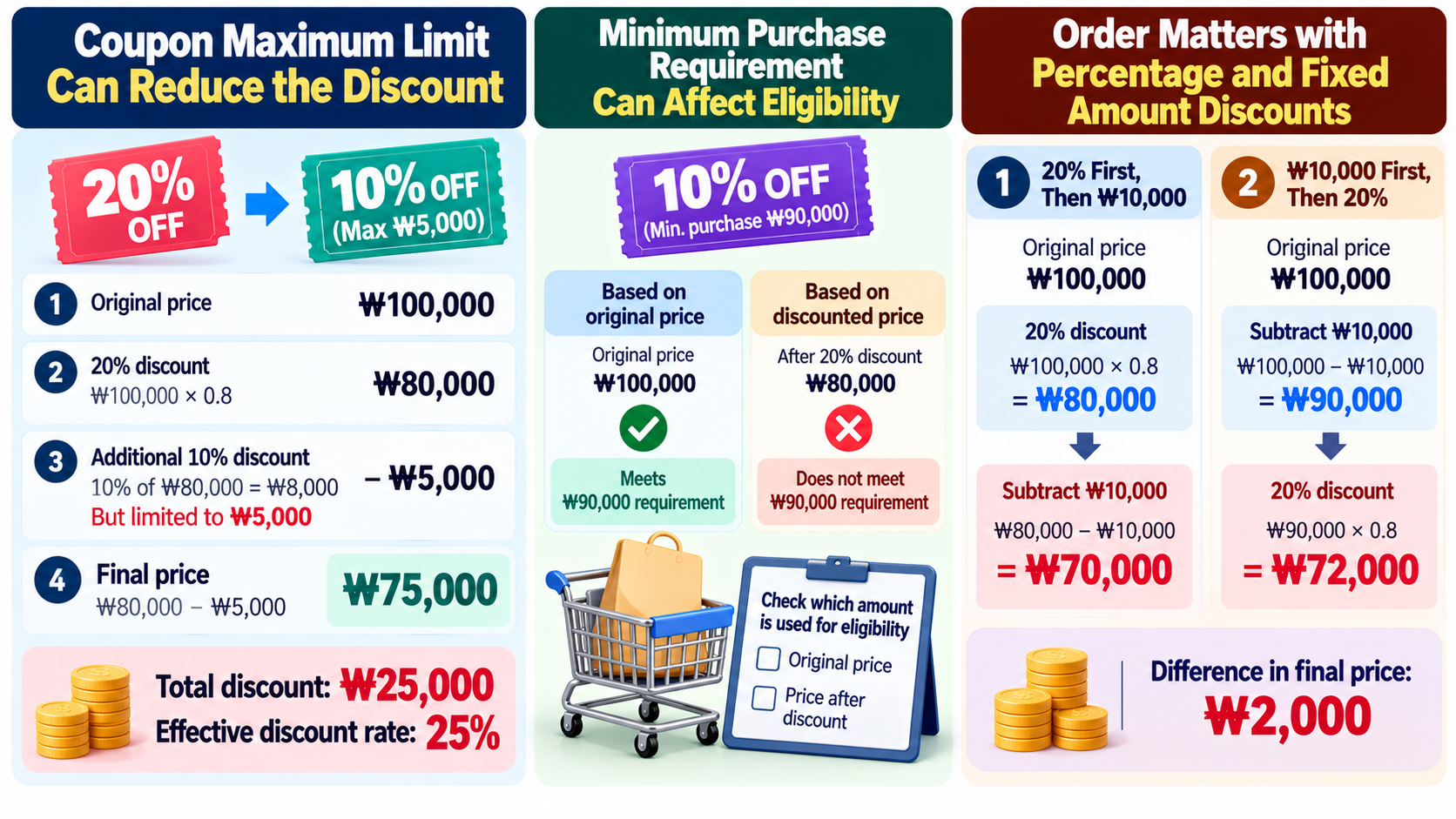
If an additional discount coupon has a maximum discount amount or minimum purchase requirement, the actual checkout price may differ from a straightforward percentage calculation. In particular, it is important to check whether the coupon's maximum discount limit restricts the amount calculated from the advertised percentage.
Consider an item originally priced at ₩100,000 that receives a 20% discount, followed by an additional 10% discount coupon.
What If the Additional 10% Discount Is Capped at ₩5,000?
The price after the first discount is ₩80,000.
Although 10% of ₩80,000 is ₩8,000, if the coupon has a maximum discount of ₩5,000, the actual additional discount is limited to ₩5,000.
₩80,000 − ₩5,000 = ₩75,000
In this case, the total discount is ₩25,000, and the effective discount rate is 25%.
What If the Additional Coupon Has a Minimum Purchase Requirement?
You need to check whether the minimum purchase requirement is evaluated using the original price or the price after the first discount.
For example, suppose an additional coupon can only be used on purchases of at least ₩90,000. The original price of ₩100,000 meets that requirement, but the discounted price of ₩80,000 does not.
Whether the coupon can be applied depends on which amount the online store uses to determine eligibility.
What Happens When You Combine a Percentage Discount With a Fixed-Amount Coupon?
The order of application can matter when combining percentage discounts with fixed-amount discounts.
Consider an item originally priced at ₩100,000 with a 20% discount and a fixed ₩10,000 discount coupon.
Apply 20% off first, then subtract ₩10,000: ₩70,000
Subtract ₩10,000 first, then apply 20% off: ₩72,000
Even though the same two discount benefits are involved, the order of application creates a ₩2,000 difference. The actual order must follow the seller's coupon policy and checkout system.
What Should You Check Before Completing Your Purchase?
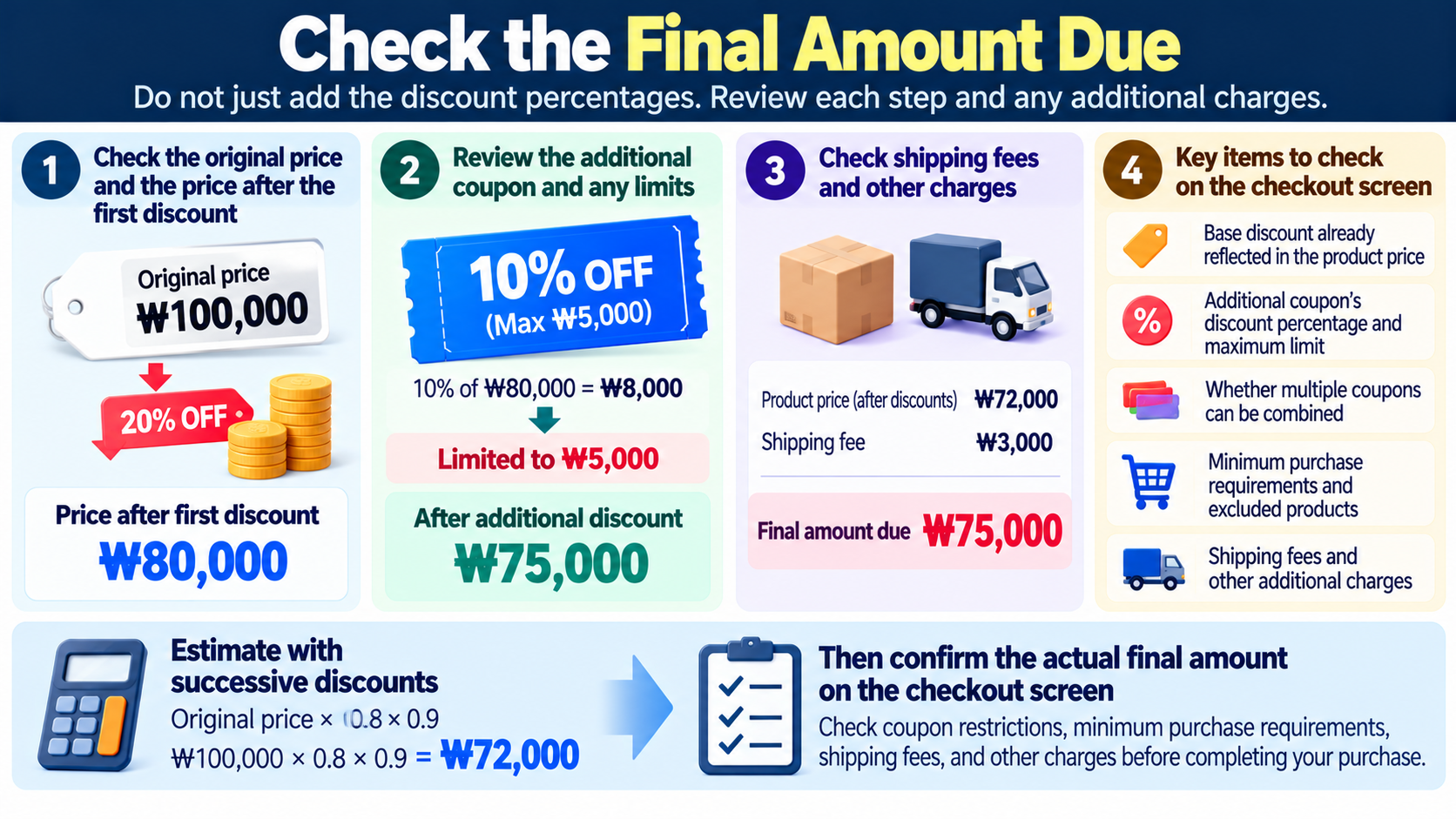
When buying an item with multiple discounts, checking the final amount due is more reliable than adding up the advertised discount percentages.
Start by checking the item's original price and the price after the first discount. Then review how the additional coupon is calculated and whether a maximum discount limit applies.
On the checkout screen, it is useful to check the following items separately:
The base discount already reflected in the product price
The additional coupon's discount percentage and maximum discount amount
Whether multiple coupons can be combined
Minimum purchase requirements and excluded products
Shipping fees and other additional charges
If shipping is charged separately, the discounted product price and the total checkout amount may differ.
For example, if the product price after discounts is ₩72,000 and shipping costs ₩3,000, the final amount payable is ₩75,000.
Therefore, when an item is advertised with 20% off plus an additional 10% discount, first multiply the original price by 0.8 and 0.9 to estimate the discounted price. Then check the coupon restrictions and any additional charges on the checkout screen before completing your purchase.