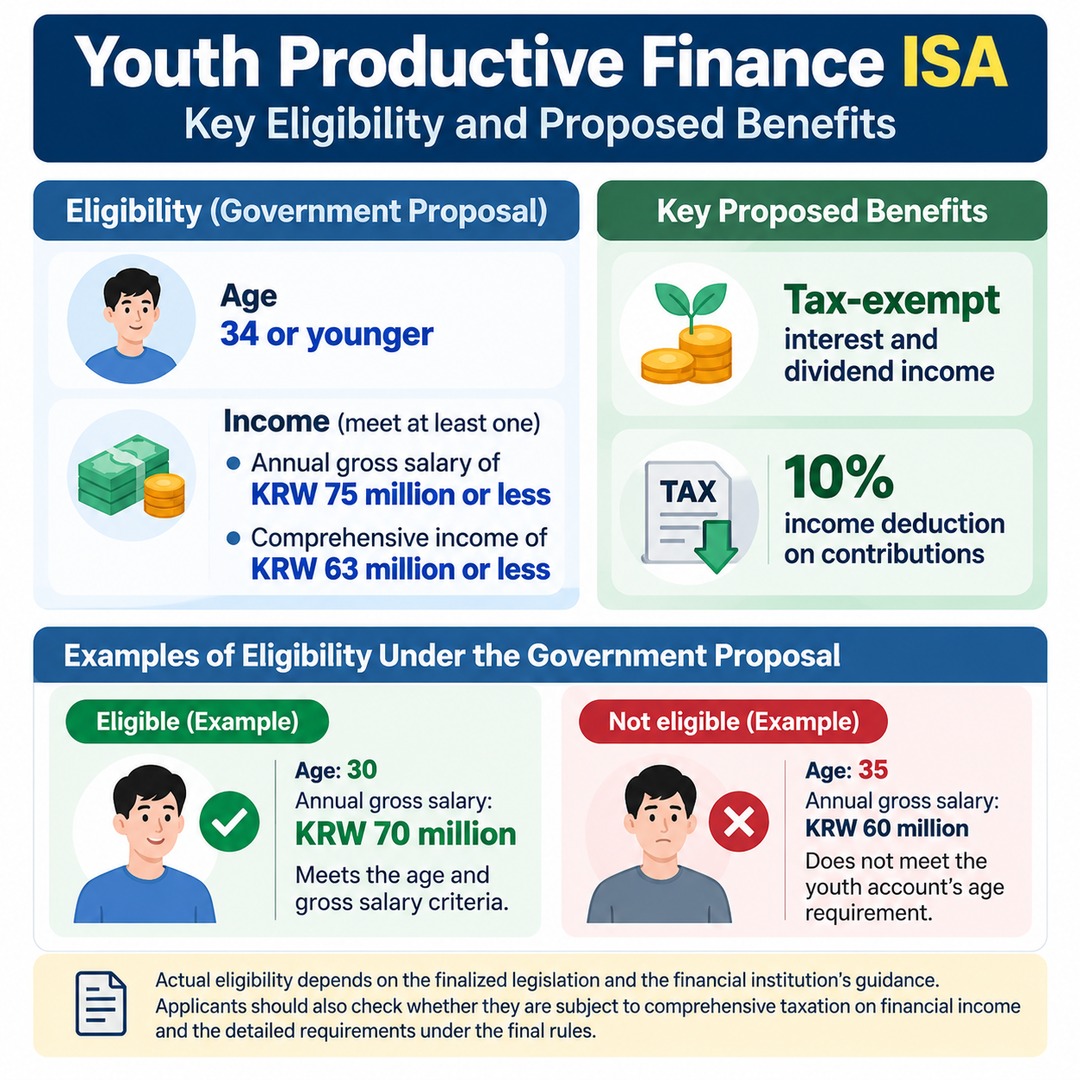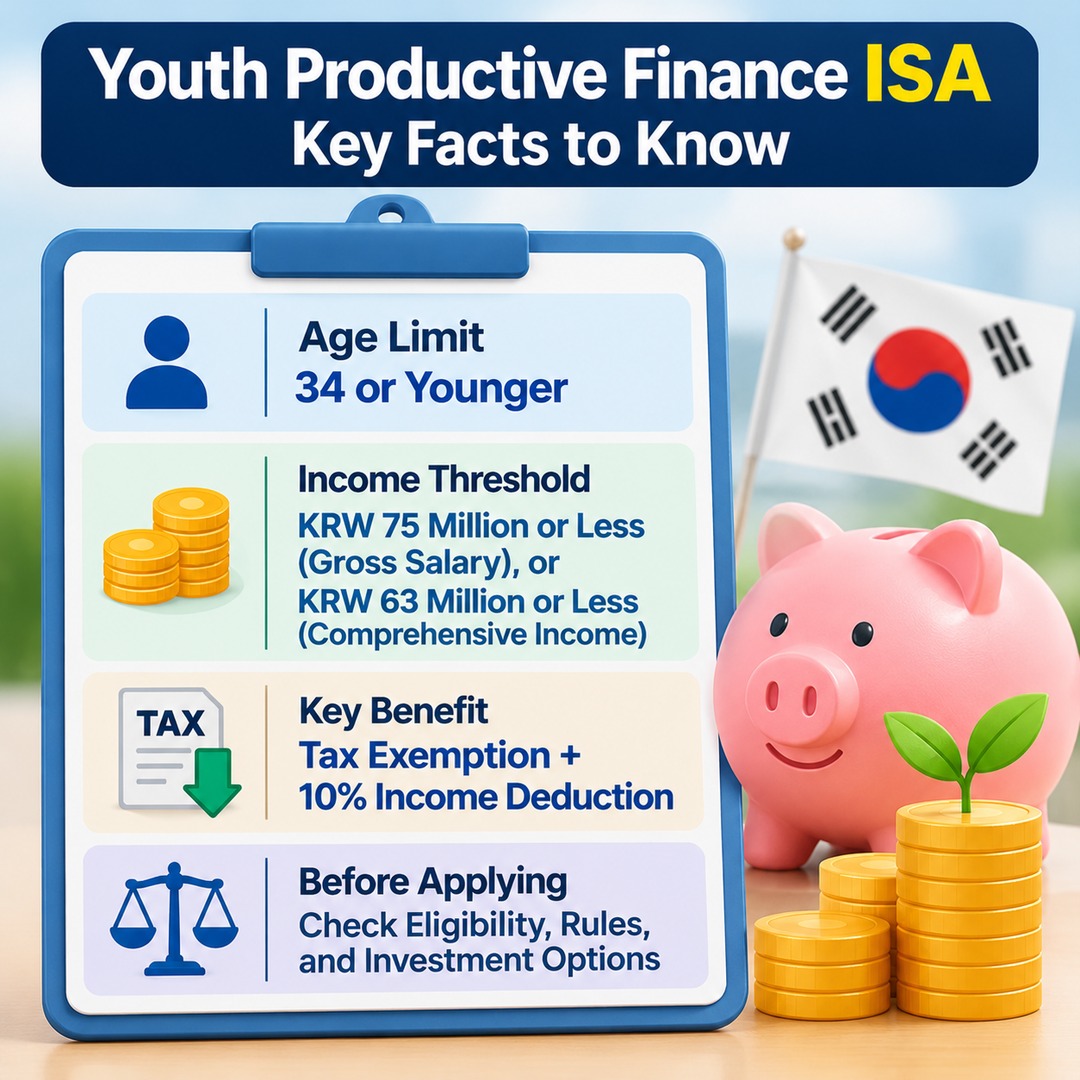
South Korea’s proposed Youth Productive Finance Individual Savings Account (ISA), included in the government’s 2026 tax reform proposal, was designed for young people aged 34 or younger whose annual gross salary does not exceed KRW 75 million or whose comprehensive income does not exceed KRW 63 million. Its key proposed benefits are tax-exempt interest and dividend income and a 10% income deduction on contributions. However, the benefits outlined in the government proposal must be distinguished from the final system that will actually take effect.
Who is eligible to open a Youth Productive Finance ISA?
Under the government proposal, eligibility for the youth account depends on both age and income. Applicants must be aged 34 or younger and meet at least one of the specified income thresholds.
Age: 34 or younger
Income: Annual gross salary of KRW 75 million or less, or comprehensive income of KRW 63 million or less
Additional checks: Whether the applicant is subject to comprehensive taxation on financial income and the detailed eligibility requirements under the final legislation
Gross salary refers to employment income measured after excluding tax-exempt employment income and similar items. Comprehensive income refers to the combined income included in the comprehensive income tax calculation for the relevant tax year, such as business, interest, and dividend income. These are different income concepts, so applicants should check the threshold applicable to their own income type.
For example, a 30-year-old employee with an annual gross salary of KRW 70 million meets the age and gross-salary criteria in the government proposal. By contrast, someone aged 35 would not meet the youth account’s age requirement, even if their income were below the threshold. Actual eligibility must nevertheless be checked against the finalized legislation and the financial institution’s guidance.
How much of a 10% income deduction can you receive with a Youth ISA?
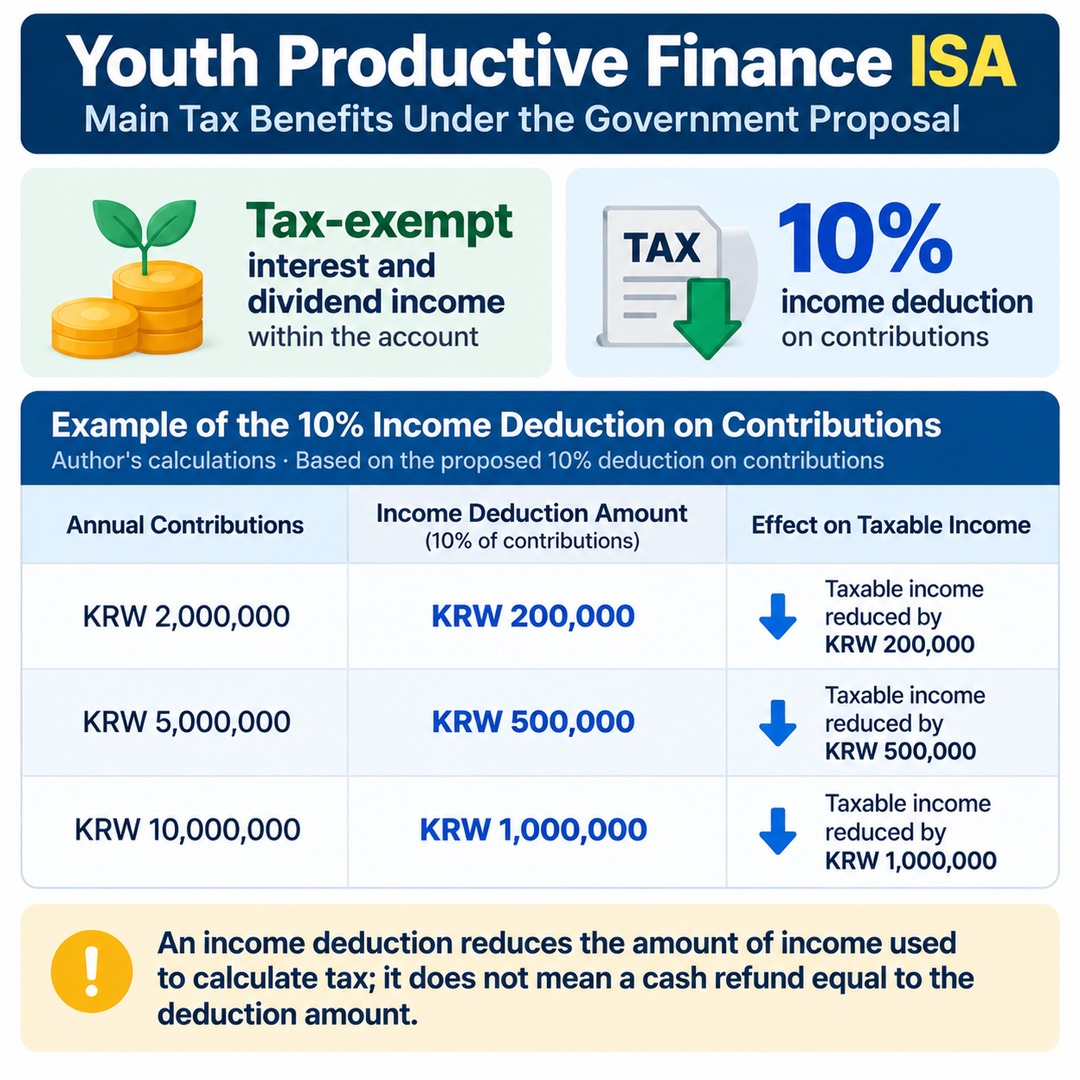
The proposed Youth Productive Finance ISA offers a 10% income deduction on contributions, in addition to tax-exempt interest and dividend income within the account. An income deduction reduces the amount of income used to calculate tax; it does not mean that the applicant receives a cash refund equal to the deduction amount.
Author's calculations · Based on the proposed 10% deduction on contributions
Examples of income deductions by contribution amount
| Contribution amount | Amount calculated at 10% |
|---|---|
| KRW 300,000 per month × 12 months | KRW 360,000 |
| KRW 500,000 per month × 12 months | KRW 600,000 |
| KRW 10 million contributed annually | KRW 1 million |
| KRW 20 million contributed annually | KRW 2 million |
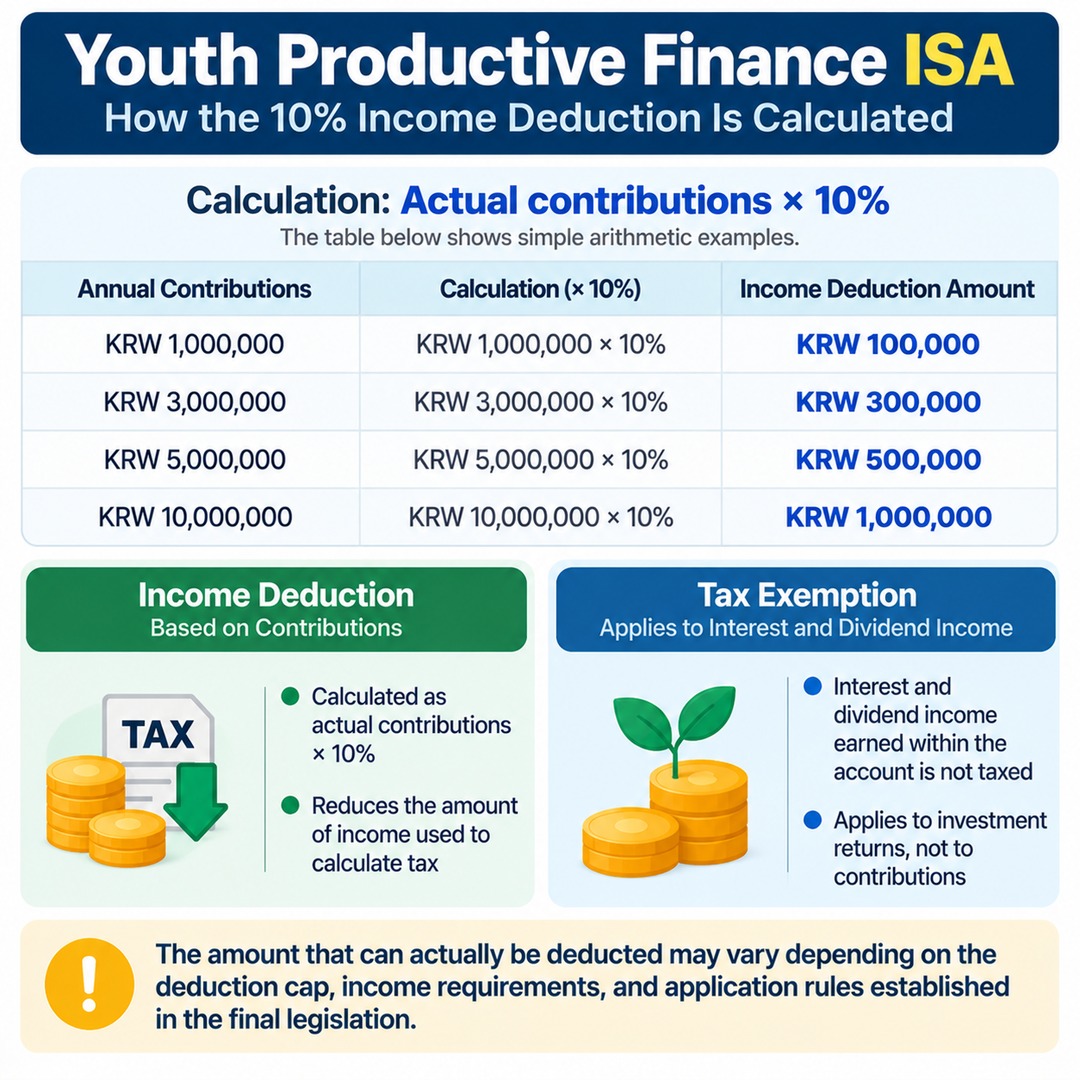
Calculation: Actual contributions × 10%. The table provides simple arithmetic examples. The amount that can actually be deducted may vary depending on the deduction cap, income requirements, and application rules established in the final legislation.
Income deductions and tax exemptions apply to different things. An income deduction is based on contributions, whereas a tax exemption means that interest and dividend income earned within the account is not taxed. Understanding this distinction helps avoid overstating the actual tax savings.
How does it differ from an existing ISA?
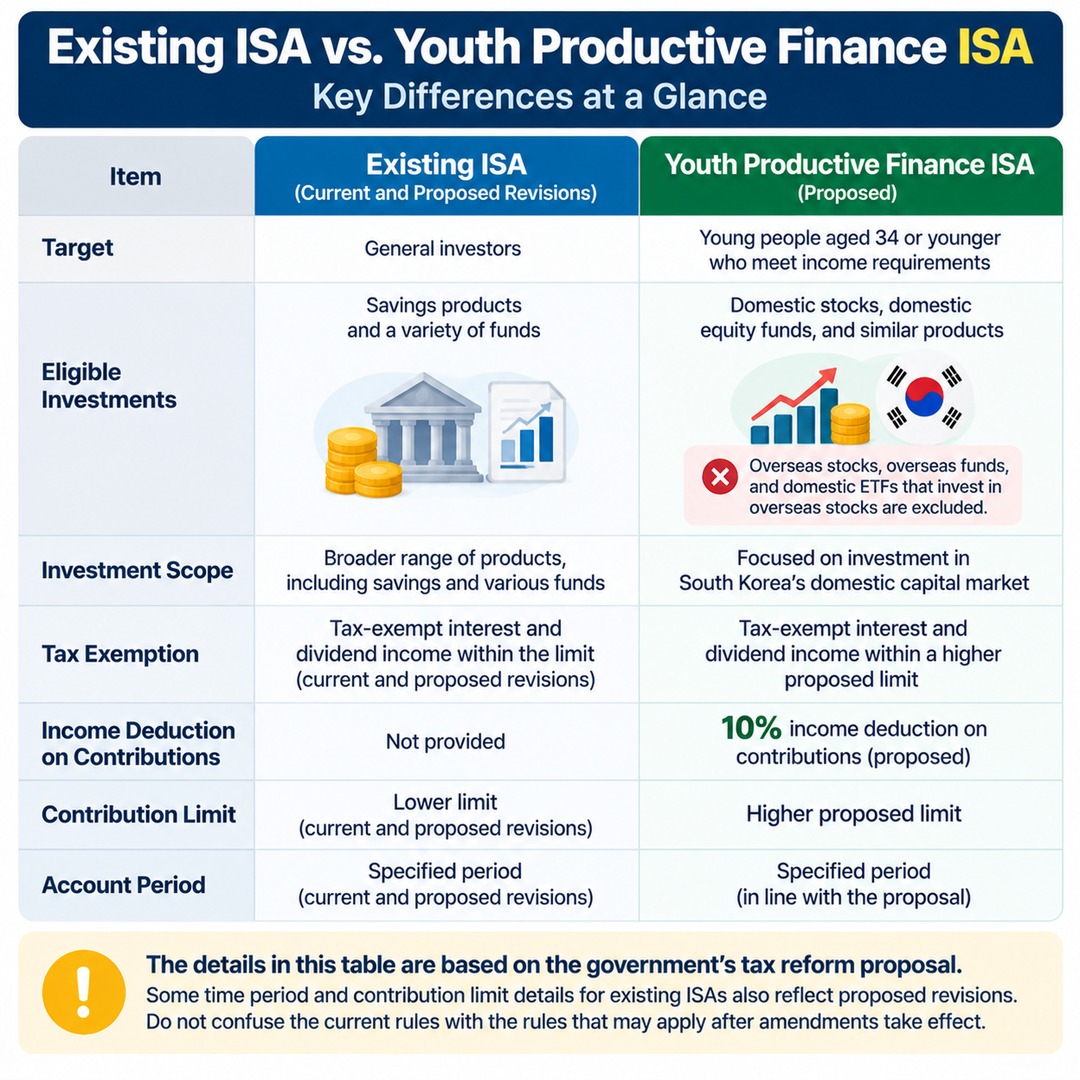
The main differences concern the range of eligible investments and the tax-exemption structure. The government proposal included both revisions to the tax framework for existing ISAs and the introduction of a separate Productive Finance ISA focused on investment in South Korea’s domestic capital market.
| Comparison | Existing ISA framework | Proposed Productive Finance ISA |
|---|---|---|
| Eligible applicants | Requirements vary by account type, including general and lower-income types | For the general type, South Korean residents aged 19 or older, or employed people aged 15 or older |
| Additional youth benefit | No dedicated additional deduction for the youth type | The youth type offers a 10% income deduction on contributions if eligibility requirements are met |
| Tax exemption on interest and dividends | Up to KRW 2 million for the general type and KRW 4 million for the lower-income type | Full exemption for interest and dividend income within the account was proposed |
| Annual contribution limit | KRW 20 million | KRW 20 million |
| Total contribution limit | KRW 100 million | KRW 200 million |
| Investment scope | Savings deposits, installment savings, domestic stocks, funds, and other eligible products | Domestic stocks, domestic equity funds, the National Growth Fund, and other specified investments |
| Investment period | Minimum of 3 years; the government proposal provides for an extension to a total of 5 years | Minimum of 3 years; the proposal provides for an extension to a total of 10 years |
The Productive Finance ISA details in this table are based on the government’s tax reform proposal. Some of the time-period and contribution-limit details for existing ISAs also reflect proposed revisions. Do not confuse the current rules with the rules that may apply after amendments take effect.
An existing ISA has the advantage of allowing investment in savings products and a variety of funds. The proposed Productive Finance ISA, by contrast, narrows its investment scope to domestic stocks, domestic equity funds, and similar products while offering higher proposed tax-exemption and contribution limits.
In particular, exchange-traded funds (ETFs) listed in South Korea that invest in overseas stocks, as well as funds investing in overseas assets, were described as excluded from the proposed Productive Finance ISA’s eligible investments. If international diversification is important to you, compare the permitted investments as well as the tax benefits.
What is the difference between the youth and general types?
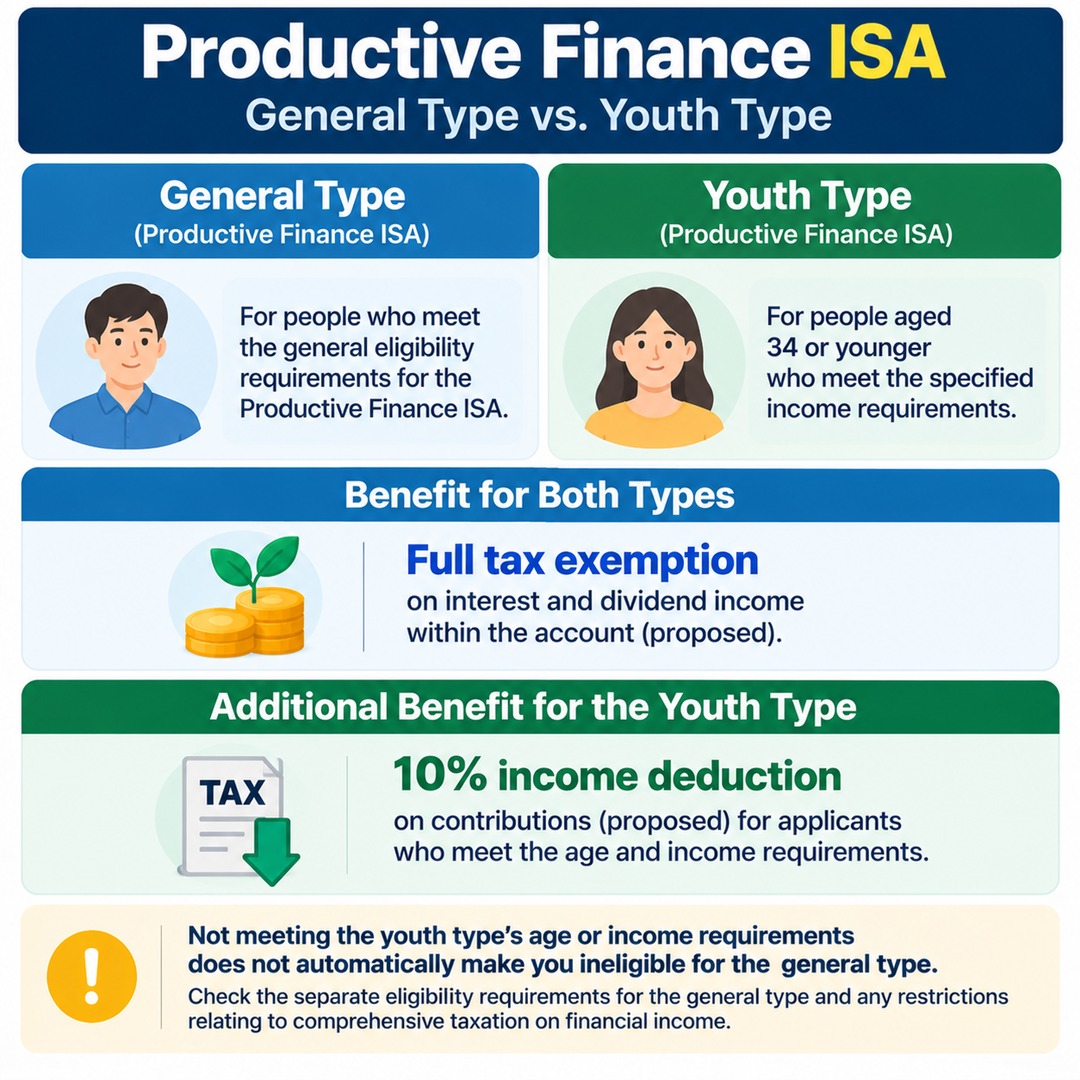
The main difference between the youth and general types is the additional income deduction. Under the government proposal, both types would receive a full exemption from tax on interest and dividend income within the account. The youth type would also provide a 10% income deduction on contributions for applicants who meet the age and income requirements.
General type: For people who meet the general eligibility requirements for the Productive Finance ISA.
Youth type: For people aged 34 or younger who meet the specified income requirements.
Shared benefit: The government proposal provides for a full tax exemption on interest and dividend income within the account.
Additional benefit: The youth type includes a proposed 10% income deduction on contributions.
Failing to meet the youth type’s age or income requirements does not automatically mean that you are ineligible for the general type of Productive Finance ISA. You should check the separate eligibility requirements for the general type and any restrictions relating to comprehensive taxation on financial income.
When can you apply, and should you apply now?
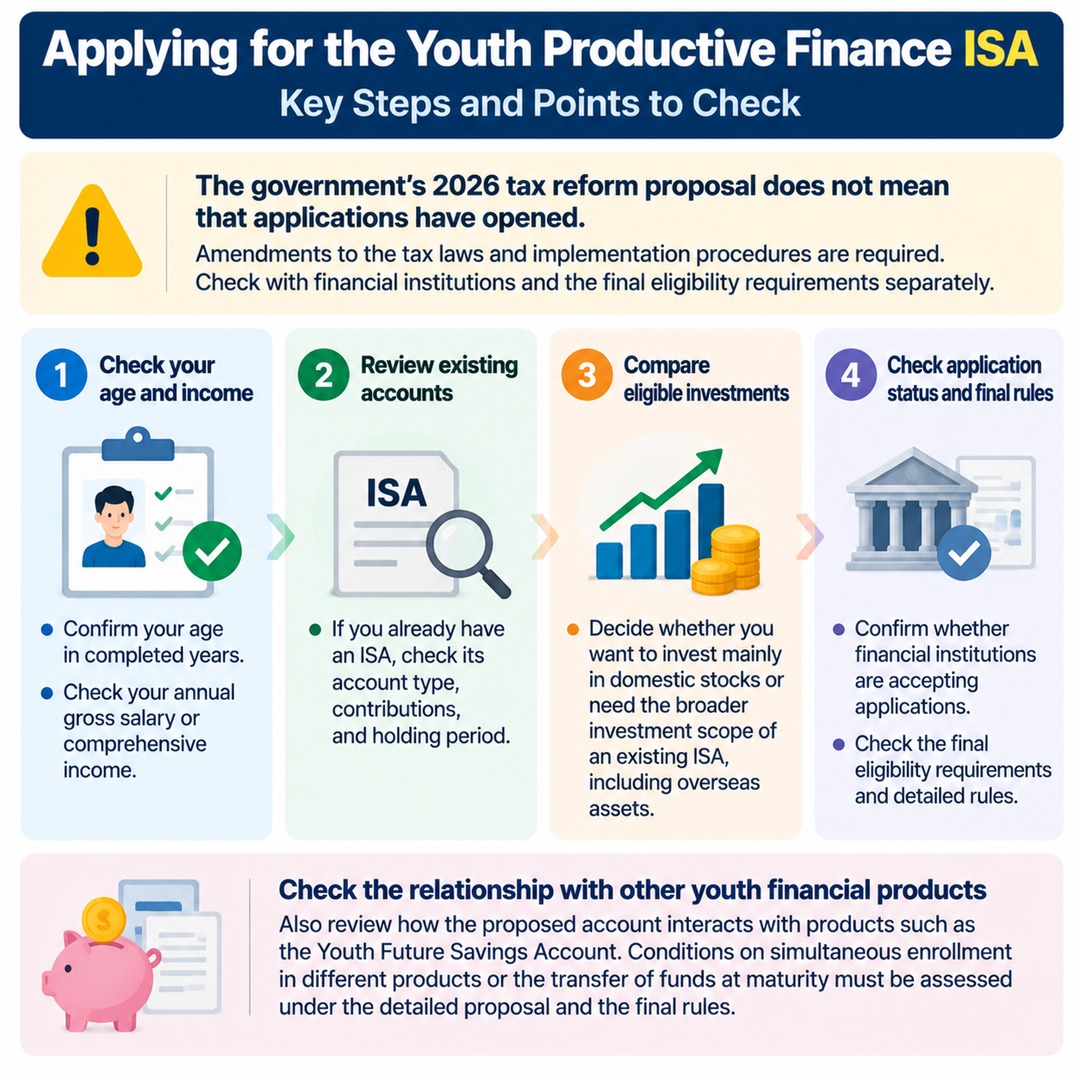
The announcement of the government’s 2026 tax reform proposal does not, by itself, mean that applications have opened. Amendments to the relevant tax laws and the associated implementation procedures are required. You should separately confirm whether financial institutions are accepting applications for the new account and whether the final eligibility requirements have been established.
If you are preparing to apply, follow these steps:
1. Check your age and income: Confirm your age in completed years and your annual gross salary or comprehensive income.
2. Review existing accounts: If you already have an ISA, check its account type, contributions, and holding period.
3. Compare eligible investments: Decide whether you want to invest primarily in domestic stocks or need the broader investment scope of an existing ISA, including overseas assets.
4. Confirm implementation: Review the final tax legislation and financial institution announcements for the application opening date, tax benefits, deduction limits, and rules on holding multiple accounts.
You should also check how the proposed account interacts with other youth financial products, such as the Youth Future Savings Account. Conditions concerning simultaneous enrollment in different products or the transfer of funds at maturity must be assessed under the detailed proposal and the final rules.
Should you close your existing ISA and switch to the new account?
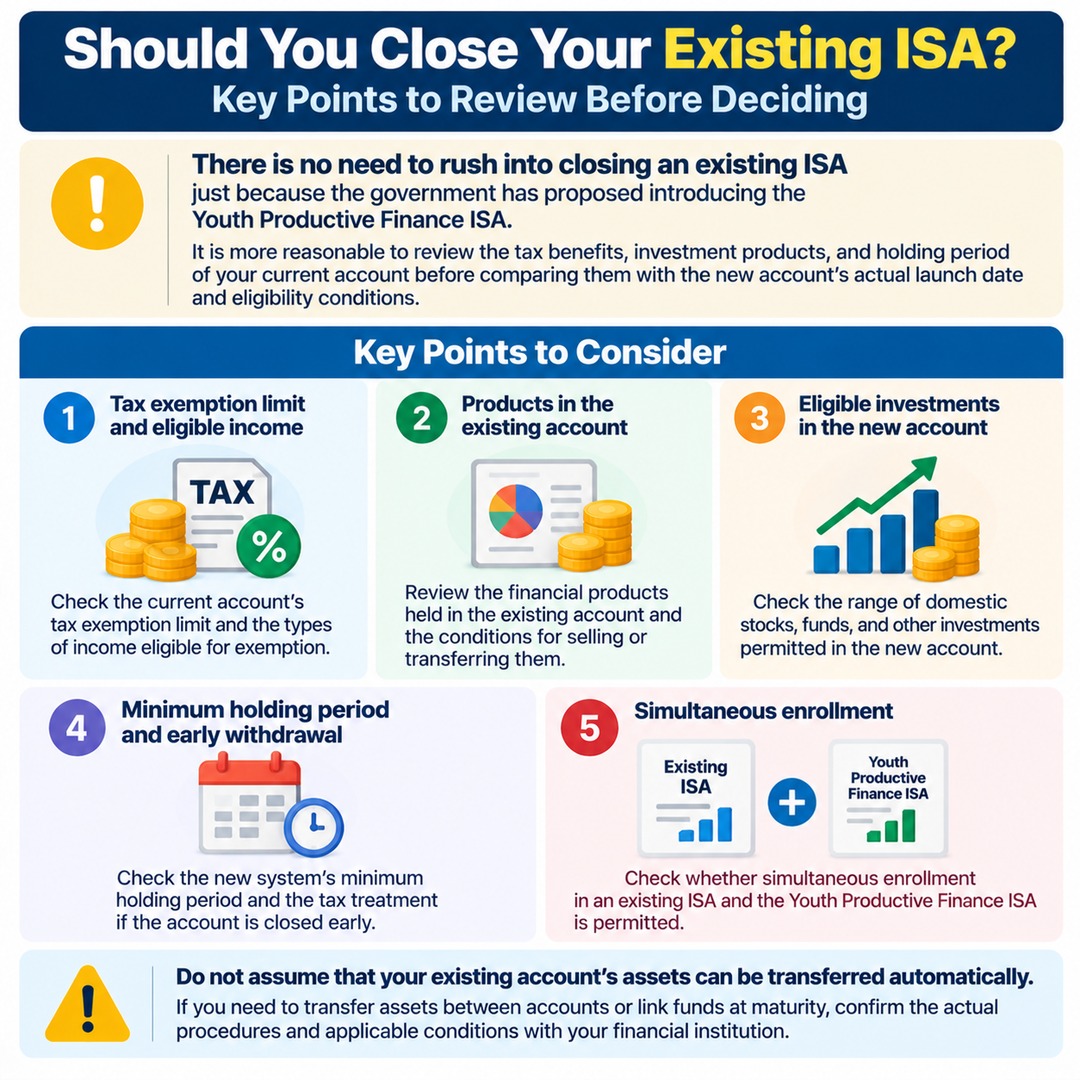
There is no need to rush into closing an existing ISA simply because the government has proposed introducing the Youth Productive Finance ISA. It is more reasonable to review the tax benefits, investment products, and holding period of your current account before comparing them with the new account’s actual launch date and eligibility conditions.
When deciding whether to keep your existing ISA, consider the following:
The current account’s tax-exemption limit and the types of income eligible for exemption
The financial products held in the existing account and the conditions for selling or transferring them
The range of domestic stocks, funds, and other investments permitted in the new account
The new system’s minimum holding period and tax treatment if the account is closed early
Whether simultaneous enrollment in an existing ISA and the Youth Productive Finance ISA is permitted
Even if the new account offers greater tax benefits, you should not assume that assets in your existing account can be transferred automatically. If you need to transfer assets between accounts or link funds at maturity, confirm the actual procedures and applicable conditions with your financial institution.
Frequently asked questions
Can I open the youth account if I am older than 34?
The youth age limit proposed by the government is 34 or younger. However, the age assessment date used to determine eligibility and the detailed conditions must be checked against the finalized rules.
Am I automatically excluded if my annual gross salary exceeds KRW 75 million?
Even if your gross salary exceeds the threshold, you should check whether you meet the comprehensive income threshold and other requirements applicable to your income type. The government proposal specified annual gross salary of KRW 75 million or less, or comprehensive income of KRW 63 million or less. Final eligibility must be determined under the enacted legislation.
Will I receive 10% of my contributions back in cash?
No. An income deduction reduces the amount of income subject to tax by a specified amount. The actual reduction in tax depends on your applicable tax rate, deduction limits, and individual circumstances.
Can existing ISA holders use the new account too?
Whether existing ISA holders can open the new account or hold both accounts simultaneously depends on the final rules. Rather than deciding to close or transfer your current account first, check the eligibility requirements and account-transfer arrangements.
When considering the Youth Productive Finance ISA, start by checking whether you are aged 34 or younger, whether you meet the income requirements, whether the system has actually taken effect, and which investments are permitted. Rather than rushing to apply, compare the new account with your existing ISA after the final conditions have been confirmed.
*This article provides general information to help readers understand market developments and is not a recommendation to invest in any particular security or asset. You are responsible for your own investment decisions and their consequences.*