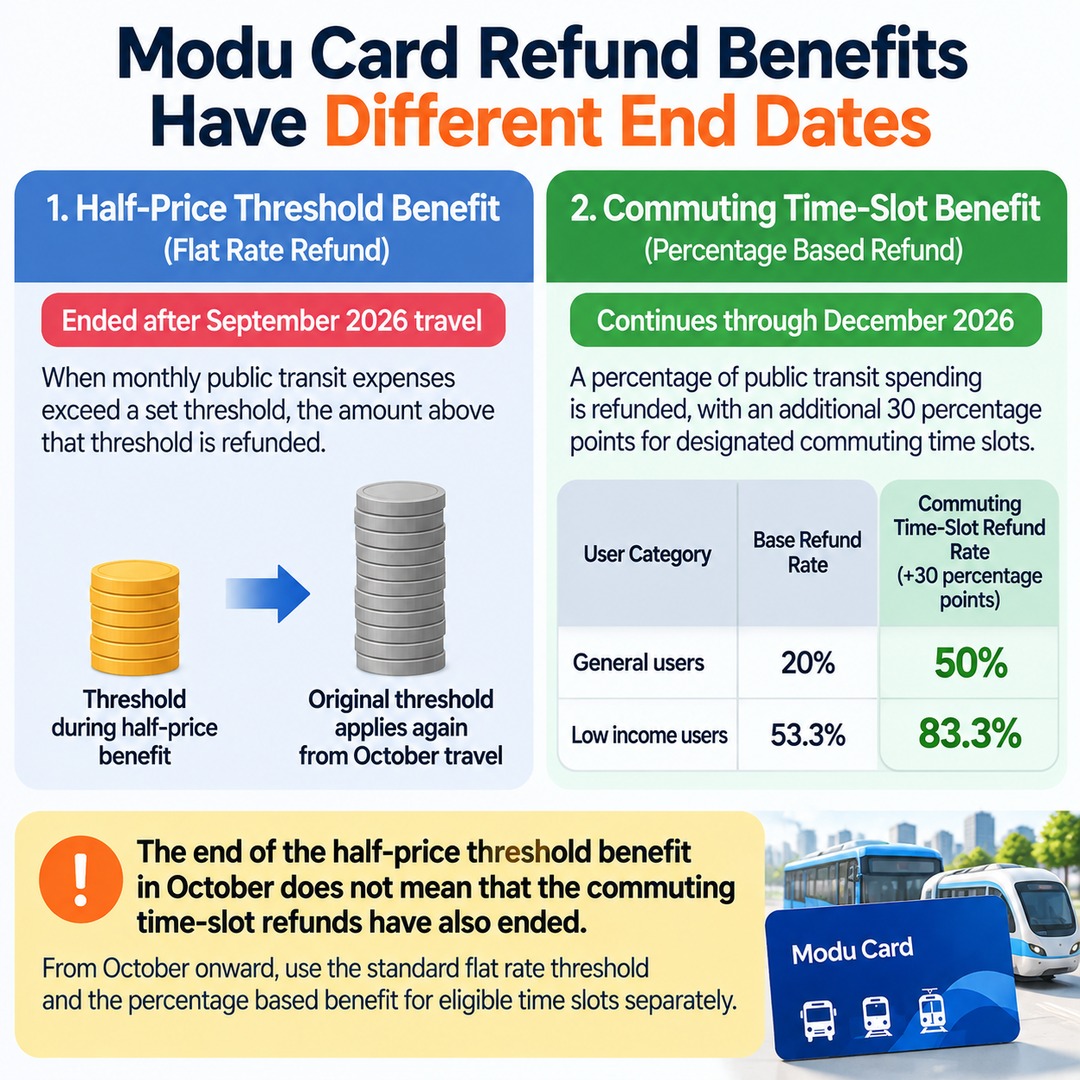

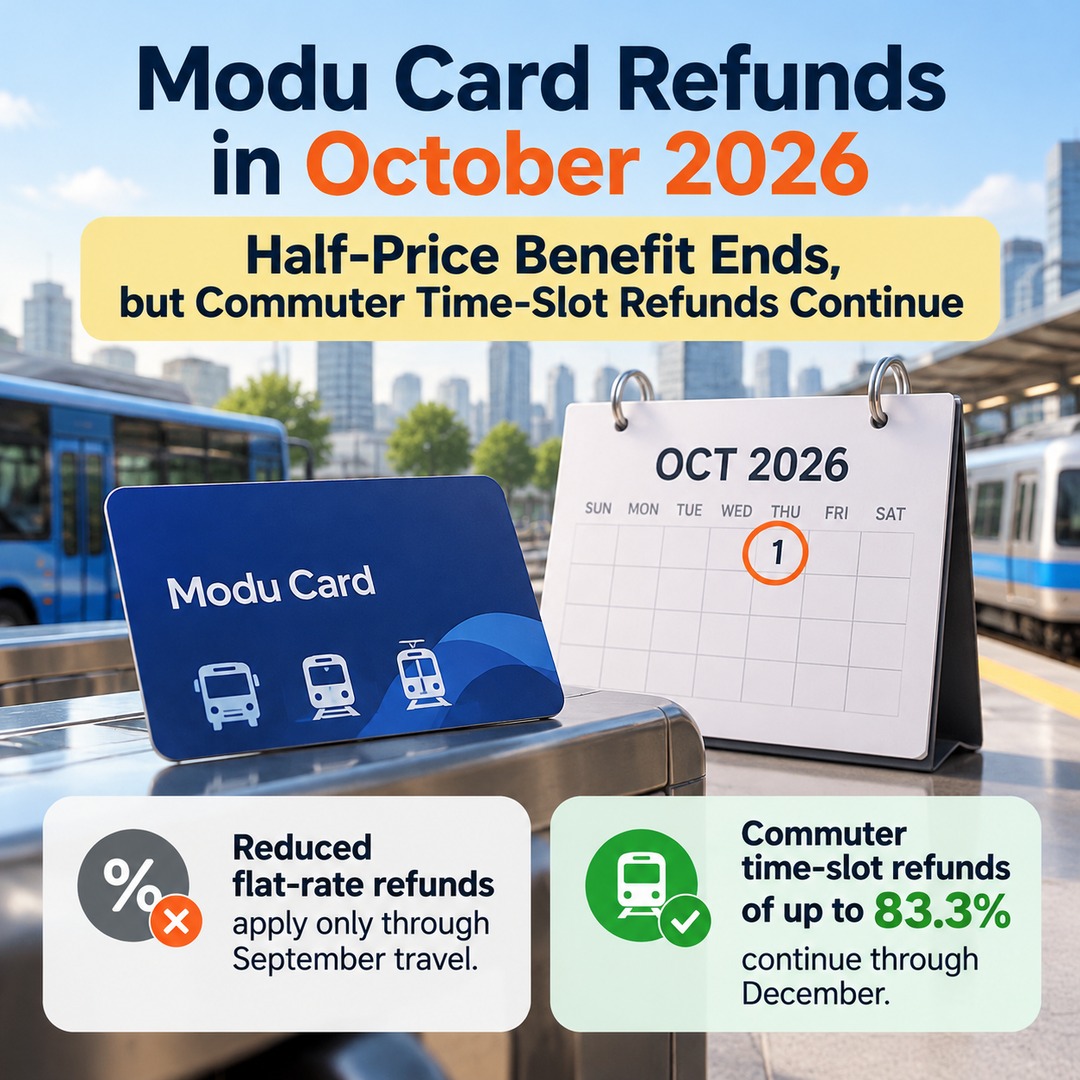
Starting in October 2026, the benefit that cut the Modu Card's flat-rate refund threshold in half has ended, but the benefit that increases public transit refund rates for designated commuting time slots continues through December. General users can receive a refund of 50% during eligible time slots, while low-income users can receive up to 83.3%. The key distinction is that these two benefits have different end dates.
Which Modu Card Refund Benefits Remain After the Half-Price Benefit Ends?
The benefit that ended after September 2026 travel was the reduction in the threshold used to calculate flat-rate refunds. By contrast, the additional percentage-based refunds for designated commuting time slots have been extended through December.
The two benefits use different refund calculation methods.
Flat-rate refund: If monthly public transit expenses exceed a specified threshold, the amount above that threshold is refunded. During the half-price benefit period, the threshold was reduced. Starting with October travel, the original threshold applies again.
Percentage-based refund: A specified percentage of public transit spending is refunded. For designated commuting time slots, an additional 30 percentage points are added to the existing refund rate through the end of the year.
Therefore, the end of the half-price benefit in October does not mean that the additional commuting time-slot refunds have also ended. From October onward, users should distinguish between the standard flat-rate threshold and the percentage-based benefit for eligible time slots.
What Are the Designated Commuting Time Slots, and When Must You Travel to Qualify?
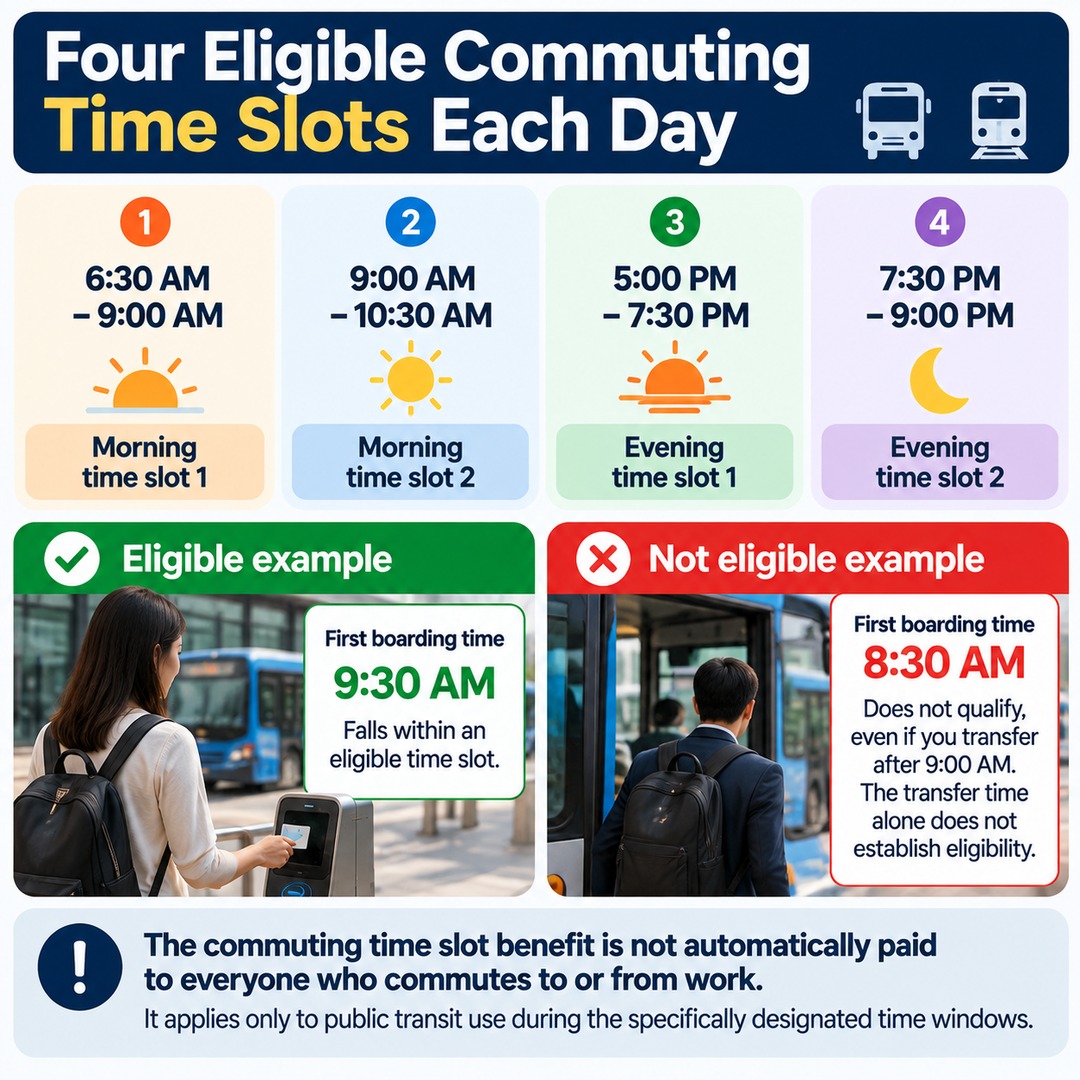
There are four eligible time slots each day. To determine whether a trip qualifies, check whether the time of your first boarding falls within one of these windows.
| Time Slot | Eligible Hours |
|---|---|
| Early morning | 5:30 a.m.–6:30 a.m. |
| Morning | 9:00 a.m.–10:00 a.m. |
| Afternoon | 4:00 p.m.–5:00 p.m. |
| Evening | 7:00 p.m.–8:00 p.m. |
For example, taking public transit at 9:30 a.m. falls within an eligible time slot. However, if you first board at 8:30 a.m., you should not assume that the trip qualifies for the additional refund simply because you transfer after 9:00 a.m. The transfer time alone does not establish eligibility.
The commuting time-slot benefit is not automatically paid to everyone who commutes to or from work. It applies to public transit use during the specifically designated time windows.
How Do Refund Rates Differ by User Category?
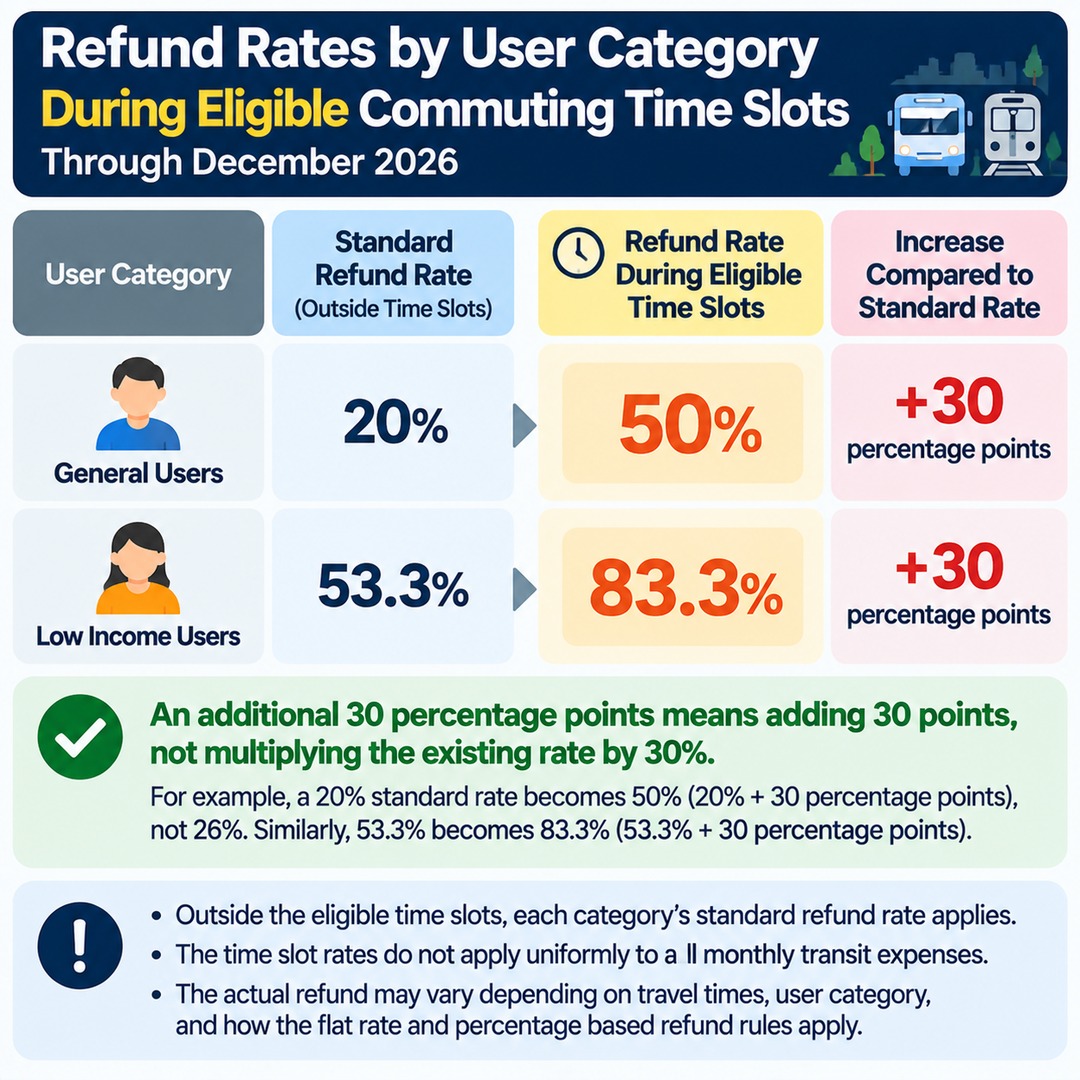
Through December 2026, the refund rate during eligible time slots ranges from 50% for general users to a maximum of 83.3% for low-income users. Outside these time slots, each category's standard refund rate applies.
| User Category | Eligible Time Slots | Other Times |
|---|---|---|
| General users | 50% | 20% |
| Young adults, families with two children, and older adults | 60% | 30% |
| Families with three or more children | 80% | 50% |
| Low-income users | 83.3% | 53.3% |
During eligible time slots, the refund rate is 30 percentage points higher than the standard rate for each category. An additional 30 percentage points does not mean multiplying the existing refund rate by 30%; it means adding 30 percentage points to the rate itself.
For example, the standard refund rate for general users is 20%, rising to 50% during eligible time slots. For low-income users, the rate increases from 53.3% to 83.3%.
However, these rates should not be assumed to apply uniformly to all monthly transit expenses. The actual refund may vary depending on travel times, user category, and how the flat-rate and percentage-based refund rules apply.
What Should You Check When Using Public Transit in October?
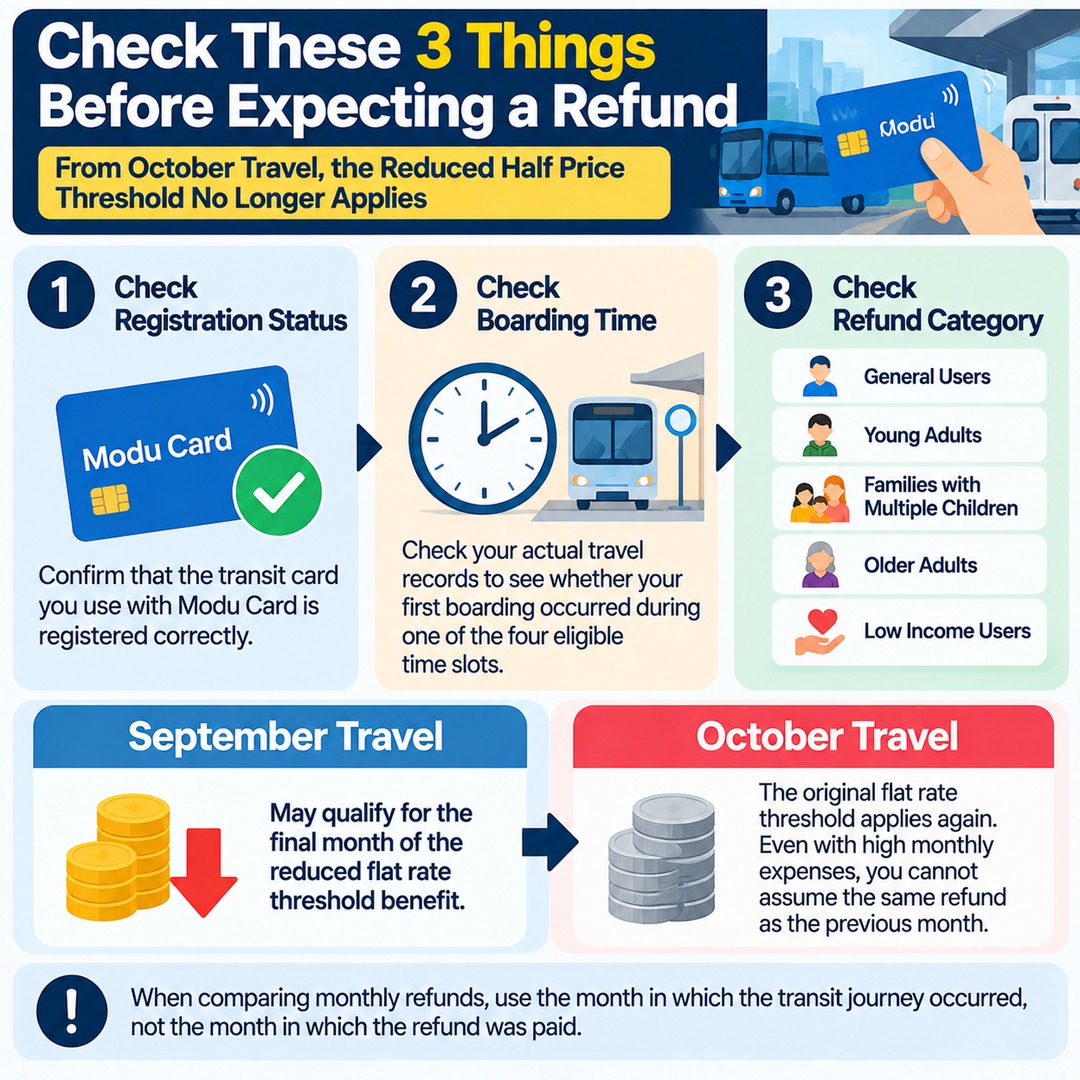
Starting with October travel, the reduced half-price threshold no longer applies. Even if your monthly transit expenses are high, you cannot assume you will receive the same refund as in the previous month. Instead, check your eligible time-slot trips and your registered refund category together.
There are three things to check.
1. Registration status: Confirm that the transit card you use with Modu Card is registered correctly.
2. Boarding time: Check your actual travel records to see whether your first boarding occurred during one of the four eligible time slots.
3. Refund category: Confirm which category applies to you: general users, young adults, families with multiple children, older adults, or low-income users.
In particular, distinguish between September and October travel when comparing monthly refunds. Transit expenses incurred in September may qualify for the final month of the reduced flat-rate threshold benefit, while the original flat-rate threshold applies again to October travel. For an accurate comparison, use the month in which the transit journey occurred, not the month in which the refund was paid.
Will the Additional Time-Slot Refund Continue in 2027?
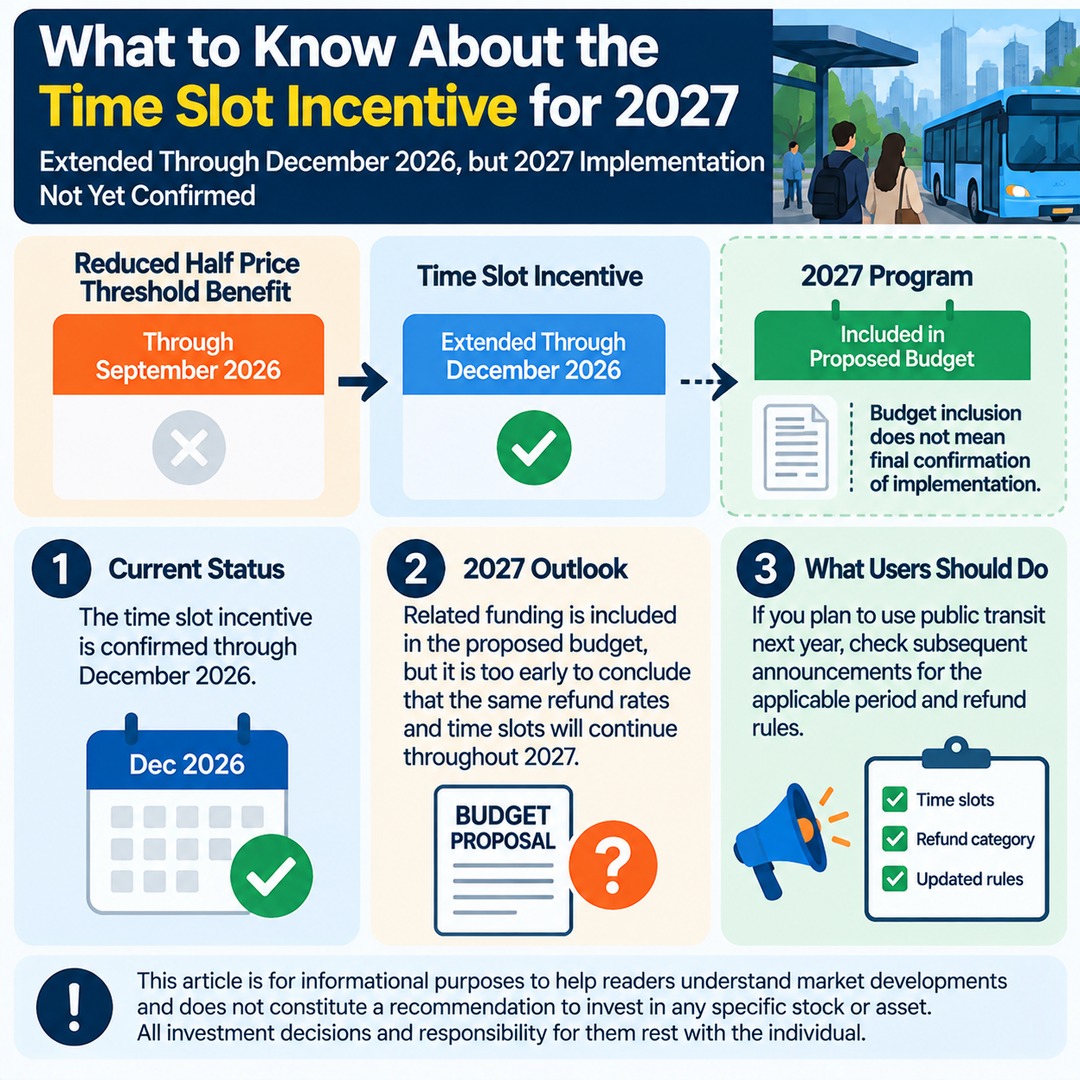
The government extended the time-slot incentive through December 2026 and included related funding in its proposed budget to continue the benefit in 2027. However, inclusion in a proposed budget is not the same as final confirmation that the program will be implemented.
The currently confirmed extension runs through December 2026. It is therefore too early to conclude that the same refund rates and time slots will remain in place throughout 2027. Anyone planning transit use for next year should check subsequent announcements for the applicable period and refund rules.
The most important point when calculating transit refunds from October onward is straightforward: the half-price flat-rate benefit has ended, but additional refunds for designated commuting time slots remain available through the end of the year. If you regularly use public transit, start by checking the four eligible time slots and your refund category.
Note: This article is for informational purposes to help readers understand market developments and does not constitute a recommendation to invest in any specific stock or asset. All investment decisions and responsibility for them rest with the individual.