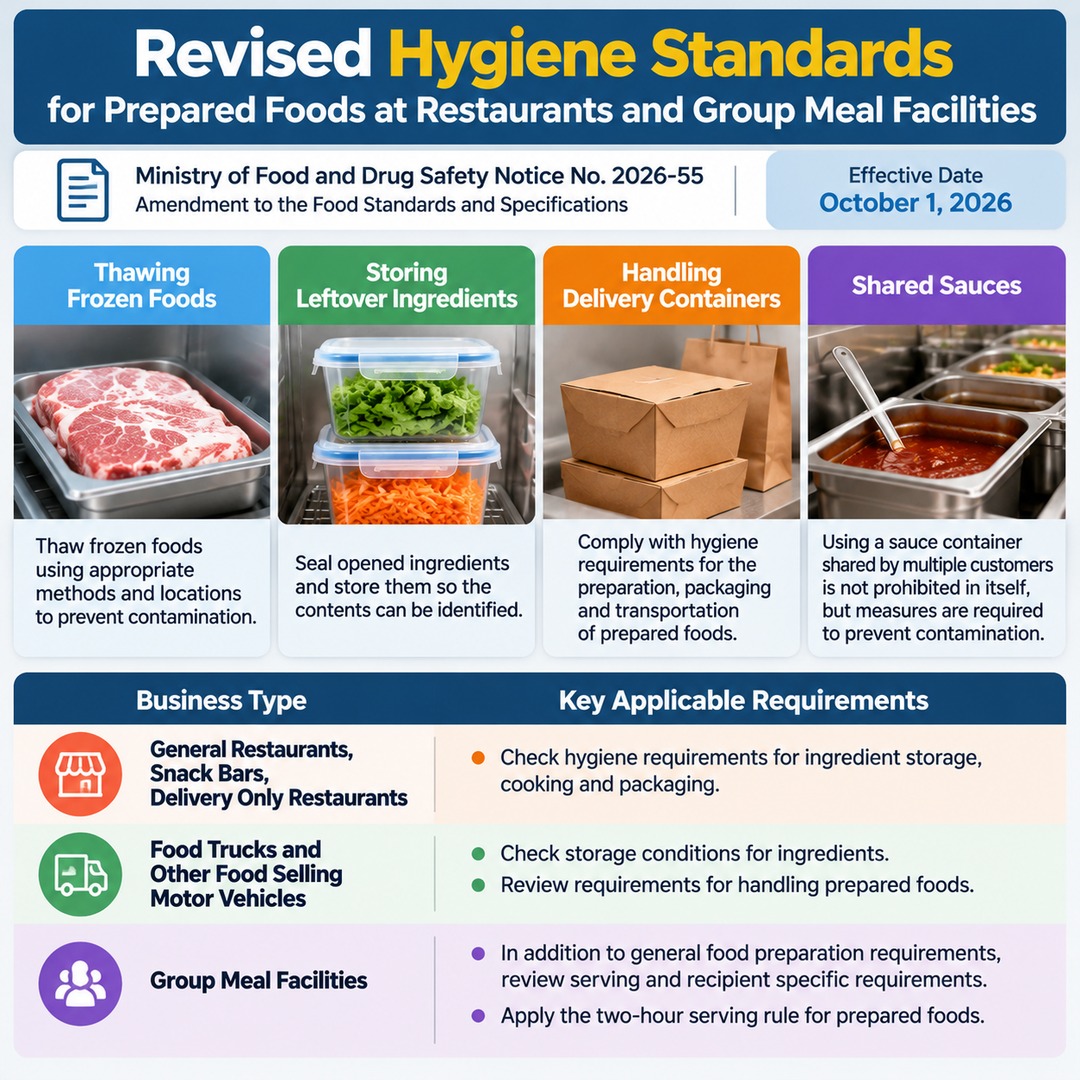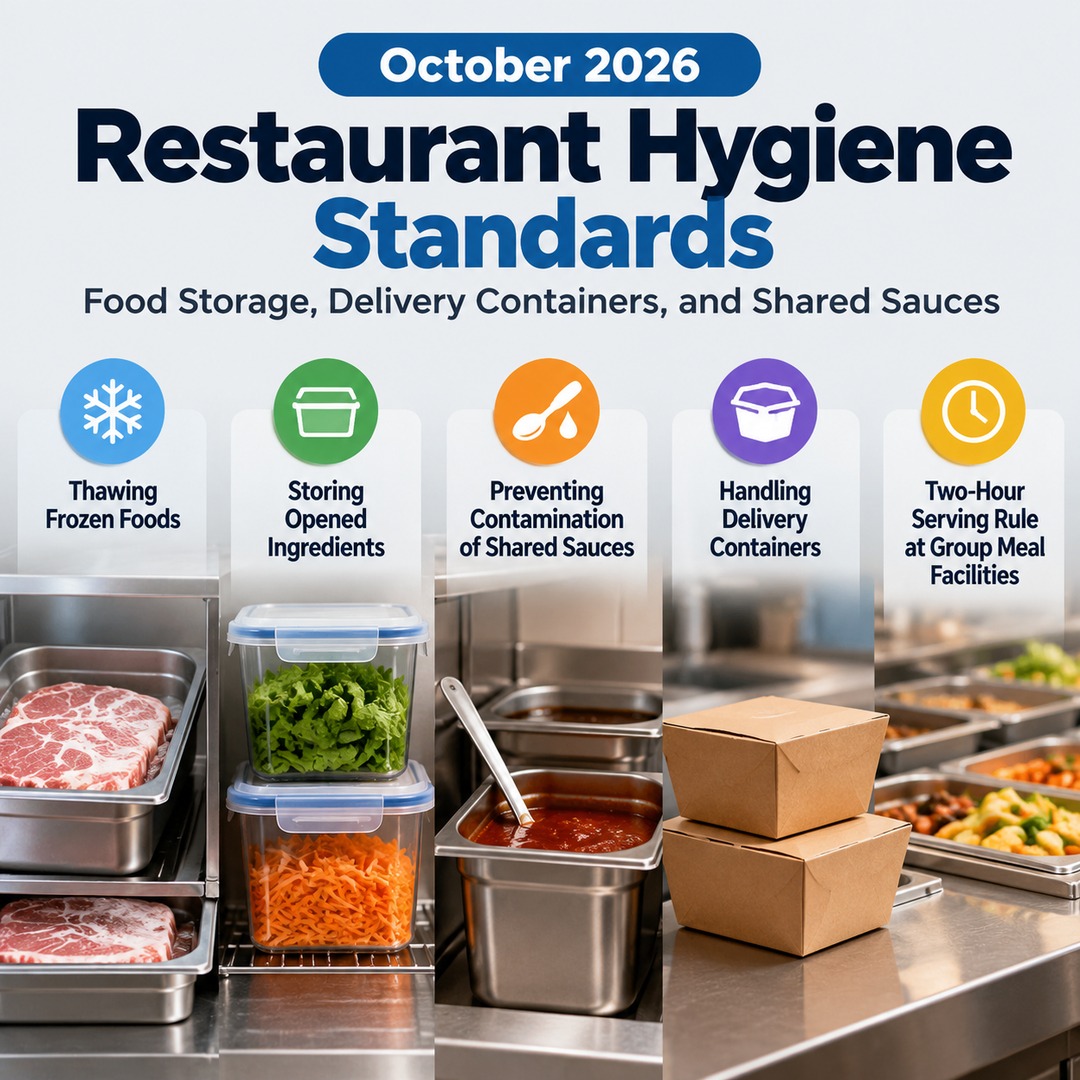
The revised hygiene standards for prepared foods at restaurants and group meal facilities in South Korea took effect on October 1, 2026. Key areas include thawing frozen foods, sealing and storing leftover ingredients, handling delivery containers, and preventing contamination of shared sauces. However, using a sauce container shared by multiple customers is not prohibited in itself, and the requirement to serve food within two hours of preparation does not apply uniformly to every restaurant.
The main purpose of the revision is to specify hygiene management practices throughout the process, from food preparation to packaging and transportation. General restaurants, delivery-only restaurants, food trucks, and group meal facilities should determine which provisions apply to them based on their business type and the relevant requirements.
Which food businesses are covered by the hygiene standards introduced in October?
The revision was introduced under Korea's Ministry of Food and Drug Safety Notice No. 2026-55, which amended the *Food Standards and Specifications*. It took effect on October 1, 2026. The main areas covered include the handling of ingredients and the preparation, packaging, and transportation of prepared foods at food service establishments and group meal facilities.
To understand the scope of the requirements, first distinguish between restaurants and institutional meal facilities.
General restaurants, snack bars, and delivery-only restaurants: Check the applicable hygiene requirements for ingredient storage, cooking, and packaging.
Food trucks and other food-selling motor vehicles: Check the storage conditions for ingredients as well as the requirements for handling prepared foods.
Group meal facilities: In addition to general food preparation requirements, review the serving and recipient-specific standards applicable to institutional meal services.
The revised notice introduced or strengthened hygiene management requirements for prepared foods. This does not mean that every individual provision applies in exactly the same way to every type of food business.
How should the storage temperature of delivered food be checked?
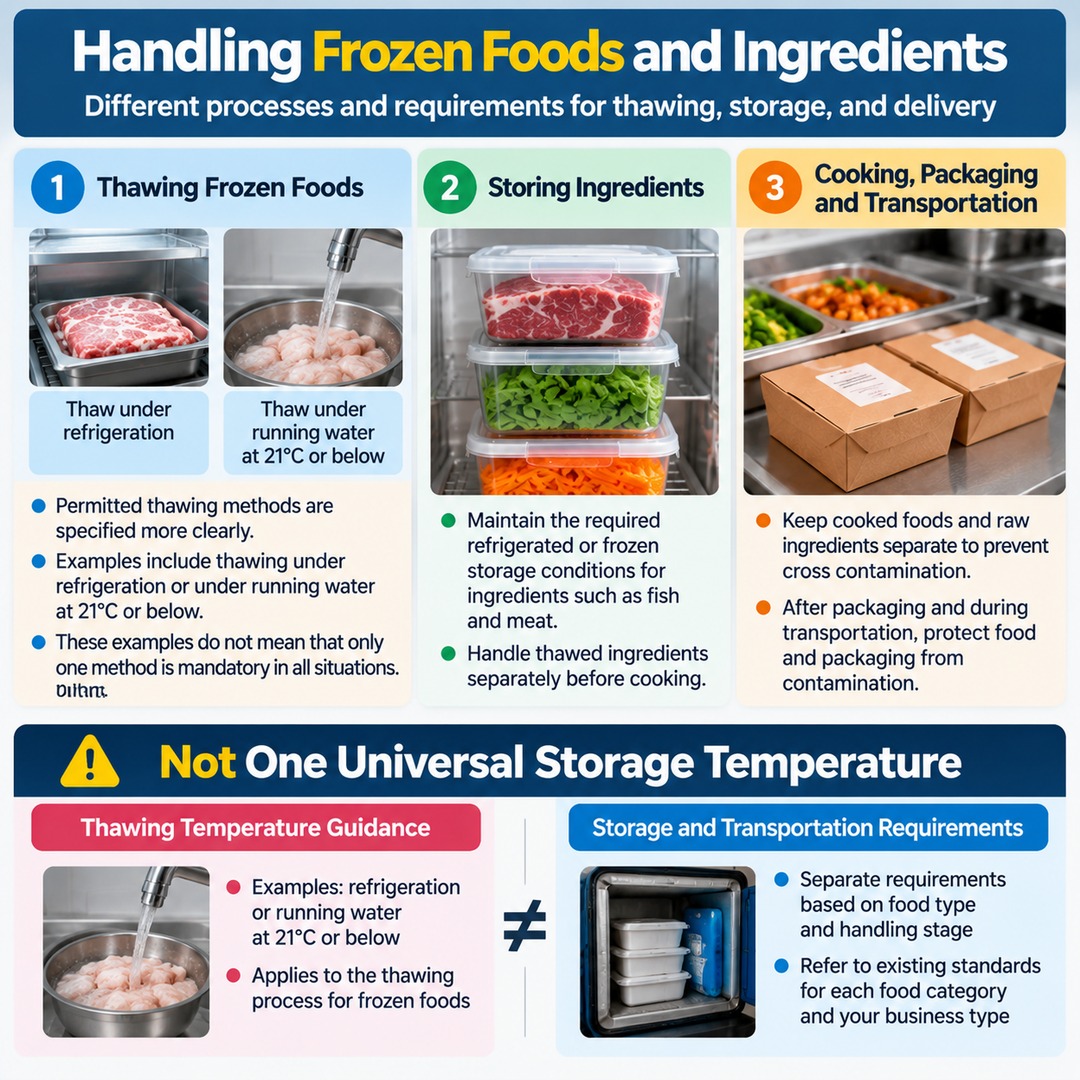
The revision should not be interpreted as imposing one universal storage temperature on all delivered foods. Instead, the appropriate handling method depends on the type of food and the stage at which it is being handled. In particular, thawing frozen foods and storing ingredients are separate processes that require separate consideration.
The permitted approaches to thawing frozen foods have been specified more clearly. Examples include thawing under refrigeration or under running water at 21°C or below. However, these examples should not be interpreted as meaning that only one particular thawing method is mandatory in every situation.
Restaurants should review the following:
Where and how frozen foods are thawed.
How thawed ingredients are handled before cooking.
Whether the required refrigerated or frozen storage conditions for ingredients such as fish and meat are maintained.
Whether cooked foods and raw ingredients are kept separate to prevent cross-contamination.
Whether food and packaging are protected from contamination after packaging and during transportation.
The important distinction is that the temperature guidance for thawing must not be treated as identical to the storage and transportation temperature requirements for prepared foods. The publicly available guidance on this revision does not establish one temperature that can be applied to every food. Restaurants must also check the existing standards for each food category and the provisions applicable to their establishment.
Is sealing leftover ingredients enough?
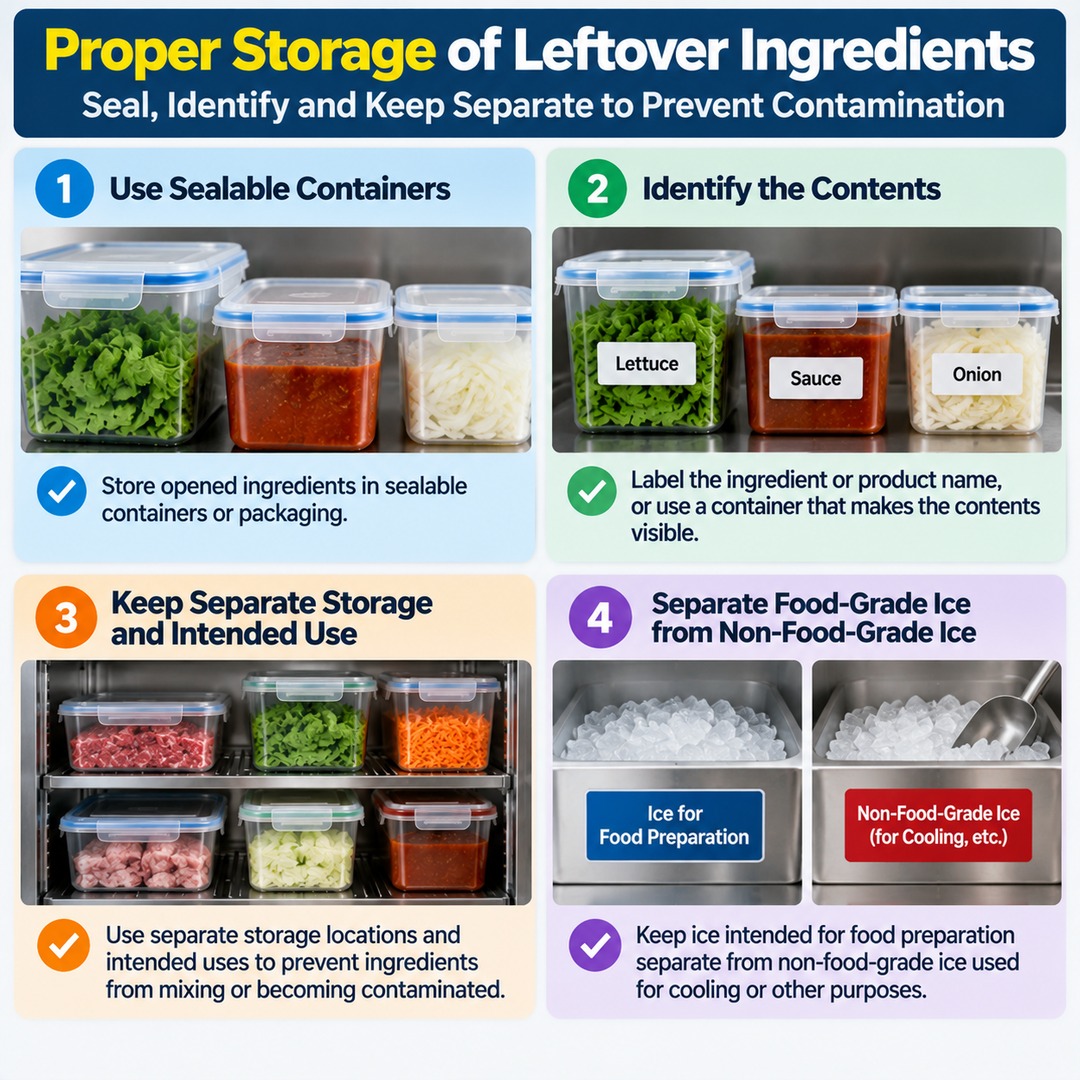
Leftover ingredients should not only be sealed; they should also be stored so that their contents can be identified. If an ingredient is removed from its original packaging and transferred to another container, staff should be able to determine what the container holds.
In practice, businesses can manage ingredients as follows:
Store opened ingredients in sealable containers or packaging.
Identify the contents by labeling the ingredient or product name, or by using a container that makes the contents visible.
Separate storage locations and intended uses to prevent ingredients from mixing or becoming contaminated.
Keep ice intended for food preparation separate from non-food-grade ice used for cooling or other purposes.
For example, if an opened sauce ingredient is transferred to another container, closing the lid is not enough on its own. Staff should also be able to identify what is inside.
Can restaurants continue using shared sauce containers and self-service bars?
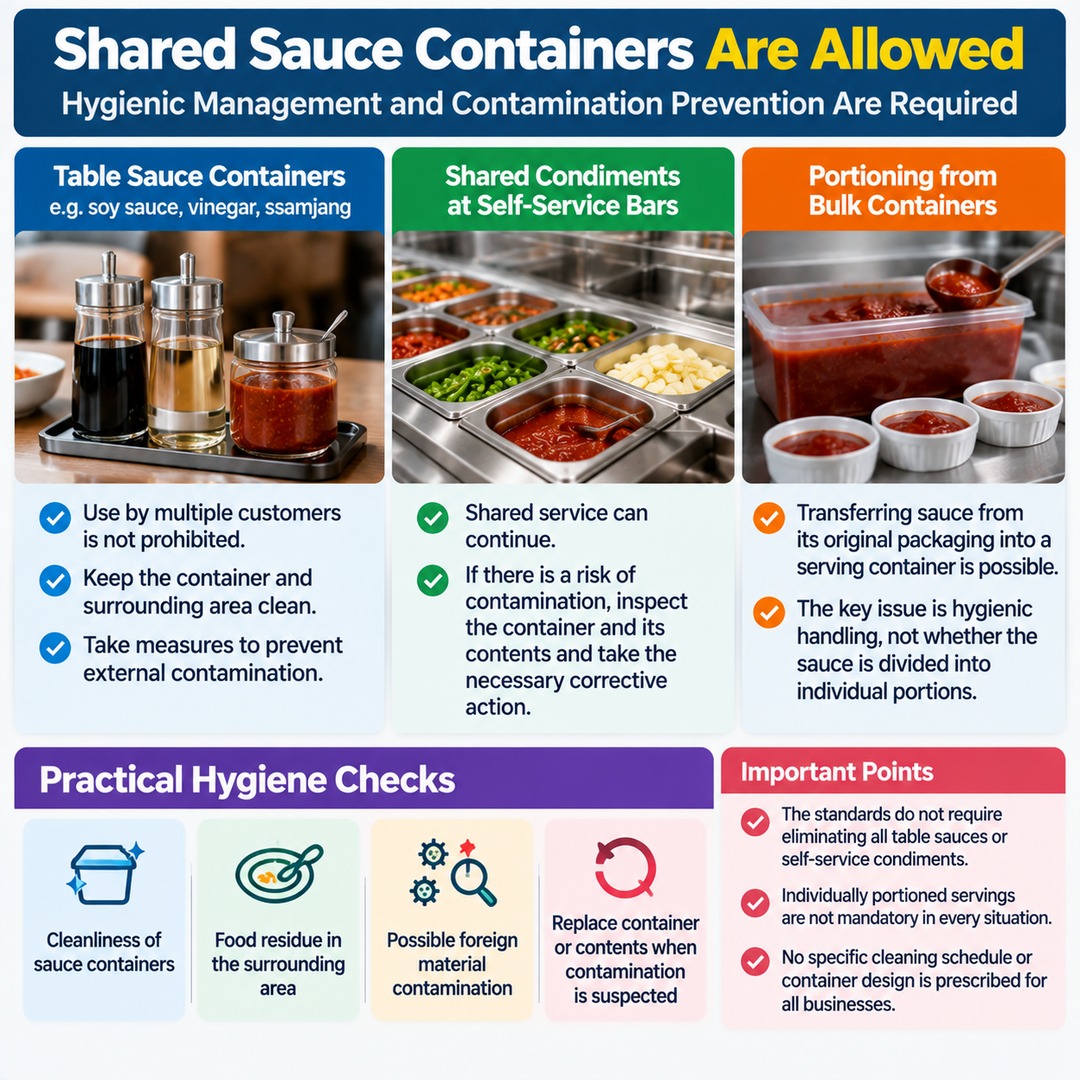
Operating shared sauce containers or self-service bars is not prohibited in itself. The revised standards require sauces and similar items that customers serve themselves to be portioned and provided hygienically, with precautions to prevent contamination from external sources.
This should not be interpreted as requiring restaurants to eliminate all table sauces, such as soy sauce and vinegar, or condiments such as ssamjang (a Korean dipping paste commonly served with grilled meat). Nor does it mean that every customer must always receive an individually portioned serving.
Sauce containers on tables
The use of a container by multiple customers is not prohibited in itself. Keep the container and surrounding area clean, and take measures to prevent external contamination.
Shared condiments at self-service bars
Shared service can continue. However, if there is a risk of contamination, inspect the container and its contents and take the necessary corrective action.
Portioning sauces from bulk containers
Transferring sauce from its original packaging into a serving container is also possible. The key issue is hygienic handling, not whether the sauce is divided into individual portions.
Practical checks include the cleanliness of sauce containers, food residue in the surrounding area, possible foreign-material contamination, and procedures for replacing containers or contents when contamination is suspected. Do not arbitrarily prescribe a cleaning schedule or container design as a legal requirement applicable to every situation.
What should restaurants change about delivery containers and packaging?
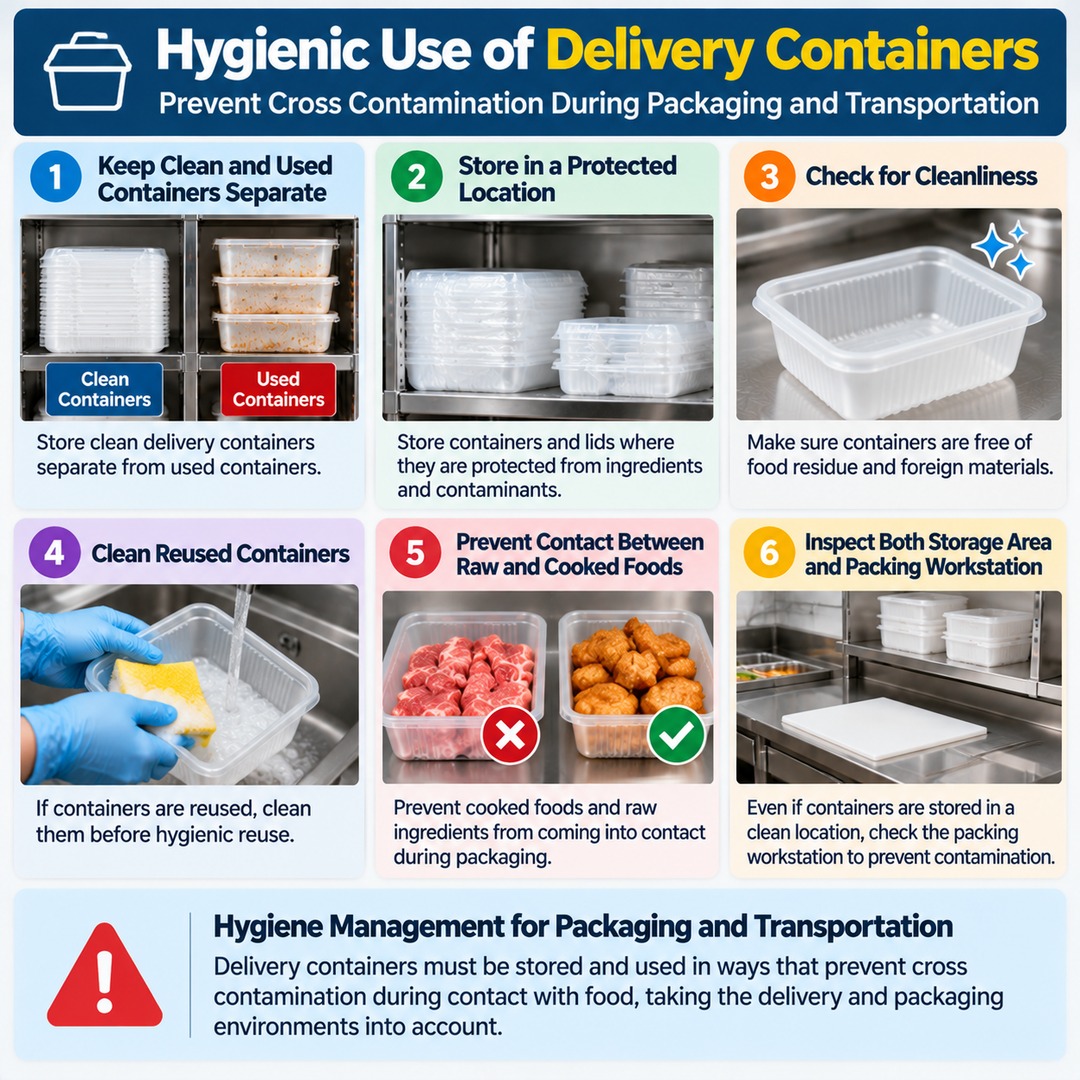
Delivery containers must be stored and used in ways that prevent cross-contamination during contact with food. The revision specifies hygiene management requirements for the packaging and transportation of prepared foods, taking delivery and packaging environments into account.
Restaurants should check the following:
Keep clean delivery containers separate from used containers.
Store containers and lids in locations where they are protected from ingredients and contaminants.
Check that containers are free of food residue and foreign materials.
If containers are reused, clean them before hygienic reuse.
Prevent cooked foods and raw ingredients from coming into contact with one another during packaging.
Even if packaging containers are stored in a clean location, contamination during the actual food-packing process can still undermine hygiene. Both the storage area and the packing workstation should be inspected.
Does the two-hour serving rule apply to every restaurant?
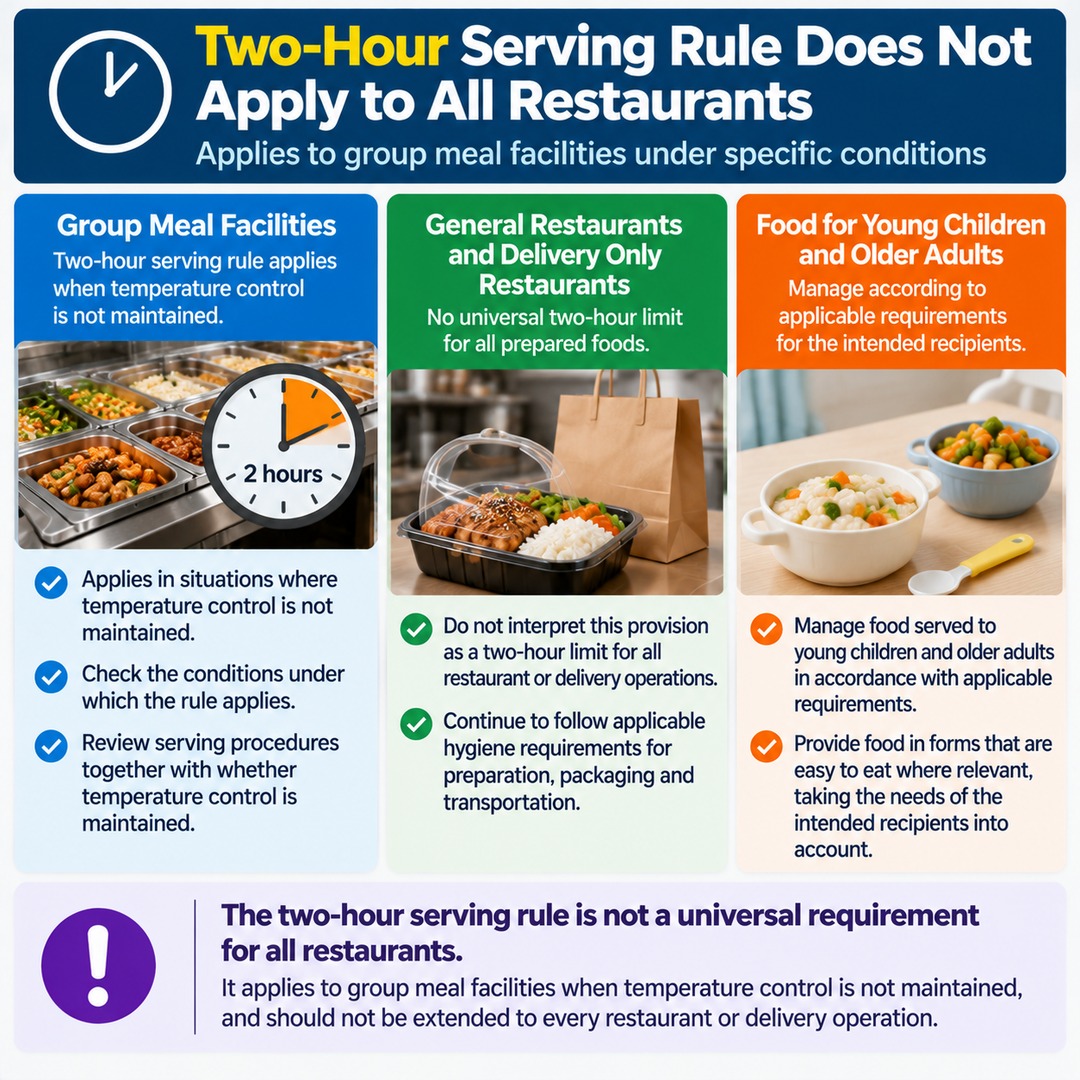
No. Under the revision, the requirement to serve food within two hours of preparation relates to group meal facilities in circumstances where temperature control is not maintained. It must not be extended to mean that every restaurant must sell or deliver all prepared foods within two hours of cooking.
Operators of group meal facilities should check the conditions under which the rule applies and review serving procedures alongside whether temperature control is maintained. General restaurants and delivery-only restaurants should not conclude that this provision creates a universal two-hour limit for all their operations.
Food served to young children and older adults should also be managed in accordance with applicable requirements that take the needs of the intended recipients into account, including serving food in forms that are easy to eat where relevant.
What should restaurants inspect first?
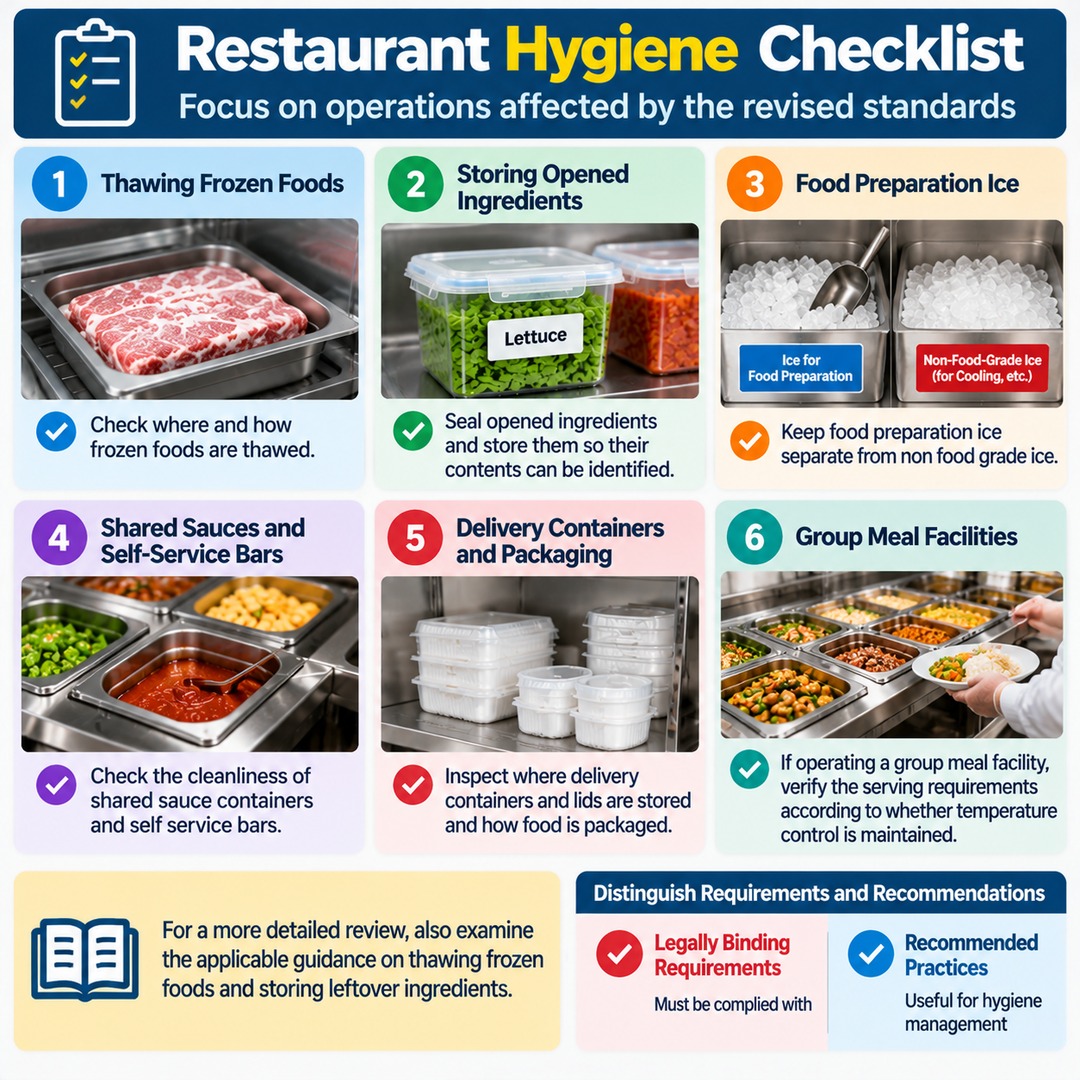
It is most efficient for businesses to start with the operations directly affected by the revised standards. The following list can be used as a store-level checklist, but recommended practices and legally binding requirements should be distinguished.
Check where and how frozen foods are thawed.
Seal opened ingredients and store them so their contents can be identified.
Keep food-preparation ice separate from non-food-grade ice.
Check the cleanliness of shared sauce containers and self-service bars.
Inspect where delivery containers and lids are stored and how food is packaged.
If operating a group meal facility, separately verify the serving requirements applicable according to whether temperature control is maintained.
For a more detailed review, also examine the applicable guidance on thawing frozen foods and storing leftover ingredients.