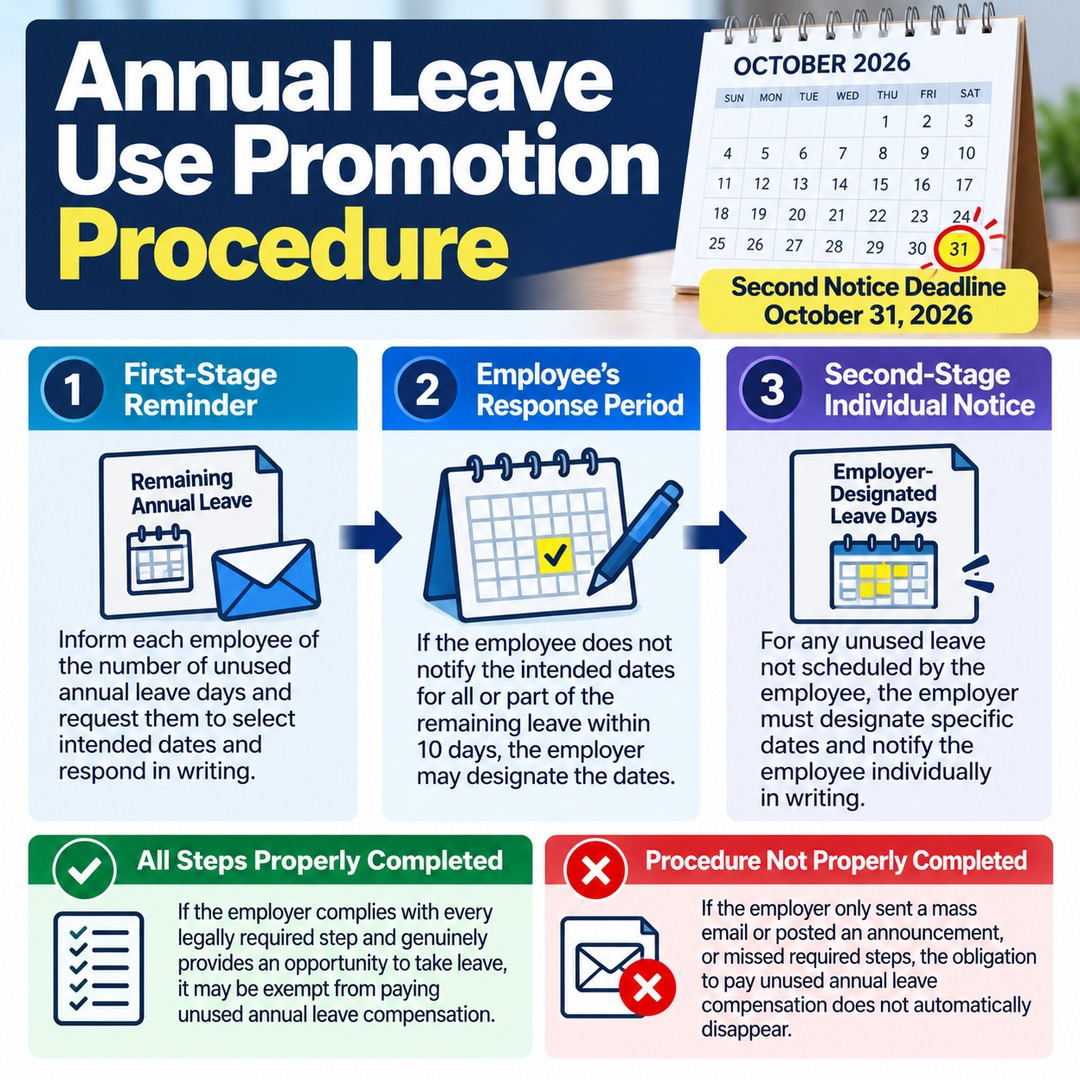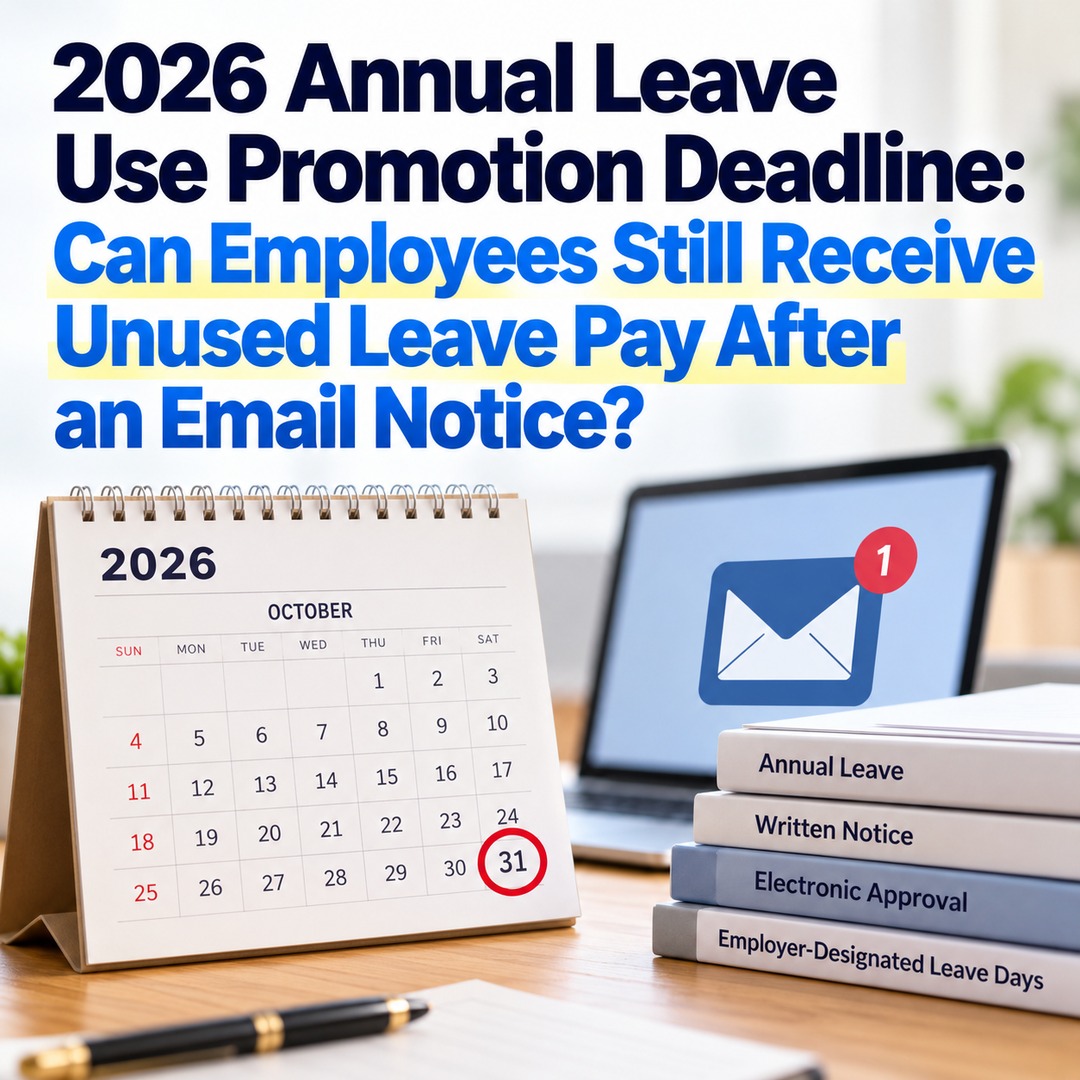
For ordinary annual paid leave in South Korea with a usage period ending on December 31, 2026, the deadline for the second statutory leave use promotion notice is October 31. If an employer has only notified employees by email, its obligation to compensate them for unused annual leave does not automatically disappear. The outcome depends on whether the first reminder was issued, whether individual written notice requirements were legally satisfied, and whether the employee actually used the leave.
In particular, if an employer refuses to pay unused annual leave compensation simply because it sent a mass email or posted an announcement on an internal bulletin board, employees should check whether the statutory leave use promotion procedure was properly completed.
Conversely, if the employer complied with every legally required step and genuinely provided employees with an opportunity to take their leave, the employer may be exempt from paying compensation for unused annual leave.
What Must Employers Do by October 31?
For ordinary annual leave whose usage period expires on December 31, the employer must complete any required second-stage leave use promotion notice by October 31. However, this does not mean every employee must automatically receive a second notice.
Article 61 of South Korea's Labor Standards Act establishes a two-stage annual leave use promotion procedure.
First-stage reminder
July 1–10
*Stage for informing employees about their remaining annual leave*
The employer informs each employee of the number of unused annual leave days and requests that the employee select the dates on which they intend to use the leave and respond in writing.
Employee response
Within 10 days
*Stage for employees to select their leave dates*
If an employee who receives the first reminder does not notify the employer of the intended dates for using all or part of their remaining leave within 10 days, the employer may designate those dates.
Second-stage notice
October 31
*Stage for the employer to designate the dates for remaining leave*
For unused leave that the employee has not scheduled, the employer must designate specific dates and notify the employee individually in writing.
Importantly, October 31 is not a universal deadline for every type of annual leave. This schedule assumes ordinary annual leave whose usage period ends on December 31, 2026.
For employees whose annual leave usage periods expire on different dates based on their employment start dates, the promotion deadlines must be calculated from the applicable expiration dates.
Furthermore, if an employer missed the first-stage reminder in July, merely sending a notice in October does not correct the earlier procedural omission.
Can Employees Receive Unused Annual Leave Pay If Their Employer Only Sent an Email?
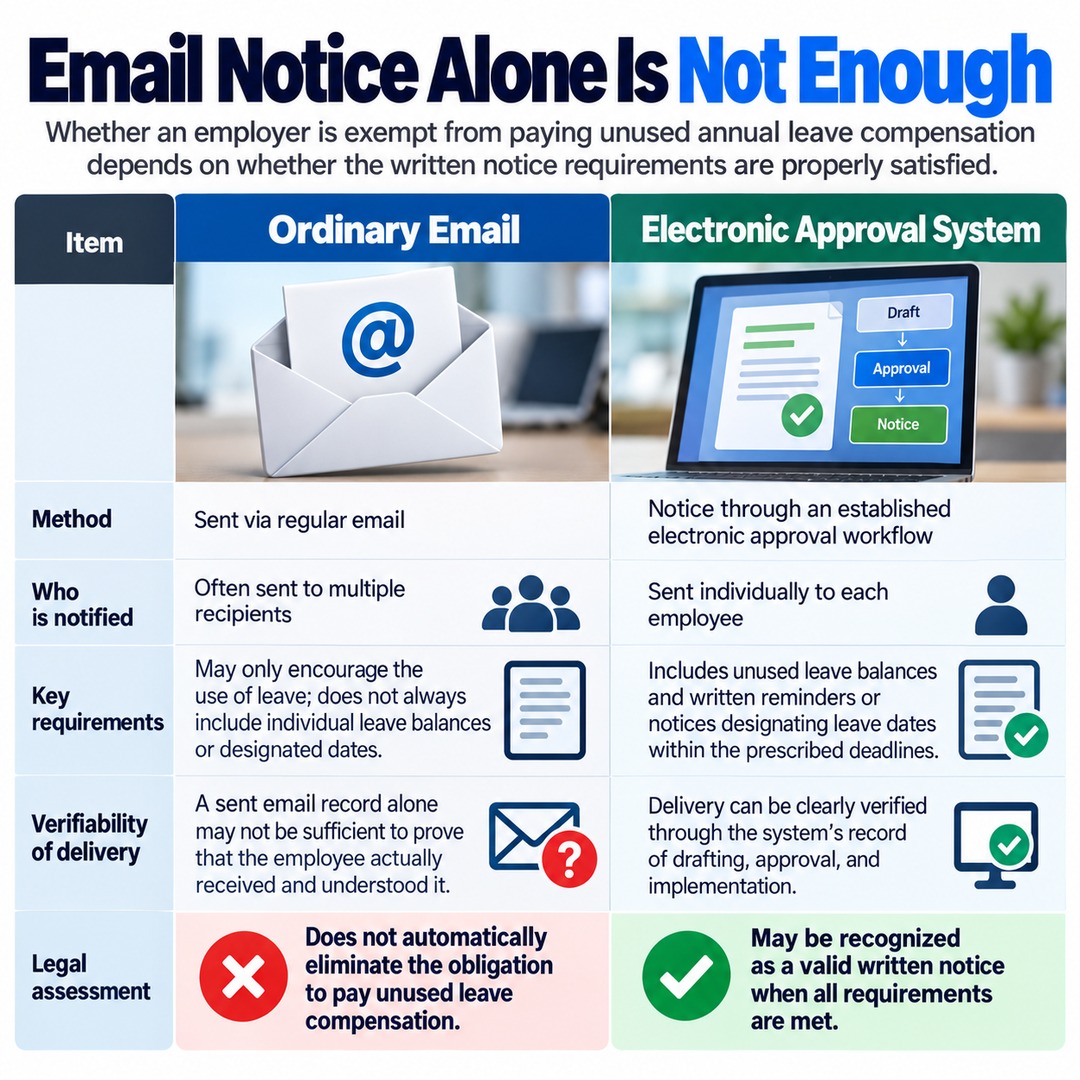
When an employer conducts annual leave use promotion solely through ordinary email, the central question is whether the communication satisfies the statutory written notice requirements. Simply receiving an email does not automatically release the employer from its obligation to pay compensation for unused annual leave.
Article 61 of South Korea's Labor Standards Act requires more than merely encouraging employees to take time off. Employers must inform individual employees of their unused leave balances and issue written reminders or notices designating leave dates within the prescribed deadlines.
The legal considerations differ depending on how the employer delivers the notice.
| Employer's notification method | Key consideration |
|---|---|
| General announcement on an internal bulletin board | Unlikely to substitute for individual written notice |
| Mass email sent to all employees | Whether it constitutes legally valid notice to each employee |
| Ordinary email sent individually | Sending an email alone does not conclusively establish compliance with written notice requirements |
| Individual notice through an electronic approval system | Depends on the system's characteristics and whether receipt by each employee can be verified |
| Individual delivery of a paper document | Other statutory requirements, including timing, content, and delivery, must also be satisfied |
Electronic documents are not necessarily invalid.
According to administrative interpretations by South Korea's Ministry of Employment and Labor, notice through an electronic approval system may be recognized when the employer has an established electronic workflow covering document drafting, approval, and implementation, manages business documents electronically, and can clearly verify that the document reached the employee.
By contrast, a record showing that an ordinary email was sent may not be sufficient to establish that the employee properly received and understood its contents.
Therefore, employees who receive an email should examine more than its subject line. They should consider the delivery method, whether the notice was addressed individually, the document's contents, the employer's electronic approval system, and evidence confirming delivery.
Does Reading an Email Without Taking Annual Leave Eliminate Unused Leave Compensation?
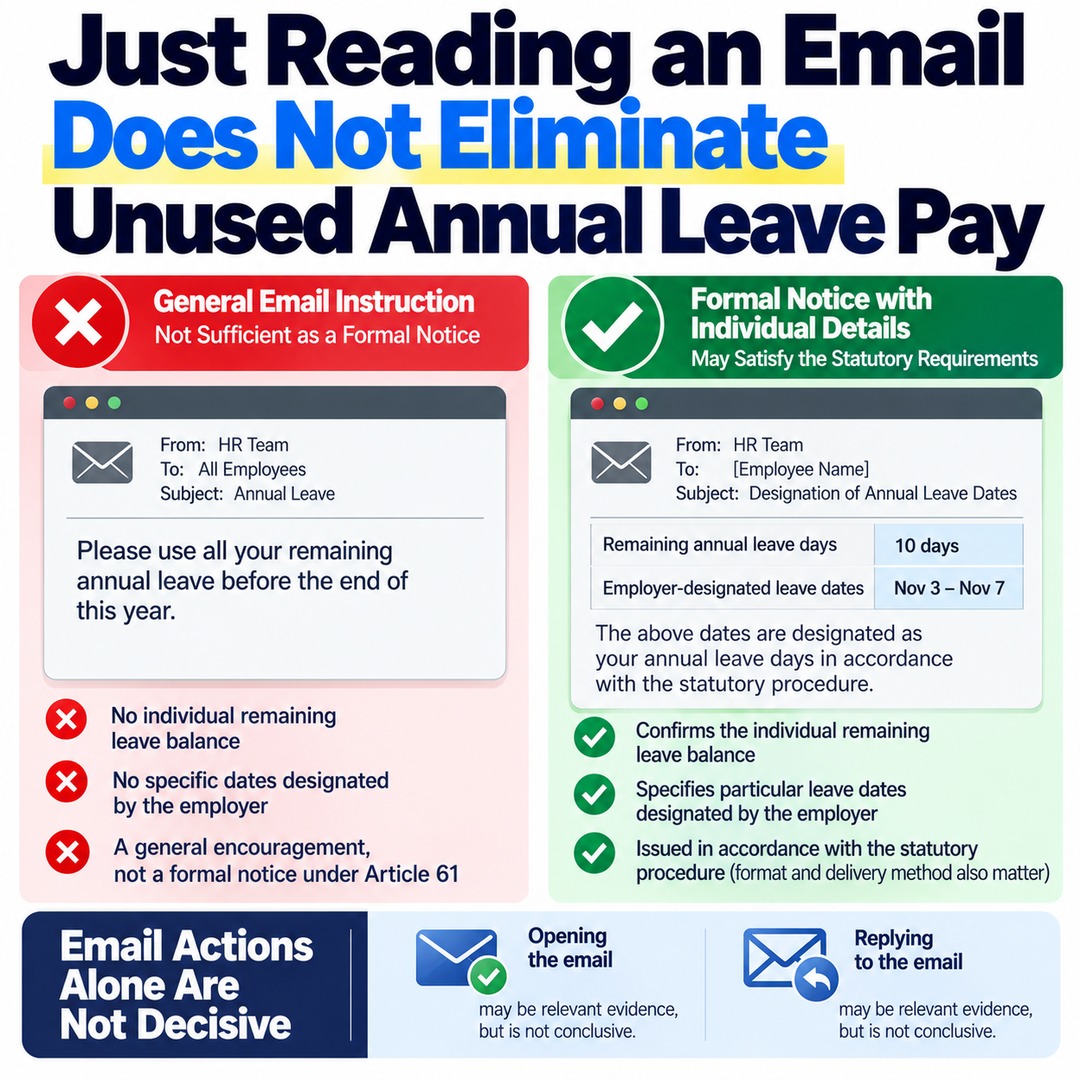
Simply reading an email does not eliminate an employee's entitlement to compensation for unused annual leave. Whether the employer legally completed the statutory leave use promotion procedure must be assessed separately.
For example, suppose an employer sends the following email in October:
"Please use all your remaining annual leave before the end of this year."
This message does not specify the employee's individual remaining leave balance or the particular dates designated by the employer.
A general instruction encouraging employees to use annual leave must be distinguished from a formal notice designating leave dates under Article 61 of the Labor Standards Act.
Conversely, if an employer confirms each employee's remaining leave balance and delivers a document specifying particular leave dates in accordance with the statutory procedure, the document's format and delivery process must also be examined.
Whether an employee opened the email or replied to it may be relevant evidence. However, neither fact alone conclusively establishes that the statutory leave use promotion procedure was properly completed.
What Happens If an Employee Works on an Employer-Designated Annual Leave Day?
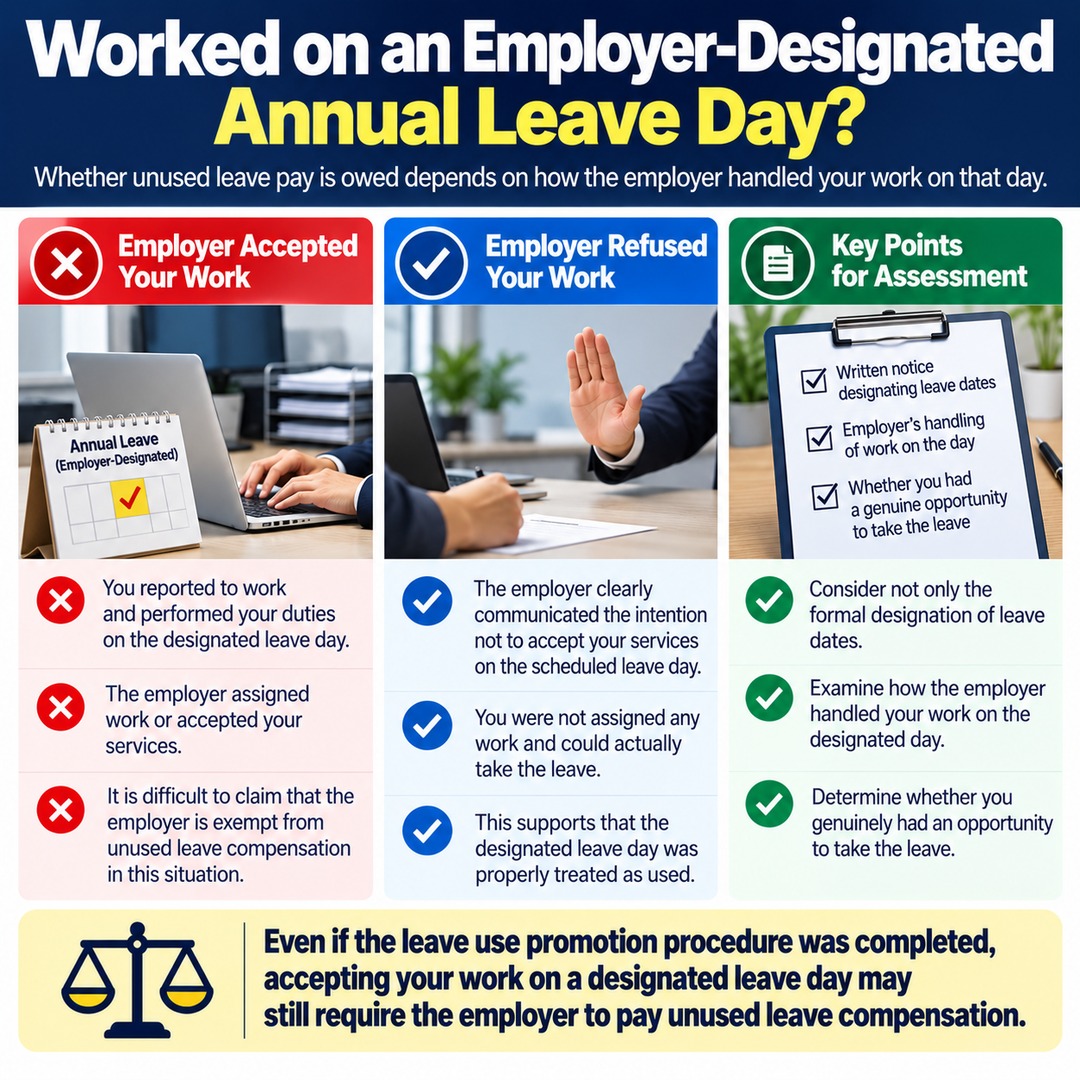
If an employee reports to work and actually performs their duties on a day designated by the employer as annual leave, the employer's handling of that work is important when determining entitlement to unused leave compensation.
Even if the employer completed the leave use promotion procedure, questions may arise about whether the designated leave day can be treated as properly used if the employer accepted the employee's work on that day.
A relevant legal concept is the refusal to accept labor, meaning that the employer clearly communicates its intention not to accept the employee's services on a scheduled leave day.
For example, suppose an employee comes to work on a designated annual leave day and performs their usual duties while the employer assigns work or accepts the employee's services. In that situation, it is difficult to conclude that the employer is exempt from paying unused leave compensation merely because it previously issued a leave use promotion notice.
The employer's intention to refuse the employee's services must also be communicated in a manner the employee can recognize.
Ultimately, the assessment must consider not only whether leave dates were formally designated in documents but also whether the employee genuinely had an opportunity to take the leave.
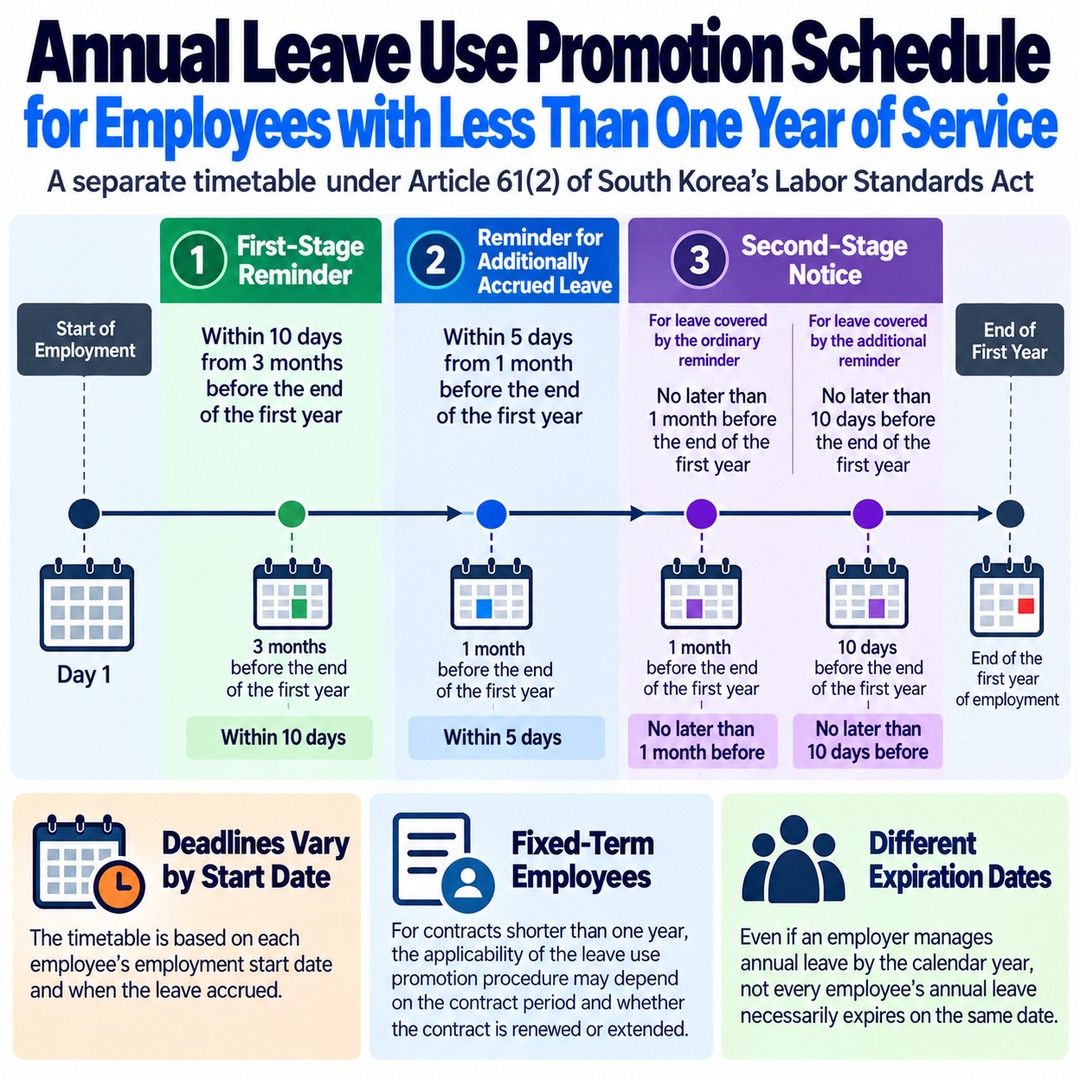
Does the October 31 Deadline Apply to Employees With Less Than One Year of Service?
Annual leave accrued through full attendance in individual months by employees with less than one year of continuous service is treated differently from ordinary annual leave subject to the October 31 schedule.
Article 61(2) of South Korea's Labor Standards Act establishes a separate leave use promotion timetable based on the employee's first year of employment.
First-stage reminder: Within 10 days from the point three months before the end of the first year of employment.
Reminder for additionally accrued leave: Within five days from the point one month before the end of the first year of employment.
Second-stage notice: For leave covered by the ordinary reminder, no later than one month before the end of the first year of employment. For leave covered by the additional reminder, no later than 10 days before the end of that year.
These deadlines vary according to the employee's employment start date and when the leave accrued.
In particular, for fixed-term employees whose employment contracts are shorter than one year, the applicability of the leave use promotion procedure may depend on the contract period and whether the contract is renewed or extended. Their circumstances should not automatically be assessed in the same way as those of regular employees.
Even when an employer manages annual leave according to the calendar year, not every employee's annual leave necessarily expires on the same date.
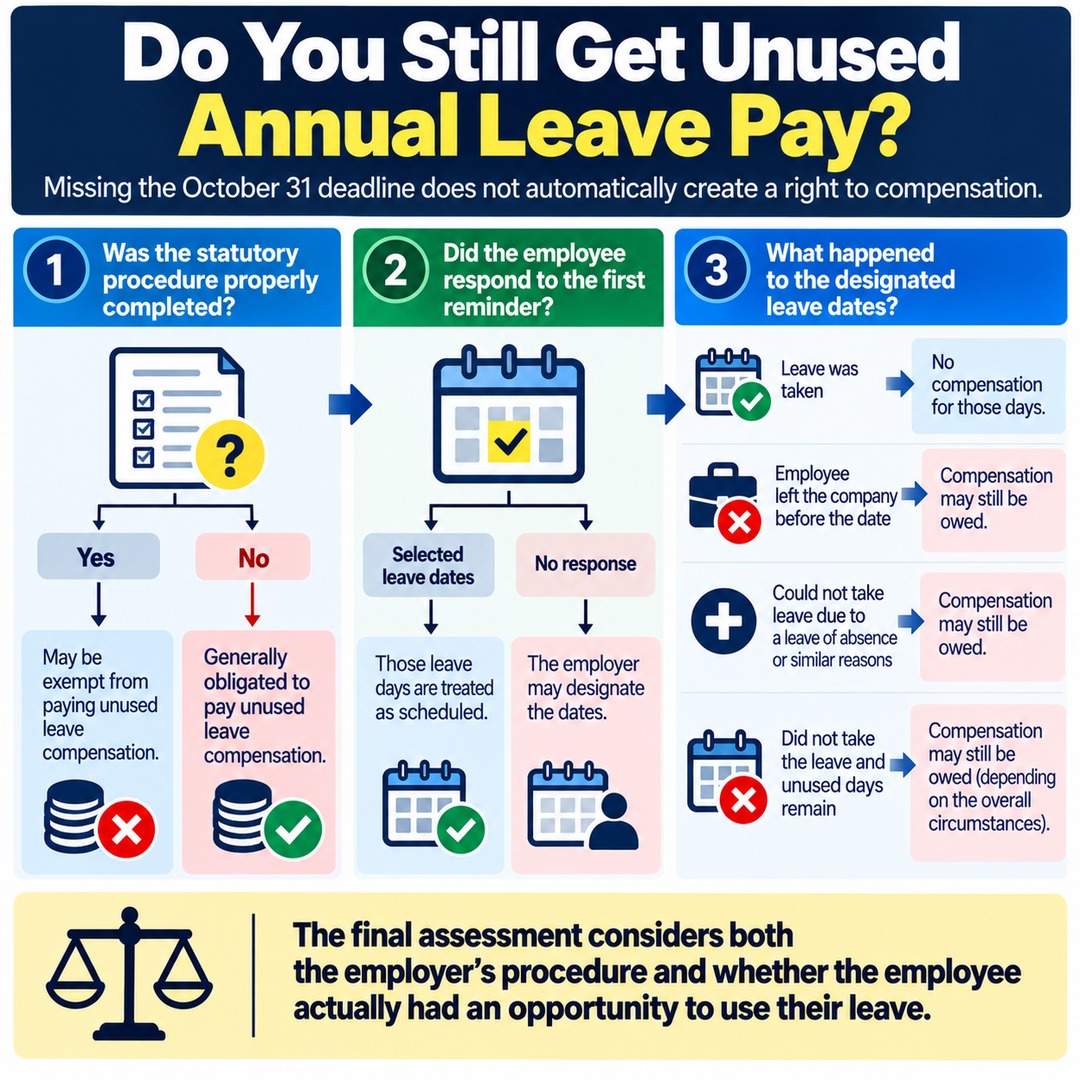
Must Employers Pay Unused Annual Leave Compensation If They Miss October 31?
If an employer fails to properly complete the statutory leave use promotion procedure, it generally remains obligated to pay compensation for unused annual leave.
However, missing October 31 does not automatically create a compensation entitlement for every employee.
The outcome depends on whether the employee already responded to the first reminder by selecting leave dates, whether the leave was actually taken, and which annual leave days remain unused.
Additionally, the employer may remain obligated to provide compensation if an employee leaves the company before the designated leave date or cannot take annual leave on that date because of a leave of absence or similar circumstances.
Whether the employer legally completed the leave use promotion procedure and whether the employee actually had an opportunity to use the leave must be considered together.
For further discussion of compensation when an employer designates annual leave dates, see the related article 2026 Second-Stage Annual Leave Use Promotion Notice: Can Employees Receive Unused Leave Pay When the Employer Chooses the Dates?
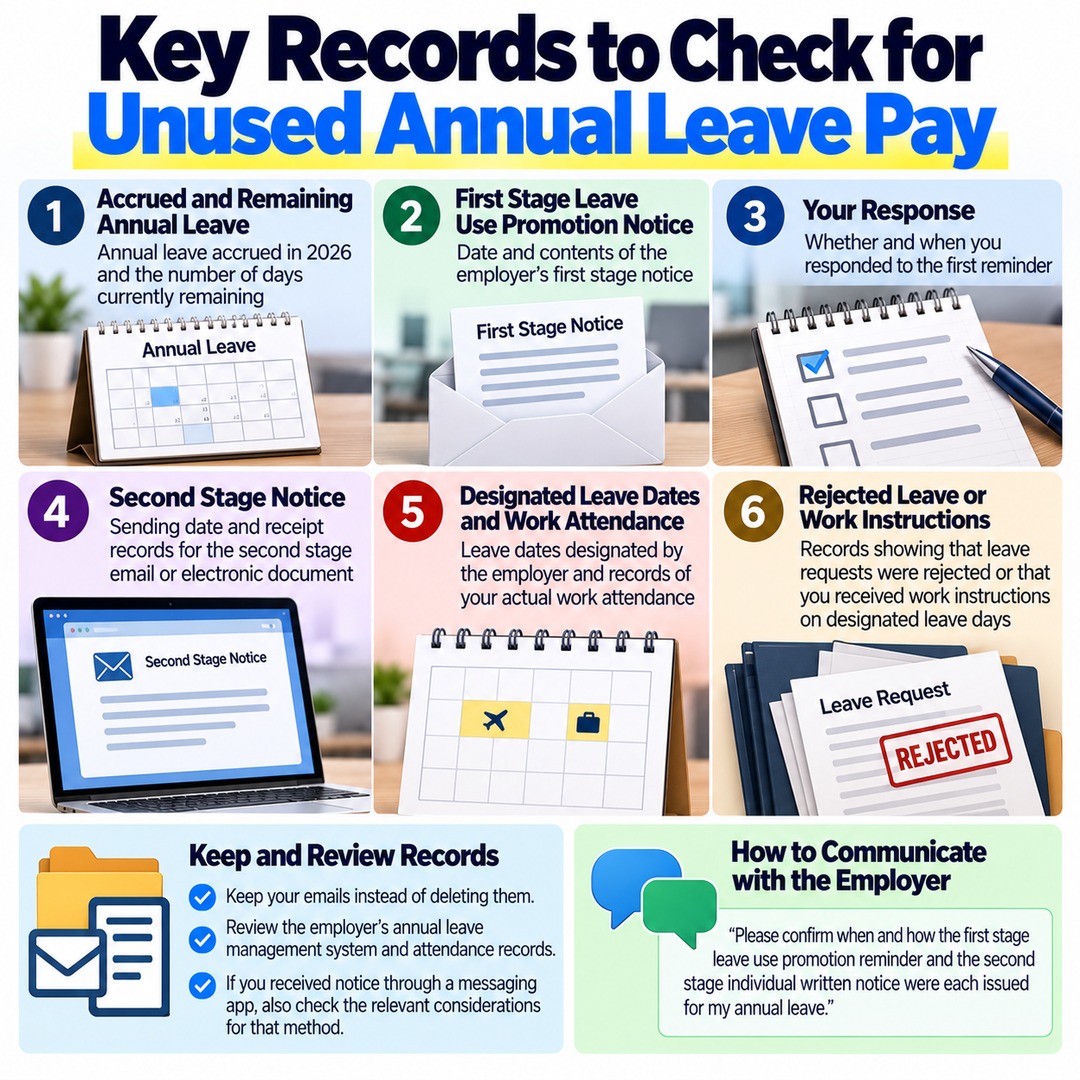
What Records Should Employees Check to Determine Their Unused Annual Leave Compensation?
If an employer issued a leave use promotion notice by email, employees should first preserve the relevant records.
Checking the following information can help employees explain their circumstances more precisely.
Annual leave accrued in 2026 and the number of days currently remaining.
The date and contents of the employer's first-stage leave use promotion notice.
Whether and when the employee responded to the first reminder.
The sending date and receipt records for the second-stage email or electronic document.
Leave dates designated by the employer and records of the employee's actual work attendance.
Records showing that leave requests were rejected or that the employee received work instructions on designated leave days.
Employees should retain their emails rather than deleting them and also review the employer's annual leave management system and attendance records.
When contacting the employer, rather than simply asking, "Am I entitled to unused annual leave pay?", employees can clarify the issue by requesting: "Please confirm when and how the first-stage leave use promotion reminder and the second-stage individual written notice were each issued for my annual leave."
Employees who received notice through KakaoTalk, a messaging application widely used in South Korea, can also review the separate considerations applicable to that notification method.
If an employee and employer disagree about whether compensation is payable, the employee should prepare the notification documents and work records and seek advice from South Korea's Ministry of Employment and Labor or ask the relevant regional labor office to review the specific circumstances.
The key issue in South Korea's annual leave use promotion system is not how many times an employer told employees to take time off. What matters is whether legally compliant individual written notices were delivered within the statutory deadlines and whether employees genuinely had an opportunity to use their annual leave. These factors are central to determining whether compensation for unused annual leave must be paid.