Even if a tenant signs a new jeonse lease agreement without changing the deposit, whether they can move out before the lease expires depends on how the agreement was renewed. Under South Korea's Housing Lease Protection Act, if the lease was renewed automatically or through the tenant's statutory right to request renewal, the lease terminates three months after the landlord receives the tenant's termination notice. However, if the landlord and tenant separately negotiated and agreed to renew the lease, the same rule does not automatically apply.
The fact that a tenant signed a new agreement or that the deposit remained unchanged is not enough to determine their termination rights. It is necessary to examine whether the tenant exercised the statutory lease renewal right, what terms were agreed upon with the landlord, and whether the agreement contains any special provisions allowing early termination.
Can You Terminate a Lease Three Months After Giving Notice Even If You Signed a New Agreement?
Even when a new lease agreement has been signed, the statutory three-month termination rule may apply if the tenant can establish that they exercised their statutory right to request lease renewal. The circumstances surrounding the renewal matter more than the format of the agreement.
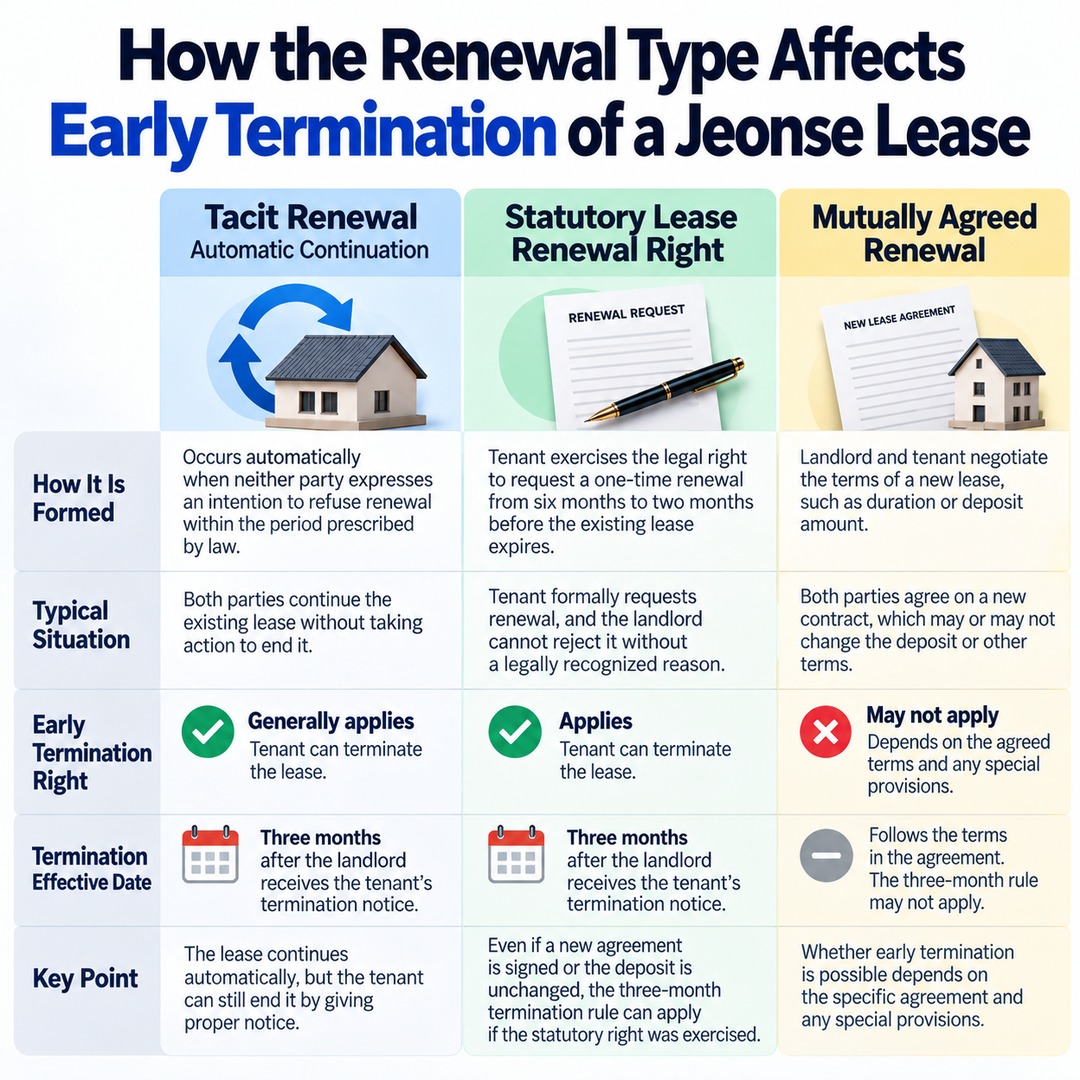
South Korea's Housing Lease Protection Act distinguishes between different types of lease renewal.
| Type of renewal | Early termination rights | When termination takes effect |
|---|---|---|
| Tacit renewal (automatic renewal by operation of law) | The tenant may give termination notice at any time | Three months after the landlord receives the notice |
| Exercise of the statutory lease renewal right | The tenant may give termination notice at any time | Three months after the landlord receives the notice |
| Separately negotiated renewal by mutual agreement | The lease terms and the parties' agreement must be examined | The three-month rule does not automatically apply |
Tacit renewal occurs when the landlord and tenant do not express an intention to refuse renewal or take other relevant action within the period prescribed by law, allowing the existing lease to continue automatically.
The statutory lease renewal right is a tenant's legal right to request an extension of the lease. In principle, the tenant may exercise this right from six months to two months before the existing lease expires. Unless a legally recognized ground for refusal exists, the landlord cannot reject the request.
By contrast, a mutually agreed renewal occurs when the landlord and tenant negotiate the terms of continuing the lease, such as its duration or deposit amount.
Although all three arrangements may result in the tenant continuing to live in the same property, the legal rules governing early termination can differ.
Does an Unchanged Deposit Mean the Tenant Exercised the Statutory Lease Renewal Right?
Keeping the deposit exactly the same does not necessarily mean the tenant exercised the statutory lease renewal right. Conversely, a change in the deposit does not automatically mean that the tenant did not exercise that right.
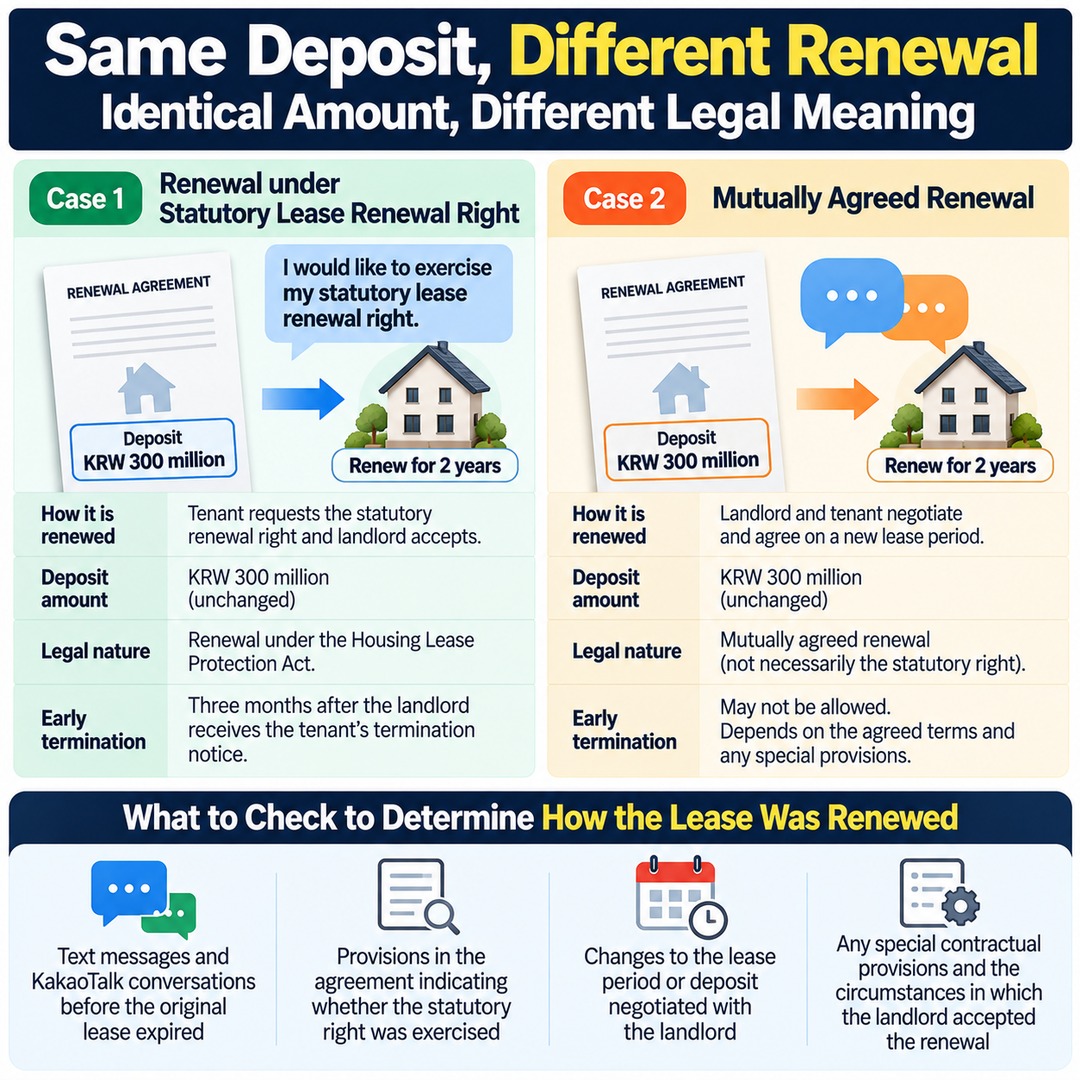
Consider a tenant living in a property under a jeonse lease with a deposit of KRW 300 million. Jeonse is a residential rental arrangement commonly used in South Korea in which the tenant provides a substantial refundable lump-sum deposit, typically instead of paying monthly rent.
Suppose the tenant and landlord agree that the tenant will remain in the property for another two years and sign a renewed lease agreement.
They may have reached that arrangement in two legally different ways.
In the first situation, the tenant informed the landlord that they intended to exercise their statutory lease renewal right. The landlord accepted the request, and the parties signed a renewed agreement while maintaining the existing KRW 300 million deposit.
In the second situation, the landlord and tenant negotiated a new lease period and agreed to maintain the KRW 300 million deposit without any indication that the tenant was exercising the statutory lease renewal right.
Although the deposit amounts written in the two agreements are identical, the legal nature of the renewals is not necessarily the same.
To determine how the lease was actually renewed, it is advisable to examine the following records:
Text messages and KakaoTalk conversations exchanged before the original lease expired
Provisions in the agreement indicating whether the statutory lease renewal right was exercised
Changes to the lease period or deposit negotiated with the landlord
Any special contractual provisions concerning early termination
The circumstances in which the landlord accepted the renewal request before or after the new agreement was signed
In particular, a message explicitly stating that the tenant intended to exercise the statutory lease renewal right may be important evidence.
Even if the agreement does not clearly state whether that right was exercised, the relevant communications and circumstances surrounding the agreement should be considered together.
Must You Stay Until the End of the Lease Term After a Mutually Agreed Renewal?
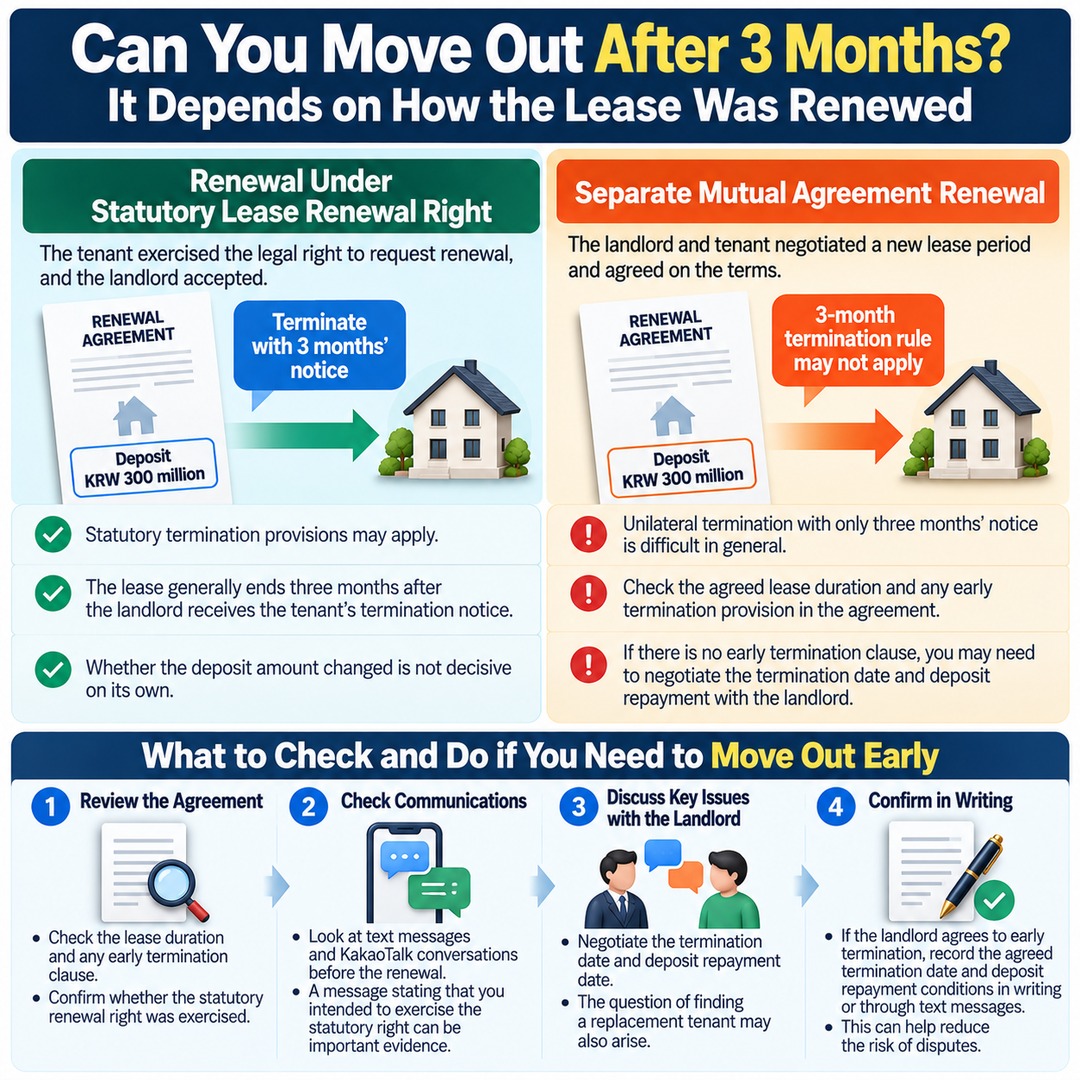
When a lease is renewed through a separate mutual agreement, it is difficult to conclude that the tenant can unilaterally terminate it simply by providing three months' notice. The agreed lease duration, any early termination provisions, and the landlord's consent are important factors.
For example, imagine that a tenant agrees to extend a jeonse lease for two years but needs to move to another region after only six months.
If the renewal resulted from the tenant exercising the statutory lease renewal right, the statutory termination provisions may apply.
However, if the parties entered into a separately negotiated renewal, the tenant should first check whether the agreement contains an early termination clause.
If there is no contractual provision allowing early termination, the tenant may need to negotiate the termination date and deposit repayment date with the landlord.
The question of finding a replacement tenant may also arise. However, whether the existing tenant must find a new tenant before terminating the lease, and who must pay the real estate brokerage fee, must be assessed separately based on the legal nature of the lease and the parties' agreement.
If the landlord agrees to early termination, recording the agreed termination date and deposit repayment conditions in writing or through text messages can help reduce the risk of disputes.
When Does the Three-Month Termination Period Begin: On the Moving Date or When the Notice Is Sent?
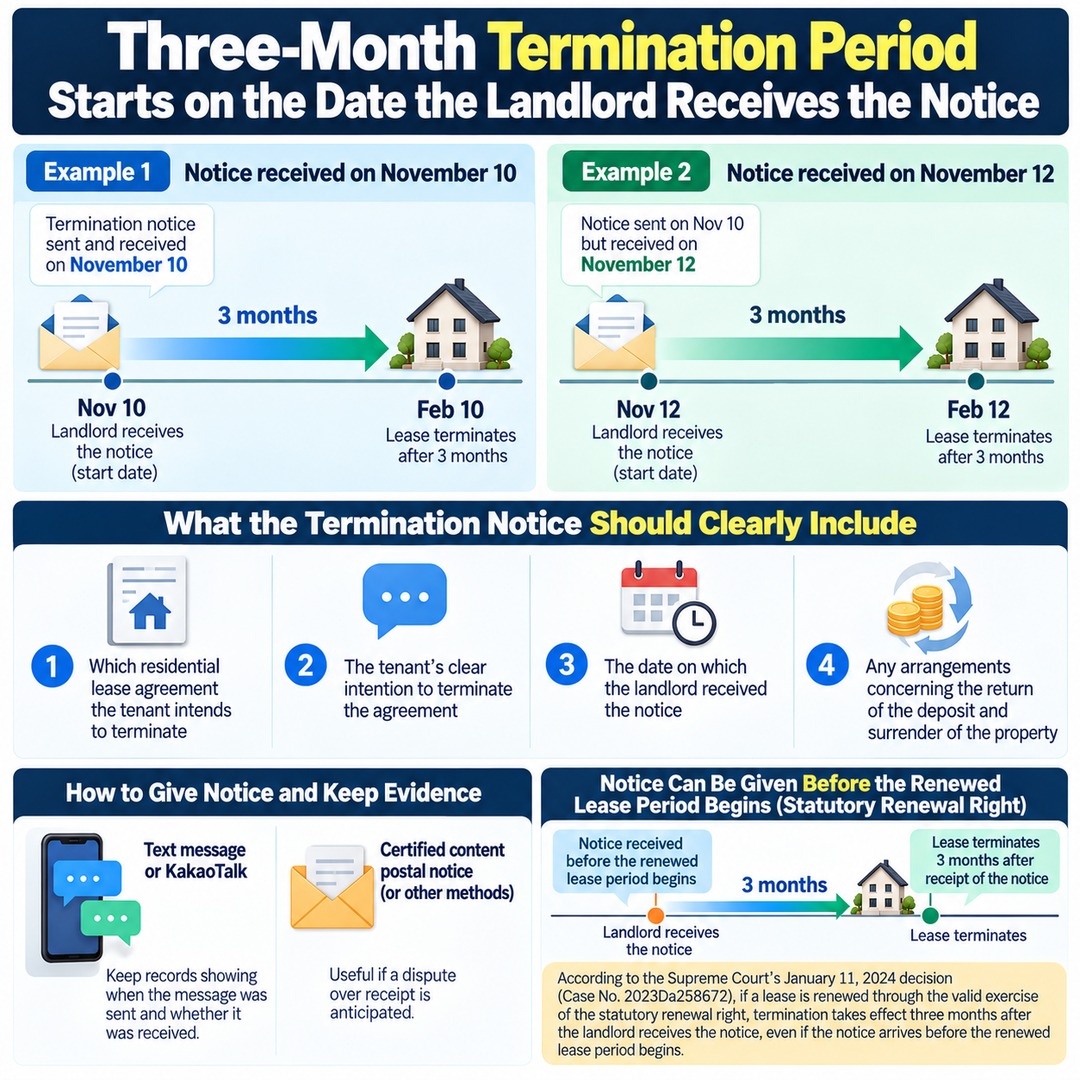
The statutory three-month termination period is calculated from the date the landlord receives the termination notice. It does not begin when the tenant decides to move or drafts the message.
For example, suppose a tenant who validly exercised the statutory lease renewal right sends a termination notice on November 10.
If the landlord receives the notice that same day, termination takes effect after three months have elapsed from that date. However, if the notice actually reaches the landlord on November 12, the starting date for the calculation changes accordingly.
The termination notice should therefore clearly establish the following:
1. Which residential lease agreement the tenant intends to terminate
2. The tenant's clear intention to terminate the agreement
3. The date on which the landlord received the notice
4. Any arrangements concerning the return of the deposit and surrender of the property
If notice is given by text message or KakaoTalk, the tenant should retain records showing when the message was sent and whether it was received.
If a dispute over receipt is anticipated, the tenant may also consider a certified-content postal notice, known in South Korea as a content-certified notice, or another method that can provide evidence of the notification.
Can You Give Termination Notice Before the Renewed Lease Period Begins?
If a lease has been validly renewed through the exercise of the statutory lease renewal right, the tenant may give termination notice even before the new lease period begins.
The Supreme Court of South Korea addressed the effectiveness of termination notices for leases renewed through the statutory lease renewal right in its January 11, 2024 decision, Case No. 2023Da258672.
According to the ruling, when a lease has been renewed through the valid exercise of the statutory renewal right, termination takes effect three months after the landlord receives the notice, even if the notice arrives before the renewed lease period begins.
In other words, the tenant does not have to wait until the first day of the renewed lease period and then begin counting another three months.
However, this ruling concerns leases renewed through the exercise of the statutory lease renewal right. It should not automatically be applied to separately negotiated renewals.
Will You Receive Your Jeonse Deposit Immediately When the Lease Ends?
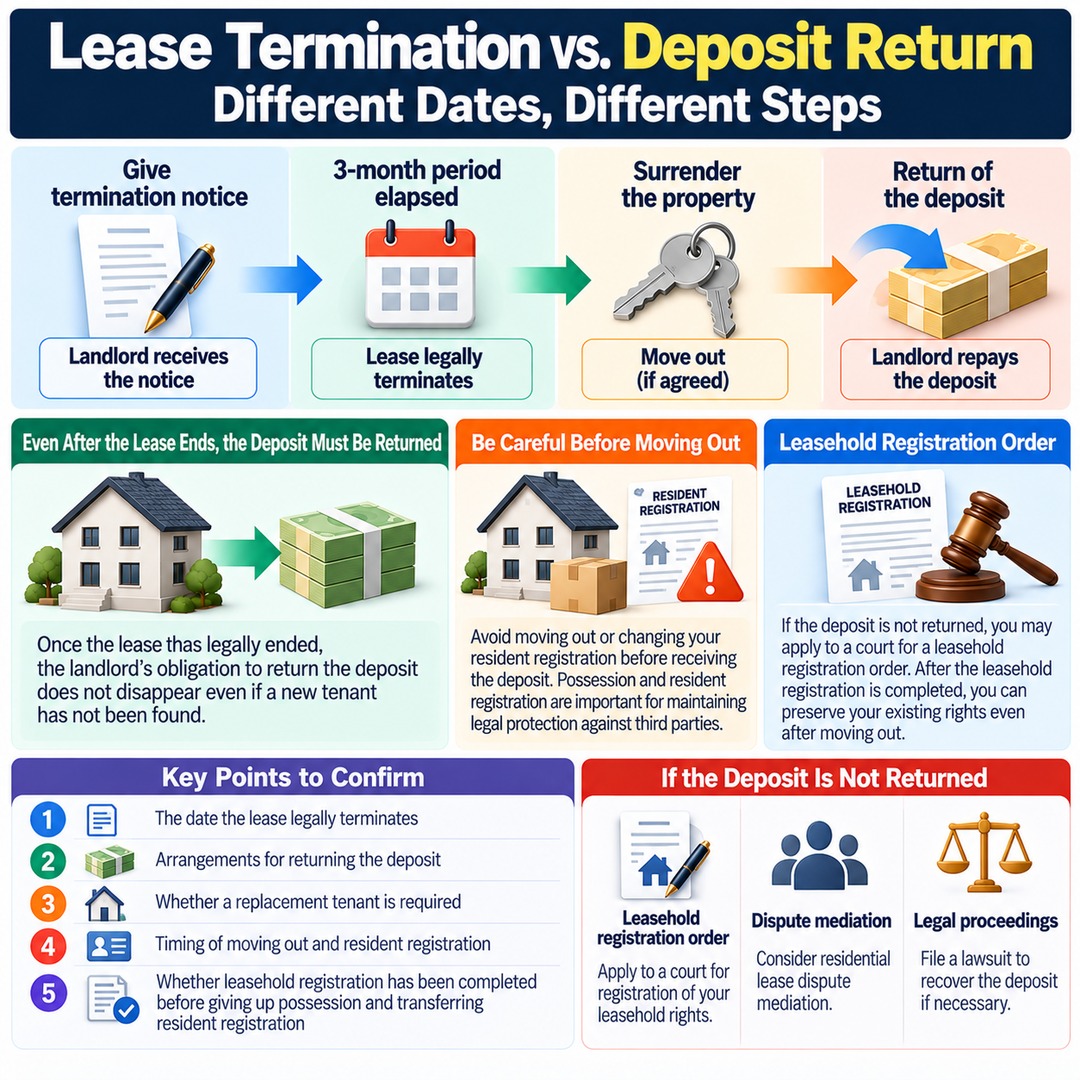
The date on which a lease legally terminates must be distinguished from the date on which the landlord actually returns the deposit. Even when the lease has ended and the tenant is entitled to demand repayment, additional action may be necessary if the landlord fails to pay on time.
A jeonse deposit is often needed to pay the balance on the tenant's next home or cover moving expenses.
Therefore, when giving early termination notice, it is important to confirm not only the termination date but also the practical arrangements for returning the deposit.
A landlord may say that the deposit can only be returned after a new tenant moves in. However, once the lease has legally ended, the landlord's obligation to return the existing tenant's deposit does not disappear merely because a replacement tenant has not been found.
Tenants should be particularly cautious about moving out or changing their registered residential address before receiving their deposit.
Under South Korean housing lease law, possession of the property and resident registration are important requirements for maintaining the tenant's legal protection against third parties, known as opposability.
What If You Must Move Before Receiving Your Deposit?
If the lease has ended but the landlord has not returned the deposit, the tenant may consider applying for a leasehold registration order, known in South Korea as an imchakwon deunggi myeongnyeong.
This is a legal procedure through which a tenant who has not recovered their rental deposit may apply to a court for registration of their leasehold rights.
A tenant who has already acquired opposability and a preferential repayment right may preserve those existing rights after moving out, provided the leasehold registration has been completed.
The preferential repayment right is a protection under South Korean law that can give qualifying tenants priority in recovering their deposit from certain proceeds of the property.
An important distinction is that merely submitting an application for a leasehold registration order is not sufficient.
The tenant should confirm that the leasehold registration has actually been completed before deciding when to surrender possession of the property and transfer their resident registration to another address.
If there is a dispute over whether the lease has ended, or if the landlord refuses to return the deposit, the tenant may consider residential lease dispute mediation or legal proceedings to recover the deposit.
What Should Tenants Check First If They Have Already Signed a Renewed Lease?
If a tenant has already signed a renewed lease but subsequently needs to move, the safest first step is to determine when the existing lease can legally end before signing a contract for another home.
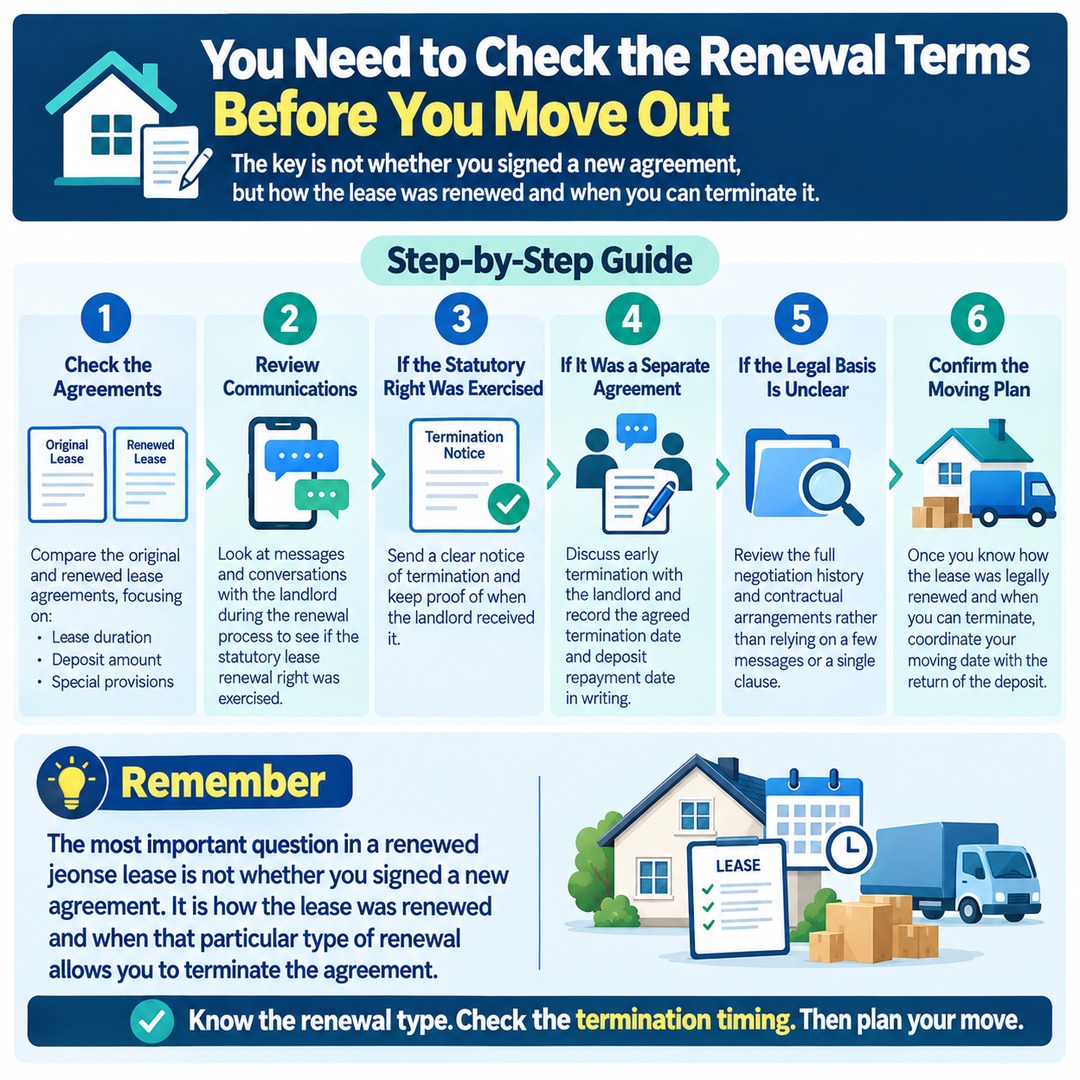
Start by comparing the original lease agreement with the renewed agreement, paying particular attention to the lease duration, deposit amount, and special contractual provisions.
Next, review communications exchanged with the landlord during the renewal process to determine whether the statutory lease renewal right was exercised.
If there is a record showing that the tenant exercised that right, the tenant should clearly communicate their intention to terminate the lease and preserve evidence of the date the notice reached the landlord.
If the renewal appears to have been a separately negotiated agreement, the tenant should discuss early termination with the landlord and document the agreed termination date and deposit repayment date in writing.
If the legal basis for the renewal remains unclear, it is important to review the entire sequence of negotiations and contractual arrangements rather than drawing a conclusion from a few messages or an isolated clause in the agreement.
The most important question in a renewed jeonse lease is not whether the tenant signed a new agreement. It is how the lease was legally renewed and when that particular type of renewal allows the tenant to terminate the agreement.
Only after determining those points can the tenant safely coordinate the actual moving date with the return of the jeonse deposit.