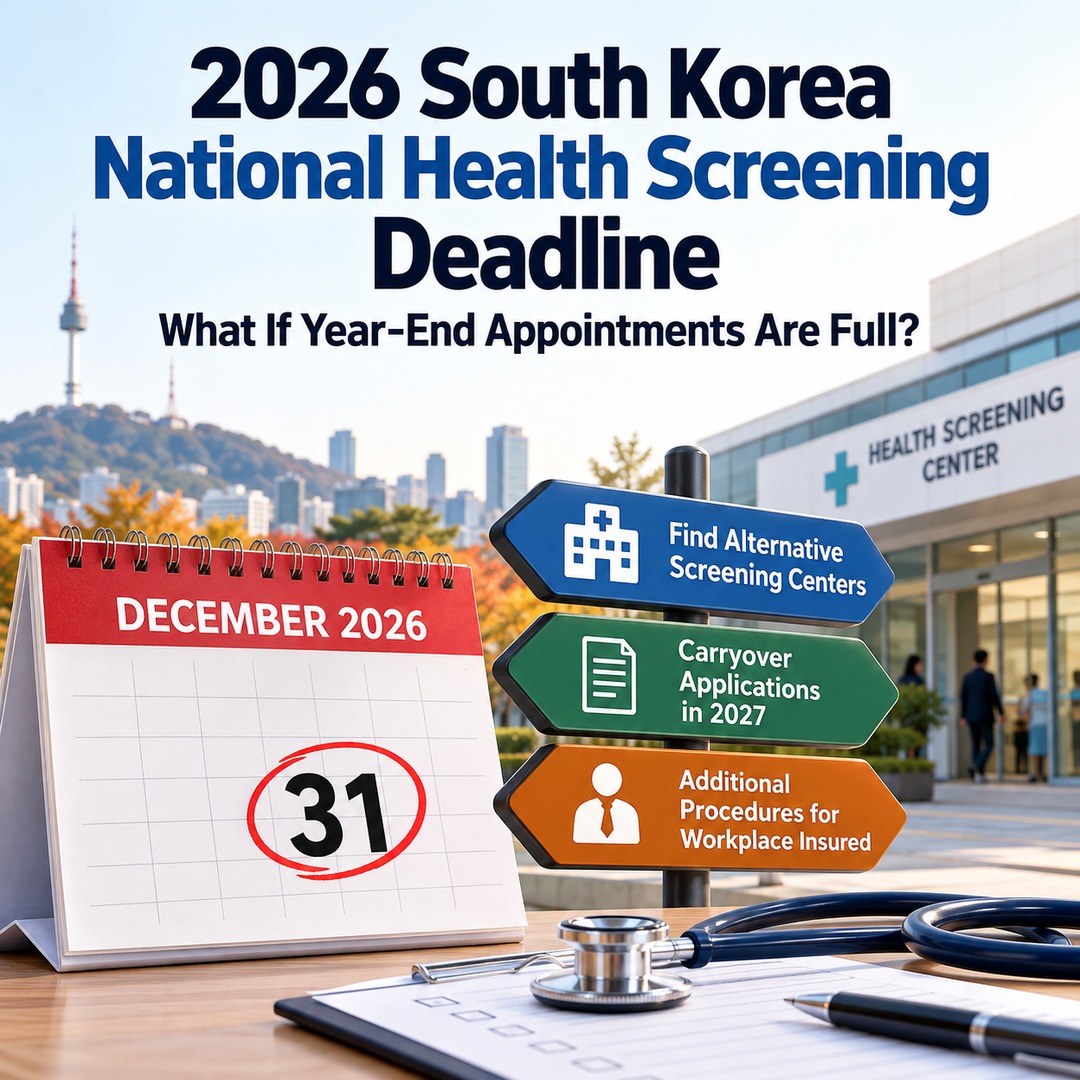
Individuals eligible for South Korea's 2026 National Health Screening Program must generally complete their screenings by December 31. If hospital appointments are fully booked toward the end of the year, they should check availability at other designated screening centers. Those who cannot complete their screenings in 2026 may be able to apply the following year for screenings missed in the previous year. However, this does not mean that the deadlines for all screening items are automatically extended.
It is particularly important to distinguish between general health screenings, national cancer screenings, and the application procedures for employees insured through their workplaces. If you are at risk of missing your 2026 screening, it is advisable to look for an available screening center while separately checking whether you qualify for additional registration in 2027.
What Is the Deadline for South Korea's 2026 National Health Screenings?
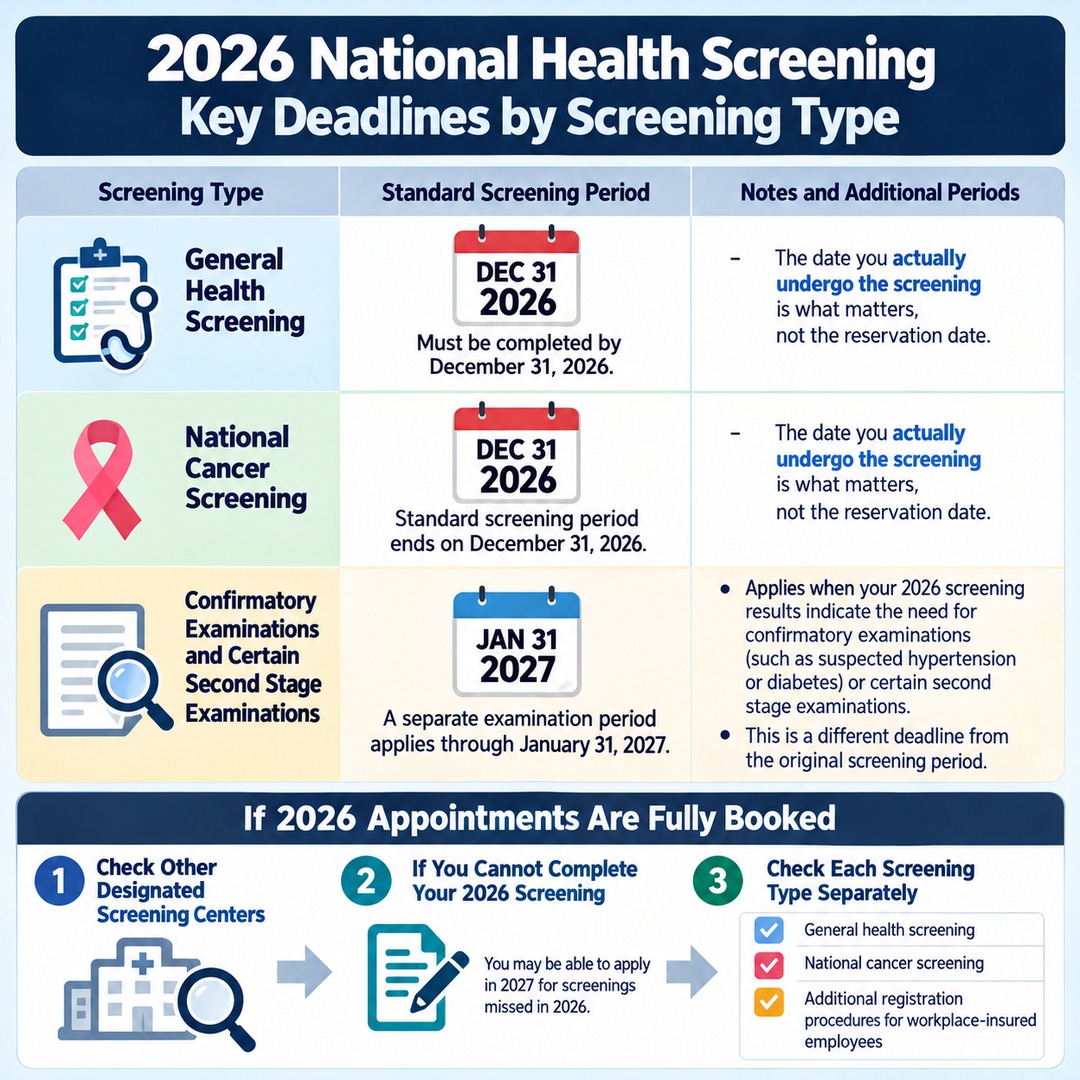
The standard screening period for both general health screenings and screenings under South Korea's National Cancer Screening Program ends on December 31, 2026. What matters is the date you actually undergo the screening, not simply whether you have booked an appointment before the end of the year.
However, the periods allowed for follow-up examinations differ depending on the type of screening.
General health screenings: Must be completed by December 31 of the applicable year.
National cancer screenings: The standard screening period ends on December 31 of the applicable year.
Confirmatory examinations and certain second-stage examinations: A separate examination period applies through January 31 of the following year.
For example, if you undergo a general health screening in December 2026 and the results indicate suspected hypertension or diabetes, the necessary confirmatory examinations are subject to a different deadline from the original general health screening.
Conversely, this does not mean that someone who fails to undergo their 2026 general health screening can simply receive it in January 2027 without completing any additional procedures.
Understanding this distinction makes it easier to determine which procedures to check first when year-end appointments are difficult to secure.
What Should You Do If All Year-End Screening Appointments Are Fully Booked?
The first step is to look for other medical institutions authorized to provide national health screenings, rather than relying only on the hospital you originally considered.
For South Korea's national health screenings, you need to check both your eligibility and the actual appointment availability at each screening center.
Finding a hospital through the National Health Insurance Service (NHIS) screening center search does not necessarily mean that the hospital has appointments available on your preferred date.
Follow these steps:
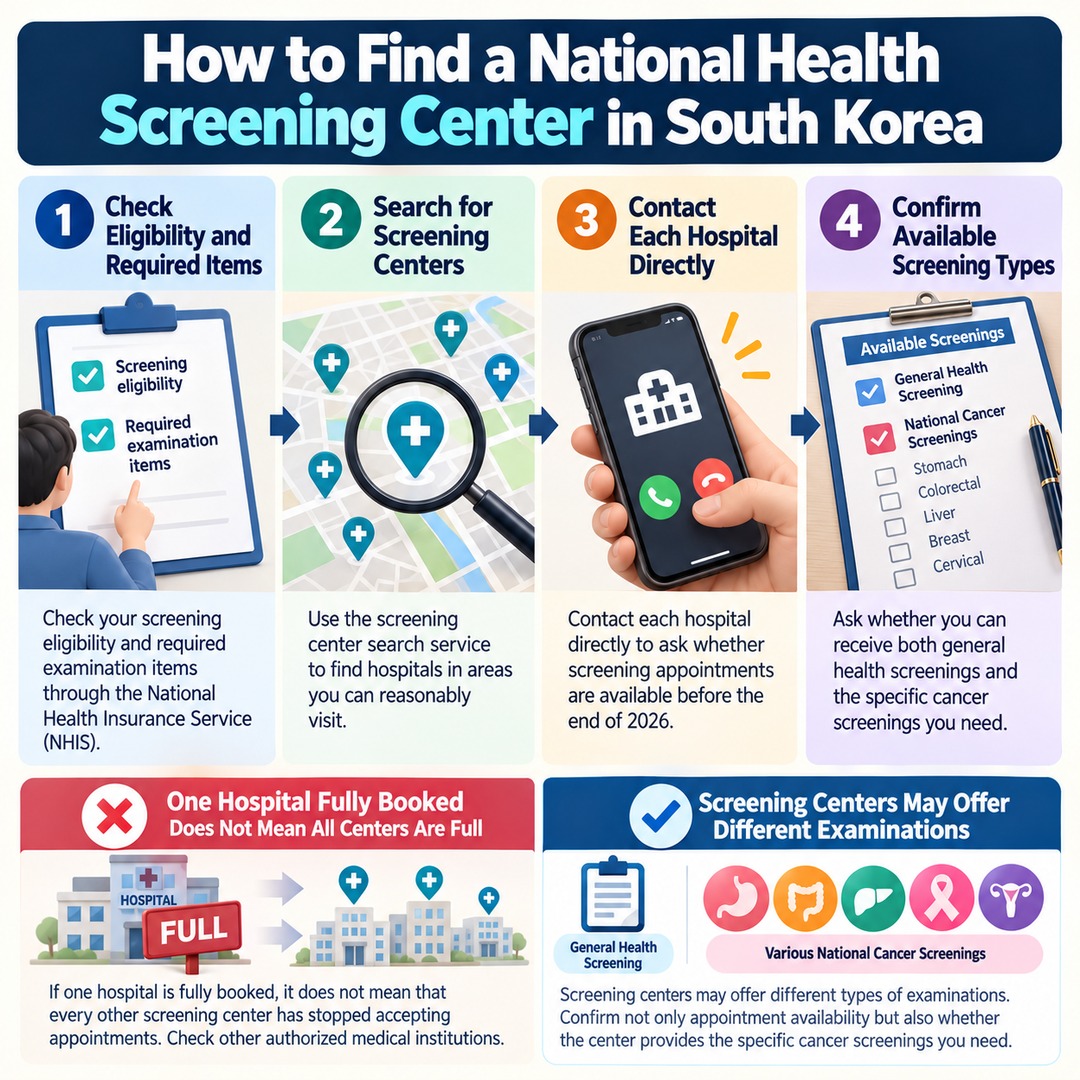
1. Check your screening eligibility and required examination items through the National Health Insurance Service (NHIS), South Korea's public health insurance administrator.
2. Use the screening center search service to find hospitals in areas you can reasonably visit.
3. Contact each hospital directly to ask whether screening appointments are available before the end of 2026.
4. Ask whether you can receive both your general health screening and any required cancer screenings during the same visit.
5. Once your appointment is confirmed, check the preparation instructions and scheduled arrival time.
A fully booked schedule at one hospital does not mean that every other screening center has also stopped accepting appointments.
In addition, screening centers may offer different types of examinations. It is therefore advisable to confirm not only the availability of general health screenings but also whether the center provides the specific cancer screenings you need.
Can You Apply for Additional Registration in 2027 If You Miss Your 2026 Screening?
South Korea's National Health Insurance Service operates an additional application system for individuals who did not undergo their national health screenings in the previous year.
Therefore, if you miss your 2026 screening, you can check in 2027 whether you are eligible to apply for additional registration as someone who missed the previous year's screening.
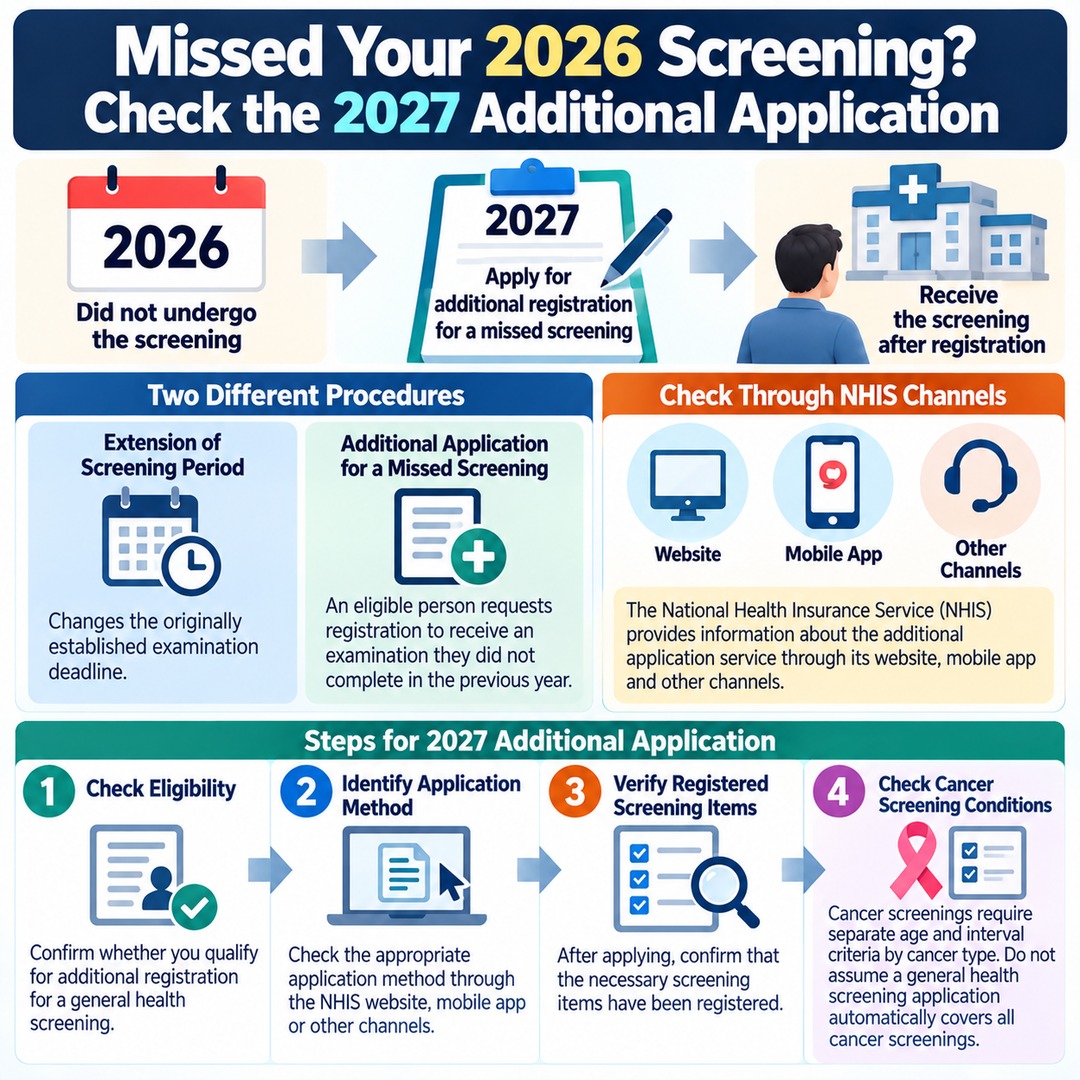
The important distinction is that extending a screening period and registering for a missed screening are two different procedures.
An extension of the screening period means changing the originally established examination deadline. By contrast, an additional application for a previous year's missed screening is a procedure through which an eligible person requests registration to receive an examination they did not complete in the preceding year.
The NHIS provides information about this additional application service through its website, mobile app, and other channels.
After confirming whether you qualify for additional registration for a general health screening and identifying the appropriate application method, you should verify that the necessary screening items have been registered.
Cancer screenings require particular attention because eligibility ages and screening intervals differ by cancer type. You should not assume that an additional application for a general health screening automatically covers every cancer screening in the same way.
Why Should Employees Check With Their Company's HR Department First?
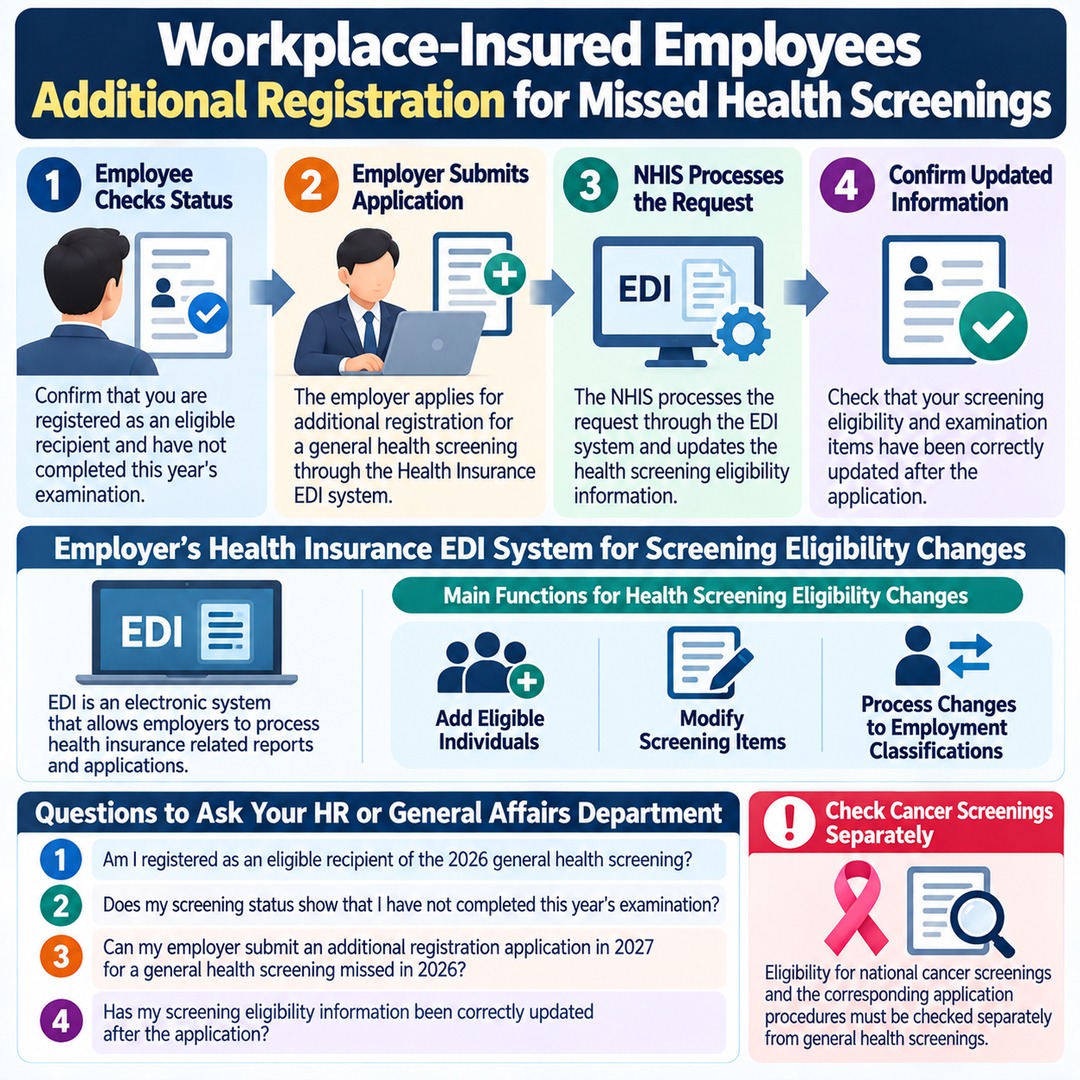
For employees enrolled in South Korea's workplace-based National Health Insurance system, additional registration for general health screenings is handled through the employer.
The NHIS guidance on additional applications for screenings missed in the previous year specifically distinguishes workplace-insured employees and directs them to apply for additional general health screening registration through their workplaces.
Employers can use the Health Insurance Electronic Data Interchange (EDI) system to submit requests to change, add, or exclude individuals from health screening eligibility lists.
EDI is an electronic system that allows employers to process health insurance-related reports and applications.
Through the health screening eligibility change application used by workplace administrators, employers can process changes to employment classifications, add eligible individuals, and modify screening items.
If you are covered by workplace-based National Health Insurance, it is advisable to ask your company's human resources or general affairs department to confirm the following:
Whether you are registered as an eligible recipient of the 2026 general health screening.
Whether your screening status shows that you have not completed this year's examination.
Whether your employer can submit an additional registration application in 2027 for a general health screening missed in 2026.
Whether your screening eligibility information has been correctly updated after the application.
Even for workplace-insured employees, eligibility for national cancer screenings and the corresponding application procedures must be checked separately from general health screenings.
Where Can You Apply for a Screening Missed in the Previous Year?
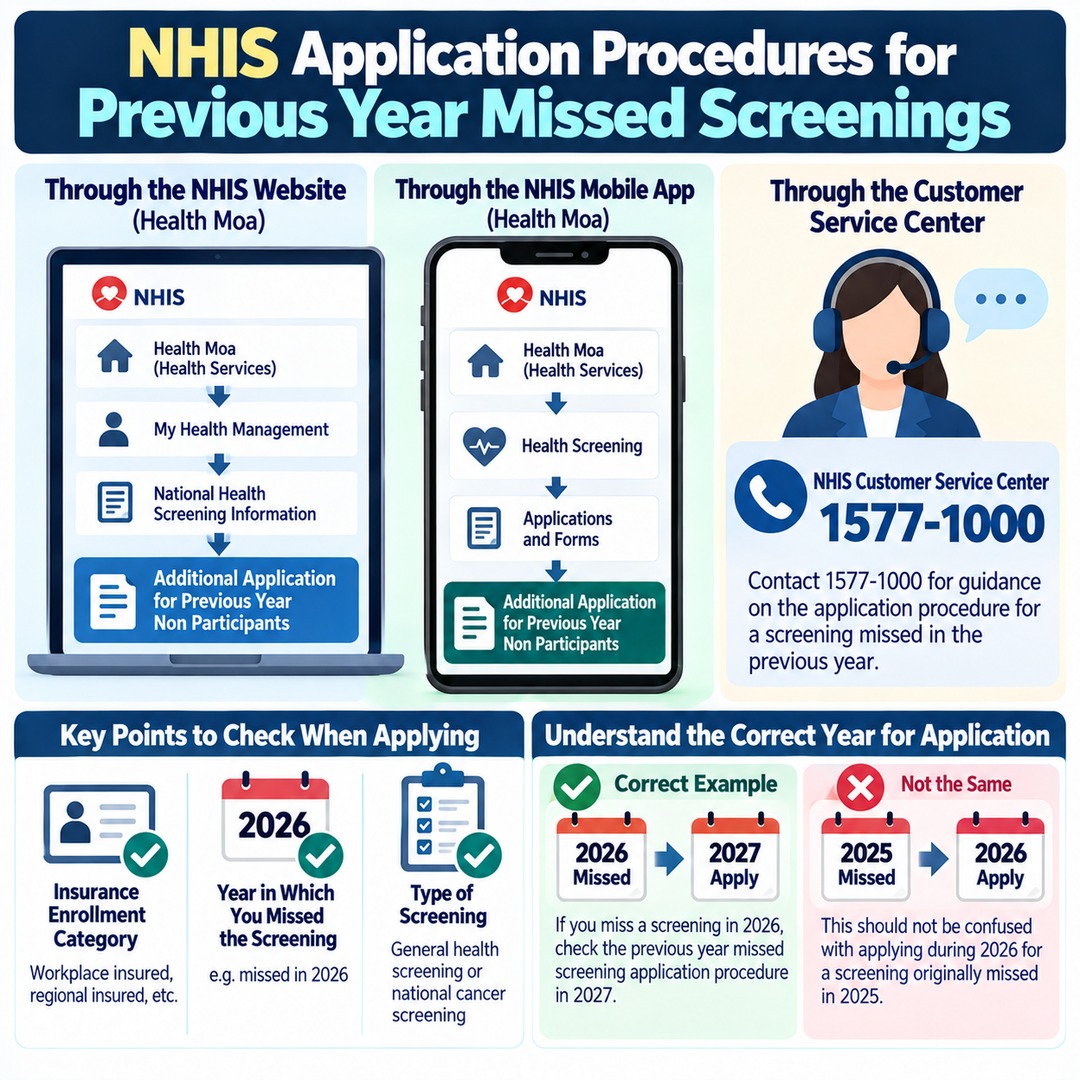
Except for additional general health screening registration handled through an employer for workplace-insured employees, you can check the application procedures through the NHIS website, mobile app, or customer service center.
The main application channels provided by the NHIS are outlined below.
NHIS Website
Health Moa (Health Services) → My Health Management → National Health Screening Information → Additional Application for Previous-Year Non-Participants
Mobile App
Health Moa (Health Services) → Health Screening → Applications and Forms → Additional Application for Previous-Year Non-Participants
Telephone Assistance
You can contact the National Health Insurance Service customer service center at 1577-1000 for guidance on applying for a screening missed in the previous year.
When applying, it is important to distinguish your insurance enrollment category, the year in which you missed the screening, and the type of screening involved.
Someone who misses a screening in 2026 would check the previous-year missed-screening application procedure in 2027. This should not be confused with applying during 2026 for a screening originally missed in 2025.
What Happens If Your 2026 and 2027 Health Screening Eligibility Overlaps?
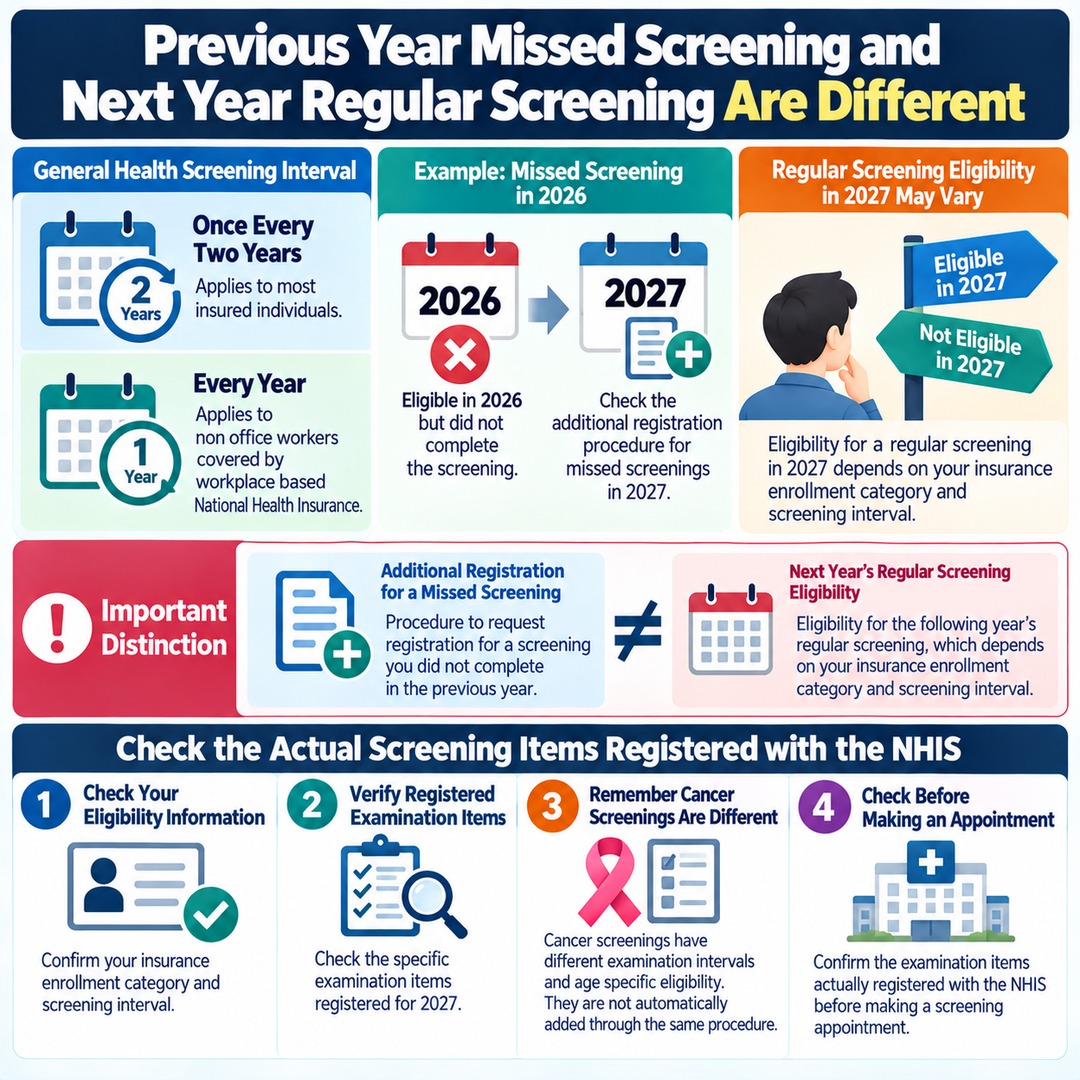
Additional registration for a screening missed in the previous year must be checked separately from eligibility for the following year's regular health screening.
In South Korea, general health screenings are normally conducted once every two years. However, non-office workers covered by workplace-based National Health Insurance are eligible for annual screenings.
Consequently, eligibility for a regular screening in 2027 may vary depending on your insurance enrollment category and screening interval.
For example, someone eligible for a general health screening in 2026 who fails to complete it can check the additional registration procedure for missed screenings in 2027. However, the specific examination items registered for 2027 must be confirmed through that person's individual screening eligibility information.
You should not assume that cancer screenings with different examination intervals or age-specific tests will automatically be added through the same procedure.
The most reliable approach is to check the examination items actually registered with the NHIS before making a screening appointment.
Will You Face Immediate Penalties If You Miss the Year-End Screening Deadline?
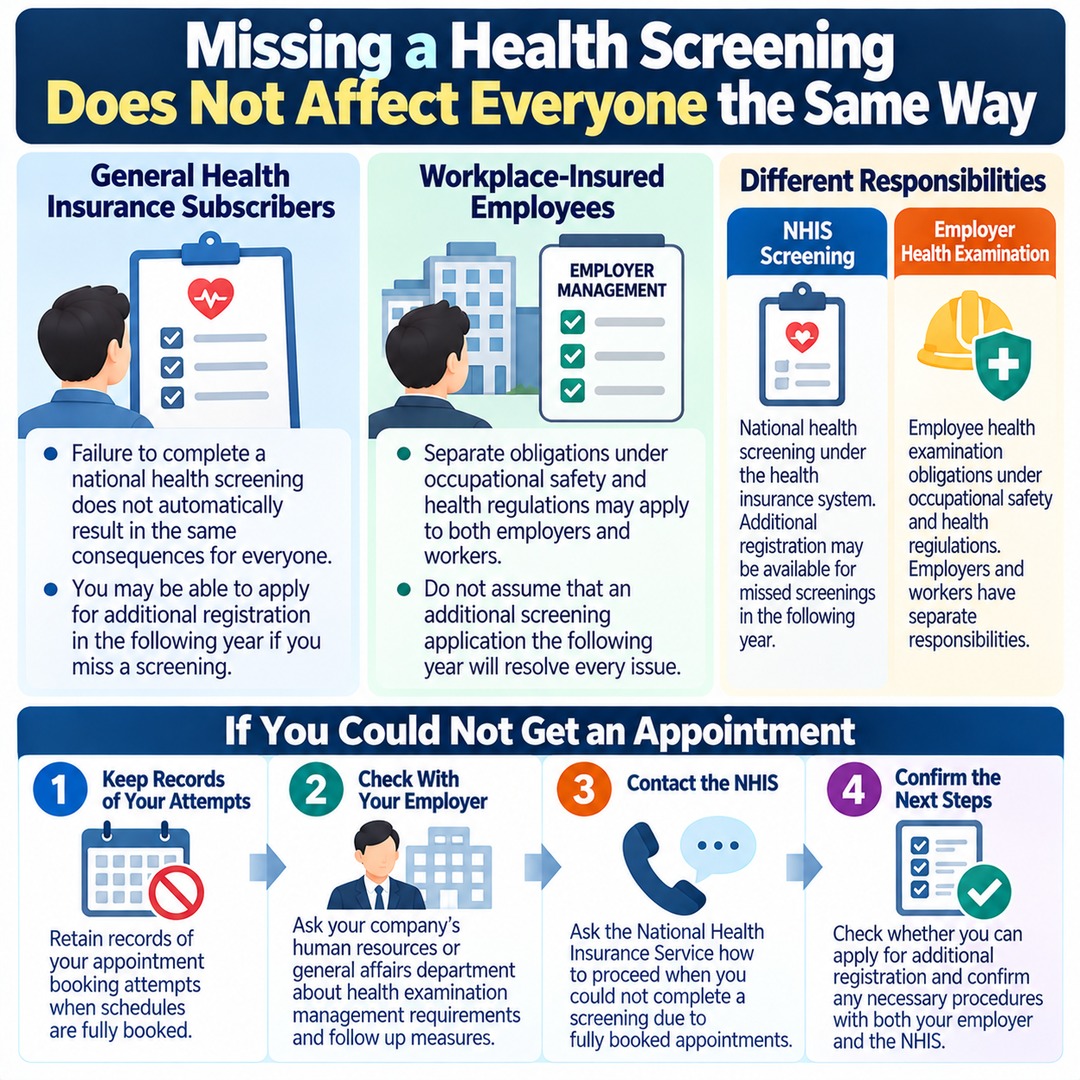
Failing to undergo a national health screening does not automatically result in the same consequences for everyone.
In particular, a general health insurance subscriber's failure to complete a screening must be distinguished from the employee health examination obligations managed by an employer.
For employees, separate obligations under South Korea's occupational safety and health regulations may apply to both employers and workers.
Therefore, workplace-insured employees should not simply assume that applying for an additional screening the following year will resolve every issue. They should also check their employer's health examination management requirements and any necessary follow-up measures.
If you could not complete your screening because appointments were fully booked, it is advisable to retain records of your booking attempts and ask your employer's representative and the NHIS how to proceed.
What Should You Check Before December?
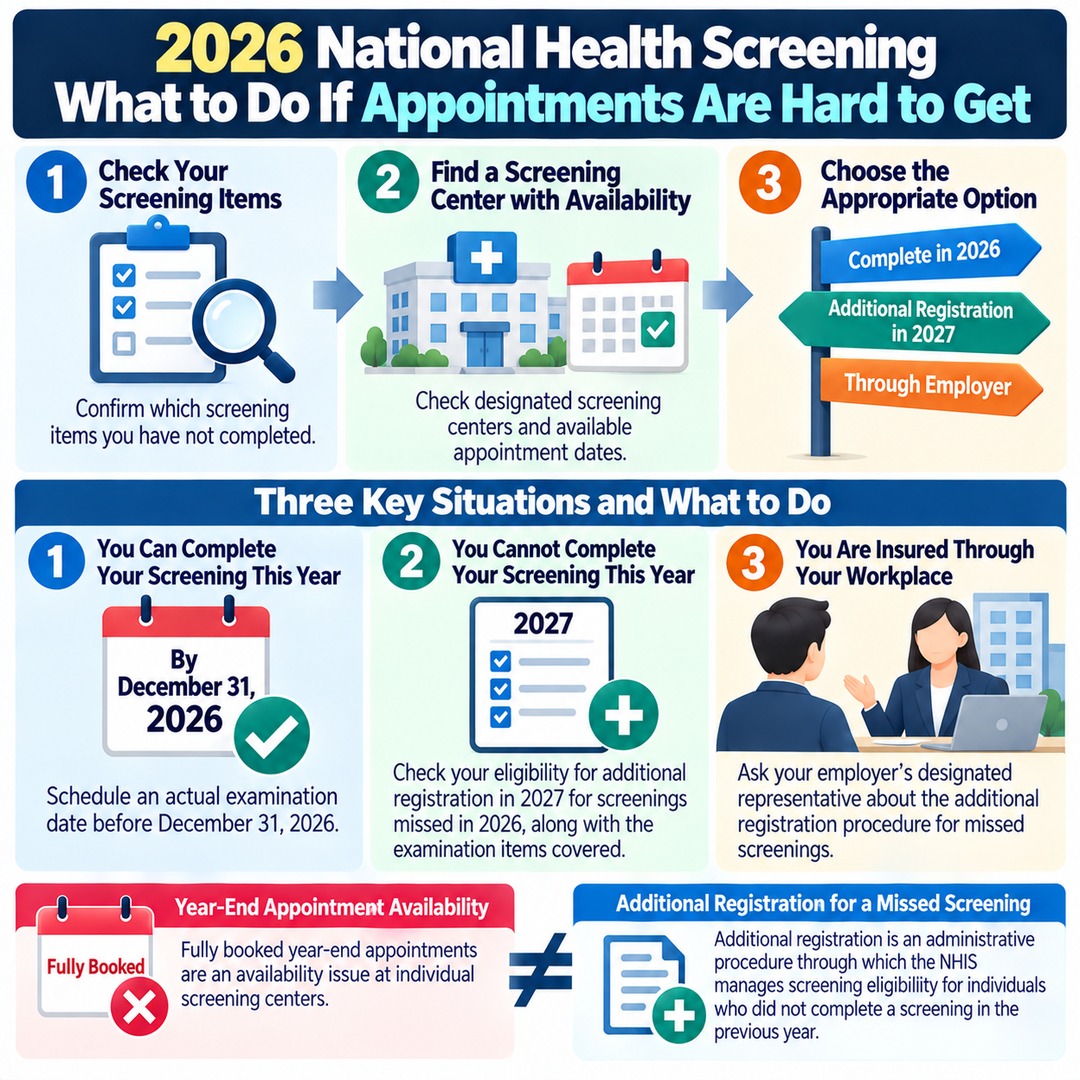
If you are eligible for South Korea's 2026 National Health Screening Program, start by checking which screening items you have not completed and which designated screening centers still have available appointments.
Difficulty securing a year-end appointment does not mean you need to immediately choose the following year's additional application procedure. If a screening center can accommodate you before the end of 2026, completing the examination within the designated screening period is the simplest option.
On the other hand, if completing your screening in 2026 is unlikely, you can identify the additional registration procedure that applies to your insurance enrollment category in advance.
The following three situations are particularly important to distinguish:
If you can complete your screening this year: Schedule an actual examination date before December 31, 2026.
If you cannot complete your screening this year: Check your eligibility for additional registration in 2027 for screenings missed in 2026, along with the examination items covered.
If you are insured through your workplace: Ask your employer's designated representative about the additional registration procedure for general health screenings.
Fully booked year-end appointments are an availability issue at individual screening centers. Additional registration for a screening missed in the previous year, however, is an administrative procedure through which the NHIS manages screening eligibility.
Understanding and checking these two matters separately will help you follow the correct procedures even if you miss your original health screening deadline.