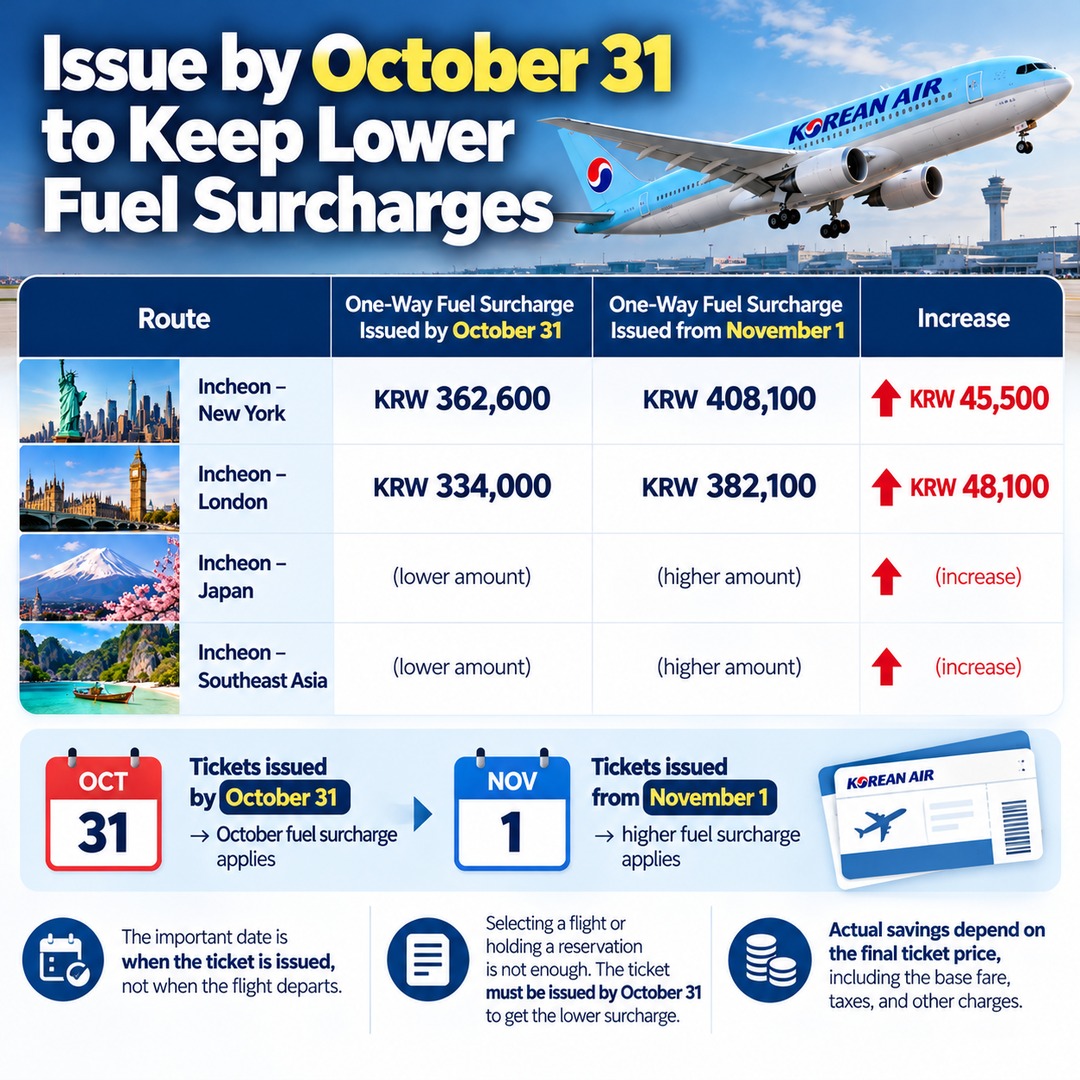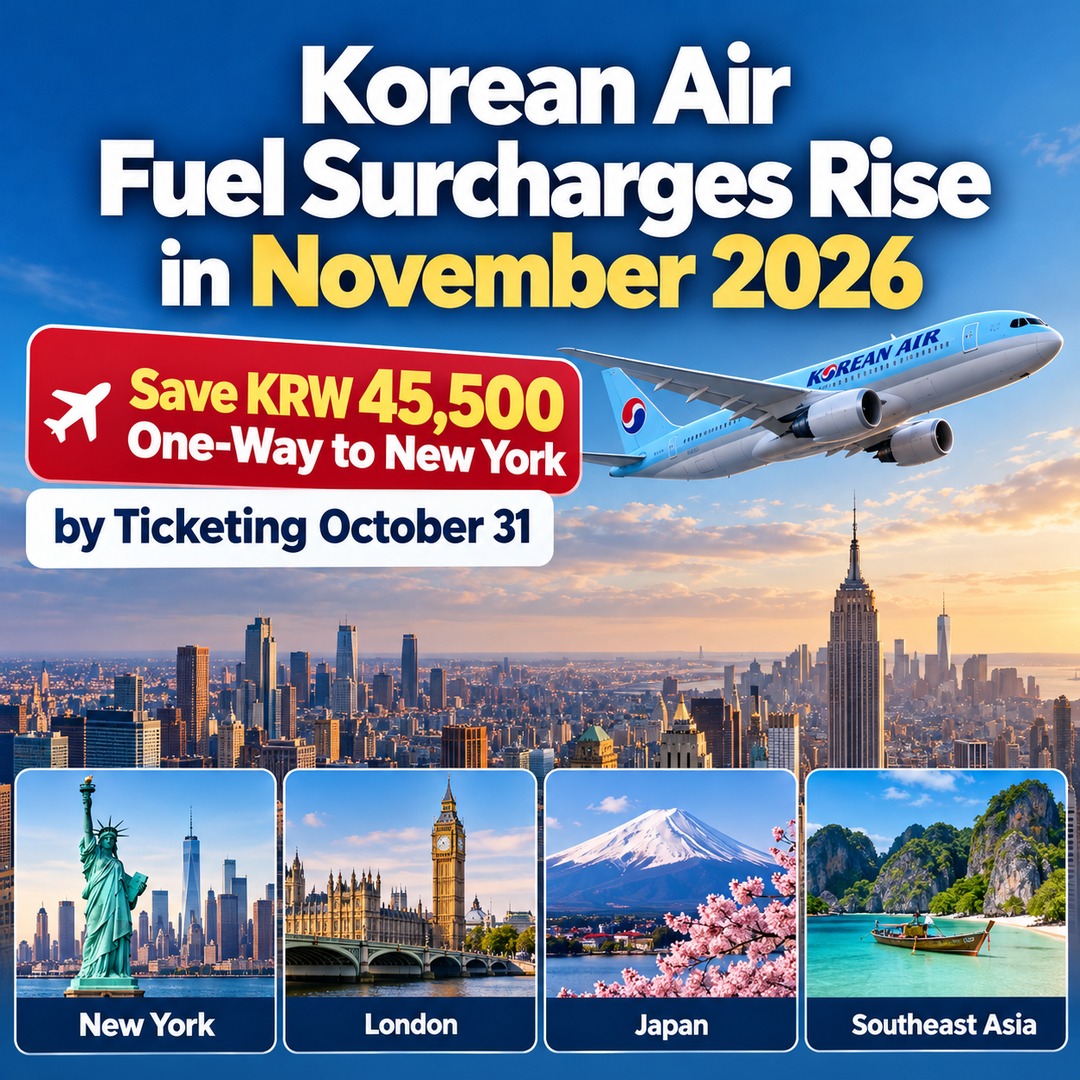
Korean Air international tickets for flights departing in November 2026 or later will still be subject to October fuel surcharges if issued by October 31. Starting November 1, the one-way surcharge increases by KRW 45,500 on the Incheon–New York route and KRW 48,100 on the Incheon–London route. However, actual savings depend on the final ticket price, including the base fare, taxes, and other charges.
Traveling in November does not necessarily mean paying November's fuel surcharge. The important date is when the ticket is issued, not when the flight departs.
Which Fuel Surcharge Applies If You Buy a November Flight on October 31?
Korean Air applies fuel surcharges to international flights departing from South Korea based on the ticket issuance date. The October 2026 rates apply to tickets issued from October 1 through October 31, while the increased November rates apply to tickets issued from November 1 through November 30.
Suppose you are purchasing a Korean Air ticket from Incheon to New York for departure on November 20.
If the ticket is issued on October 31, the one-way fuel surcharge for the flight departing South Korea is KRW 362,600. If the same ticket is issued on November 1, the applicable surcharge is KRW 408,100.
The difference between the two ticketing dates is KRW 45,500.
It is important to distinguish between selecting a flight or holding a reservation and actually completing ticket issuance. To qualify for the October surcharge, the ticket must be issued by the end of October 31.
How Much Are Korean Air Fuel Surcharges Increasing by Route?
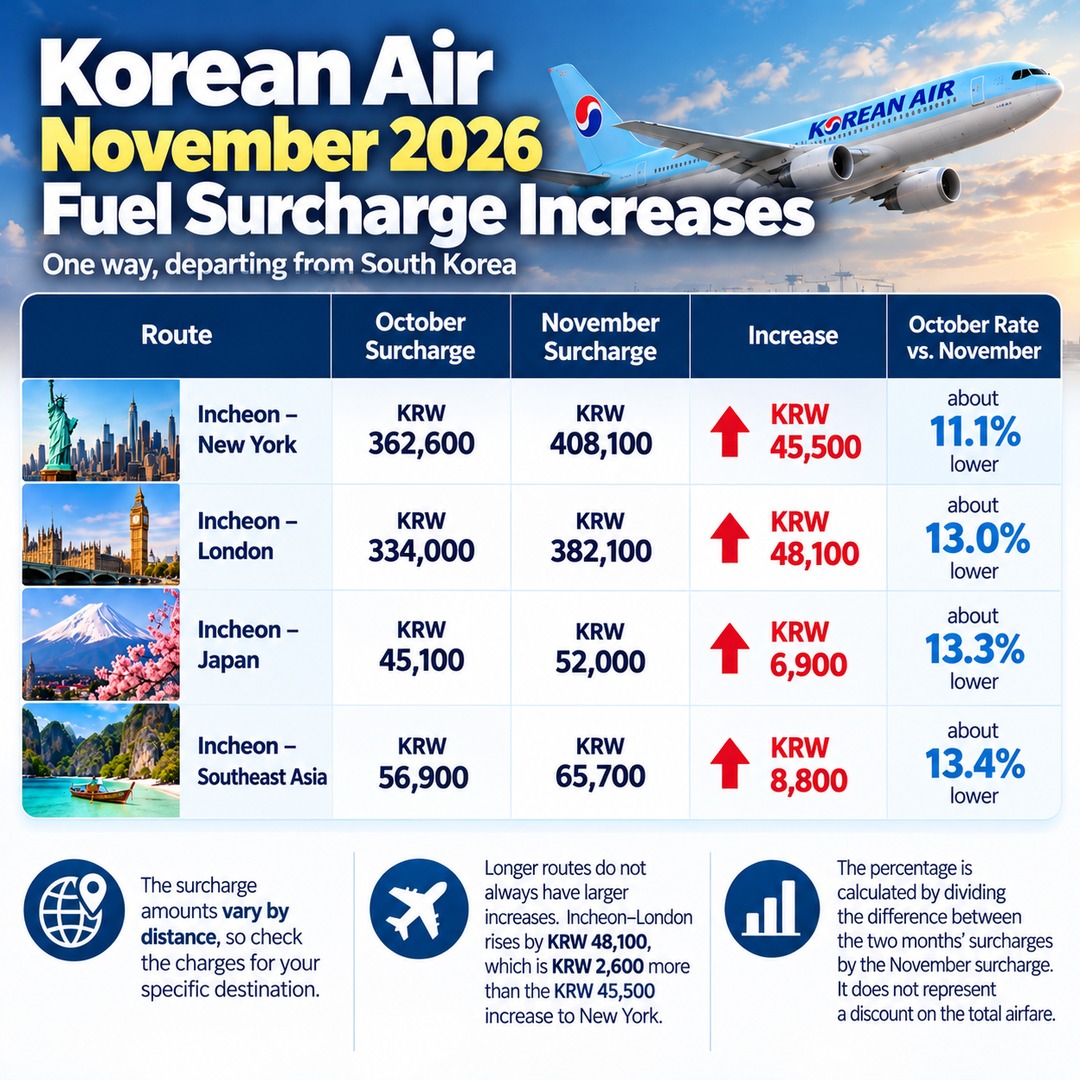
Korean Air's November 2026 international fuel surcharges for departures from South Korea are increasing across the major routes listed below. However, the applicable amounts vary by distance, so travelers should check the charges for their specific destinations.
The following amounts apply to one-way flights departing from South Korea.
| Major Route | October Ticketing | November Ticketing | Increase |
|---|---|---|---|
| Incheon–Fukuoka | KRW 49,000 | KRW 55,600 | KRW 6,600 |
| Incheon–Tokyo Narita | KRW 65,800 | KRW 76,000 | KRW 10,200 |
| Incheon–Da Nang | KRW 116,200 | KRW 132,900 | KRW 16,700 |
| Incheon–Bangkok | KRW 162,400 | KRW 185,800 | KRW 23,400 |
| Incheon–Honolulu | KRW 226,800 | KRW 254,900 | KRW 28,100 |
| Incheon–London | KRW 322,000 | KRW 370,100 | KRW 48,100 |
| Incheon–New York | KRW 362,600 | KRW 408,100 | KRW 45,500 |
Longer routes do not always have larger surcharge increases. For example, the Incheon–London surcharge rises by KRW 48,100, which is KRW 2,600 more than the KRW 45,500 increase on the Incheon–New York route.
Comparing fuel surcharges alone, the October ticketing rate is approximately 13.0% lower for Incheon–London and approximately 11.1% lower for Incheon–New York. These percentages are calculated by dividing the difference between the two months' surcharges by the November surcharge. They do not represent discounts on the total airfare.
Can You Save Twice the One-Way Increase on a Round-Trip Ticket?
Simply doubling the one-way fuel surcharge increase may not accurately reflect the difference in the total cost of a round-trip ticket.
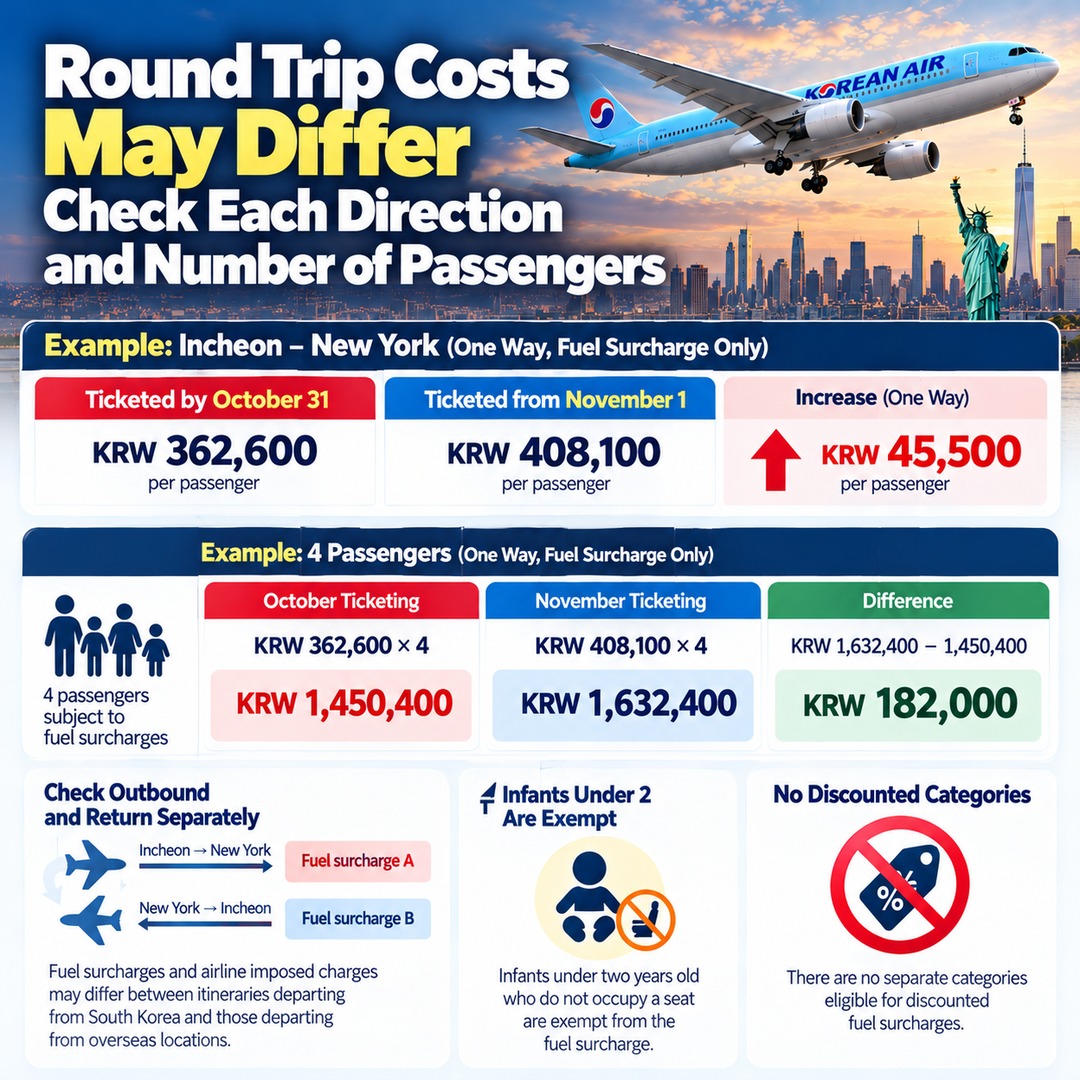
Korean Air explains that fuel surcharges and airline-imposed charges may differ between itineraries departing from South Korea and those departing from overseas locations.
For example, the fact that the November one-way surcharge from Incheon to New York is KRW 408,100 does not mean the same amount necessarily applies to the return flight from New York to Incheon.
When purchasing a round-trip ticket, travelers should therefore check the fuel surcharges shown separately for the outbound and return flights.
For family trips, the total cost also depends on the number of passengers.
Suppose four passengers who are subject to fuel surcharges purchase one-way tickets from Incheon to New York.
October ticketing: KRW 362,600 × 4 passengers = KRW 1,450,400
November ticketing: KRW 408,100 × 4 passengers = KRW 1,632,400
Difference: KRW 182,000
This is an illustrative calculation comparing only the fuel surcharges for the same one-way route departing from South Korea. It does not include return flights, base fares, or taxes.
Meanwhile, under Korean Air's applicable fuel surcharge rules, infants under two years old who do not occupy a seat are exempt from the surcharge. There are no separate categories eligible for discounted fuel surcharges.
Will You Pay More If Fuel Surcharges Rise After Your Ticket Is Issued?
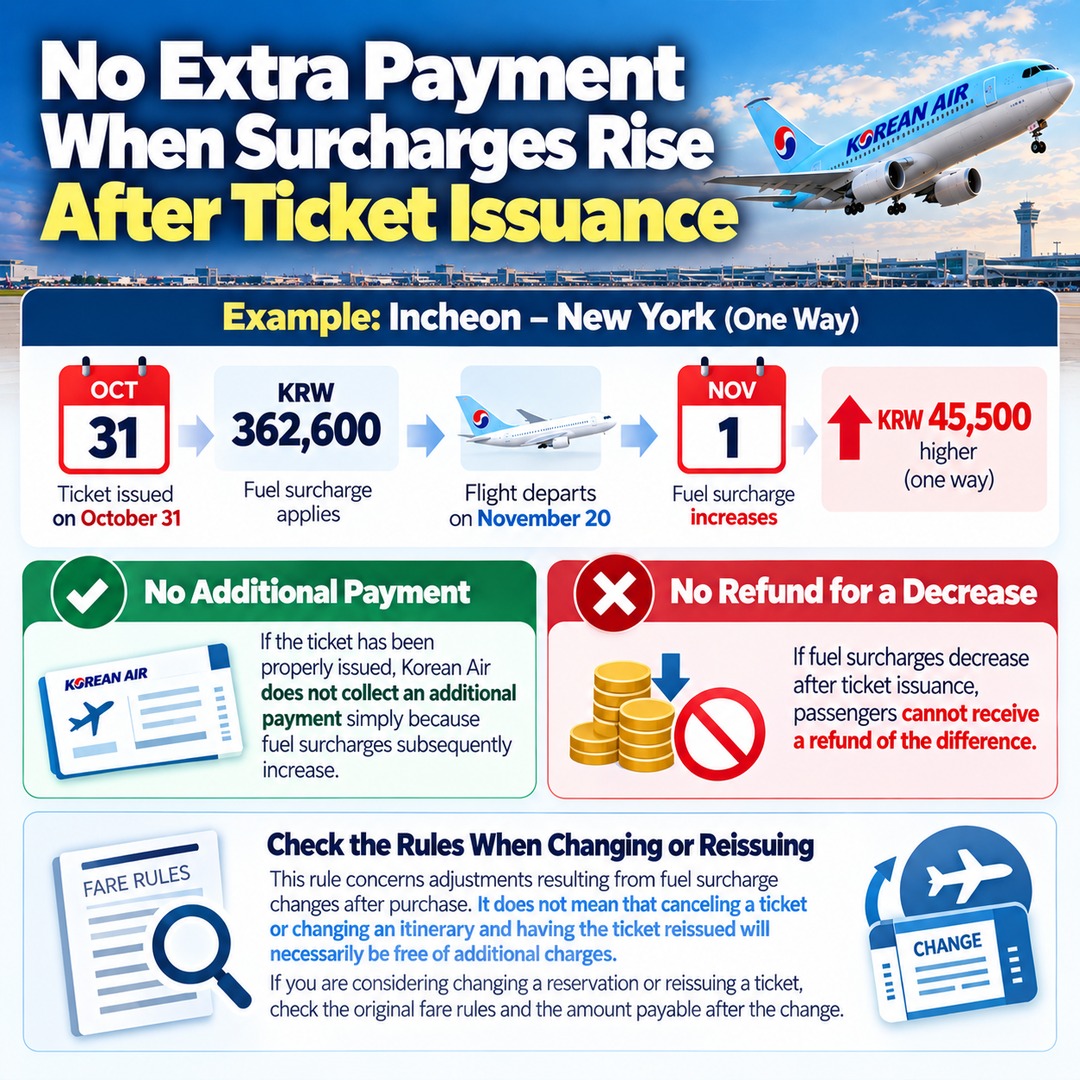
Once a ticket has been properly issued, Korean Air does not collect an additional payment simply because fuel surcharges subsequently increase.
Conversely, if fuel surcharges decrease after ticket issuance, passengers cannot receive a refund of the difference.
For example, if you issue an Incheon–New York ticket on October 31 and fly on November 20, you will not have to pay an additional KRW 45,500 merely because the November surcharge has increased.
This rule concerns adjustments resulting from fuel surcharge changes after purchase. It does not mean that canceling a ticket or changing an itinerary and having the ticket reissued will necessarily be free of additional charges.
If you are considering changing a reservation or reissuing a ticket, check the original fare rules and the amount payable after the change.
Is It Always Better to Rush and Issue Your Ticket on October 31?
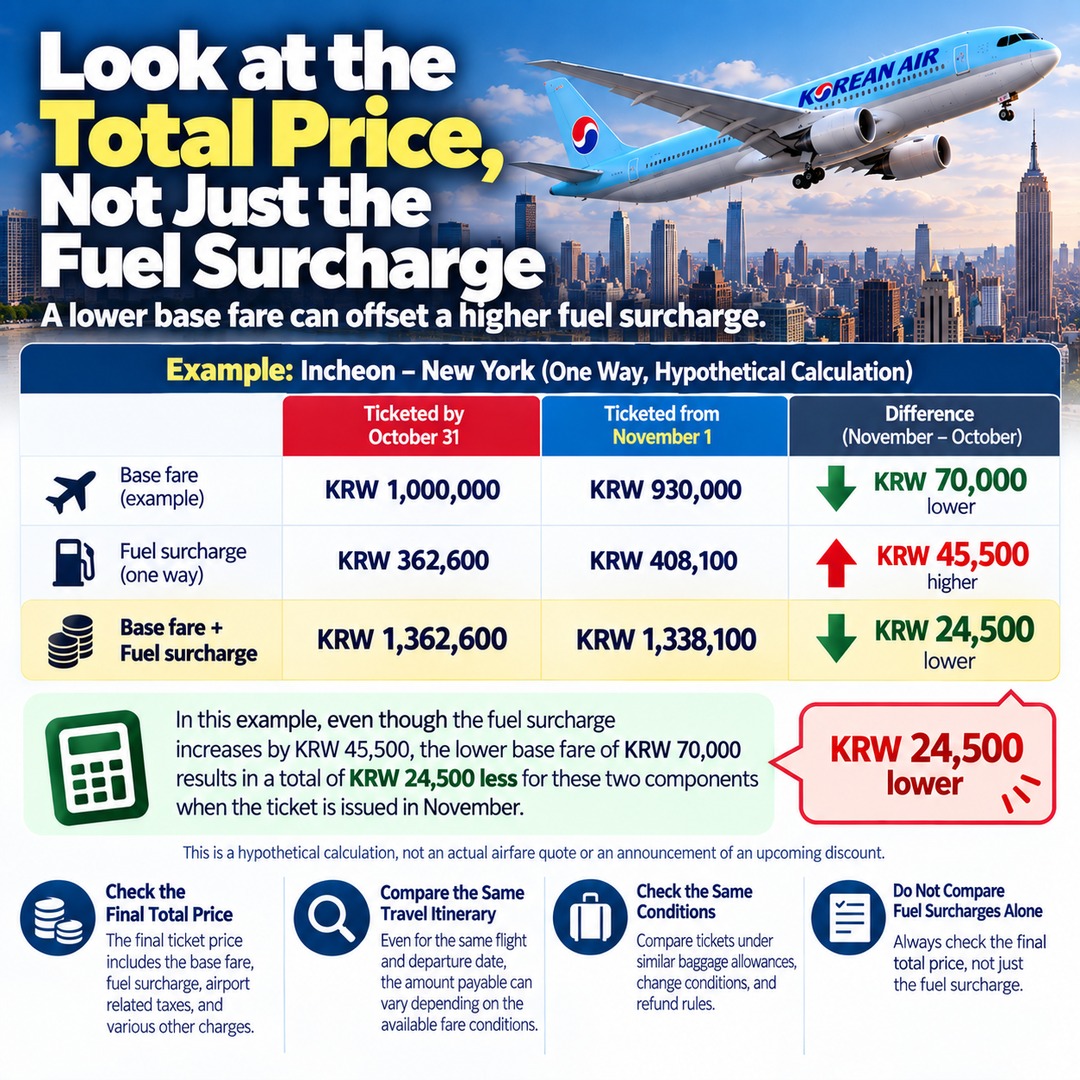
For example, suppose the base fare for a one-way Incheon–New York ticket becomes KRW 70,000 cheaper on November 1 than it was on October 31.
Although the fuel surcharge increases by KRW 45,500, if the base fare falls by KRW 70,000, the combined cost of those two components is actually KRW 24,500 lower when the ticket is issued in November.
This is a hypothetical calculation, not an actual airfare quote or an announcement of an upcoming discount. It illustrates why travelers should compare base fares and fuel surcharges together.
The final ticket price includes the base fare, fuel surcharge, airport-related taxes, and various other charges. Even for the same flight and departure date, the amount payable can vary depending on the available fare conditions.
Therefore, when buying airline tickets, do not compare fuel surcharges alone. Check the final total price for the same travel itinerary under comparable baggage allowances, change conditions, and refund rules.
What Should You Check Before Issuing a Ticket on October 31?
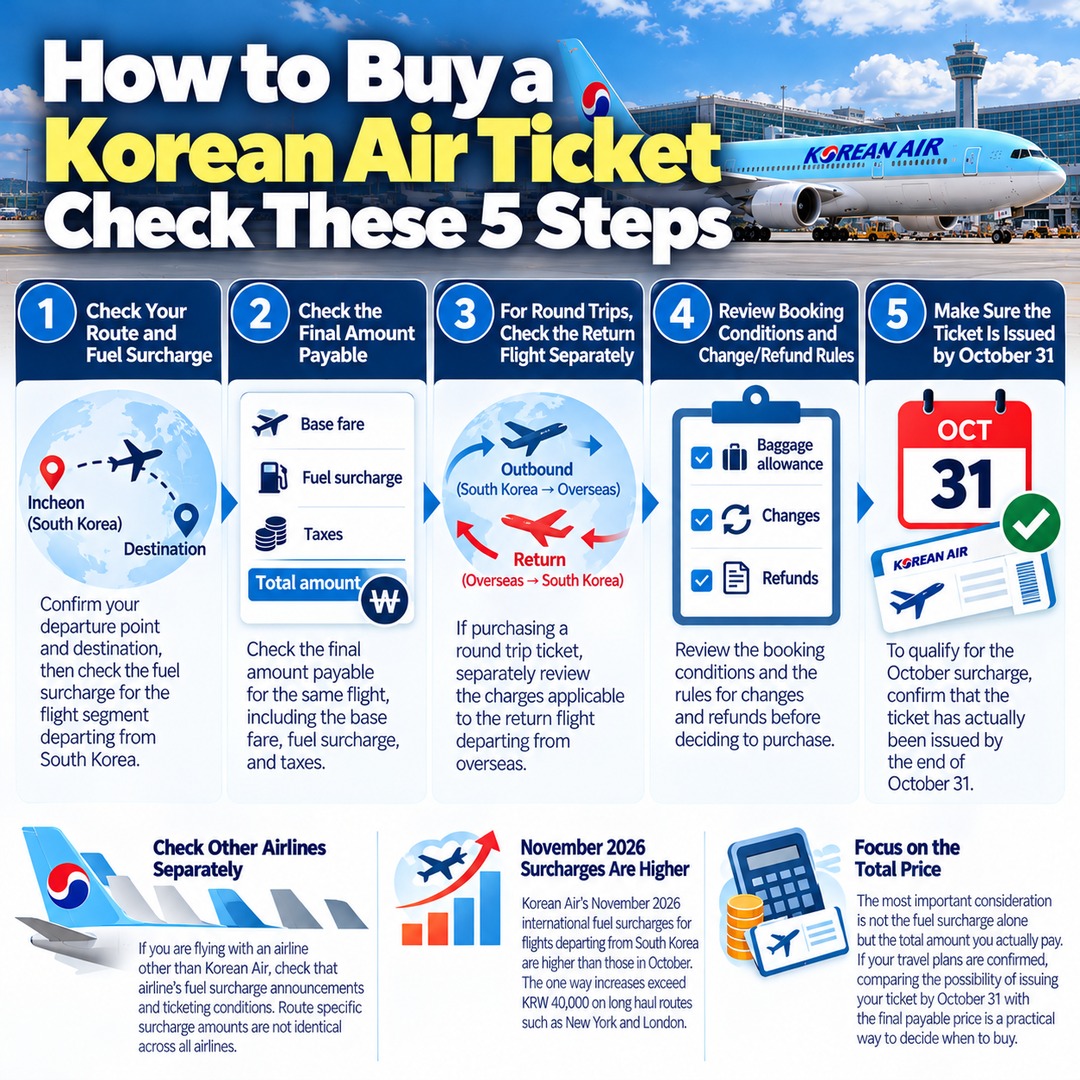
If you are planning to purchase a Korean Air international ticket, the following sequence can help you make an informed decision.
1. Confirm your departure point and destination, then check the fuel surcharge applicable to the flight segment departing from South Korea.
2. Check the final amount payable for the same flight, including the base fare, fuel surcharge, and taxes.
3. If purchasing a round-trip ticket, separately review the charges applicable to the return flight departing from overseas.
4. Review the booking conditions and the rules for changes and refunds before deciding to purchase.
5. To qualify for the October surcharge, confirm that the ticket has actually been issued by the end of October 31.
If you are flying with an airline other than Korean Air, check that airline's fuel surcharge announcements and ticketing conditions. Route-specific surcharge amounts are not identical across all airlines.
Korean Air's November 2026 international fuel surcharges for flights departing from South Korea are higher than those in October. In particular, the one-way increases exceed KRW 40,000 on long-haul routes such as New York and London, making the ticket issuance date a meaningful factor in the cost.
However, the most important consideration when purchasing an airline ticket is not the fuel surcharge alone but the total amount you actually pay. If your travel plans are confirmed, comparing the possibility of issuing your ticket by October 31 with the final payable price is a practical way to decide when to buy.