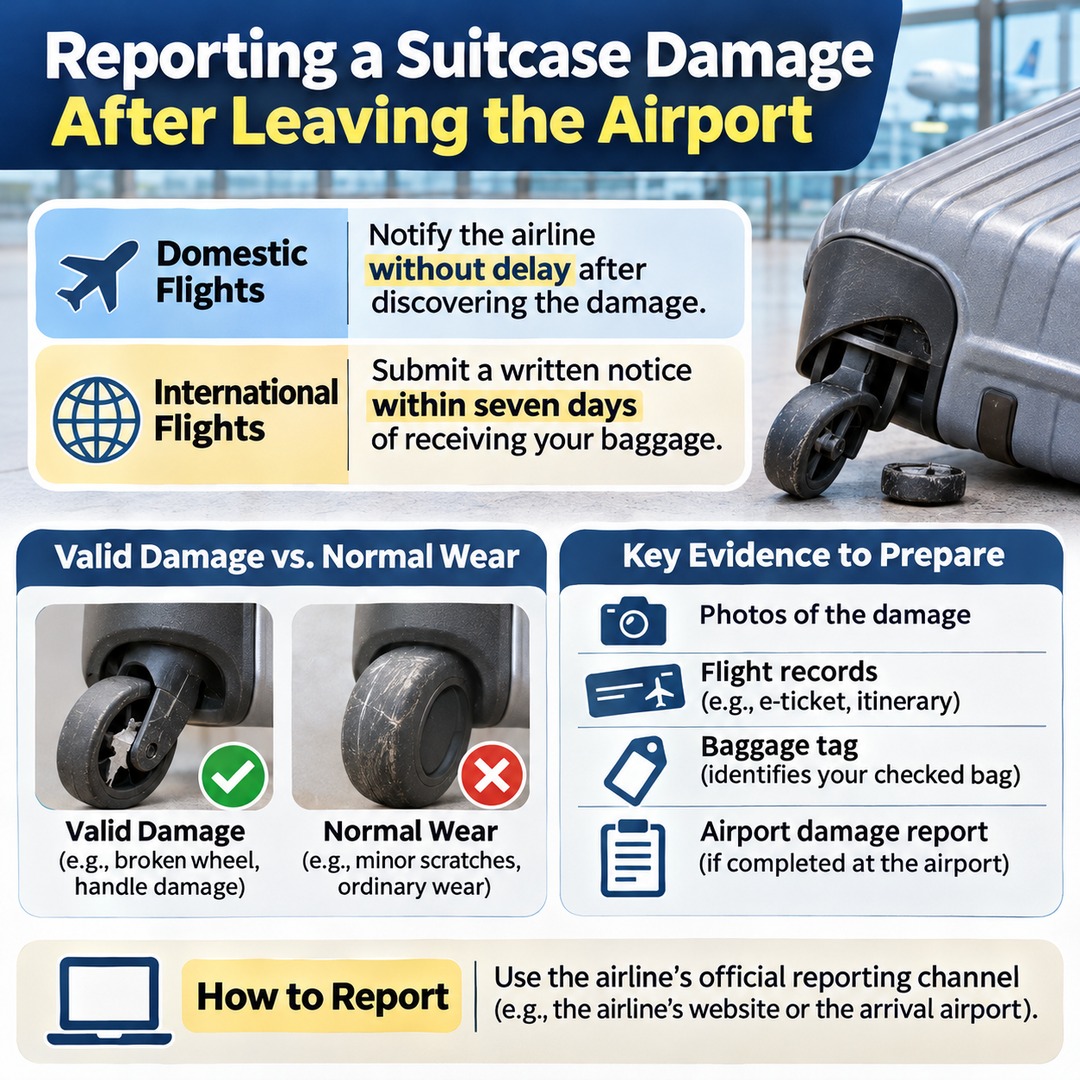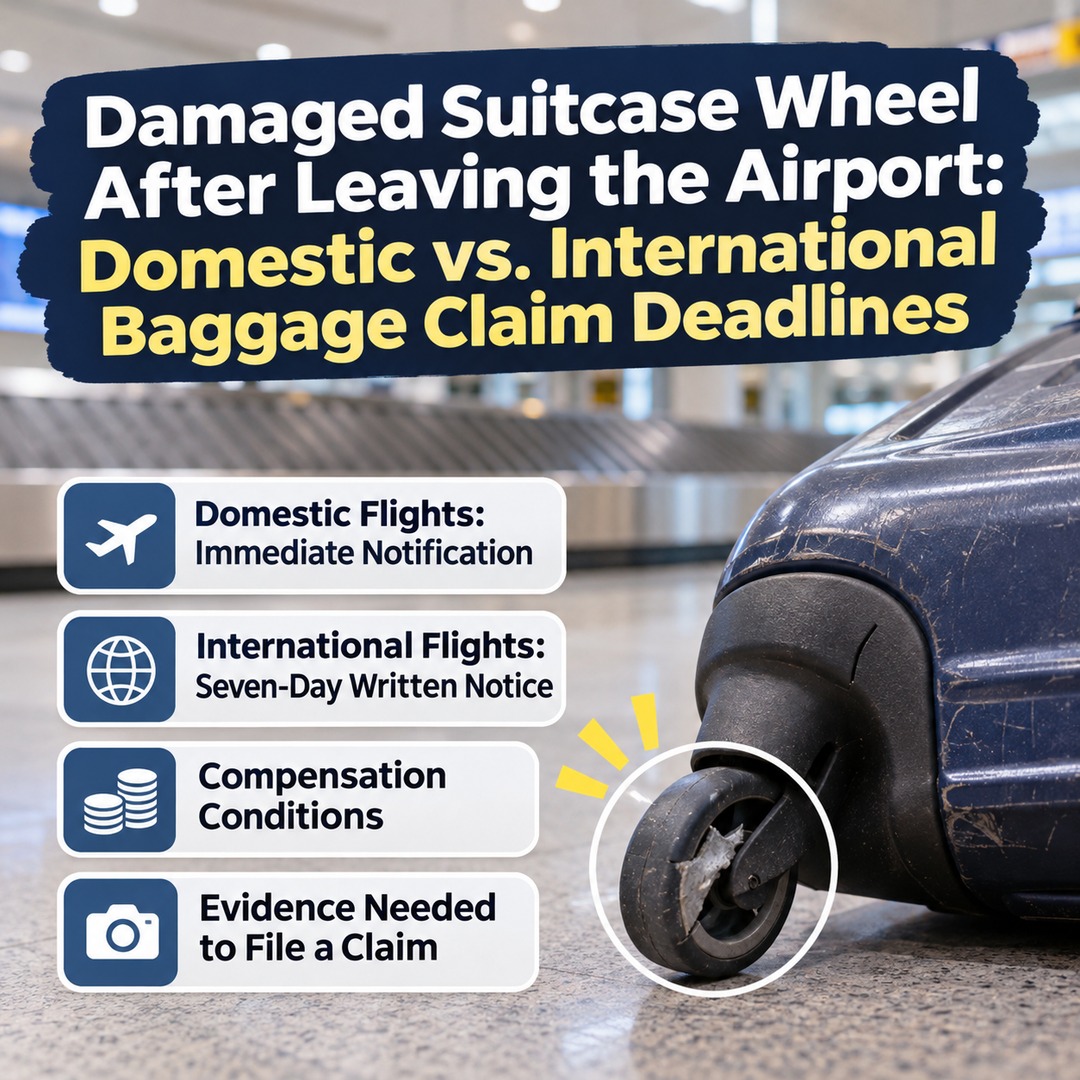
If you collect your suitcase at the airport and discover a broken wheel only after arriving home or at your accommodation, you can still report the damage to the airline. However, for domestic flights in South Korea, the general rule is to notify the airline without delay after discovering the damage. For international flights governed by the Montreal Convention, written notification must be submitted within seven days of receiving the baggage. Even if you meet the deadline, compensation depends on whether the damage occurred during air transportation.
A completely broken wheel or damaged handle should be distinguished from ordinary signs of wear and tear. You do not necessarily have to abandon your claim simply because you did not complete a damage report at the airport. However, once you have left the airport, establishing when the damage occurred becomes more important.
Can You Report Suitcase Damage Discovered After Leaving the Airport?
You can report damage to checked baggage even if you discover it outside the airport. Korean Air provides instructions for passengers who discover baggage damage after leaving the airport to submit a report through its website. Asiana Airlines also provides procedures for reporting baggage incidents through the arrival airport.
However, being allowed to submit a report does not mean compensation will necessarily be approved.
The airline may examine whether the baggage was damaged during transportation, whether the damage resulted from normal wear and tear, or whether the suitcase itself had a defect.
If you completed a damage report in the airport baggage claim area, that record can help establish the condition of your suitcase. If you left without reporting the damage, photographs taken afterward, flight records, and baggage tags become important supporting evidence.
If you have already arrived home, it is generally better to check the airline's official baggage damage reporting channels before making another trip to the airport.
Is Reporting Suitcase Damage Within Seven Days Always Sufficient for Domestic Flights?
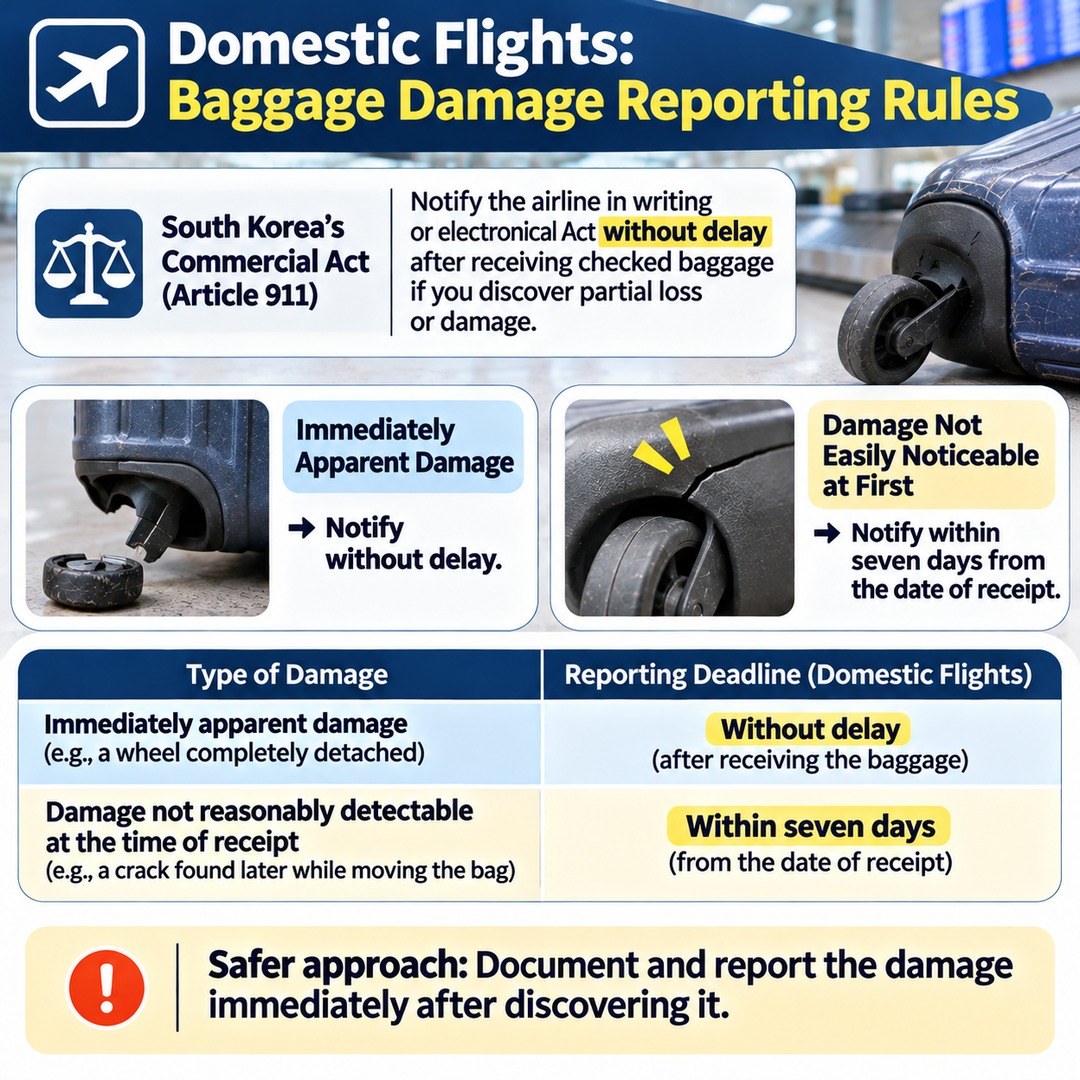
For domestic flights in South Korea, the first question is whether the damage was immediately apparent when you received your baggage.
Article 911 of South Korea's Commercial Act requires passengers who discover partial loss of or damage to checked baggage to notify the airline in writing or by electronic document without delay after receiving the baggage.
For damage that could not reasonably have been discovered immediately upon receipt, a notification deadline of seven days from the date of receipt applies.
| Damage or baggage situation | Notification requirement for domestic flights in South Korea |
|---|---|
| Damage immediately apparent upon receiving the baggage | Notify the airline without delay after receipt |
| Damage that could not be discovered immediately | Notify the airline within seven days of receiving the baggage |
| Delayed delivery of baggage | Submit an objection within 21 days from the date the baggage was placed at the passenger's disposal |
For example, if an entire suitcase wheel has fallen off, whether the damage was visibly apparent when the baggage was collected may become a key issue.
Conversely, if the suitcase appeared normal at first but you discovered a crack in the wheel attachment while moving it, the important question may be whether the damage could reasonably have been detected immediately upon receipt.
Which rule applies must be determined from the actual condition of the suitcase and the circumstances in which the damage was discovered.
Asiana Airlines' domestic conditions of carriage instruct passengers to submit a written compensation claim for baggage damage within seven days of receiving the baggage.
However, rather than relying solely on an airline's seven-day provision and postponing your report, the safer approach is to document and report the damage immediately after discovering it, in accordance with South Korea's statutory notification requirements for domestic air transportation.
What Happens If You Report International Baggage Damage After Seven Days?
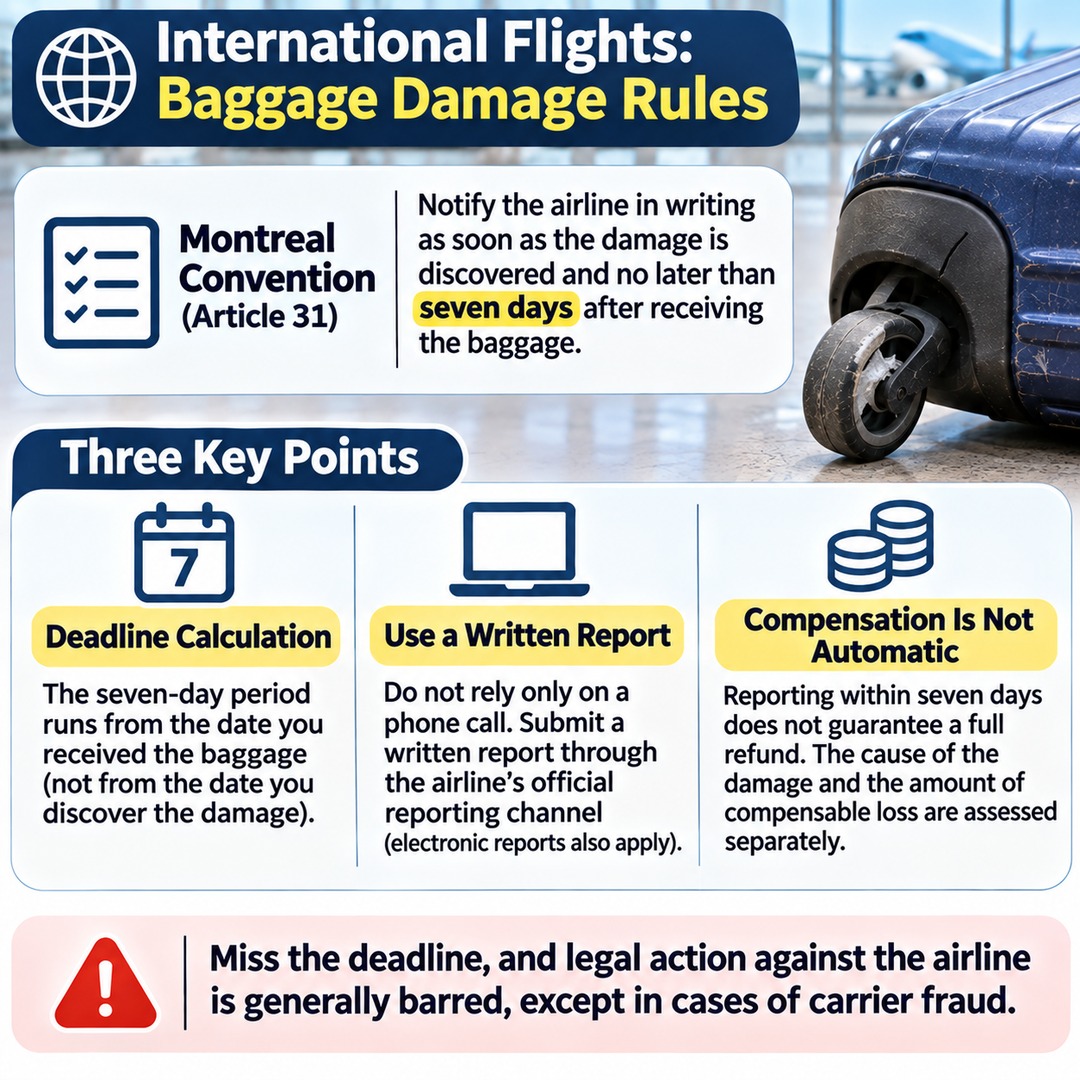
For damage to checked baggage on international flights governed by the Montreal Convention, passengers must notify the airline in writing as soon as the damage is discovered and no later than seven days after receiving the baggage.
Article 31 of the Montreal Convention establishes the notification deadline and written notice requirements for damaged baggage.
Three points are particularly important.
First, the seven-day period does not begin anew on the date you discover the damage. It is calculated from the date you received the baggage.
Second, do not rely solely on explaining the situation over the telephone. Submit a written report through the airline's official reporting channels. An electronic report recorded in the airline's system may also satisfy the written notice requirement.
Third, reporting the damage within seven days does not automatically entitle you to reimbursement of the suitcase's full purchase price. Whether the damage occurred during transportation and the amount of compensable loss must be assessed separately.
If the notification deadline established by the Convention is missed, legal action against the airline is generally barred. The Convention provides an exception involving fraud by the carrier.
Not every international itinerary is necessarily governed by the same convention, so passengers should also check the conditions of carriage shown on their tickets and the applicable international agreement.
When Can You Receive Compensation for a Broken Suitcase Wheel?
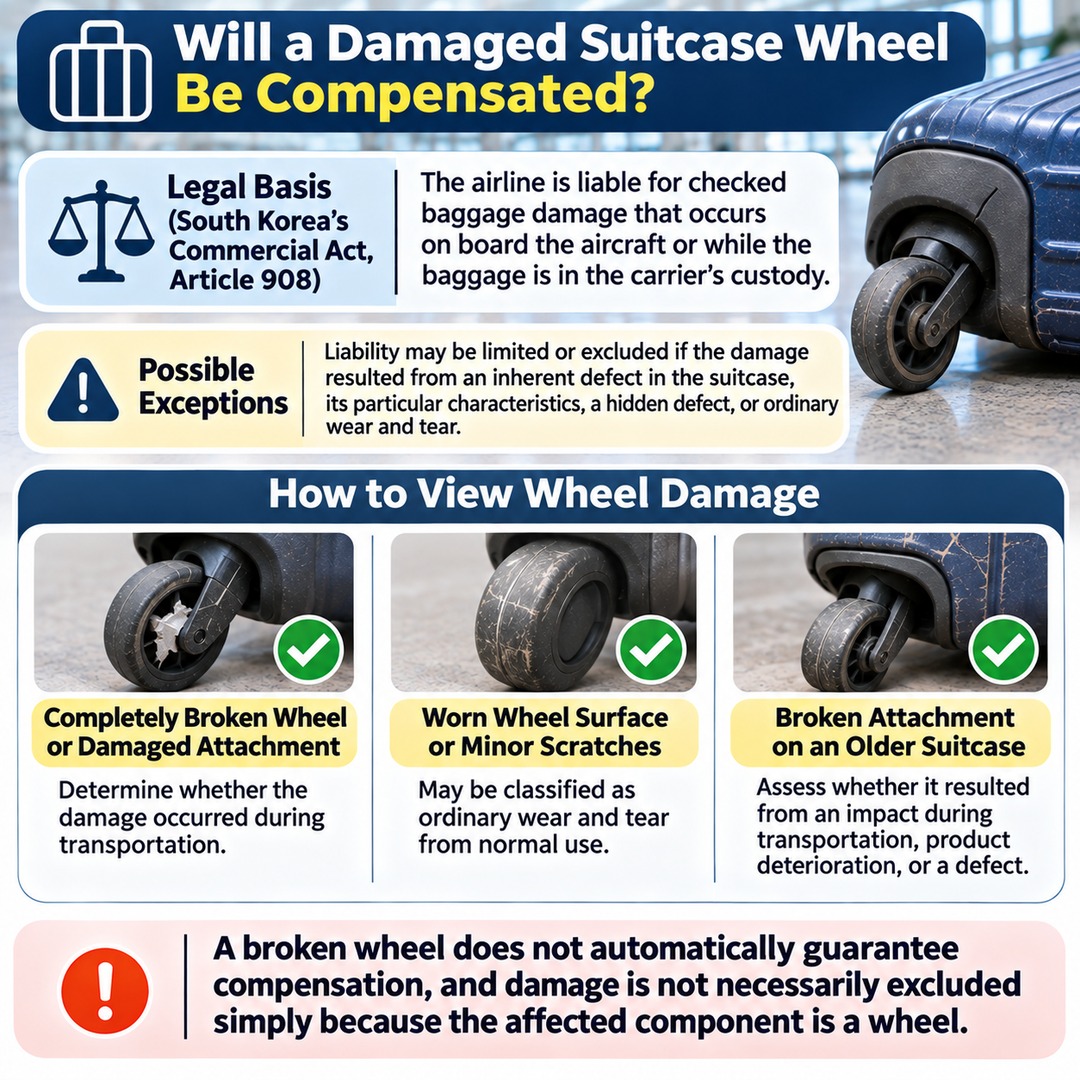
Damage that occurs while checked baggage is under the airline's control may qualify for compensation. However, liability may be limited or excluded if the damage resulted from an inherent defect in the suitcase or ordinary wear and tear.
Article 908 of South Korea's Commercial Act establishes carrier liability for checked baggage damage when the event causing the damage occurred on board the aircraft or during the period when the baggage was in the carrier's custody. However, it provides exceptions for damage caused by the baggage's inherent defects, particular characteristics, or hidden defects.
When examining a damaged suitcase wheel, the following distinctions matter:
A completely broken wheel or damaged wheel attachment: It is necessary to determine whether the damage occurred during transportation.
A worn wheel surface or minor scratches: These may be classified as ordinary wear and tear from normal use.
A broken wheel attachment on an older suitcase: The key issue may be whether the damage resulted from an impact during transportation, deterioration of the product itself, or a combination of factors.
Damage to handles, exterior decorations, or covers: The type of component and the airline's liability exclusions should be reviewed.
Asiana Airlines identifies minor scratches arising from normal handling, ordinary wear and tear, and damage to certain external accessories among the types of damage for which it excludes liability.
Therefore, a broken wheel does not automatically guarantee compensation. Equally, damage is not necessarily excluded simply because the affected component is a wheel.
How Should You Report Suitcase Damage Discovered Outside the Airport?
The first step is to document the damage before repairing or disposing of the suitcase.
Asiana Airlines instructs passengers reporting baggage damage to provide information such as passenger details, flight information, baggage tags, photographs of the damage, product information, and purchase price.
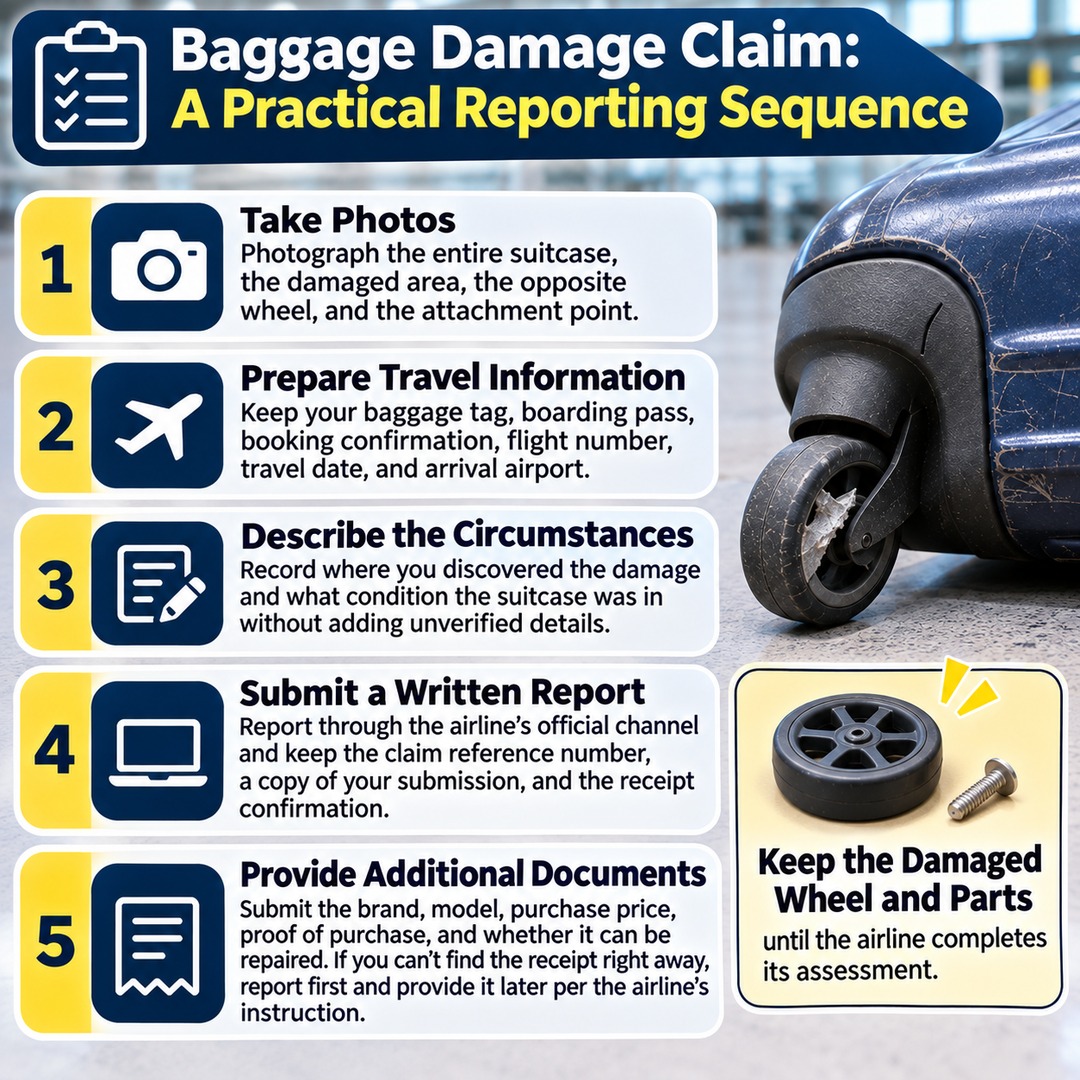
Based on these requirements, the following reporting sequence is practical.
1. Photograph the entire suitcase and the damaged areas. In addition to the broken wheel, photograph the suitcase as a whole, the wheel on the opposite side, and the damaged attachment point.
2. Collect your baggage tag and flight information. Prepare your boarding pass, booking confirmation, flight number, travel date, and arrival airport details.
3. Record the circumstances in which you discovered the damage. Describe accurately where you noticed the damage and what condition the suitcase was in. Do not invent an impact or incident during transportation that has not been established.
4. Submit a written report through the airline's official channels. Keep the claim reference number, a copy of the information submitted, and any confirmation screen or email acknowledging receipt.
5. Provide any additional documents requested by the airline. Confirm the brand, model, purchase price, proof of purchase, and whether the suitcase can be repaired.
If you cannot immediately locate the purchase receipt, do not delay the initial report. It is better to notify the airline of the damage within the applicable deadline and provide purchase-related documentation later according to the airline's instructions.
It is also advisable to keep the damaged wheel and any detached components until the airline has completed its assessment.
Can You Receive the Full Purchase Price of Your Suitcase as Compensation?
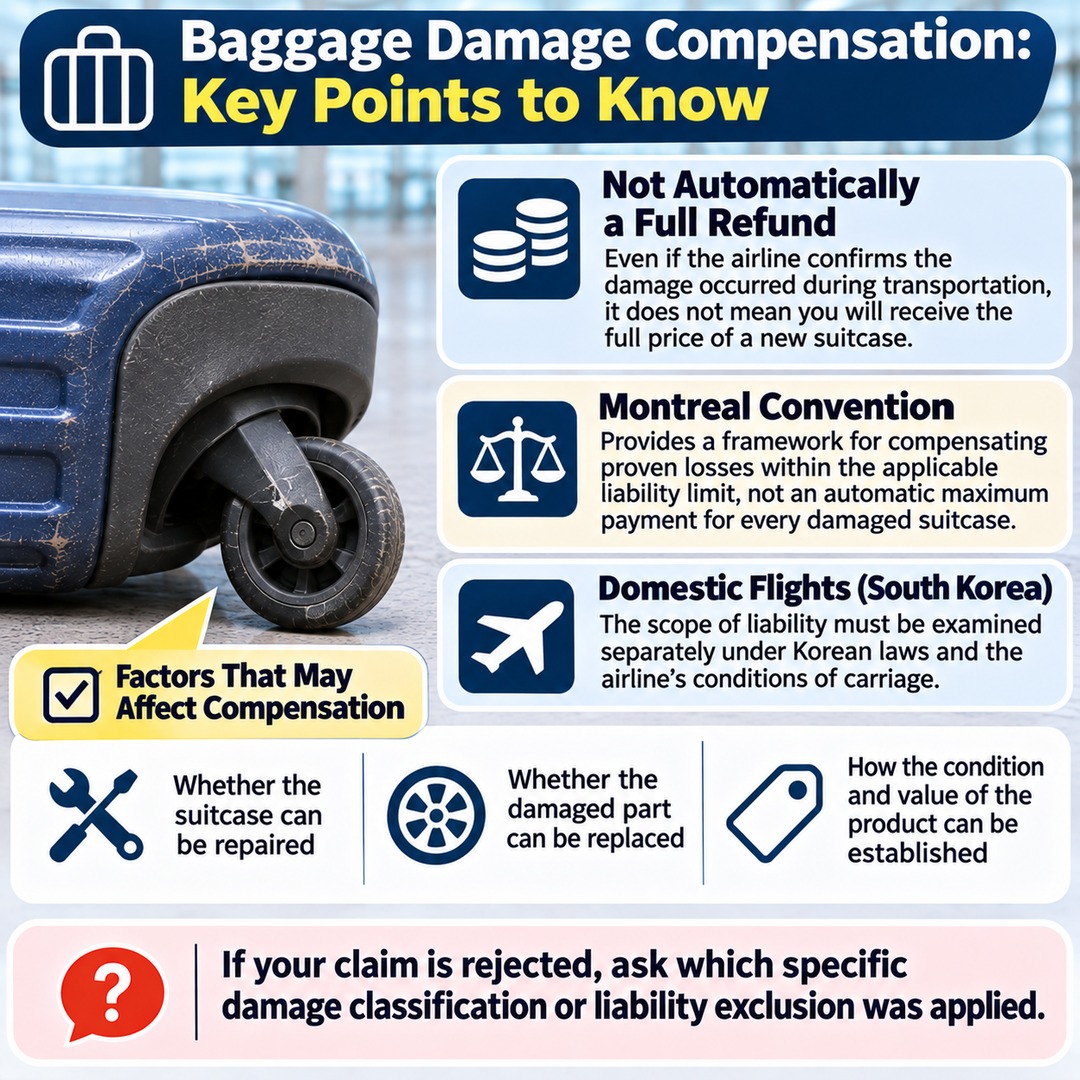
Even if the airline accepts that your suitcase was damaged during transportation, you should not assume that it will reimburse the full price of a new replacement.
Airline compensation is assessed based on the loss that is recognized and the applicable limits of liability.
Factors that may affect the compensation assessment include whether the suitcase can be repaired, whether the damaged component can be replaced, and how the condition and value of the product can be established.
In particular, the liability limit under the Montreal Convention does not mean that the airline must automatically pay the maximum amount whenever one suitcase is damaged. The Convention provides a framework for compensating proven losses within the applicable liability limit.
For domestic flights in South Korea, the scope of liability must be examined separately under the applicable Korean laws and the airline's conditions of carriage.
If the airline informs you that the damage is not eligible for compensation, it is advisable to ask which specific damage classification or liability exclusion was applied rather than accepting the rejection without further explanation.
What If the Airline Does Not Respond or Rejects Your Compensation Claim?
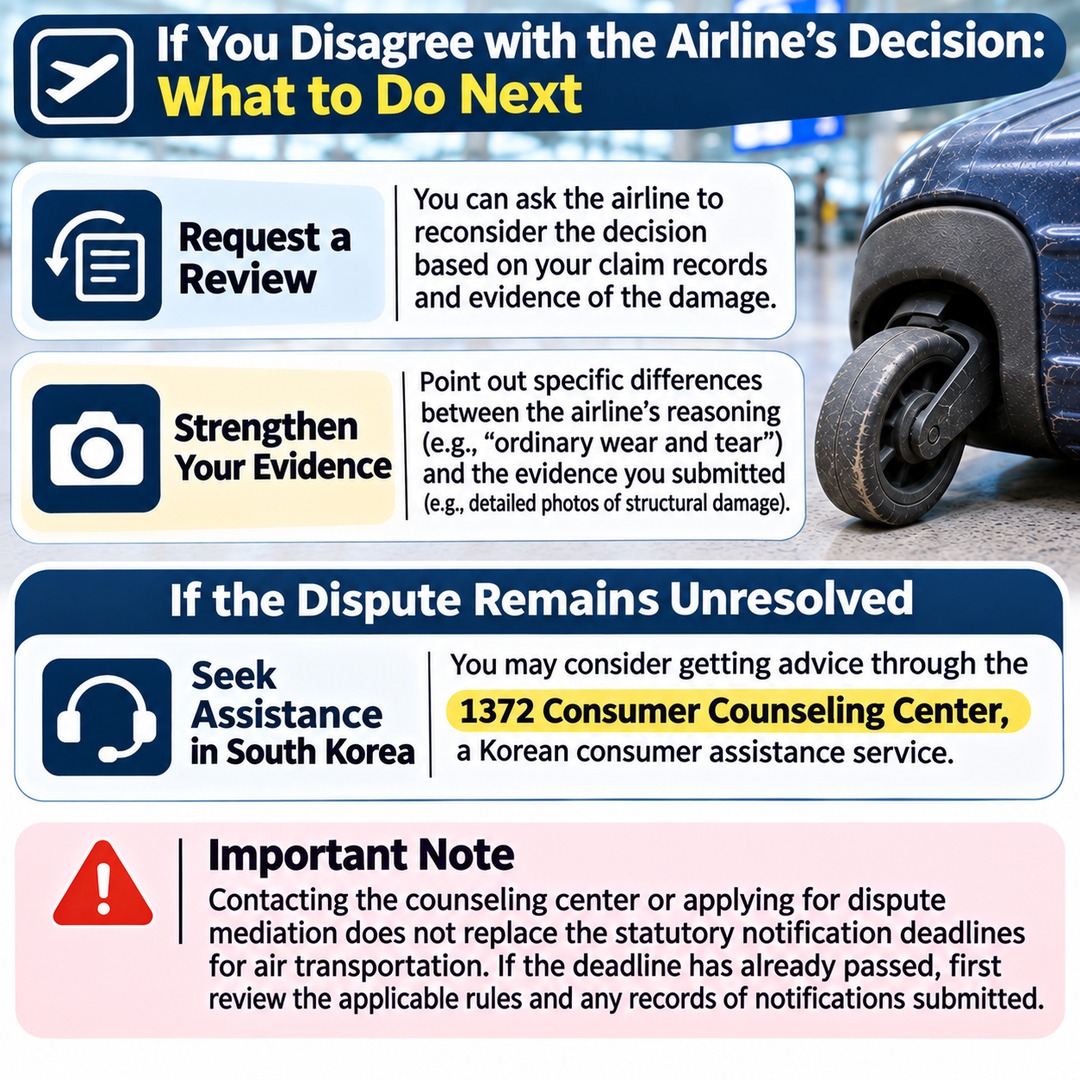
If you disagree with the airline's initial decision, you can request a review based on your claim records and evidence of the damage.
When requesting reconsideration, it is more useful to identify specific differences between the facts relied upon by the airline and the evidence you submitted than to focus on emotional explanations.
For example, if the airline classified the damage as ordinary wear and tear, you may submit additional photographs showing whether the affected area has only surface wear or has suffered structural damage.
If a consumer dispute with the airline remains unresolved in South Korea, you may also consider seeking advice through the 1372 Consumer Counseling Center, a Korean consumer assistance service. However, contacting the counseling center or applying for dispute mediation does not replace the statutory notification deadlines applicable to air transportation.
If the statutory notification deadline has already passed, you should first review the applicable rules and any records of notifications previously submitted.
What Should You Do Now If You Did Not File a Damage Report at the Airport?
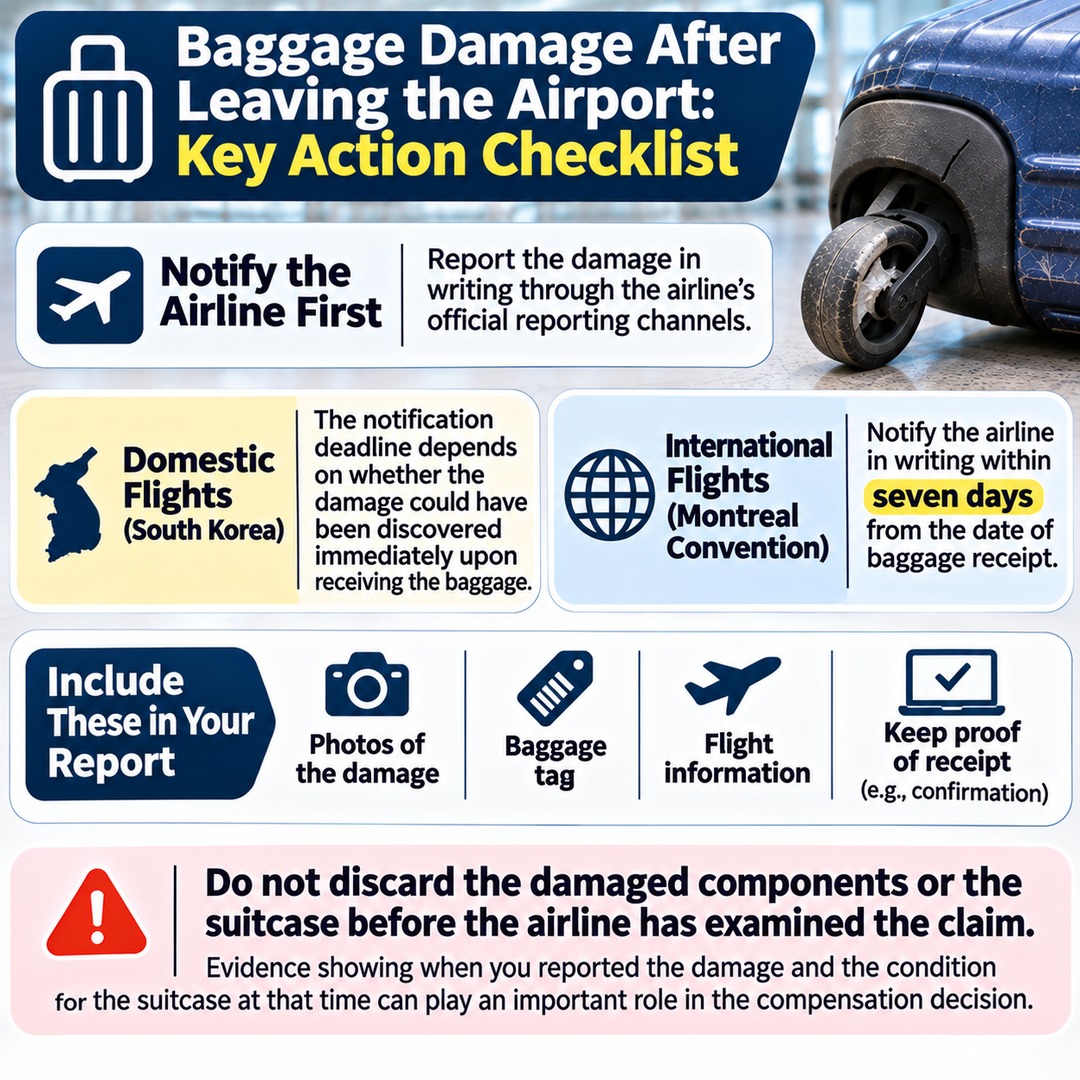
If you discover a broken suitcase wheel after leaving the airport, your first priority should be to notify the airline of the damage in writing through its official reporting channels.
For domestic flights in South Korea, the notification deadline depends on whether the damage could have been discovered immediately upon receiving the baggage. For international flights governed by the Montreal Convention, the seven-day deadline calculated from the date of baggage receipt is particularly important.
When submitting your report, include photographs of the damage, the baggage tag, and flight information, and retain proof that the airline received your notification.
Even if the suitcase can no longer be used, it is better not to discard damaged components or dispose of the suitcase before the airline has examined the claim. Evidence showing when you reported the damage and the condition of the suitcase at that time can play an important role in the subsequent compensation decision.