
Individual officially announced land prices in South Korea were determined and publicly announced on October 29 for parcels affected by land changes, including subdivision, consolidation, and land-use category changes, between January 1 and June 30, 2026. Landowners and legally interested parties can file objections by November 27. Depending on the property's location, applications can be submitted online through the Real Estate Price Disclosure Portal or through the relevant local government office by visiting in person, mail, or fax.
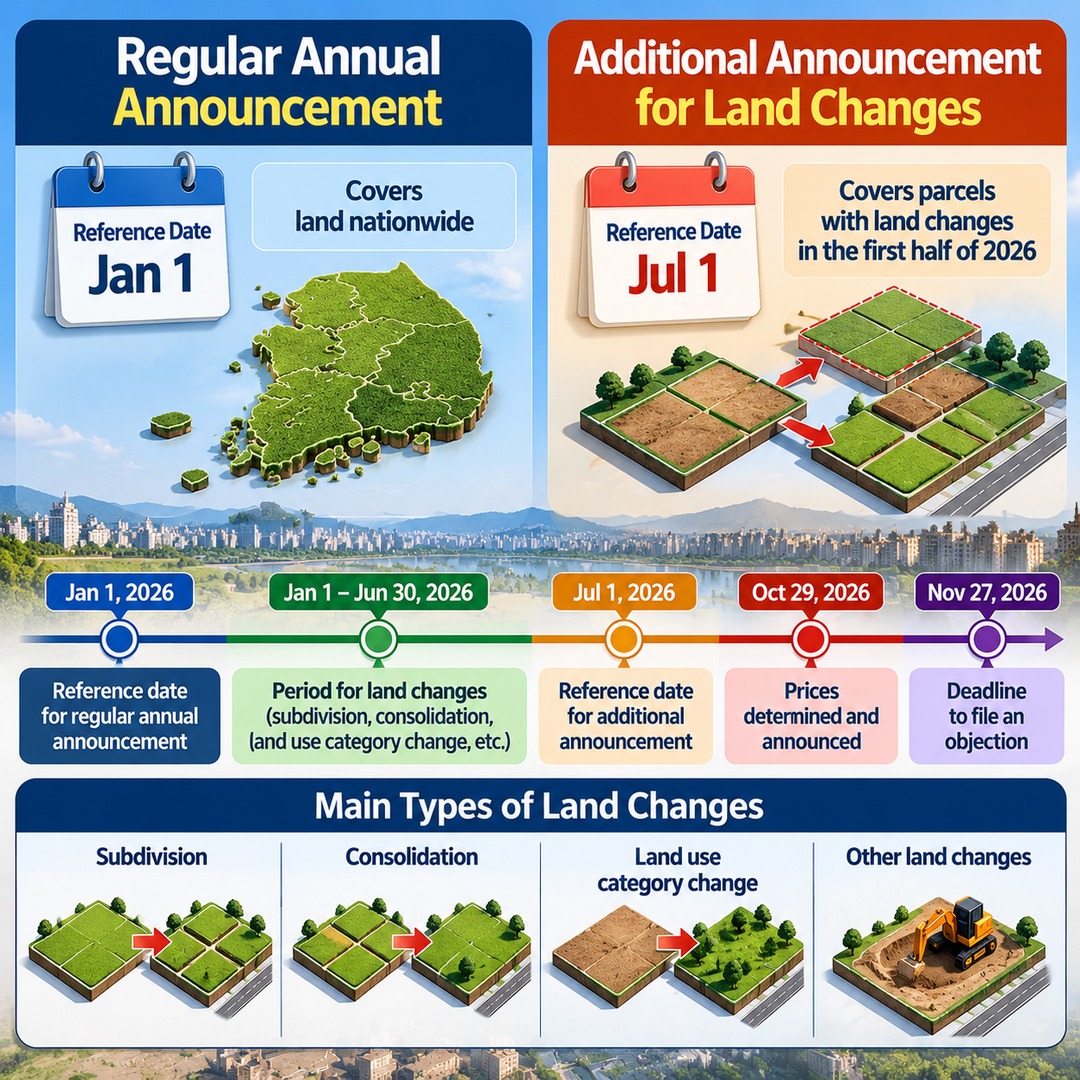
This announcement should be distinguished from the regular annual announcement based on January 1, which covers land nationwide. It is important to check whether any land changes occurred during the first half of the year and whether the newly determined price per square meter is consistent with comparable nearby properties.
Which Types of Land Are Covered by This Announcement?
This additional announcement primarily covers parcels that underwent land changes during the first half of 2026, such as subdivision, consolidation, or changes to their officially registered land-use category. Simply owning land does not automatically mean that every parcel is included in this announcement.
The relevant period to check is January 1 through June 30, 2026.
The main types of land changes include:
Land subdivision: One parcel is divided into multiple separate parcels.
Land consolidation: Multiple parcels are combined into a single parcel.
Land-use category change: The officially registered land-use category is changed to another category.
Other land changes: Other changes to a parcel that fall within the scope of the relevant local government's assessment.
Even if a land change occurred, you should not automatically assume that the parcel is included in this announcement. Check whether your specific parcel number appears on the actual determination and announcement list.
July 1, 2026, is the valuation reference date for this individual officially announced land price assessment. October 29 is the date on which the prices were actually determined and announced. These two dates should not be confused.
How Is the July 1 Announcement Different from the January 1 Annual Announcement?
In South Korea, individual officially announced land prices are generally investigated and determined based on January 1 and July 1 reference dates.
The January 1 announcement is the regular annual announcement covering land nationwide. In contrast, the July 1 announcement is an additional assessment covering parcels that underwent land changes during the first half of that year.
Therefore, even if you have already checked your land's officially announced price based on January 1, you should separately check the July 1 assessment if your parcel was subdivided, consolidated, or otherwise changed during the first half of the year.
Where Can You Check Your Land's Officially Announced Price?
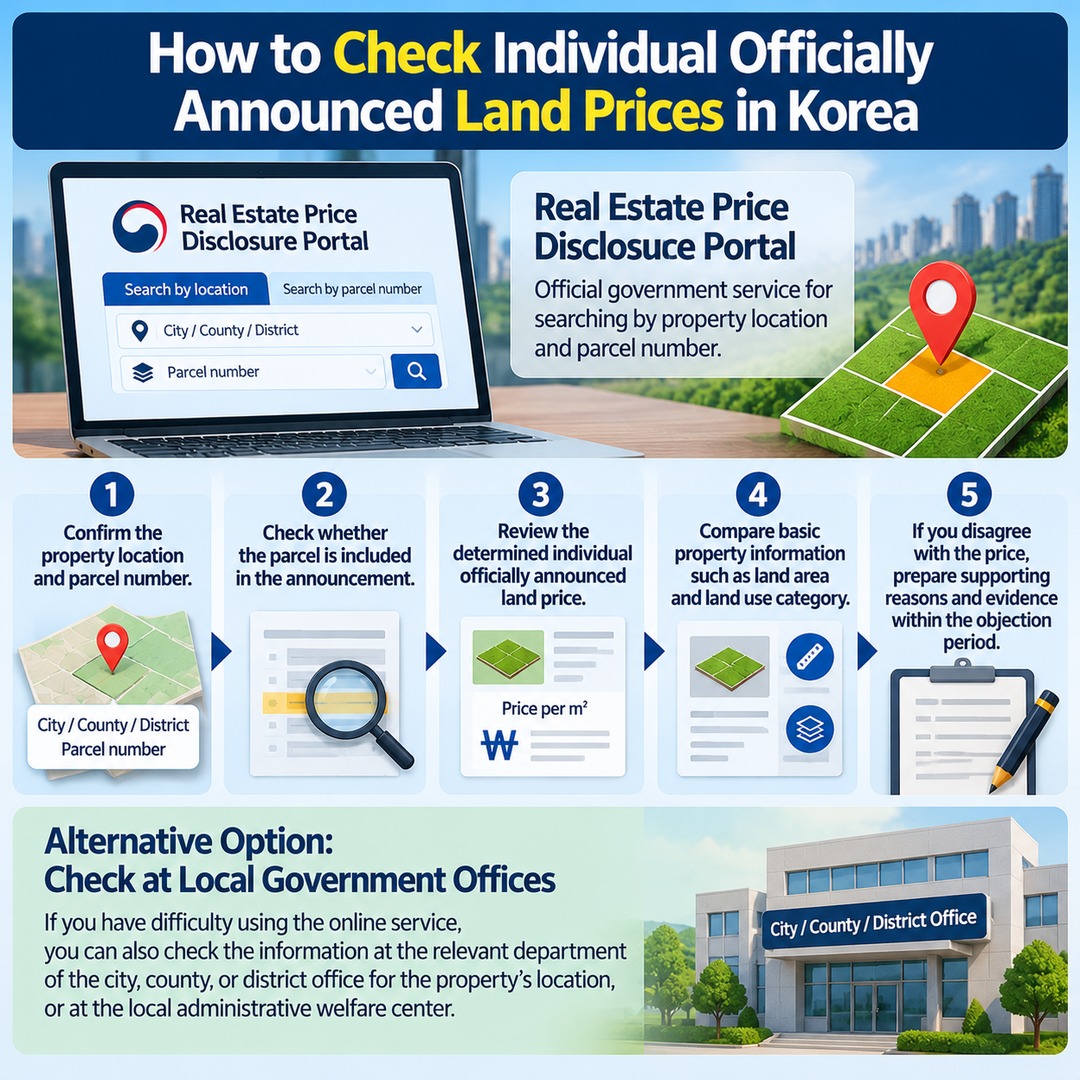
The easiest method is to search by property location and parcel number through the Ministry of Land, Infrastructure and Transport's Real Estate Price Disclosure Portal. The website allows users to check the individual officially announced land price for each parcel on a per-square-meter basis.
Real Estate Price Disclosure Portal
Individual Officially Announced Land Price Lookup and Objection Filing
Official government service for searching by property location and parcel number.
After accessing the official service, follow these steps:
1. Confirm that the property location and parcel number are correct.
2. Check whether the parcel is included in the announcement.
3. Review the determined individual officially announced land price.
4. Compare the basic property information, including land area and land-use category.
5. If you disagree with the price, prepare supporting reasons and evidence within the objection period.
If you have difficulty using the online service, you can also check the information through the relevant department at the city, county, or district office responsible for the property's location, or at the local administrative welfare center serving the relevant town, township, or neighborhood.
What Should You Compare to Determine Whether the Announced Land Price Is Appropriate?
If you disagree with the individual officially announced land price, it is better to examine the actual characteristics of your land and the prices of comparable properties rather than simply stating that the announced price is too high or too low.
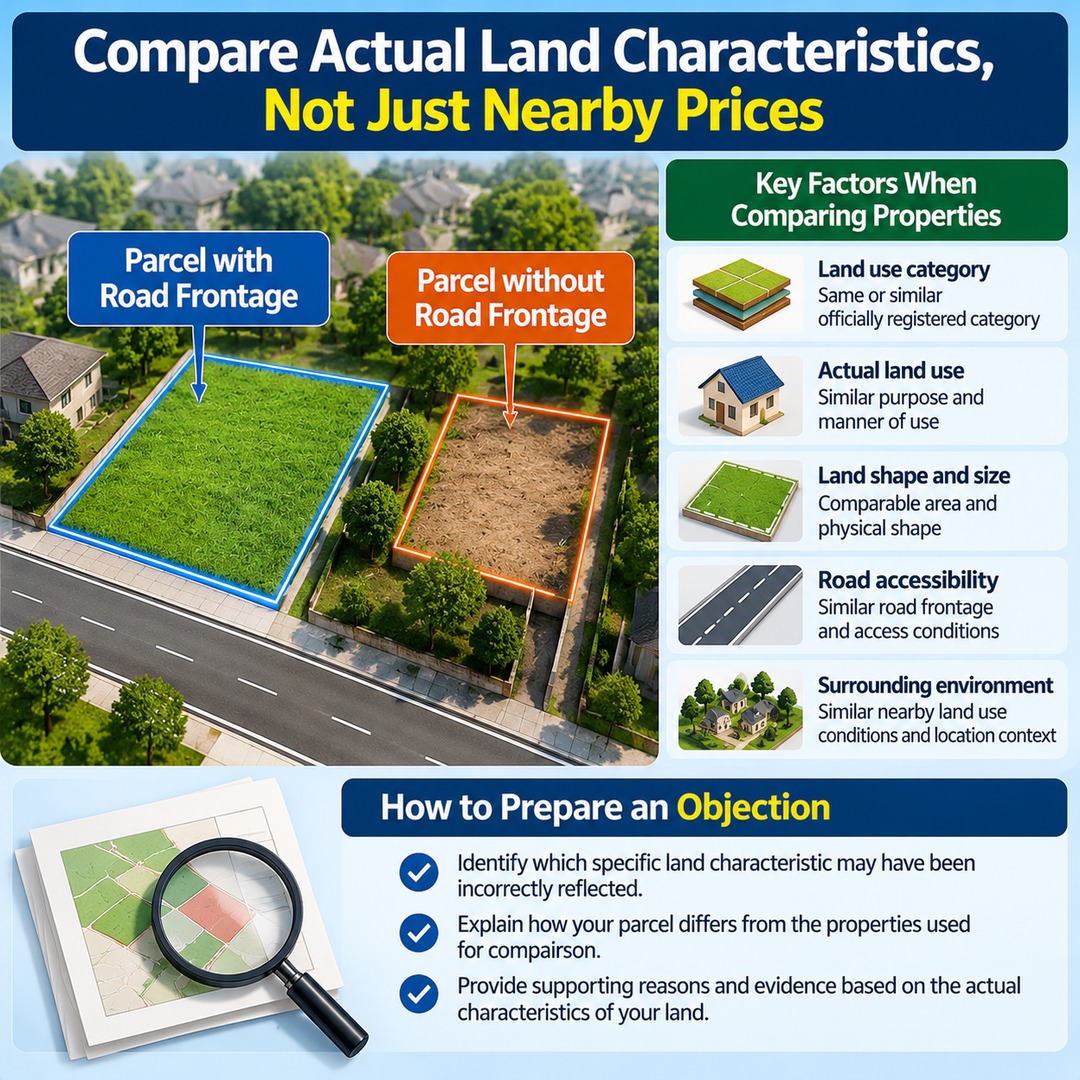
Individual officially announced land prices in South Korea are calculated by reflecting the characteristics of each parcel against the officially announced price of a standard reference parcel with similar use value. Therefore, when comparing properties, you should consider whether their actual conditions are similar, rather than looking only at whether they are located nearby.
Pay particular attention to the following factors:
Land-use category: Whether the officially registered land-use category is identical or similar.
Actual land use: Whether the actual purpose and manner of use are comparable.
Land shape and size: Whether there are significant differences in area or physical shape.
Road accessibility: Whether the parcels have similar road frontage and access conditions.
Surrounding environment: Whether nearby land-use conditions and location characteristics are comparable.
Standard reference land price: Whether the officially announced price of the relevant standard reference parcel is appropriate.
For example, if your land has no direct road frontage but its price was assessed using the same conditions as an adjacent parcel with road frontage, it may be worth reviewing whether the valuation appropriately reflected the difference.
Conversely, the fact that another parcel has a lower announced price does not automatically mean your land has been incorrectly valued. The difference may be justified by variations in road accessibility or actual land use.
When preparing an objection, clearly explain which specific land characteristic may have been incorrectly reflected and how your parcel differs from the properties used for comparison.
How Can You File an Objection to an Individual Officially Announced Land Price?
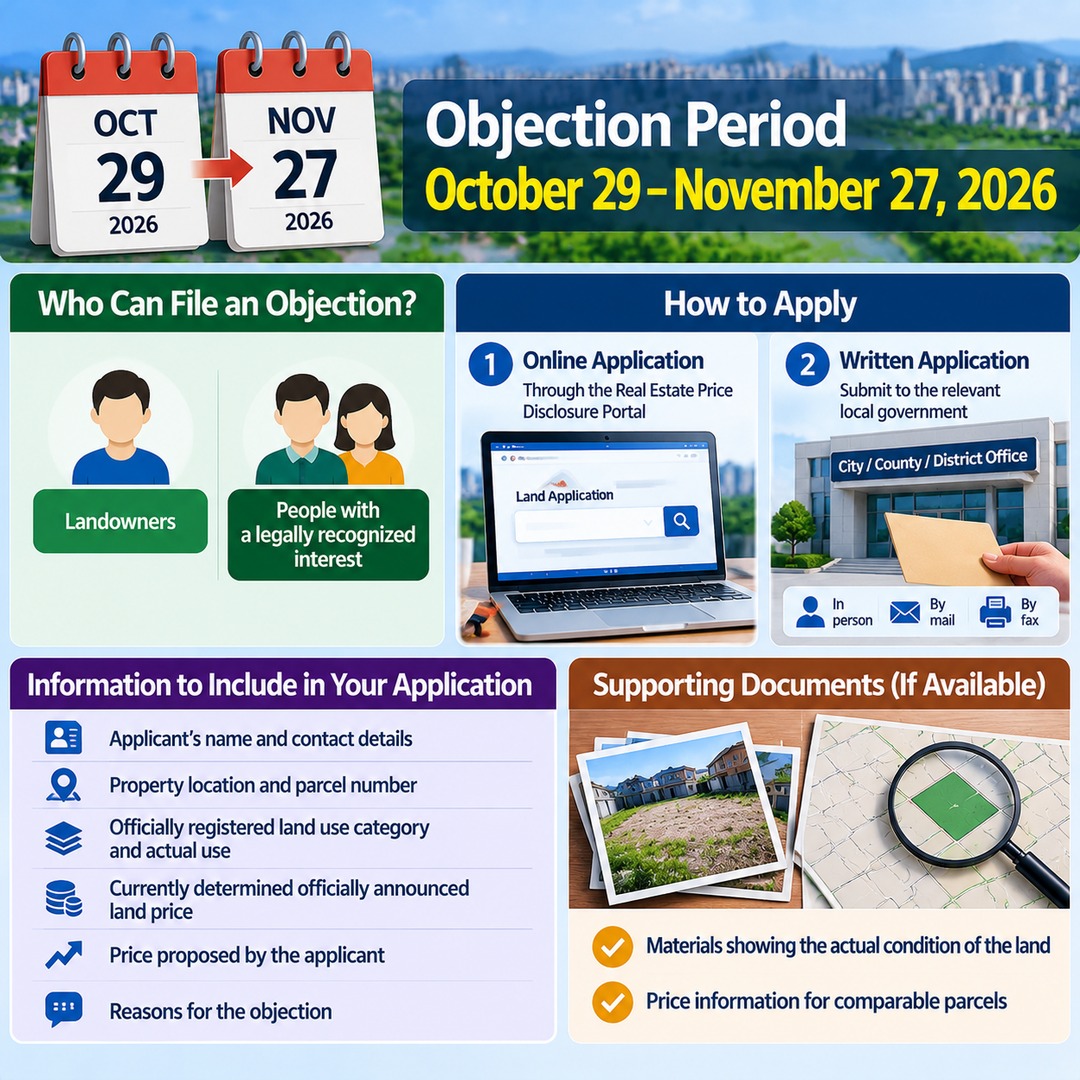
Objections can be filed from October 29 through November 27, 2026. Both landowners and people with a legally recognized interest in the property may submit an application.
Applications can be submitted online or in writing through the relevant local government. However, the available submission channels may differ by region, so check the official announcement issued by the relevant city, county, or district office.
Online Applications
Visit the Real Estate Price Disclosure Portal and use the menu for individual officially announced land price inquiries and objection applications.
Check the property information, select the relevant parcel, complete the objection details, and submit the application. The online application process may require identity verification or additional information.
Applications in Person, by Mail, or by Fax
You can submit an individual officially announced land price objection form to the department responsible for land prices at the local government office overseeing the property's location.
Depending on the local government's instructions, applications may be accepted in person, by mail, or by fax. For example, Paju City has designated its Real Estate Division's Land Price Team as the receiving department and announced submission options including in-person delivery, mail, and fax.
The application should include the following information:
Applicant's name and contact details
Property location and parcel number
Officially registered land-use category and actual use
Currently determined officially announced land price
Price proposed by the applicant
Reasons for the objection
You may also submit supporting documents if available. Materials showing the actual condition of the land or price information for comparable parcels can help explain the reasons for your objection.
What to Check Before Submitting an Objection
| Item | Details |
|---|---|
| Application opening date | October 29, 2026 |
| Application deadline | November 27, 2026 |
| Eligible applicants | Landowners and legally interested parties |
| Application fee | No application fee |
The absence of an application fee refers to the statutory objection procedure. If you need to obtain separate supporting documents, check with the relevant institution about any document issuance charges.
Will Filing an Objection Definitely Change the Officially Announced Land Price?
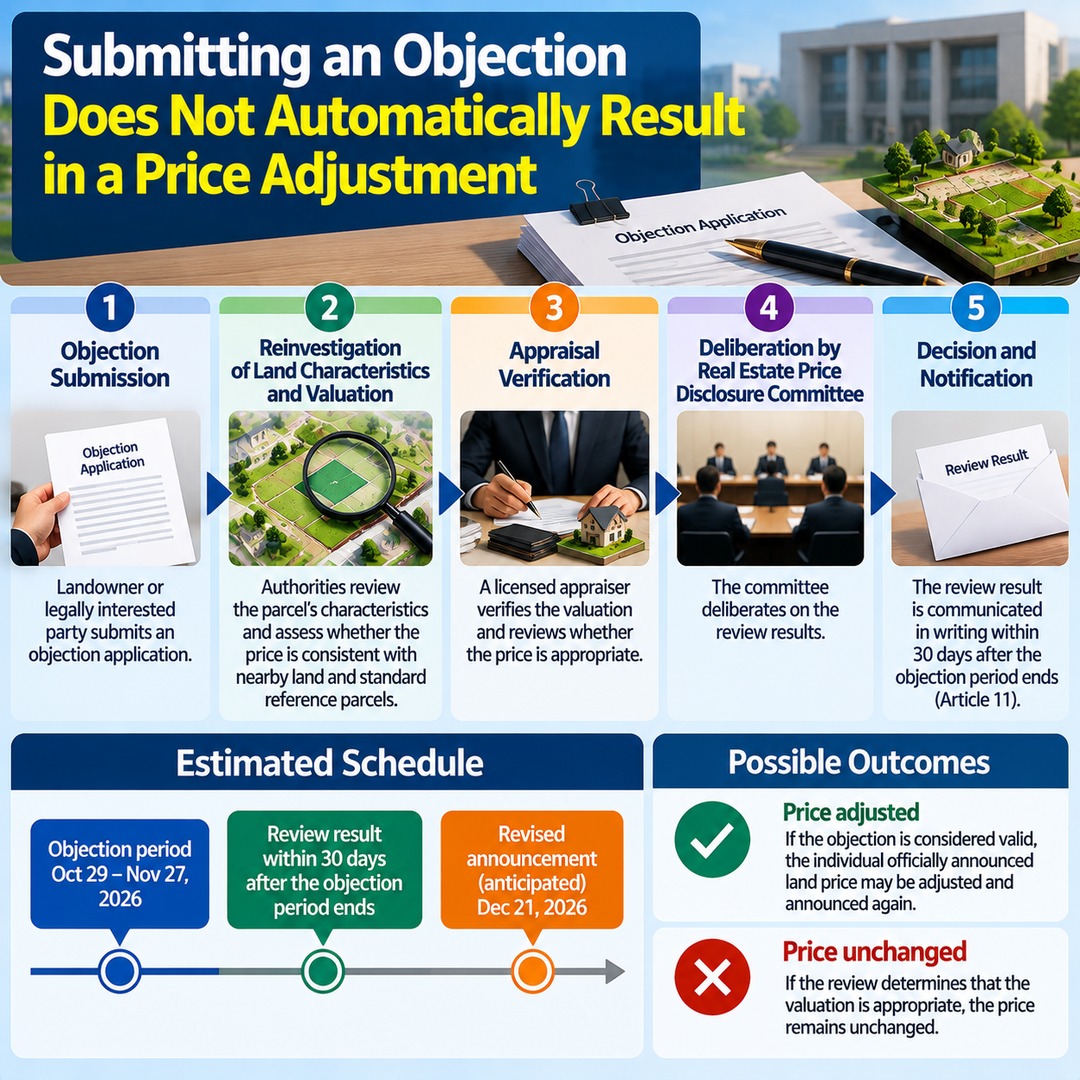
Submitting an objection does not automatically result in a price adjustment. The relevant authorities review the property's characteristics and the appropriateness of its valuation based on the submitted reasons before deciding whether an adjustment is necessary.
The general review process is as follows:
1. Objection submission: The landowner or legally interested party submits an objection application.
2. Reinvestigation of land characteristics and valuation: The authorities review the characteristics of the parcel and assess whether its price is consistent with nearby land and standard reference parcels.
3. Appraisal verification: A licensed appraiser verifies the valuation and reviews whether the price is appropriate.
4. Deliberation by the Real Estate Price Disclosure Committee: The committee considers the reassessment findings and deliberates on whether an adjustment is warranted.
5. Notification and revised announcement: The applicant is notified of the result, and any price requiring adjustment is determined and publicly announced again.
Article 11 of South Korea's Act on the Public Announcement of Real Estate Values requires the review result to be communicated in writing within 30 days after the objection period ends.
If the objection is considered valid, the individual officially announced land price may be adjusted and announced again.
Several local governments have indicated December 21 as the anticipated date for the revised announcement. However, the actual processing schedule and how to check the result should be confirmed with the local government responsible for the property's location.
What Should You Check Before November 27?
The first step is to determine whether your parcel is included in the July 1 assessment. If it is not covered by this announcement, you should check which other official announcement or objection procedure applies to your property.
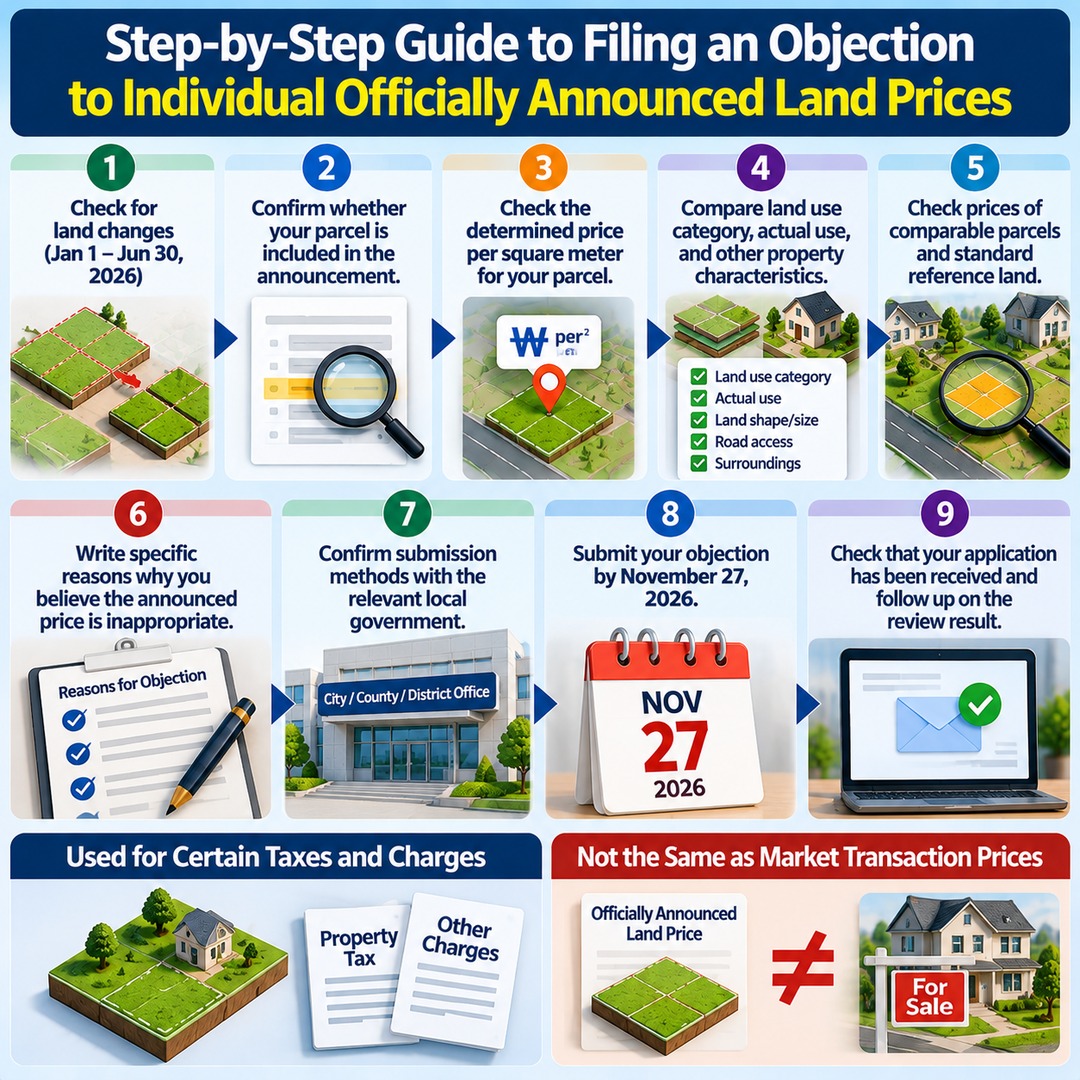
If you intend to file an objection, follow this sequence:
Check whether any land changes occurred between January 1 and June 30, 2026.
Confirm whether your parcel is included in the announcement.
Check the determined price per square meter for your parcel number.
Compare the registered land-use category, actual land use, and other property characteristics.
Check the prices of comparable nearby parcels and standard reference land.
Write down specific reasons why you believe the announced price is inappropriate.
Confirm the submission methods accepted by the relevant local government.
Submit your objection by November 27, 2026.
Check that your application has been received and follow up on the review result.
Individual officially announced land prices are used in South Korea as a basis for calculating certain land-related taxes and other charges. However, an officially announced land price is not the same as the actual market transaction price. Therefore, you should not base an objection solely on advertised asking prices or actual property transaction prices.
Frequently Asked Questions
Q. Can I file an objection if my land did not undergo any changes during the first half of 2026?
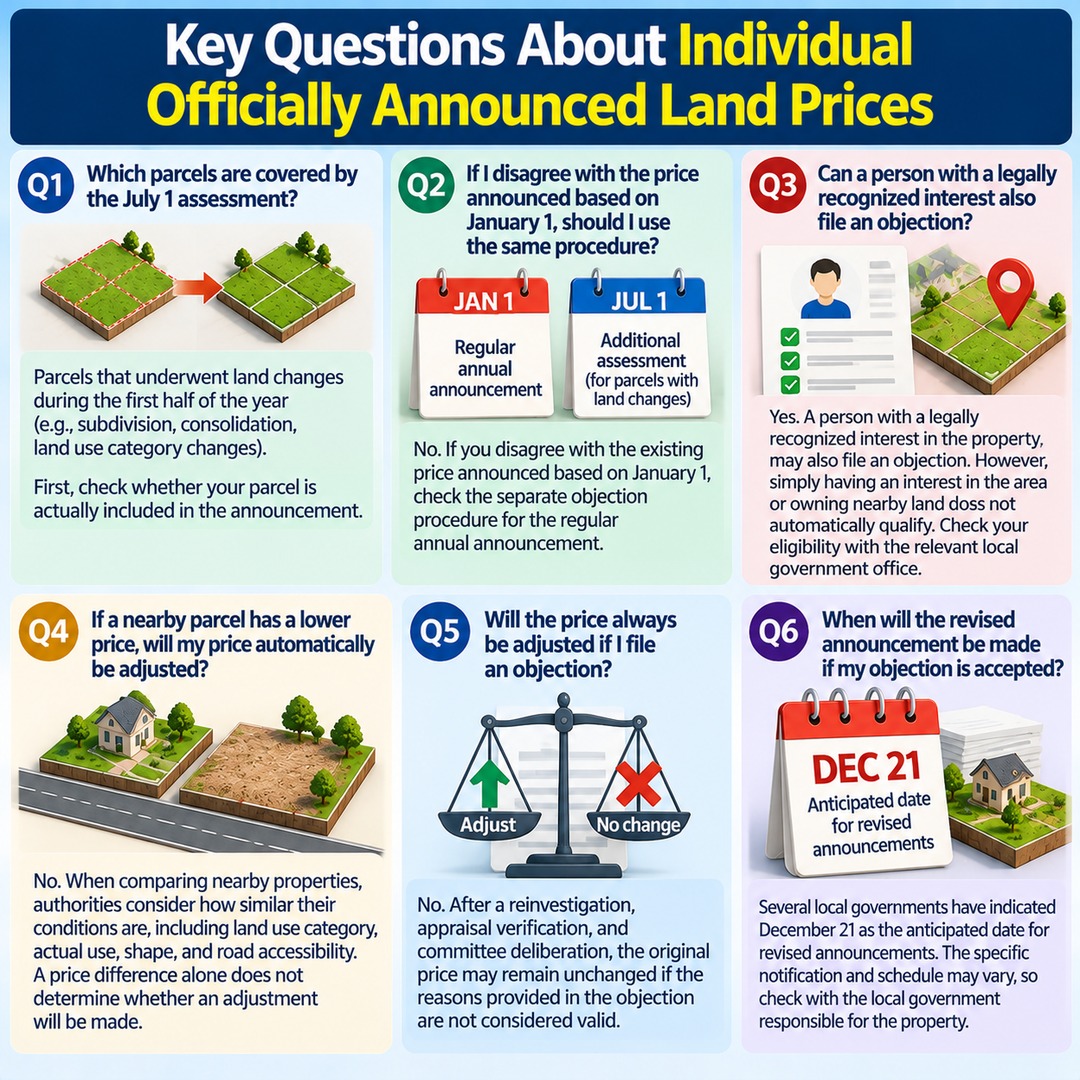
The main parcels covered by this additional July 1 assessment are those that underwent land changes during the first half of the year. First, check whether your parcel is actually included in the announcement. If you disagree with the existing price announced based on January 1, you should check the separate objection procedure for that regular annual announcement.
Q. Can someone who is not the landowner file an objection?
Yes. A person with a legally recognized interest in the property may also file an objection. However, simply having an interest in the area or owning nearby land does not automatically qualify someone as an interested party. It is advisable to confirm your eligibility with the relevant local government office.
Q. Will the announced price automatically be adjusted if it is higher than the prices of nearby properties?
No. When comparing nearby properties, the authorities must consider how similar their conditions are, including land-use category, actual use, physical shape, and road accessibility. A price difference alone does not determine whether an adjustment will be made.
Q. Can the original price remain unchanged even after I file an objection?
Yes. Following a reinvestigation, appraisal verification, and committee deliberation, the original price may remain unchanged if the reasons provided in the objection are not considered valid.
Q. Will I receive the result on December 21 if I file an objection?
December 21 is the anticipated date for revised announcements published by several local governments. The specific notification and revised announcement schedules should be confirmed according to the processing arrangements of the local government responsible for the property.
Check Your Land's Officially Announced Price by November 27
Filing an objection to an individual officially announced land price is an important procedure for landowners and legally interested parties whose parcels underwent land changes during the first half of the year.
Rather than filing an objection simply because the announced price differs from your expectations, compare the actual characteristics of your land with the prices of similar nearby properties. Clearly explain which aspects of the valuation you believe are inappropriate and why.
If you have not checked your property yet, search for your parcel number through the Real Estate Price Disclosure Portal and confirm the submission procedure with the relevant local government. It is advisable to complete your application before November 27.