
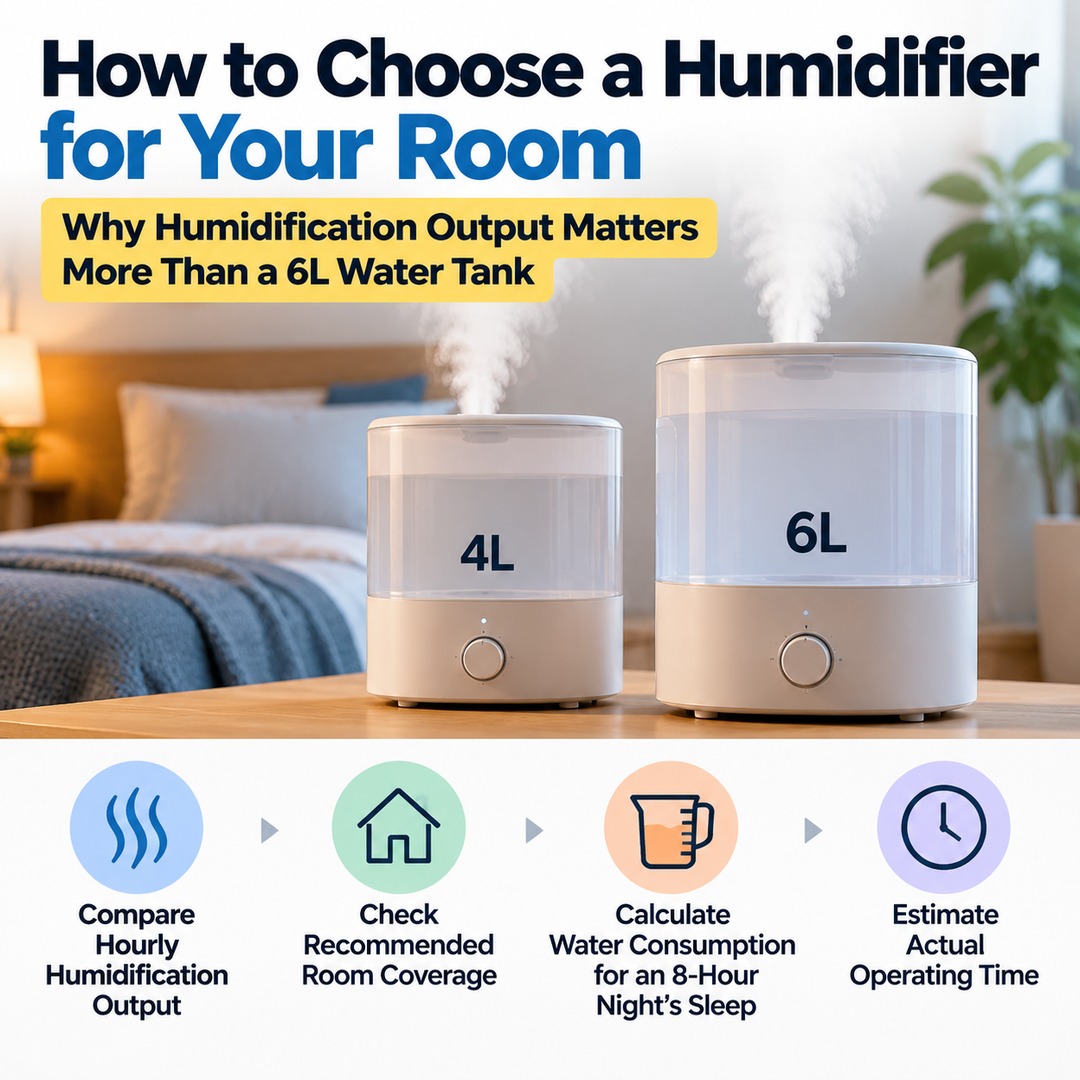
When choosing a humidifier, check its hourly humidification output (mL/h) and the coverage area specified by the manufacturer before considering water tank capacity. Hourly output indicates how much moisture the humidifier can supply to a room, while tank capacity (L) determines how long it can operate before needing a refill. Comparing these two specifications separately helps you choose a product that matches both your room size and intended operating time.
What Is the Difference Between Humidification Output and Water Tank Capacity?
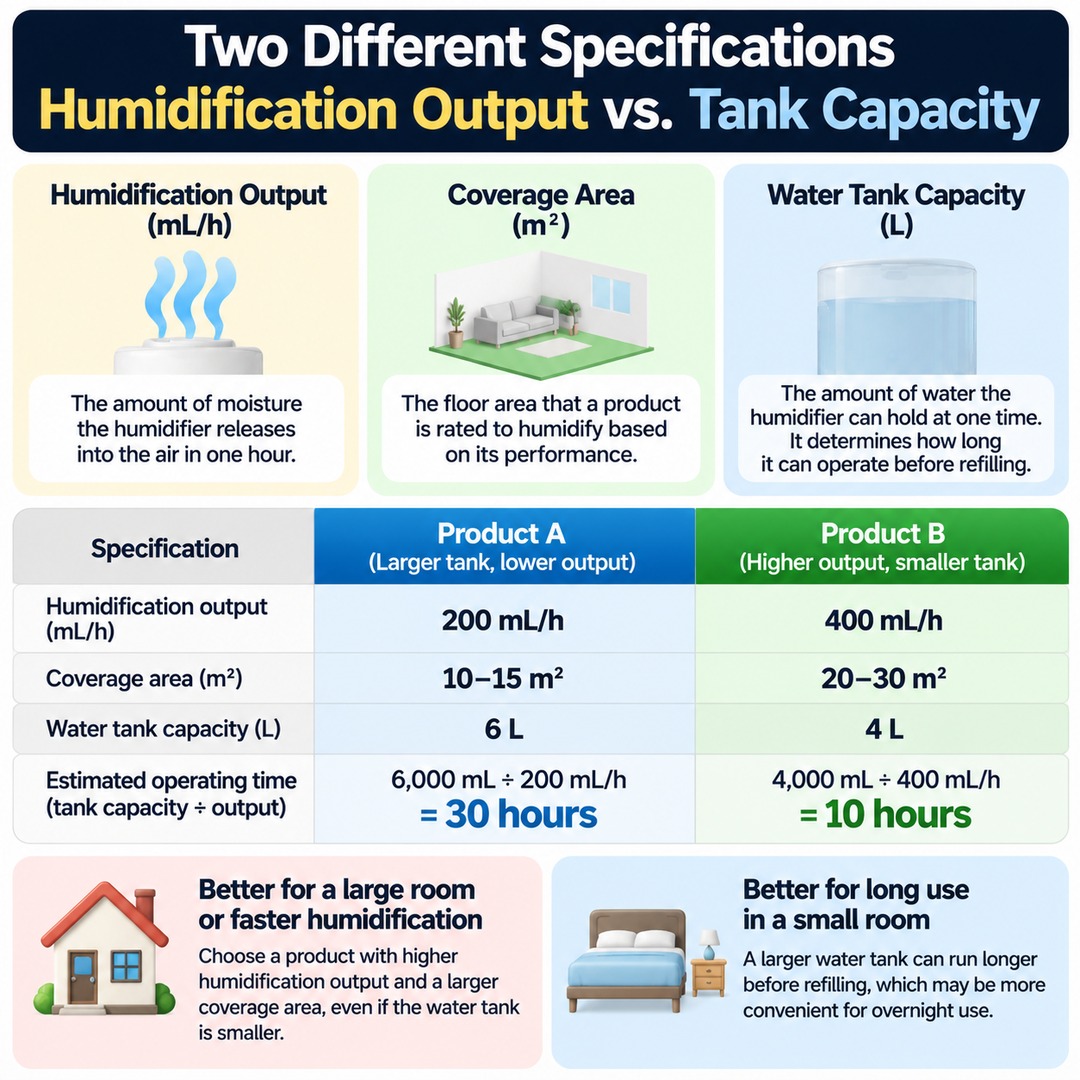
Humidification output is the amount of moisture a humidifier releases into the air in one hour. Water tank capacity is the amount of water the humidifier can hold at one time.
Although both specifications describe quantities of water, they serve completely different purposes.
Hourly humidification output (mL/h): A measure of the humidifier's ability to supply moisture to a space.
Water tank capacity (L): The amount of water available before the tank needs to be refilled.
Humidification coverage area (m²): The floor area that a product is rated to humidify based on its performance.
Consider the following comparison between two products.
| Specification | Product A | Product B |
|---|---|---|
| Water tank capacity | 6L | 4L |
| Hourly humidification output | 200mL/h | 400mL/h |
| Main characteristic | Less frequent refilling | Higher hourly humidification output |
| Estimated operating time at maximum output | 30 hours | 10 hours |
Author's calculation: These are theoretical estimates assuming that the entire tank can be used and the hourly humidification output remains constant.
Product A stores more water, but it supplies only half as much moisture per hour as Product B.
Therefore, if your goal is to raise humidity in a large room, Product A is not necessarily the better choice simply because it has a larger tank. On the other hand, if you plan to use a humidifier for extended periods in a small room, a product with a larger water reservoir, such as Product A, may be more convenient.
How Do You Calculate the Required Humidification Output for Your Room Size?
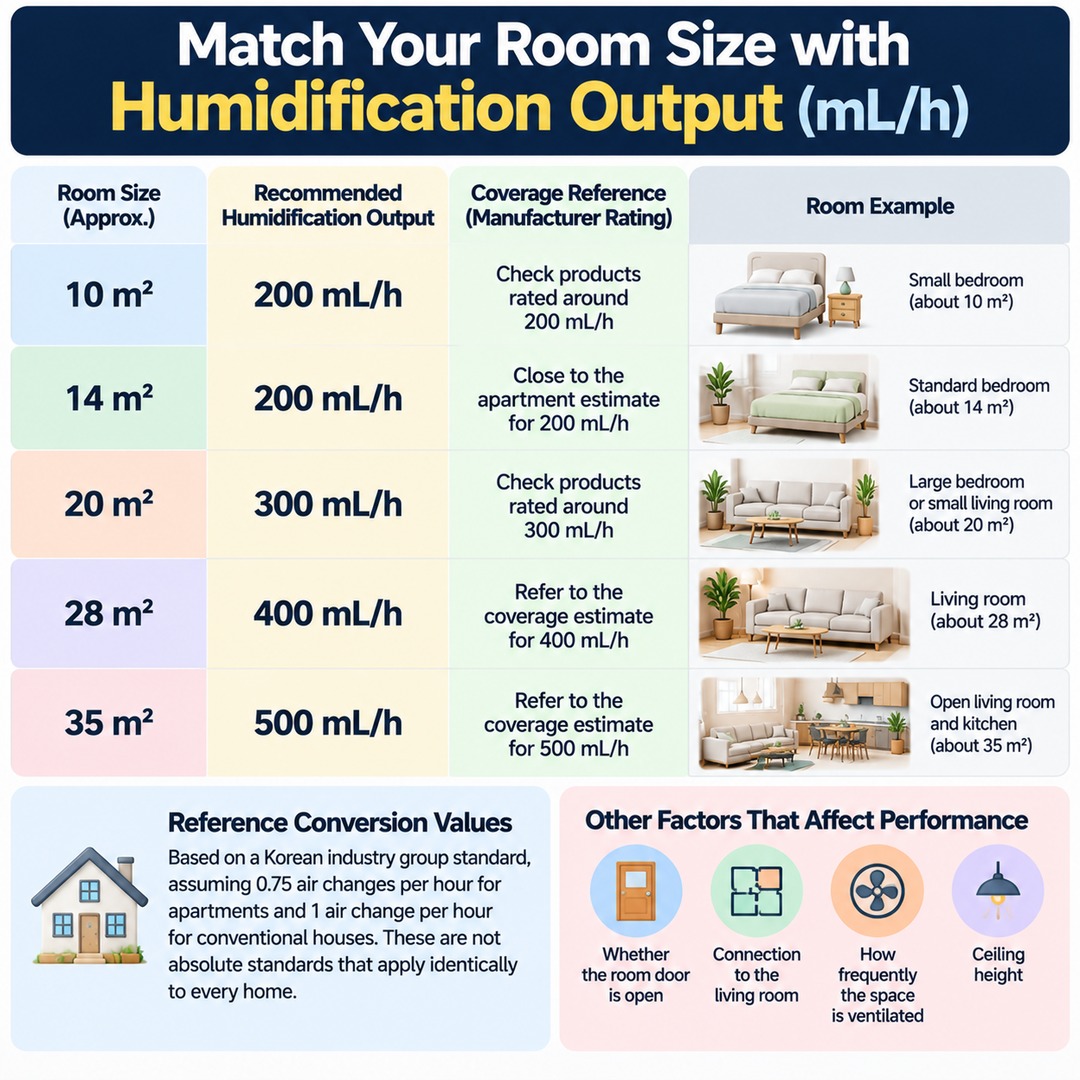
When selecting a humidifier, compare the actual floor area of your room with the product's hourly humidification output. Rather than relying only on product categories such as bedroom or living room humidifiers, it is more accurate to check the coverage area specified by the manufacturer.
| Hourly humidification output | Equivalent apartment coverage area | Equivalent conventional house coverage area |
|---|---|---|
| 200mL/h | 14㎡ | 11㎡ |
| 300mL/h | 21㎡ | 16㎡ |
| 400mL/h | 28㎡ | 21㎡ |
| 500mL/h | 35㎡ | 26㎡ |
| 600mL/h | 43㎡ | 32㎡ |
These are reference conversion values from a Korean industry group standard. The calculation assumes 0.75 air changes per hour for apartments and 1 air change per hour for conventional houses. They are not absolute standards that apply identically to every home.
You can use these figures to make an initial assessment of your space:
Room of approximately 10㎡: Start by checking the coverage rating of a 200mL/h product.
Room of approximately 14㎡: This is close to the apartment coverage estimate for a 200mL/h product.
Room of approximately 20㎡: Check products rated around 300mL/h.
Space of approximately 28㎡: Refer to the coverage estimate for a 400mL/h product.
Space of approximately 35㎡: Refer to the coverage estimate for a 500mL/h product.
The important point is that floor area alone cannot determine humidification performance with certainty.
Actual conditions vary depending on whether the bedroom door is open, whether the room connects to the living room, how frequently the space is ventilated, and how high the ceiling is.
In particular, a humidifier intended for a single bedroom may need to be evaluated differently from one intended for a connected living room and kitchen, even if the total floor areas appear similar.
How Much Does Humidification Output Vary Between Actual Products?
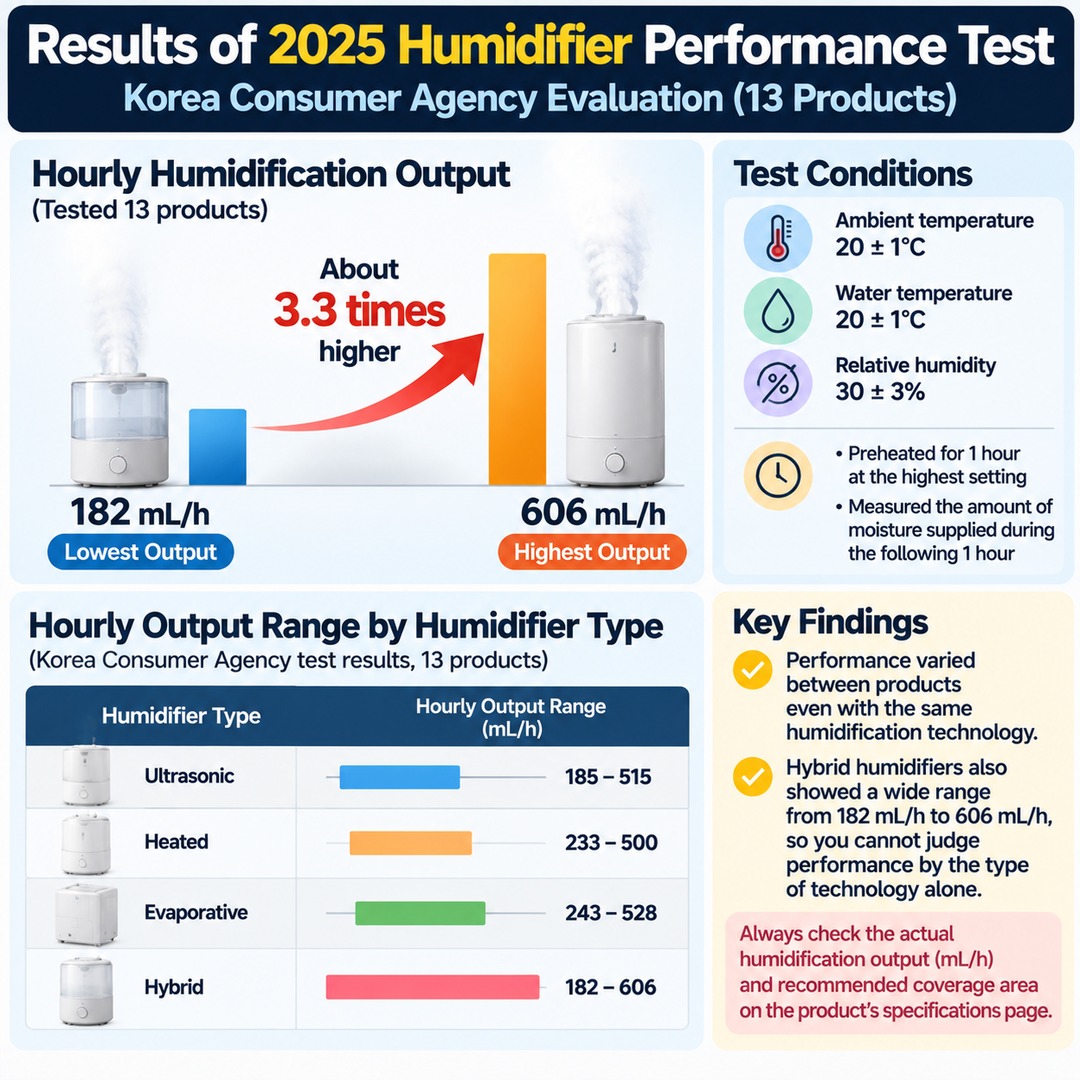
In a 2025 performance evaluation of 13 humidifiers conducted by the Korea Consumer Agency, hourly humidification output ranged from 182 to 606mL/h. The highest-output product delivered approximately 3.3 times as much moisture per hour as the lowest-output product.
The tests were conducted under the following conditions: ambient temperature of 20±1°C, water temperature of 20±1°C, and relative humidity of 30±3%. Each product was preheated for one hour at its highest humidification setting. The amount of moisture supplied during the following hour was then measured.
The results showed that performance varied between products even when they used the same humidification technology.
| Humidification method | Output range among tested products | Equivalent humidification coverage area |
|---|---|---|
| Ultrasonic | 198–267mL/h | 13.9–18.8㎡ |
| Heated | 338–499mL/h | 23.8–35.2㎡ |
| Hybrid | 182–606mL/h | 12.9–42.9㎡ |
| Evaporative | 234–433mL/h | 16.5–30.5㎡ |
These ranges represent measurements from the products included in the Korea Consumer Agency evaluation. They are not market-wide averages or fixed performance levels for each humidification method.
One particularly important finding concerns hybrid humidifiers. Even among products classified as hybrid models, hourly humidification output ranged from 182mL to 606mL.
This means you should not judge a humidifier's performance based solely on whether it uses ultrasonic, heated, or evaporative technology.
Check the actual humidification output and recommended coverage area separately on the product's specifications page.
How to Calculate Whether a Water Tank Can Last Through the Night
Water tank capacity directly affects convenience. If you plan to leave your humidifier running while you sleep or use it for extended periods, consider both hourly humidification output and tank capacity.
Use the following formula:
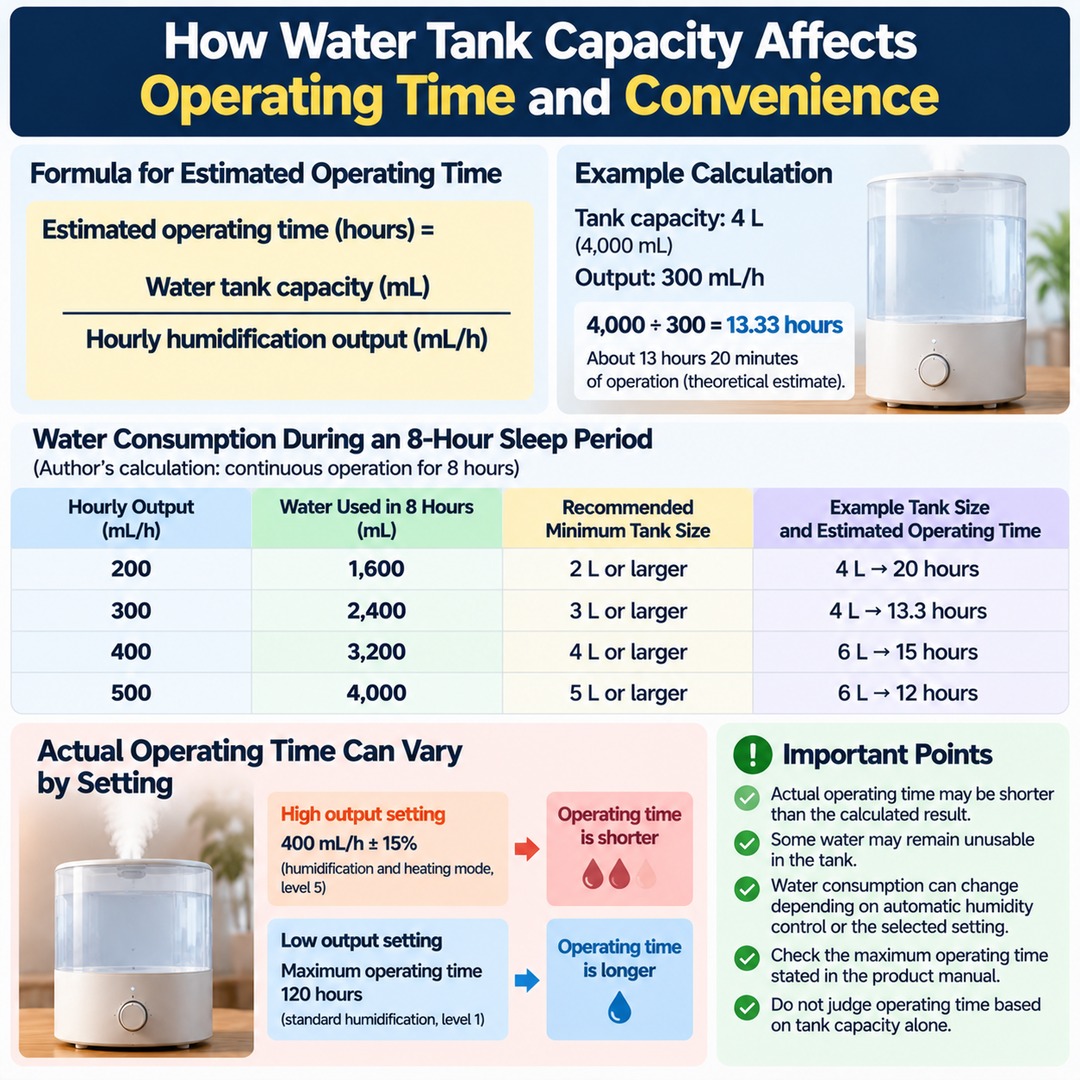
Estimated operating time = Water tank capacity (mL) ÷ Hourly humidification output (mL/h)
If a humidifier has a 4L tank, convert the capacity to 4,000mL before calculating.
For example, suppose a humidifier has a 4L tank and an hourly humidification output of 300mL.
4,000 ÷ 300 = 13.33 hours
Theoretically, this amount of water would support approximately 13 hours and 20 minutes of operation.
Now compare water consumption based on an 8-hour sleeping period.
| Hourly humidification output | Water consumed over 8 hours | Water required |
|---|---|---|
| 200mL/h | 1,600mL | 1.6L |
| 300mL/h | 2,400mL | 2.4L |
| 400mL/h | 3,200mL | 3.2L |
| 500mL/h | 4,000mL | 4L |
Author's calculation: These figures assume continuous operation for 8 hours at a constant humidification output.
You can use this calculation to compare the tank sizes needed for overnight operation.
However, actual operating time may differ from the calculated result. Some water may remain unusable in the tank, and water consumption can change depending on automatic humidity control or adjustments to the humidification setting.
You should also check the maximum operating time stated in the product manual.
For example, the Winix WLT series manual separately lists a 7.5L water tank, a humidification output of 400mL/h ±15% (humidification and heating mode, level 5), and a maximum operating time of 120 hours (standard humidification, level 1).
This demonstrates that operating time at maximum output can be very different from operating time at a lower setting. It is one reason why you should not estimate actual operating time based on tank capacity alone.
What Should You Check Before Buying a Humidifier?
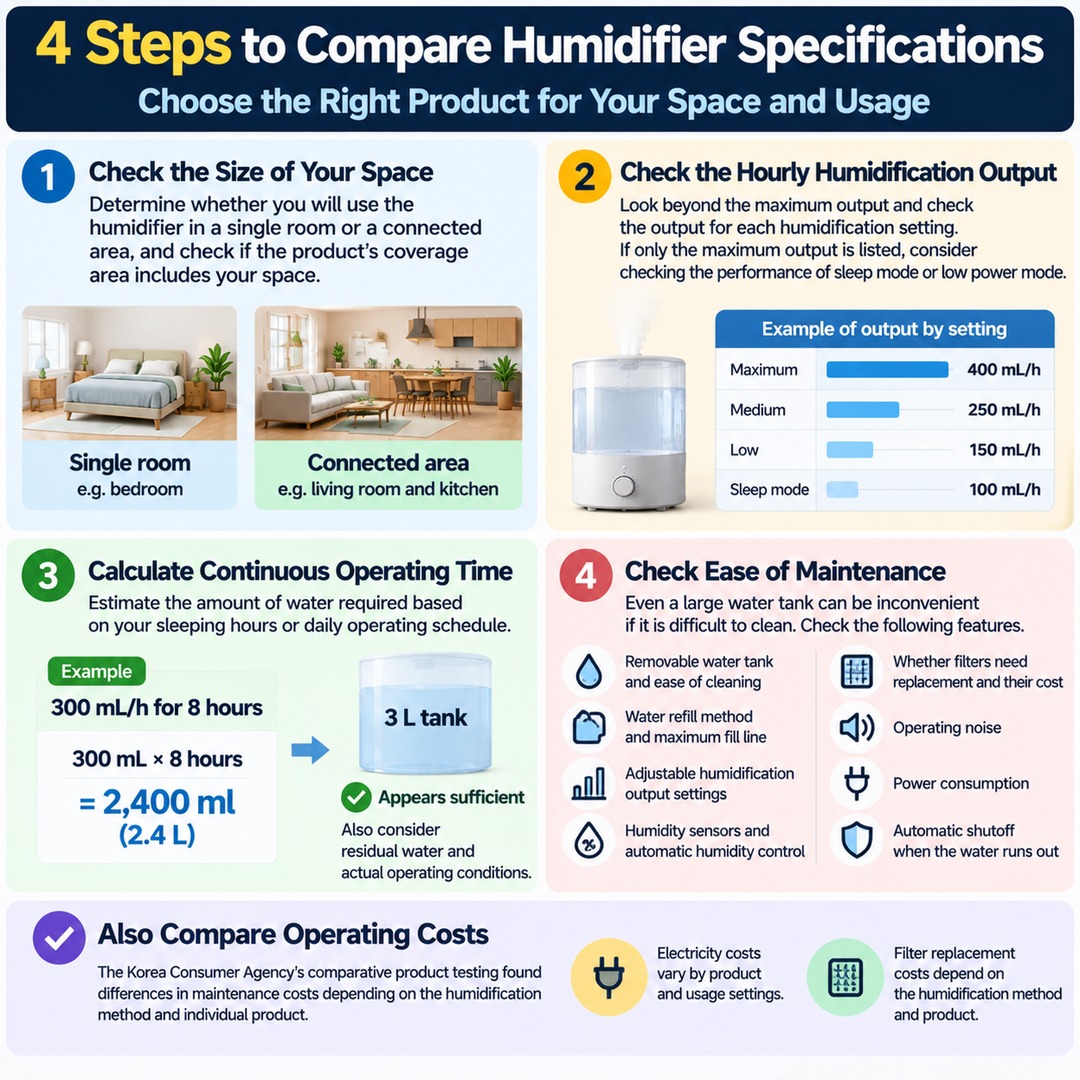
You can compare product specifications by following these steps.
First, check the size of the space where you will use the humidifier.
Determine whether you intend to humidify a single room or a connected area that includes the living room and kitchen. Check whether the product's stated coverage area adequately includes the space you intend to use it in.
Second, check the hourly humidification output.
Look beyond the maximum output listed on the product page and check the figures for each humidification setting. If only the maximum output is provided, it is worth checking the performance of sleep mode or low-power mode separately.
Third, calculate continuous operating time based on tank capacity.
Estimate the amount of water required based on your sleeping hours or daily operating schedule.
For example, a product rated at 300mL/h theoretically requires 2.4L of water for 8 hours of operation. A 3L tank appears sufficient based on this calculation, but you should also account for residual water and actual operating conditions.
Fourth, check whether the product is easy to maintain.
Even a humidifier with a large water tank can become difficult to manage if it is hard to clean.
Also check the following features:
Whether the water tank can be removed and cleaned
The water refill method and maximum fill line
Adjustable humidification output settings
Humidity sensors and automatic humidity control
Whether filters need replacement and how much they cost
Operating noise and power consumption
Automatic shutoff when the water runs out
The Korea Consumer Agency's comparative product testing also found differences in maintenance costs depending on the humidification method and individual product. Rather than focusing only on humidification performance, it is worth checking electricity costs and filter replacement expenses as well.
What Problems Can Occur If Humidification Output Is Too High or Too Low?
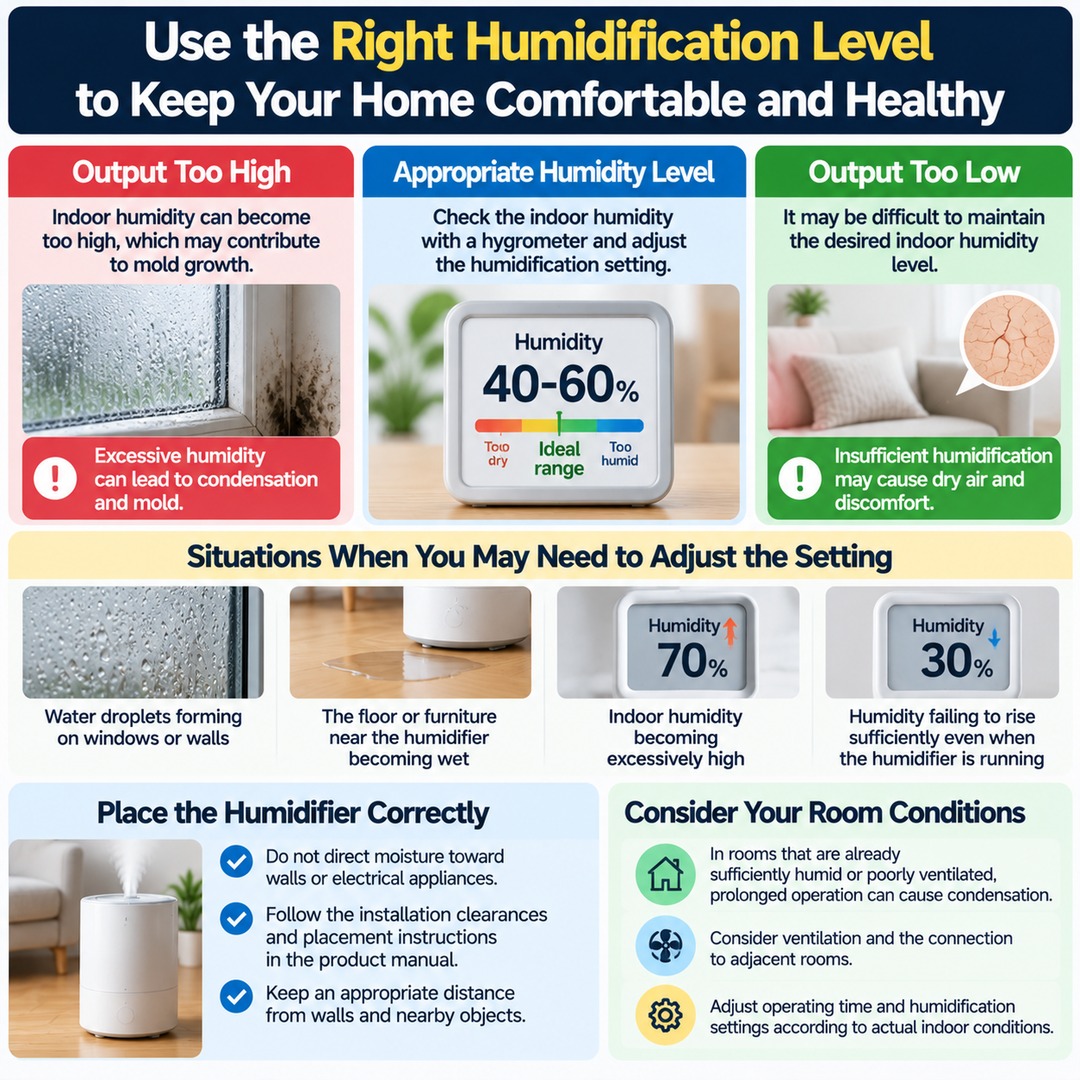
A humidifier is not necessarily better simply because it operates at maximum output. If its humidification capacity is excessive for the room, indoor humidity may become too high, potentially contributing to mold growth.
Conversely, insufficient humidification output may make it difficult to maintain the desired indoor humidity level.
It is a good idea to use a hygrometer to monitor the actual humidity in your room while the humidifier is running.
You may need to adjust the humidification setting in situations such as these:
Water droplets forming on windows or walls
The floor or furniture near the humidifier becoming wet
Indoor humidity becoming excessively high
Humidity failing to rise sufficiently even when the humidifier is running
The placement of the humidifier also matters. Avoid directing moisture toward walls or electrical appliances, and follow the installation clearances and placement instructions in the product manual.
In rooms that are already sufficiently humid or poorly ventilated, prolonged continuous operation can cause condensation. Adjust operating time and humidification settings according to actual indoor conditions.
How to Choose the Right Humidifier for Your Room Size
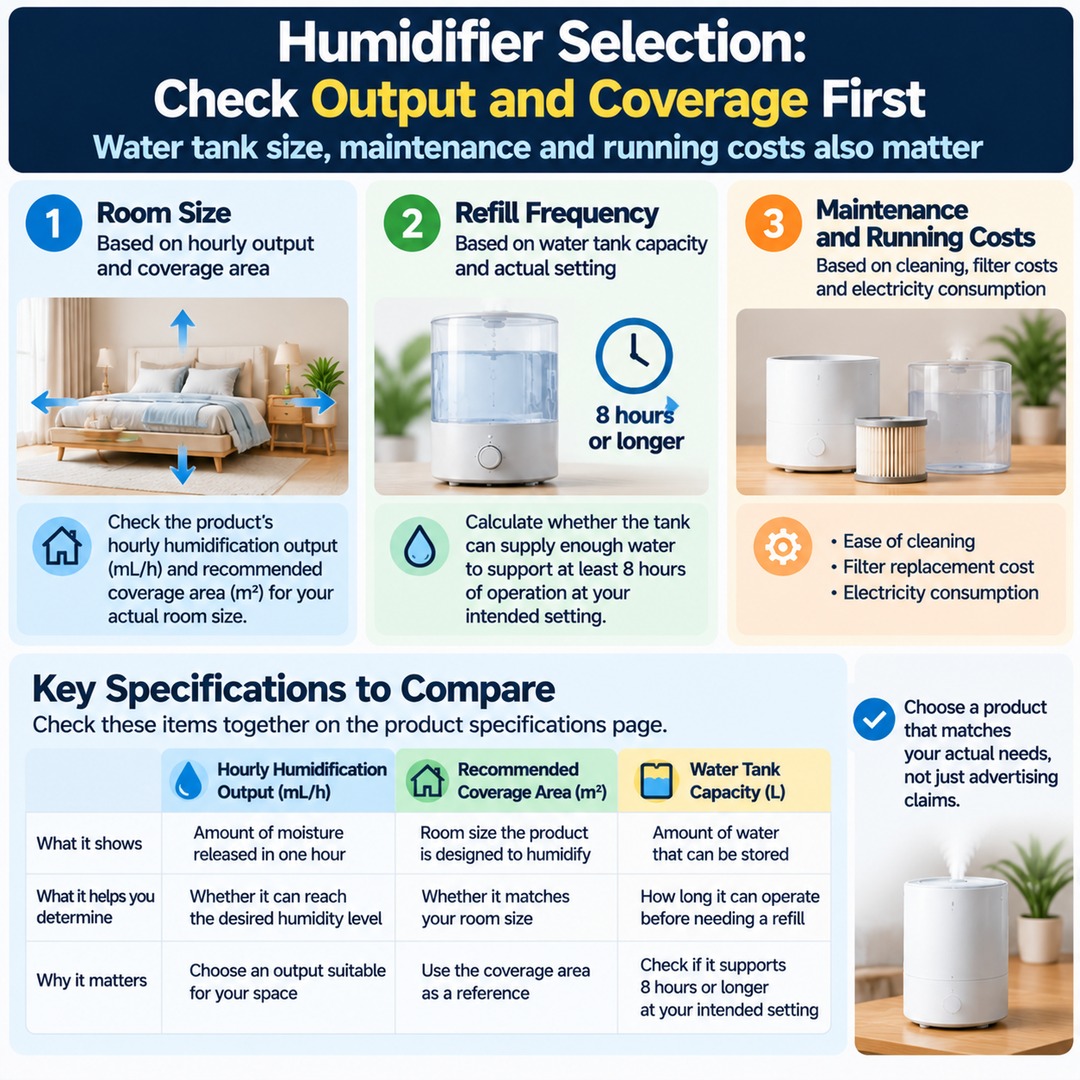
When buying a humidifier, the first specifications to check are hourly humidification output and recommended coverage area, not water tank size.
If you intend to use the product in a small room, prioritize an output suitable for the actual room size. If you plan to run it throughout the night, calculate whether the tank can supply enough water to support at least 8 hours of operation at your intended setting.
Ultimately, these two specifications cannot replace each other.
Room size: Determined by hourly humidification output and recommended coverage area.
Refill frequency: Determined by water tank capacity and the actual humidification setting.
Maintenance requirements: Determined by cleaning convenience, filter costs, and electricity consumption.
By checking humidification output (mL/h), recommended coverage area (m²), and water tank capacity (L) side by side on the product specifications page, you can choose a humidifier that matches your actual needs instead of relying on advertising claims.