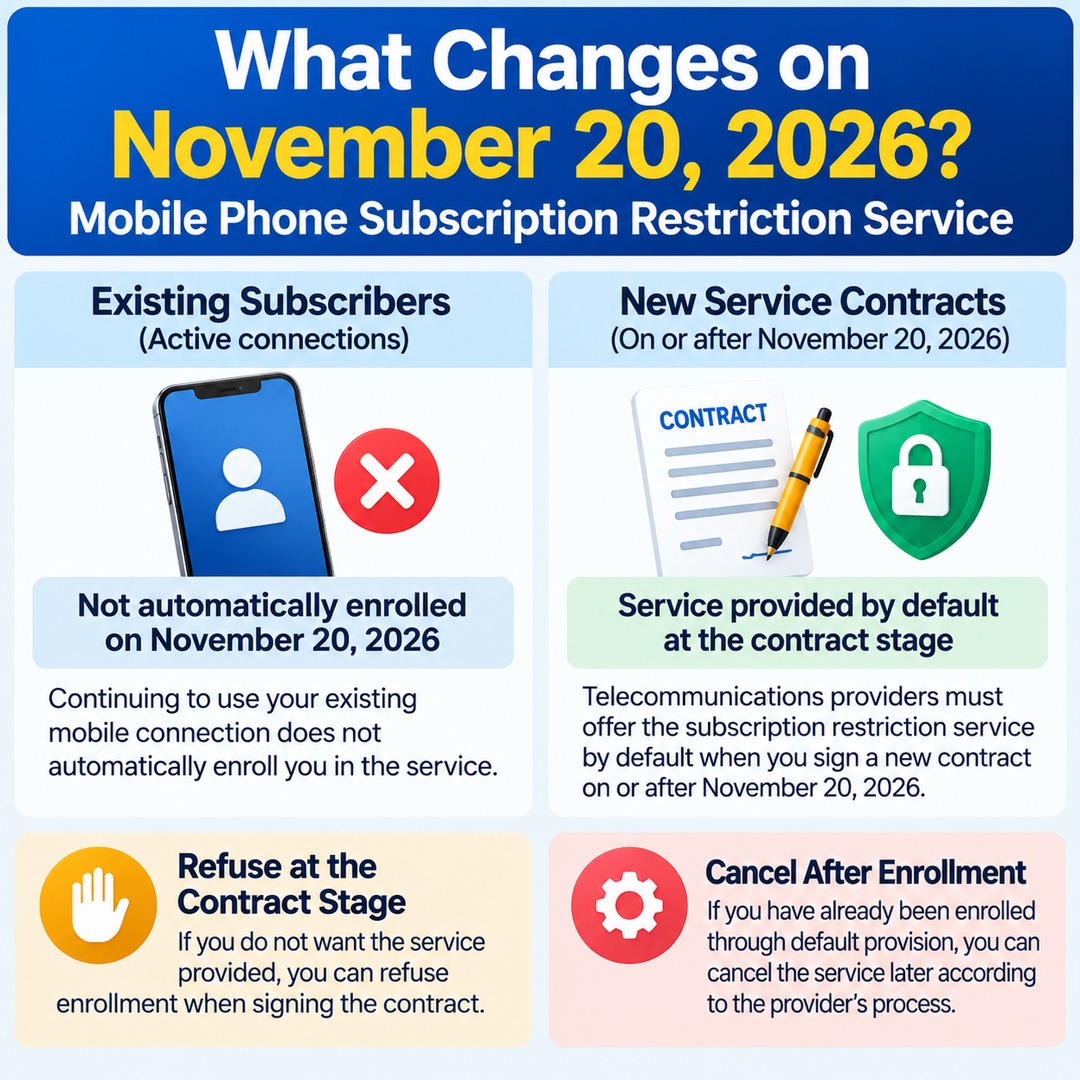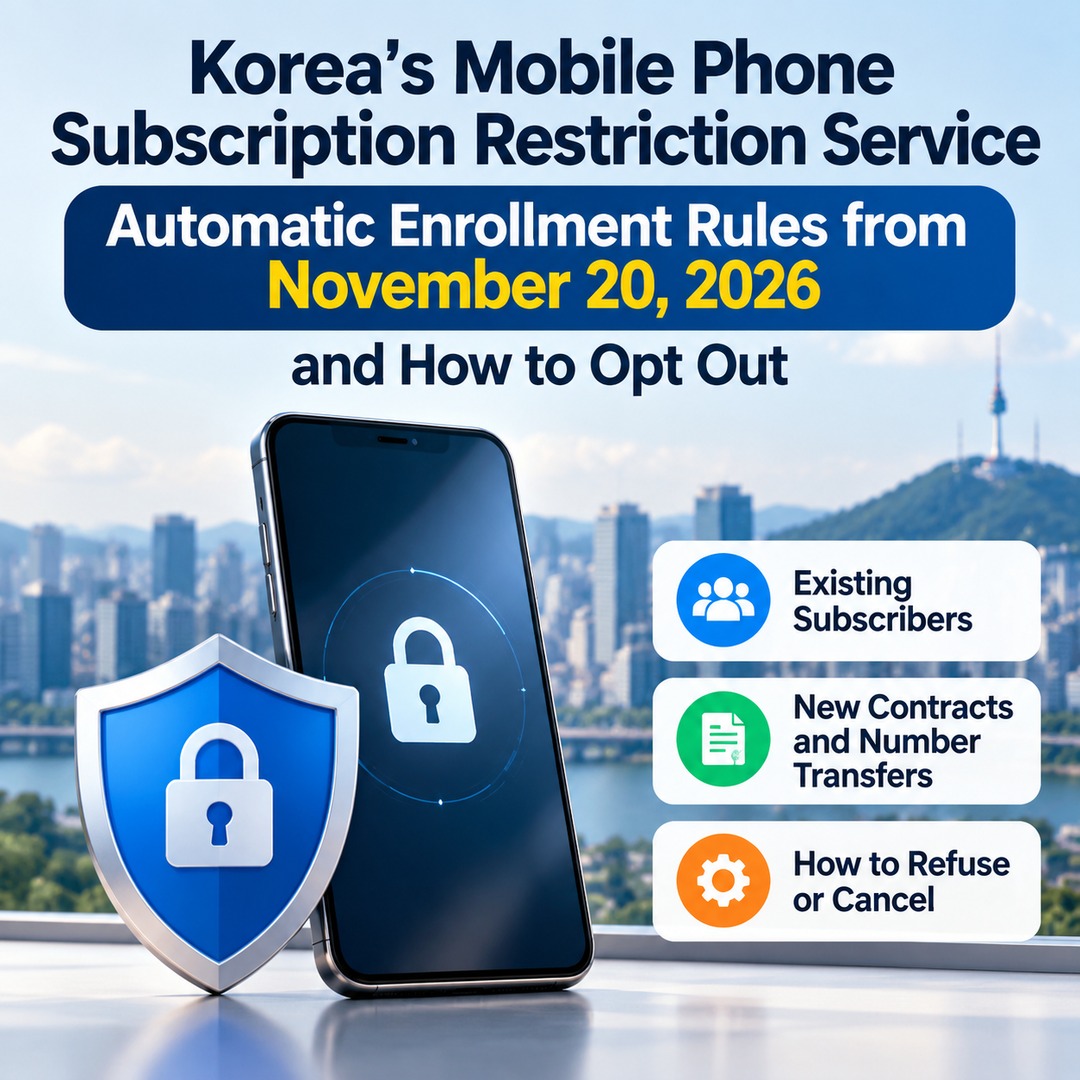
Starting November 20, 2026, mobile telecommunications providers must offer the mobile phone subscription restriction service by default when entering into telecommunications service contracts. However, this does not mean that every existing mobile phone user will automatically be enrolled on that date. The distinction lies in the law's requirement concerning the signing of new service contracts. Users can refuse the service before enrollment and request cancellation even after enrolling.
The mobile phone subscription restriction service is an identity theft prevention feature designed to stop other people from opening mobile phone accounts under your name without your permission. It does not restrict your mobile phone plan or existing telecommunications connections. Instead, it is a separate protective service that controls the opening of mobile phone accounts registered in your name.
Will the Service Automatically Apply to Existing Mobile Phone Users from November 20?
It is important to distinguish between automatically enrolling all existing subscribers and providing the service by default when entering into a new service contract.
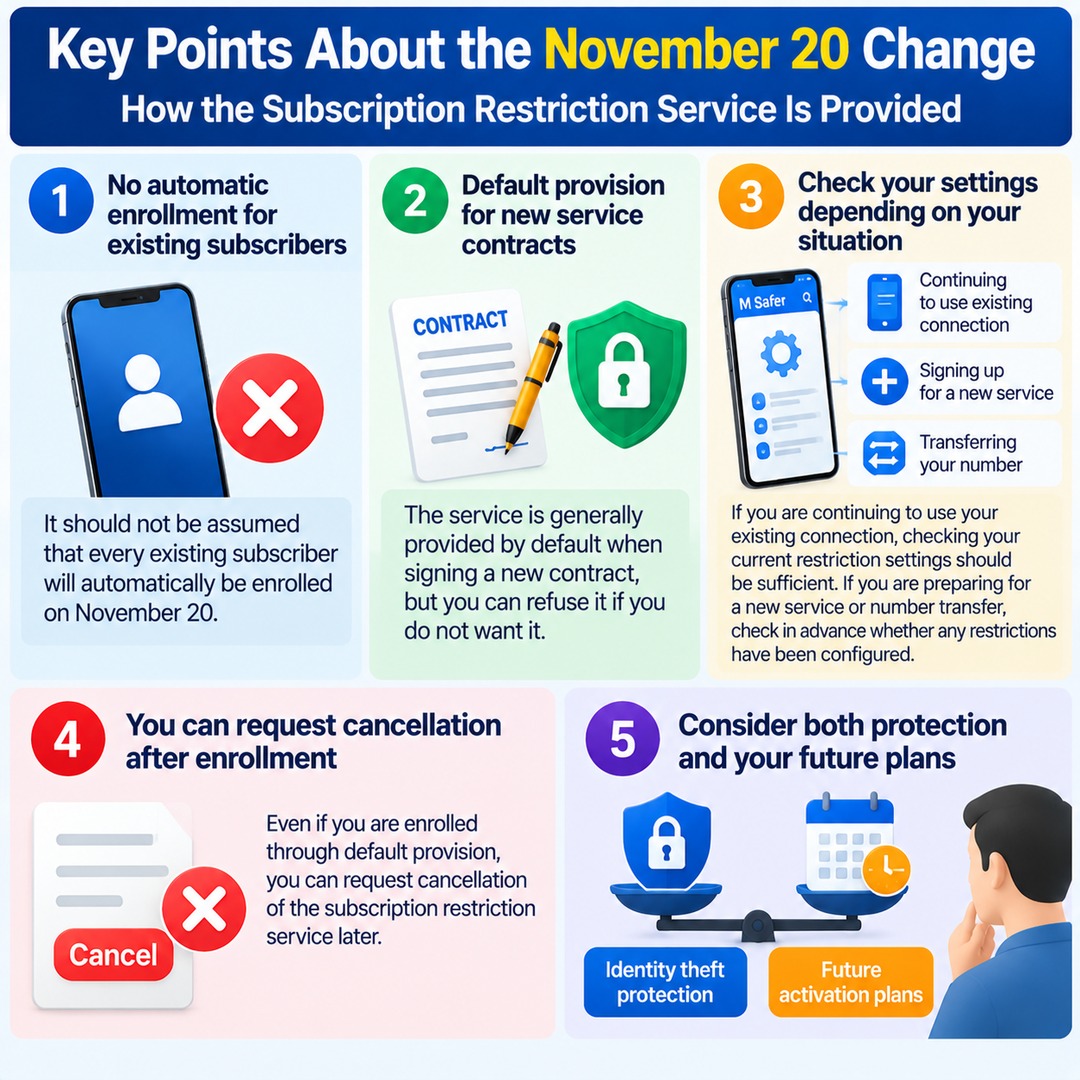
Article 32-6(3) of South Korea's amended Telecommunications Business Act requires relevant telecommunications providers to offer the subscription restriction service by default when entering into a service contract. Therefore, the November 20 effective date should not be interpreted as meaning that every previously activated mobile connection will automatically be enrolled at the same time.
The important criterion is whether a telecommunications service contract is being entered into, not simply whether someone already owns or uses a mobile phone.
Existing active connections that continue to be used: It cannot be assumed that all existing subscribers will be automatically enrolled on the effective date.
New service contracts signed on or after November 20: Eligible for default provision of the subscription restriction service.
Users who do not want the service provided at the contract stage: May refuse enrollment and provision.
Users enrolled through default provision: May subsequently request cancellation.
The law's contract-signing requirement alone does not establish a separate implementation schedule or automatic conversion procedure for existing subscribers.
What Happens When You Sign Up for a New Service or Transfer Your Number?
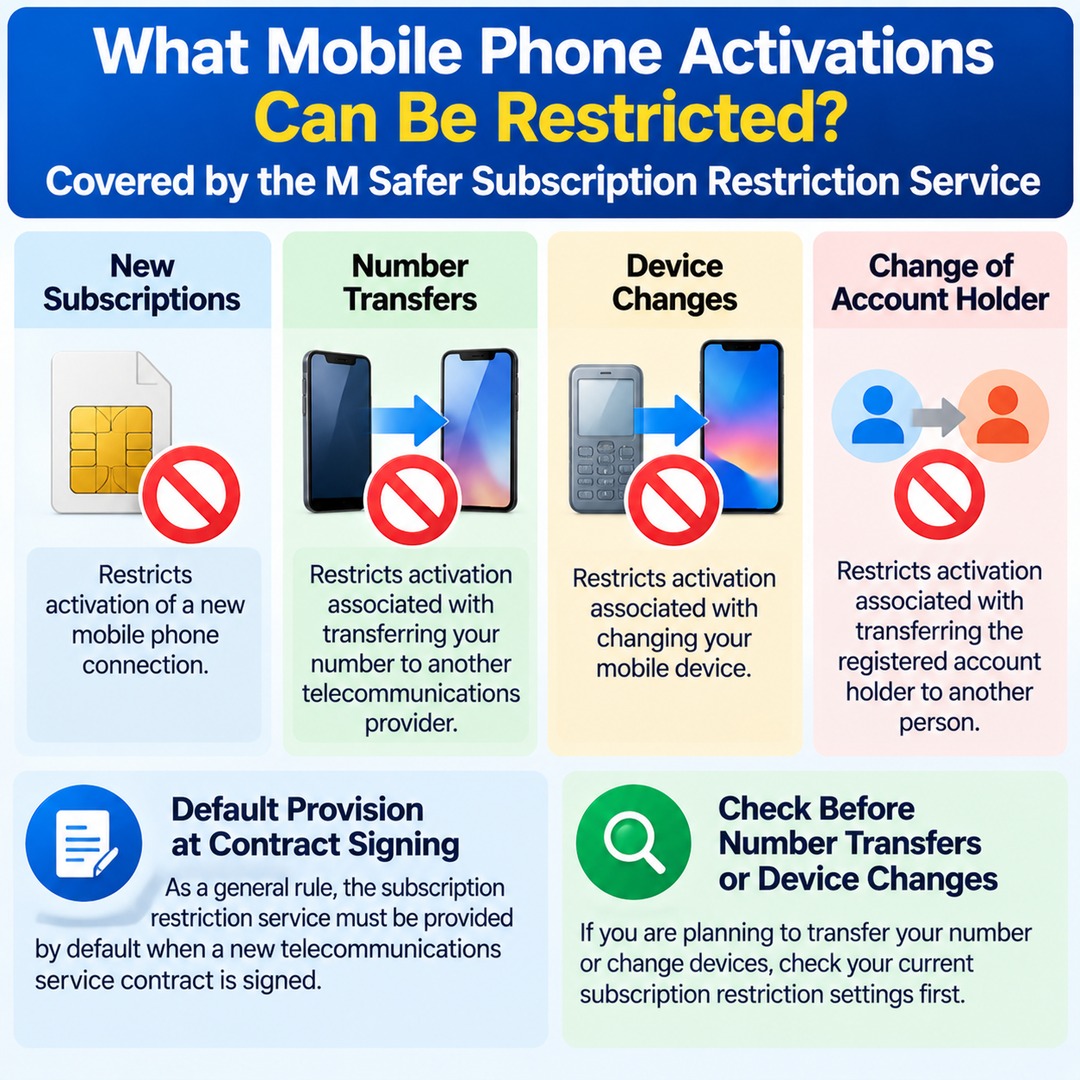
As a general rule, the subscription restriction service must be provided by default when a new telecommunications service contract is signed. However, number transfers and device changes should be considered separately because their treatment depends on how the actual contract process is handled.
The existing M-Safer subscription restriction service can restrict the following mobile phone activation procedures:
New subscriptions: Restricts activation of a new mobile phone connection.
Number transfers: Restricts activation associated with transferring your number to another telecommunications provider.
Device changes: Restricts activation associated with changing your mobile device.
Change of account holder: Restricts activation associated with transferring the registered account holder to another person.
If you are planning to transfer your number or change devices, it is advisable to check your current subscription restriction settings first.
However, restrictions that users personally configured through the existing M-Safer service should be distinguished from the service provided by default under telecommunications contracts after November 20. Once the new system takes effect, additional operational guidance from individual providers may be needed to clarify which contract types they treat as new service contracts and what procedures apply to number transfers and device changes.
Can You Refuse Default Provision or Cancel the Service Later?
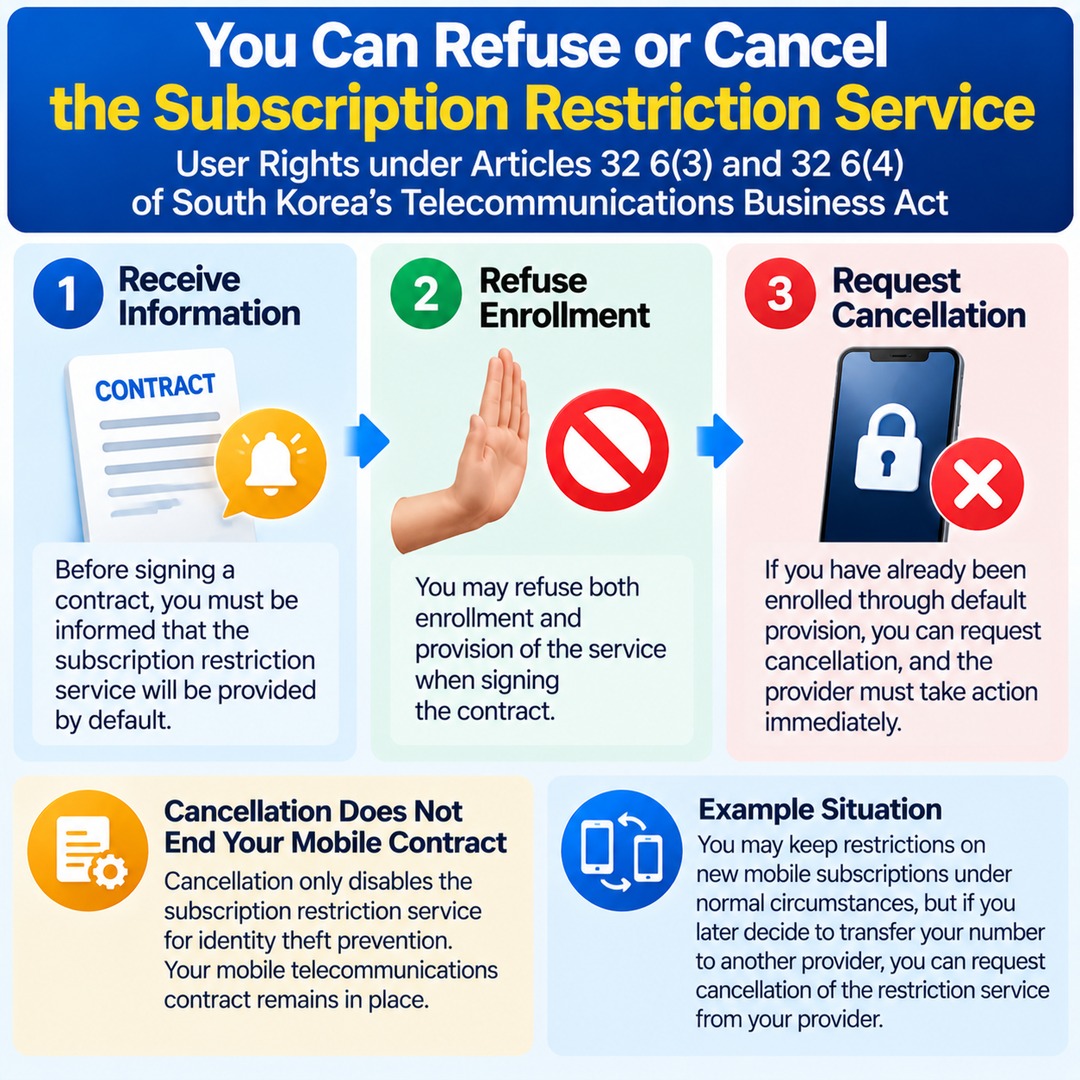
Yes. Articles 32-6(3) and 32-6(4) of South Korea's amended Telecommunications Business Act explicitly protect users' right to choose.
Before signing a contract, users must be informed that the subscription restriction service will be provided by default. They may refuse both enrollment and provision of the service.
Users who have already been enrolled through default provision may also request cancellation. The telecommunications provider must take action immediately upon receiving the request.
| Stage | User's rights | Provider's obligations |
|---|---|---|
| Before signing the contract | Refuse enrollment and provision | Notify the user in advance that the service is provided by default |
| After enrollment | Request cancellation at any time | Take action immediately upon receiving the request |
Cancellation here does not mean terminating your mobile telecommunications contract. It means disabling only the subscription restriction service provided for identity theft prevention.
For example, you may want to keep restrictions on new mobile subscriptions registered in your name under normal circumstances. If you later decide to transfer your number to another telecommunications provider, you can request cancellation of the restriction service from your provider.
How Is This Different from the Existing M-Safer Service?
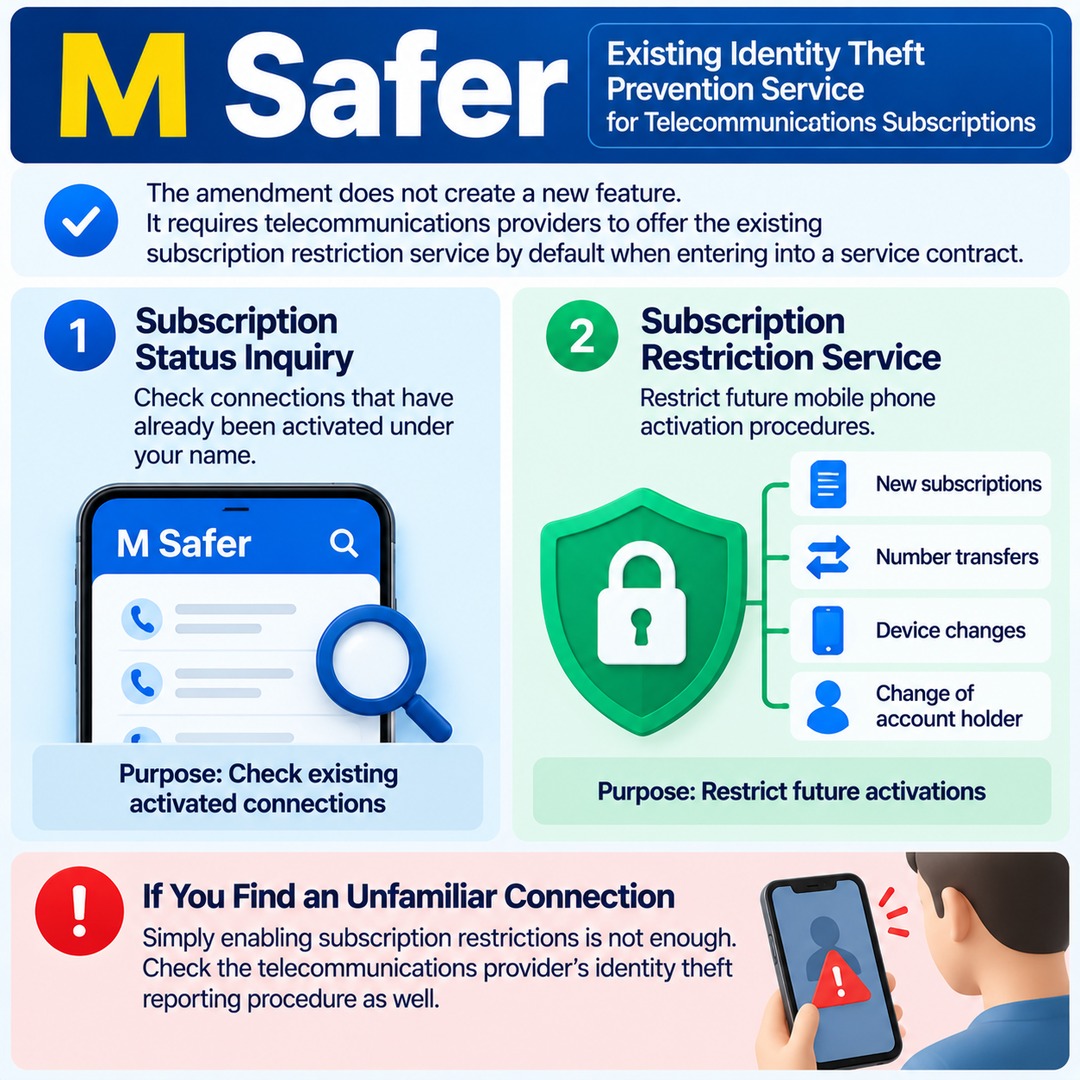
M-Safer is South Korea's existing identity theft prevention service for telecommunications subscriptions. The significance of the amendment is not that it creates an entirely new protection feature, but that it introduces a legal obligation to provide the existing subscription restriction service by default at the stage of entering into a telecommunications service contract.
The existing identity theft prevention service includes several features with different purposes.
| Service | Main function |
|---|---|
| Subscription Status Inquiry | Checks telecommunications services activated under your name |
| Subscription Restriction Service | Restricts mobile phone activations, including new subscriptions and number transfers |
| SMS Subscription Notification | Sends a text message notifying you when a contract is established under your name |
| Email Notification Service | Sends activation notifications to an email address you have registered for the service |
The Subscription Status Inquiry feature allows you to check connections that have already been activated. The Subscription Restriction Service, on the other hand, restricts future mobile phone activation procedures.
These two services should not be confused. If you discover an unfamiliar connection already registered under your name, simply enabling subscription restrictions is not enough. You should also check the relevant telecommunications provider's identity theft reporting procedure.
How to Check Your Current Subscription Restriction Settings
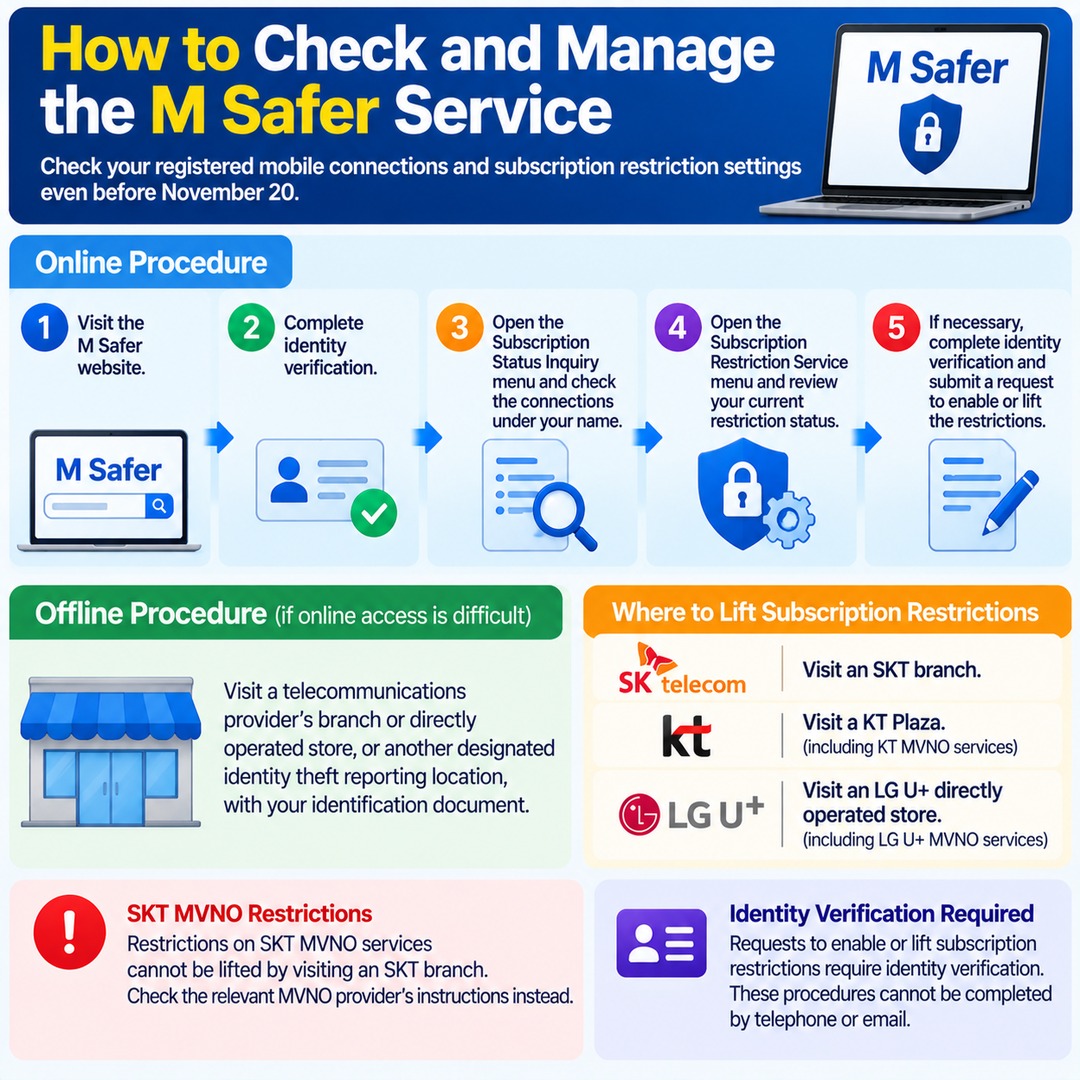
Even before November 20, you can use the existing M-Safer service to check telecommunications connections registered under your name and review your current subscription restriction settings.
How to Check on a PC
1. Visit the M-Safer website:
2. Complete identity verification.
3. Open the Subscription Status Inquiry menu and check the mobile connections registered under your name.
4. Open the Subscription Restriction Service menu and review your current restriction status.
5. If necessary, complete identity verification and submit a request to enable or解除 the subscription restrictions.
If you have difficulty using the online service, you can visit a telecommunications provider's branch or directly operated store, or another designated identity theft reporting location, with your identification document.
According to the current M-Safer guidance, the locations where subscription restrictions can be lifted vary by telecommunications provider. The published guidance specifies the following locations:
SK Telecom (SKT): Visit an SKT branch to lift subscription restrictions.
KT and KT mobile virtual network operator (MVNO) services: Visit a KT Plaza.
LG U+: Visit an LG U+ directly operated store to lift restrictions, including those associated with LG U+ MVNO services.
Restrictions on SKT MVNO services cannot be lifted by visiting an SKT branch. Users should check the relevant MVNO provider's instructions instead.
In addition, requests to enable or lift existing subscription restrictions require identity verification. These procedures cannot be completed by substituting a telephone call or email for the required identity verification.
What Should Mobile Phone Users Remember?
The change taking effect on November 20 concerns how the subscription restriction service is provided. It should not be assumed that every existing subscriber will automatically be enrolled on the effective date. Default provision is the general rule for new service contracts, but users can refuse the service if they do not want it.
If you are continuing to use your existing mobile phone connection, checking your current subscription restriction settings should be sufficient. If you are preparing to sign up for a new service or transfer your number, it is advisable to check first whether any restrictions have been configured that could affect activation.
One particularly important point is that you can still request cancellation after being enrolled through default provision. Consider both identity theft protection and your future mobile phone activation plans when deciding whether to use the service.