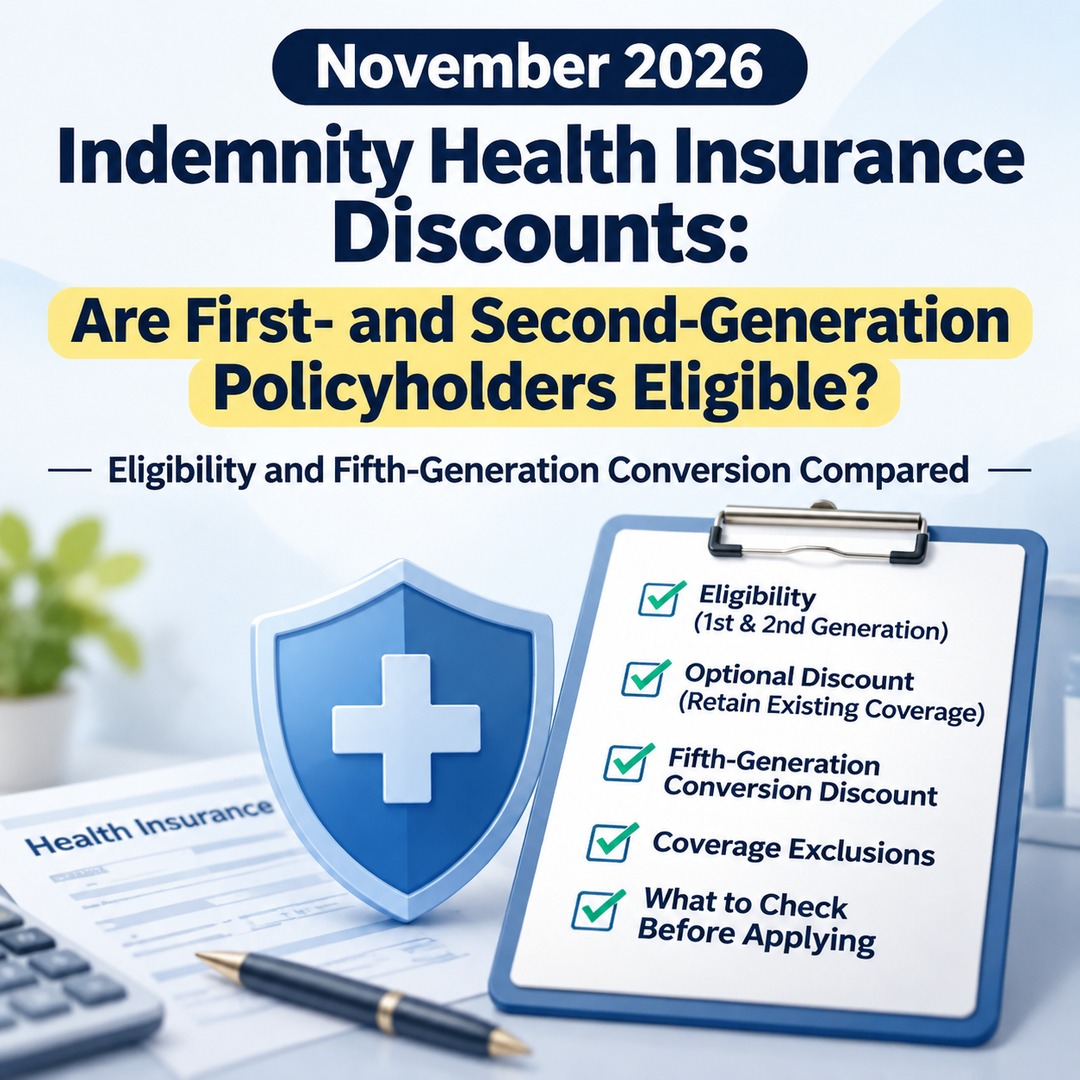
If you have held an older indemnity health insurance policy for years, you may have new options to reduce your premiums starting in November 2026. Eligible policies are early first- and second-generation indemnity health insurance contracts purchased before March 2013 that do not contain a contractual re-enrollment requirement. Two options are available: retain your existing policy while excluding selected coverage, or switch to fifth-generation indemnity insurance and receive a premium discount for three years. However, simply having enrolled during the relevant period does not automatically qualify you for a discount.
The important consideration is not just how much your premium will decrease. You also need to determine whether you will still be able to receive the treatments previously covered by your policy and how much your premium will be after the discount expires.
Can All First- and Second-Generation Policyholders Receive an Indemnity Insurance Discount?
No. Your policy must have been purchased before March 2013 and must not contain a contractual provision requiring you to re-enroll in a different insurance product.
A re-enrollment requirement refers to a provision in an insurance policy requiring the policyholder to change to an indemnity insurance product being sold at the time and re-enroll after a specified period.
Even if your policy is relatively old, having this provision may mean that it falls outside the eligibility criteria for the support program for early-generation indemnity insurance.
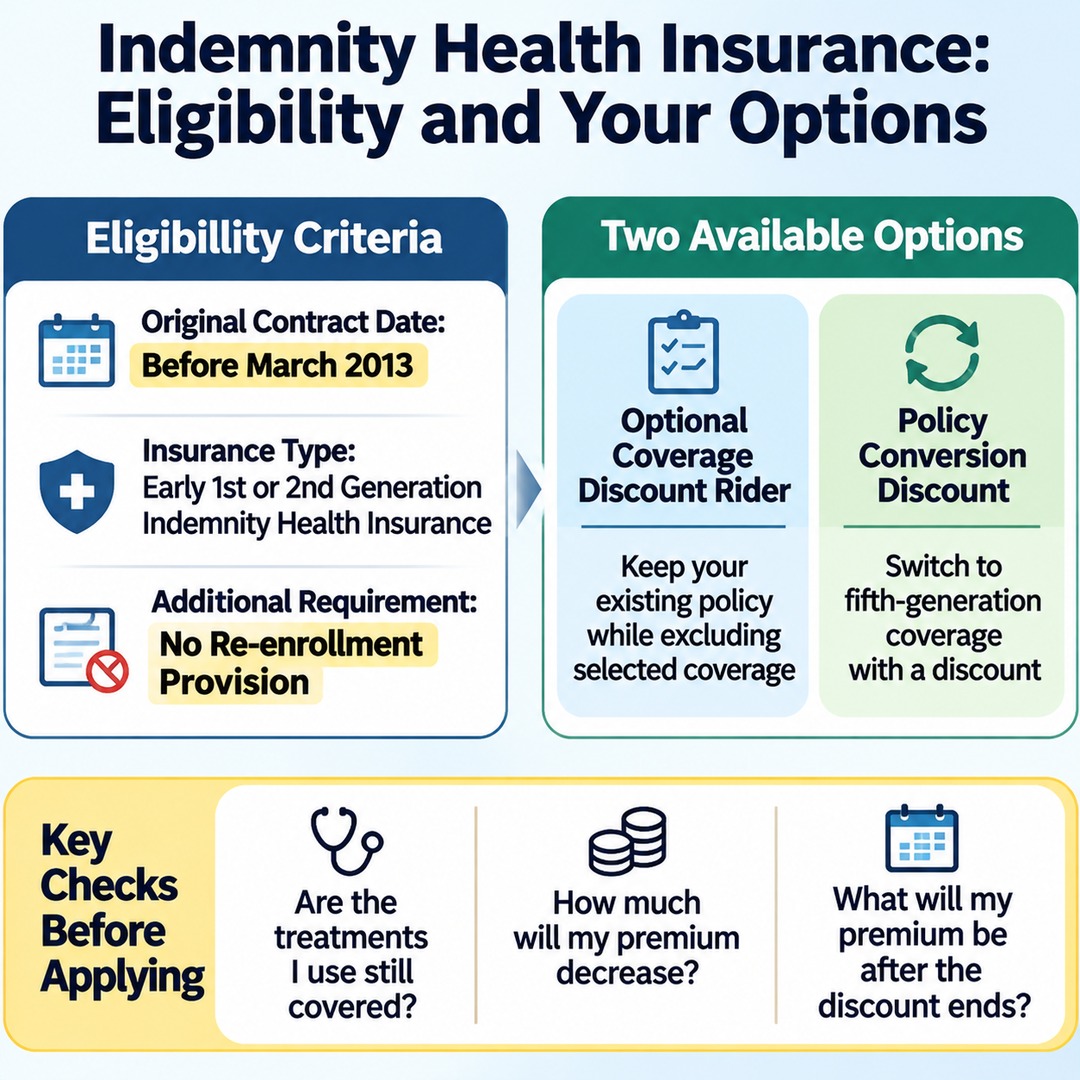
The eligibility criteria announced by South Korea's Financial Services Commission are as follows:
Original contract date: Before March 2013
Insurance type: Early first- or second-generation indemnity health insurance
Additional requirement: No re-enrollment provision in the policy terms
Available options: Optional coverage discount rider or policy conversion discount
As of the end of 2024, approximately 47.5% of all indemnity health insurance policies were classified as contracts without a re-enrollment requirement. This figure includes certain first- and second-generation policies.
Therefore, you should not assume that you qualify simply because your insurance certificate identifies your policy as first- or second-generation coverage.
Does Eligibility for Second-Generation Indemnity Insurance Depend on the Enrollment Date?
Yes. Re-enrollment requirements for second-generation indemnity insurance can vary depending on when the policy was purchased.
In particular, you need to distinguish between policies purchased before March 2013 and those purchased from April 2013 onward.
If you enrolled before March 2013, you may qualify, subject to confirmation of the other requirements. Second-generation policies purchased from April 2013 onward are not included in the basic eligibility criteria for this support program.
The most reliable approach is to ask your insurance company to confirm two things:
1. The original date of your indemnity insurance contract.
2. Whether your current policy contains a re-enrollment or policy amendment provision.
If your insurance certificate only shows the enrollment date, ask your insurer to check the actual policy terms and confirm whether a re-enrollment requirement applies.
How Can You Receive a Discount While Keeping Your Existing Indemnity Insurance?
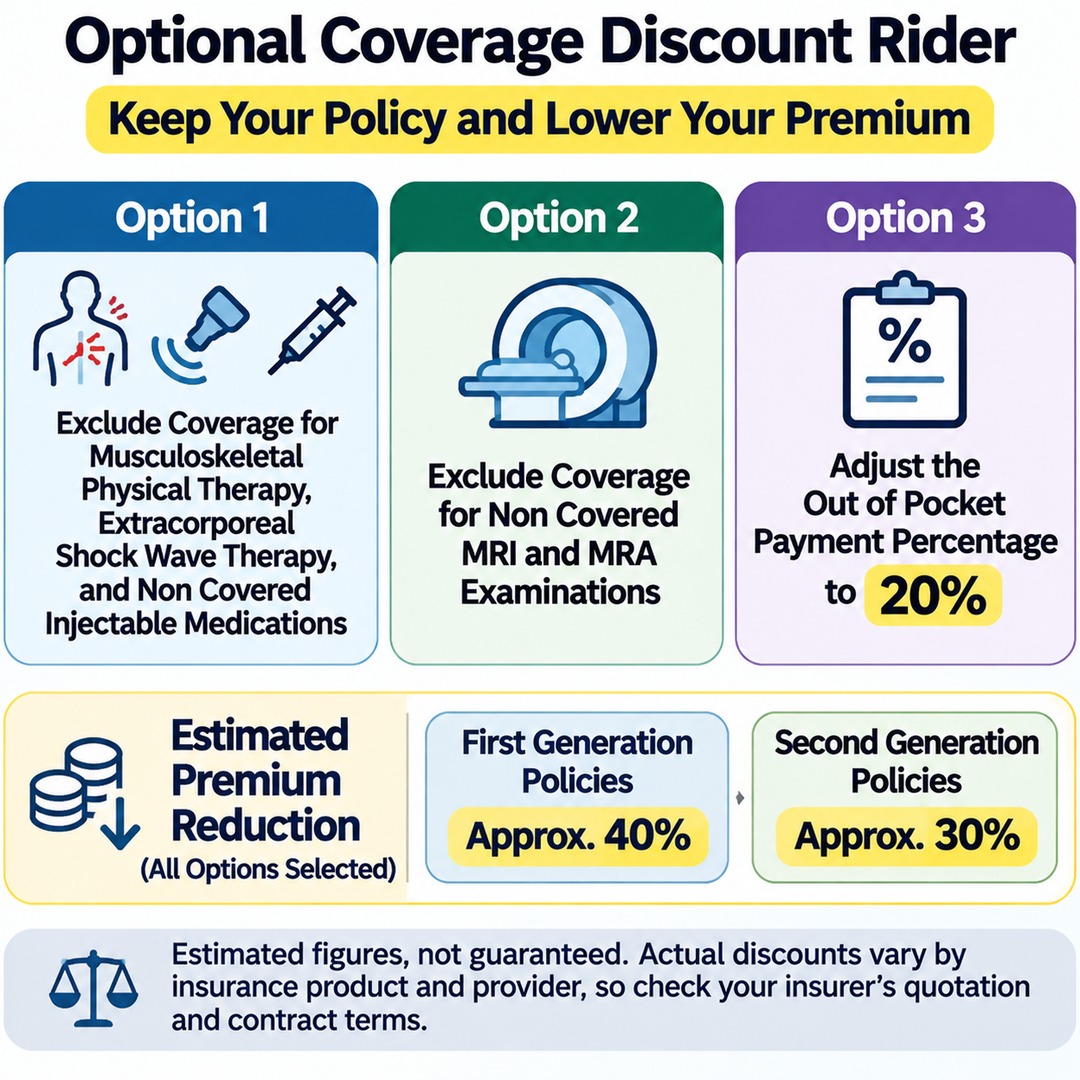
If you want to retain your existing policy, you can consider an optional coverage discount rider. This approach reduces premiums by excluding selected non-covered medical treatments or increasing your out-of-pocket payment percentage.
There are three main options to consider.
The first option is to exclude coverage related to musculoskeletal physical therapy, extracorporeal shock wave therapy, and non-covered injectable medications.
This option requires particular attention if you regularly receive manual therapy or extracorporeal shock wave treatment. Once these treatments are excluded, you may no longer be eligible to receive insurance benefits for the associated medical expenses in the future.
The second option is to exclude coverage for non-covered MRI and MRA examinations.
The actual cost of MRI and MRA examinations varies depending on their medical purpose and whether the examinations are covered or non-covered services under South Korea's National Health Insurance system. If you are likely to need non-covered examinations, calculate the potential out-of-pocket costs before prioritizing premium savings.
The third option is to adjust the out-of-pocket payment percentage to 20%.
The out-of-pocket payment percentage is the portion of medical expenses that the insured person must pay directly. Because this may change the coverage structure of your existing policy, compare the insurer's coverage tables before and after the proposed changes.
These three options are designed to allow policyholders to select individual exclusions or combine multiple options.
The Financial Services Commission estimated that selecting all available options could result in an overall premium reduction of approximately 30–40%. More specifically, the estimated reduction was in the 40% range for first-generation policies and the 30% range for second-generation policies. Actual discounts may vary depending on the insurance product and provider.
These figures are estimates, not guaranteed discount rates for every policyholder. You must check your insurer's actual quotation and the terms of your individual contract to determine the applicable premium.
How Much Can You Save by Switching to Fifth-Generation Indemnity Insurance?
If you choose not to retain your existing policy and instead switch to fifth-generation indemnity health insurance, you may be eligible for a separate policy conversion discount.
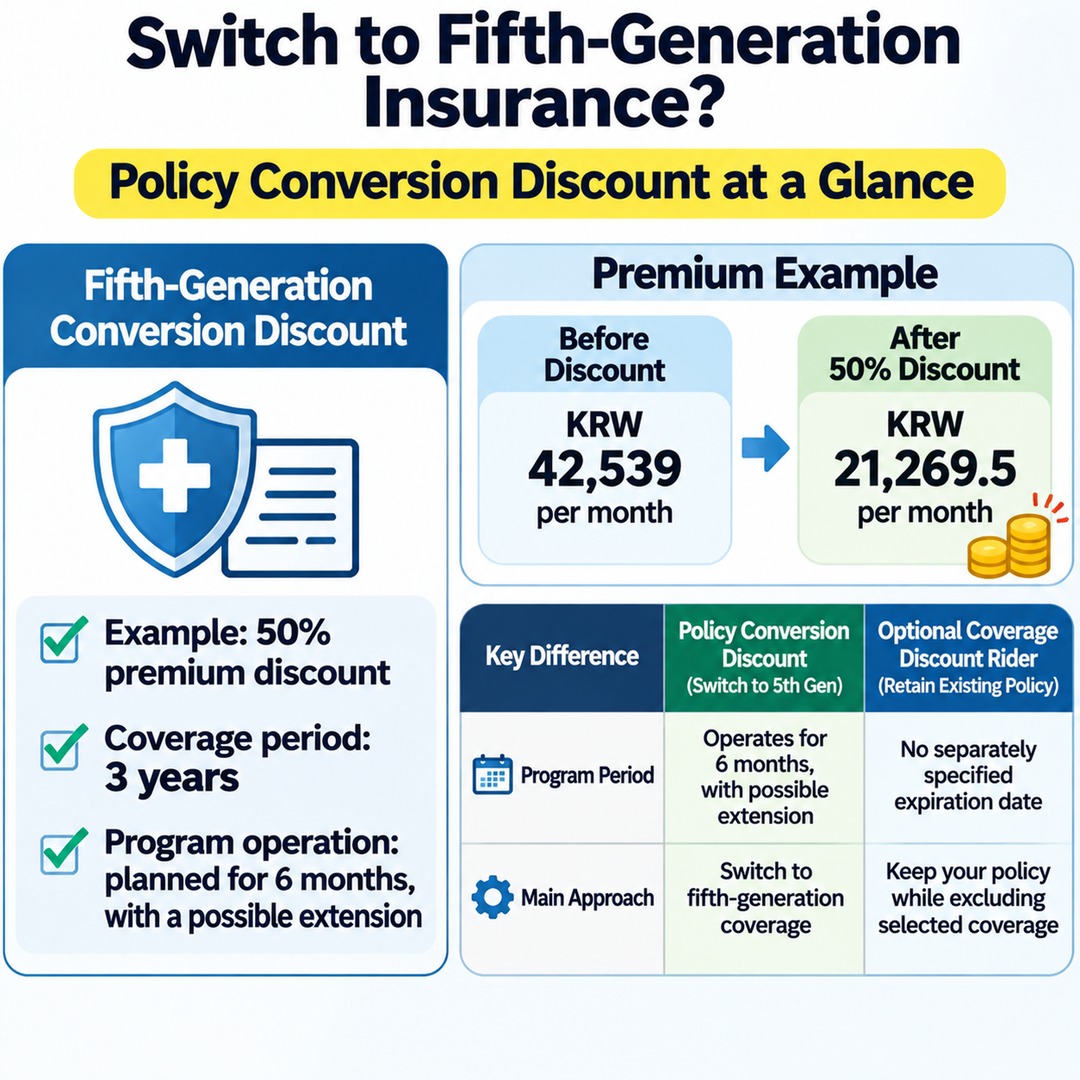
One example presented by the financial authorities involves a 50% premium discount on fifth-generation insurance for three years.
For example, if the monthly premium before the discount is KRW 42,539, a 50% discount would reduce it to approximately KRW 21,269.5 per month. The actual amount charged may differ depending on how fractional amounts are rounded.
This approach is substantially different from choosing an optional discount while keeping your existing policy.
| Comparison | Optional Coverage Discount | Fifth-Generation Conversion Discount |
|---|---|---|
| Existing policy | Retained | Replaced with fifth-generation coverage |
| Premium discount | Based on selected coverage options | Discount applied for a specified period after conversion |
| Coverage structure | Selected coverage excluded or out-of-pocket percentage adjusted | Fifth-generation coverage structure applies |
| Discount period | Planned to operate without a specified end date | Three-year discount example |
| Implementation plan | November 2026 | Begins in November 2026, with an initial six-month implementation period and subsequent extension review |
In particular, the policy conversion discount was presented as a temporary program that would operate for six months before the authorities considered whether to extend it. The optional coverage discount rider was announced as a program without a separately specified expiration date.
Therefore, these two arrangements should not be treated as identical discount products.
Will Lower Insurance Premiums Also Reduce Your Actual Medical Expenses?
Not necessarily. You need to calculate both the premium savings and the additional medical expenses you may have to pay because certain treatments are excluded from coverage.
Fifth-generation indemnity insurance generally has lower premiums than older products, but the out-of-pocket payment percentages and coverage limits for non-severe non-covered treatments are different.
In particular, musculoskeletal physical therapy, extracorporeal shock wave treatment, and non-covered injectable medications may fall under excluded coverage categories in fifth-generation products.
The outcome can be very different for someone who rarely visits medical facilities and is struggling with high premiums compared with someone who regularly receives non-covered treatments.
For example, even if you save KRW 50,000 in premiums every month, you may have to pay an additional KRW 1 million annually for treatments excluded from your coverage. In that situation, premium savings alone are not enough to establish that switching is financially beneficial.
What Costs Should You Calculate When Comparing Your Options?
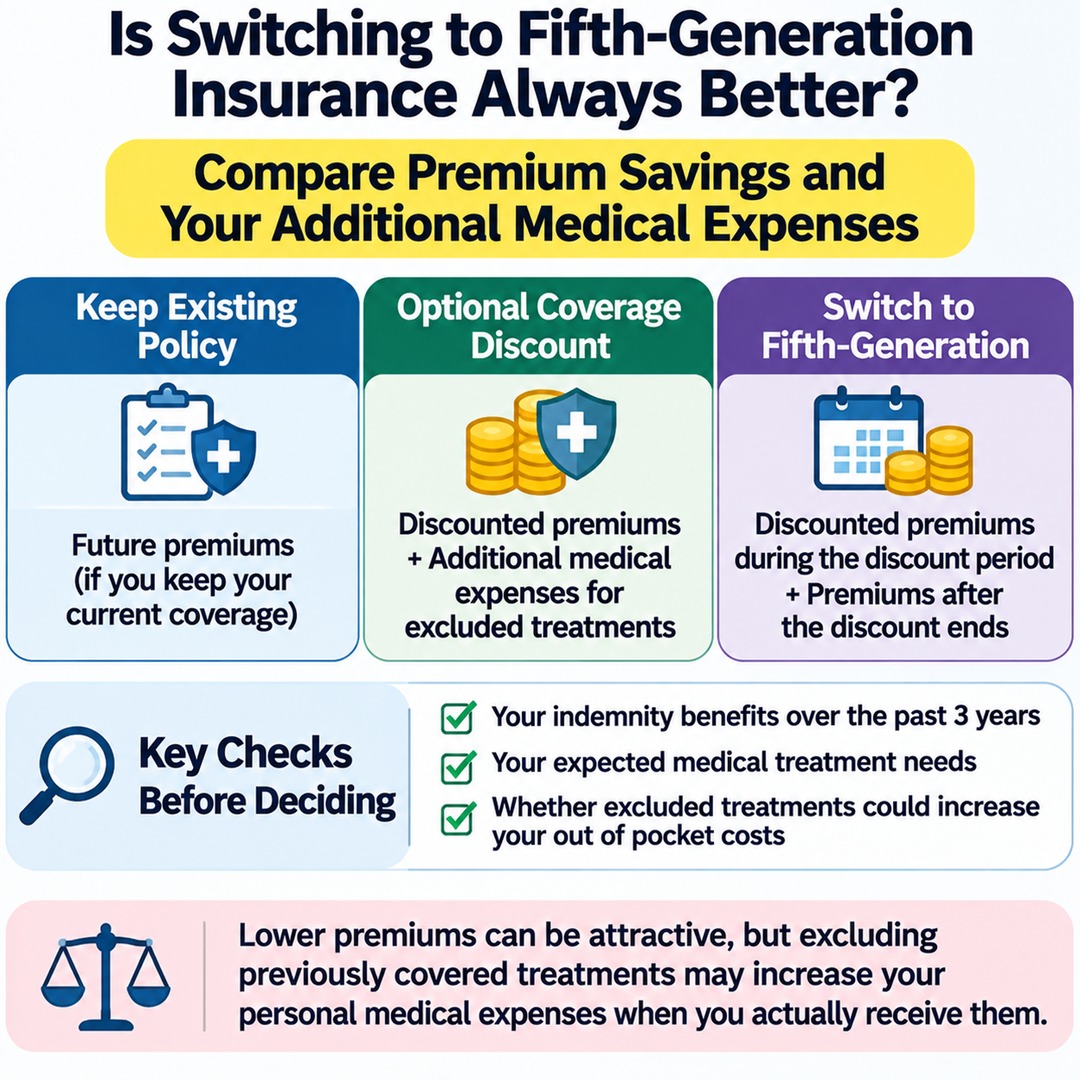
It is advisable to compare the following three categories over the same period:
The premiums you would pay in the future if you retained your existing policy.
The premiums after applying an optional coverage discount, together with the medical expenses for excluded treatments.
The premiums during the discount period after switching to fifth-generation coverage and the premiums after the discount expires.
You should also review the indemnity insurance benefits you received over the past three years and consider your expected medical treatment needs in the future.
In particular, excluding treatments previously covered by your existing policy may reduce your premiums but increase your personal medical expenses when you actually receive those treatments.
How Can You Apply for an Indemnity Insurance Discount in November 2026?
If you are preparing to apply, first contact the insurance company that issued your policy and confirm whether your contract qualifies.
This program does not automatically reduce premiums for every eligible policyholder. Instead, you must choose between retaining your existing policy with optional coverage changes and switching to fifth-generation coverage.
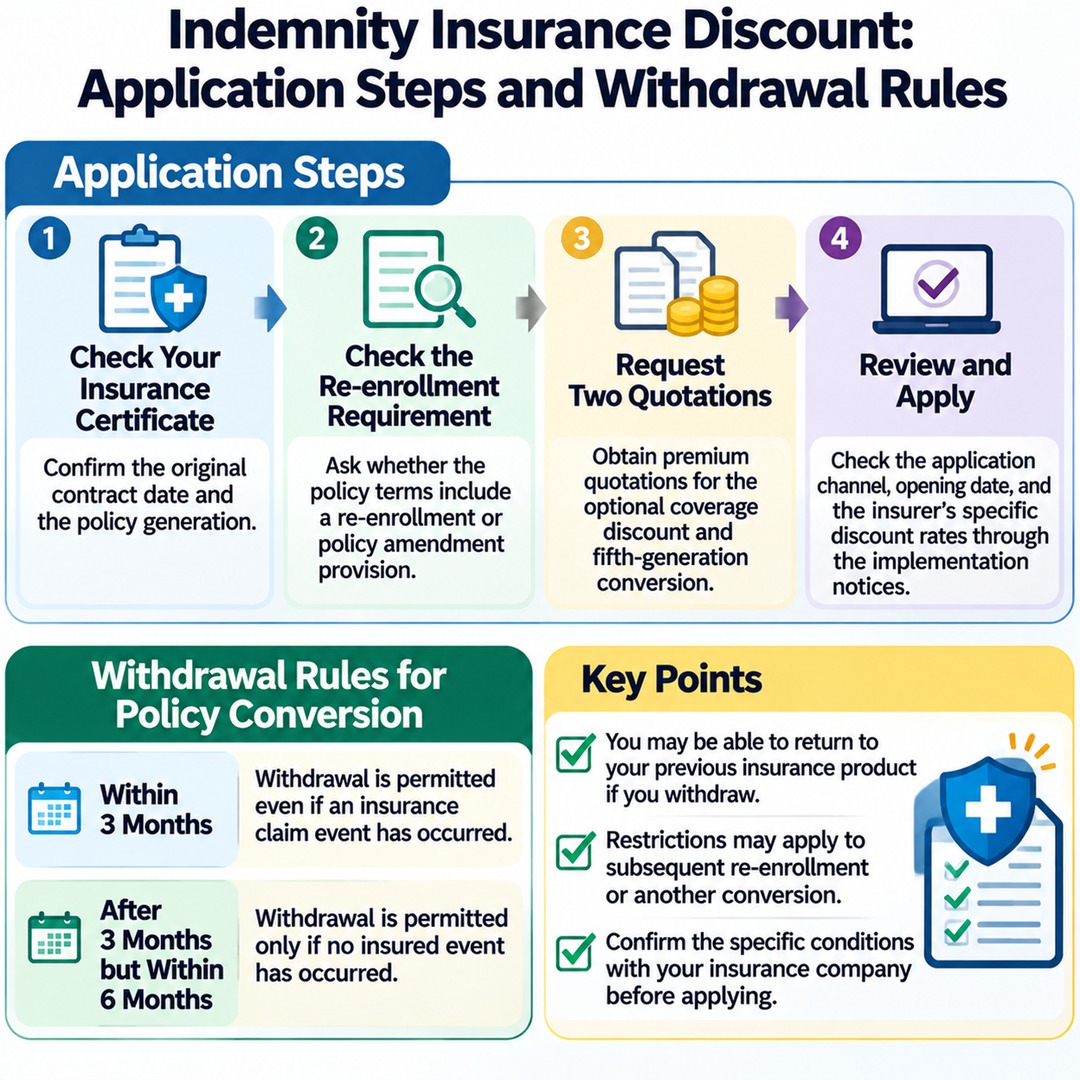
The following steps provide a practical application process:
1. Check your insurance certificate: Confirm your original contract date and the generation of your current indemnity insurance policy.
2. Check the re-enrollment requirement: Ask your insurer whether the policy terms contain a re-enrollment or policy amendment provision.
3. Request two quotations: Obtain separate premium quotations for the optional coverage discount and fifth-generation policy conversion.
4. Review excluded coverage: Check changes involving manual therapy, extracorporeal shock wave treatment, non-covered injectable medications, MRI, and MRA examinations.
5. Compare long-term costs: Calculate not only the premiums during the discount period but also the premiums and medical expenses after the discount expires.
6. Make your final decision: Choose between retaining your existing policy and converting to fifth-generation coverage based on your medical treatment needs.
You should confirm the application channel, actual application opening date, and insurer-specific discount rates through the implementation notices issued by each insurance company. The currently announced policy information does not establish that every insurer has finalized identical application screens or a common application procedure.
Can You Return to Your Previous Policy After Switching to Fifth-Generation Insurance?
A policy withdrawal mechanism has also been introduced as a consumer protection measure for policy conversions.
According to the publicly announced policy information, arrangements allow policyholders to withdraw from a conversion within six months after switching.
However, the applicable conditions depend on when you request withdrawal.
Within three months after conversion: Withdrawal is permitted even if an insurance claim event has occurred.
After three months but within six months: Withdrawal is permitted only if no insured event has occurred.
If you withdraw, you may be able to return to your previous insurance product. However, restrictions may apply to subsequent re-enrollment or another conversion. Therefore, confirm the specific conditions with your insurance company before submitting your application.
It is safer to understand the withdrawal conditions in advance so that you do not encounter unexpected problems when attempting to restore your previous coverage after switching primarily for the discount.
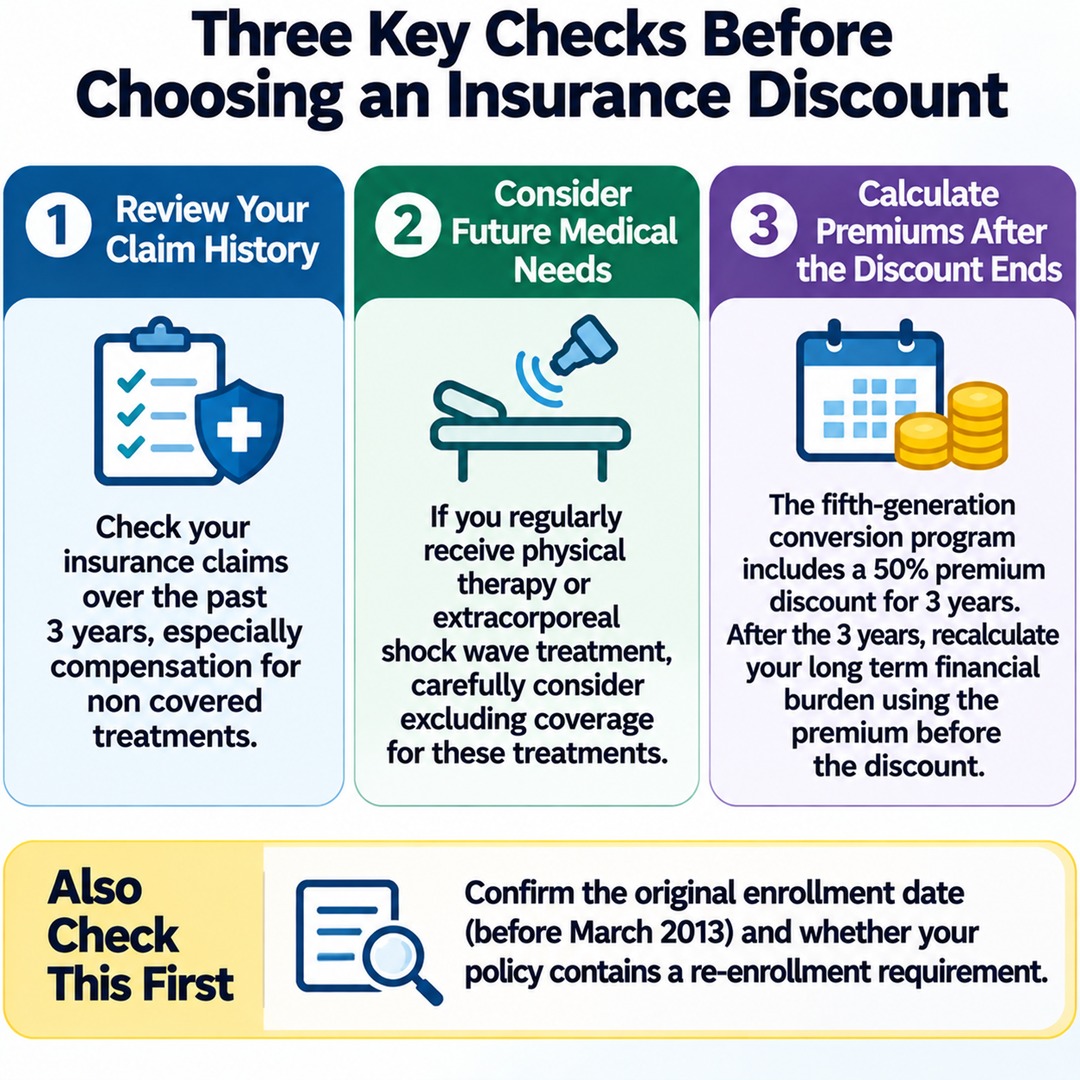
Three Things to Check Before Applying for an Indemnity Insurance Discount
Before making your final decision, review the following three factors.
First, check your insurance claim history over the past three years.
Looking only at your premiums makes it difficult to properly assess the value of your existing insurance. In particular, check how much compensation you received for non-covered medical treatments.
Second, consider the medical services you may need in the future.
If you regularly receive physical therapy or extracorporeal shock wave treatment, carefully consider whether excluding coverage for these treatments is appropriate for your circumstances.
Third, calculate your premiums after the discount expires.
The fifth-generation policy conversion program includes an example of a 50% premium discount for three years. After those three years, you should recalculate your long-term financial burden using the premium before the discount.
Ultimately, choosing an indemnity insurance discount is not simply about selecting the option with the largest percentage reduction. You need to consider your premiums paid to date, the insurance benefits you have received, and the medical expenses you expect to incur in the future.
If you purchased an early-generation indemnity insurance policy before March 2013, the first step is to check the original enrollment date on your insurance certificate and confirm whether your policy contains a re-enrollment requirement.