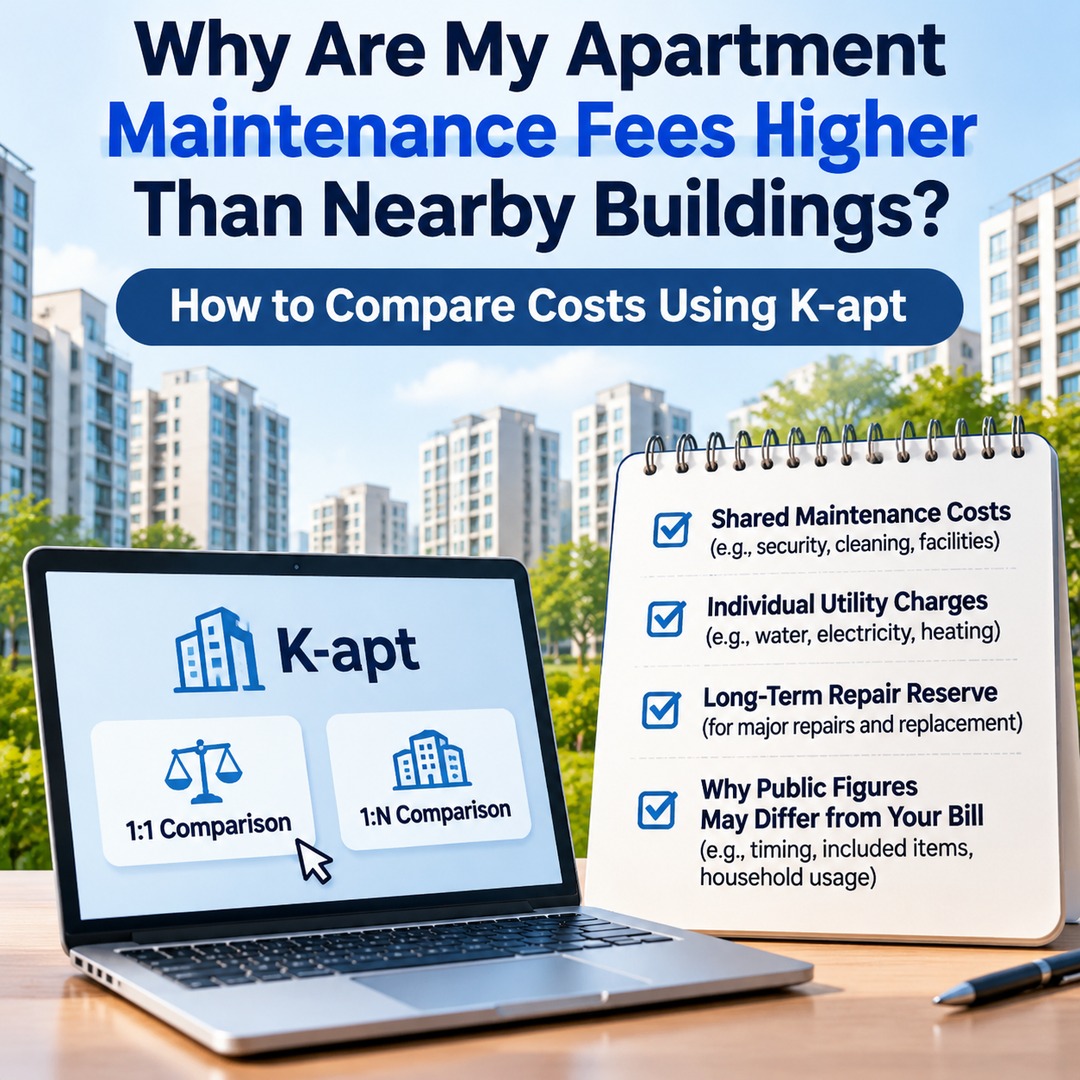
If your apartment is in the same neighborhood as another building with a similar unit size, but your monthly maintenance bill is higher, comparing only the total amount will not reveal the reason. You need to compare the same billing month and area measurement in K-apt, then examine shared maintenance costs, individual utility charges, and long-term repair reserves separately. Most importantly, K-apt publishes complex-wide figures, so its amounts may not match the actual bill for your individual household.
Why Do K-apt Maintenance Fees Differ from Actual Apartment Bills?
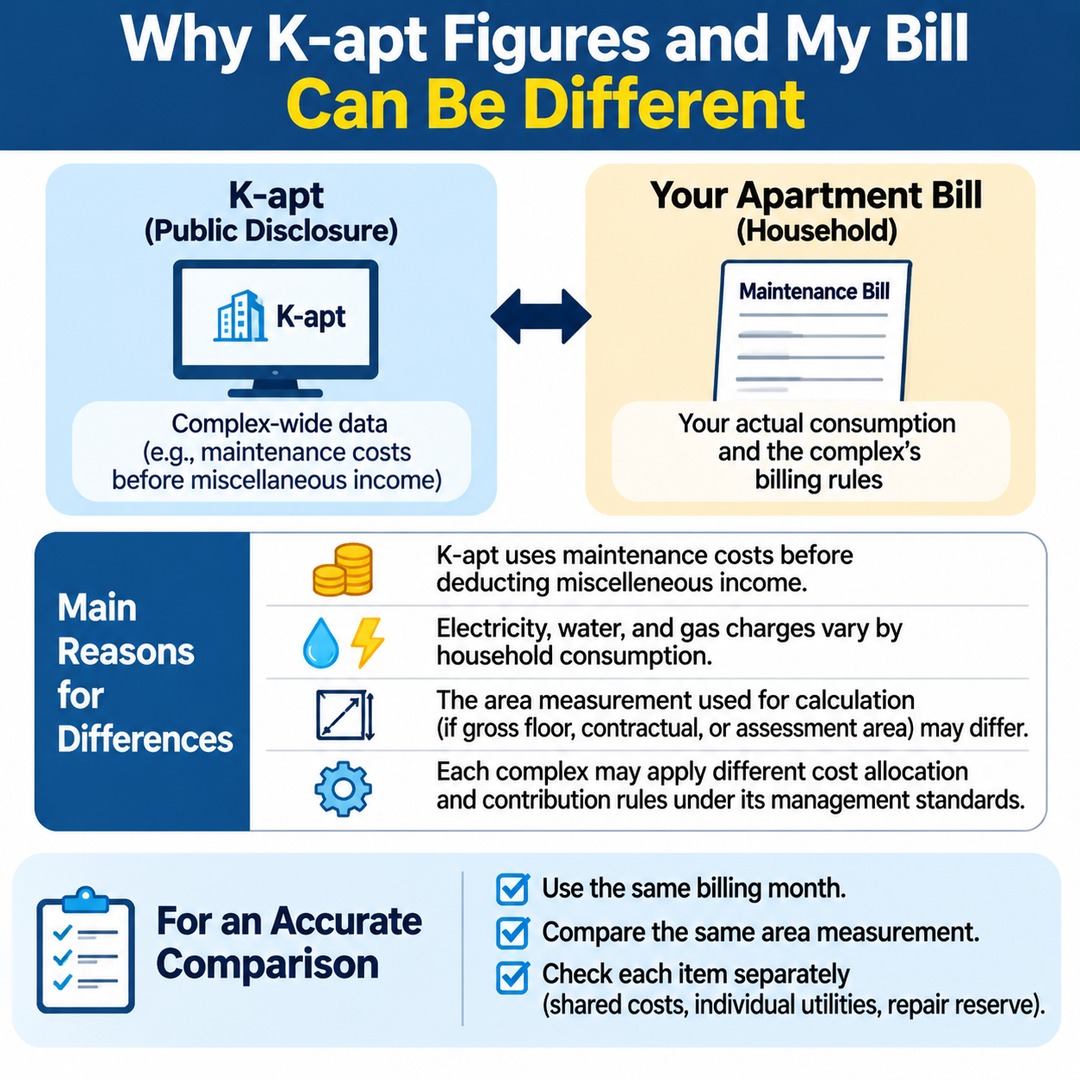
K-apt is South Korea's apartment management information system. It allows users to view publicly disclosed maintenance fees and utility charges for apartment complexes and compare them with other properties. By contrast, an actual apartment maintenance bill reflects the individual household's consumption and the complex's specific billing rules.
There are several reasons why the two figures may differ:
K-apt's publicly disclosed figures are based on maintenance costs before deducting miscellaneous income generated by the apartment complex.
Electricity, water, and gas charges vary according to each household's actual consumption.
The area measurement used to calculate maintenance fees per unit of area may differ.
Each apartment complex may calculate cost allocations and household contributions differently under its own management bylaws.
In particular, K-apt explains that when figures are displayed using the gross floor area, contractual area, or maintenance-fee assessment area rather than the residential exclusive-use area, the management entity is responsible for entering the applicable area measurement.
Therefore, if you multiply the per-square-meter amount displayed in K-apt by your home's exclusive-use area and get a different result from your actual bill, you should not immediately conclude that the charges were calculated incorrectly.
How to Compare Nearby Apartment Maintenance Fees Using K-apt
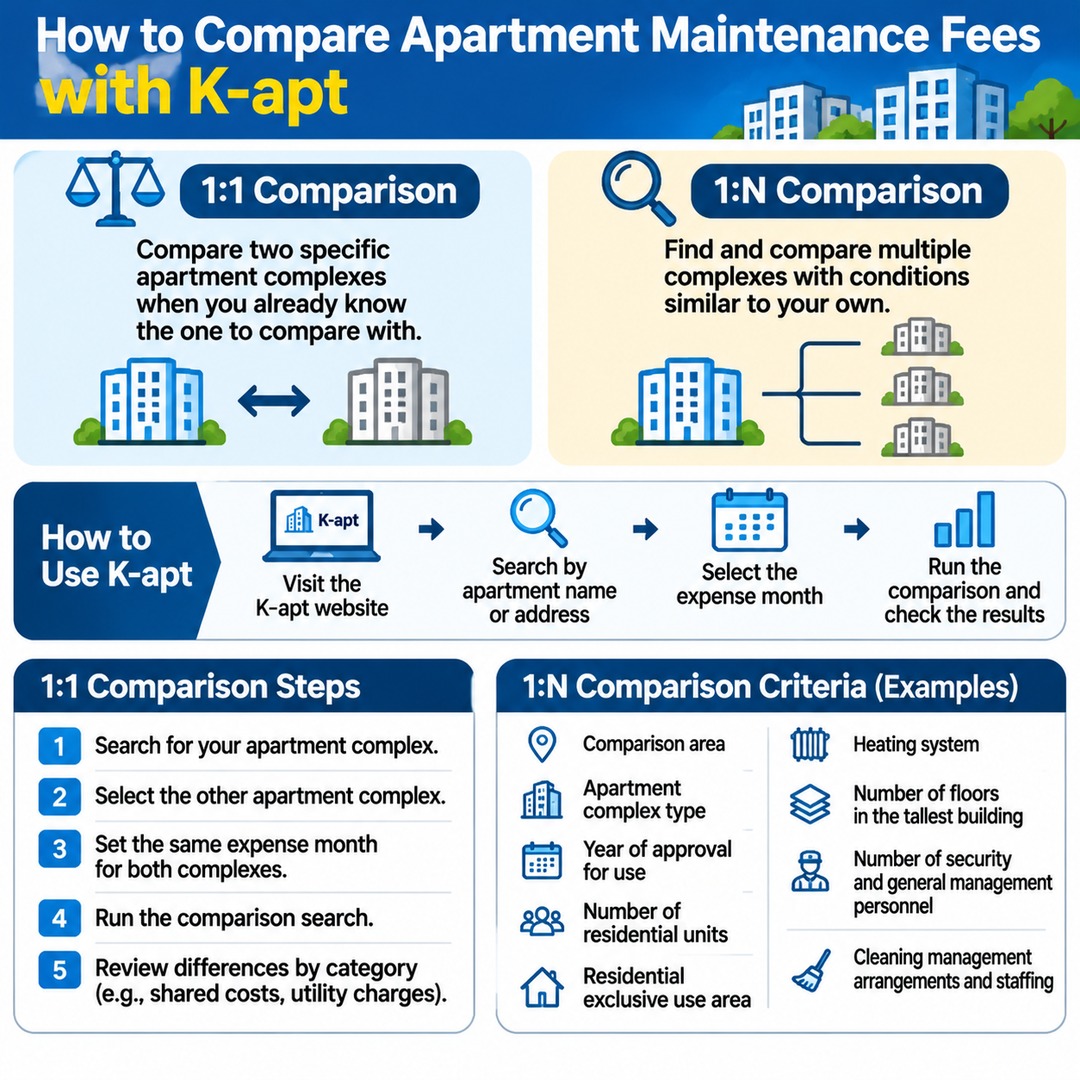
K-apt provides two useful comparison features: a 1:1 comparison between two apartment complexes and a 1:N comparison involving multiple similar complexes.
The 1:1 comparison is useful when you already know which apartment you want to compare with. The 1:N comparison is more useful when you want to identify complexes with conditions similar to your own.
1. Look Up Your Apartment's Maintenance Fees First
Visit the K-apt website and open the maintenance fee section to look up the figures for your apartment complex.
K-apt Apartment Management Information System: Direct Access
Search by apartment complex name or address, then select the month in which the maintenance costs were incurred.
One important distinction is the difference between the month you received the bill and the month in which the maintenance expenses were incurred. K-apt's comparison screens use the expense month as their reference, so comparing figures from different months can lead to inaccurate conclusions.
For example, if you select October expenses for one complex and September expenses for another, seasonal differences in consumption and costs may affect the comparison.
2. Compare Two Apartment Complexes Using the 1:1 Feature
m.sateconomy.co.kr
If you already know which apartment you want to compare, use the following menu:
Compare Maintenance Fees and Other Charges with Another Complex: 1:1 Comparison
Follow these steps:
1. Search for your apartment complex.
2. Select the other apartment complex you want to compare.
3. Set the same expense month for both complexes.
4. Run the comparison search.
5. Review the differences in individual categories, including shared maintenance costs and utility charges.
Some apartment complexes may have similar names, so it is advisable to verify their addresses and locations as well.
3. Compare Multiple Similar Apartments Using the 1:N Feature
blog.naver.com
If you have not yet decided which apartment complexes to compare, the customized 1:N comparison feature may be more convenient.
Customized 1:N Comparison with Other Apartment Complexes
This feature allows you to combine the following criteria:
Comparison area
Apartment complex type
Year of approval for use (the year the building was approved for occupancy)
Number of residential units
Residential exclusive-use area
Heating system
Number of floors in the tallest building
Number of security and general management personnel
Cleaning management arrangements and staffing levels
When starting your search, it is generally best to focus on location, year of approval for use, number of units, and heating system.
If you narrow the criteria too much, there may not be enough complexes available for comparison. Start with broadly similar conditions and add more specific criteria as needed.
What Is the Real Reason Your Apartment Maintenance Fees Are Higher Than Those of Nearby Buildings?
When investigating differences in maintenance fees, first identify which categories are more expensive rather than focusing only on the total amount.
Article 23 of the Enforcement Decree of South Korea's Multi-Family Housing Management Act distinguishes between management fees, long-term repair reserve contributions, and utility charges.
If Shared Maintenance Costs Are Higher
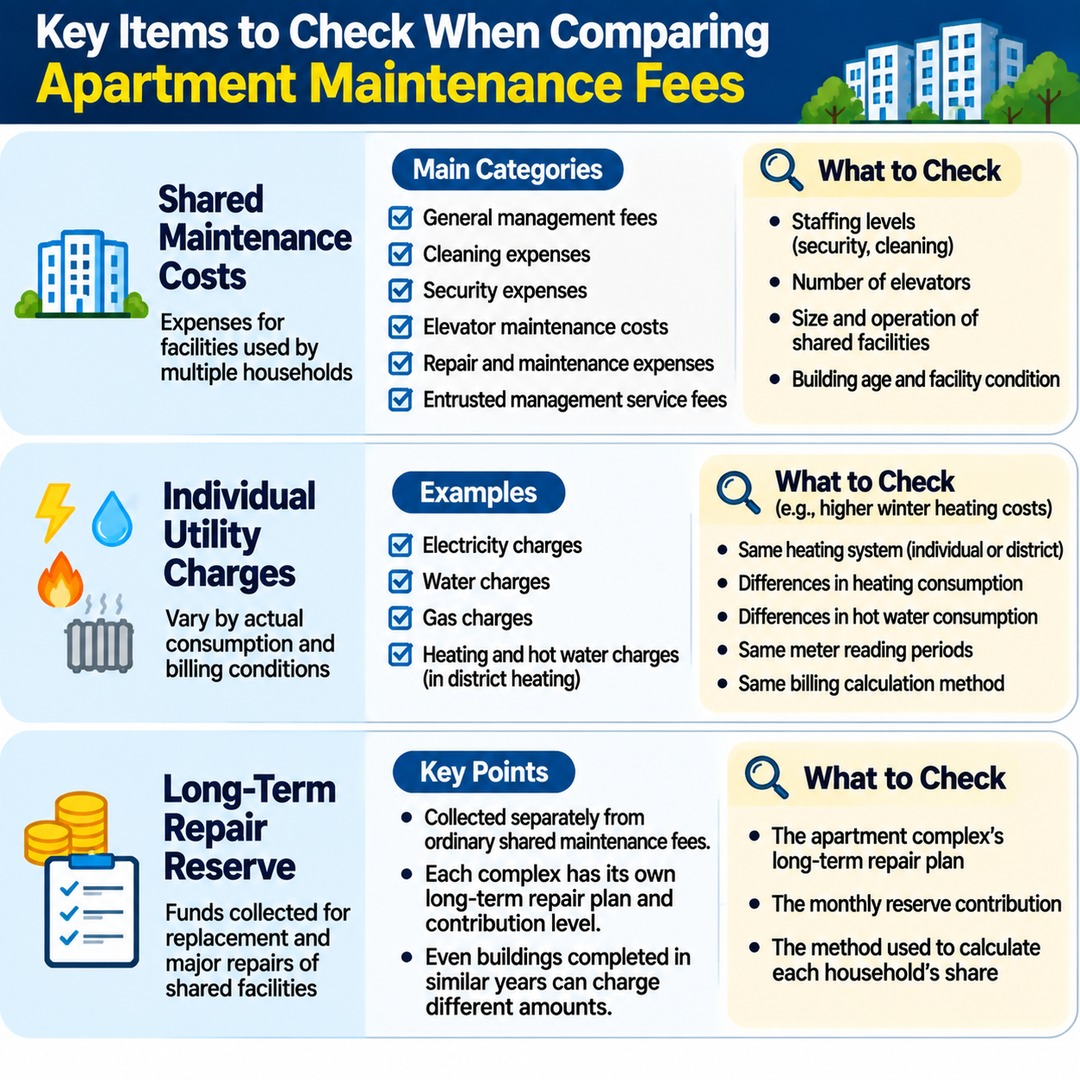
Shared maintenance costs cover facilities used by multiple households and expenses necessary to manage the apartment complex.
Common categories include:
General management fees
Cleaning expenses
Security expenses
Elevator maintenance costs
Repair and maintenance expenses
Entrusted management service fees
If your apartment's shared maintenance costs are higher than those of nearby complexes, examine staffing levels and facility operating conditions together.
For example, the number of security guards and cleaning staff, the number of elevators, and the size of shared facilities can all affect management expenses.
The building's age and the condition of its shared facilities are also worth comparing.
If Individual Utility Charges Are Higher
Individual utility charges vary according to actual consumption and applicable billing conditions.
Common examples include electricity, water, and gas charges. In apartments with district heating, heating and hot water charges are also classified as utility expenses.
For these items, do not compare only the total amounts for each complex. Check actual consumption figures as well.
For example, if your winter heating costs are unusually high, examine the following:
Whether the apartments use the same heating system
How much their heating consumption differs
Whether hot water consumption is different
Whether the meter-reading periods are the same
Whether the same billing calculation method is used
In particular, individual heating and district heating may display costs differently, so comparing only the combined totals is not appropriate.
If Long-Term Repair Reserve Contributions Are Higher
A long-term repair reserve is money collected to fund the replacement and repair of major apartment facilities over an extended period.
Under South Korean apartment management regulations, these contributions are collected separately from ordinary shared maintenance fees.
Each apartment complex has its own long-term repair plan and reserve contribution levels. As a result, even buildings completed in similar years may charge different amounts.
A higher long-term repair reserve contribution does not, by itself, mean that the apartment's maintenance fees have been unfairly calculated.
You should also examine the long-term repair plan, monthly reserve contributions, and the method used to calculate each household's share.
Four Conditions That Are Easy to Overlook When Comparing Apartment Maintenance Fees
If K-apt shows that your apartment has higher fees than nearby complexes, check the following conditions again.
| Comparison criterion | What to check |
|---|---|
| Expense month | Whether the figures are from the same year and month |
| Area measurement | Whether the calculation uses exclusive-use area, gross floor area, or the maintenance-fee assessment area |
| Heating system | Whether both complexes use individual, district, or central heating |
| Complex size | Differences in the number of units, floors, shared facilities, and management staff |
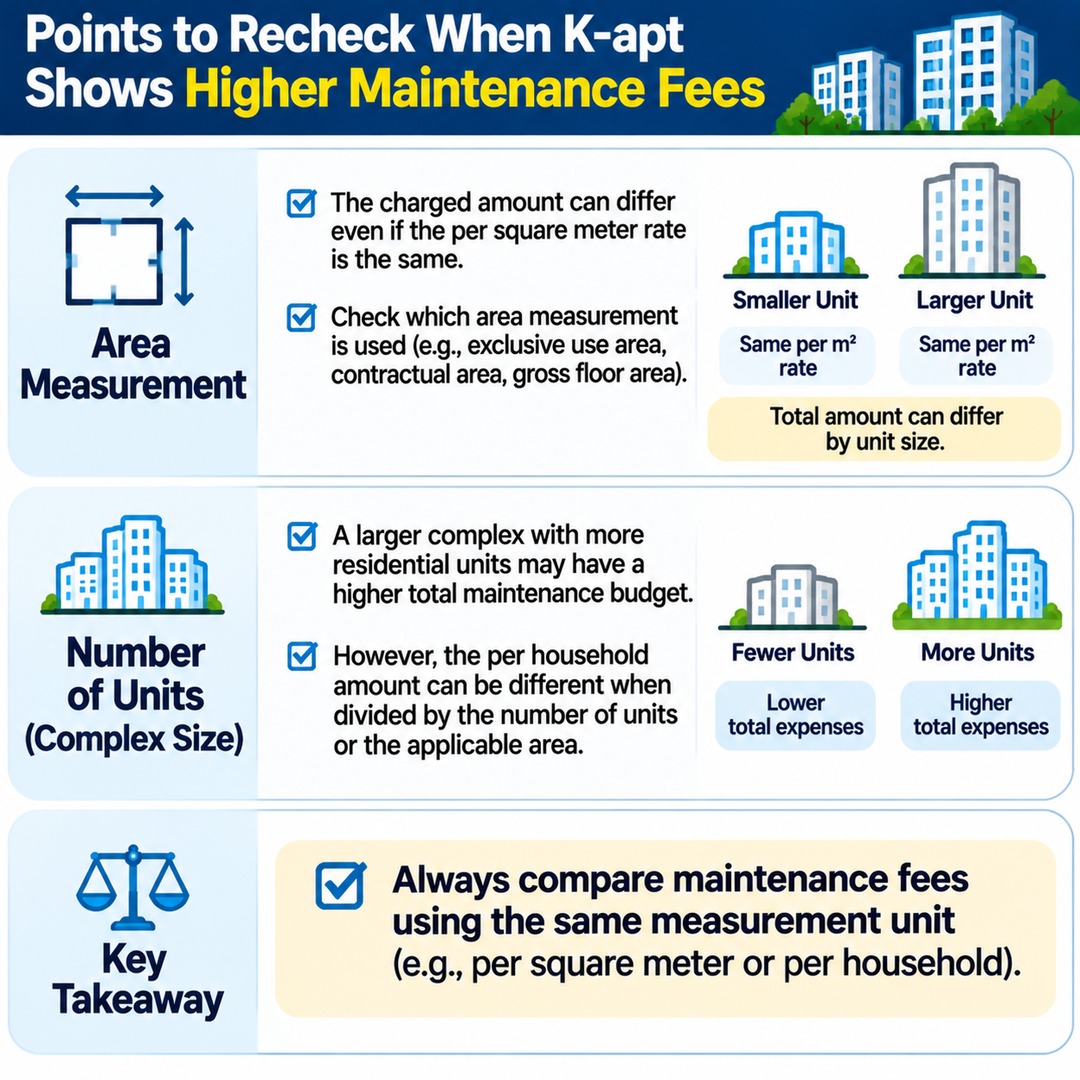
Area measurement deserves particular attention.
Even if maintenance fees per square meter are identical, the actual amount charged to each household may differ depending on the size of the unit.
Similarly, a higher total maintenance expense for an entire apartment complex does not necessarily mean that individual households pay higher fees.
For example, an apartment complex with many residential units may have a larger overall maintenance budget. However, dividing that amount by the number of units or the applicable area can produce a different comparison result.
Always compare amounts using the same measurement unit.
Where Should You Inquire If K-apt Figures Differ from Your Actual Apartment Bill?
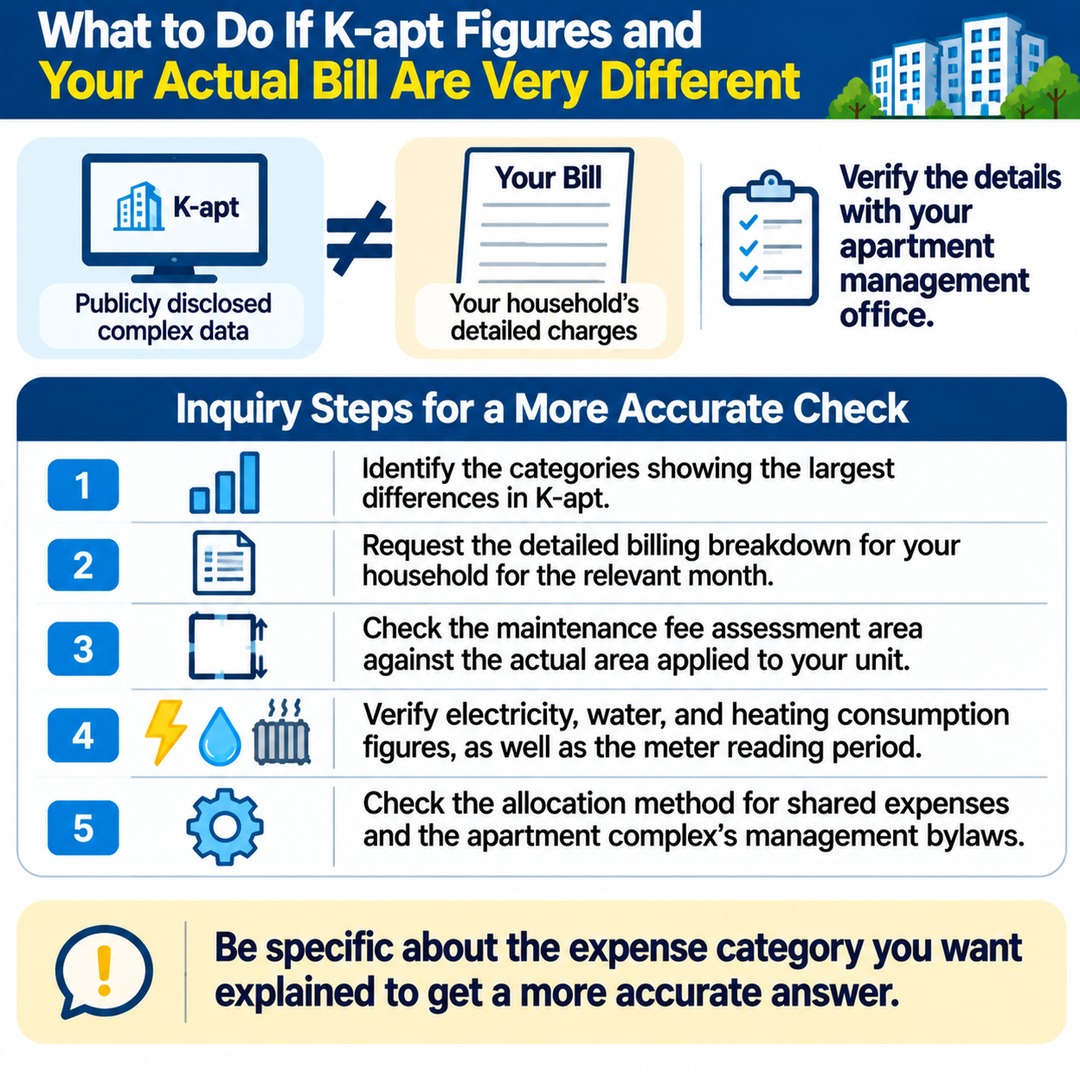
If there is a significant difference between the K-apt comparison results and your actual bill, it is advisable to request your household's detailed charge breakdown from the apartment management office.
Article 23 of South Korea's Multi-Family Housing Management Act requires disclosure of itemized calculations for management fees and related charges. However, the information publicly disclosed through K-apt is not the same as the individual billing breakdown for each household.
To verify the actual amount charged to your household, you need to check the relevant month's calculation details and billing criteria with the management office.
Follow these steps when making an inquiry:
1. Identify the categories showing the largest differences in K-apt.
2. Request the detailed billing breakdown for your household for the relevant month.
3. Check the maintenance-fee assessment area against the actual area applied to your unit.
4. Verify electricity, water, and heating consumption figures, as well as the meter-reading period.
5. Check the allocation method for shared expenses and the apartment complex's management bylaws.
You can make a more specific inquiry to the management office by identifying the exact expense category you want explained.
Specifying individual items in this way can help you obtain a more accurate answer than simply asking why your maintenance fees are so expensive.
Should You Compare Maintenance Fees When Choosing an Apartment to Move Into?
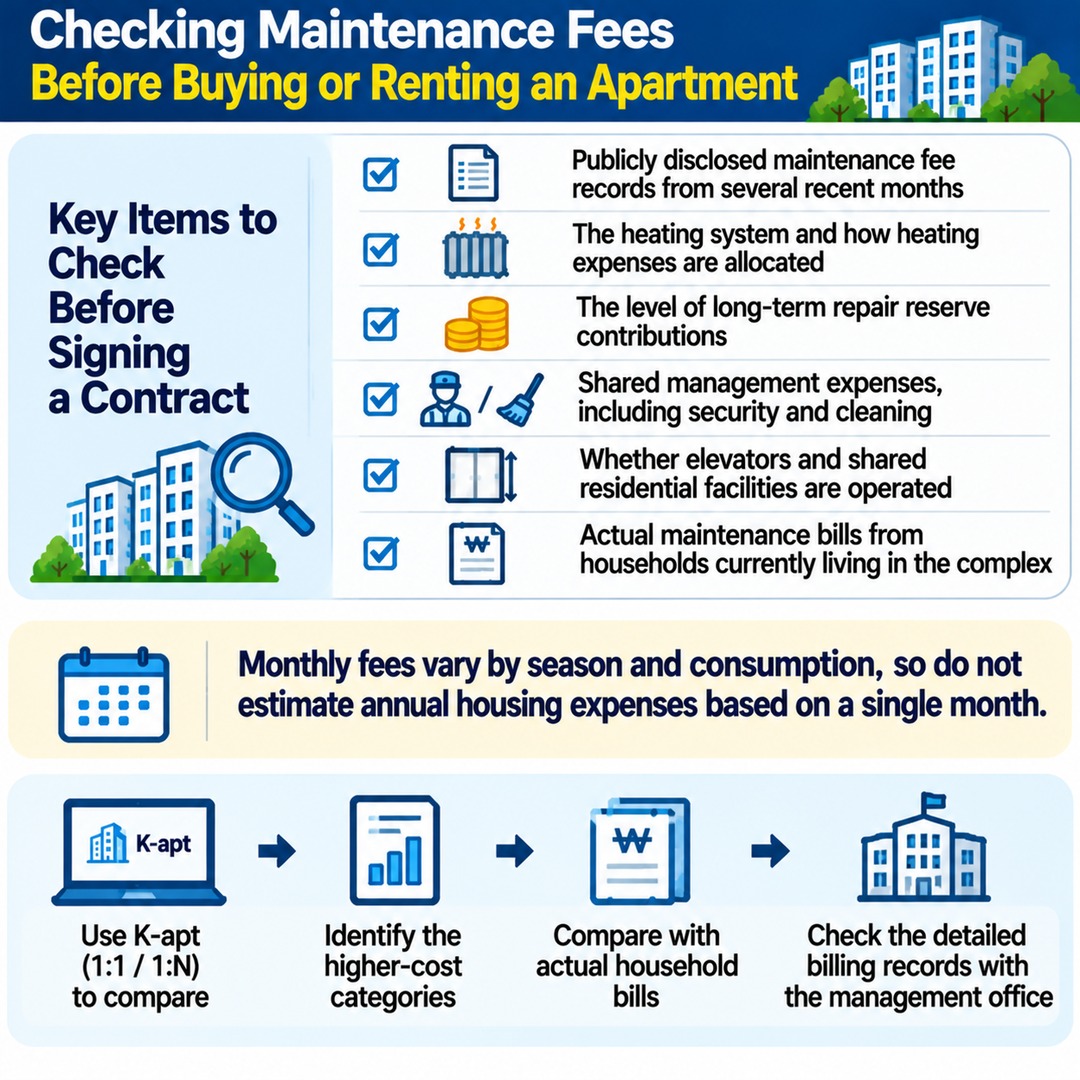
Whether you are purchasing an apartment or signing a rental agreement in South Korea, maintenance fees are part of your recurring housing expenses, so it is worth checking them before signing a contract.
In particular, consider the following items before making your decision:
Publicly disclosed maintenance fee records from several recent months
The heating system and how heating expenses are allocated
The level of long-term repair reserve contributions
Shared management expenses, including security and cleaning
Whether elevators and shared residential facilities are operated
Actual maintenance bills from households currently living in the complex
Monthly maintenance fees vary depending on the season and consumption levels. Therefore, you should not estimate annual housing expenses based on the amount charged in just one month.
A more accurate approach is to first examine the complex's overall maintenance fee structure using publicly disclosed information, then review actual household bills from existing residents to understand the costs of living in the specific apartment you are considering.
When comparing apartment maintenance fees, what matters is not simply whether your complex charges more than nearby buildings, but which categories account for the difference and how large those differences are. Use K-apt's 1:1 and 1:N comparison features to identify the categories with higher costs, then compare those figures with actual household bills and the management office's detailed billing records. This can help prevent misunderstandings and reveal the specific reasons behind your apartment's maintenance expenses.