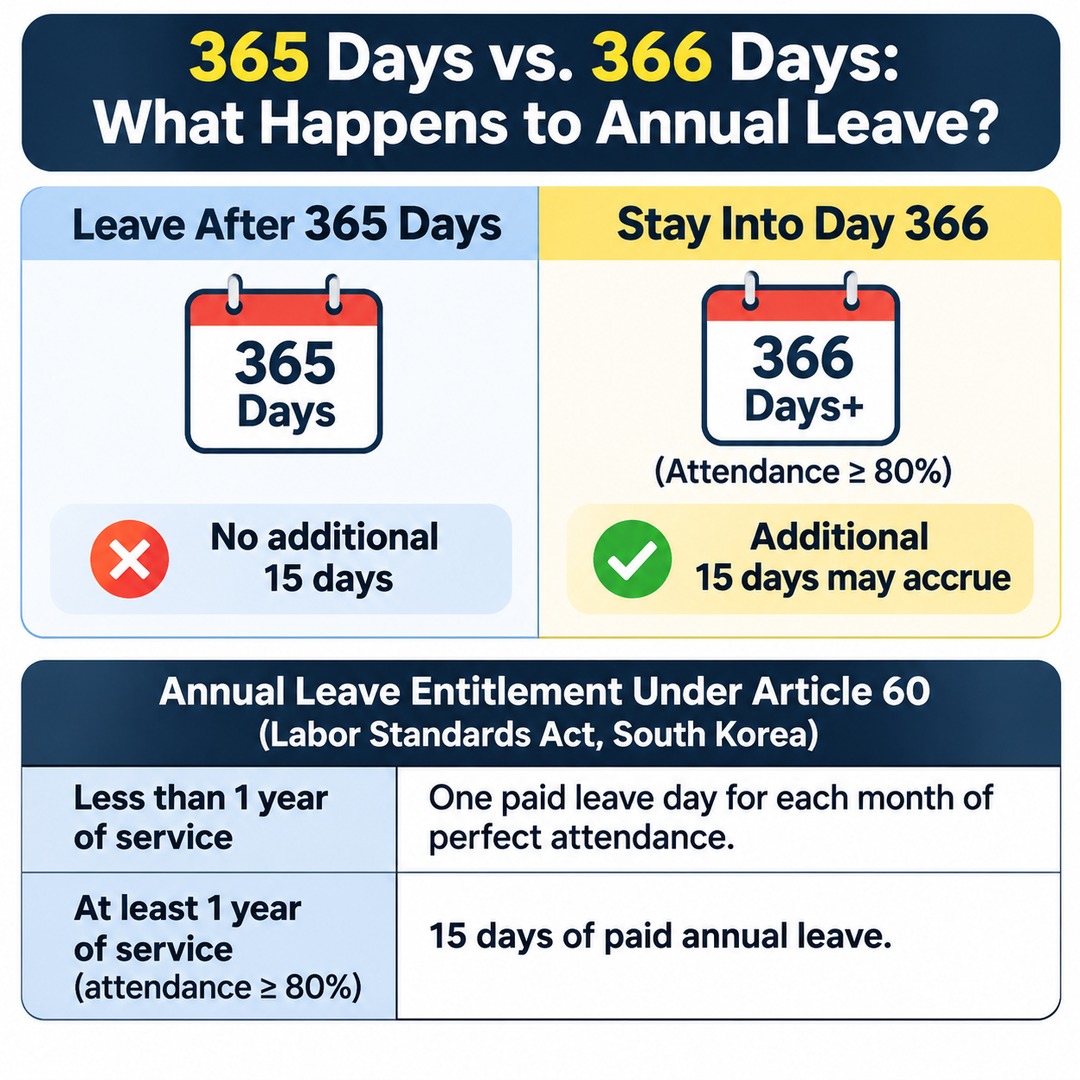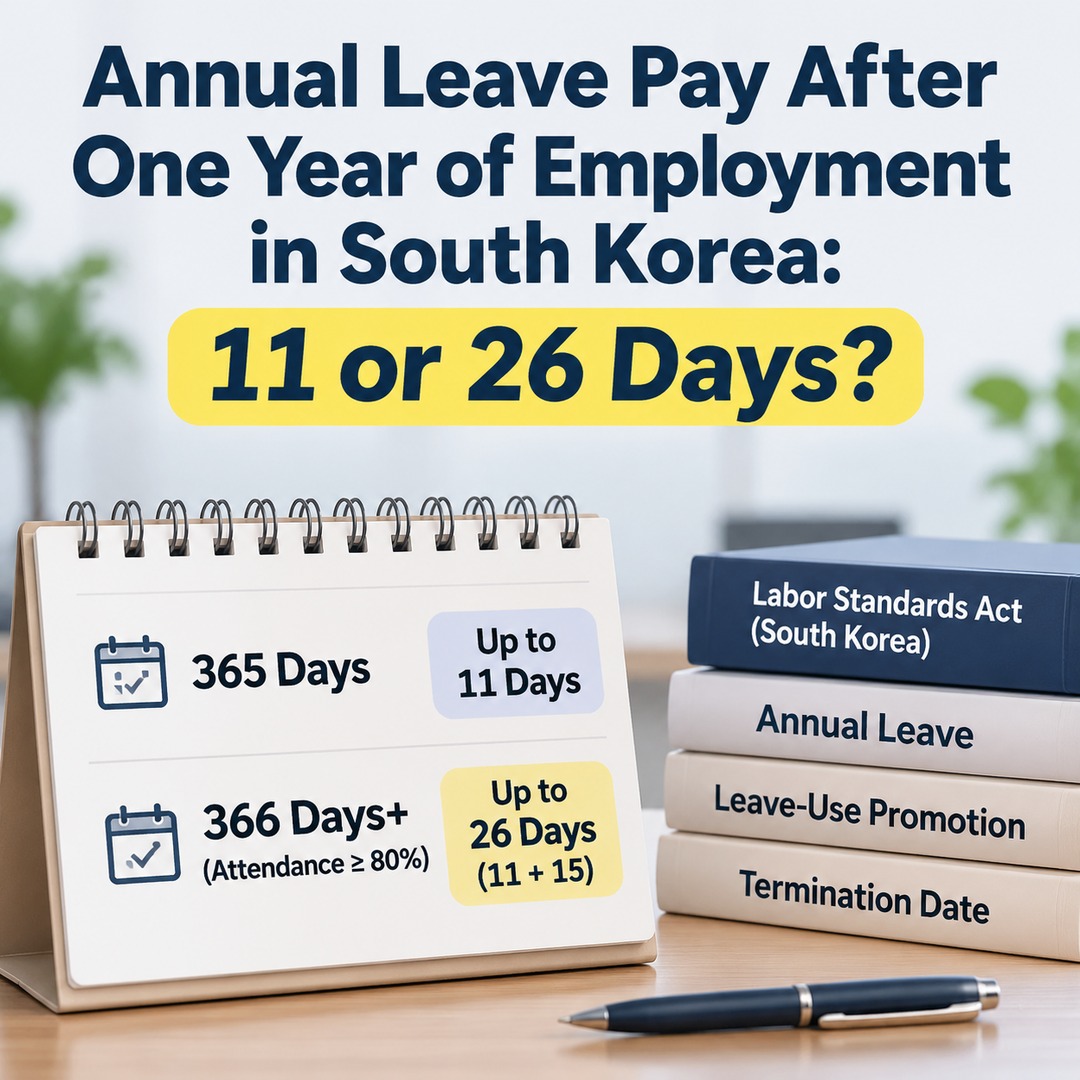
If you leave your job after exactly one year (365 days) of employment in South Korea, you may be entitled to payment for unused annual leave accrued during your first year, but you do not receive an additional 15 days. However, if your employment relationship continues into the 366th day, an additional 15 days may accrue, provided your attendance rate is at least 80%. The difference of just one day matters because of when the additional annual leave entitlement arises.
Can you receive 15 additional annual leave days if you leave after 365 days?
No. If your employment relationship ends on the date you complete one year of service, you are not entitled to the 15 days of annual leave that would otherwise accrue the following day.
Article 60 of South Korea's Labor Standards Act establishes two separate annual leave entitlements:
Employees with less than one year of service: One paid leave day for each month of perfect attendance.
Employees with at least one year of service and an attendance rate of 80% or higher: 15 days of paid annual leave.
The important point is that the 15 days do not accrue in advance on the final working day of the first year. The employee must complete one year of service and remain in an employment relationship on the following day for the entitlement to arise.
The Supreme Court of South Korea clarified this accrual timing in its judgment of October 14, 2021, case No. 2021Da227100.
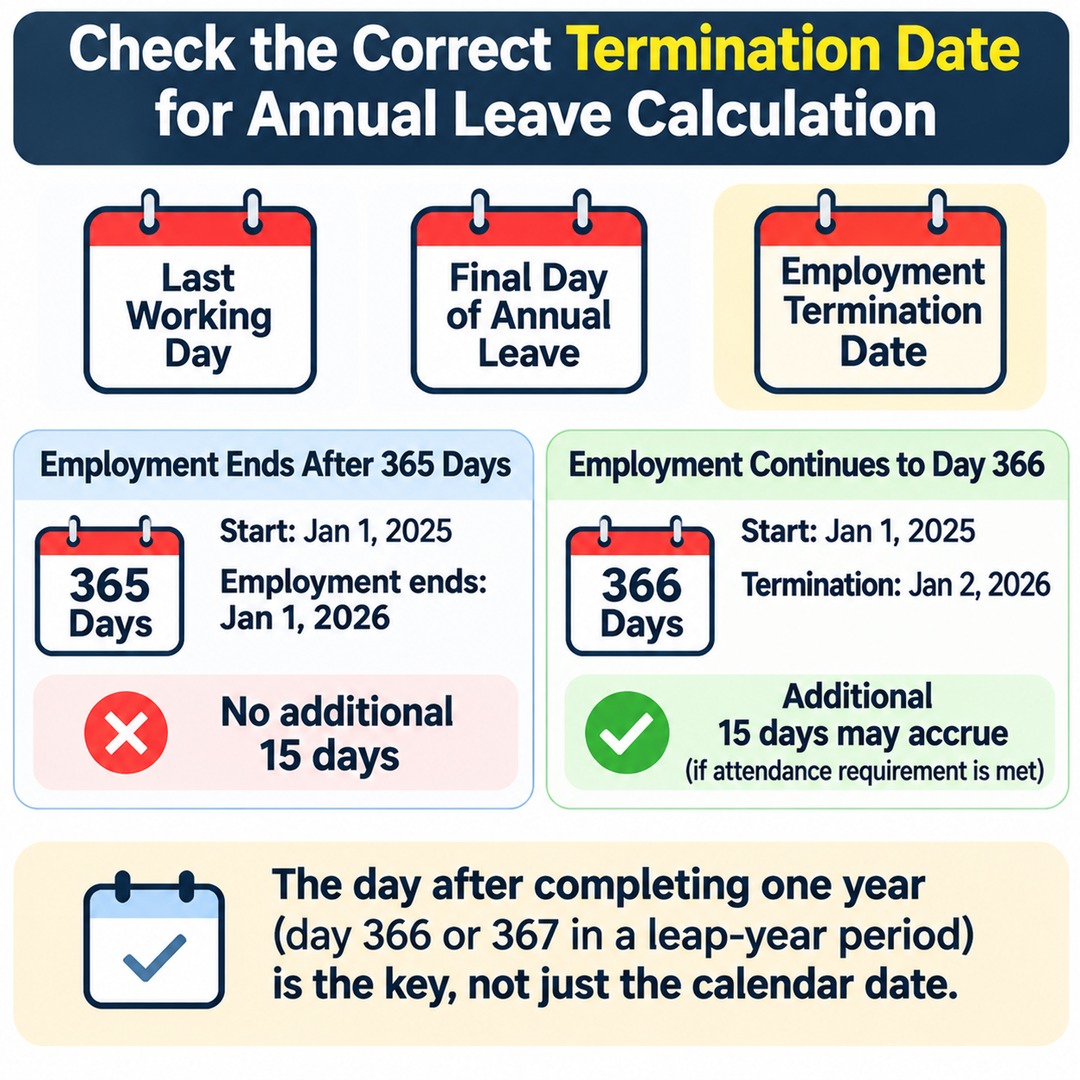
What is the difference between leaving on day 365 and day 366?
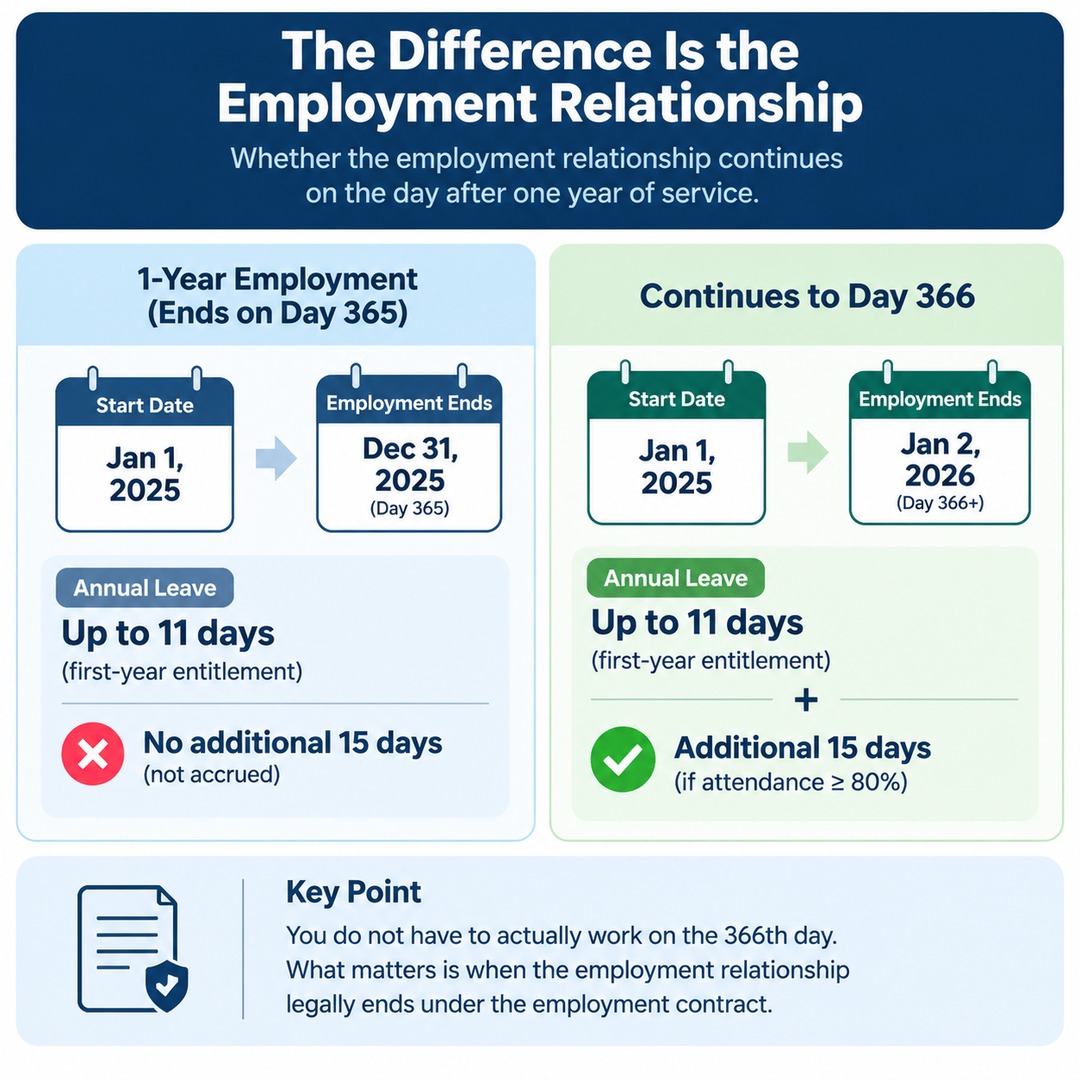
The difference is whether the employment relationship continues on the day after the employee completes one year of service.
Consider an employee whose start date is January 1, 2025.
| Situation | Employment termination date | Additional 15 days |
|---|---|---|
| Leaves after one year of employment | December 31, 2025 | Not accrued |
| Remains employed through day 366 | Leaves on or after January 1, 2026 | May accrue |
In the second situation, the employment relationship is still in effect on January 1, 2026, the day after the employee completes the first year. If the statutory requirements, including the attendance threshold, are satisfied, 15 additional annual leave days accrue.
This does not mean the employee must physically report to work on day 366. What matters is not simply whether the employee actually works that day, but when the employment relationship legally ends under the employment contract.
Calculate the first year's maximum of 11 leave days separately
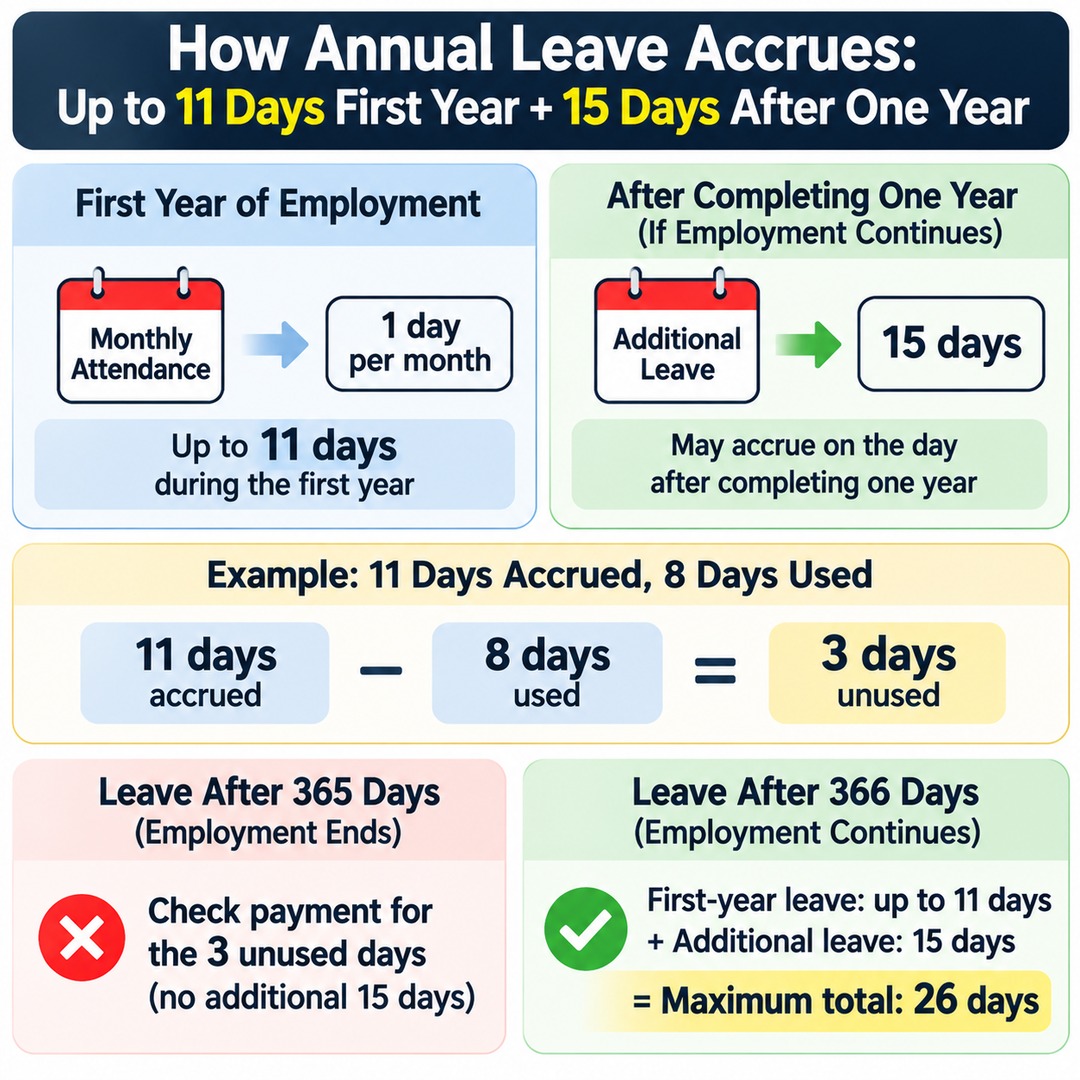
The monthly leave days accrued during the first year and the additional 15 days accrued after completing one year are separate entitlements. Therefore, leaving after one year does not automatically eliminate the leave accrued during the first year.
During the first year of employment, an employee accrues one leave day for each month of perfect attendance. This can amount to a maximum of 11 days during the first year.
For example, suppose an employee accrued 11 days during the first year and used eight. The remaining balance is three days. If the employment relationship ends on day 365, the employee should generally check whether payment is due for those three unused days, but cannot separately claim the additional 15 days.
If the employment relationship continues into day 366, the potential accrual can be calculated as follows:
First-year monthly attendance leave: Up to 11 days
Leave accrued after completing one year: 15 days
Maximum total accrued leave: 26 days
This applies to employees whose employment continues beyond the first year. In its judgment of September 7, 2022, case No. 2022Da245419, the Supreme Court of South Korea also distinguished the initial 11 days from the additional 15 days accruing on the following day, recognizing that the total could reach 26 days.
Are you automatically entitled to payment for every unused annual leave day?
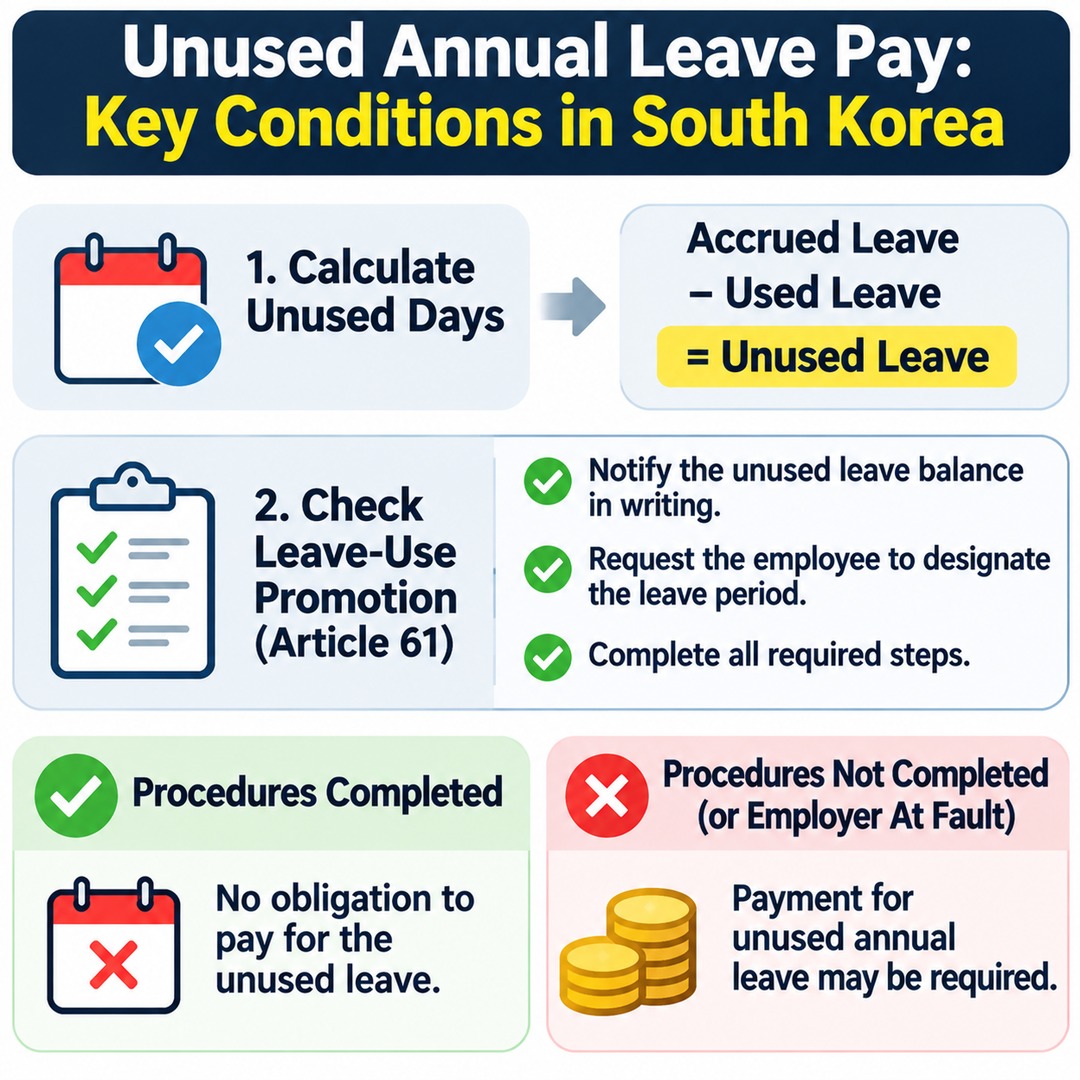
No. Not every accrued leave day necessarily results in payment. You must subtract the days already used and check whether the employer properly completed the statutory annual leave-use promotion procedures under Article 61 of South Korea's Labor Standards Act.
Employees who accrue leave during their first year of employment are subject to separate leave-use promotion procedures.
If the employer has completed all legally required steps, including notifying the employee in writing of the unused leave balance at the prescribed time and requesting that the employee designate when the leave will be taken, the employer may be released from the obligation to compensate the employee for leave that remains unused.
Conversely, if the employer did not properly follow the statutory procedures, payment for unused annual leave may still be required. Separate consideration is also necessary when the employer refused to allow the employee to take leave or the employee could not use it for reasons attributable to the employer.
Why must your last working day be distinguished from your termination date?
When calculating annual leave compensation, checking only the last day you physically attended work is not sufficient. You need to distinguish between your last working day, the final day of annual leave used, and the date on which the employment relationship legally ends.
For an employee who started work on January 1, 2025, the following examples illustrate the distinction:
If the employee works through December 31, 2025, and the employment relationship ends effective January 1, 2026, this represents 365 days of employment. No additional 15 days accrue.
If the employment relationship remains in effect through January 1, 2026, and the employee's termination takes effect on January 2, the employee has remained employed through day 366. If the attendance requirement is met, an additional 15 days accrue.
In other words, first establish whether the termination date written in your documents means your last physical day at work or the actual date your employment relationship ends.
The labor-management manual published by the Jeollanam-do Provincial Office of Education in South Korea also distinguishes the employee's last actual working day from the legal termination date and separately explains whether the termination date is included in the continuous employment period.
The 366th day does not apply in exactly the same calendar way to every employee. If a leap year falls within the relevant period, the day on which one year of service is completed may result in the following day being day 366 or day 367. The calculation should therefore be based on the day after completion of the actual one-year employment period, rather than simply counting calendar dates without considering the start date.
What should you check with your employer before resigning?
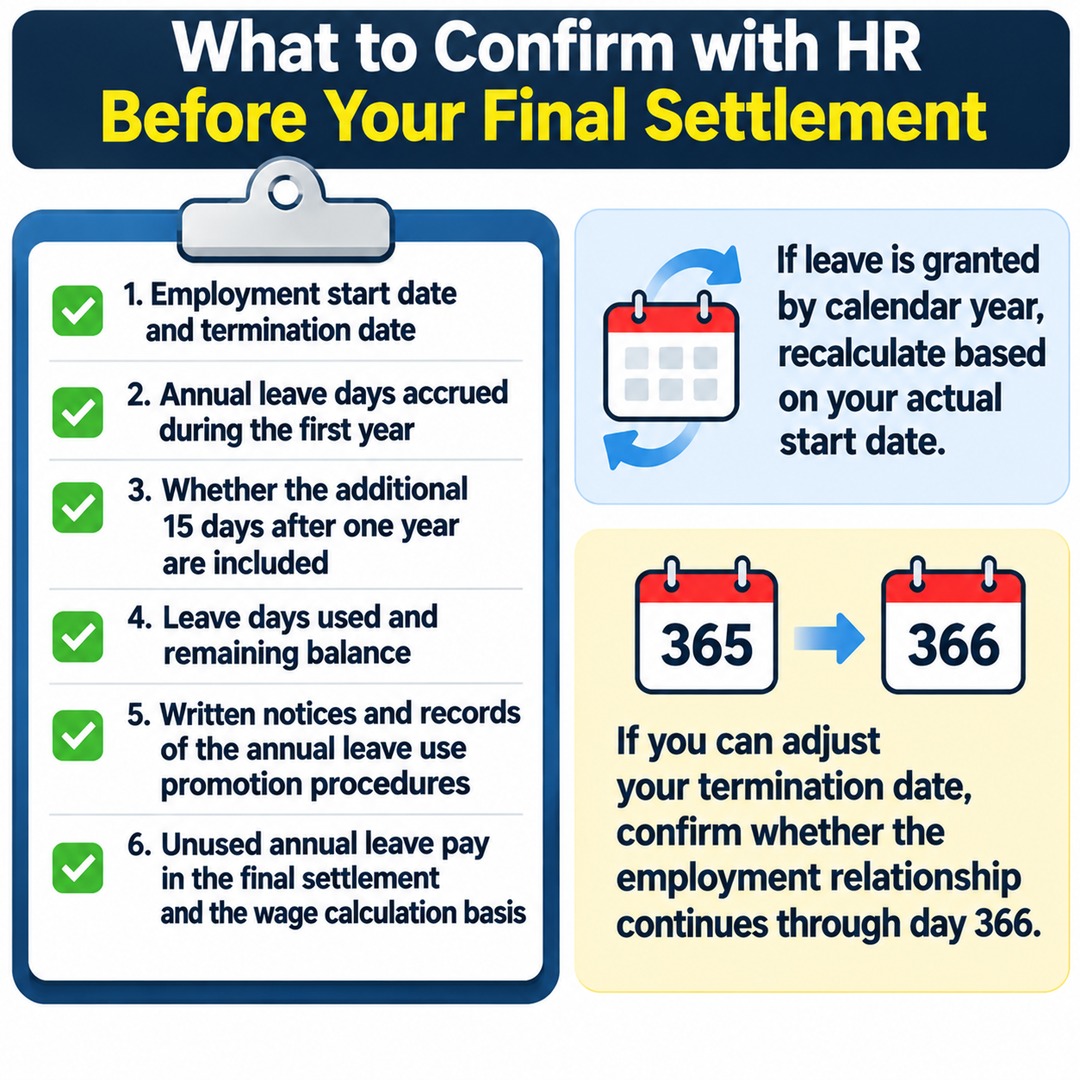
Before your final payroll settlement, it is advisable to request the following information in writing from your HR department:
1. Your employment start date and the recorded date on which the employment relationship ends.
2. The number of annual leave days accrued during your first year, calculated from your actual start date.
3. Whether the additional 15 days accrued after completing one year have been included in the calculation.
4. The number of leave days already used and the remaining unused balance.
5. Written notices and records showing whether the employer carried out the statutory annual leave-use promotion procedures.
6. The unused annual leave compensation included in your final settlement and the wage calculation basis used.
If your employer grants annual leave based on a calendar year rather than your individual employment anniversary, check whether the leave balance must be recalculated using your actual start date when you leave. Do not assume that the number of days granted at the beginning of the calendar year is automatically the final amount owed.
If you have an opportunity to adjust your termination date by one day, first confirm whether the employment relationship will actually remain in effect through day 366. Simply writing a later date on a resignation letter does not, by itself, establish the legal requirements for additional annual leave accrual.
Frequently asked questions about annual leave pay after one year of employment
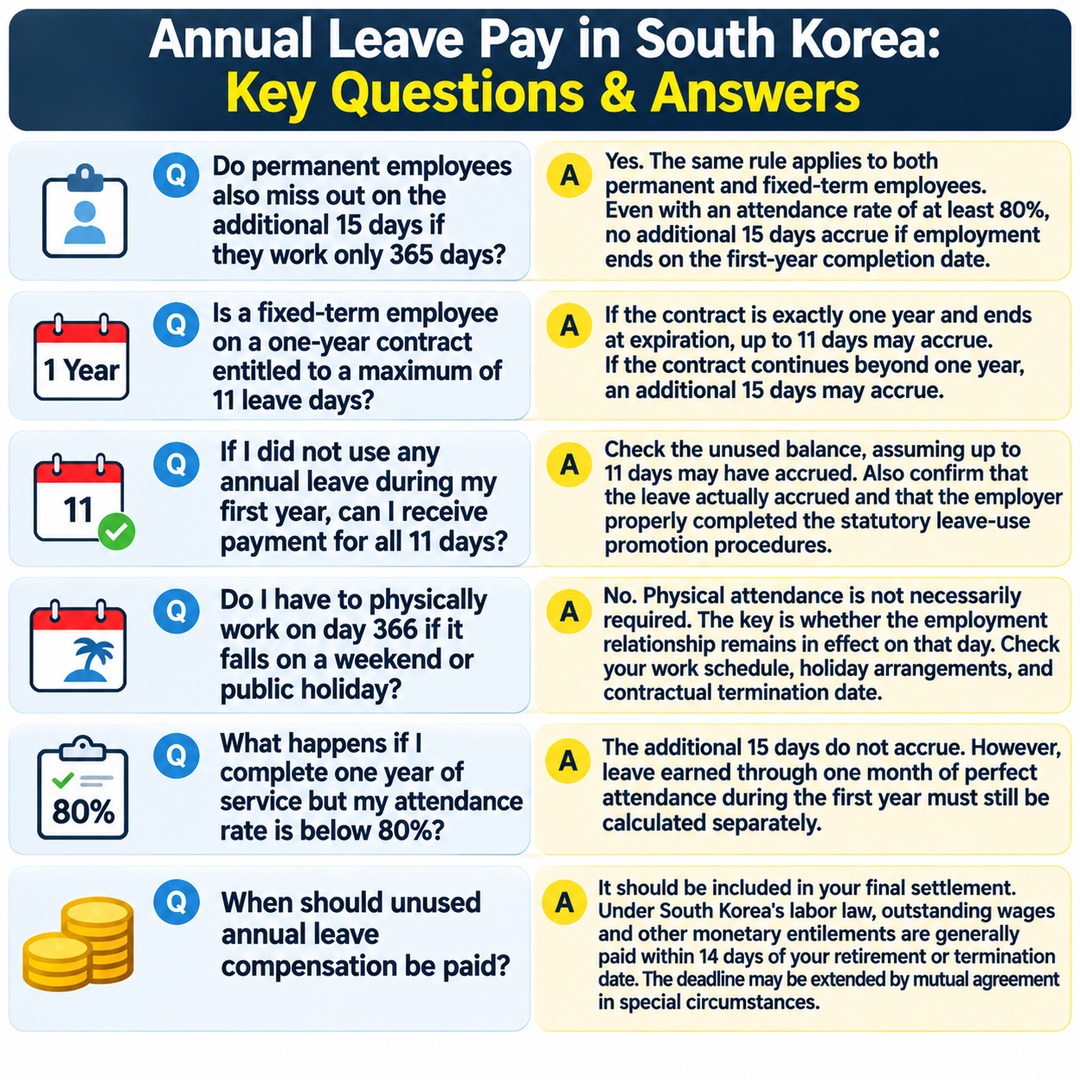
Q. Do permanent employees also miss out on the additional 15 days if they work only 365 days?
Yes. The general rule applies to both permanent and fixed-term employees. Even if the employee has an attendance rate of at least 80% during the year, the additional 15 days do not accrue if the employment relationship ends on the date the first year is completed.
Q. Is a fixed-term employee on a one-year contract entitled to a maximum of 11 leave days?
If the contract lasts exactly one year and the employment relationship ends when that contract expires, the employee may accrue up to 11 days. If the contract extends beyond one year and the employment relationship continues into the following day, an additional 15 days may accrue.
Q. If I did not use any annual leave during my first year, can I receive payment for all 11 days?
You should check the unused balance on the assumption that up to 11 days may have accrued. However, you must also establish whether the leave actually accrued and whether the employer properly completed the statutory leave-use promotion procedures.
Q. Do I have to physically work on day 366 if it falls on a weekend or public holiday?
No. Physical attendance on that date is not necessarily required. The important question is whether the employment relationship remains in effect on that day. Check your work schedule, holiday arrangements, and contractual termination date together.
Q. What happens if I complete one year of service but my attendance rate is below 80%?
The additional 15 days do not accrue. However, leave earned through one month of perfect attendance during the first year must still be calculated separately.
Q. When should unused annual leave compensation be paid?
Any unused annual leave compensation that is legally payable should be included in the employee's final settlement. Under South Korea's labor law, outstanding wages and other monetary entitlements are generally required to be settled within 14 days of the employee's retirement or termination date. If special circumstances exist, the employer and employee may agree to extend the payment deadline.