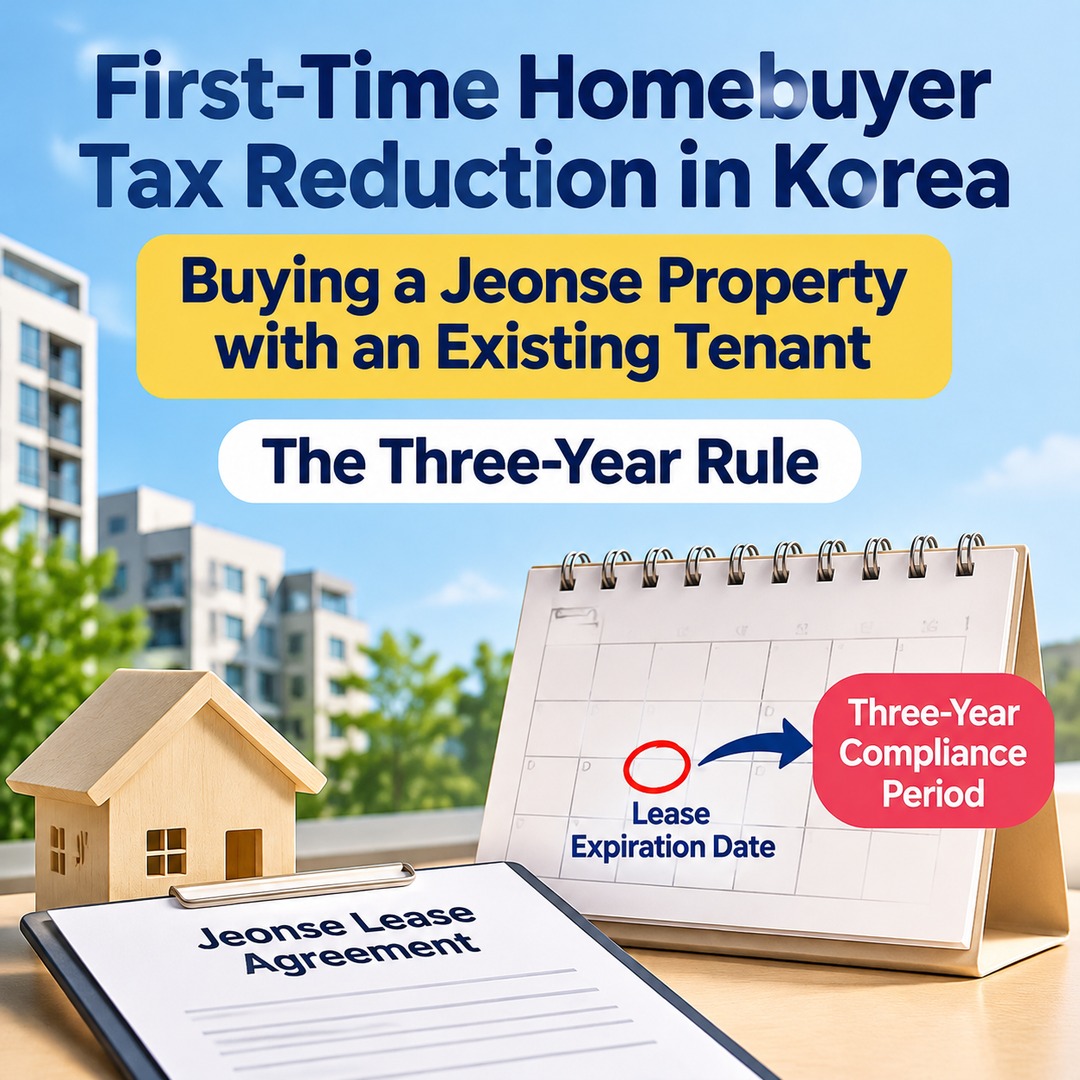
In South Korea, you may qualify for the first-time homebuyer acquisition tax reduction even when purchasing a property occupied by an existing jeonse tenant. If you succeed to the previous landlord’s legal position, the tenant continues living in the property, and no more than one year remains on the lease when you acquire the home, the three-year compliance period begins on the lease expiration date rather than the acquisition date. However, simply purchasing a property with an existing tenant does not automatically qualify you for the reduction.
Two separate issues must be considered: whether you qualify for the first-time homebuyer acquisition tax reduction and how the post-acquisition compliance period works after receiving it. These are related but distinct requirements.
Can You Receive South Korea's First-Time Homebuyer Tax Reduction When Buying a Property with an Existing Tenant?
A property is not automatically excluded from South Korea's first-time homebuyer acquisition tax reduction simply because an existing tenant lives there. However, the buyer must acquire the property for personal residential use and satisfy the statutory requirements, including the applicable homeownership and property-value conditions.
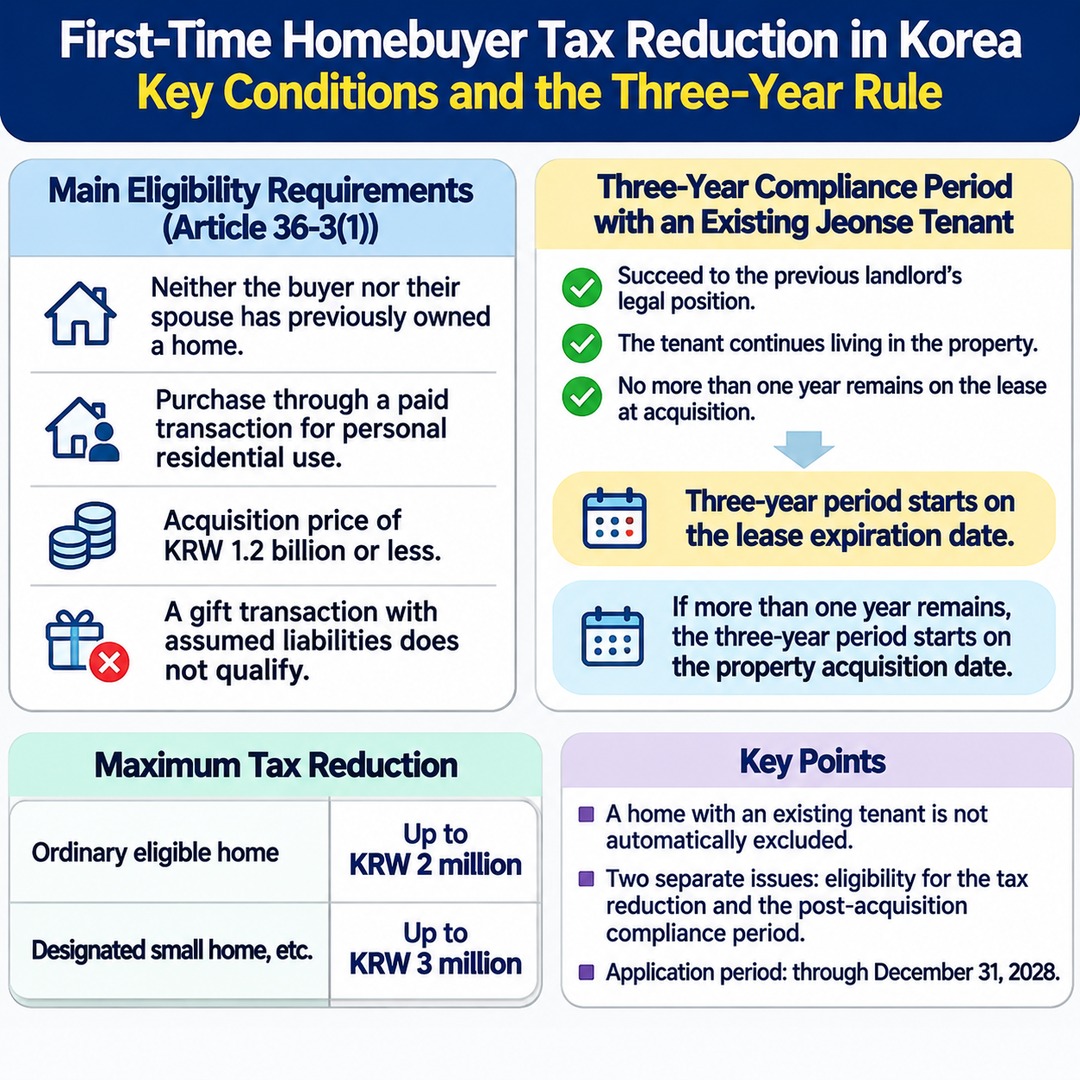
Article 36-3(1) of South Korea's Act on Restriction on Special Cases Concerning Local Taxation establishes the eligibility requirements for the first-time homebuyer acquisition tax reduction.
The main requirements include:
Neither the buyer nor their spouse must have previously owned a home as of the property acquisition date, subject to statutory exceptions.
The buyer must purchase the property through a paid transaction for their own residential use.
The property's acquisition price must not exceed KRW 1.2 billion.
A gift transaction involving the assumption of existing liabilities does not qualify as an eligible paid transaction under this reduction.
Buyers who are minors are excluded.
The maximum tax reduction depends on the property category.
| Property category | Maximum acquisition tax reduction |
|---|---|
| Legally designated small homes and other qualifying properties | KRW 3 million |
| Other generally eligible residential properties | KRW 2 million |
For an ordinary eligible home, acquisition tax is fully exempt if the calculated tax amount is KRW 2 million or less. If the calculated amount exceeds KRW 2 million, the reduction is KRW 2 million.
The statutory application period for this tax reduction runs through December 31, 2028.
The maximum reduction is not the same for every property. Buyers should check the property category, acquisition price, floor area, and whether the property is being acquired jointly.
What Conditions Allow the Three-Year Period to Start on the Tenant's Lease Expiration Date?
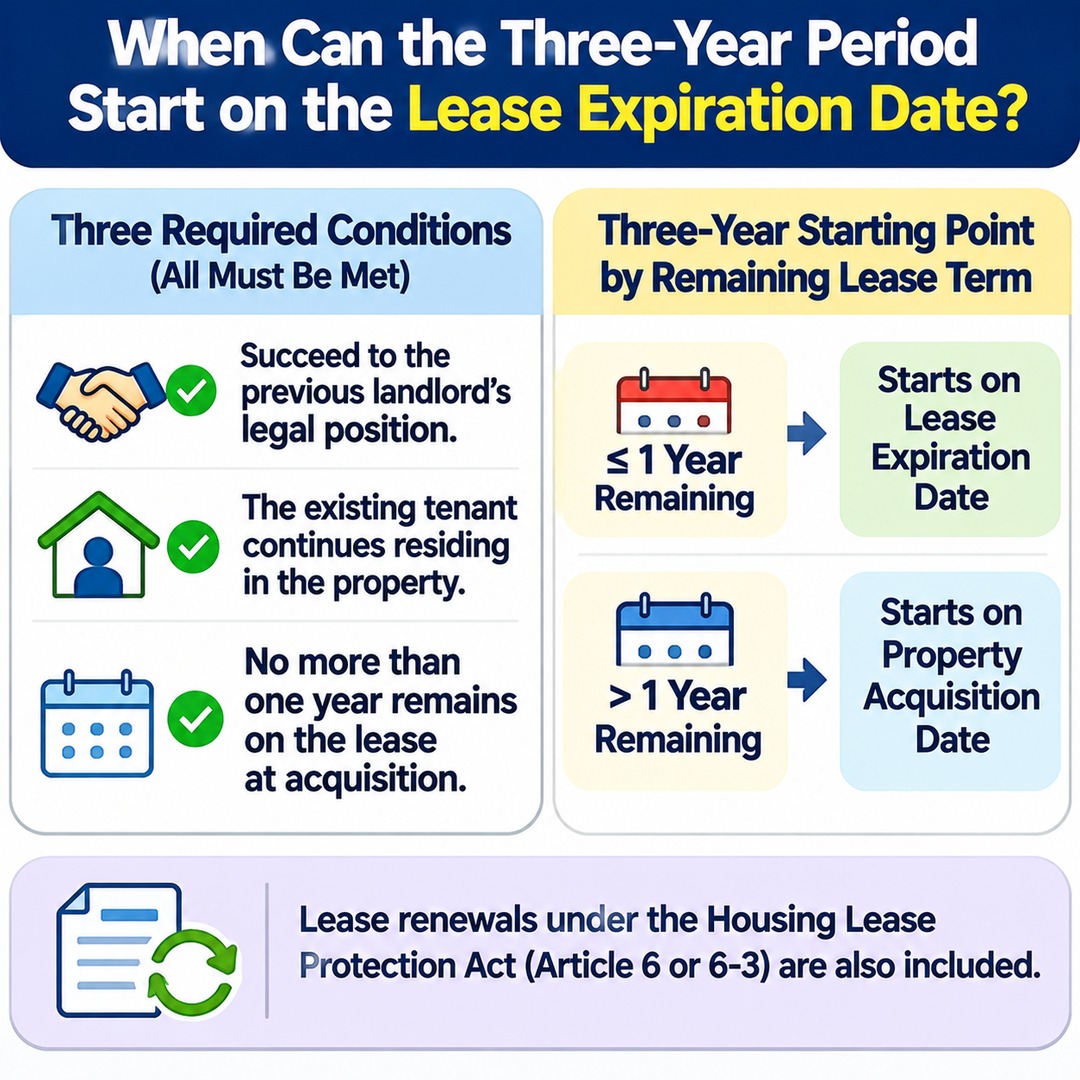
All three of the following conditions must be satisfied for the three-year period to be calculated from the existing tenant's lease expiration date.
1. The buyer must succeed to the previous landlord's legal position.
2. The existing tenant must continue residing in the property.
3. No more than one year may remain on the lease as of the property acquisition date.
These requirements are stipulated in Article 36-3(4) of South Korea's Act on Restriction on Special Cases Concerning Local Taxation.
The third condition is particularly important. The starting point for the three-year period changes depending on whether the remaining lease term is one year or less or exceeds one year.
| Circumstances at acquisition | Starting date for the three-year period |
|---|---|
| Landlord succession, continued tenant occupancy, and one year or less remaining on the lease | Lease expiration date |
| More than one year remaining on the lease | Property acquisition date |
| Landlord succession requirement not satisfied | Property acquisition date |
The statutory provision also includes lease renewals made under Article 6 or Article 6-3 of South Korea's Housing Lease Protection Act.
Therefore, simply stating in the purchase agreement that a tenant occupies the property is not enough to qualify for this special rule. The buyer must also confirm that the legal succession of the landlord's position and the existing tenant's continued occupancy requirements are satisfied.
How Does the Three-Year Period Change Depending on the Actual Lease Expiration Date?
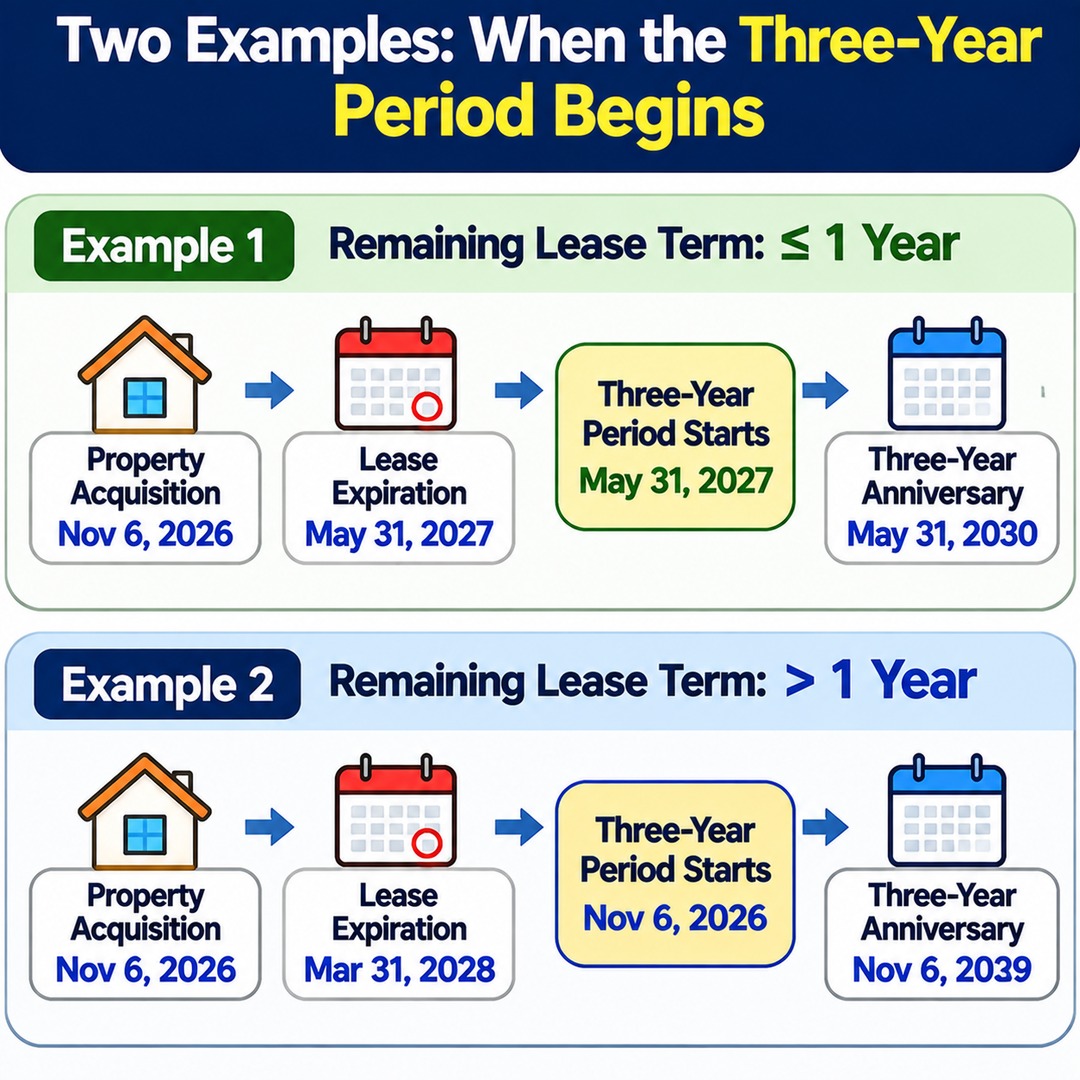
Consider a hypothetical buyer who acquires a property on November 6, 2026.
If the existing tenant's lease expires on May 31, 2027, and the landlord-succession and continued-occupancy requirements are both satisfied, the remaining lease term is less than one year. The three-year period is therefore calculated from the lease expiration date.
Illustrative calculation: Hypothetical lease arrangement
Property acquisition date
November 6, 2026
Existing lease expiration date
May 31, 2027
Starting date for the three-year compliance period, assuming one year or less remains
May 31, 2027
Three-year anniversary
This is an illustrative calendar calculation. The actual deadline should be determined using the applicable date-counting rules and confirmed with the relevant local government authority.
By contrast, if more than one year remains on the lease when the property is acquired, the buyer cannot wait until the lease expires and then begin a new three-year period.
For example, if the buyer purchases the property on November 6, 2026, and the existing lease expires on March 31, 2028, more than one year remains. In this situation, the three-year period is calculated from November 6, 2026, the property acquisition date.
The determining factor is not simply when the tenant eventually moves out. It is how much time remained on the lease when the buyer acquired the property.
What Happens If You Sell or Rent Out the Property Again Within Three Years?
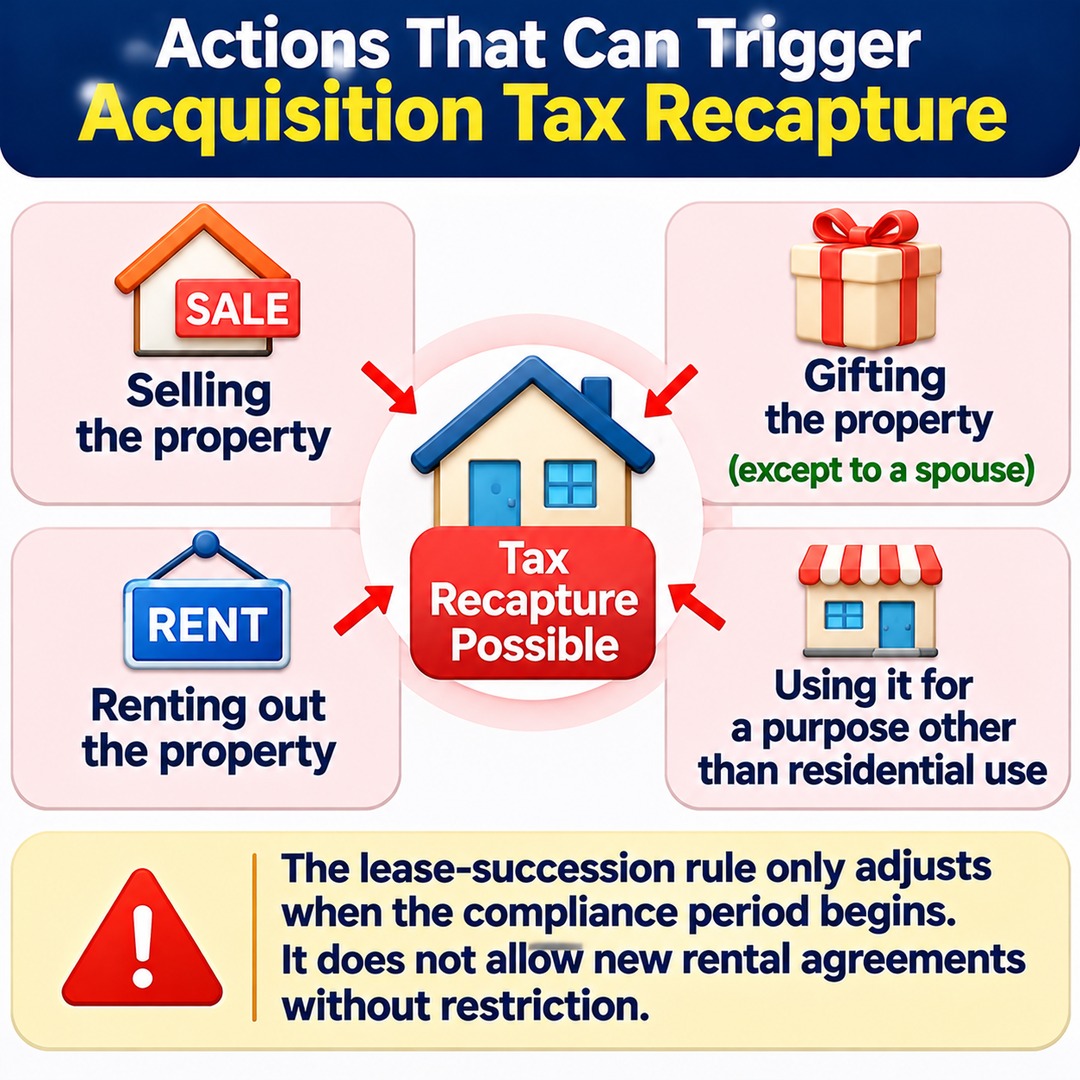
If a buyer receives the first-time homebuyer acquisition tax reduction and subsequently sells, gifts, or uses the property for another purpose during the statutory compliance period, the reduced acquisition tax may be reclaimed.
The main circumstances specified in Article 36-3(4) of South Korea's Act on Restriction on Special Cases Concerning Local Taxation include:
Selling the property.
Gifting the property, except for transfers of ownership interests to a spouse under the statutory exception.
Renting out the property.
Using the property for a purpose different from the residential purpose for which it was acquired.
The special rule for buyers who succeed to an existing tenant's lease adjusts the beginning of the post-acquisition compliance period to account for the tenant's continued occupancy under the existing lease.
It should not be interpreted as permission to enter into new rental agreements without restriction.
In particular, buyers who plan to accept a new tenant after the existing tenant moves out, or who intend to use the property for a purpose other than their own residence, should check whether the proposed arrangement would violate the post-acquisition requirements.
Transfers or gifts of ownership interests to a spouse are separately excluded from the recapture grounds specified in Paragraph 4.
What Documents Should You Check Before Signing the Purchase Agreement?
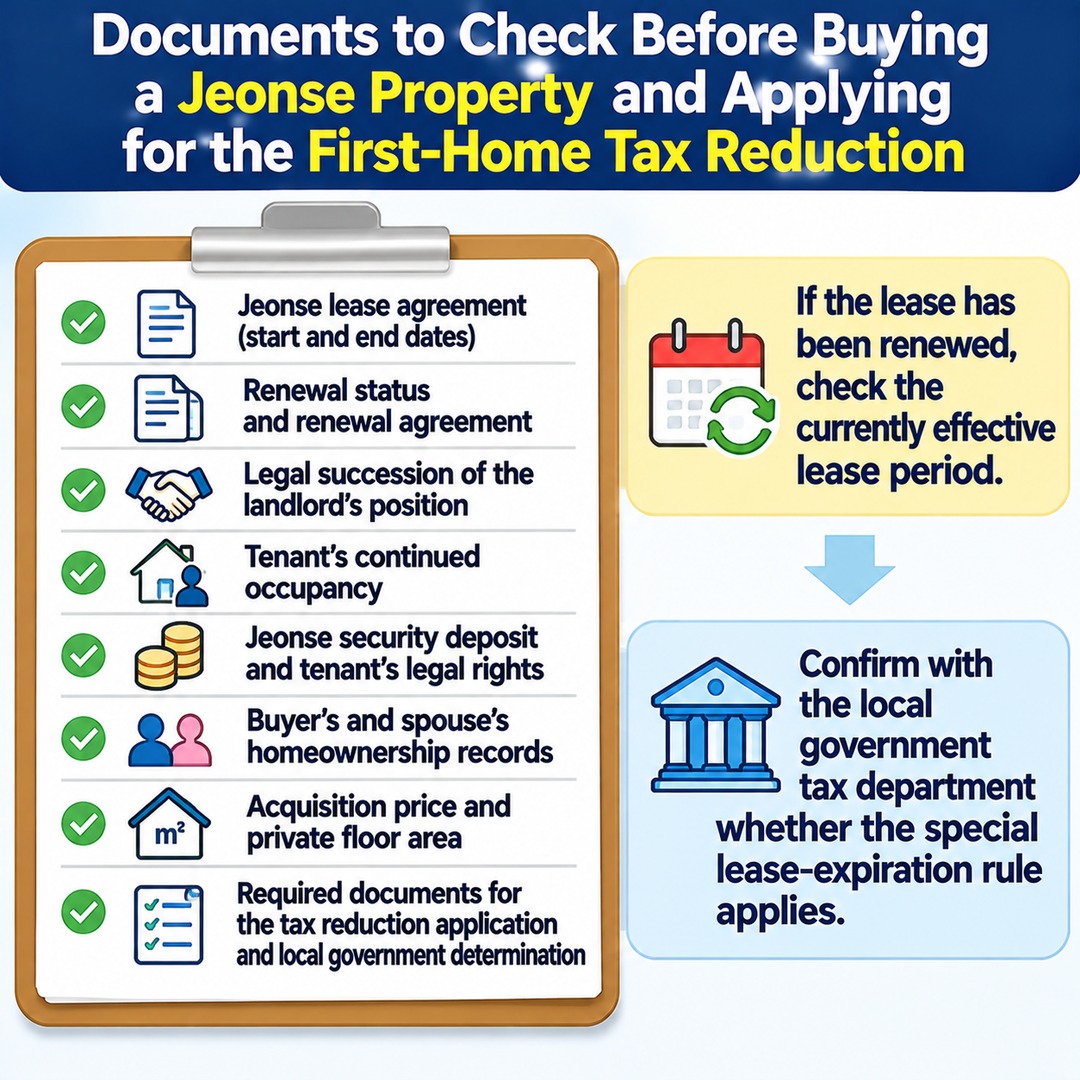
If you plan to purchase a property with an existing jeonse tenant and apply for the first-time homebuyer acquisition tax reduction, you should obtain and review the relevant lease documents before signing the purchase agreement.
In particular, check the following:
The original jeonse lease agreement, including its initial commencement and expiration dates.
Whether the lease has been renewed and any renewal agreements.
Whether the buyer will legally succeed to the existing landlord's position.
Whether the tenant is actually continuing to reside in the property as of the acquisition date.
The jeonse security deposit and the tenant's legal rights concerning the property.
The buyer's and spouse's previous homeownership records.
The acquisition price and private floor area of the property.
The documents required for the tax reduction application and the determination of the relevant local government authority.
Checking only the expiration date written in the original lease may not be sufficient. If the lease has been renewed, verify the currently effective lease period and determine whether the landlord's legal position will actually transfer to the buyer as part of the property transaction.
Before applying for the acquisition tax reduction, it is advisable to present the purchase agreement and lease documents to the tax department of the city, county, or district government responsible for the property. Ask whether the special rule allowing the three-year period to begin on the lease expiration date applies to your transaction.
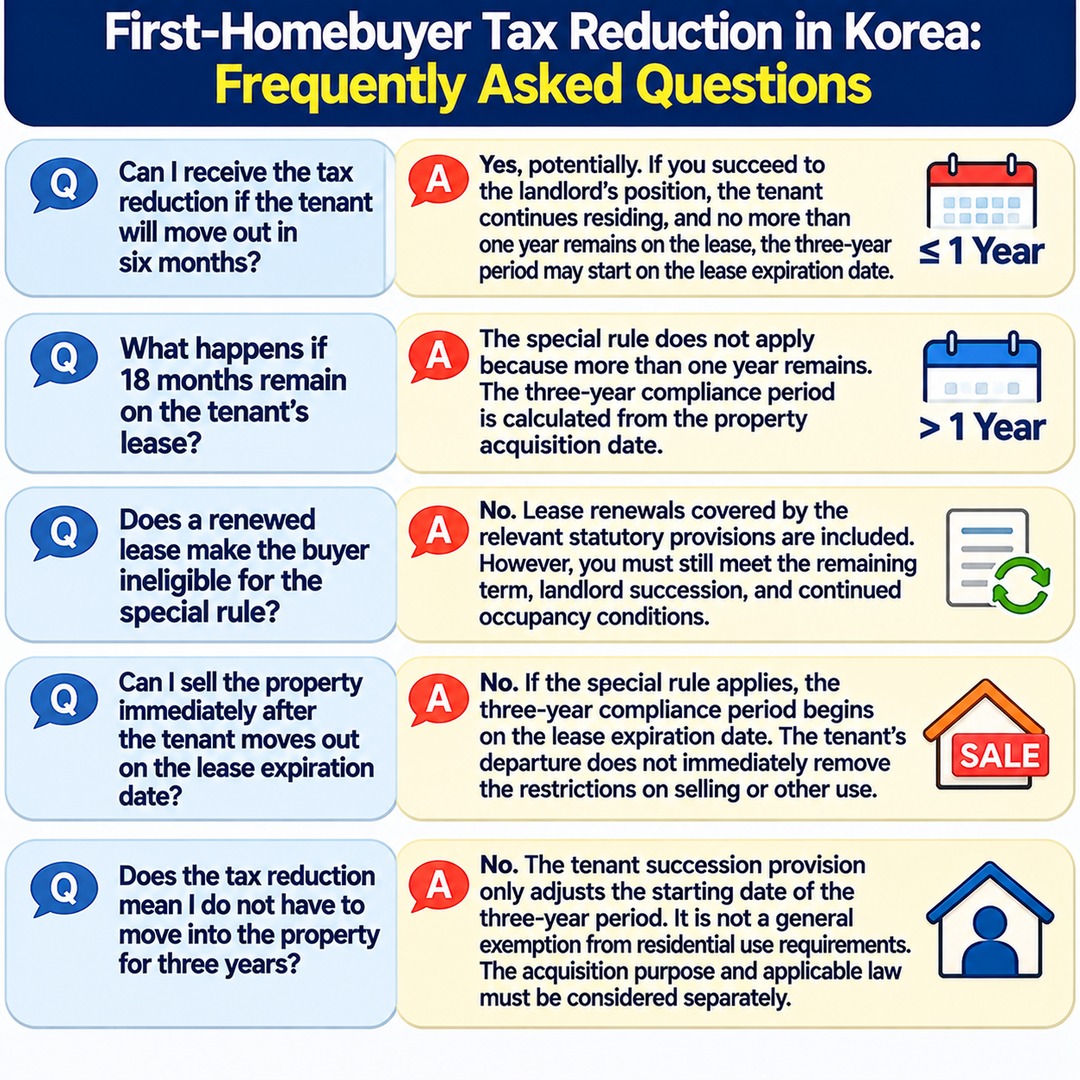
Frequently Asked Questions
Q. Can I receive the tax reduction if the existing tenant will move out in six months?
Yes, potentially. If you succeed to the previous landlord's position, the existing tenant continues residing in the property, and no more than one year remains on the lease at the acquisition date, the three-year period may be calculated from the lease expiration date. All other first-time homebuyer eligibility requirements must also be satisfied.
Q. What happens if 18 months remain on the tenant's lease?
The special rule based on the lease expiration date does not apply because more than one year remains. The three-year post-acquisition compliance period is calculated from the property acquisition date.
Q. Does a renewed lease make the buyer ineligible for the special rule?
No. Lease renewals covered by the relevant statutory provisions are included. However, the buyer must still satisfy the remaining-term requirement, landlord-succession requirement, and continued-occupancy condition.
Q. Can I sell the property immediately after the tenant moves out on the lease expiration date?
No. If the special rule applies, the three-year post-acquisition compliance period begins on the lease expiration date. The tenant's departure does not immediately eliminate the restrictions on selling the property or using it for another purpose.
Q. Does the first-time homebuyer acquisition tax reduction mean I do not have to move into the property for three years?
No. The existing-tenant succession provision adjusts the starting date of the post-acquisition compliance period. It is not a general exemption from residential-use requirements for every buyer. The acquisition purpose, lease-succession conditions, and legislation applicable on the acquisition date must be considered separately.