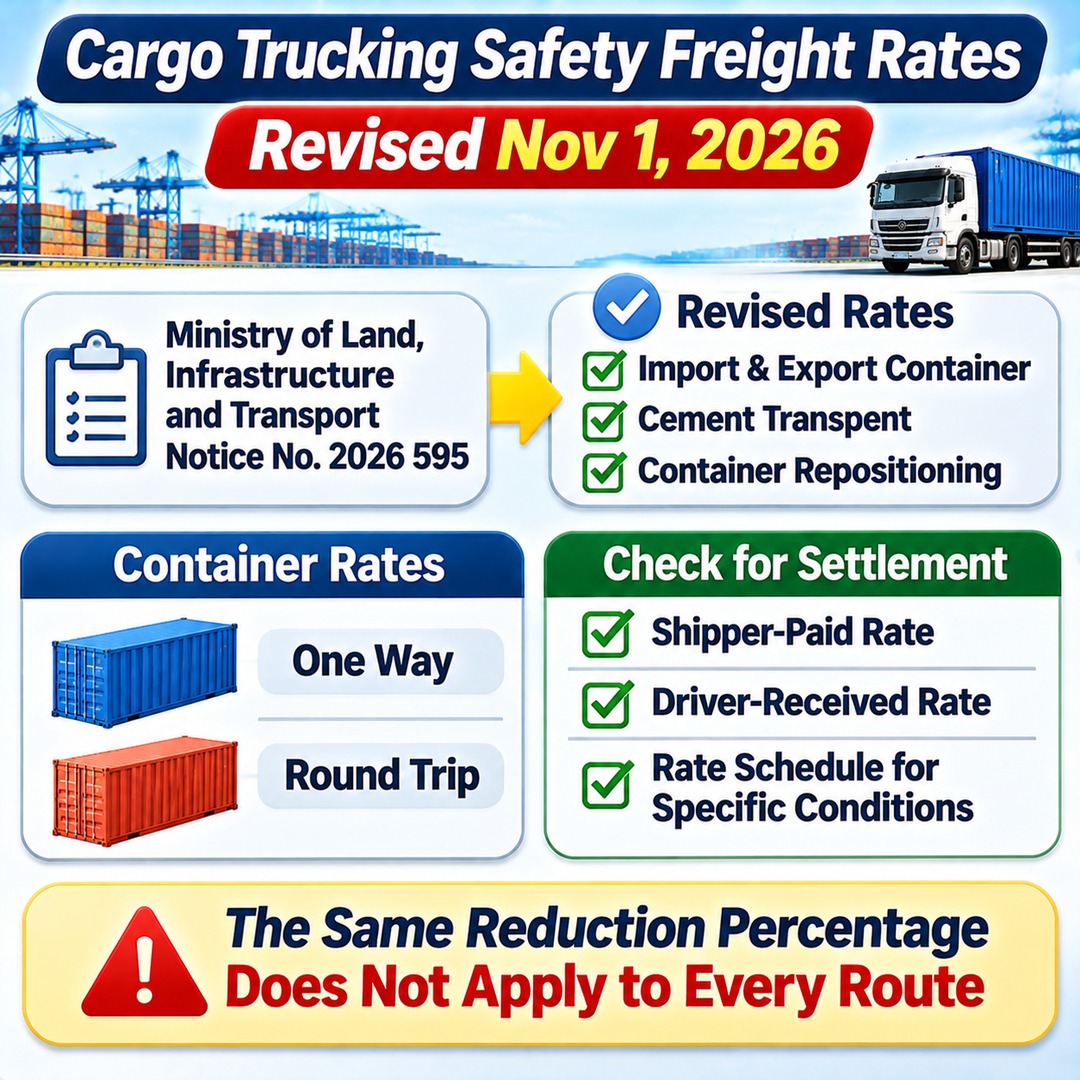
South Korea's Cargo Trucking Safety Freight Rates were revised effective November 1, 2026. Under Ministry of Land, Infrastructure and Transport Notice No. 2026-595, rates for import and export container transport and cement transport were changed, and the separate rate schedule for container repositioning was also revised. The same reduction percentage does not apply to every transport route. Container size, origin, destination, and one-way or round-trip conditions must be considered separately.
When comparing the rates that applied in August with the revised November rates, it is important to distinguish between the safe transport rate paid by the shipper and the safe entrusted transport rate received by the truck driver. Actual contract amounts must be checked against the revised rate schedule applicable to the specific transport conditions.
When Did the November Freight Safety Rates Take Effect?
The revised rates took effect on November 1, 2026. This was a partial amendment to South Korea's 2026 Cargo Trucking Safety Freight Rates, finalized under Ministry of Land, Infrastructure and Transport Notice No. 2026-595.
The revised rates cover import and export container transport and cement transport. Container rates are divided into separate schedules for one-way and round-trip journeys, while container repositioning is governed by its own rate schedule.
Therefore, transport completed on or after November 1 should be settled using the revised rate schedule rather than relying exclusively on the rates that applied in August.
How Much Did Container Freight Safety Rates Change Between August and November?
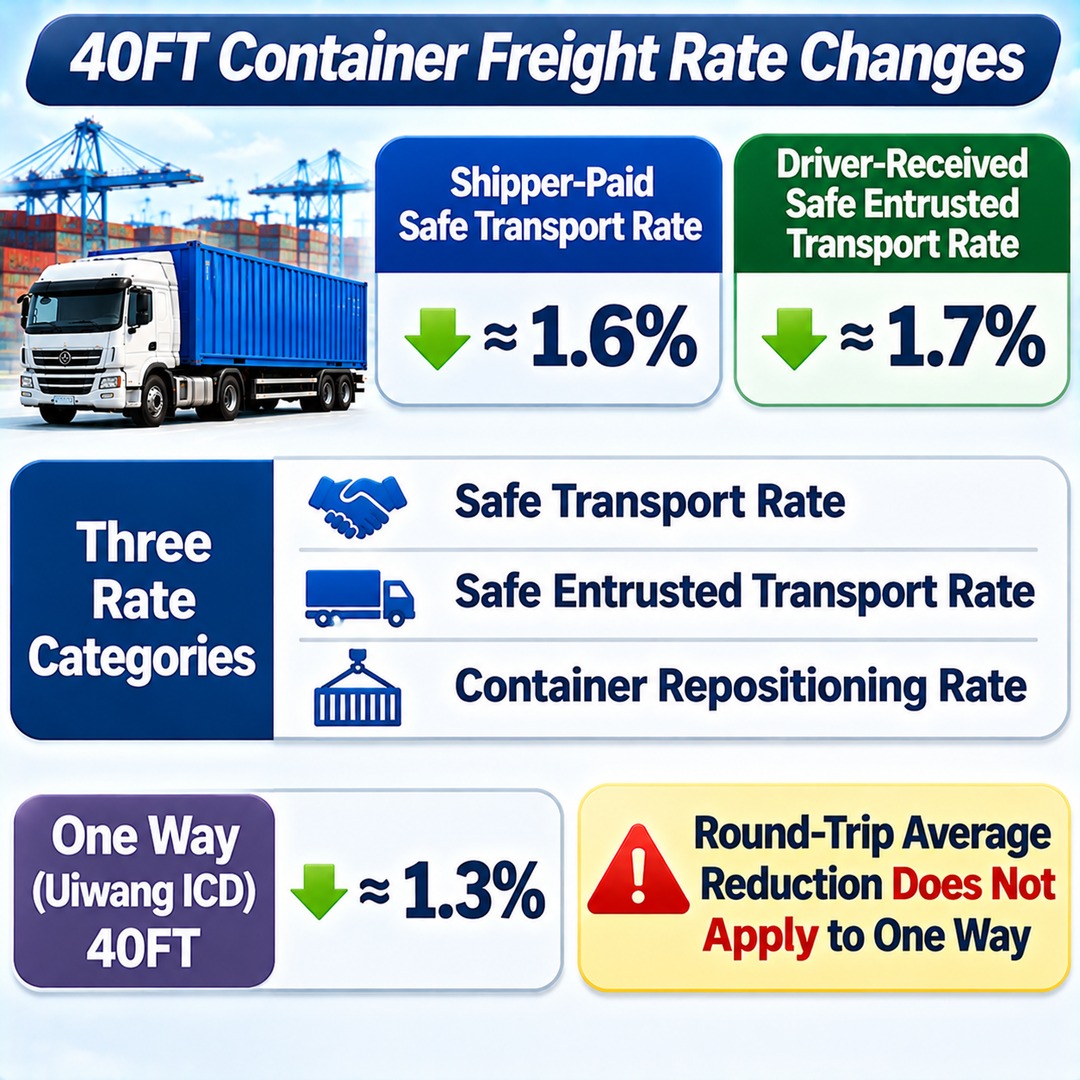
For 40FT container round trips, the average safe transport rate paid by shippers decreased by approximately 1.6%, while the average safe entrusted transport rate received by truck drivers decreased by approximately 1.7%. These percentages represent average changes across the rate schedules. They are not universal discounts that can be applied to every individual shipment.
The three relevant rate categories are:
Safe transport rate: The rate a shipper pays to a trucking business operator.
Safe entrusted transport rate: The rate a trucking business operator pays to a truck driver or owner-operator.
Container repositioning rate: A separate rate applicable when transport is entrusted to another trucking business operator during the transportation process.
The average adjustments for 40FT container round trips differ between the shipper-paid safe transport rate and the driver-received safe entrusted transport rate. One-way rates must also be calculated separately.
For one-way transport associated with Uiwang Inland Container Depot (ICD), the average shipper-paid rate for 40FT containers decreased by approximately 1.3%. The average reduction for round trips should not be applied directly to one-way journeys.
How Much Did 40FT Transport Costs from Busan New Port to Gimpo Decrease?
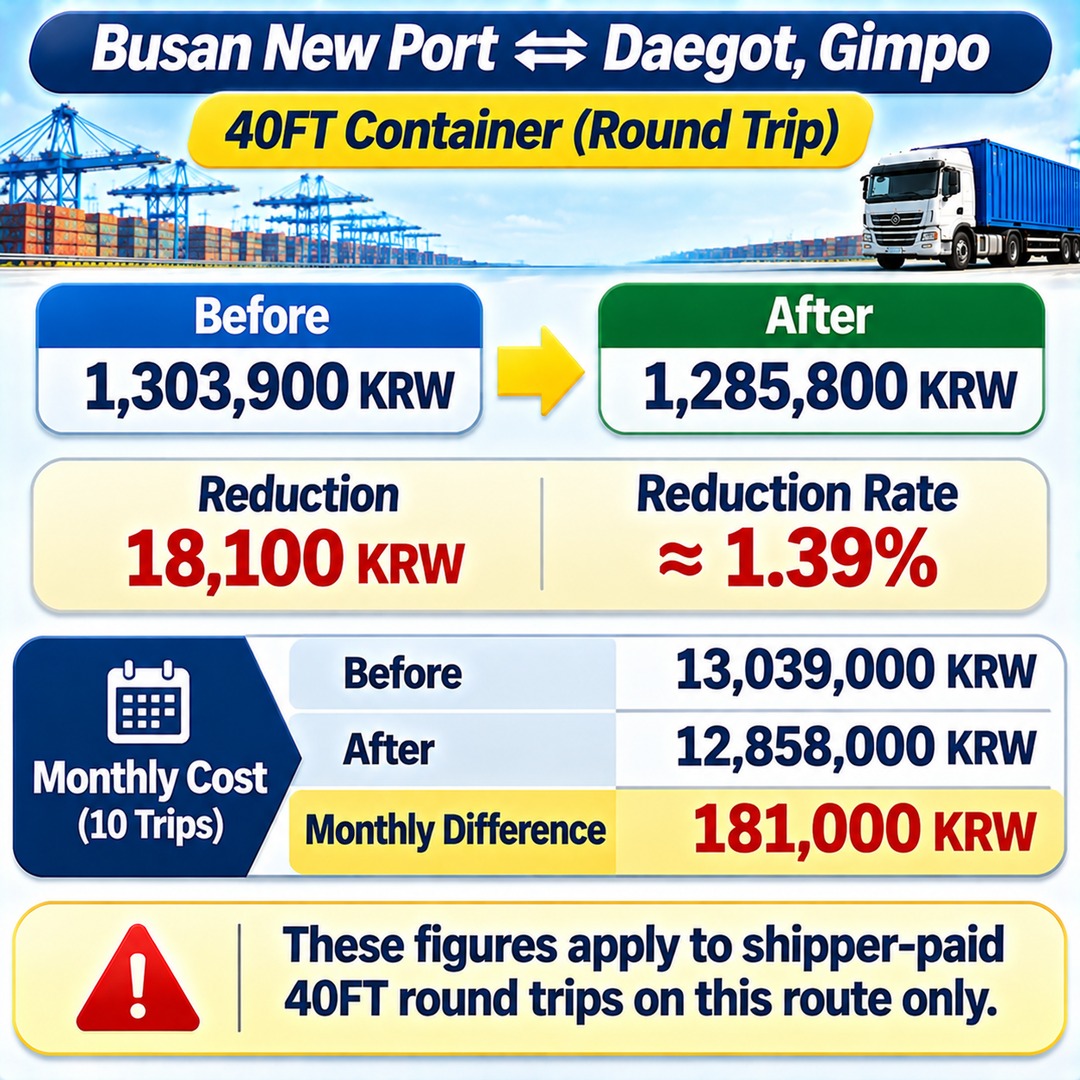
Comparing actual route-specific amounts provides a clearer picture than relying on average reduction percentages. The shipper-paid round-trip rate for a 40FT container transported from Busan New Port to Daegot-myeon, Gimpo, Gyeonggi Province, changed from 1,303,900 won to 1,285,800 won.
Unit: Korean won (KRW), excluding value-added tax (VAT).
| Item | August Rate | November Rate |
|---|---|---|
| 40FT round-trip freight rate | 1,303,900 | 1,285,800 |
| Difference | -18,100 |
The reduction percentage, calculated from these figures, is:
18,100 ÷ 1,303,900 × 100 ≈ 1.39%
This means the round-trip charge for this particular route decreased by 18,100 won, or approximately 1.39% compared with the previous rate.
Assuming 10 identical trips per month, the monthly figures would be:
Monthly transport cost before the revision: 13,039,000 won
Monthly transport cost after the revision: 12,858,000 won
Monthly difference: 181,000 won
These figures are a straightforward calculation assuming 10 trips under identical transport conditions. Additional costs and applicable surcharges must be checked separately when calculating the actual settlement amount.
The differences also vary across other routes.
| 40FT Round-Trip Route | Previous Rate | Revised Rate | Reduction |
|---|---|---|---|
| Busan New Port → Daegot-myeon, Gimpo | 1,303,900 won | 1,285,800 won | 18,100 won |
| Incheon New Port → Yangchon-eup, Gimpo | 374,400 won | 369,000 won | 5,400 won |
| Busan New Port → Sangju, North Gyeongsang Province | 760,100 won | 746,900 won | 13,200 won |
| Busan North Port → Jinhae-gu, Changwon | 265,500 won | 261,900 won | 3,600 won |
|---|
These figures compare shipper-paid rates for 40FT round-trip journeys on the listed routes. They should not be applied directly to other container sizes or to payments received by truck drivers.
Why Should 20FT and 40FT Container Rates Not Be Calculated Using the Same Percentage?
20FT and 40FT containers have different specifications, so their respective rate schedules must be checked separately. Even when the departure port is the same, the actual transport charge varies depending on the destination and transport distance.
The following conditions should be checked when determining the applicable rate:
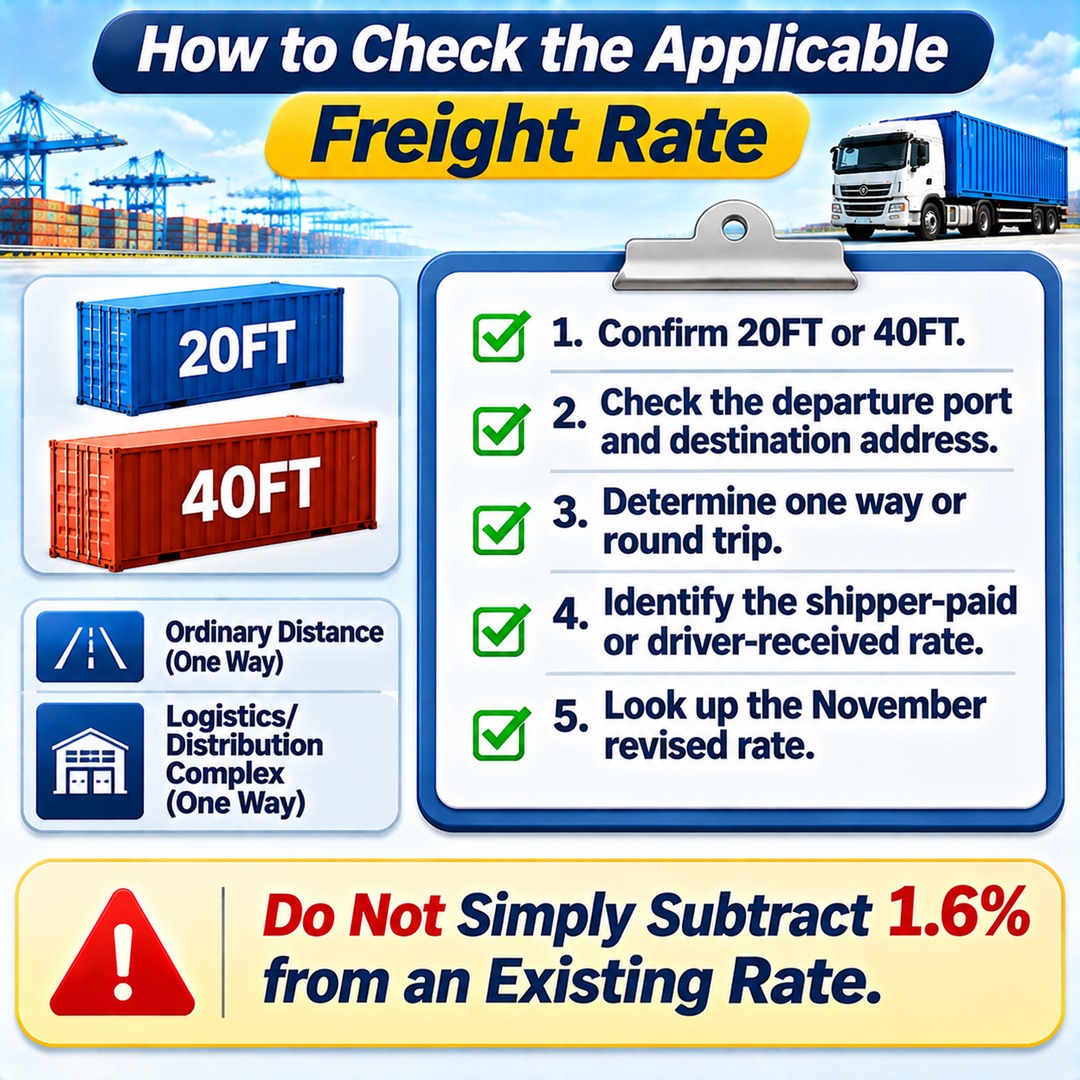
1. Confirm whether the container is 20FT or 40FT.
2. Check the departure port and destination address.
3. Determine whether the journey is one-way or round-trip.
4. Identify whether the amount is the shipper-paid rate or the driver-received rate.
5. Look up the November revised rate applicable to those specific conditions.
In particular, one-way rates for ordinary distance-based routes must be distinguished from separately specified one-way rates for logistics and distribution complexes.
Simply subtracting 1.6% from an existing rate is not a reliable way to calculate the revised charge. The result may differ from the actual amount specified in the official rate schedule.
What Changed for Cement Freight and Container Repositioning?
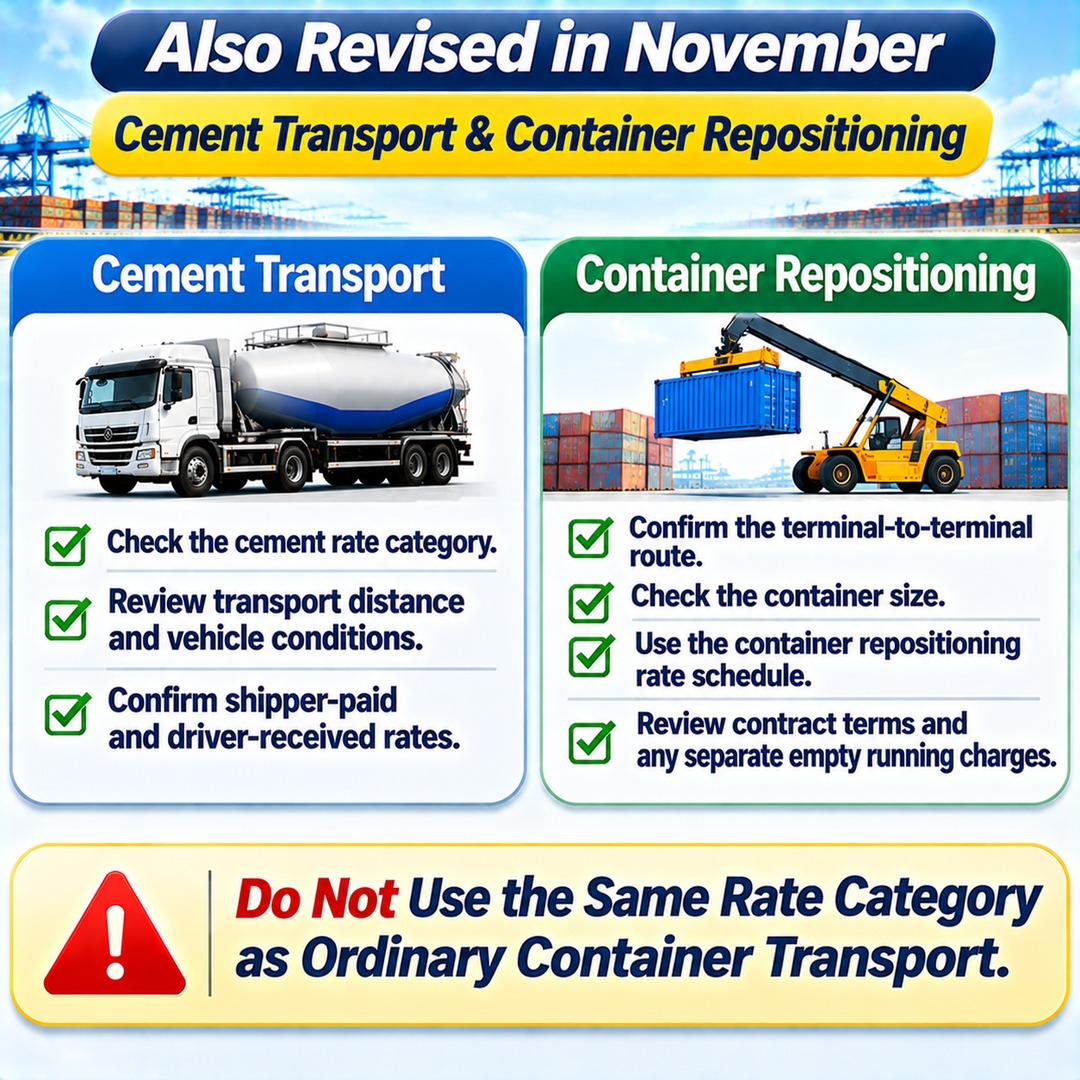
The November amendment was not limited to container transport. The rate schedules for cement transport and container repositioning were also included in the revision.
Cement transport operators must check the rate category applicable to cement rather than using container freight rates. Transport distance, vehicle conditions, and the distinction between the shipper-paid safe transport rate and the driver-received safe entrusted transport rate are important.
Container repositioning refers to a separate transport arrangement involving the movement of containers from one terminal to another. An earlier amendment, Notice No. 2026-402, which took effect on August 1, 2026, introduced a separate container repositioning rate schedule as an attachment. The November amendment under Notice No. 2026-595 revised that schedule again.
Ordinary container transport and container repositioning should therefore not be calculated using the same rate category.
When container repositioning occurs, check the following:
The actual route between the terminals.
The applicable container size.
The corresponding route in the container repositioning rate schedule.
Contractual terms between the trucking business operators responsible for paying the transport charges.
Whether separate empty-running charges or other additional costs apply.
For route-specific changes to repositioning rates, the revised fourth-quarter attachment must be checked directly. Proposed routes or amounts from an administrative advance notice should not be treated as final published rates.
How Should VAT and Additional Charges Be Calculated?
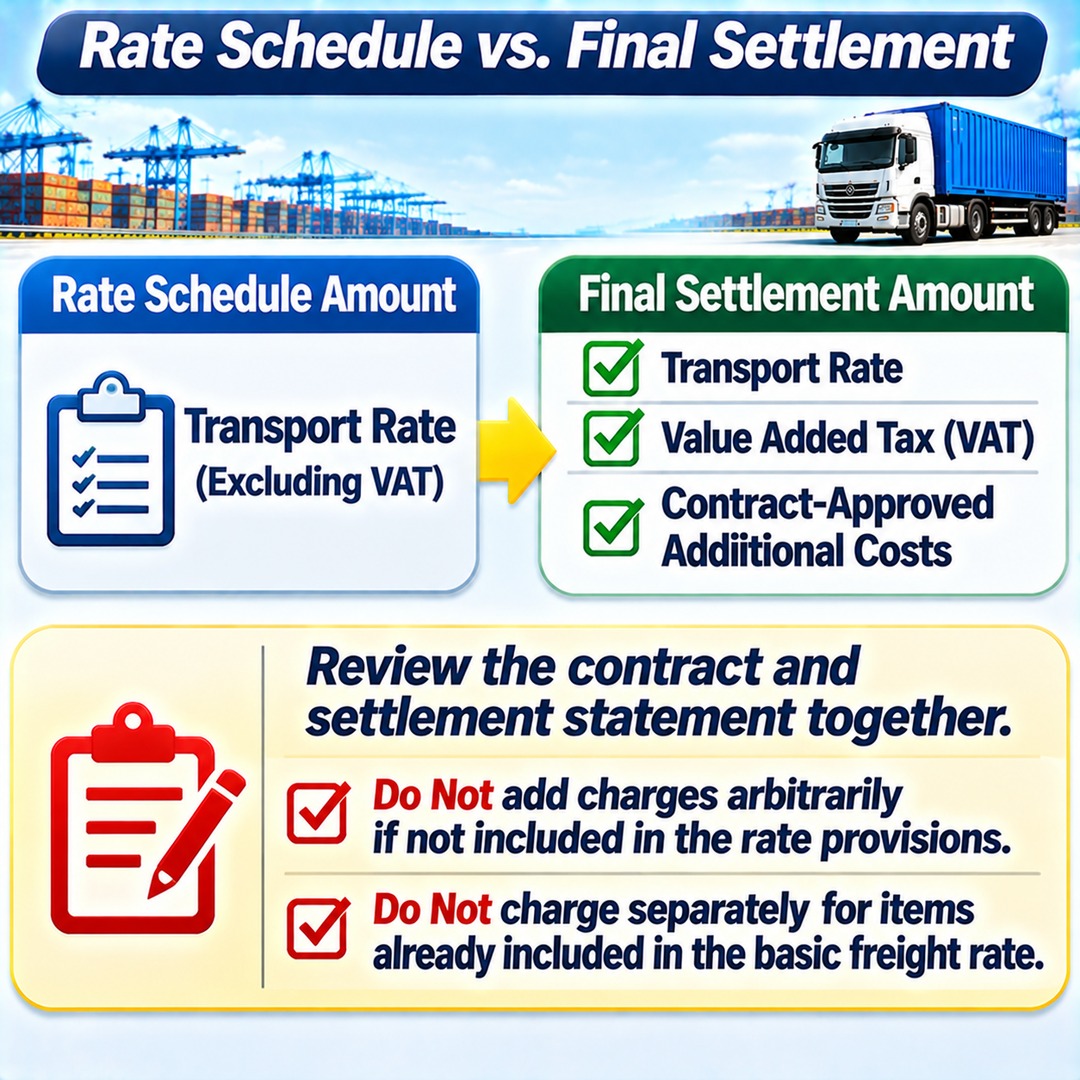
The amount shown in the safety freight rate schedule must be distinguished from the final settlement amount. The transport examples compared above are exclusive of VAT.
Actual contracts and settlements should distinguish between the following items:
| Item | What to Check |
|---|---|
| Basic safety freight rate | The applicable amount in the revised rate schedule for the specific route |
| Value-added tax (VAT) | Whether VAT is charged separately and whether a tax invoice is issued |
| Public holiday and nighttime surcharges | Whether the relevant surcharge conditions apply |
| Dangerous goods | Any separate freight conditions applicable to the cargo |
| Tolls and similar charges | Whether separate settlement is permitted under the contract |
| Other incidental expenses | Items recognized under the official rate schedule and the contract |
To avoid disputes, review the contract and settlement statement together. Do not add charges arbitrarily if they are not included in the applicable rate provisions, and do not charge separately for items already included in the basic freight rate.
What Should Be Checked in an Actual Transport Contract?
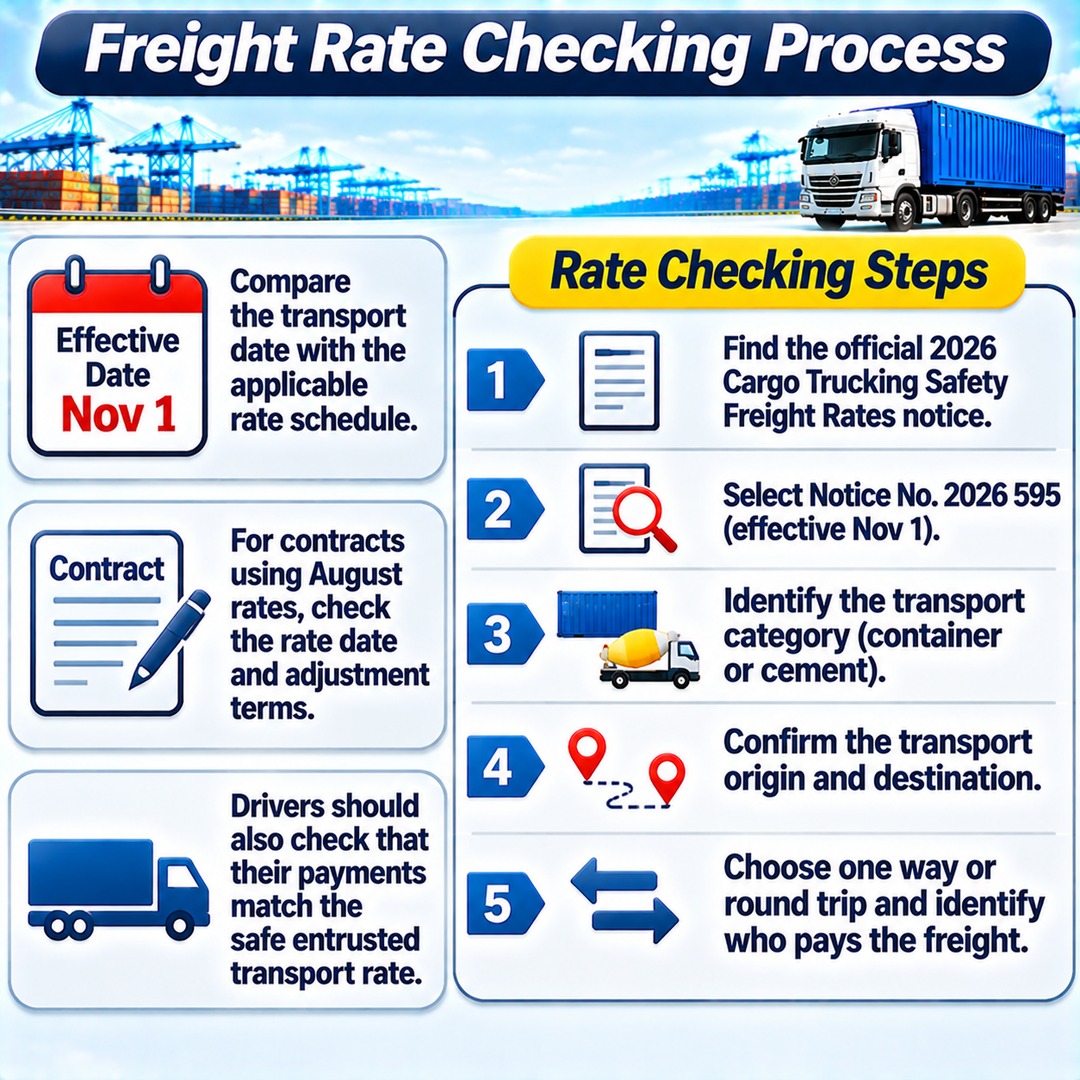
Shippers and freight forwarders should compare the transport date with the applicable rate schedule, using November 1 as the effective-date boundary.
If an existing contract was prepared using the August rates, check how the contract defines its applicable rate date and how adjustments are handled when freight rates change.
Truck drivers and owner-operators should also check separately whether the payments they receive from trucking business operators comply with the applicable safe entrusted transport rate.
The practical rate-checking process is as follows:
1. Find the official 2026 Cargo Trucking Safety Freight Rates notice issued by South Korea's Ministry of Land, Infrastructure and Transport.
2. Select Notice No. 2026-595, which took effect on November 1.
3. Identify the transport category, such as container or cement transport.
4. Confirm the transport origin and destination.
5. Select the applicable one-way or round-trip condition and identify who pays the freight charge.
6. If container repositioning is involved, consult the separate repositioning rate schedule attached to the notice.
7. Calculate the settlement amount by accounting for VAT and any additional expenses permitted under the contract.
Frequently Asked Questions
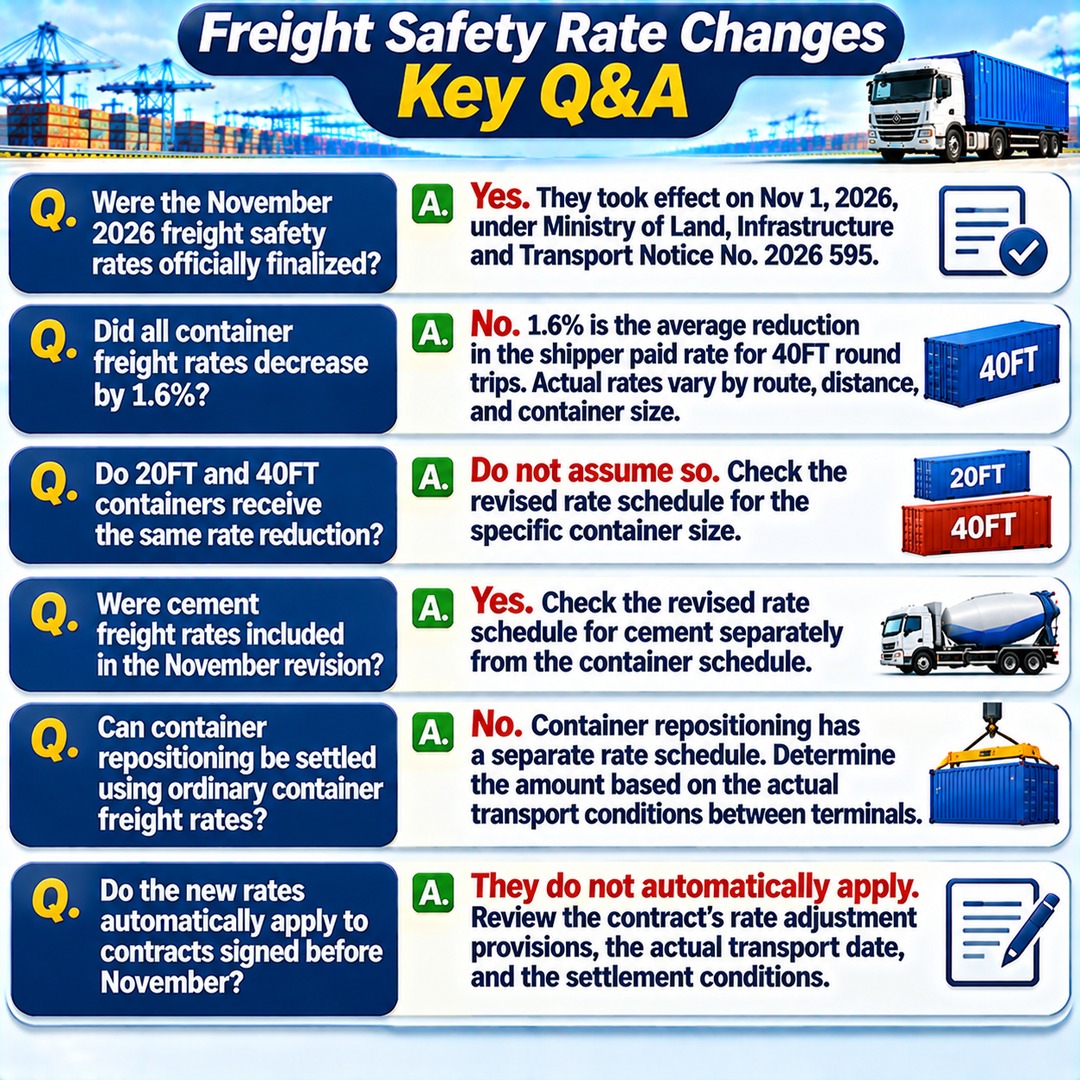
Q. Were the November 2026 freight safety rates officially finalized?
Yes. The revised rates took effect on November 1, 2026, under Ministry of Land, Infrastructure and Transport Notice No. 2026-595. The final published notice, rather than an administrative advance notice or proposal, should be used when checking the applicable rates.
Q. Did all container freight rates decrease by 1.6%?
No. The 1.6% figure is the average reduction in the shipper-paid rate for 40FT round-trip container transport. Actual rates vary depending on the departure port, destination, transport distance, and container size.
Q. Do 20FT and 40FT containers receive the same rate reduction?
You should not assume that they do. Consult the revised rate schedule for the specific container size.
Q. Were cement freight rates included in the November revision?
Yes. Check the revised rate schedule for cement separately from the container transport schedule.
Q. Can container repositioning be settled using ordinary container freight rates?
No. Container repositioning has a separate rate schedule. The applicable amount must be determined according to the actual transport conditions between the terminals.
Q. Do the new rates automatically apply to contracts signed before November?
The transport date and contract terms must be considered together. Review the contract's freight rate adjustment provisions, the actual transport date, and the settlement conditions. Do not assume that every existing contract amount automatically changes simply because the revised rates have taken effect.