

When renting a studio apartment or officetel in South Korea, tenants should check the amount of shared management fees separately rather than relying only on the advertised monthly rent and total management fees. Since August 28, 2026, licensed real estate agents must verify and explain not only the total management fees but also the amount attributable to shared building management during residential lease transactions. Before signing a lease, it is important to distinguish shared management fees from individual utility charges in the Property Disclosure and Explanation Statement.
When Did the Obligation to Explain Shared Management Fees Take Effect?
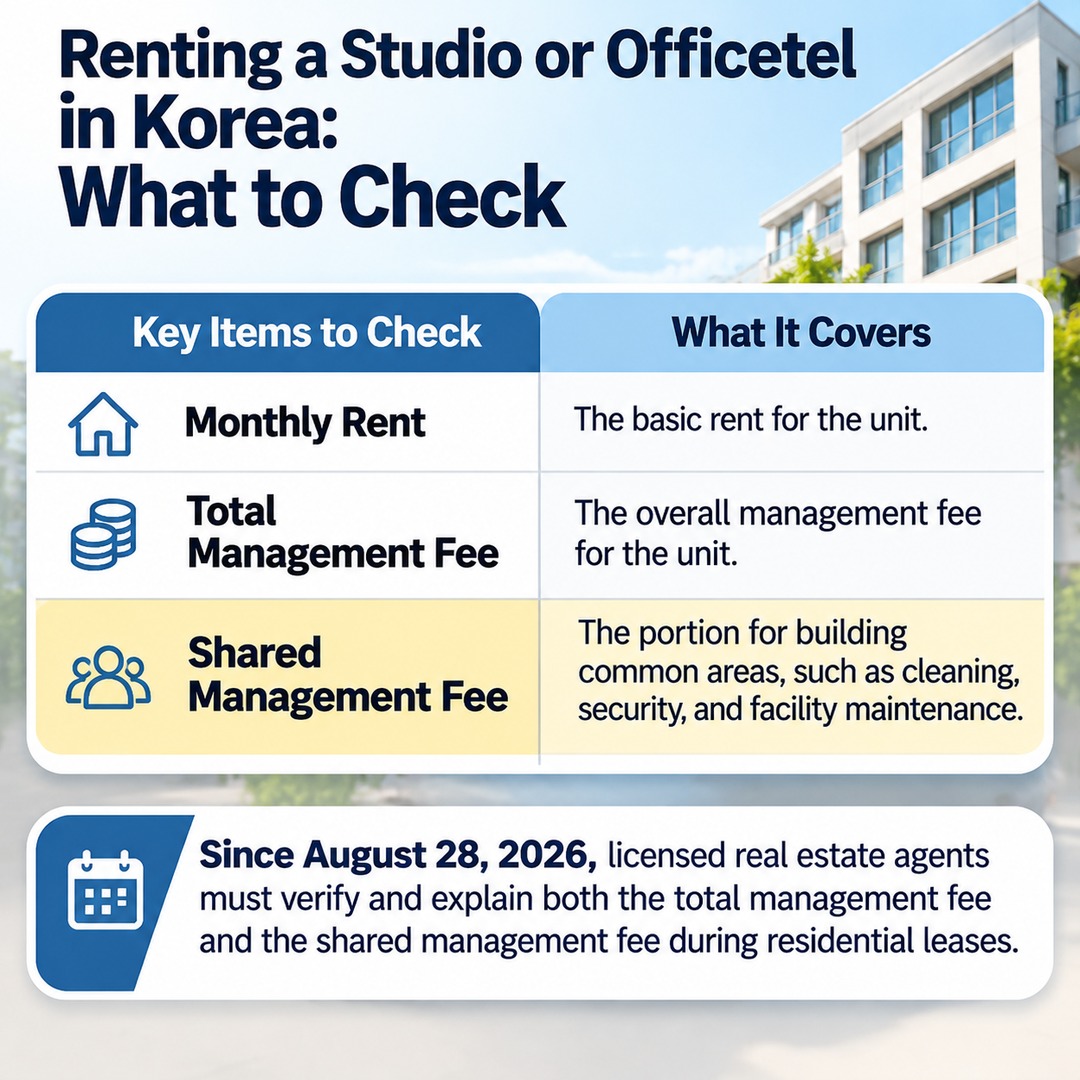
On August 28, 2026, amendments to the Enforcement Decree and Enforcement Rules of South Korea's Licensed Real Estate Agents Act took effect, adding shared management fees as a separate item that must be verified and explained when brokering leases for small residential properties.
Previously, explanations generally focused on the total management fee. Under the amended rules, tenants can also check how much of that amount represents shared expenses for maintaining common areas of the building.
The changes are relevant to prospective tenants entering into residential leases for small properties, including studio apartments and officetels in South Korea. Licensed real estate agents handling these transactions must verify and explain the shared management fee in addition to the existing total management fee.
However, this obligation does not mean that every individual management expense must be disclosed with supporting receipts. The obligation to verify and explain the amount of shared management fees is separate from a requirement to disclose every actual expenditure incurred by the building.
What Is the Difference Between Shared Management Fees and Individual Utility Charges?
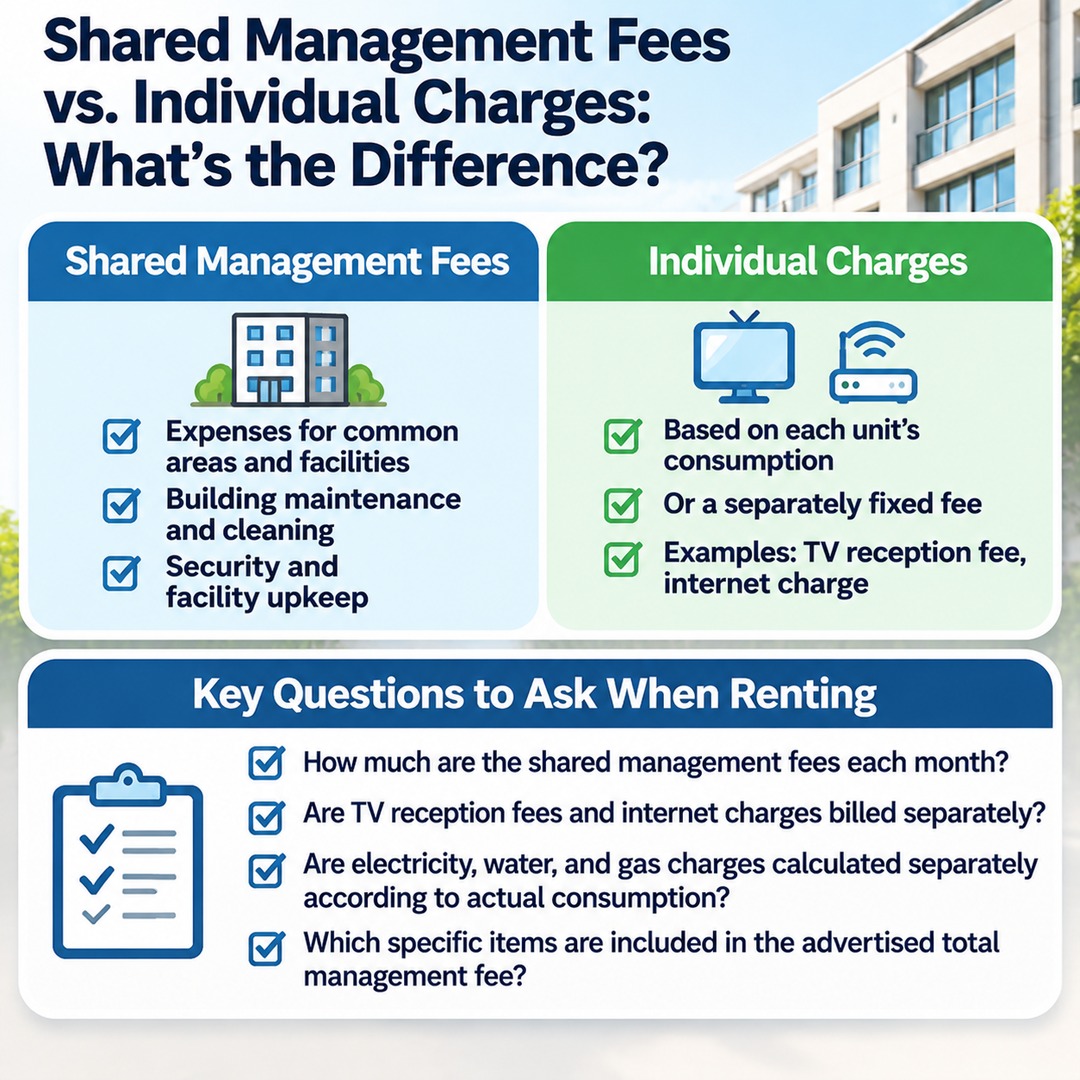
The two categories differ in how the costs arise. Shared management fees cover expenses associated with maintaining common areas and facilities in a building. Individual charges are based on a particular residential unit's consumption or a separately established individual fee.
An important distinction under the revised system is whether consumption can be measured separately for each unit and whether the charge is individually fixed.
For example, items such as TV reception fees and internet charges may be excluded from shared management fees when they are individually identifiable by unit or charged at a fixed rate.
During the property-brokering process, tenants can ask the following questions:
How much are the shared management fees each month?
Are TV reception fees and internet charges billed separately?
Are electricity, water, and gas charges calculated separately according to actual consumption?
Which specific items are included in the advertised total management fee?
Even when charges are grouped under the same general label of management fees, their billing methods may differ. Make sure to check how each item is categorized.
Which Sections Should You Check in the Property Disclosure and Explanation Statement?
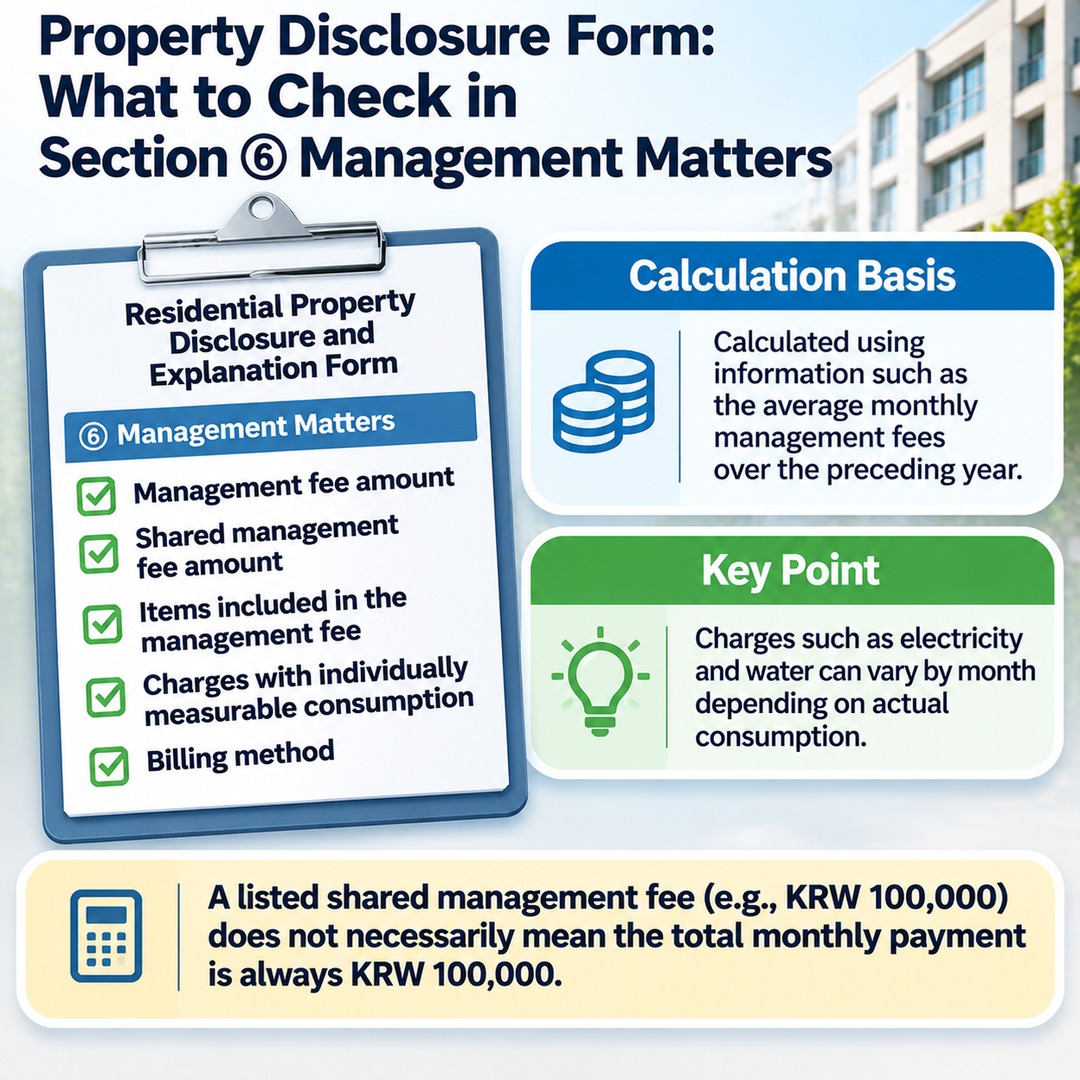
The residential property disclosure and explanation form, revised on August 28, 2026, includes a separate field for shared management fees. Under Section ⑥, Management Matters, check the management fee amount, shared management fee amount, items included in the management fee, charges for which individual consumption can be measured, and the billing method.
Management Items in the Revised Residential Property Disclosure and Explanation Statement
| Item to Check | What to Look For |
|---|---|
| Management fee amount | Total monthly management fees |
| Shared management fee amount | Shared building expenses, excluding individual charges and similar items |
| Items included in management fees | Electricity, water, gas, heating, internet, TV, and other charges |
| Items with measurable individual consumption | Whether consumption or costs can be identified separately for each unit |
| Management fee billing method | Whether the landlord collects the fees directly or they are charged under the building's management regulations |
One detail that is easy to overlook is the basis used to calculate management fees. The instructions for completing the revised form specify that amounts should be calculated using information such as the average monthly management fees over the preceding year. It is also necessary to explain that charges such as electricity and water may vary from month to month depending on actual consumption.
Therefore, even if the shared management fee is listed as KRW 100,000, this does not necessarily mean that the tenant's total monthly payment will always be KRW 100,000. Individual utility charges and separately billed items must also be checked to calculate the actual monthly housing cost.
How Should You Compare a Property With Lower Rent Against One With Lower Management Fees?
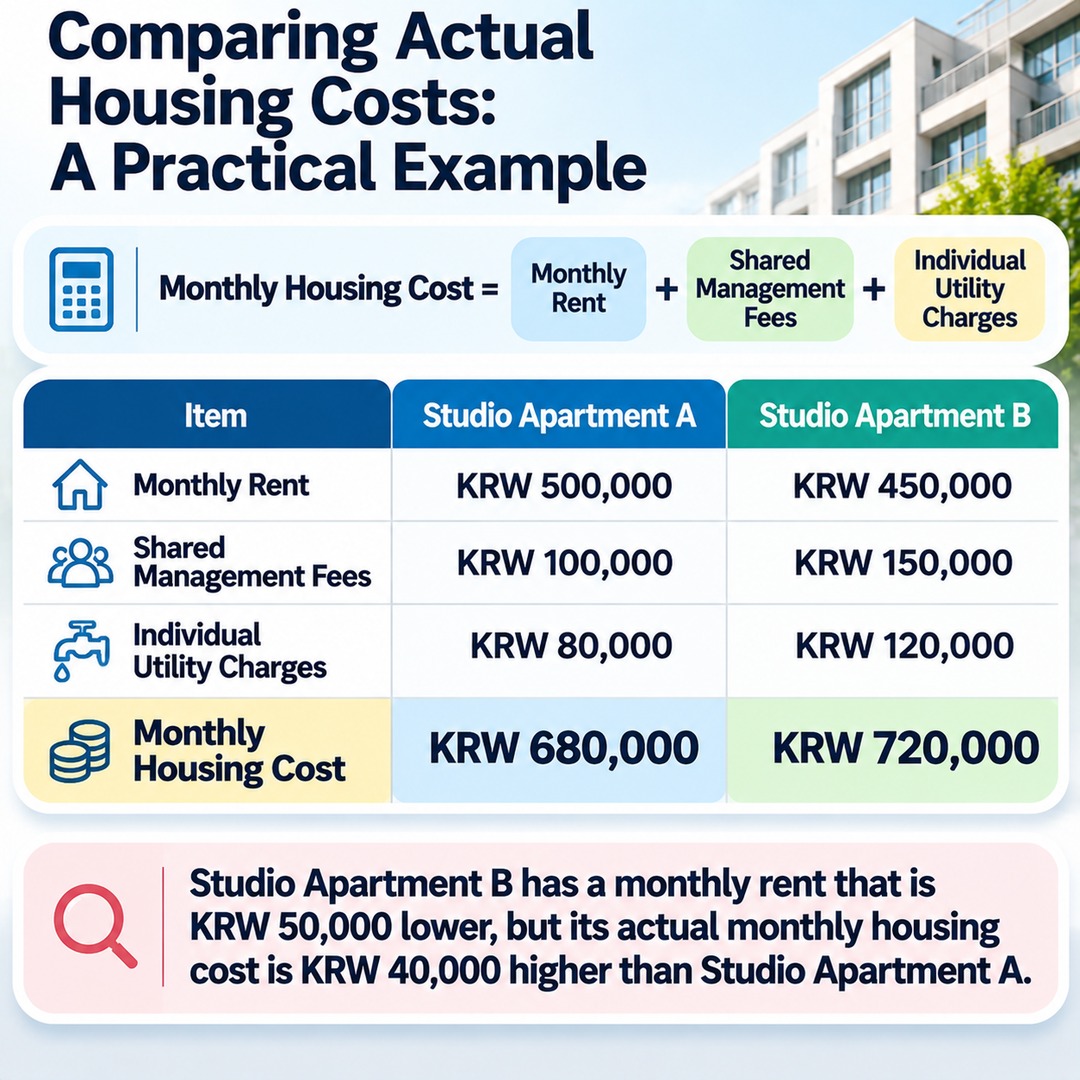
To compare actual housing expenses, separate the monthly rent, shared management fees, and individual utility charges. The following is a hypothetical example provided to illustrate the calculation method.
| Item | Studio Apartment A | Studio Apartment B |
|---|---|---|
| Monthly rent | KRW 500,000 | KRW 450,000 |
| Shared management fees | KRW 100,000 | KRW 150,000 |
| Individual utility charges | KRW 80,000 | KRW 120,000 |
| Total monthly housing cost | KRW 680,000 | KRW 720,000 |
In this example, Studio Apartment B has monthly rent that is KRW 50,000 lower. However, its actual monthly housing cost is KRW 40,000 higher than that of Studio Apartment A.
The calculation is:
Monthly housing cost = Monthly rent + Shared management fees + Individual utility charges
These figures are hypothetical and are provided solely to explain the calculation. They do not represent the actual management fees or average utility charges of any particular property. If there are additional expenses, such as a security deposit, parking fees, or a separate internet subscription, compare those costs separately as well.
Comparing properties based only on monthly rent and the advertised management fee can lead to an inaccurate assessment of actual expenses, particularly when one property includes electricity, water, and gas in its management fees while another bills these utilities separately according to consumption.
What Should Tenants Check Personally Before Signing a Lease?
In addition to listening to the real estate agent's explanation, tenants should verify how the actual payments are structured. In particular, check how the total management fee is divided between shared management fees and other charges.
Before signing a lease, follow these steps:
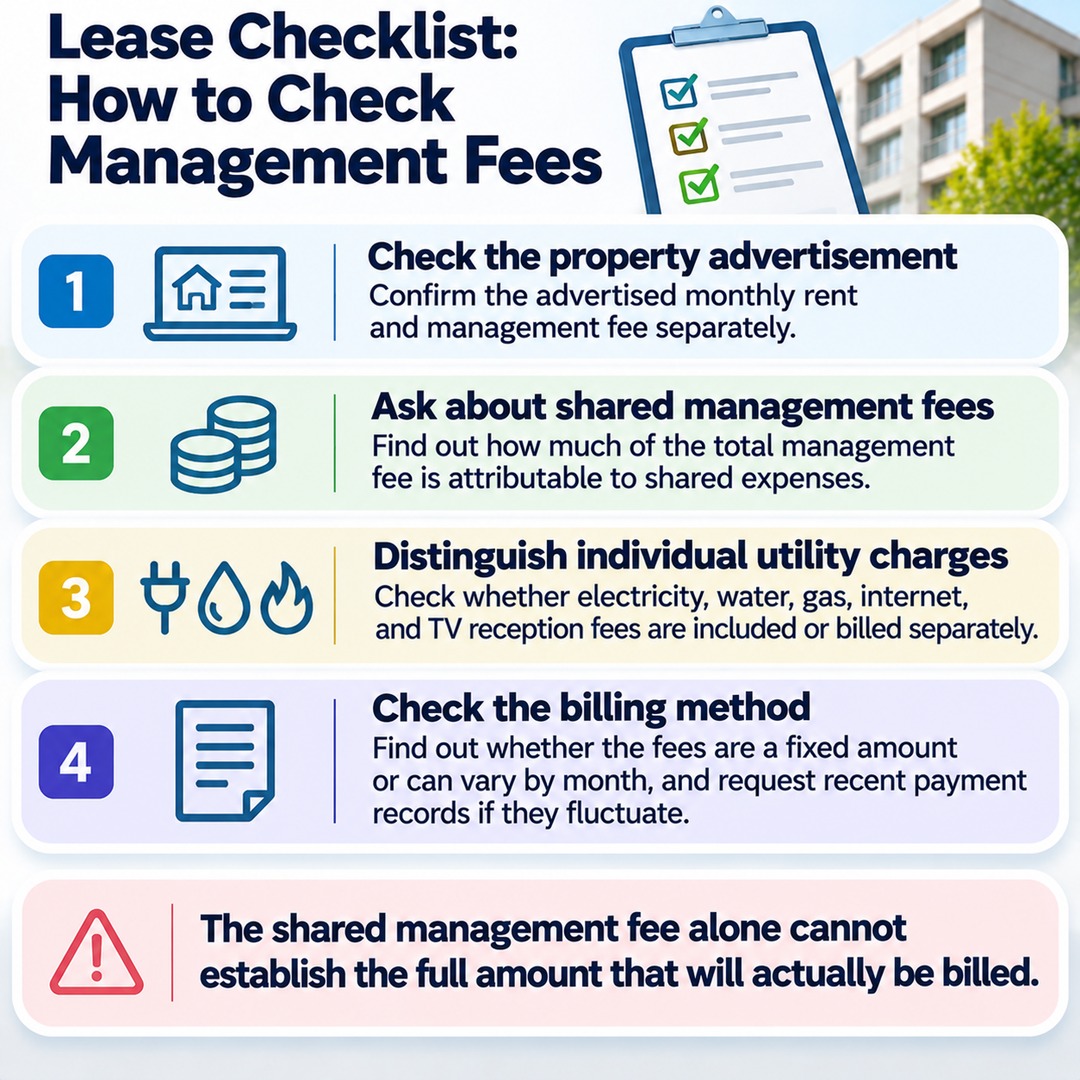
1. Check the property advertisement: Confirm the advertised monthly rent and management fee separately.
2. Ask about shared management fees: Find out how much of the total management fee is attributable to shared expenses.
3. Distinguish individual utility charges: Check whether electricity, water, gas, internet, and TV reception fees are included or billed separately.
4. Check the billing method: Find out whether the landlord collects the fees directly or whether they are charged under the building's management regulations.
5. Check for possible variations: Identify expenses that may change depending on the season or actual consumption, such as heating costs.
6. Compare the disclosure statement: Check whether the amounts recorded under Section ⑥, Management Matters, match the explanations you received.
7. Review the lease agreement: Confirm that the conditions for paying management fees and separate utility charges are consistent with the written agreement.
If the building's management fees fluctuate from month to month, it is advisable to request recent payment records or supporting information about how the fees are calculated. The shared management fee alone cannot establish the full amount that will actually be billed.
What Should You Do If the Management Fees Were Not Properly Explained?
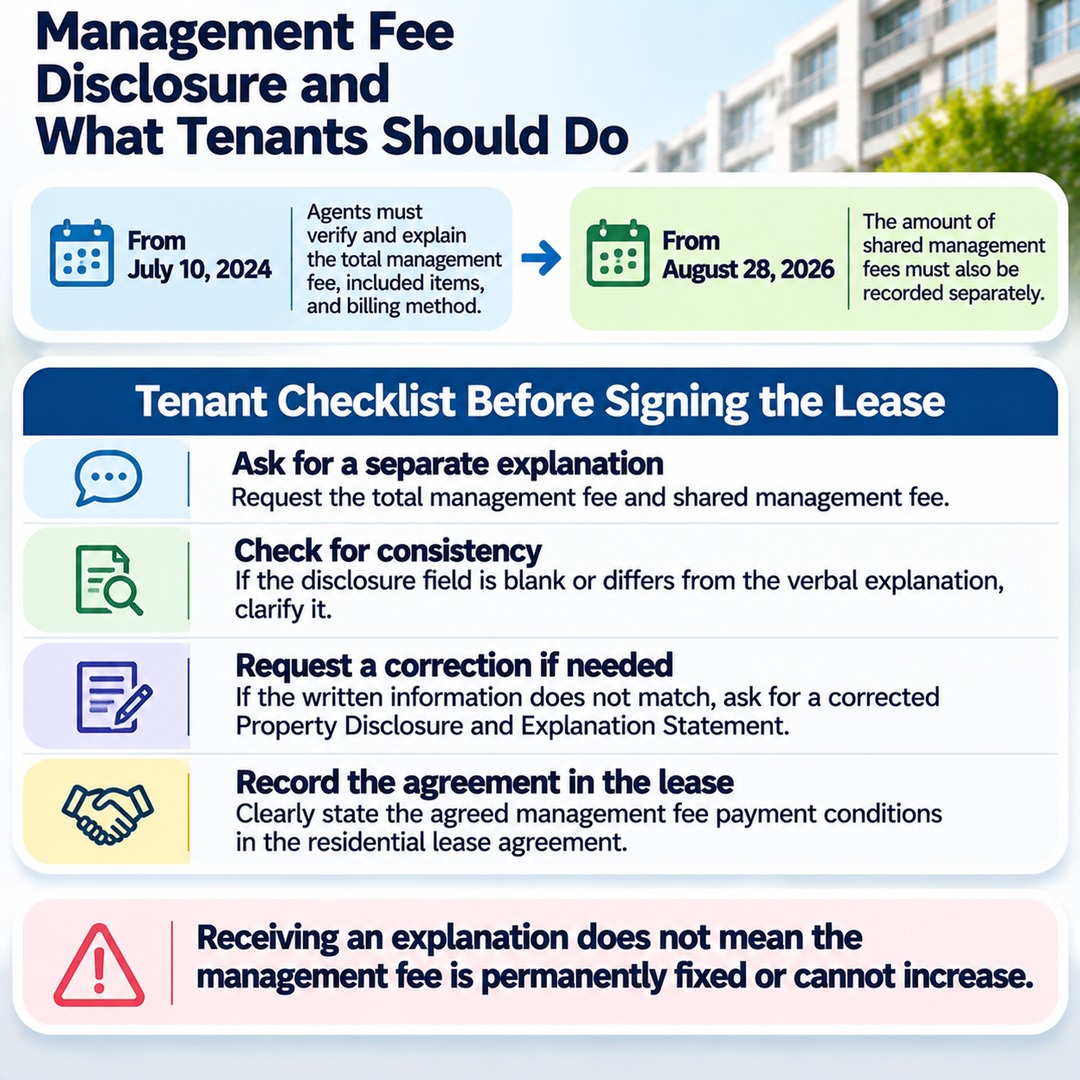
You can ask the licensed real estate agent to explain the total management fee and shared management fee separately. In particular, if the shared management fee field in the disclosure statement is blank or the written amount differs from what you were told verbally, clarify the discrepancy before signing the lease.
A system requiring real estate agents to verify and explain the total management fee, included items, and billing method had already been in effect since July 10, 2024. The amendment introduced on August 28, 2026, further specified that the amount of shared management fees must be recorded separately.
Therefore, the latest amendment should not be interpreted as requiring disclosure of every supporting document for every management expense. The licensed real estate agent's obligation to verify and explain the relevant information should be distinguished from a tenant's separate request to the landlord or building management entity for detailed expense records.
If the written disclosure does not match the explanation you received, request a corrected Property Disclosure and Explanation Statement. It is also advisable to clearly record the agreed management fee payment conditions in the residential lease agreement. Receiving an explanation does not mean that the actual management fee is permanently fixed or that future increases are prohibited.
Frequently Asked Questions
Must a licensed real estate agent explain shared management fees separately?
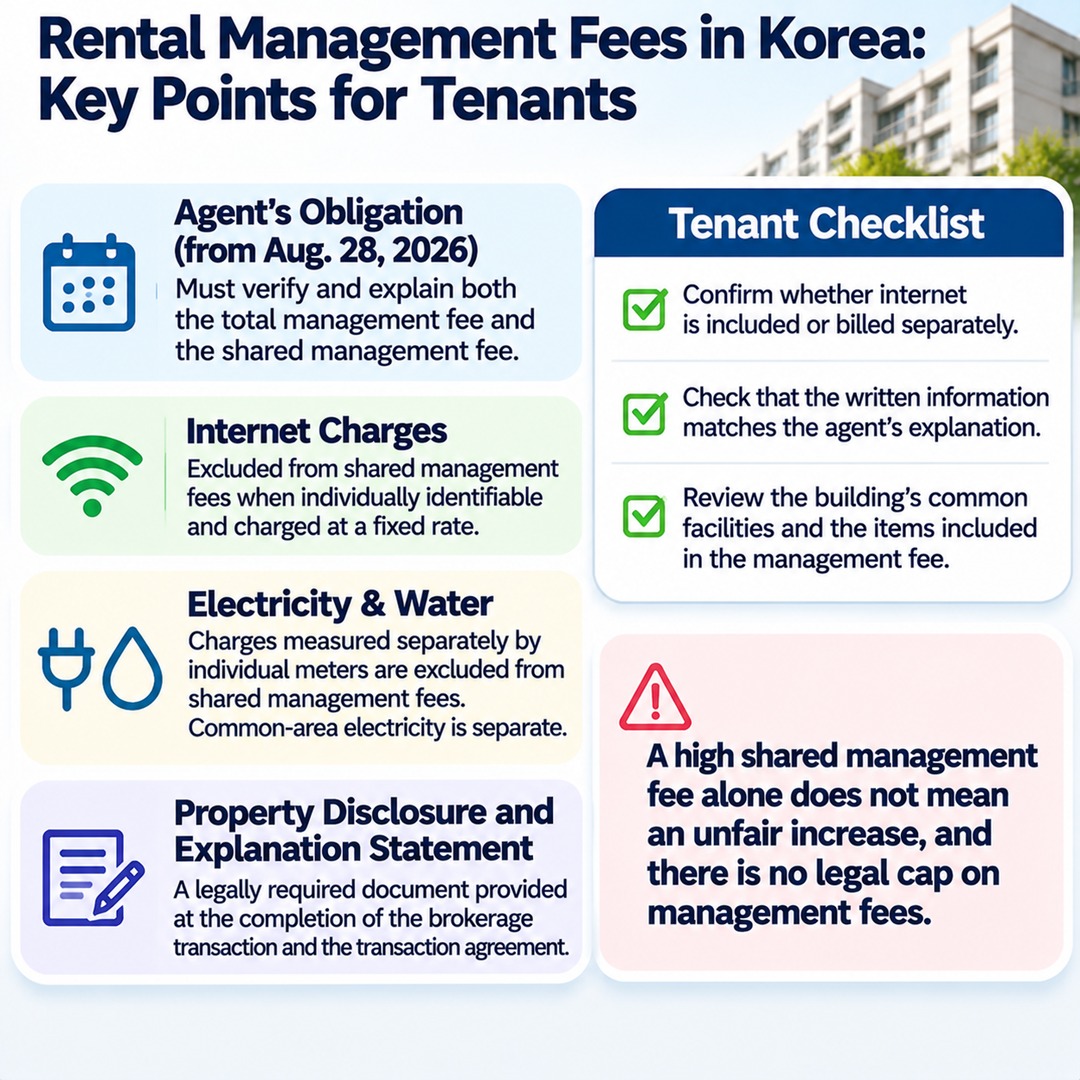
Yes. Under the amendments that took effect on August 28, 2026, licensed real estate agents must verify and explain both the total management fee and the shared management fee when brokering leases for residential buildings in South Korea.
Are internet charges included in shared management fees?
Internet charges are excluded from shared management fees when they are individually identifiable and charged at a fixed rate. For an actual lease, check whether internet service is included in the management fee or billed separately.
Are electricity and water charges considered shared management fees?
Electricity and water charges that can be measured separately for each residential unit through individual meters are excluded from shared management fees. However, electricity used in common areas should be considered separately.
Can tenants receive the Property Disclosure and Explanation Statement before signing a lease?
The Property Disclosure and Explanation Statement is a legally required document that must be prepared and provided when the brokerage transaction is completed and the transaction agreement is drawn up. Before signing, tenants can ask the real estate agent to explain the property's management fees and shared management fees in advance. When the lease agreement is prepared, they should also compare the information with the completed disclosure statement.
Does a high shared management fee mean the landlord has arbitrarily increased the charges?
A high shared management fee alone is not enough to conclude that the charges have been unfairly increased. Tenants should check the building's common facilities, management arrangements, and the actual items being billed. The amendment makes verification and explanation of shared management fees mandatory; it does not establish a legal cap on management fees in South Korea.