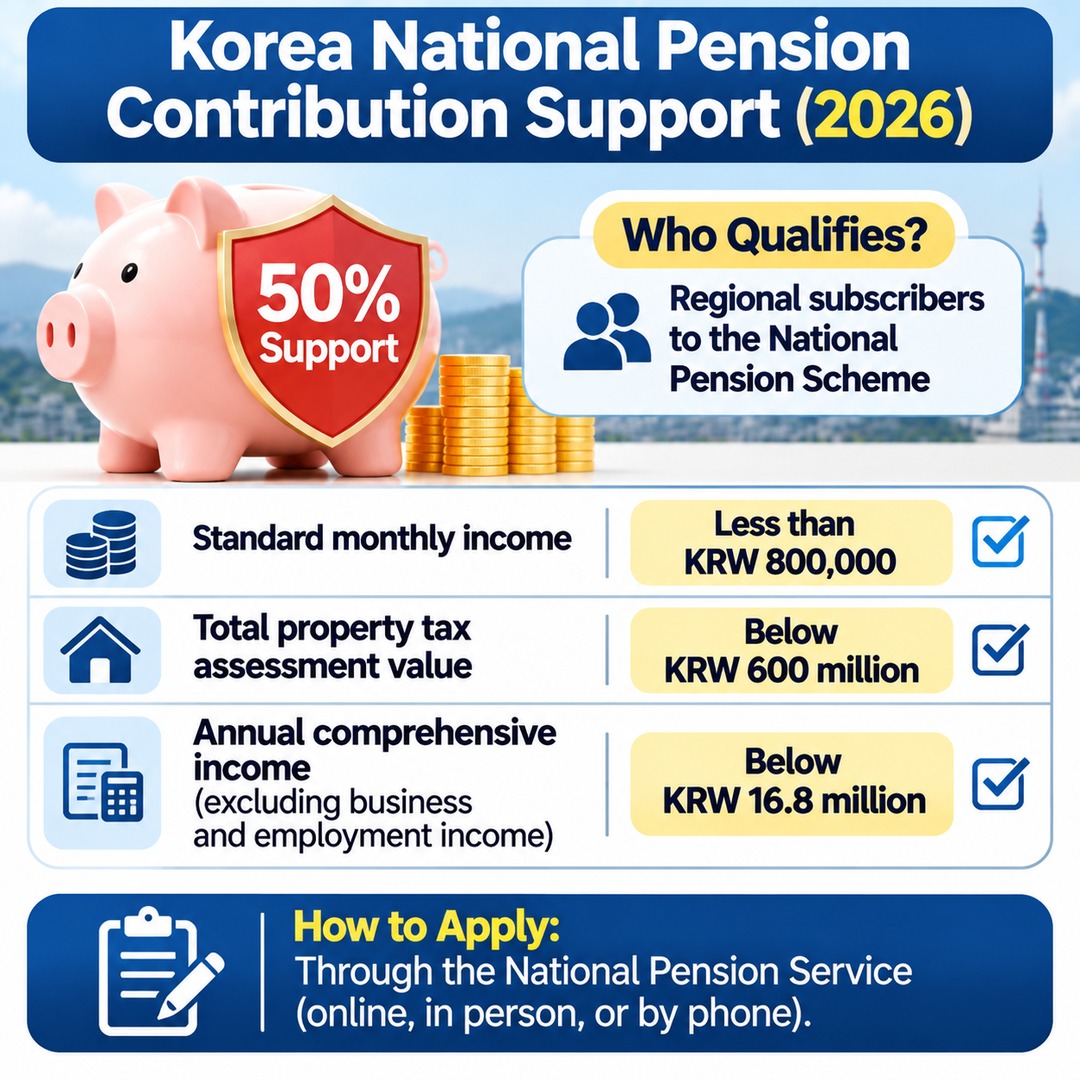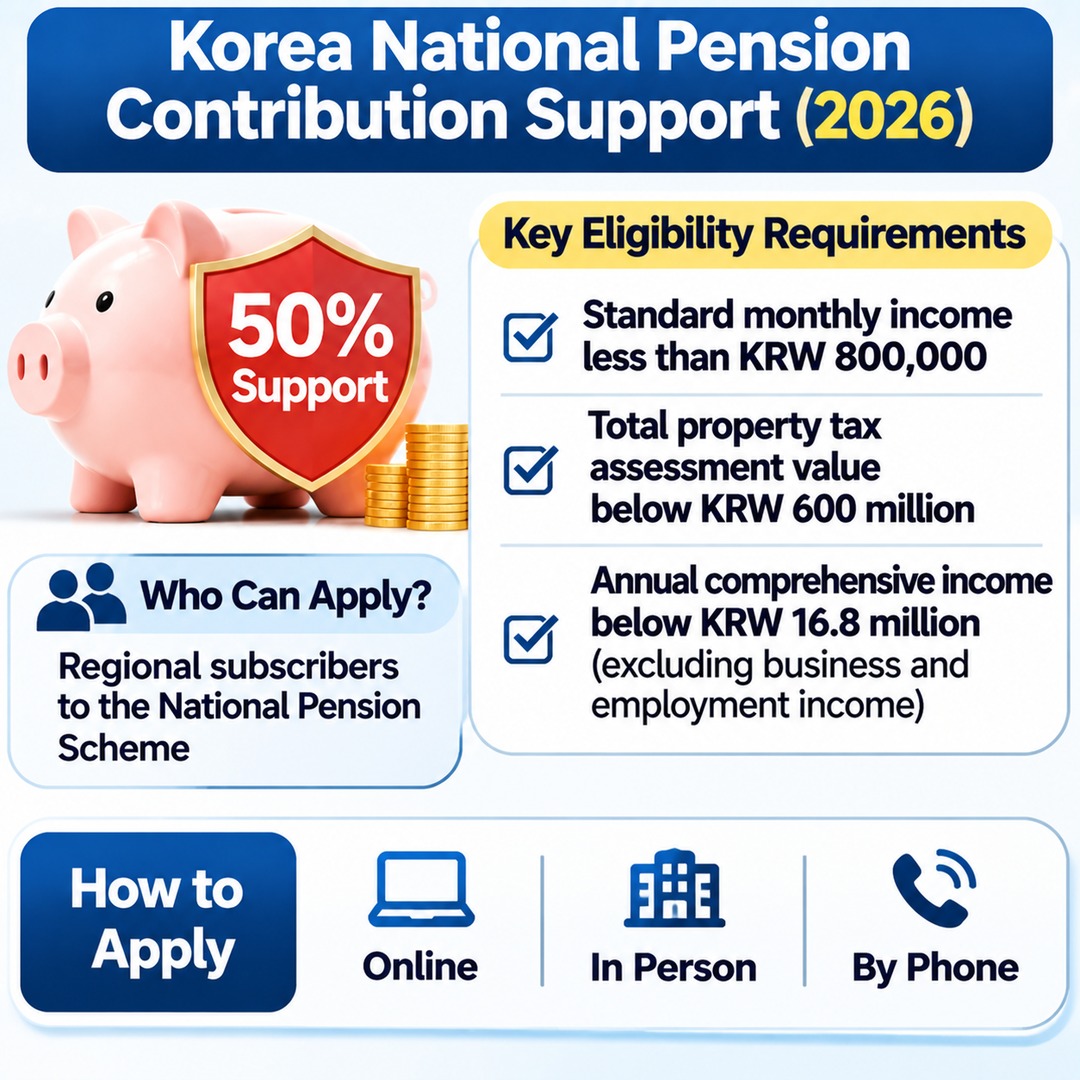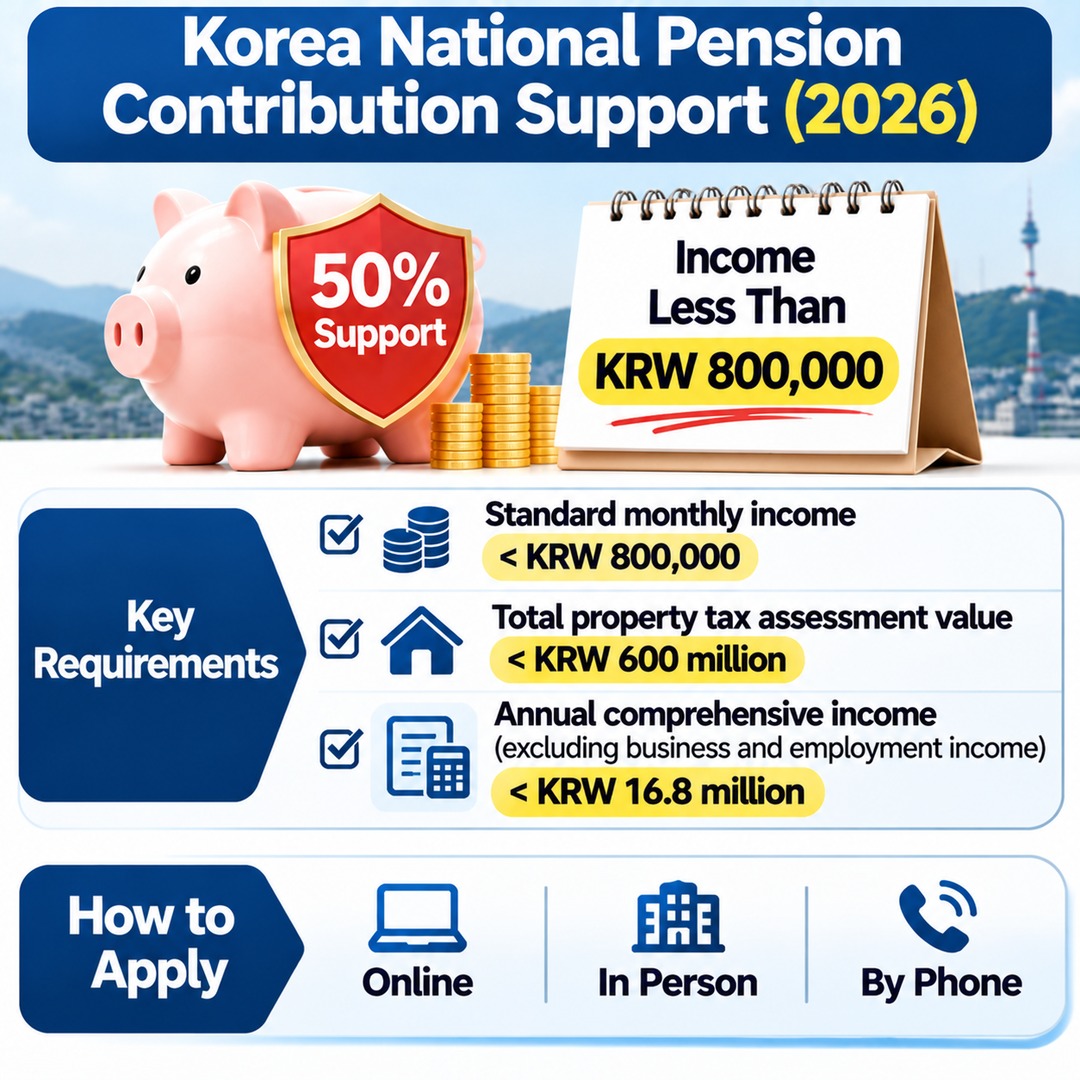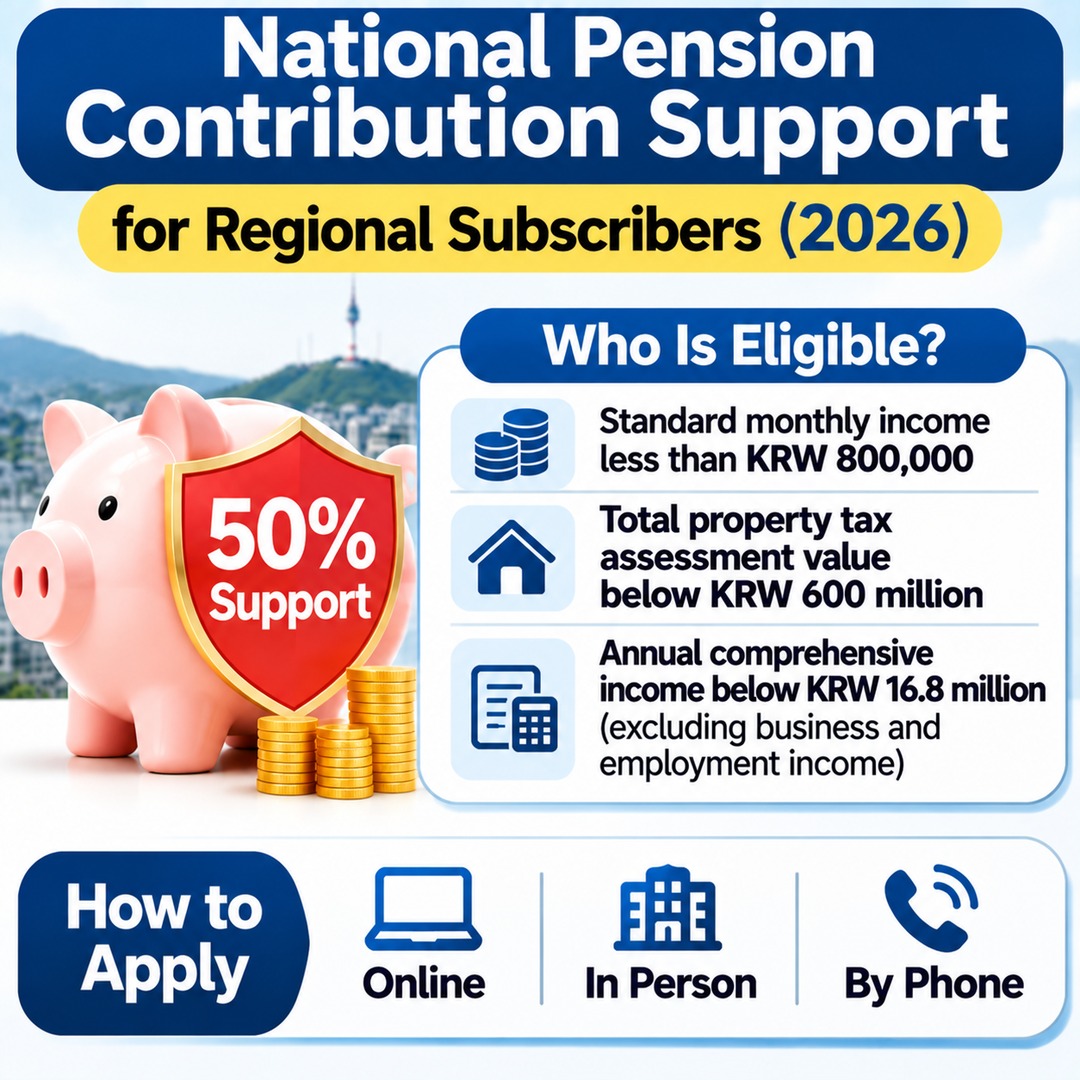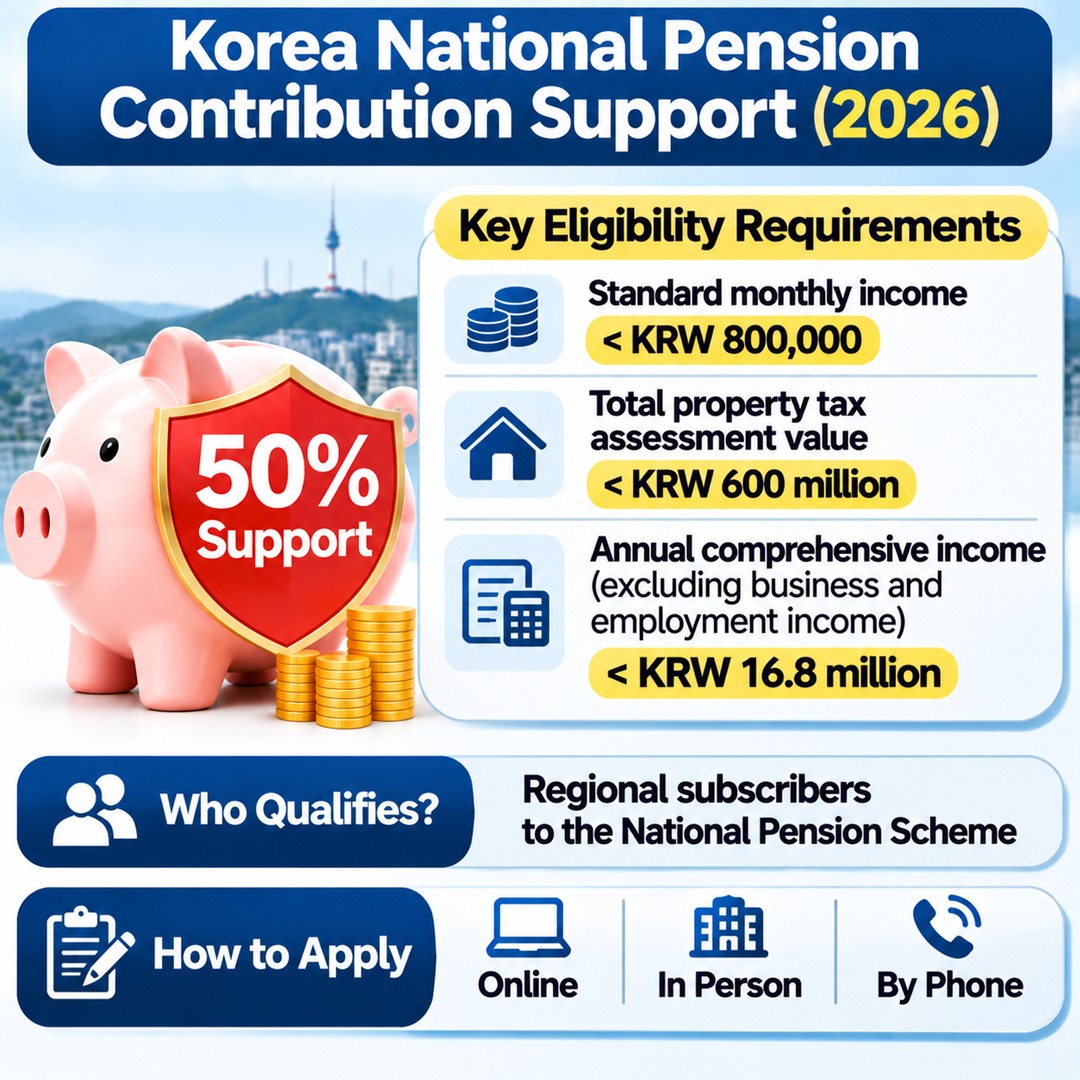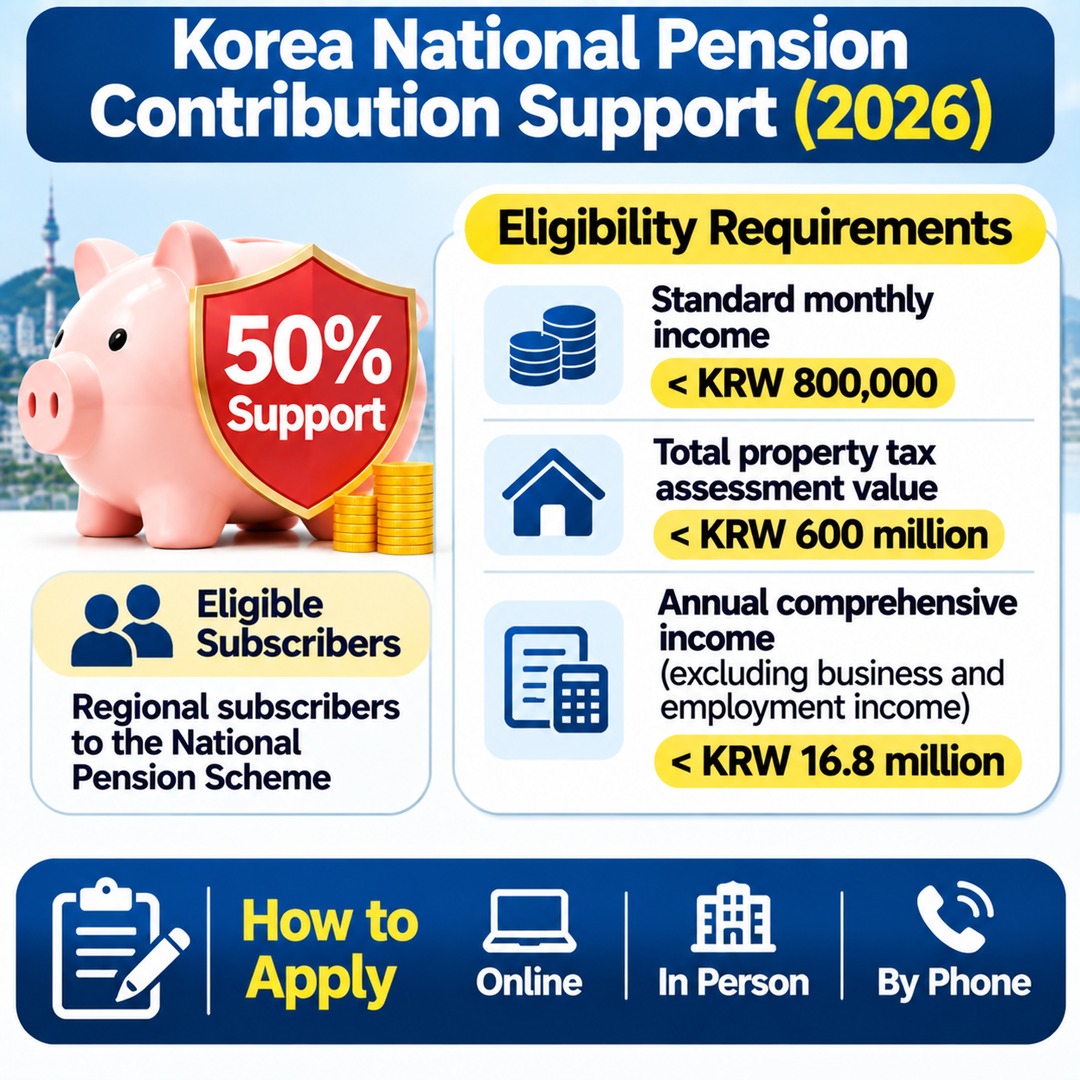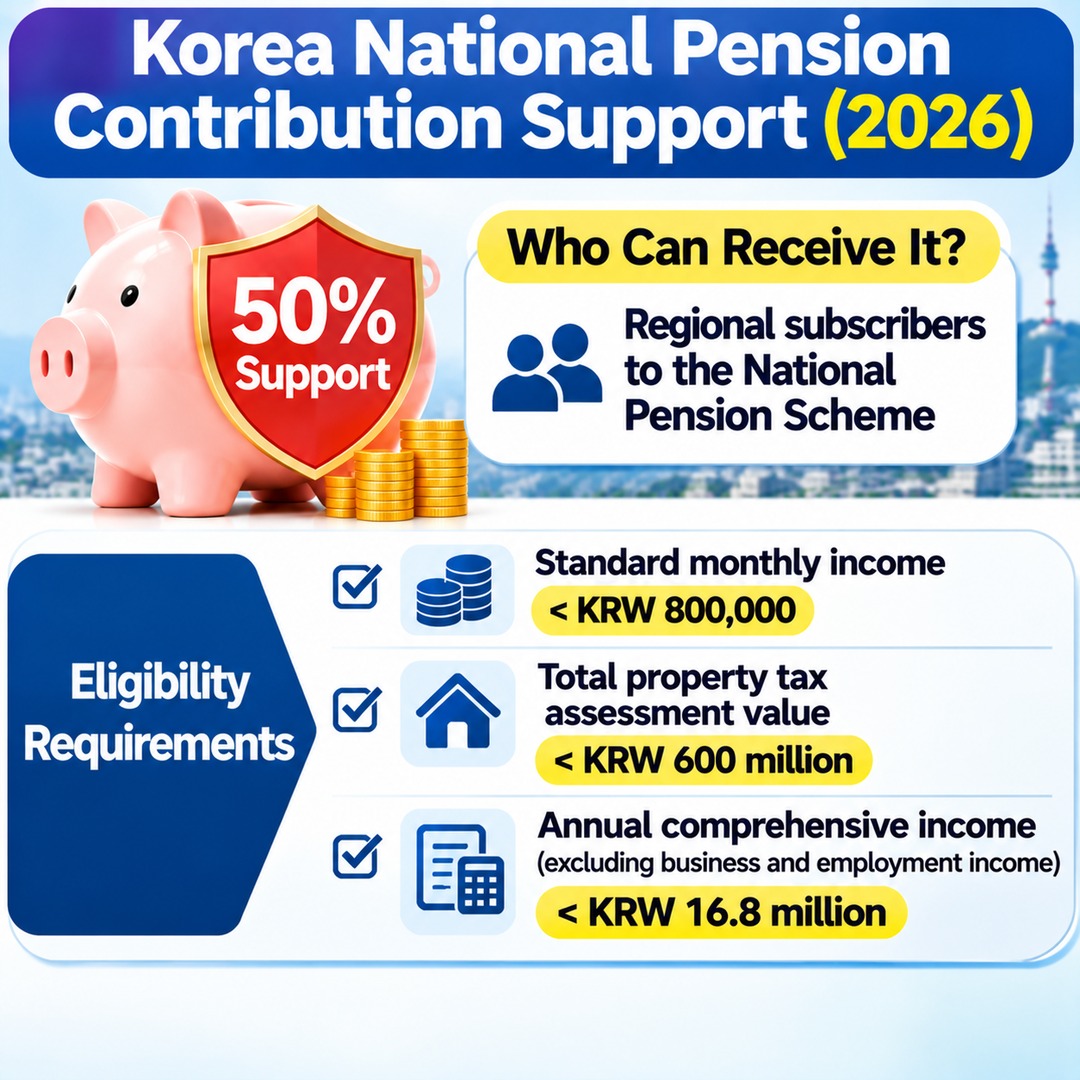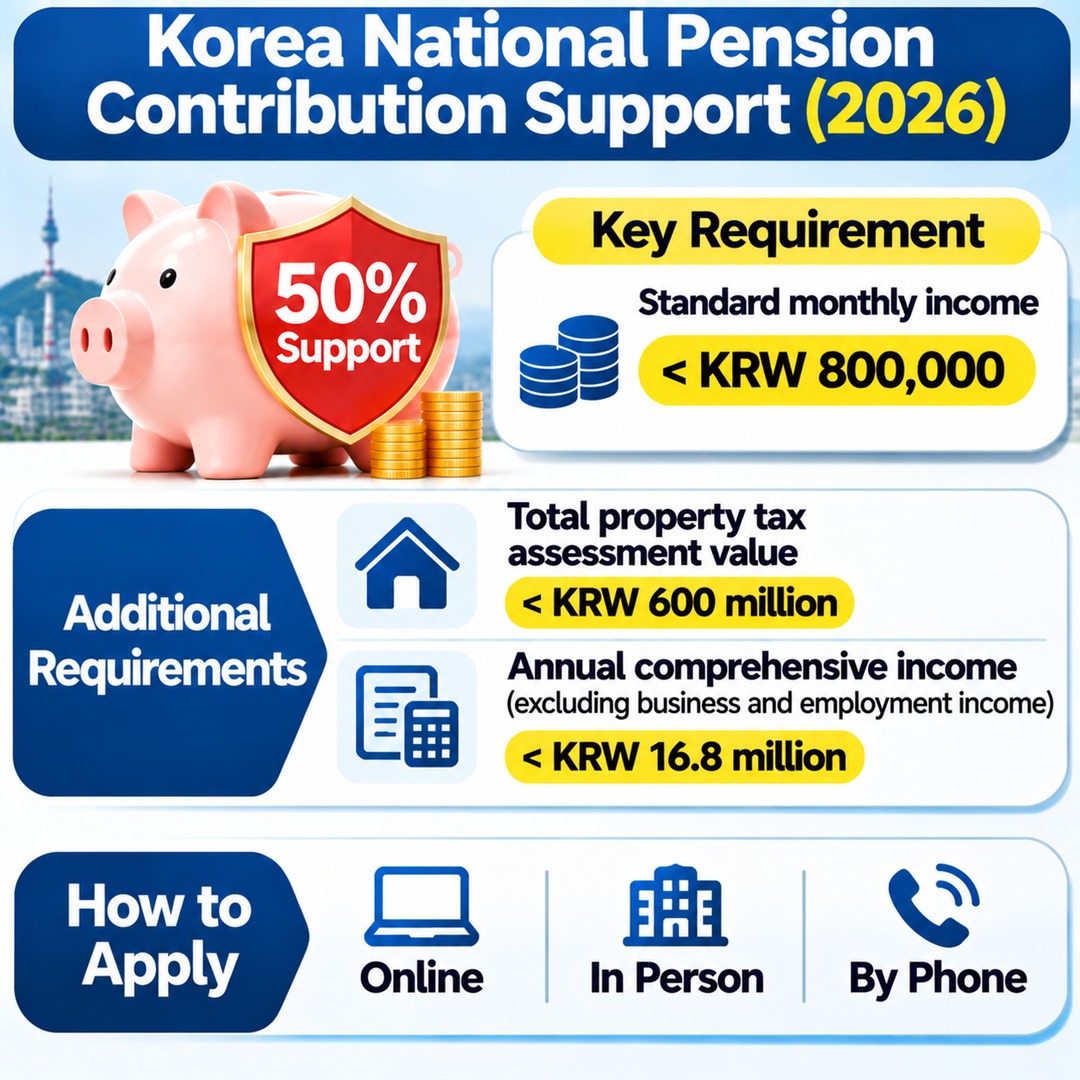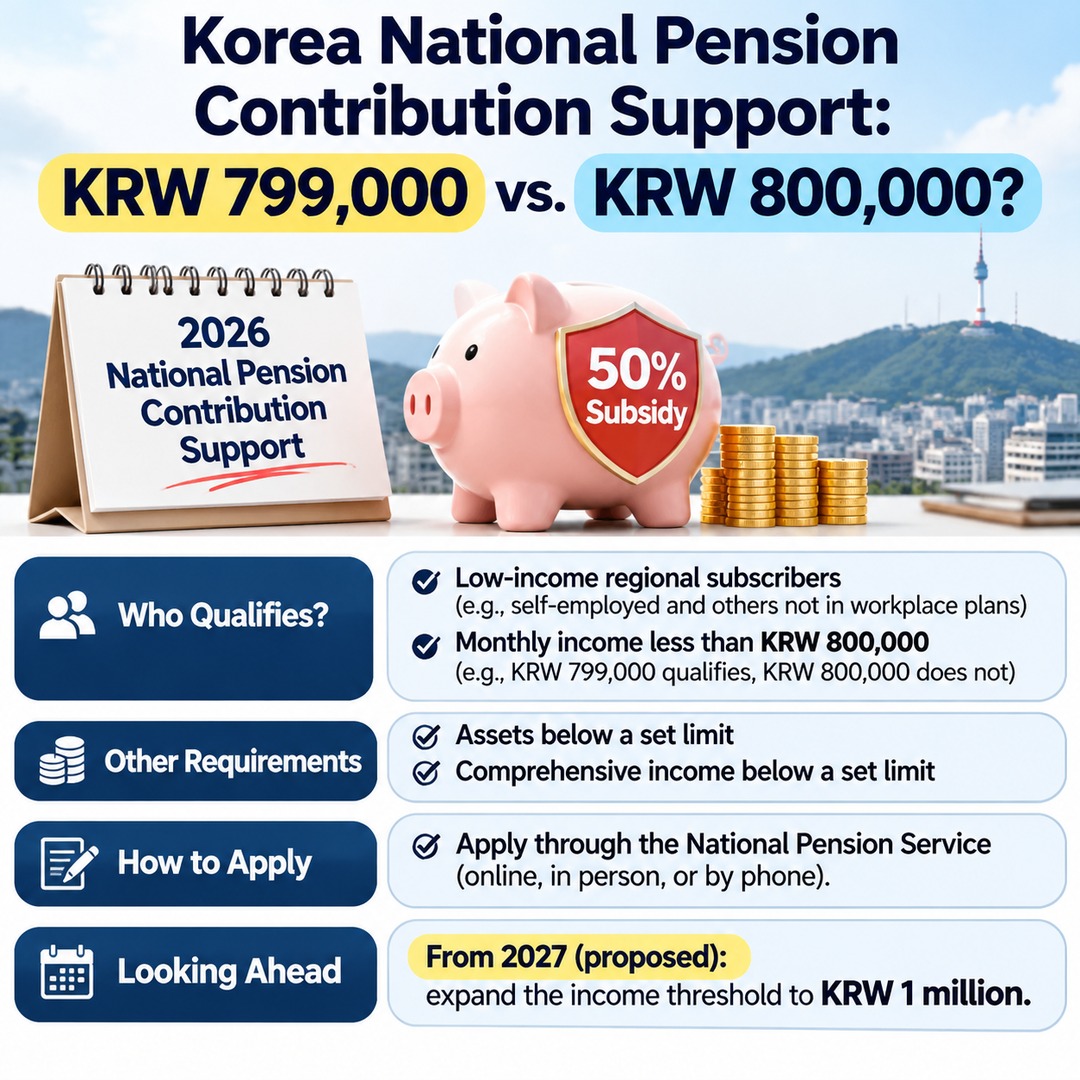
Regional subscribers to South Korea's National Pension Scheme may receive support covering 50% of their pension contributions from 2026 if their standard monthly income is less than KRW 800,000. They must also meet additional requirements, including total property tax assessment values below KRW 600 million and annual comprehensive income below KRW 16.8 million, excluding business and employment income. Applicants do not need to have previously suspended their contributions and subsequently resumed payments. Support is available for a maximum of 12 months over their lifetime.\n\nIn particular, eligibility changes depending on whether monthly income is KRW 799,000 or exactly KRW 800,000. An expansion that would raise the income threshold to less than KRW 1 million from 2027 is also being pursued, but this proposal must be distinguished from the rules currently in effect.\n\n## Who Is Eligible for National Pension Contribution Support as a Regional Subscriber?\n\nStarting in 2026, the low-income regional subscriber contribution support program was expanded. Previously, it primarily covered people who resumed contributions after receiving an exemption from payment. It now also covers regional subscribers who meet the income requirements, regardless of whether they previously received such an exemption.\n\nPeople enrolled in the National Pension Scheme as regional subscribers, including sole proprietors and freelancers, should check the following requirements:\n\n- You must be enrolled as a regional subscriber to South Korea's National Pension Scheme.\n- Your standard monthly income must be less than KRW 800,000.\n- The combined assessed value of your property for property tax purposes must be less than KRW 600 million.\n- Your annual comprehensive income, excluding business and employment income, must be less than KRW 16.8 million.\n- You must not be receiving overlapping support from another pension contribution assistance program.\n\nMeeting the monthly income requirement alone does not automatically qualify you for support.\n\nThe property and comprehensive income requirements also apply. In particular, the comprehensive income threshold excludes business and employment income, so it should not be confused with your total income.\n\n## Can You Apply from 2026 Without a Previous History of Exempt Contributions?\n\nYes. Until 2025, the program supported people who resumed paying contributions after receiving an exemption due to circumstances such as unemployment, business closure, or a leave of absence.\n\nThis requirement was removed in January 2026.\n\nFor example, the following regional subscribers may also apply if they meet the income, property, and other eligibility requirements:\n\n- Freelancers who continue paying National Pension contributions while working independently.\n- Sole proprietors whose reported income is low.\n- People with irregular income who face difficulties paying their pension contributions.\n- Low-income regional subscribers who have never previously applied for an exemption from contributions.\n\nIn other words, you no longer need to have stopped paying contributions and subsequently resumed payments to qualify.\n\nEven if you have been paying your contributions regularly, you may apply if you meet the eligibility requirements.\n\n## How Much Will You Actually Pay After Receiving the 50% Contribution Subsidy?\n\nSouth Korea's National Pension contribution rate is 9.5% in 2026. Regional subscribers are normally responsible for paying the entire contribution themselves. However, eligible low-income regional subscribers can receive support covering half of their contributions.\n\nThe following example uses a standard monthly income of KRW 799,000.\n\nFor a standard monthly income of KRW 799,000:\n\n| Item | Amount |\n| --- | ---: |\n| Monthly contribution | KRW 75,905 |\n| Government support | Approximately KRW 37,950 |\n| Subscriber's contribution after support | Approximately KRW 37,950 |\n\n*Author's calculation: Example based on the 2026 contribution rate of 9.5%, with amounts rounded down to the nearest KRW 10.*\n\nThe calculation is as follows:\n\n- Monthly contribution: KRW 799,000 × 9.5% = KRW 75,905\n- Support amount: Approximately KRW 37,950\n- Subscriber's share: Approximately KRW 37,950\n\nBecause half of the monthly contribution is subsidized, the subscriber can reduce their monthly payment by approximately KRW 38,000.\n\nHowever, the maximum monthly subsidy is capped at KRW 37,950.\n\n## What Is the Difference Between Monthly Income of KRW 799,000 and KRW 800,000?\n\nThe most important detail to understand is the requirement that monthly income must be less than KRW 800,000.\n\nThe threshold is not KRW 800,000 or less. If your standard monthly income is exactly KRW 800,000, you are excluded from the program.\n\n| Standard monthly income | Monthly contribution | Eligibility for support |\n| --- | --- | --- |\n| KRW 799,000 | Approximately KRW 75,900 | 50% support |\n| KRW 800,000 | KRW 76,000 | Not eligible |\n\nAt KRW 799,000, you can receive approximately KRW 37,950 in support. At KRW 800,000, you must pay the entire contribution yourself.\n\nAlthough the income difference is only KRW 1,000, the difference in eligibility can result in an increase of approximately KRW 38,050 in the amount you pay.\n\nThis happens because the eligibility threshold creates a cutoff at a specific income level.\n\nHowever, you must not deliberately underreport your income or report an amount that differs from your actual income. Eligibility must be determined using the standard monthly income and income and property requirements verified by the National Pension Service of Korea.\n\n## For How Many Months Can You Receive National Pension Contribution Support?\n\nSupport is available for a maximum of 12 months over each subscriber's lifetime.\n\nThis is not a program that provides a new 12-month allowance every year. Instead, there is a lifetime limit on the total number of months for which an individual can receive support.\n\nFor example, if you have already received support for five months in the past, you can receive support for a maximum of seven additional months.\n\nAfter your application is approved, you will receive a contribution notice showing the reduced amount. You must pay the full amount stated on that notice for the subsidy to be applied.\n\nTherefore, even if you have been informed that you qualify, it is important to pay the billed contribution by the payment deadline.\n\n## How Do You Apply for National Pension Contribution Support as a Regional Subscriber?\n\nIn 2026, you can apply through a National Pension Service branch or by contacting its customer service center.\n\nThe application process is as follows:\n\n1. Contact the National Pension Service customer service center at 1355 or visit a nearby branch.\n2. Check whether you qualify for low-income regional subscriber contribution support.\n3. Confirm that you meet the income and property requirements and are not receiving overlapping support.\n4. Submit your application for contribution support.\n5. Check the contribution notice showing the subsidy deduction and pay the remaining amount.\n\nApplications can be submitted not only in person at a National Pension Service branch but also by telephone, postal mail, or fax.\n\nSince June 2026, applications have also been available through the National Pension Service mobile application and official website.\n\nHowever, the available online procedures may vary depending on the application interface and your subscriber category. It is advisable to confirm the process with the customer service center at 1355 before applying.\n\n## Will the Income Threshold Be Expanded to Less Than KRW 1 Million in 2027?\n\nThe expansion currently being pursued would increase the monthly income eligibility threshold from less than KRW 800,000 to less than KRW 1 million.\n\nThe National Pension Service has announced that it is pursuing the inclusion of this proposal in the government's 2027 budget plan.\n\nIf implemented, regional subscribers with monthly incomes of KRW 800,000 or more but less than KRW 1 million, who are currently ineligible under the existing threshold, could become eligible for support.\n\nHowever, a proposed expansion must be distinguished from an actual policy change and implementation.\n\nThe currently available information is as follows:\n\n- 2026 eligibility threshold: Monthly income below KRW 800,000.\n- Proposed expanded threshold: Monthly income below KRW 1 million.\n- Target: Inclusion in the government's 2027 budget plan.\n- Implementation and specific subsidy amounts: Not yet confirmed.\n\nTherefore, if your monthly income is between KRW 800,000 and KRW 1 million, you should not assume that you are currently eligible for support. Check whether the policy has actually been revised and when any changes will take effect.\n\n## What Should You Check Before Applying for National Pension Contribution Support?\n\nChecking the following four requirements can help you determine whether you may qualify for support:\n\n- Are you currently enrolled in South Korea's National Pension Scheme as a regional subscriber?\n- Is your standard monthly income below KRW 800,000?\n- Is the combined assessed value of your property for property tax purposes below KRW 600 million?\n- Is your annual comprehensive income, excluding business and employment income, below KRW 16.8 million?\n\nIf you are receiving support through the Unemployment Credit program or the pension contribution support program for farmers and fishers, you should also check the restrictions on receiving overlapping assistance.\n\nThe biggest change in 2026 is that regional subscribers can now apply for National Pension contribution support even if they have never previously received an exemption from contributions. Check the monthly income threshold of less than KRW 800,000, along with the property and comprehensive income requirements. If you appear to qualify, contact the National Pension Service at 1355 to ask about the application process.\n\n*Note: This article is for informational purposes only and is intended to help readers understand market conditions. It does not constitute a recommendation to invest in any particular stock or asset. All investment decisions and related responsibilities rest with the individual.*