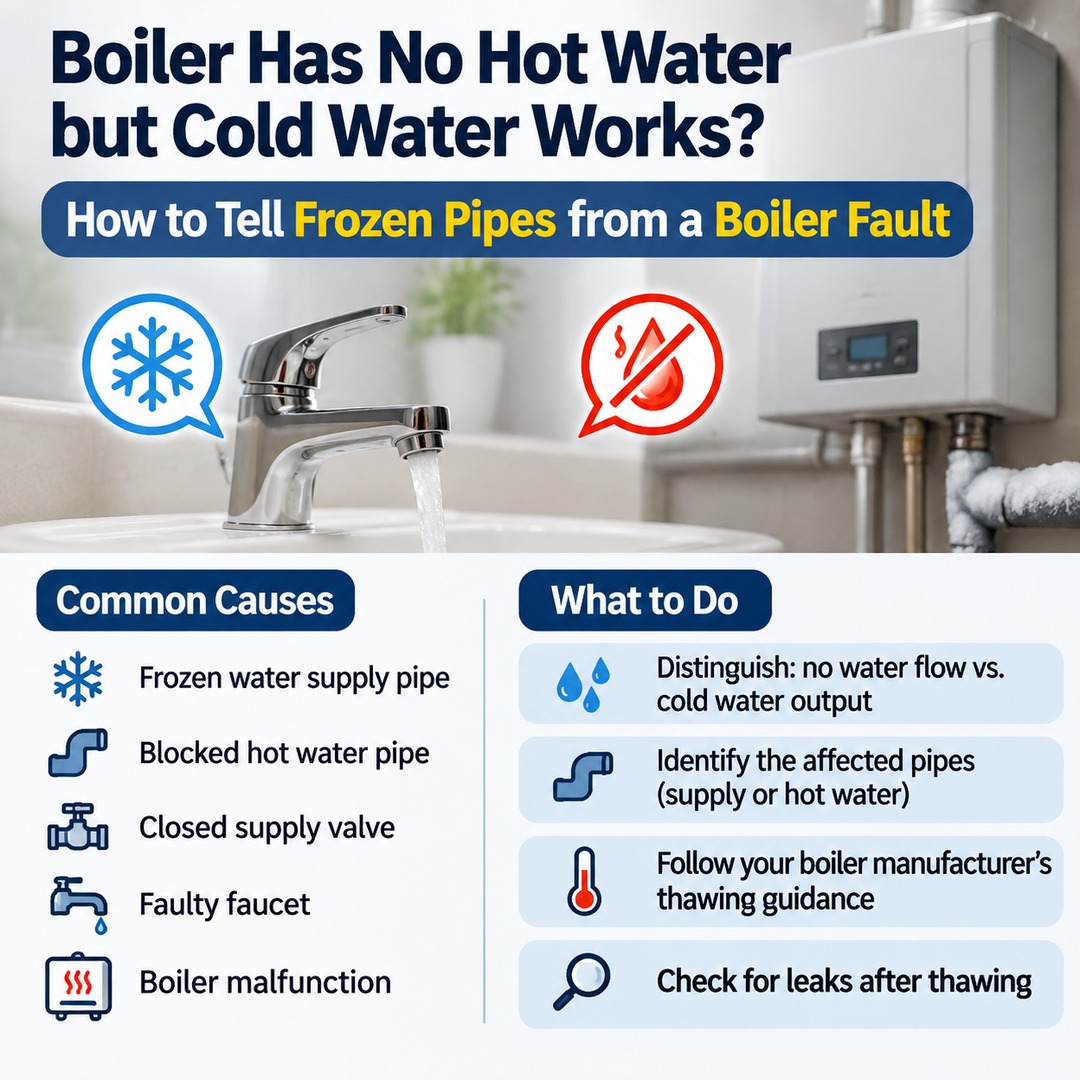
If cold water flows normally but no hot water comes out, you do not necessarily need to suspect a boiler malfunction first. If the problem occurs suddenly after temperatures drop, the cold water supply pipe connected to the boiler or the hot water pipe may be frozen. Start by checking whether no water comes out at all when you turn the faucet to the hot water position, whether water flows but remains cold, and whether the same problem occurs at every faucet in your home. These observations can help narrow down the cause.
Why Does Cold Water Work While Hot Water Does Not?
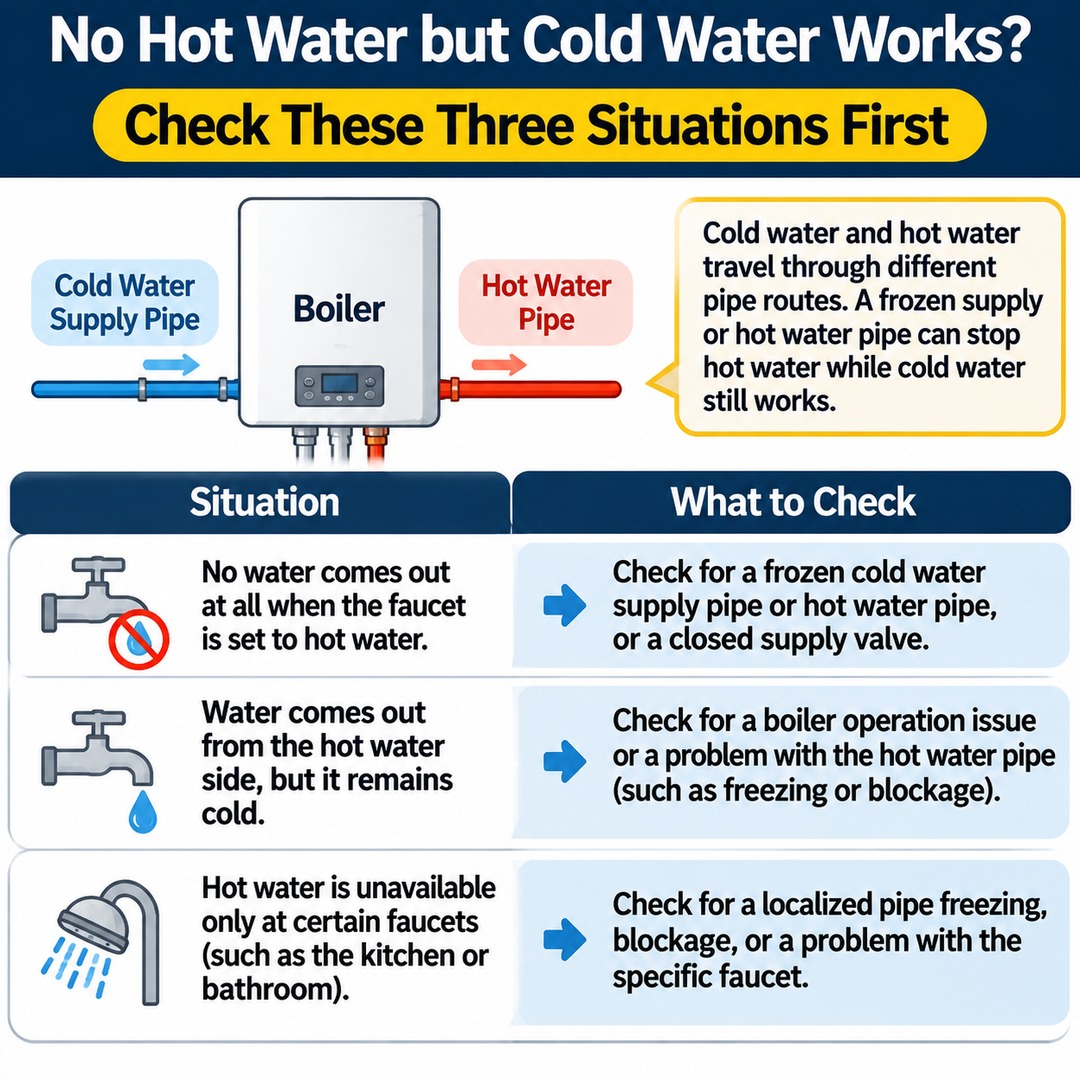
Cold water and hot water travel through different pipe routes. Therefore, normal cold water flow does not necessarily mean that the hot water pipes are also working properly. In homes with individual gas boilers, a frozen cold water supply pipe leading into the boiler or a frozen hot water outlet pipe can interrupt hot water supply while cold water remains available.
During winter, it is particularly important to distinguish between these three situations:
No water comes out at all when the faucet is turned to the hot water position.
Water comes out from the hot water side, but it remains cold.
Hot water is unavailable only at certain faucets, such as the kitchen or bathroom.
Each situation requires a different inspection approach.
What If No Water Comes Out at All from the Hot Water Side?
If the water flow stops or no water comes out when you turn the faucet to the hot water position, first check for frozen supply or hot water pipes and make sure the relevant valves are not closed.
If the boiler cannot receive the water it needs to operate, or if the pipe carrying hot water away from the boiler is blocked, hot water will not flow from the faucet.
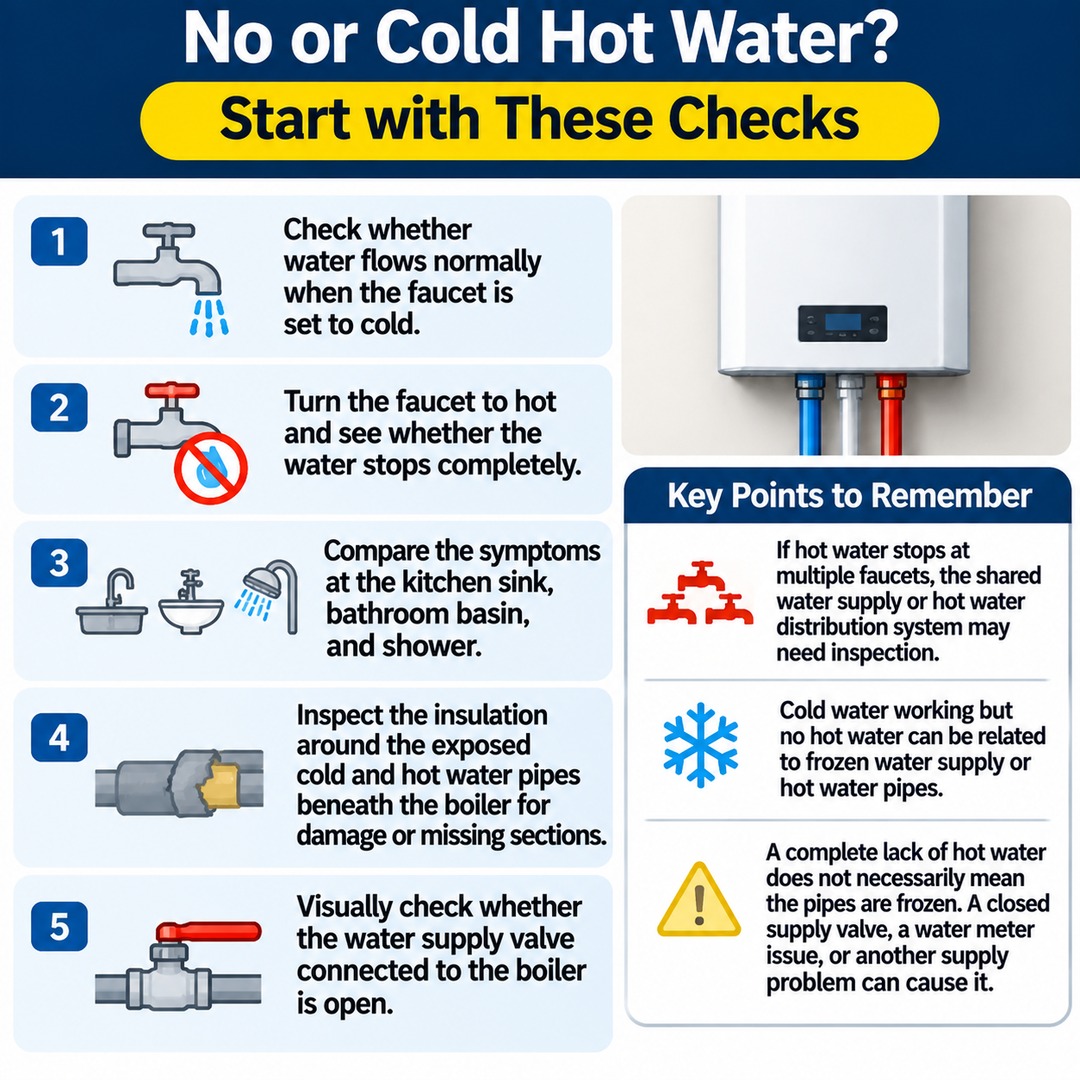
Start with the following checks:
1. Check whether water flows normally when the faucet is set to cold.
2. Turn the faucet to hot and see whether the water stops completely.
3. Compare the symptoms at the kitchen sink, bathroom basin, and shower.
4. Inspect the insulation around the exposed cold water supply and hot water pipes beneath the boiler for damage or missing sections.
5. Visually check whether the water supply valve connected to the boiler is closed.
If hot water stops flowing simultaneously from several faucets, the shared water supply or hot water distribution system may need inspection.
Daesung Celtic's official freeze-prevention guidance also identifies situations in which cold water flows but hot water does not as potentially related to frozen water supply or hot water pipes.
However, a complete lack of hot water flow does not necessarily mean the pipes are frozen. A closed direct water supply valve, a problem with the water meter, or another issue in the water supply system can produce similar symptoms.
If Water Flows but Remains Cold, Check the Boiler
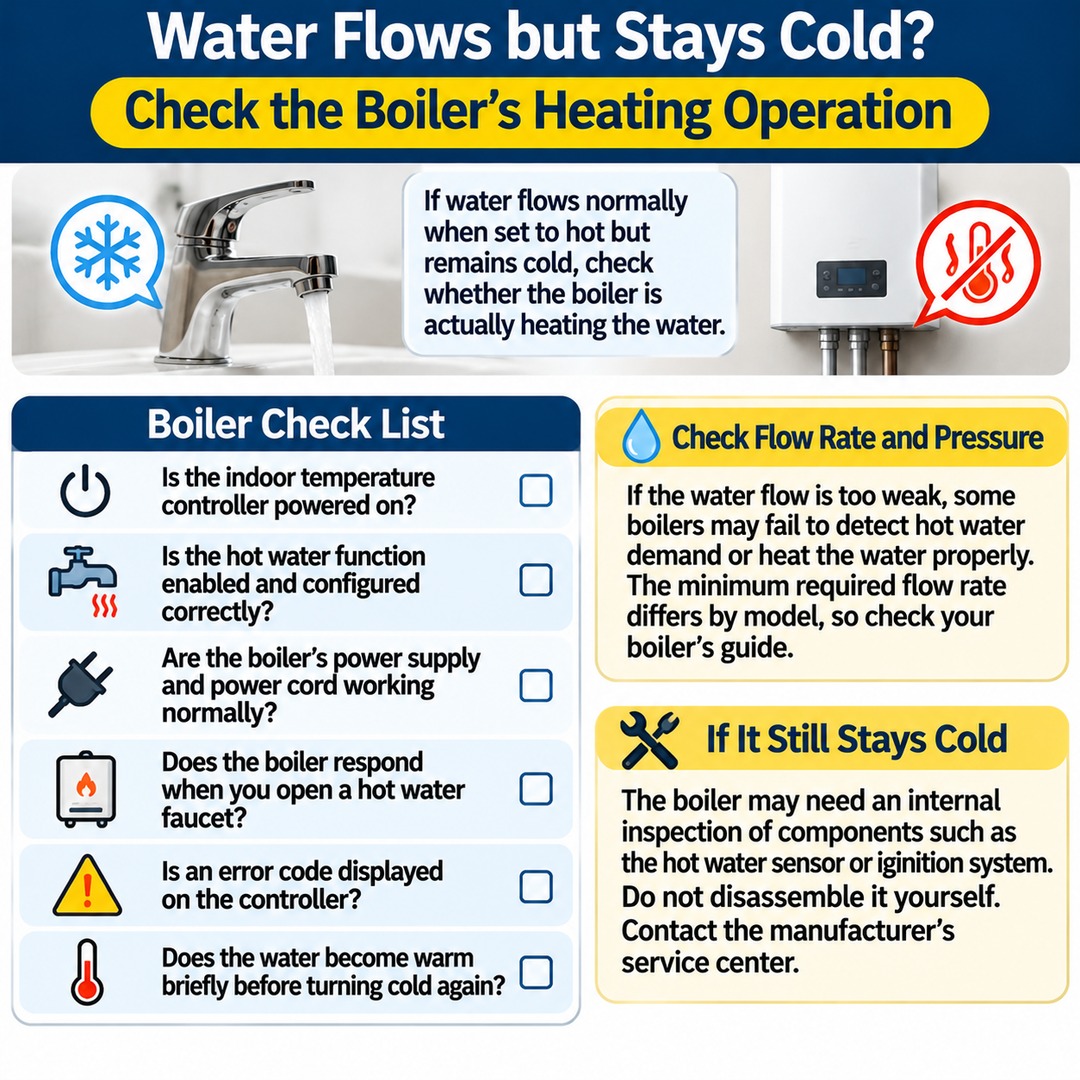
If water flows normally even when the faucet is set to hot, but the water remains cold, this is different from a situation in which a completely frozen pipe has blocked the flow.
In this case, it is important to check whether the boiler is actually heating the water.
First, make sure the indoor temperature controller is powered on. If the hot water function is switched off or incorrectly configured, water may still flow without being heated to the desired temperature.
Also check the following:
Is the hot water function enabled and configured correctly?
Are the boiler's power supply and power cord working normally?
Does the boiler respond when you open a hot water faucet?
Is an error code displayed on the controller?
Does the water become warm briefly before turning cold again?
Daesung Celtic's product-specific self-diagnosis guidance recommends checking the hot water settings, direct water supply flow rate, and water pressure when the water remains cold.
Some boilers may also fail to detect hot water demand or heat the water properly if the water flow is too weak. However, the minimum required flow rate differs by model, so you should not apply specifications from another model to your own boiler.
If the water remains cold after these checks, the boiler may require an internal inspection of components such as the hot water sensor or ignition system. Do not disassemble internal components yourself. Contact the manufacturer's service center instead.
What If the Kitchen Has Hot Water but the Bathroom Does Not?
It is also important to compare whether the same problem occurs at every faucet in your home.
If the problem is limited to one location, you should inspect not only the boiler itself but also the affected faucet and its connecting pipes.
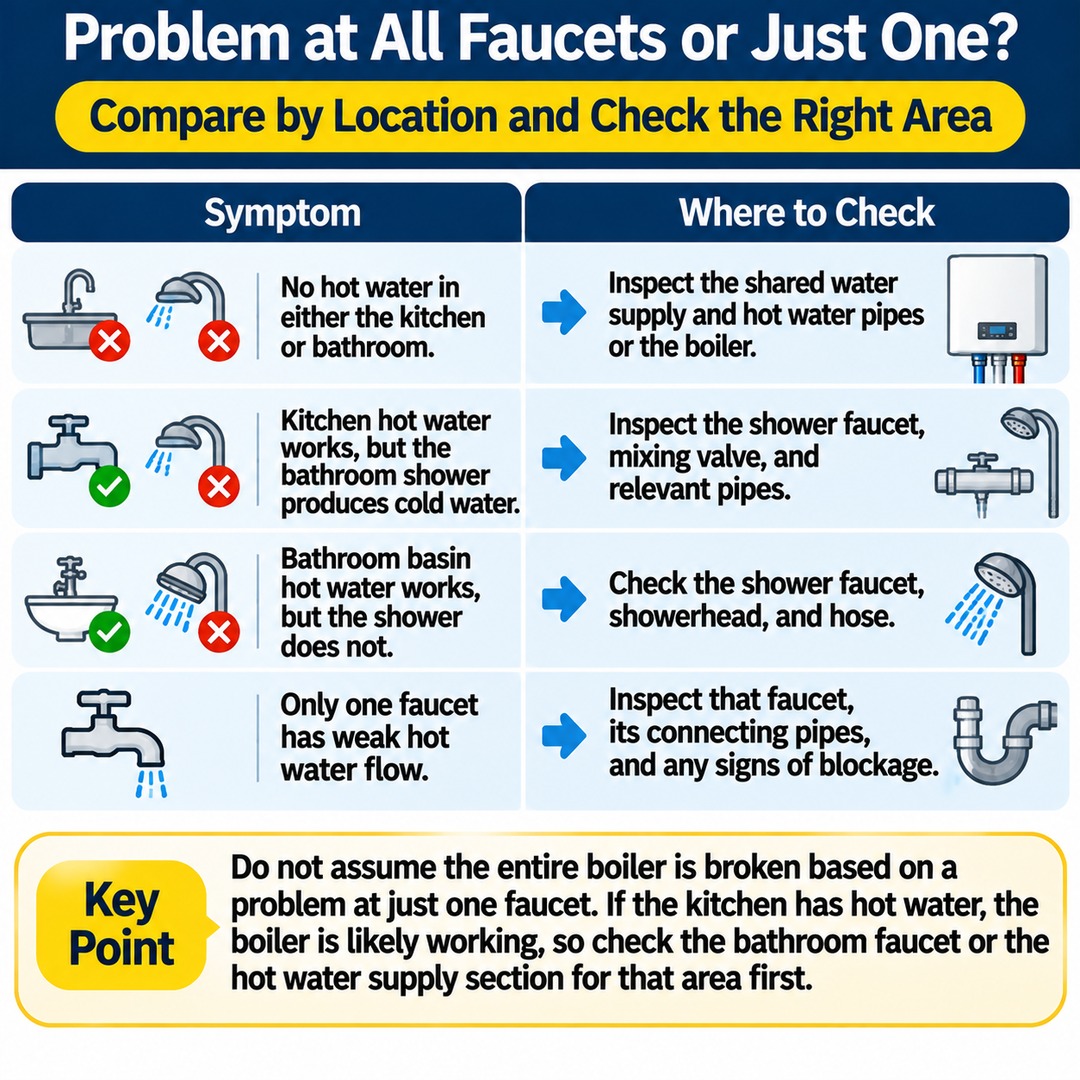
For example, the following symptoms can help narrow down the problem:
No hot water in either the kitchen or bathroom: Inspect the shared water supply and hot water pipes or the boiler.
Kitchen hot water works, but the bathroom shower produces cold water: Inspect the shower faucet, mixing valve, and relevant pipes.
Bathroom basin hot water works, but the shower does not: Check the shower faucet, showerhead, and hose.
Only one faucet has weak hot water flow: Inspect that faucet, its connecting valve, and its pipes.
The important point is not to conclude that the entire boiler is broken based on symptoms at just one faucet.
For example, if hot water flows normally in the kitchen, this confirms that the boiler is producing hot water. If the problem occurs only in the bathroom, it is more reasonable to inspect the bathroom faucet or the hot water supply section serving that area first.
What If Neither Cold nor Hot Water Flows?
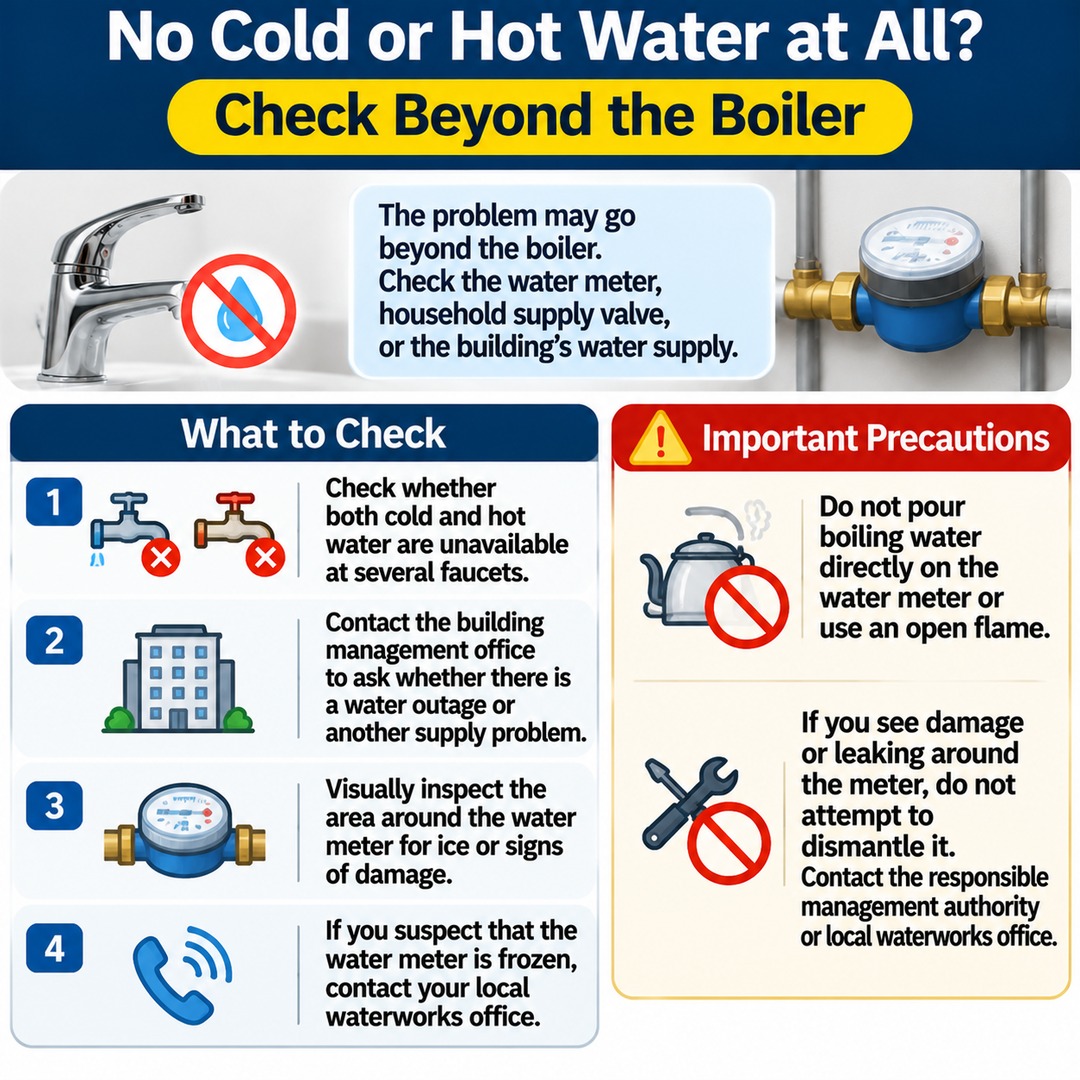
If cold water is also unavailable, the problem may extend beyond the pipes beneath the boiler.
You may need to check the water meter, the household water supply valve, or the building's overall water supply.
Follow these steps:
1. Check whether both cold and hot water are unavailable at several faucets throughout the home.
2. Contact the building management office to ask whether there is a water outage or another supply problem.
3. Visually inspect the area around the water meter for ice or signs of damage.
4. If you suspect that the water meter is frozen, contact your local waterworks office.
Daesung Celtic's freeze-response guidance also distinguishes situations in which neither cold nor hot water flows from problems involving a frozen water meter or water supply pipes.
If the water meter is frozen, do not pour boiling water directly onto it or heat it with an open flame. Sudden temperature changes can damage the meter. If you see damage or leaking around the meter, do not attempt to dismantle it. Contact the responsible management authority or local waterworks office.
How Should You Thaw Frozen Boiler Pipes?
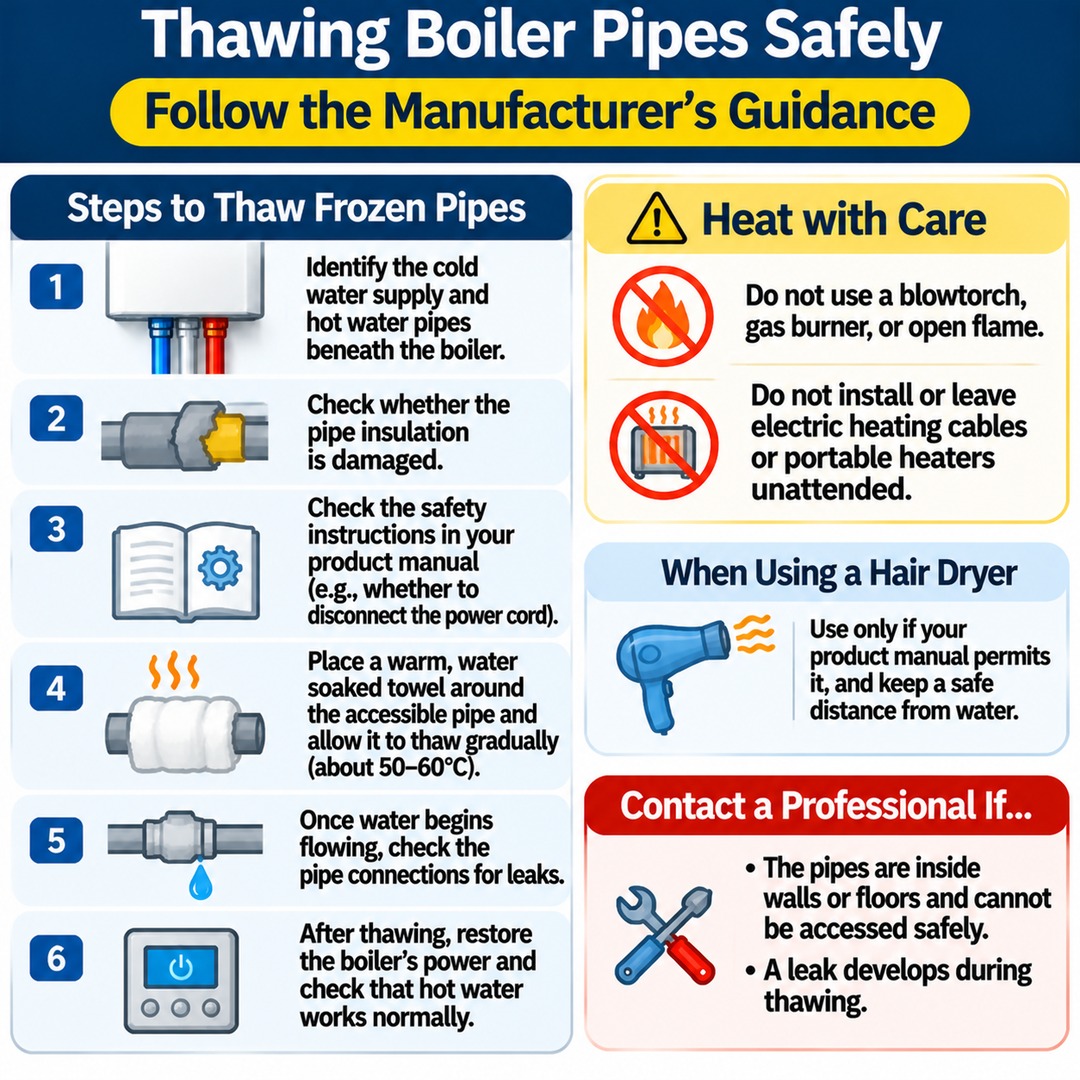
Even if you suspect frozen pipes, do not apply excessive heat. Follow the manufacturer's recommended thawing procedure and the safety instructions for your specific boiler model.
Kiturami recommends repeatedly wrapping frozen pipes with towels soaked in warm water at approximately 50–60°C.
If the exposed pipes are safely accessible, you can take the following steps:
1. Identify the cold water supply and hot water pipes beneath the boiler.
2. Check whether the pipe insulation is damaged.
3. Check the safety instructions in your product manual, including whether the power cord should be disconnected.
4. Place a warm, water-soaked towel around the accessible pipe and allow it to thaw gradually.
5. Once water begins flowing, check the pipe connections for leaks.
6. After thawing is complete, restore the pipe insulation to its original condition.
Some manufacturers also provide instructions for using a hair dryer to thaw frozen pipes. However, using electrical appliances in areas where they may come into contact with water is dangerous. Only use this method if your product manual permits it and you can maintain a safe distance from water.
Avoid direct heating with a blowtorch, gas burner, or open flame. Electric heating cables and portable heaters also present fire risks, so do not install or leave them unattended without proper guidance.
If the pipes are concealed inside walls or floors and cannot be accessed safely, or if a leak develops during thawing, stop the work and contact a professional plumbing or heating service.
What If Hot Water Still Does Not Work After Thawing?
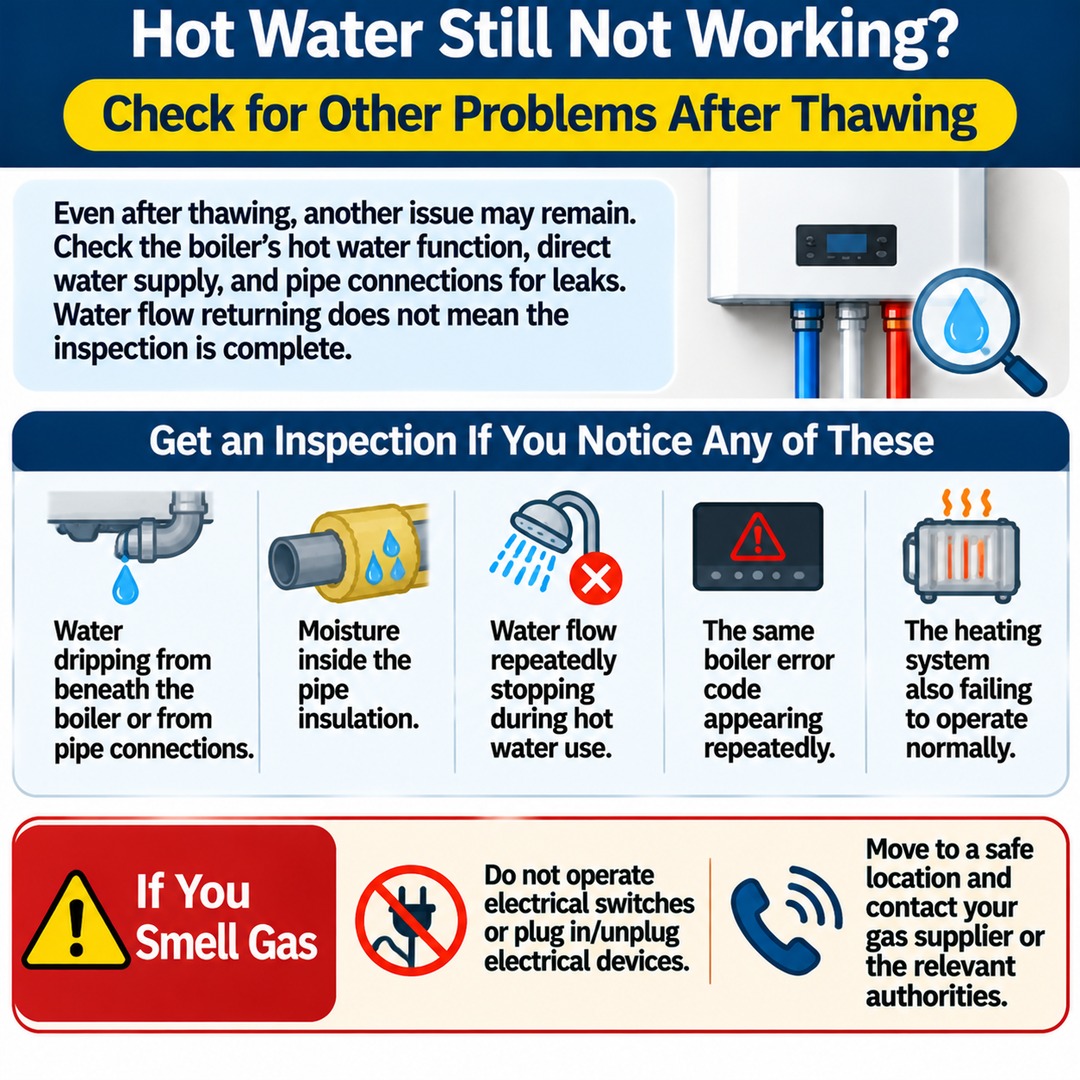
If hot water remains unavailable even after the pipes have been thawed, another problem may still be present in addition to the freezing issue.
You should also check the boiler's hot water function, direct water supply, and pipe connections for leaks.
In particular, water starting to flow again does not mean the inspection is complete. Frozen pipes or their connecting sections may have developed cracks, allowing water to leak after thawing.
Stop using the system and arrange an inspection if you notice any of the following:
Water dripping from beneath the boiler or from pipe connections.
Moisture inside the pipe insulation.
Water flow repeatedly stopping during hot water use.
The same boiler error code appearing repeatedly.
The heating system also failing to operate normally.
If you smell gas or notice an unusual combustion odor around the boiler, stop routine self-inspection. If you smell gas, do not operate electrical switches or unplug or plug in electrical devices. Move to a safe location and contact your gas supplier or the relevant authorities.
How Do Boiler Manufacturers Differ in Their Frozen-Pipe Guidance?
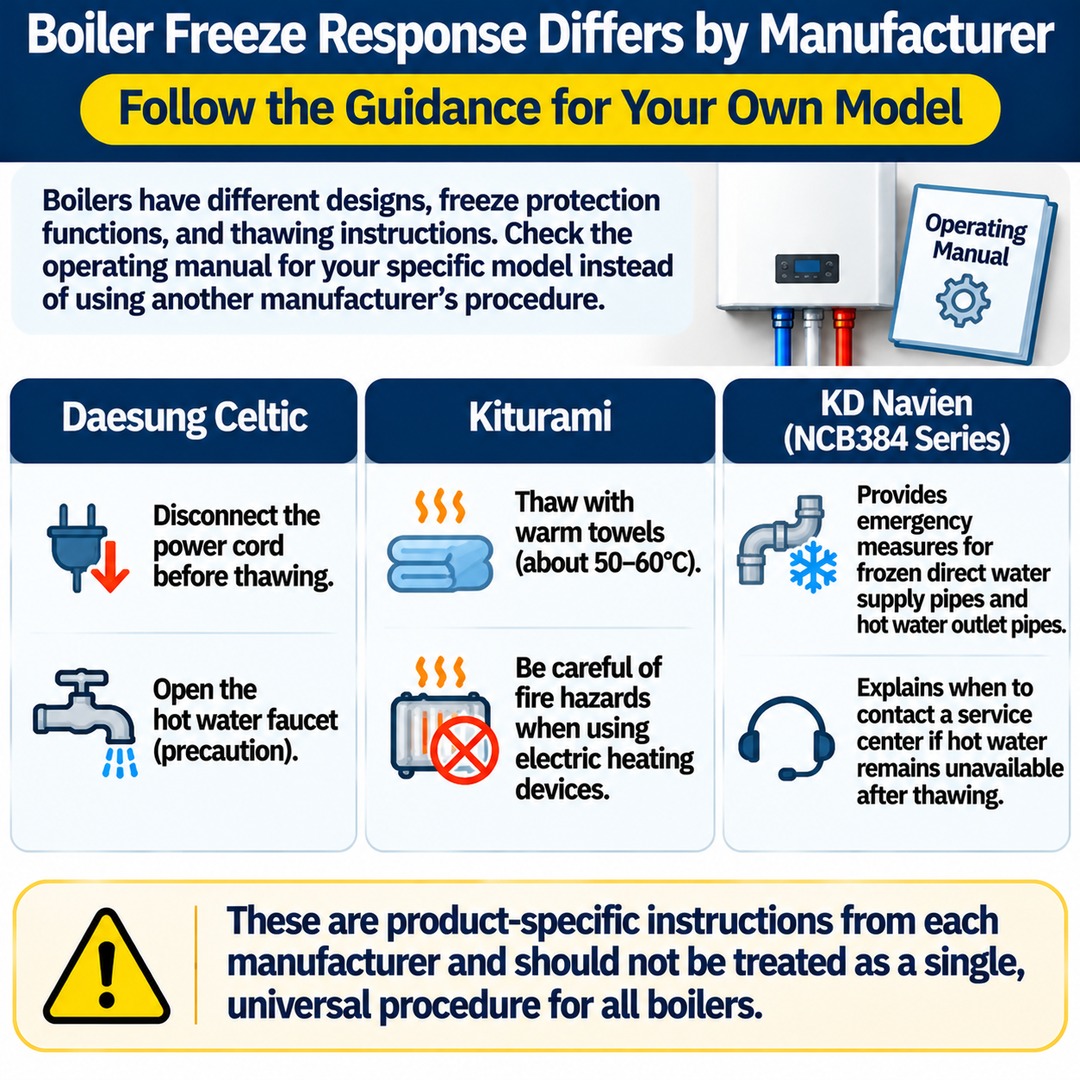
Boiler manufacturers have different product designs, freeze-protection functions, and thawing instructions. Rather than applying another manufacturer's procedures to your boiler, check the operating manual for your specific model.
| Manufacturer | Information Available in Official Guidance |
|---|---|
| Daesung Celtic | Thawing instructions for frozen water supply and hot water pipes, with product-specific safety precautions |
| Kiturami | Repeated thawing using warm towels soaked in water at 50–60°C |
| KD Navien | Instructions for thawing direct water supply pipes and hot water outlet pipes, with advice to contact a service center |
In its freeze-response procedures, Daesung Celtic advises disconnecting the power cord before thawing and opening the hot water faucet, among other precautions. Kiturami recommends thawing with warm towels and warns about fire hazards when using electric heating devices.
The operating manual for KD Navien's NCB384 series includes emergency measures for frozen direct water supply pipes and hot water outlet pipes. It also explains when to contact a service center if hot water remains unavailable after thawing.
These instructions apply to the specific products and guidance provided by each manufacturer. They should not be interpreted as one universal procedure suitable for every boiler.
How Can You Prevent Boiler Pipes from Freezing in Winter?
It is better to inspect pipe insulation in advance than to wait until pipes freeze and then attempt to thaw them.
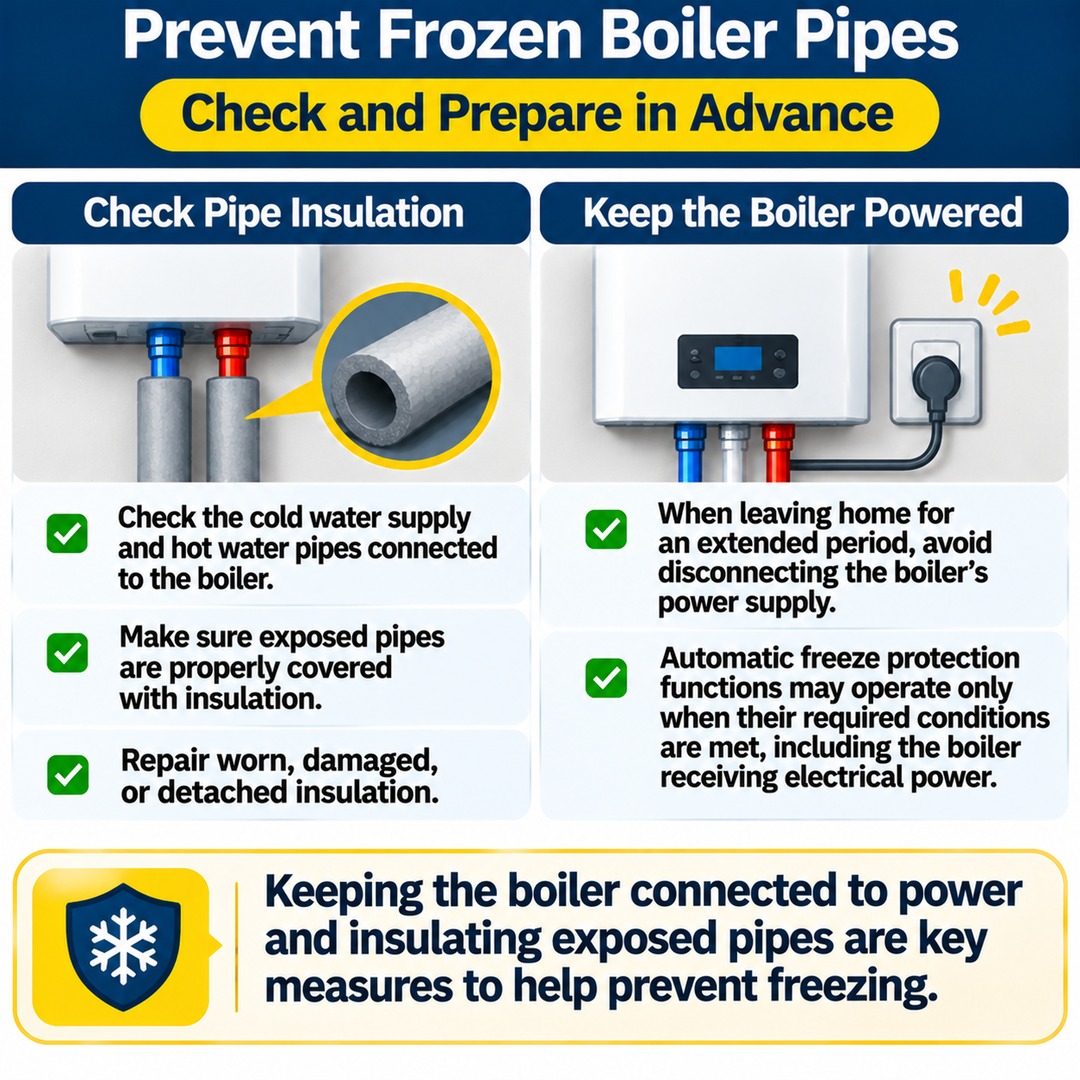
If the cold water supply and hot water pipes connected to your boiler are exposed outdoors, check whether they are properly covered with insulation. Worn, damaged, or detached insulation should be repaired.
When leaving home for an extended period, avoid automatically disconnecting the boiler's power supply. Automatic freeze-protection functions may operate only when their required conditions are met, including the boiler receiving electrical power.
Daesung Celtic and KD Navien also identify keeping the boiler connected to power and insulating exposed pipes as important freeze-prevention measures.
Frequently Asked Questions
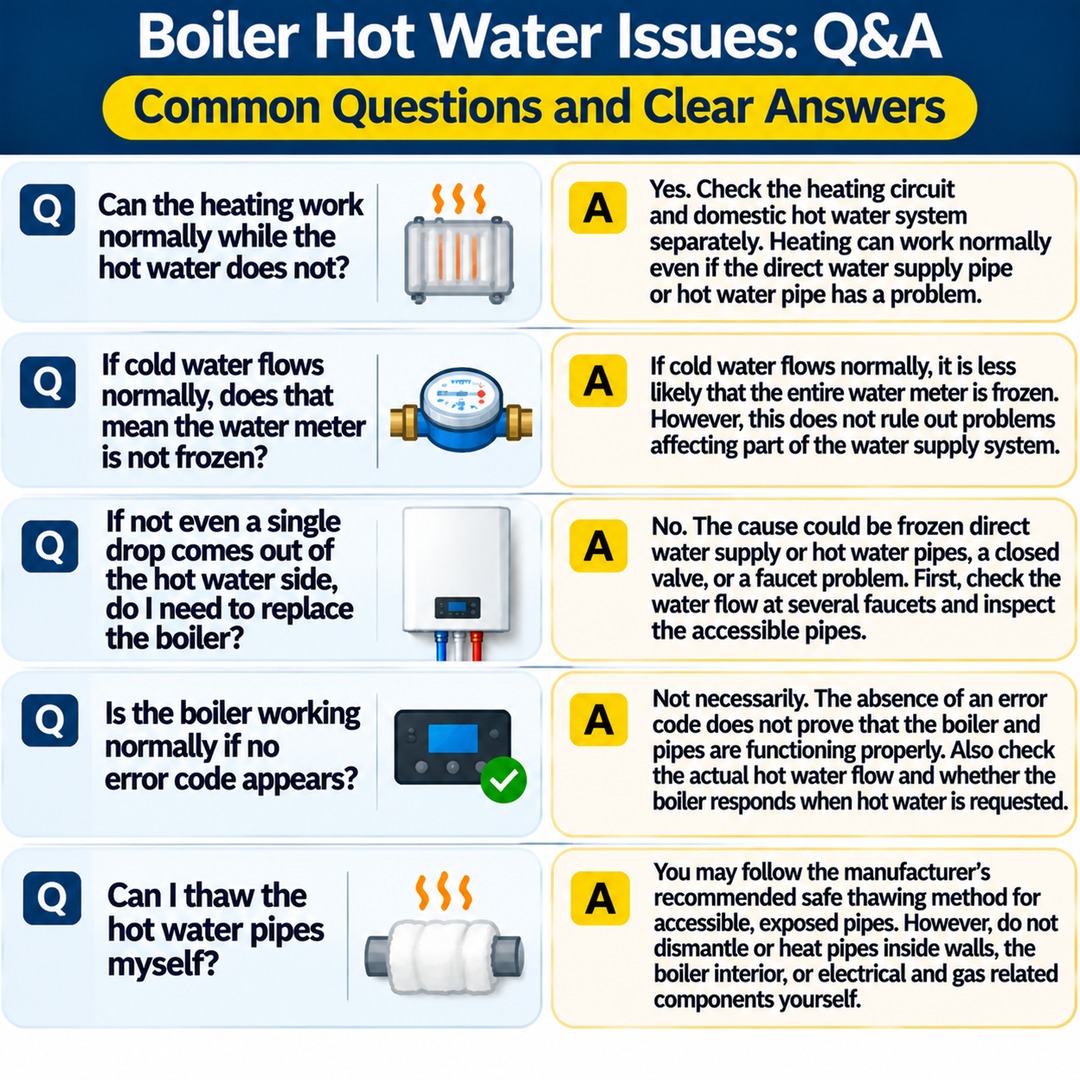
Q. Can the heating work normally while the hot water does not?
Yes. The heating circuit and domestic hot water system should be checked separately. Even if the heating system operates normally, a problem with the direct water supply pipe or hot water pipe can prevent you from using hot water.
Q. If cold water flows normally, does that mean the water meter is not frozen?
If cold water flows normally, it is less likely that the entire water meter is frozen to the point of completely stopping the water supply. However, this does not rule out problems affecting part of the water supply system.
Q. If not even a single drop comes out of the hot water side, do I need to replace the boiler?
No. The cause could be frozen direct water supply or hot water pipes, a closed valve, or a faucet problem. First, check the water flow at several faucets and inspect the accessible pipes.
Q. Is the boiler working normally if no error code appears?
Not necessarily. The absence of an error code does not prove that the boiler and pipes are functioning properly. You should also check the actual hot water flow and whether the boiler responds when hot water is requested.
Q. Can I thaw the hot water pipes myself?
You may follow the manufacturer's recommended safe thawing method for accessible, exposed pipes. However, do not dismantle or heat pipes inside walls, the boiler interior, or electrical and gas-related components yourself.