If you were charged a subscription fee after a free trial of an OTT streaming service, music platform, e-book service, or similar product ended, the first things to check are whether you consented to the paid conversion and whether the provider gave you the required advance notice. Since February 14, 2025, when a free service converts to a paid recurring subscription, the provider must obtain consumer consent and disclose the price and cancellation conditions within the 30-day period before the conversion. However, simply registering a payment method when signing up for a free trial does not necessarily constitute separate consent to the paid conversion.
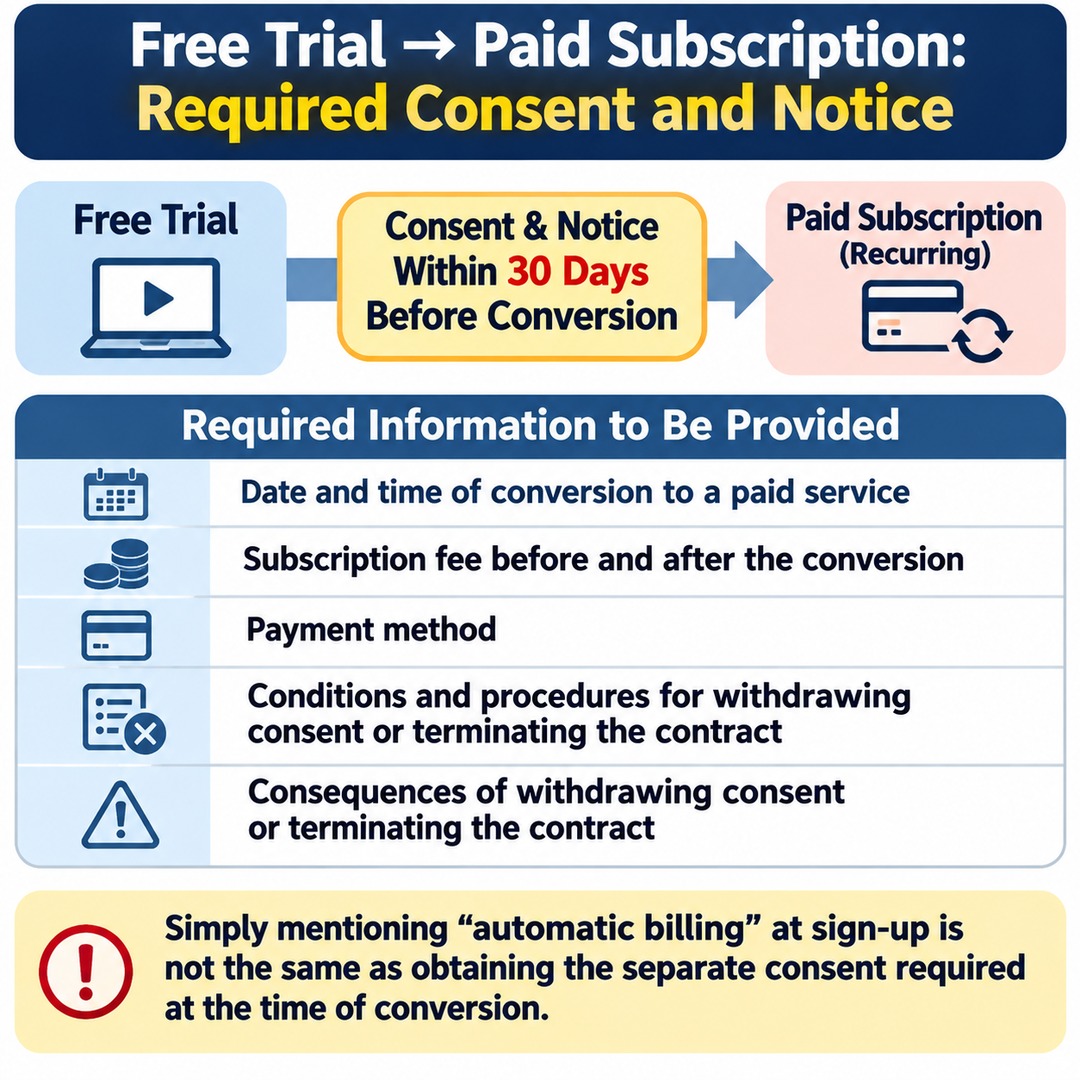
Why Paid Subscription Conversions Require Consent Within 30 Days
A business that provides a free service and then converts it into a paid recurring subscription must obtain the consumer's consent before the conversion. This requirement is set out in Article 13(6) of South Korea's Electronic Commerce Act and Article 20-2 of its Enforcement Decree.
An important distinction is that obtaining consent at least 30 days in advance is not the same as obtaining consent within 30 days before the conversion.
The legally prescribed period is the 30 days preceding the paid conversion. In other words, the required consent and disclosures must take place within the 30-day period before the conversion date.
The provider must inform consumers of the following:
The date and time when the free service will convert to a paid service
The subscription fee before and after the conversion
The payment method
The conditions and procedures for withdrawing consent to the paid conversion or terminating the contract
The consequences of withdrawing consent or terminating the contract
Simply mentioning the possibility of automatic billing when a consumer signs up for a free trial must be distinguished from obtaining the separate consent required when the service actually converts to a paid subscription.
Does Registering a Credit Card for a Free Trial Count as Consent?
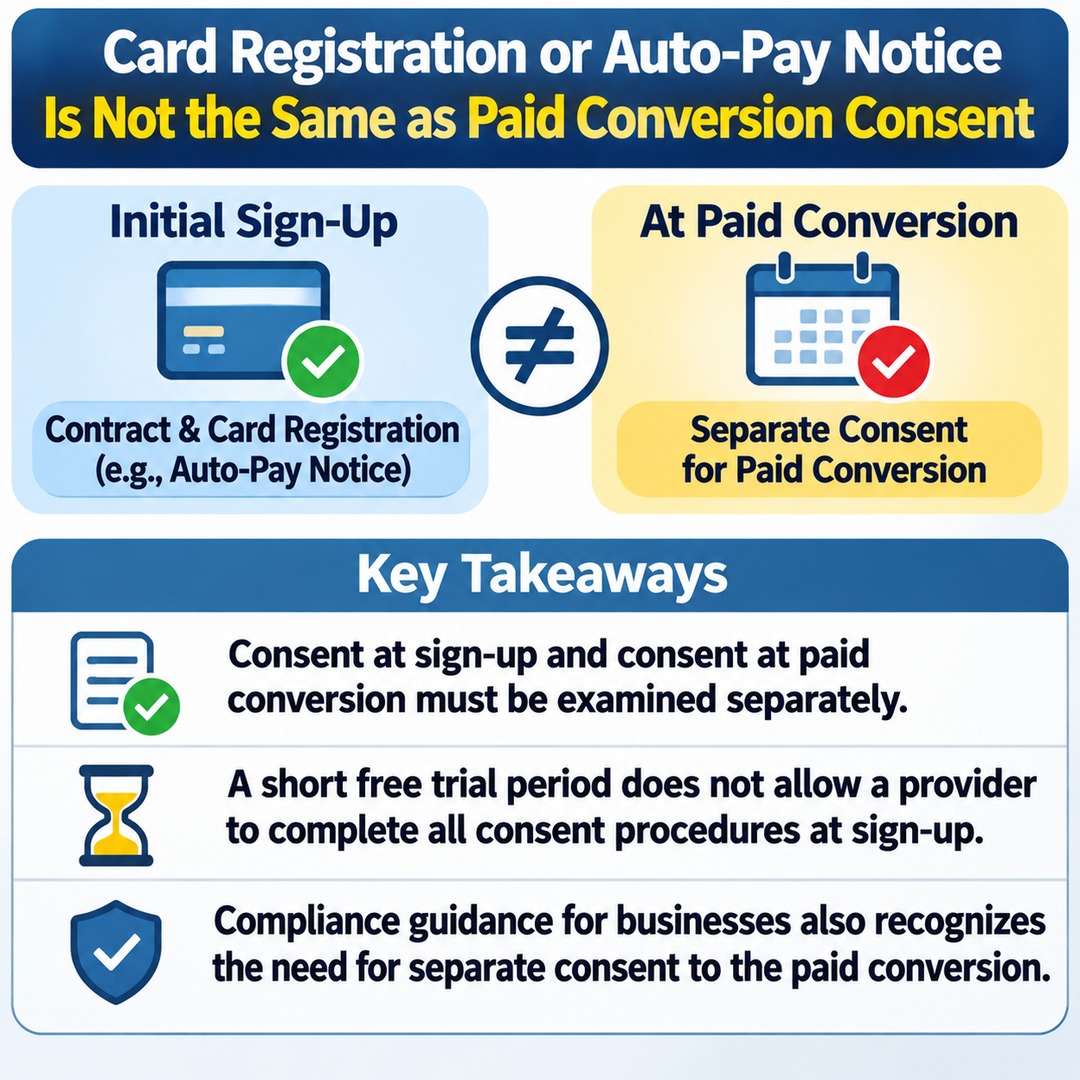
Even if you entered your card details and agreed to an automatic payment notice when signing up for a free trial, this alone does not necessarily satisfy the separate consent requirements for a paid conversion.
Consent to the initial contract and consent at the point when a free service converts to a paid service should be examined separately.
Consider the following situations:
| Sign-Up or Payment Situation | What to Check |
|---|---|
| Card registered when signing up for a free trial | Whether this is separate from consent to the paid conversion |
| Paid conversion date disclosed at sign-up | Whether separate consent was obtained before the conversion |
| Notification received shortly before conversion | Whether the price, payment date, and cancellation method were disclosed |
| Paid charge made without notification | Whether the provider has records of consent and disclosure |
In particular, a short free-trial period does not mean that a provider can automatically complete every consent procedure at the initial sign-up stage. Compliance guidance for businesses also recognizes the need for separate consent to the paid conversion, apart from the initial contract.
Can You Get a Refund If You Have Already Been Charged?
If the consumer did not consent to the paid conversion, there may be grounds to request a refund. In particular, South Korea's Consumer Dispute Resolution Standards for mobile content include a provision requiring a refund of the amount charged when a free-use period ends and the service converts to a paid service without the consumer's consent.
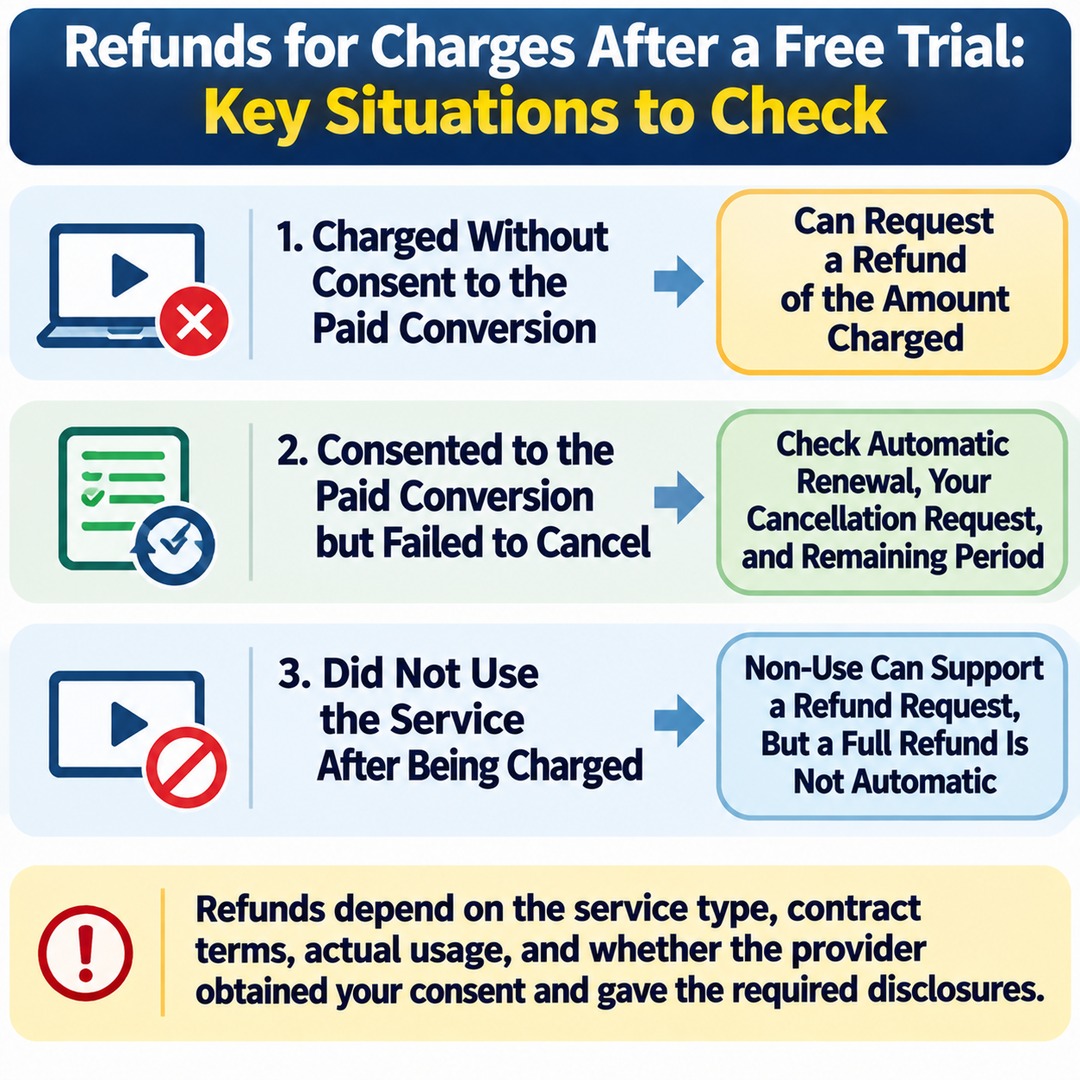
However, the same refund calculation does not automatically apply to every OTT platform and subscription service. You should consider the type of service, contract terms, actual usage, and whether the provider obtained consent and gave the required disclosures.
The following situations should be distinguished when assessing refund eligibility.
1. You were charged without consenting to the paid conversion
If the service converted to a paid subscription after the free-use period ended without your consent, you can request a refund of the amount charged. It is advisable to ask the provider for records of your consent to the paid conversion and the relevant disclosures.
2. You consented to the paid conversion but failed to cancel
In this situation, check whether the charge resulted from an automatic renewal permitted under the contract, whether your cancellation request was properly processed, and how much of the service period remains.
3. You did not use the service after being charged
Non-use can be important supporting evidence when requesting a refund. However, the fact that you did not use the service does not automatically guarantee a full refund for every subscription.
For ongoing mobile content service contracts, South Korea's Consumer Dispute Resolution Standards may allow the provider to deduct the amount corresponding to the period of actual use up to the cancellation date, along with a prescribed portion of the remaining subscription fees. By contrast, a separate refund standard applies when a service converts to a paid subscription after the free period without the consumer's consent: the amount charged for the paid service is refundable.
Where Should You Request a Refund?
First, identify the business that actually processed the payment. Requesting a refund only from the app developer because you used its app may delay the process if the payment was handled through a different channel.
If You Paid Directly Through the Provider's Website
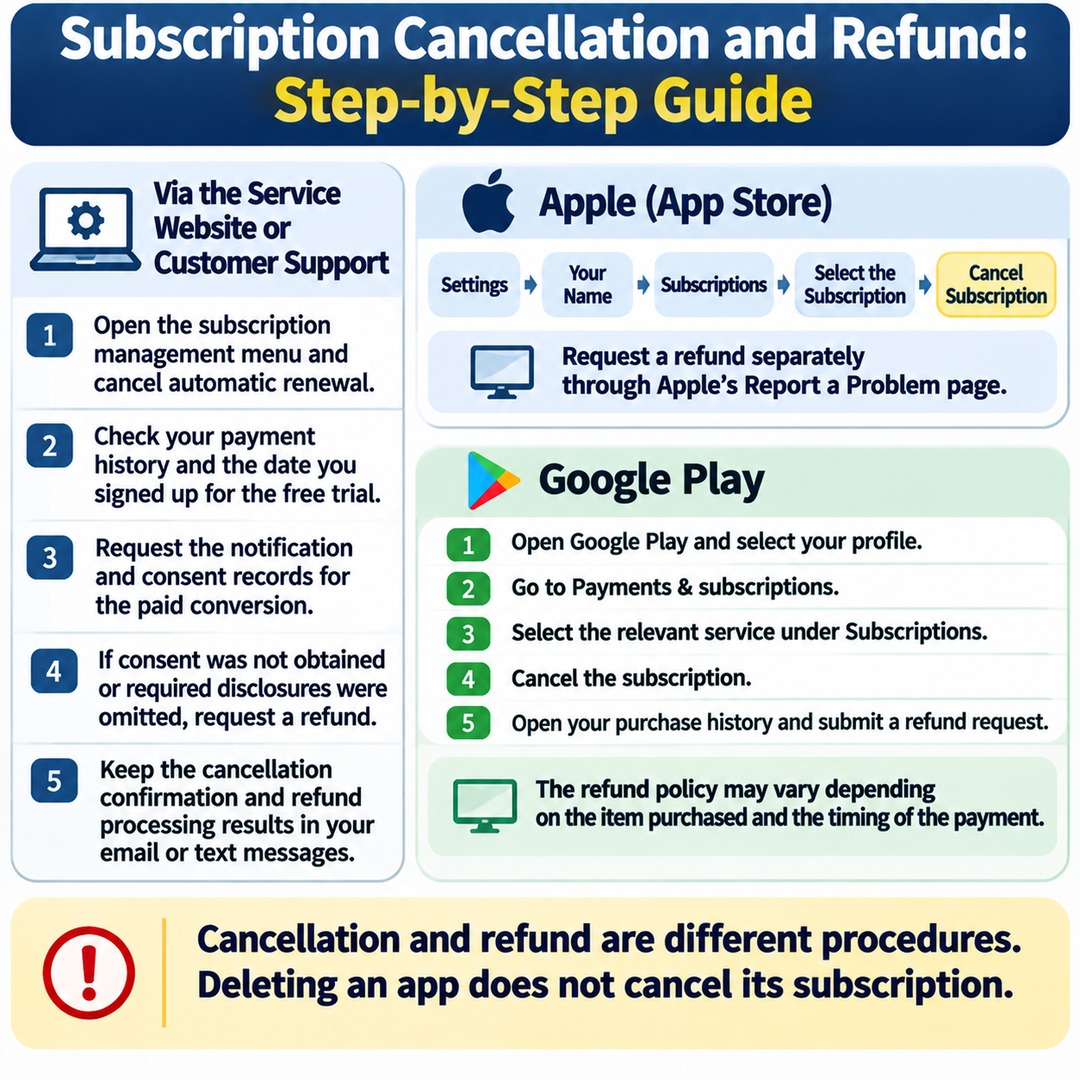
Follow these steps through the service website or customer support center:
1. Open the subscription management menu and cancel automatic renewal.
2. Check your payment history and the date you signed up for the free trial.
3. Request the notification and consent records for the paid conversion.
4. If consent was not obtained or required disclosures were omitted, request a refund.
5. Keep the cancellation confirmation and refund processing results in your email or text messages.
If You Paid Through the Apple App Store on an iPhone
If the subscription is linked to your Apple Account, follow these steps:
iPhone Settings → Your Name → Subscriptions → Select the Subscription → Cancel Subscription
Submit a separate refund request through Apple's Report a Problem page.
Canceling a subscription and requesting a refund are two different procedures. If you want a refund for an amount that has already been charged, you must submit a separate refund request.
If You Paid Through Google Play on Android
Cancel the recurring payment through Google Play and use its separate refund request process to seek reimbursement.
1. Open Google Play and select your profile.
2. Go to Payments & subscriptions.
3. Select the relevant service under Subscriptions.
4. Cancel the subscription.
5. Open your purchase history and submit a refund request.
Google Play's refund policy may vary depending on the item purchased and the timing of the payment. Deleting an app does not cancel its subscription, so make sure to check the subscription status in the recurring payment management screen.
What Information Should You Include in a Refund Request?
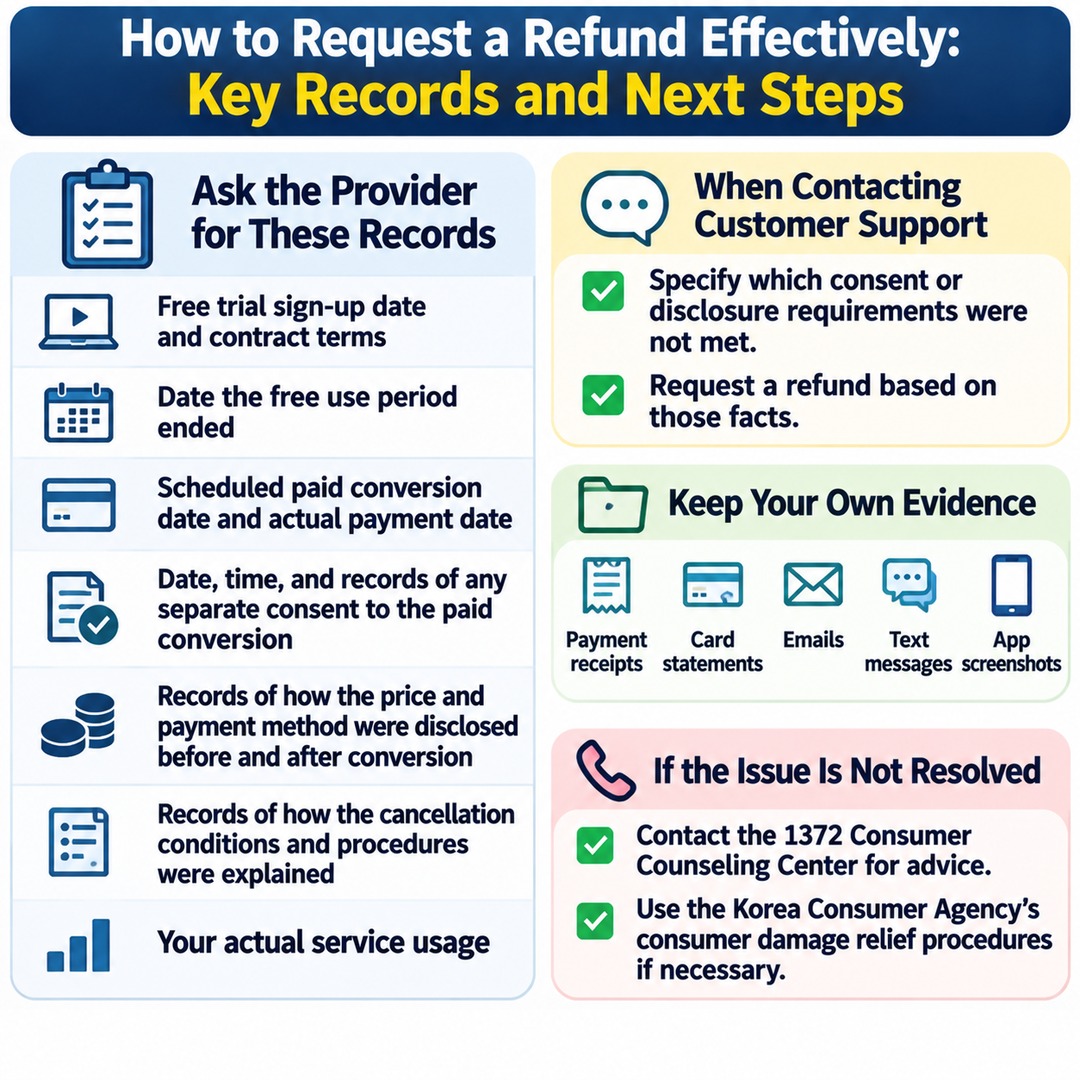
Rather than simply saying that the charge was unfair, explain specifically which consent or disclosure requirements were not met.
Ask the provider for the following records:
The original free-trial sign-up date and contract terms
The date the free-use period ended
The scheduled paid-conversion date and the actual payment date
The date, time, and records of any separate consent to the paid conversion
Records showing how the price and payment method were disclosed before and after conversion
Records showing how the cancellation conditions and procedures were explained
Your actual service usage history
If the provider cannot produce records of your consent or refuses your refund request, keep your payment receipts, card statements, emails, text messages, and screenshots from the app as supporting evidence.
You can use the following points when contacting customer support:
If the provider refuses to resolve the issue or does not respond, you can contact South Korea's 1372 Consumer Counseling Center for advice. If necessary, you can also use the Korea Consumer Agency's consumer damage relief procedures.
When Did the Paid Conversion Rules Take Effect?
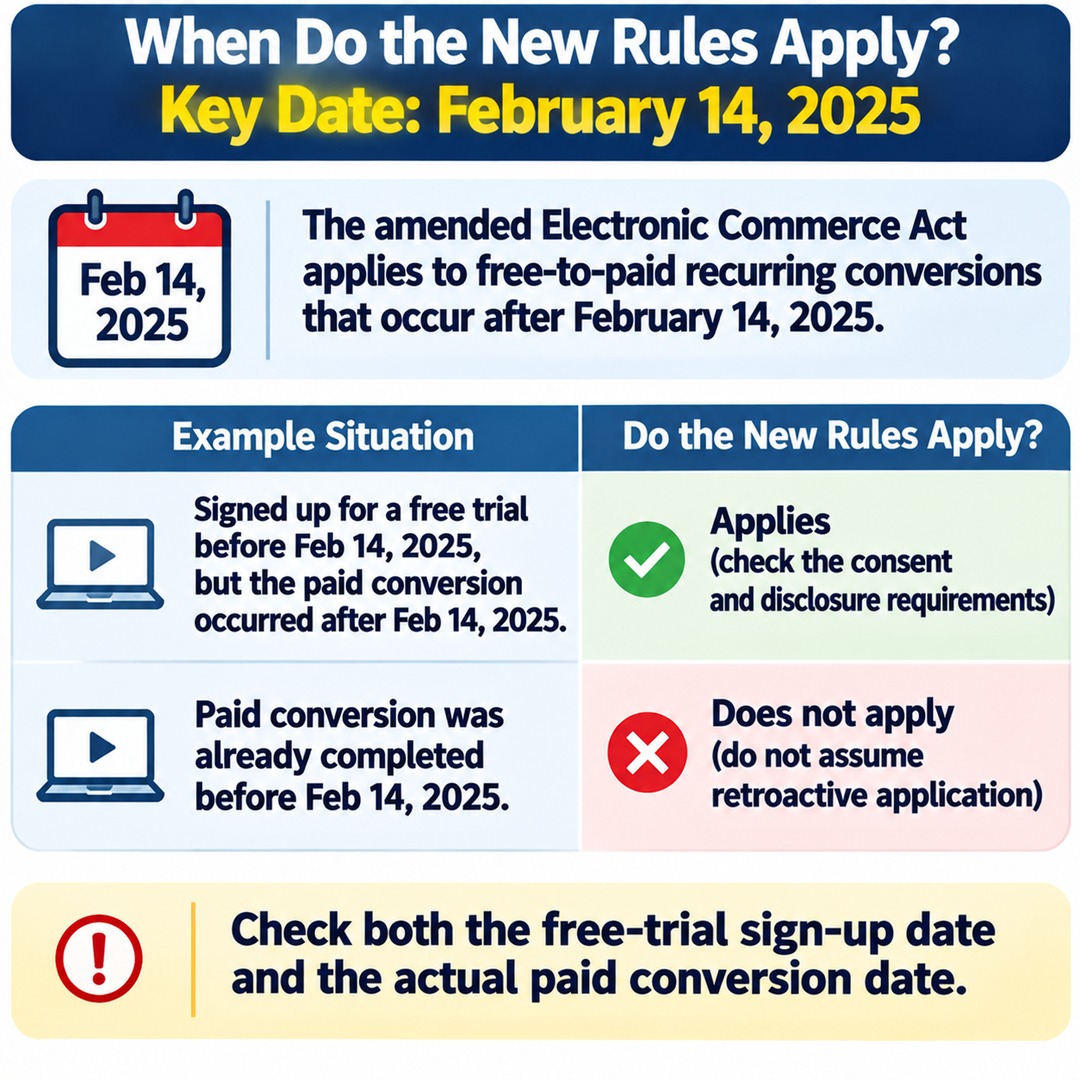
The amended Electronic Commerce Act provisions that took effect on February 14, 2025, apply to conversions from free services to paid recurring subscriptions occurring after the effective date.
Therefore, you should check not only when you signed up for the free trial but also when the actual paid conversion took place.
For example, even if you signed up for a free trial before February 14, 2025, you may need to consider whether the rules apply if the actual conversion to a paid subscription occurred after the effective date.
Conversely, you should not assume that the new rules can automatically be applied retroactively to charges for paid conversions that were already completed before the effective date.
Frequently Asked Questions About Automatic Charges After Free Trials
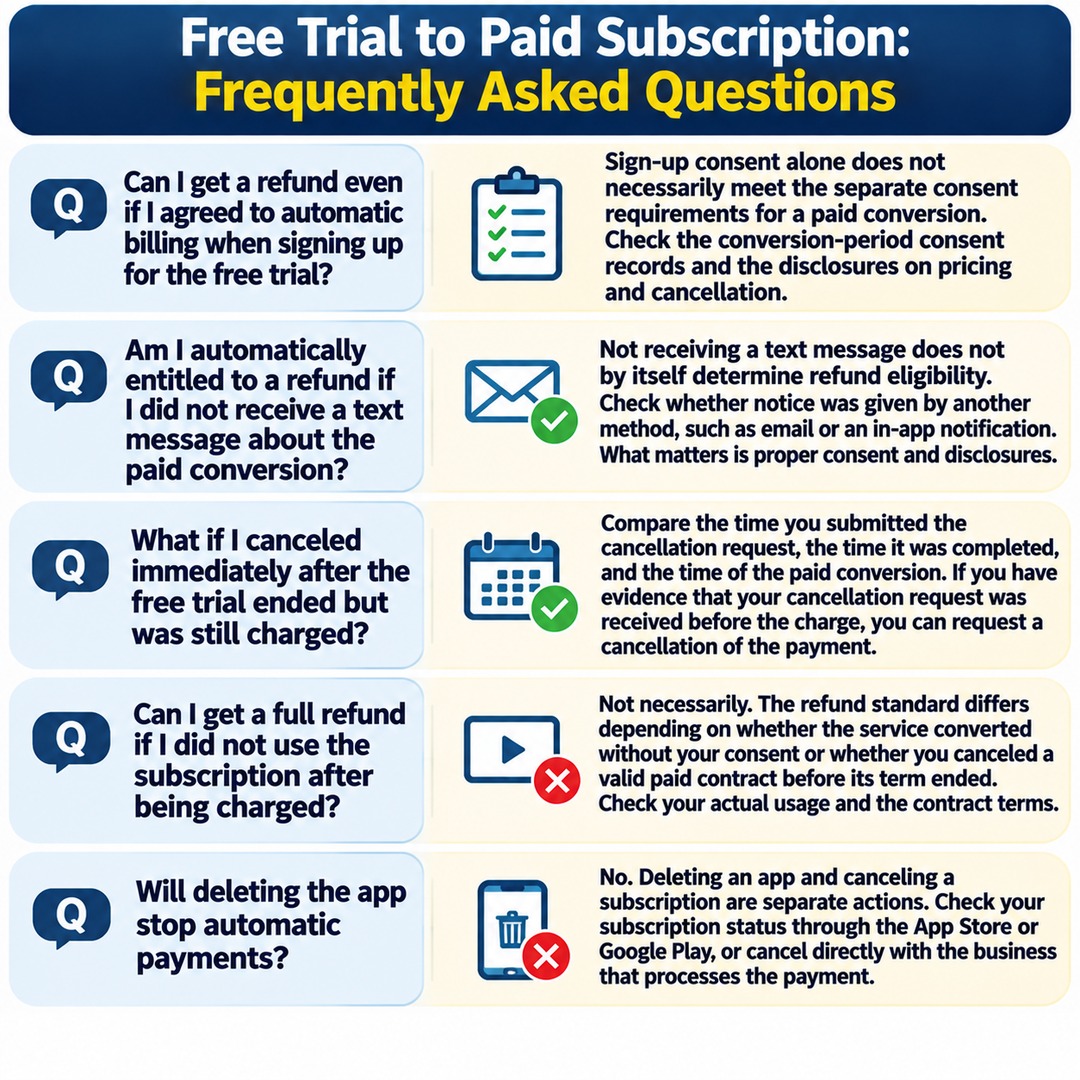
Q. Can I get a refund even if I agreed to automatic billing when signing up for the free trial?
Consent given at sign-up does not necessarily satisfy the separate consent requirements for a paid conversion. Check the consent records from the actual conversion period and the disclosures about pricing and cancellation conditions.
Q. Am I automatically entitled to a refund if I did not receive a text message about the paid conversion?
Not receiving a text message does not, by itself, determine whether you are entitled to a refund. Check whether the provider gave notice through another method, such as email or an in-app notification. What matters is whether the legally required consent and disclosures were properly completed.
Q. What if I canceled immediately after the free trial ended but was still charged?
Compare the time you submitted the cancellation request, the time cancellation was actually completed, and the time of the paid conversion. If you have evidence that your cancellation request was properly received before the charge, you can use it to request a cancellation of the payment.
Q. Can I get a full refund if I did not use the subscription after being charged?
Not necessarily. The refund standard differs depending on whether the service converted to a paid subscription without your consent or whether you canceled a valid paid contract before its term ended. You should also check your actual usage and the contract terms for the particular service.
Q. Will deleting the app stop automatic payments?
No. Deleting an app and canceling a subscription are separate actions. Check your subscription status through the App Store or Google Play, or cancel directly with the business that processes the payment.