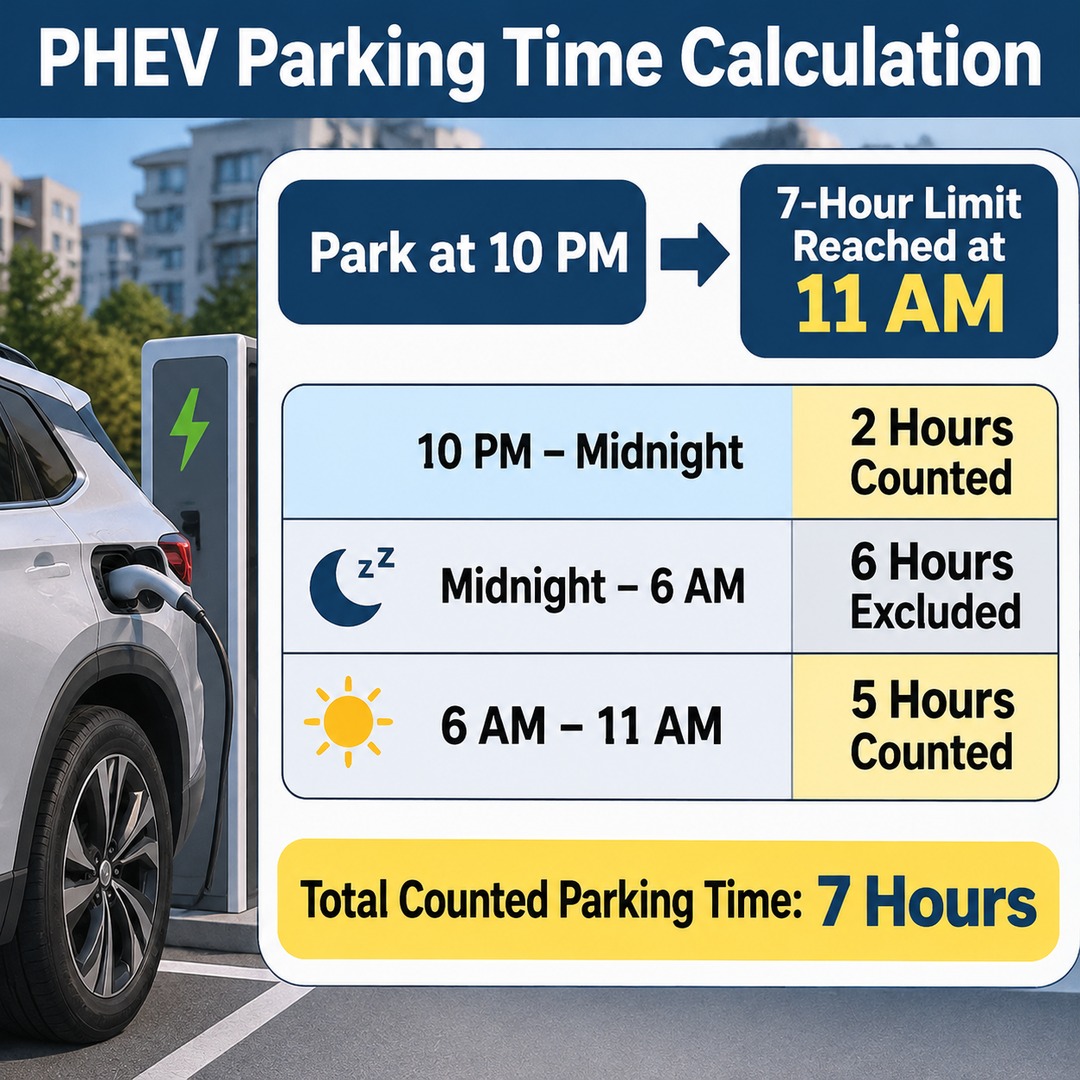

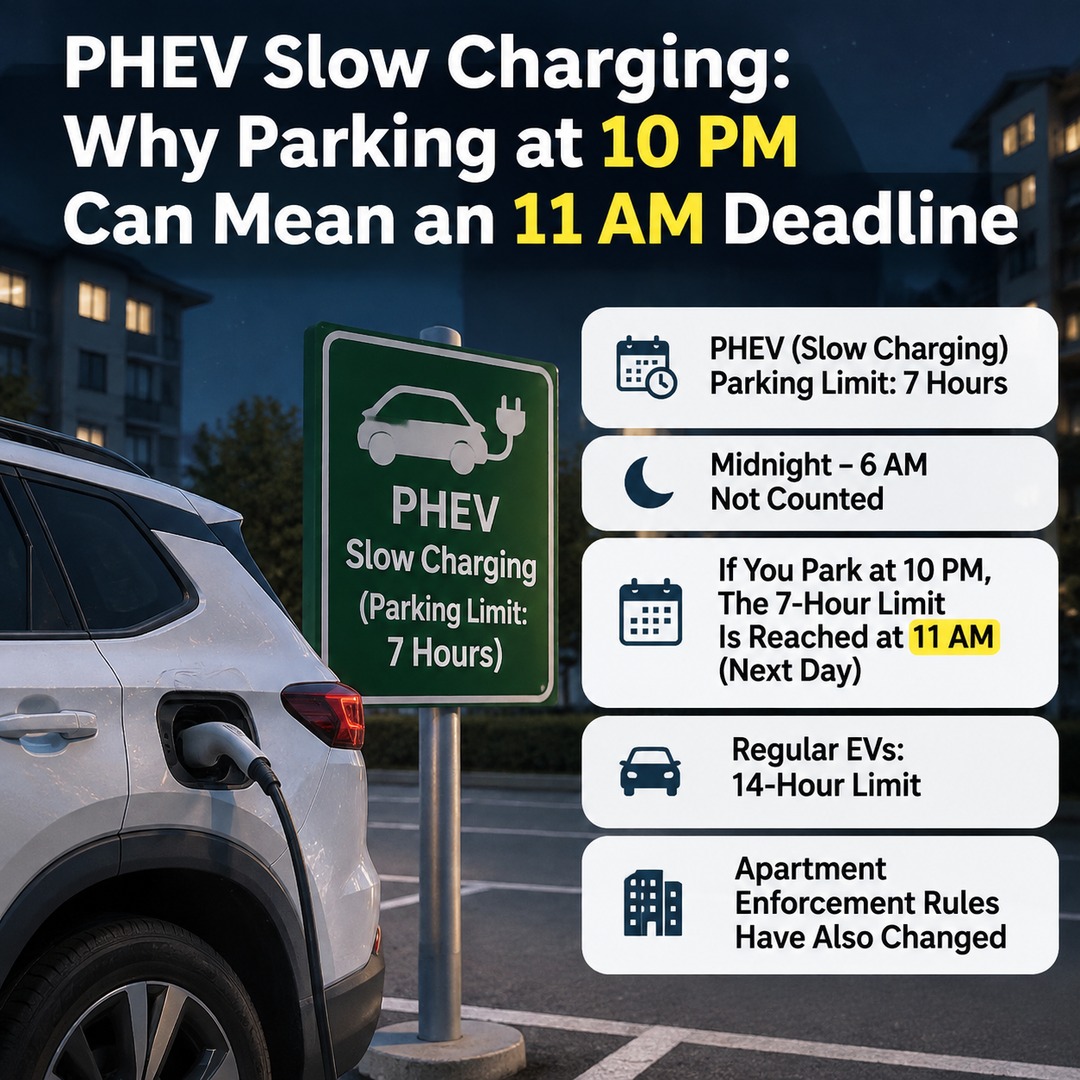
Plug-in hybrid electric vehicles (PHEVs) may park in designated slow-charging spaces for up to 7 hours, but the period from midnight to 6 AM is excluded when calculating the parking time. Therefore, if you park at 10 PM, the 2 hours until midnight count toward the limit, and another 5 hours are added from 6 AM the following day. This means the calculated 7-hour limit is reached at 11 AM. This rule took effect on February 5, 2026.
Drivers who leave their vehicles connected to apartment charging stations overnight before heading to work in the morning need to understand this calculation. Even if you park at 10 PM, the calculated 7-hour period does not end at 5 AM the next morning, as a simple 7-hour calculation might suggest. Instead, it ends at 11 AM.
Why Does Parking at 10 PM Result in an 11 AM Deadline?
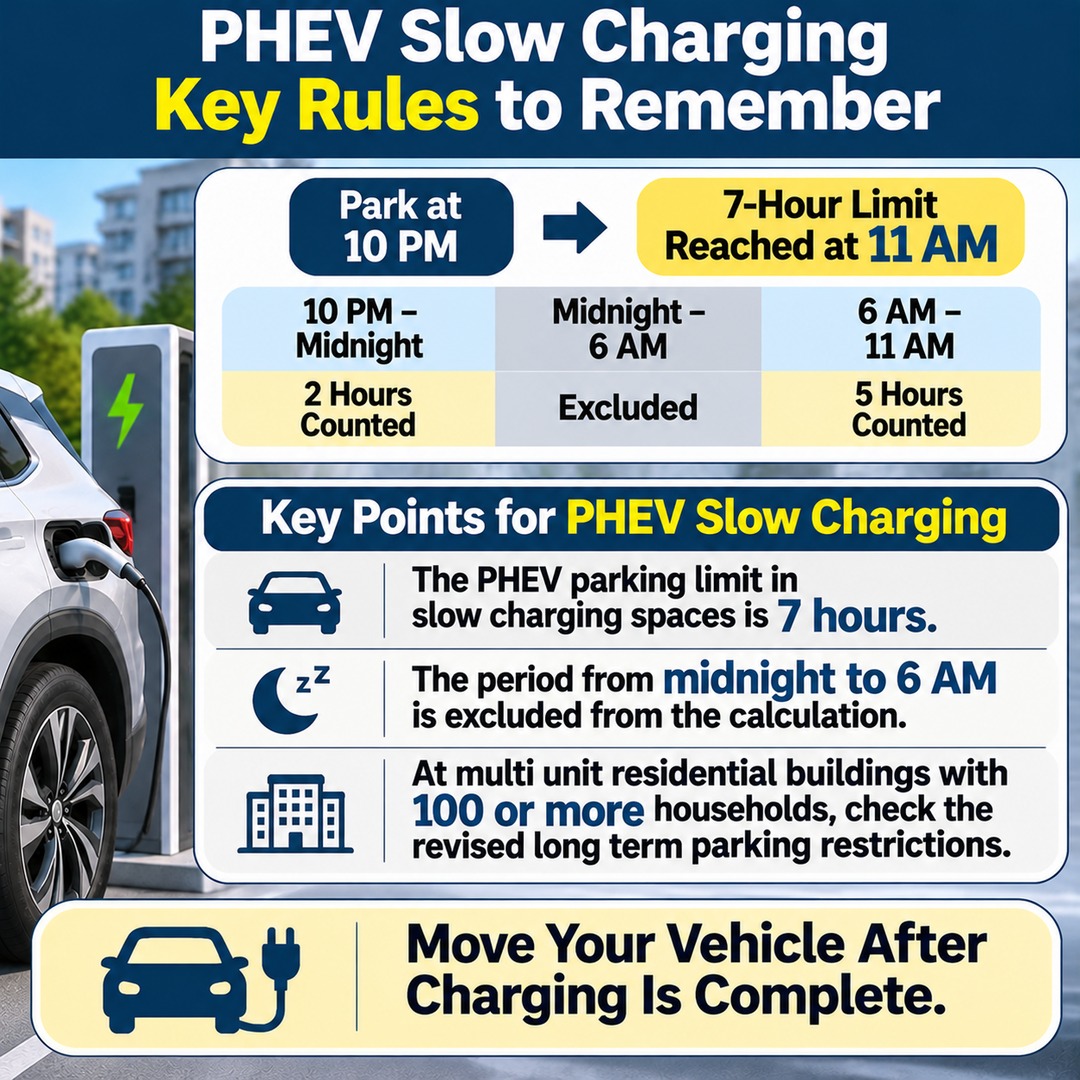
The 7-hour parking limit for PHEV slow-charging spaces is calculated differently from ordinary elapsed time. The 6-hour period between midnight and 6 AM is excluded, and only the time before and after that period is counted.
Suppose you enter a designated charging space at 10 PM:
10 PM to midnight: 2 hours counted
Midnight to 6 AM: 6 hours excluded
6 AM to 11 AM: 5 hours counted
The total calculated parking time is therefore 7 hours.
Parking Time Calculation for a 10 PM Arrival
| Time period | Calculation |
|---|---|
| 10 PM to midnight | 2 hours counted |
| Midnight to 6 AM | 6 hours excluded |
| 6 AM to 11 AM | 5 hours counted |
| Total calculated time | 7 hours |
The 7-hour limit is reached at 11 AM the following day.
This is an example of the parking-time calculation, not an estimate of when charging will be completed.
The important point is that the 2 hours accumulated between 10 PM and midnight do not disappear when the clock reaches midnight. Nor does a new 7-hour allowance begin at 6 AM. The 2 hours already used before midnight carry over into the calculation.
How Does the Deadline Change Depending on When You Park?
The time at which the 7-hour limit is reached depends on when you begin parking. In particular, if you park between midnight and 6 AM, the calculation does not begin until 6 AM.
| Parking start time | Time when the 7-hour limit is reached |
|---|---|
| 6 PM | 7 AM the following day |
| 8 PM | 9 AM the following day |
| 9 PM | 10 AM the following day |
| 10 PM | 11 AM the following day |
| 11 PM | 12 PM the following day |
| 1 AM | 1 PM the same day |
| 5 AM | 1 PM the same day |
These times are calculated by excluding the period from midnight to 6 AM.
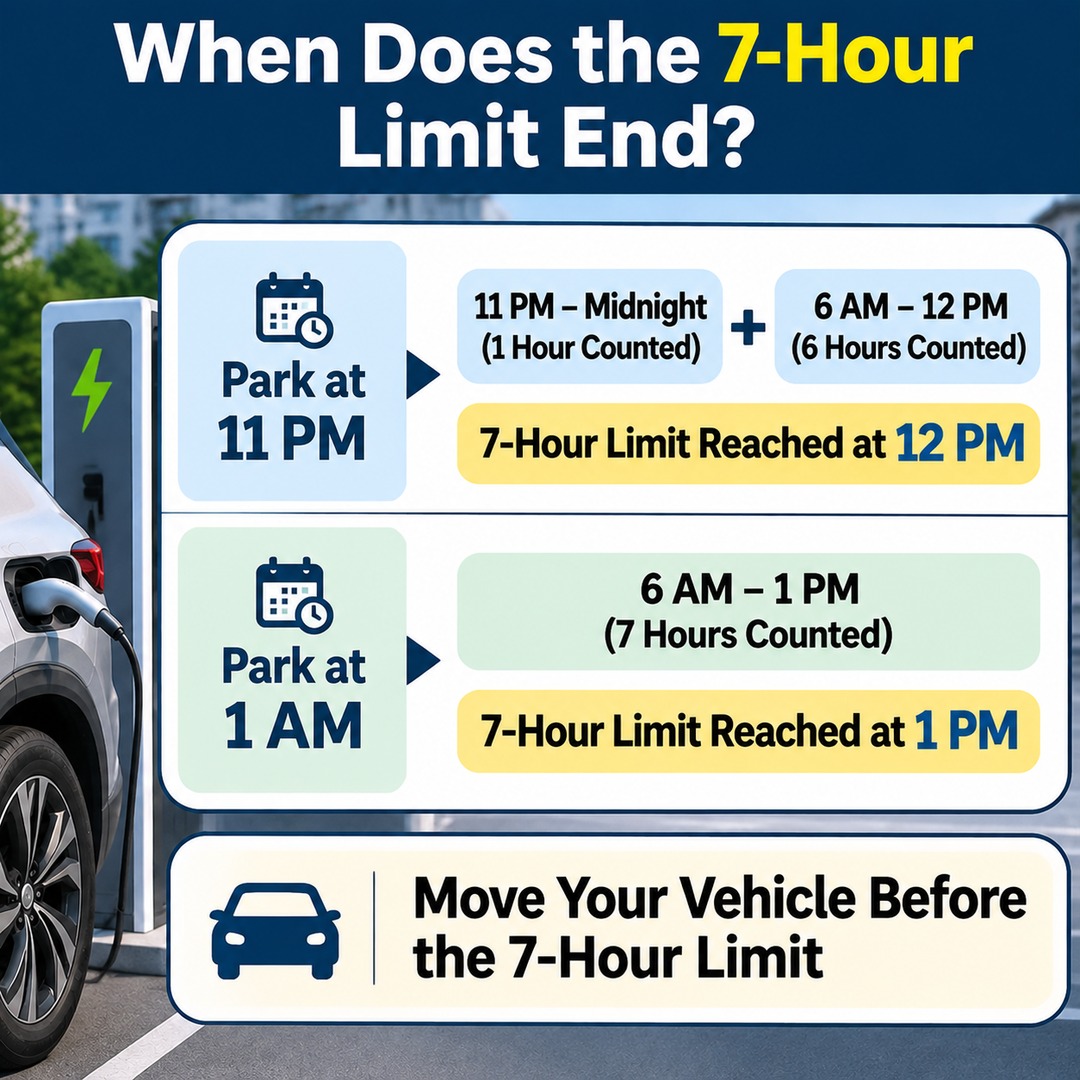
For example, if you park at 11 PM, the 1 hour before midnight counts toward the limit. You must then add another 6 hours starting at 6 AM, meaning the calculated 7-hour limit is reached at noon the following day.
By contrast, if you park at 1 AM, no parking time is counted before midnight in this calculation. The 7-hour period begins at 6 AM, so the limit is reached at 1 PM that same day.
However, it is safer to move your vehicle before the calculated parking time reaches exactly 7 hours. This helps avoid situations in which delays in moving the vehicle result in a violation after the enforcement threshold has been reached.
Does the Midnight-to-6 AM Exclusion Also Apply to Regular Electric Vehicles?
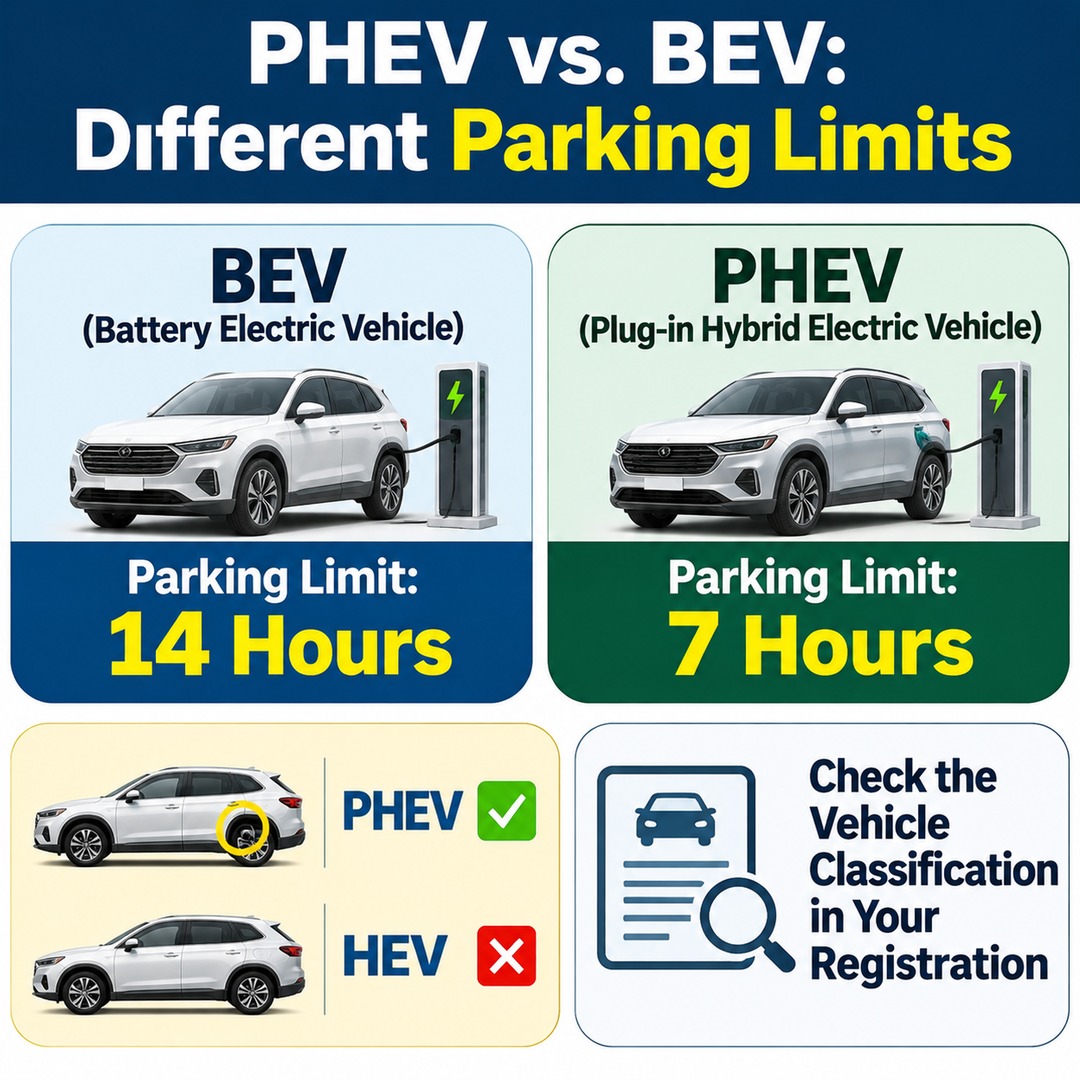
No. The slow-charging parking limits for PHEVs and regular battery electric vehicles (BEVs) are different.
Under the rules effective February 5, 2026, the limits are as follows:
| Vehicle category | Parking limit in slow-charging spaces |
|---|---|
| Regular battery electric vehicles (BEVs) | Up to 14 hours |
| Plug-in hybrid electric vehicles (PHEVs) | Up to 7 hours |
| PHEV excluded calculation period | 00:00–06:00 |
The 14-hour limit remains applicable to regular electric vehicles, while PHEVs are subject to a separate 7-hour limit.
A PHEV is a hybrid vehicle whose battery can be charged using an external power source. It should not be confused with a conventional hybrid electric vehicle (HEV), which does not have an external charging port.
Therefore, rather than relying on the vehicle's appearance or the general description 'hybrid,' check the vehicle classification shown in its official registration information.
Apartment Parking Enforcement Rules Also Changed in February 2026
The rules governing the application of long-term parking restrictions in slow-charging spaces at multi-unit residential buildings have also changed.
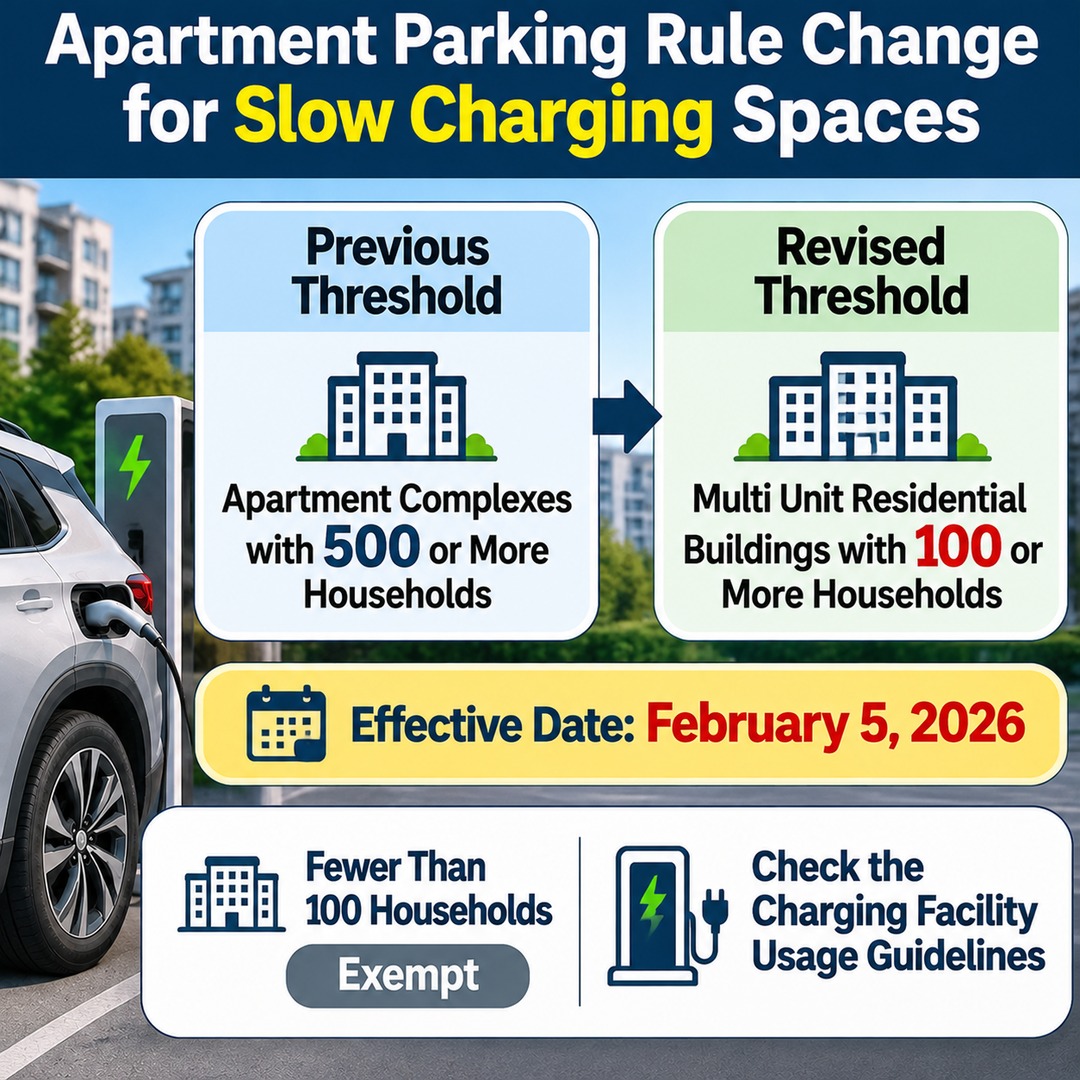
Previously, the relevant threshold was apartment complexes with at least 500 households. From February 5, 2026, the scope was expanded to include multi-unit residential buildings with at least 100 households.
Previous threshold: Apartment complexes with 500 or more households
Revised threshold: Multi-unit residential buildings with 100 or more households
Effective date: February 5, 2026
In other words, if you live in an apartment complex with 100 or more households, pay particular attention to the revised long-term parking restrictions for PHEV slow-charging spaces.
Multi-unit residential buildings with fewer than 100 households are exempt from this particular long-term parking restriction. However, this does not mean that charging spaces can be used without any restrictions. Check the charging facility's usage guidelines and any separate regulations concerning obstruction of EV charging facilities.
How Can You Report Long-Term Parking in a Charging Space?
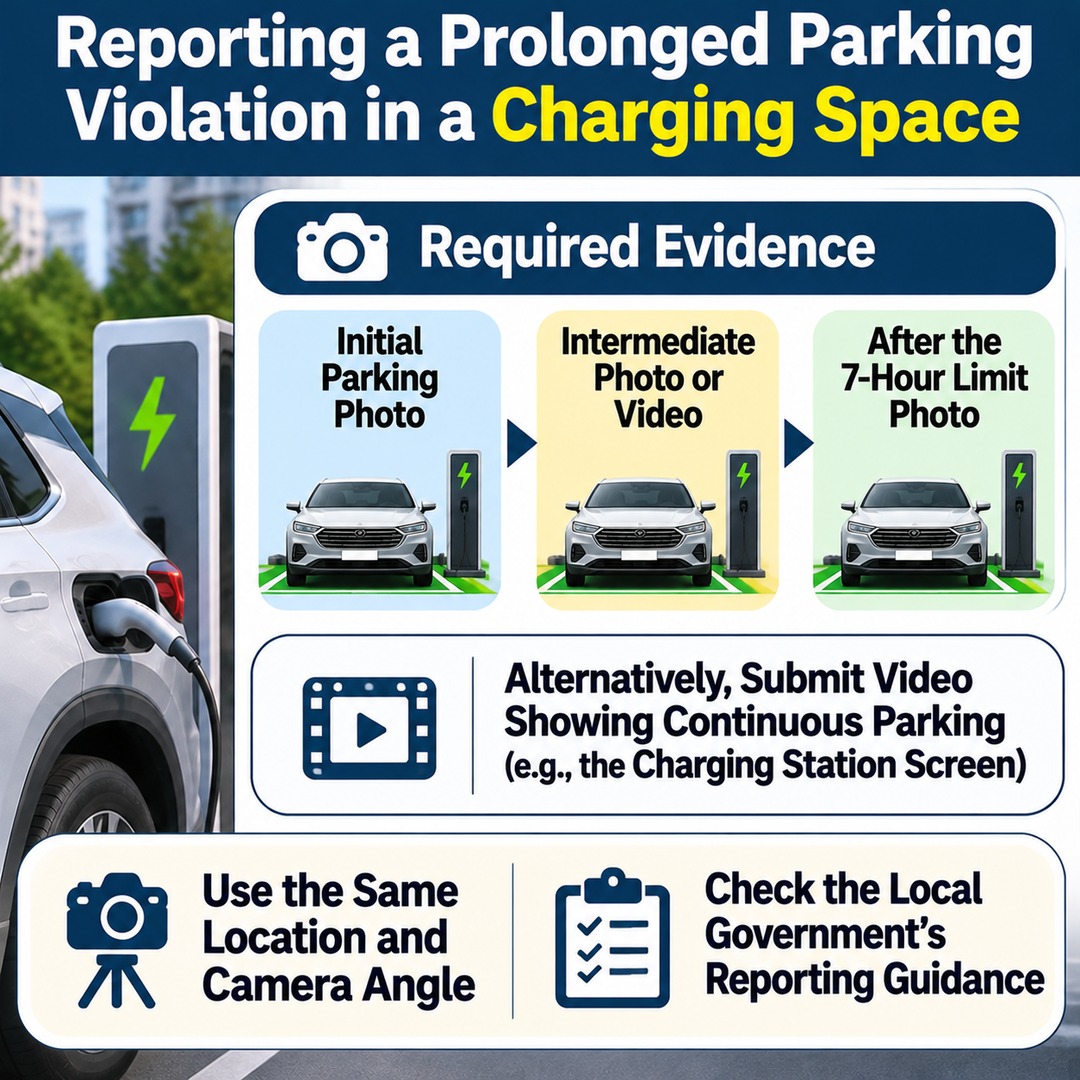
When reporting a violation involving prolonged parking in a designated charging space, it is important to provide evidence showing that the vehicle remained parked there throughout the relevant period.
Photos and videos can be submitted through reporting procedures such as South Korea's Safety e-Report (Saneonjeonmun-go) system. The evidence should make it possible to identify the vehicle's license plate, parking location, and elapsed time.
The following types of evidence are suggested for reports involving prolonged PHEV parking:
A photograph showing the vehicle's initial parking position
A photograph or video showing the vehicle at an intermediate point during the parking period
Evidence confirming that the vehicle remained parked even after the 7-hour limit had elapsed
The intermediate evidence may be replaced with video footage showing that the vehicle remained parked, such as footage displaying the charging station's screen.
When taking photographs, use the same location and camera angle so that the vehicle's license plate and the violation can be clearly identified. Check the relevant local government's guidance for reporting deadlines and the period during which reports can be accepted.
What Should PHEV Drivers Remember When Charging Overnight?
The most important thing to remember when using a slow charger overnight is the difference between actual elapsed time and the parking time counted under the regulations.
If you park at 10 PM, 7 actual hours will have passed by 5 AM the following morning. However, only 2 hours count toward the regulatory limit. You must then add another 5 hours starting at 6 AM to reach the full 7-hour limit.
Even if you use a scheduled charging feature, do not rely solely on the time charging begins. Check the actual time your vehicle entered the designated charging space and the usage conditions applicable to that facility.
If you drive a PHEV and use a slow charger at an apartment complex, remember these three points:
1. The PHEV parking limit in slow-charging spaces is 7 hours.
2. The period from midnight to 6 AM is excluded from the calculation.
3. At multi-unit residential buildings with 100 or more households, check the revised long-term parking restrictions.
Once charging is complete, moving your vehicle as soon as reasonably possible is also a good charging-space courtesy that helps other drivers.