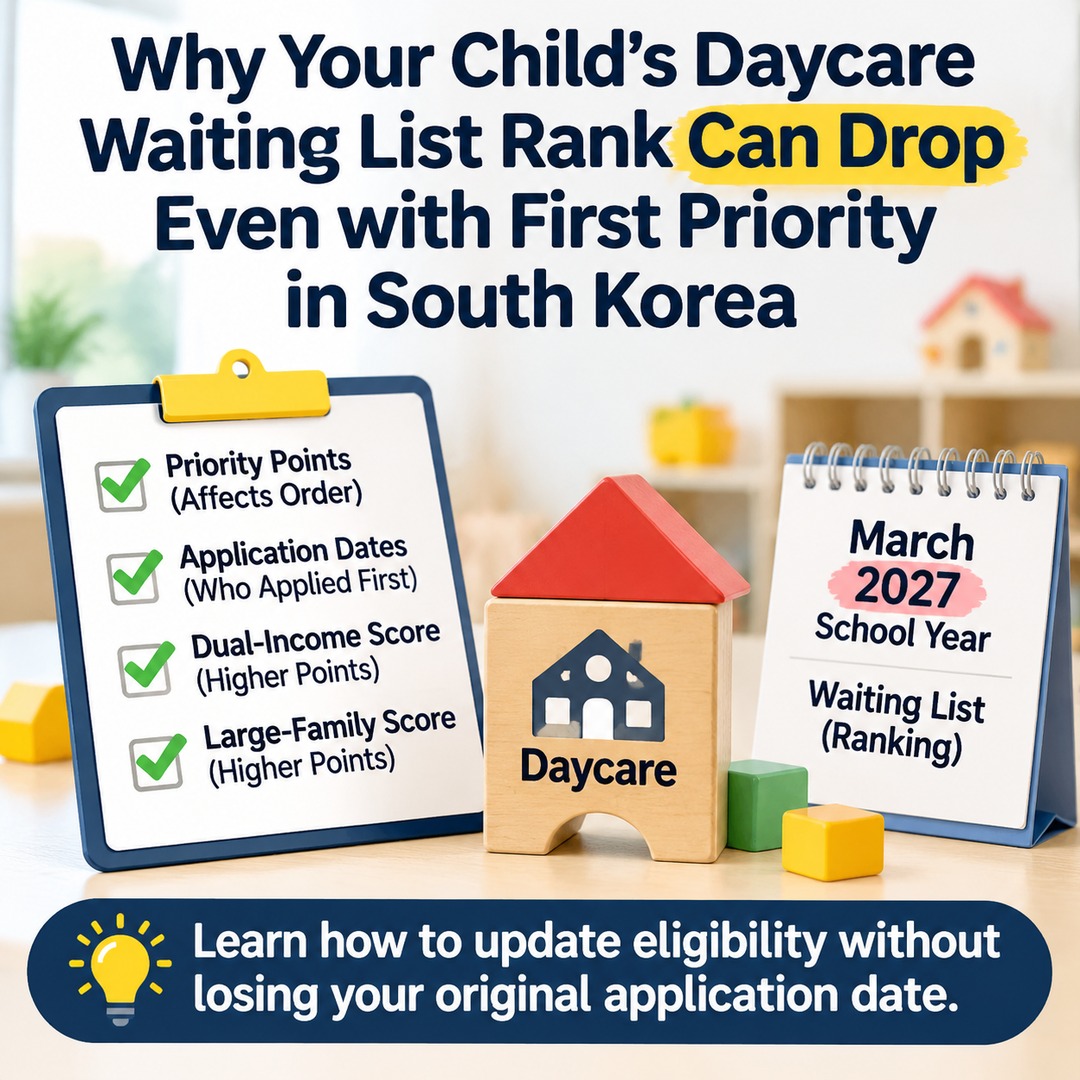
Even if your child has first-priority status on a daycare waiting list in South Korea, their position may still fall behind other applicants. This is because priority status alone does not determine admission order. Applicants receive points for qualifying circumstances, such as having both parents employed or belonging to a large family. When applicants have the same score, the child with the earlier application date takes precedence. The separate waiting-list ranking for the March 2027 school year will be available from 10:00 a.m. on November 2, 2026.
If you have already submitted a daycare application, you do not need to apply again just to check your ranking for the new school year. If you have newly become eligible for a priority category, such as a dual-income household, it is important to update the information on your existing application without deleting it.
Why Your Child Can Rank Behind Other Applicants Despite Having First Priority
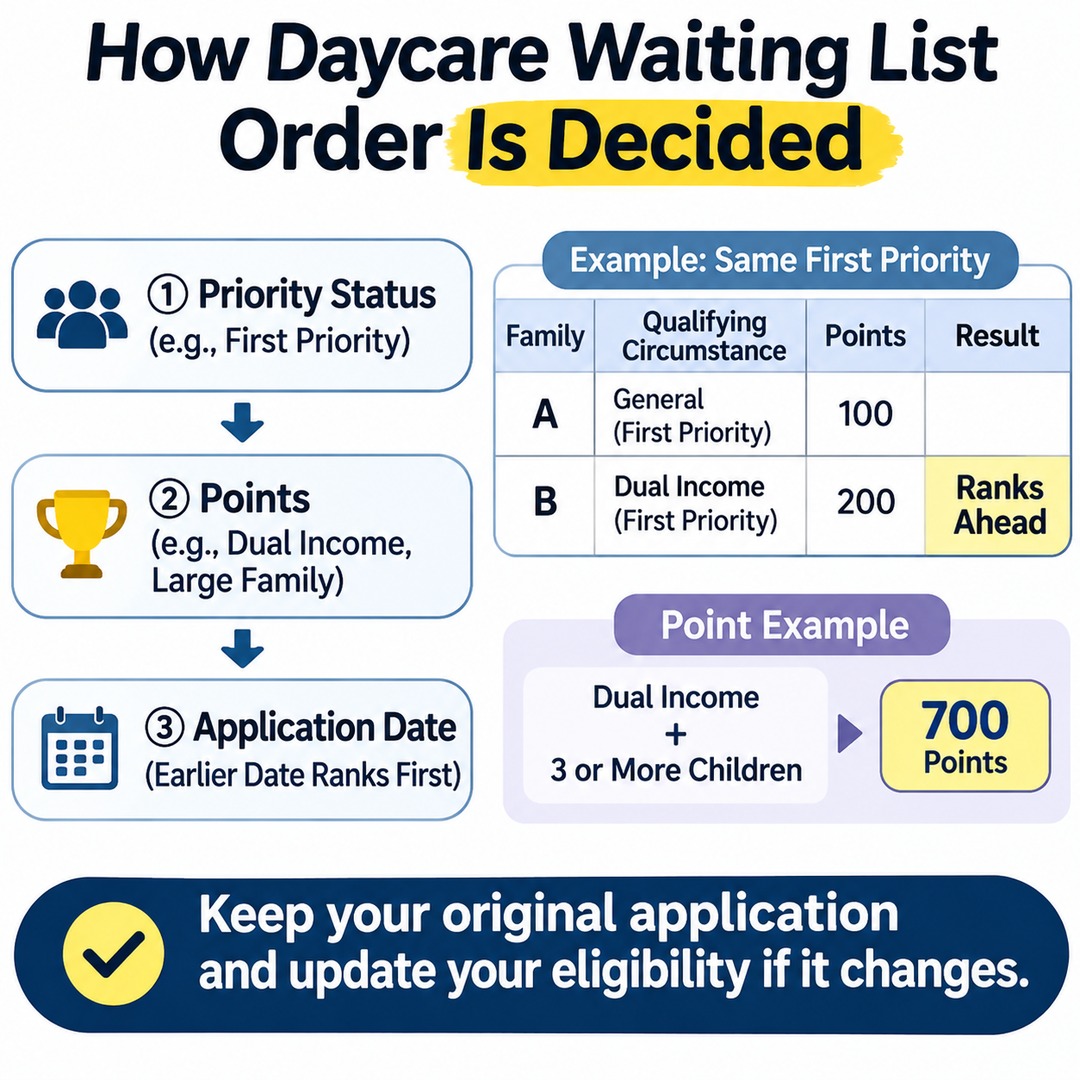
First-priority status means that your child belongs to a category receiving preferential consideration for admission. It does not mean that your child will automatically be admitted ahead of every other first-priority applicant. Even within the first-priority group, applicants can receive different scores depending on their qualifying circumstances. If their scores are equal, the child whose waiting-list application was submitted earlier takes precedence.
For example, consider two families waiting for admission to the same daycare center for the same age group:
Family A: One general first-priority category, 100 points
Family B: Dual-income household, first-priority category, 200 points
Both families qualify for first priority, but their scores differ. Family B may therefore rank ahead of Family A.
Conversely, when two applicants have the same score, the child with the earlier application date receives priority. This means that simply knowing your child has first-priority status is not enough to determine their actual waiting-list position.
How Many Points Do Dual-Income and Large Families Receive?
The following point allocations are listed in the i-Sarang childcare waiting-list guidance:
| Category | Points |
|---|---|
| General first-priority category | 100 points per category |
| Dual-income household | 200 points |
| Household with three or more children | 200 points |
| Dual-income household with three or more children | 700 points |
| Second-priority category | 50 points per category |
A household that is both dual-income and has three or more children receives a total of 700 points. This consists of the 200-point allocation plus an additional 300 points.
One important distinction is that second-priority points cannot automatically override first-priority status. A child who qualifies only for second-priority categories cannot move ahead of a first-priority applicant simply by accumulating a higher point total.
However, when first-priority applicants have equal scores, applicable second-priority categories may also be added to the calculation.
If Your Household Becomes Dual-Income, Do You Need to Reapply for Daycare?
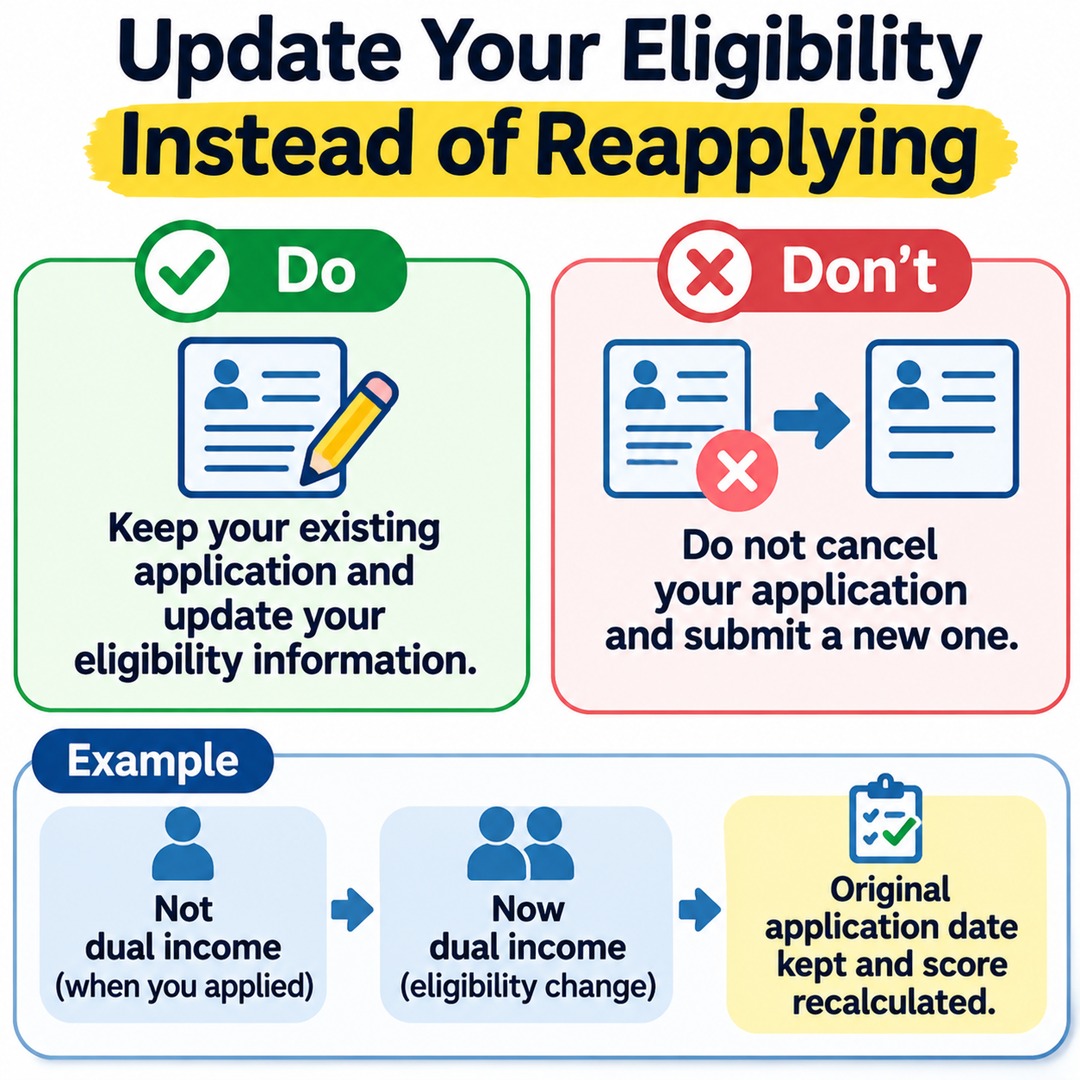
Do not cancel your existing application and submit a new one. Instead, update the priority eligibility information on your existing waiting-list application for the daycare center.
According to the i-Sarang Help Desk guidance, updating your information after a change in eligibility does not affect your original application date. Your waiting-list position is recalculated based on your updated score.
For example, consider the following situation:
When you first applied: You did not qualify as a dual-income household.
Subsequent change: Both parents became employed, making the household eligible for dual-income status.
Existing application: Keep it active.
Information to update: The priority eligibility details on that application.
Result: Your original application date is retained, and your score is recalculated.
If you delete your application and register again, you may lose your original application date. Because the application date can determine the order when scores are equal, there is no reason to reapply unnecessarily.
The same principle applies if you become newly eligible for other priority categories after submitting your original application, including basic livelihood security recipient status or near-poor household status.
Do not assume that every new eligibility category will automatically be reflected in your score. Check whether the information on your existing waiting-list application has actually been updated.
Why Is the March 2027 School-Year Ranking Different from the Regular Waiting-List Ranking?
If you are preparing for daycare admission in March 2027, you need to distinguish between the regular priority ranking and the new-school-year ranking. These two figures may differ because they cover children with different requested admission months.
According to the i-Sarang guidance:
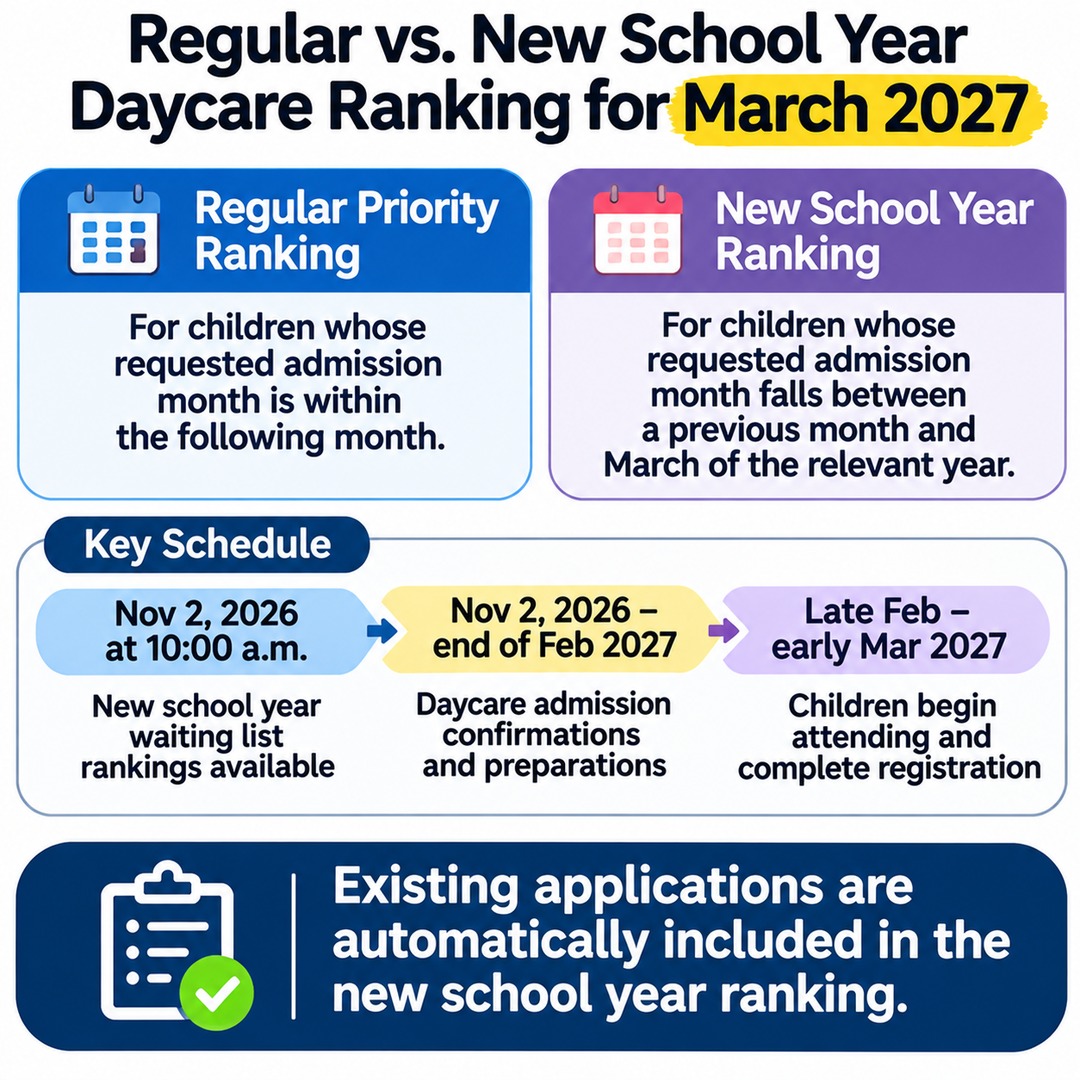
Regular priority ranking: Calculated for children whose requested admission month is within the following month.
New-school-year ranking: Calculated separately for children whose requested admission month falls between a previous month and March of the relevant year.
Therefore, if the March new-school-year ranking differs from the regular ranking you normally check, that does not necessarily mean there is an application error.
March 2027 Daycare Admission Schedule
1. November 2, 2026, at 10:00 a.m. — New-school-year waiting-list rankings become available.
2. November 2, 2026, through the end of February 2027 — Daycare admission confirmations and preparations.
3. Late February to early March 2027 — New-school-year children are scheduled to begin attending and complete registration.
The exact admission and registration dates may change depending on subsequent announcements.
The most important point is that children with existing applications are automatically included in the new-school-year ranking process.
Children who already have an active waiting-list application and whose requested admission month falls between a previous month and March 2027 are included in the new-school-year ranking calculation without submitting a separate application.
Therefore, you do not need to delete or resubmit your existing application when November 2 arrives.
You should check admission availability and enrollment capacity directly with each daycare center.
Can a Child with a Lower Waiting-List Position Be Admitted Before a Child Ahead of Them?
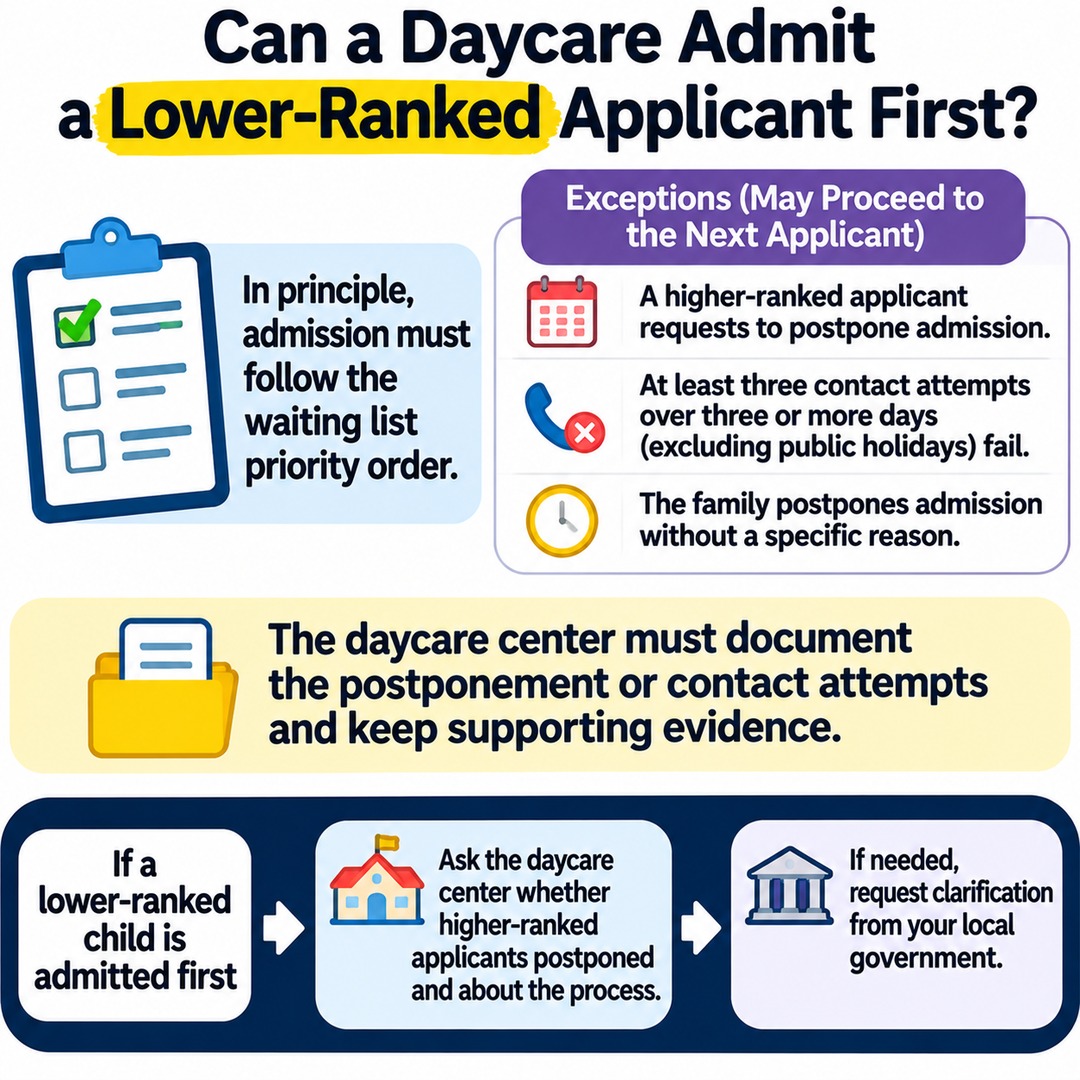
A daycare director cannot arbitrarily skip applicants higher on the waiting list and admit another child instead. In principle, the admission process must follow the priority order displayed in the system.
However, certain specified exceptions may allow the daycare center to proceed with the next applicant. These include situations in which an applicant ahead of them postpones admission or cannot be reached.
Exceptions addressed in the Ministry of Education's 2026 Childcare Business Guidelines and related guidance include:
The parent or guardian of an applicant higher on the list states that they wish to postpone admission.
The daycare center makes at least three contact attempts over a period of three or more days, excluding public holidays, but cannot reach the applicant's family.
The family postpones admission without a specific reason.
In these situations, the daycare center must document the postponement or contact attempts in accordance with the applicable procedures and retain supporting evidence.
Therefore, if a child ranked below yours is admitted first, you cannot automatically conclude that the waiting-list order was manipulated.
First, ask the daycare center whether the applicants ahead of your child were marked as having postponed admission and inquire about the current admission process. If you believe the procedure was not followed correctly, you can request clarification from the city, county, or district government responsible for the daycare center's location.
How to Check Your Child's Current Daycare Waiting-List Status
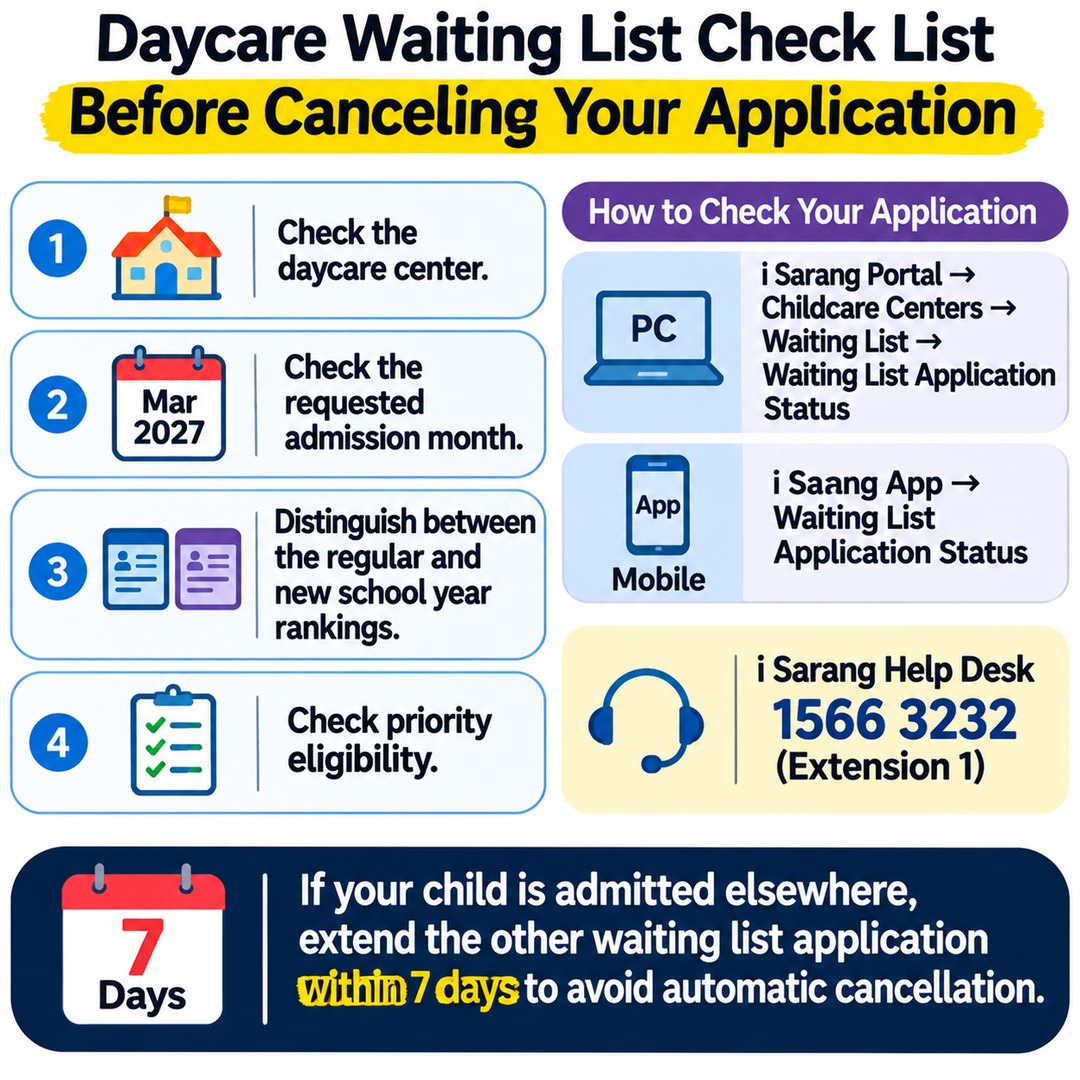
If your child's current position is different from what you expected, check the following items in order before canceling the application.
1. Check the daycare center: Make sure you are viewing the application for the correct facility and child.
2. Check the requested admission month: Confirm whether the application is for admission in March 2027.
3. Distinguish between the regular and new-school-year rankings: Make sure you are not comparing figures calculated using different applicant groups.
4. Check priority eligibility: Verify whether applicable categories, such as dual-income household or three or more children, have been reflected.
5. Check the application date: When applicants have equal scores, the original application date may determine their order. Do not delete and resubmit the application.
6. Check the daycare center's enrollment situation: Ask about available places and the admission progress for your child's age group.
You can check your application through the i-Sarang portal using the following paths:
PC: i-Sarang Portal → Childcare Centers → Waiting List → Waiting-List Application Status
Mobile: i-Sarang App → Waiting-List Application Status
If you have difficulty checking a change in priority eligibility or confirming whether the system has updated your information, contact the i-Sarang Help Desk at 1566-3232, extension 1.
If your child is admitted to another daycare center first but you want to keep an existing waiting-list application elsewhere, pay attention to the deadline. If you do not extend the waiting-list application for the other daycare center within seven days of receiving the admission notification, the application may be automatically canceled by the system.
Three Things to Distinguish When Checking a Daycare Waiting-List Position
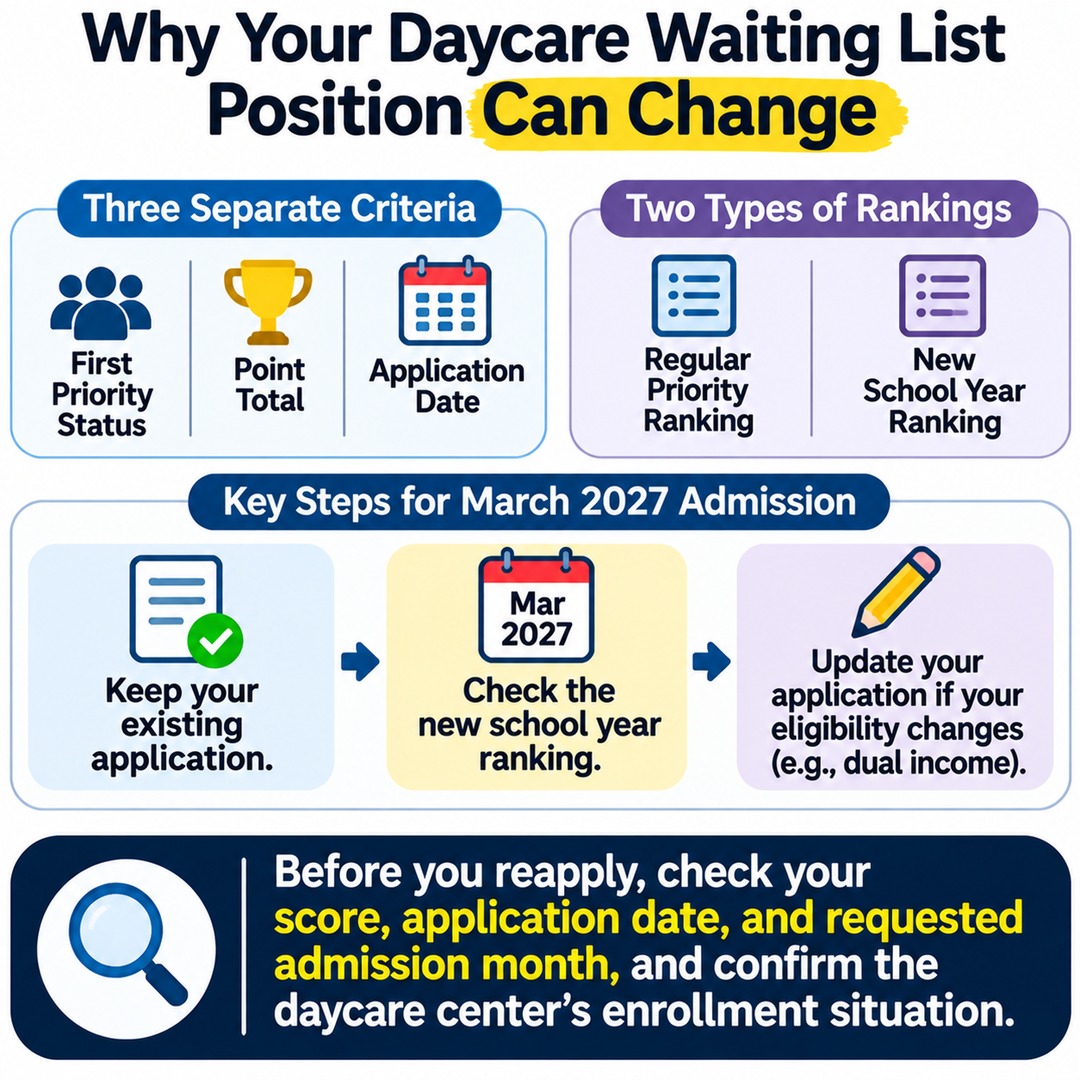
First-priority status, the actual point total, and the application date are three separate criteria. You must also distinguish between the regular priority ranking and the new-school-year ranking to understand why the displayed position may have changed.
For families waiting for admission in March 2027, the important steps are to keep the existing application active, check the separate new-school-year ranking, and update the application information if eligibility has changed, such as becoming a dual-income household.
Do not delete an existing application simply because the waiting-list position has changed. First, check the score, application date, and requested admission month. Then confirm the daycare center's actual enrollment situation. This can help you avoid an unnecessary new application and the potential loss of your original application date.