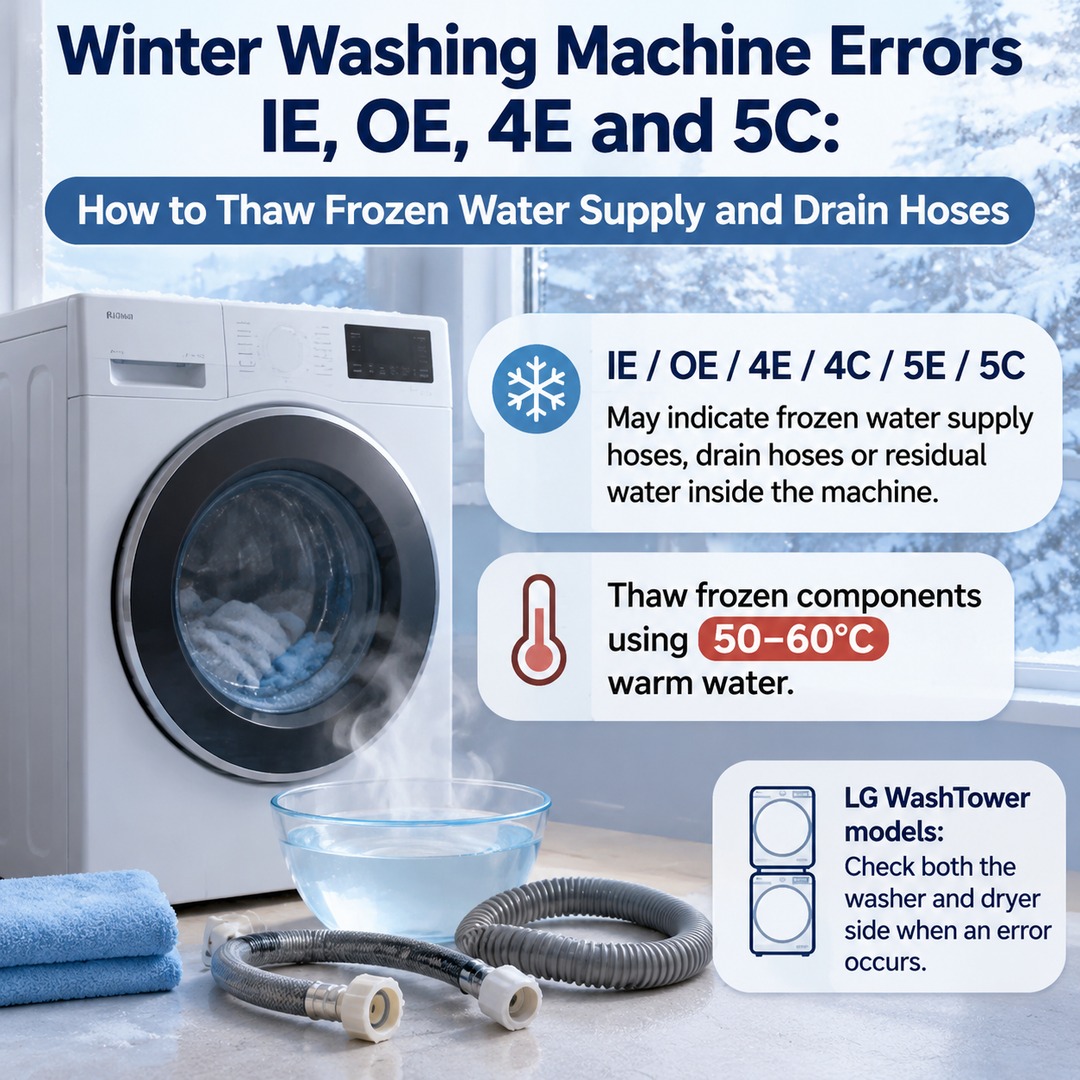
If your washing machine stops filling with water or draining after temperatures drop, displaying errors such as IE, OE, 4E, 4C or 5C, check for frozen water supply hoses, drain hoses and residual water inside the machine before assuming a component has failed. Samsung uses error codes in the 4E/4C and 5E/5C families, while LG uses codes such as IE, OE, FF and u51. The appropriate thawing method depends on which part is frozen.
An error code does not automatically mean that you need to replace or repair your washing machine. First, determine whether water cannot enter the machine or cannot drain out. If the machine is installed in an exposed area, such as a balcony or utility room, check not only the faucet and hoses but also any water remaining underneath the machine.
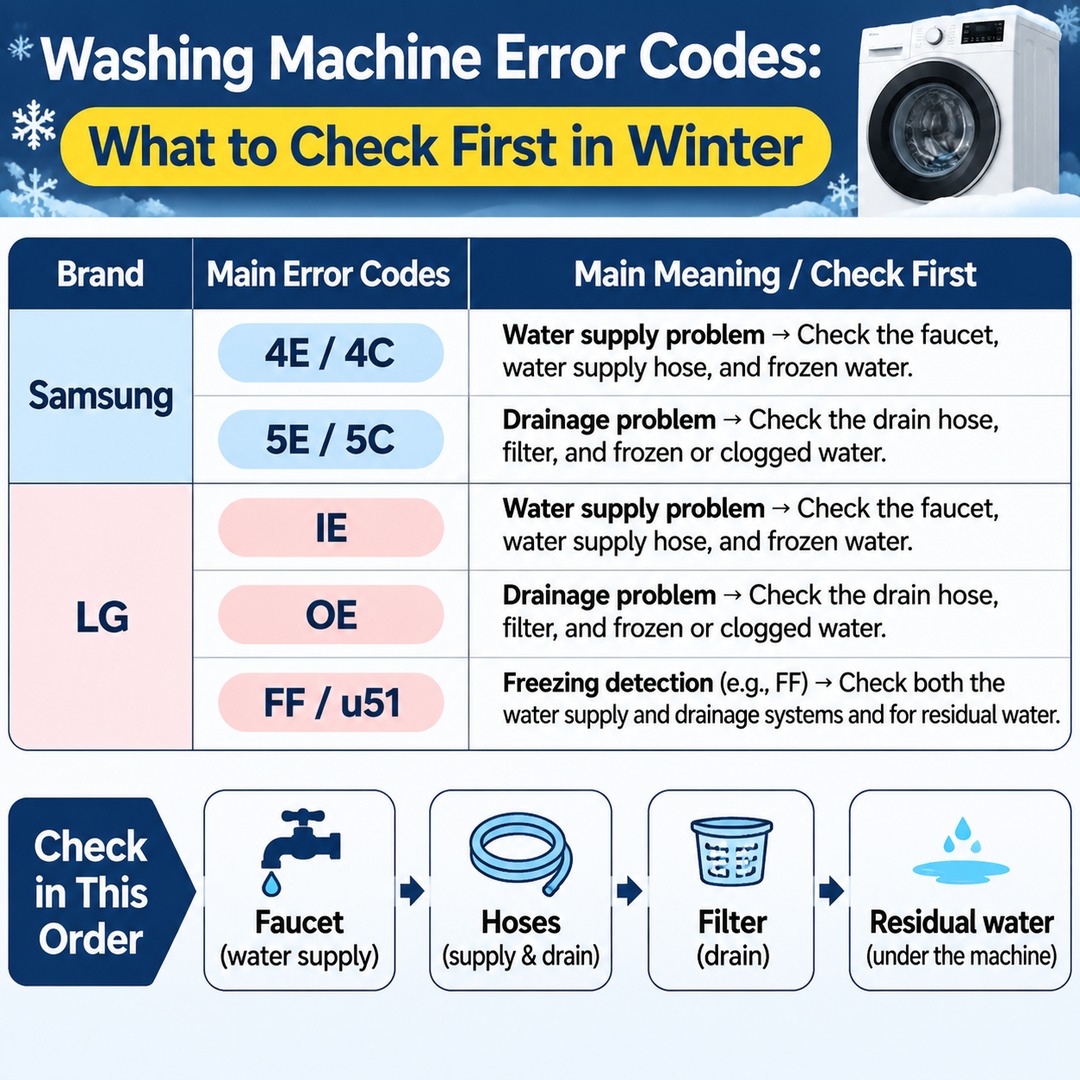
What Do IE, OE, 4E and 5C Washing Machine Errors Mean?
Error codes have different meanings depending on the manufacturer and model. Interpreting Samsung and LG codes using the same definitions can lead you to inspect the wrong component, so identify the brand first.
| Manufacturer | Error code | What to check |
|---|---|---|
| Samsung | 4E / 4C | Water supply delay; faucet and water supply hose |
| Samsung | 5E / 5C | Drainage delay; drain hose and residual water drainage system |
| LG | IE | Water supply failure; faucet and water supply hose |
| LG | OE | Drainage failure; drain hose and drainage system |
| LG | FF / u51 | Indicators associated with freezing detection |
An error code does not always identify the exact location of the ice. Water supply problems can also result from an interrupted water supply or a kinked hose. Drainage problems can occur because of debris or a clogged filter.
If you see Samsung 4E/4C or LG IE, start by checking the water supply path. If you see Samsung 5E/5C or LG OE, start by checking the drainage path.
LG's FF code is associated with freezing detection, so checking only the water supply or drainage system may not be sufficient.
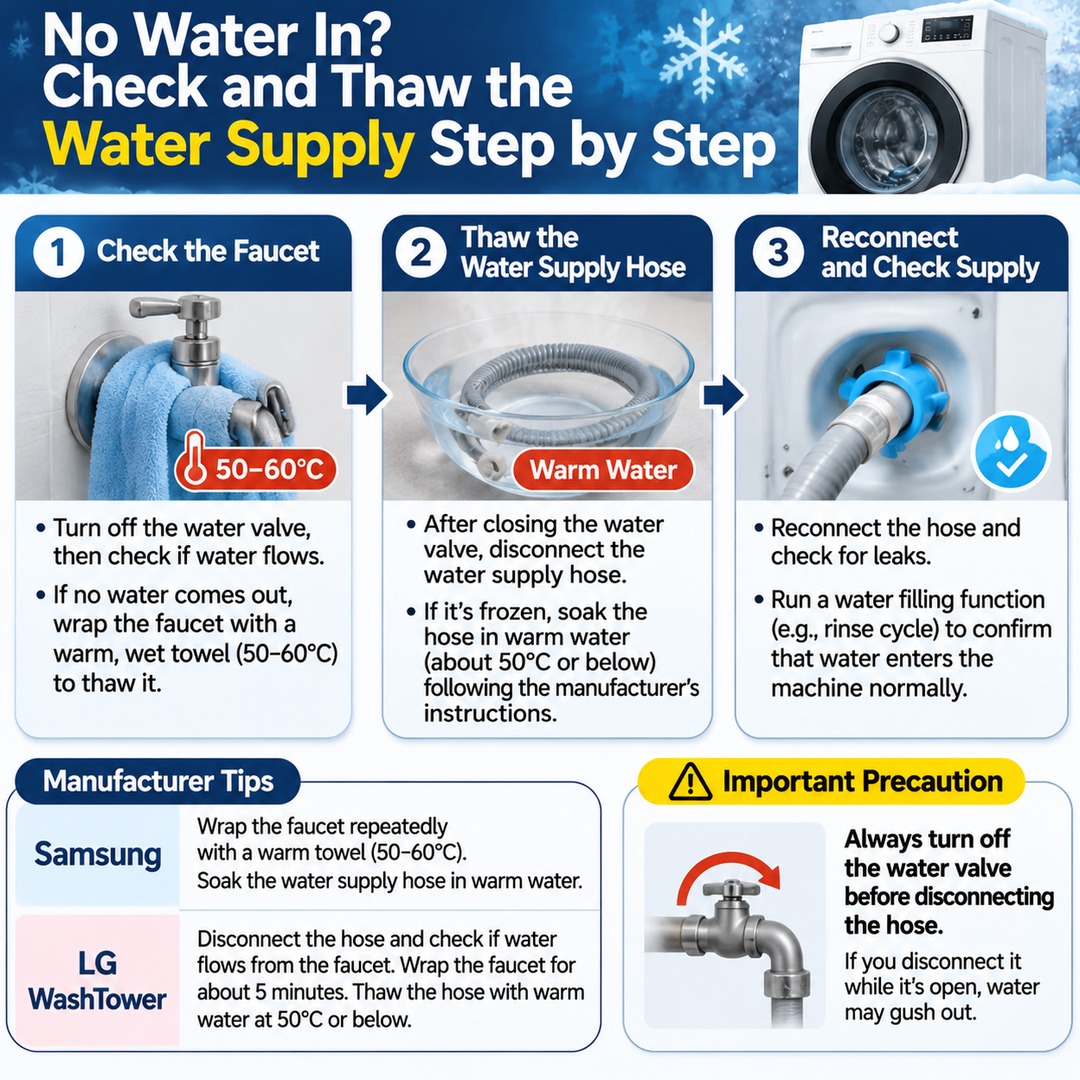
If Your Washing Machine Will Not Fill With Water, Start by Thawing the Water Supply Hose
When water does not enter the machine, check the faucet, water supply hose and washing machine connection in that order. If no water comes out of the faucet, suspect a frozen faucet or an interruption in the water supply before investigating the washing machine itself.
Steps for Thawing the Water Supply System
1. Check the faucet
Before disconnecting the water supply hose, turn off the water valve and check whether water comes out of the faucet. If no water flows, wrap the faucet area with a towel soaked in warm water to thaw it.
2. Thaw the water supply hose
Close the water valve before disconnecting the water supply hose. If the inside of the hose is frozen, thaw it by soaking it in warm water, following the manufacturer's instructions.
3. Check the connection and water supply
After the ice has melted, reconnect the hose and check for leaks. Then run a water-filling function, such as the rinse cycle, to confirm that water enters the machine normally.
Samsung Electronics Service recommends repeatedly wrapping the area around the faucet with a towel soaked in warm water at 50–60°C. It also recommends soaking the water supply hose in warm water to thaw it.
For LG WashTower models, the instructions recommend disconnecting the water supply hose and checking whether water flows from the faucet. The faucet should be wrapped in a warm towel for approximately five minutes, while the water supply hose should be thawed using warm water at 50°C or below.
One important precaution: always turn off the water valve before disconnecting the hose. If you disconnect it while the valve is open, water may gush out.
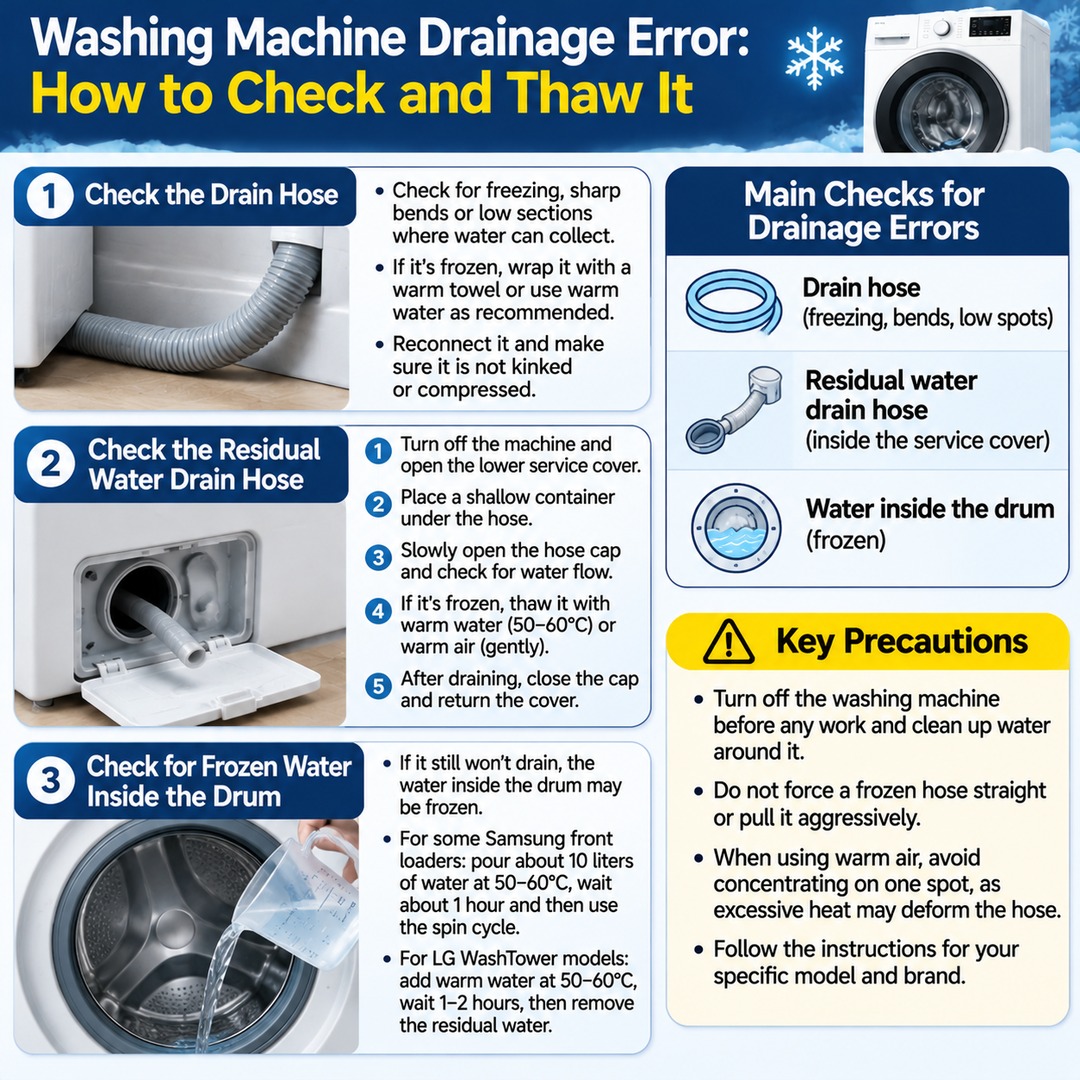
For OE and 5C Drainage Errors, Check the Drain Hose and Residual Water Drain Separately
A drainage error means that water remains inside the washing machine but cannot flow out. You need to determine whether the drain hose is frozen, the residual water drain hose underneath the machine is frozen, or water inside the drum itself has frozen.
If the drain hose is frozen, thaw the ice inside it. If no water comes out of the residual water drain hose, you may also need to check for freezing inside the washing machine.
When the Drain Hose Is Frozen
Check the drain hose, especially if it is sharply bent near the floor or has a low section where water can collect.
Turn off the washing machine and clean up any water around it.
If the hose is designed to be removable, disconnect it according to the product manual.
Wrap the frozen section with a towel soaked in warm water, or use warm water as recommended by the manufacturer.
Once the hose has thawed sufficiently, reconnect it in its original position and make sure it is not kinked or compressed.
Do not force a frozen hose straight or pull it aggressively, as this may damage it. Avoid bending a hose that has become rigid from freezing.
When the Residual Water Drain Hose Underneath the Washing Machine Is Frozen
Some front-loading washing machines have a residual water drain hose inside the service cover at the bottom of the appliance.
This hose provides an outlet for water remaining inside the washing machine. If it freezes, water may remain in the drum or the drainage process may fail.
Follow these steps when addressing the problem:
1. Turn off the washing machine and open the lower service cover.
2. Place a shallow container underneath the residual water drain hose.
3. Slowly open the hose cap and check whether water flows out.
4. If the hose is frozen, thaw it using warm water or another method specified for your model.
5. Once the water has drained, securely close the cap and return the service cover to its original position.
If no water comes out after you open the hose cap, do not immediately assume that the drain pump has failed. Ice inside the machine may not have melted completely.
Samsung Electronics Service recommends using warm water at 50–60°C or warm air from a hair dryer to thaw a frozen residual water drain hose. However, avoid concentrating hot air on one spot, as excessive heat may deform the hose.
When the Washing Machine Drum Itself Is Frozen
If you have checked both the drain hose and the residual water drain hose but the machine still will not drain, check whether residual water inside the drum has frozen.
Samsung Electronics Service explains that, for certain front-loading washing machines, you can pour approximately 10 liters of water at 50–60°C into the drum, wait about one hour, and then use the spin cycle to check whether the water drains.
For LG WashTower models, the recommended procedure is to add warm water at approximately 50–60°C to the washing tub, wait 1–2 hours, and then remove the residual water.
The required water volume, waiting time and checking procedure vary by product. It is important not to apply another manufacturer's instructions to your machine without checking the model-specific guidance.
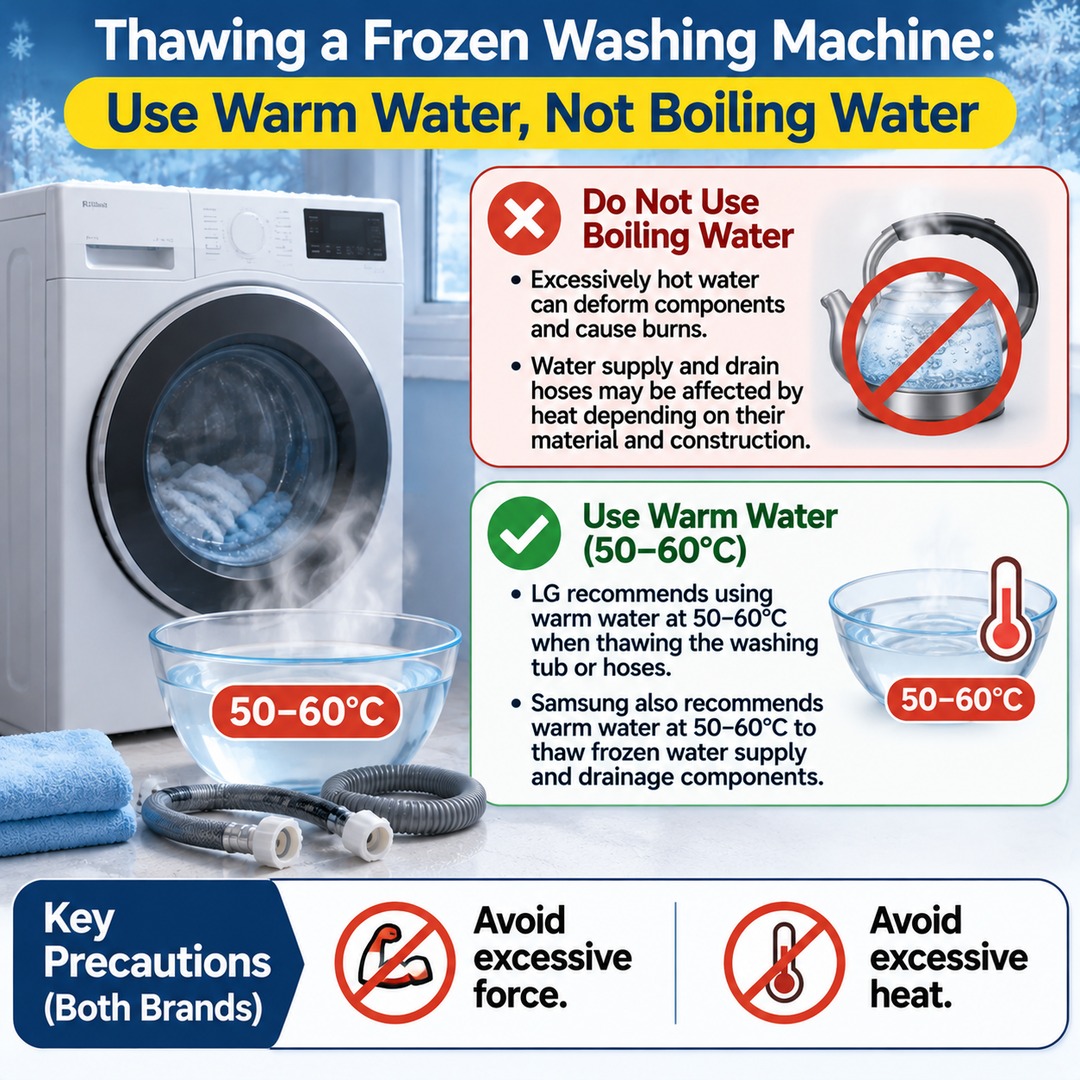
Why You Should Never Use Boiling Water to Thaw a Washing Machine
Avoid pouring boiling water into your washing machine just to melt the ice faster. Excessively hot water can deform components and cause burns.
Water supply and drain hoses, in particular, may be affected by heat depending on their material and construction.
| Component to thaw | Recommended method | Precautions |
|---|---|---|
| Faucet | Wrap with a warm, damp towel | Avoid burns |
| Water supply hose | Disconnect and thaw using warm water | Turn off the water valve first |
| Drain hose | Use a warm, damp towel or warm water as specified in the product instructions | Do not force it to bend |
| Residual water drain hose | Use warm water or the method specified for your model | Avoid excessive heat that could cause deformation |
| Inside the drum | Use water at the temperature recommended by the manufacturer | Follow the specified water volume and waiting time |
LG Electronics recommends using warm water at 50–60°C, rather than boiling water, when thawing the washing tub or hoses.
Samsung Electronics Service also recommends using warm water at 50–60°C to thaw frozen water supply and drainage components.
A common precaution in both manufacturers' instructions is to avoid excessive force and excessive heat.
What If the IE or OE Error Does Not Disappear After Thawing?
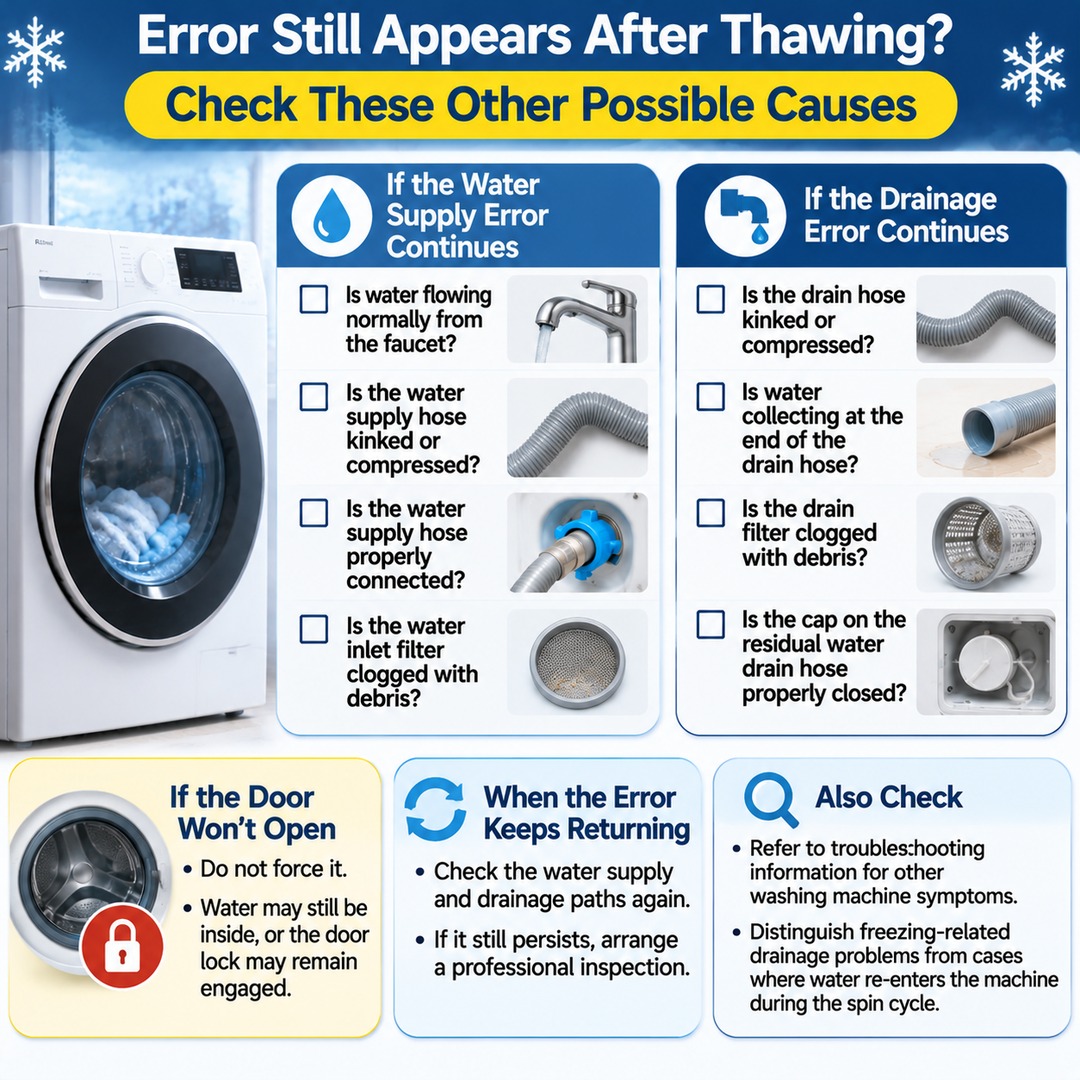
If the ice has melted but the error continues to appear, investigate other possible causes besides freezing. First, check whether the water supply and drainage paths are working properly. If the same error keeps returning, arrange a professional inspection.
Check the following items.
If the water supply error continues:
Is water flowing normally from the faucet?
Is the water supply hose kinked or compressed?
Is the water supply hose properly connected?
Is the water inlet filter clogged with debris?
If the drainage error continues:
Is the drain hose kinked or compressed?
Is water collecting at the end of the drain hose?
Is the drain filter clogged with debris?
Is the cap on the residual water drain hose properly closed?
If the washing machine door also refuses to open, do not force it. Water may still be inside the machine, or the door lock may remain engaged.
You can also refer to related troubleshooting information for other washing machine symptoms.
It is also worth distinguishing freezing-related drainage problems from situations where water re-enters the machine during the spin cycle, as these may have different causes.
How to Prevent Your Washing Machine from Freezing on a Balcony
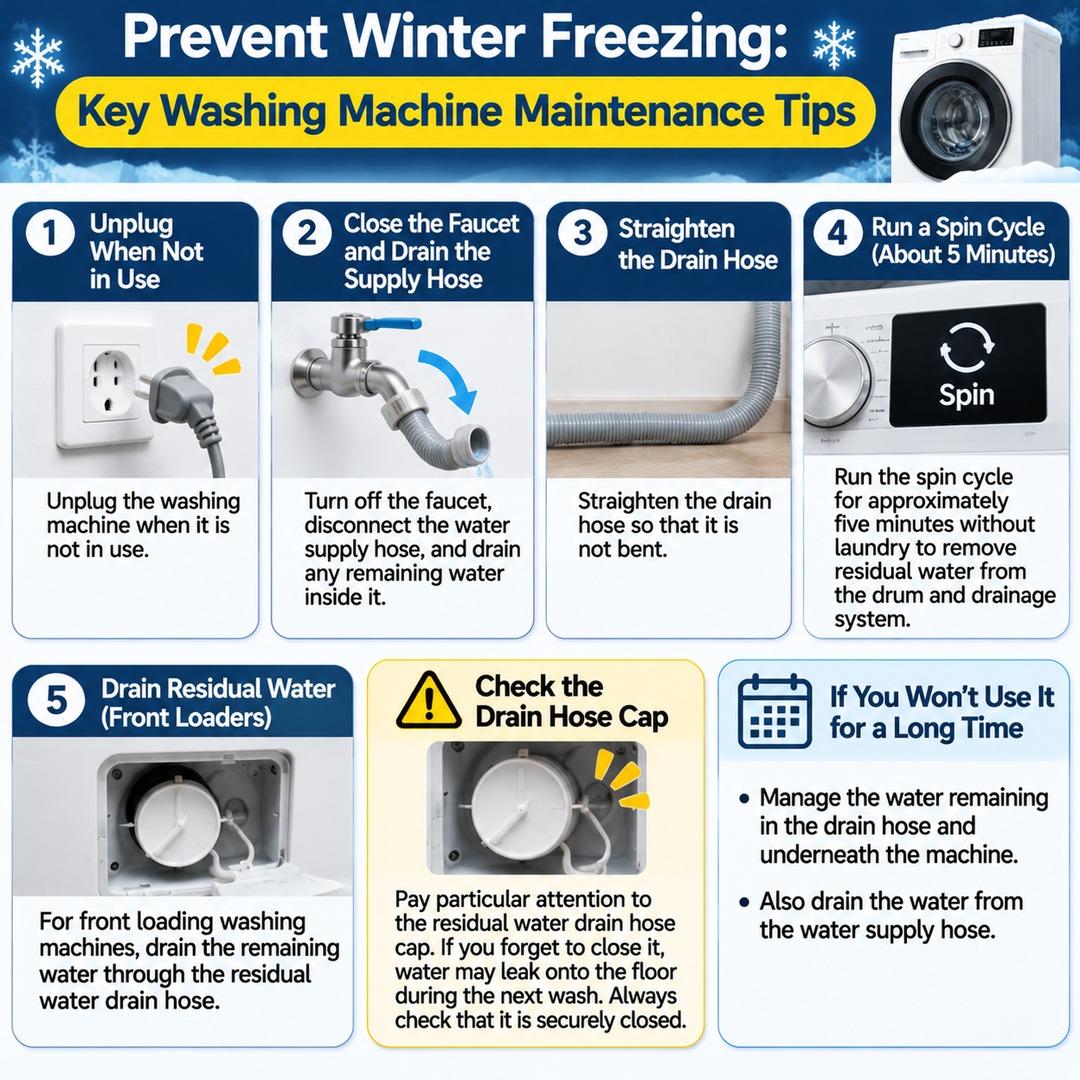
The most important way to prevent winter freezing is to make sure that water does not remain inside the water supply hose, drain hose or washing machine when it is not in use.
Samsung Electronics Service recommends the following winter maintenance steps:
Unplug the washing machine when it is not in use.
Turn off the faucet, disconnect the water supply hose and drain any remaining water inside it.
Straighten the drain hose so that it is not bent.
Run the spin cycle for approximately five minutes without laundry to remove residual water from the drum and drainage system.
For front-loading washing machines, drain the remaining water through the residual water drain hose.
After draining the water, close the hose cap again.
Pay particular attention to the residual water drain hose cap. If you forget to close it, water may leak onto the floor during the next wash. Always check that it is securely closed.
If you will not be using the washing machine for an extended period, manage the water remaining in the drain hose and underneath the machine as well as the water supply hose.
Can You Thaw a WashTower or an Outdoor Washing Machine Yourself?
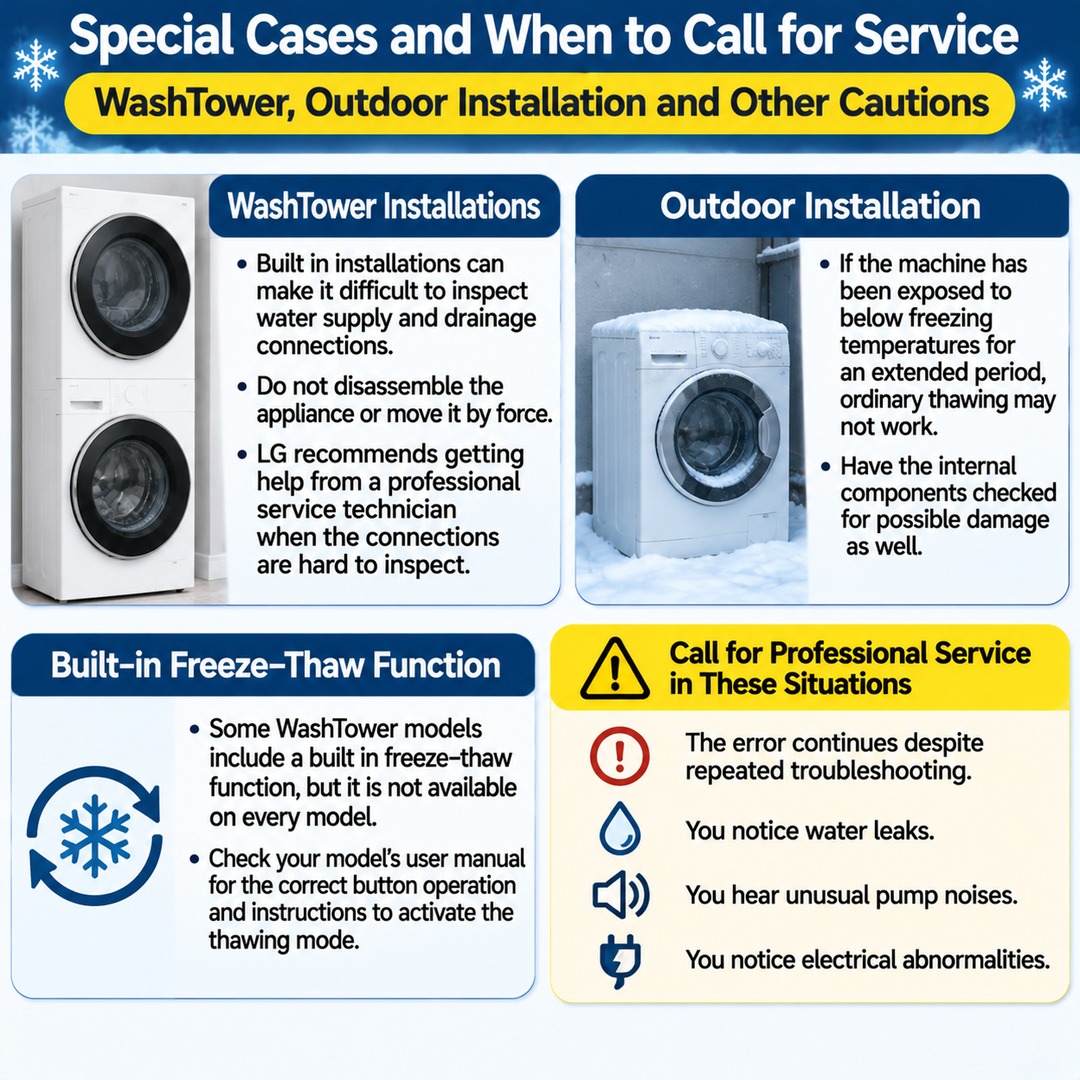
Not every washing machine can be thawed using the same procedure. In particular, built-in WashTower installations can make it difficult to inspect the water supply and drainage connections. It is safer not to disassemble the appliance or move it by force.
LG Electronics recommends seeking help from a professional service technician when hose connections are difficult to inspect, as can happen with WashTower installations.
If your washing machine is installed outdoors and has been exposed to below-freezing temperatures for an extended period, ordinary thawing procedures may not resolve the problem. In such environments, it is advisable to have the internal components checked for possible damage as well.
Some WashTower models also include a built-in freeze-thaw function, but this feature is not available on every model. Check your model's user manual for the correct button operation and instructions for activating the thawing mode.
If the error persists despite repeated attempts at self-troubleshooting, or if you notice water leaks, unusual pump noises or electrical abnormalities, stop operating the machine and request professional service.
Frequently Asked Questions About Winter Washing Machine Errors
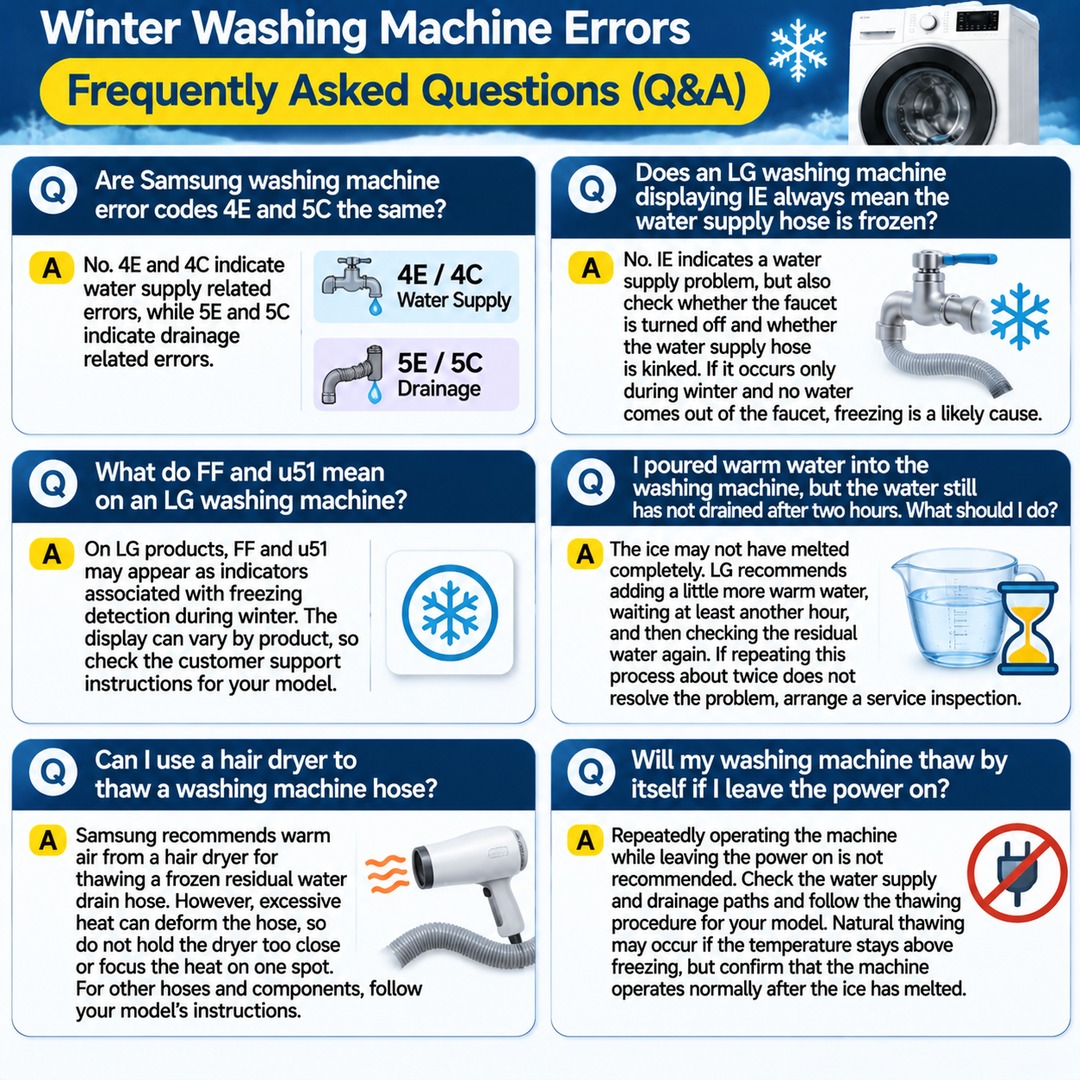
Q. Are Samsung washing machine error codes 4E and 5C the same?
No. Codes 4E and 4C indicate water supply-related errors, while 5E and 5C indicate drainage-related errors. First determine whether you need to inspect the water supply hose or the drain hose.
Q. Does an LG washing machine displaying IE always mean that the water supply hose is frozen?
No. IE indicates a water supply problem, but you should also check whether the faucet is turned off and whether the water supply hose is kinked. If the error occurs only during winter and no water comes out of the faucet, freezing is one possible cause to investigate first.
Q. What do FF and u51 mean on an LG washing machine?
On LG products, FF and u51 may appear as indicators associated with freezing detection during winter. The way these codes are displayed can vary by product, so check the customer support instructions for your specific model.
Q. I poured warm water into the washing machine, but the water still has not drained after two hours. What should I do?
The ice inside the machine may not have melted completely. LG Electronics recommends adding a little more warm water, waiting at least another hour, and then checking the residual water again. If repeating this process approximately twice does not resolve the problem, arrange a service inspection.
Q. Can I use a hair dryer to thaw a washing machine hose?
Samsung Electronics Service recommends warm air from a hair dryer as one method for thawing a frozen residual water drain hose. However, excessive heat can deform the hose, so do not hold the dryer too close or concentrate the heat on one spot. For other hoses and components, follow the instructions for your specific model.
Q. Will my washing machine thaw by itself if I leave the power on?
Repeatedly operating the washing machine while leaving the power on is not recommended. Check the water supply and drainage paths and follow the thawing procedure specified for your model. Natural thawing may occur if the surrounding temperature remains above freezing, but you should still confirm that the machine operates normally after the ice has melted.