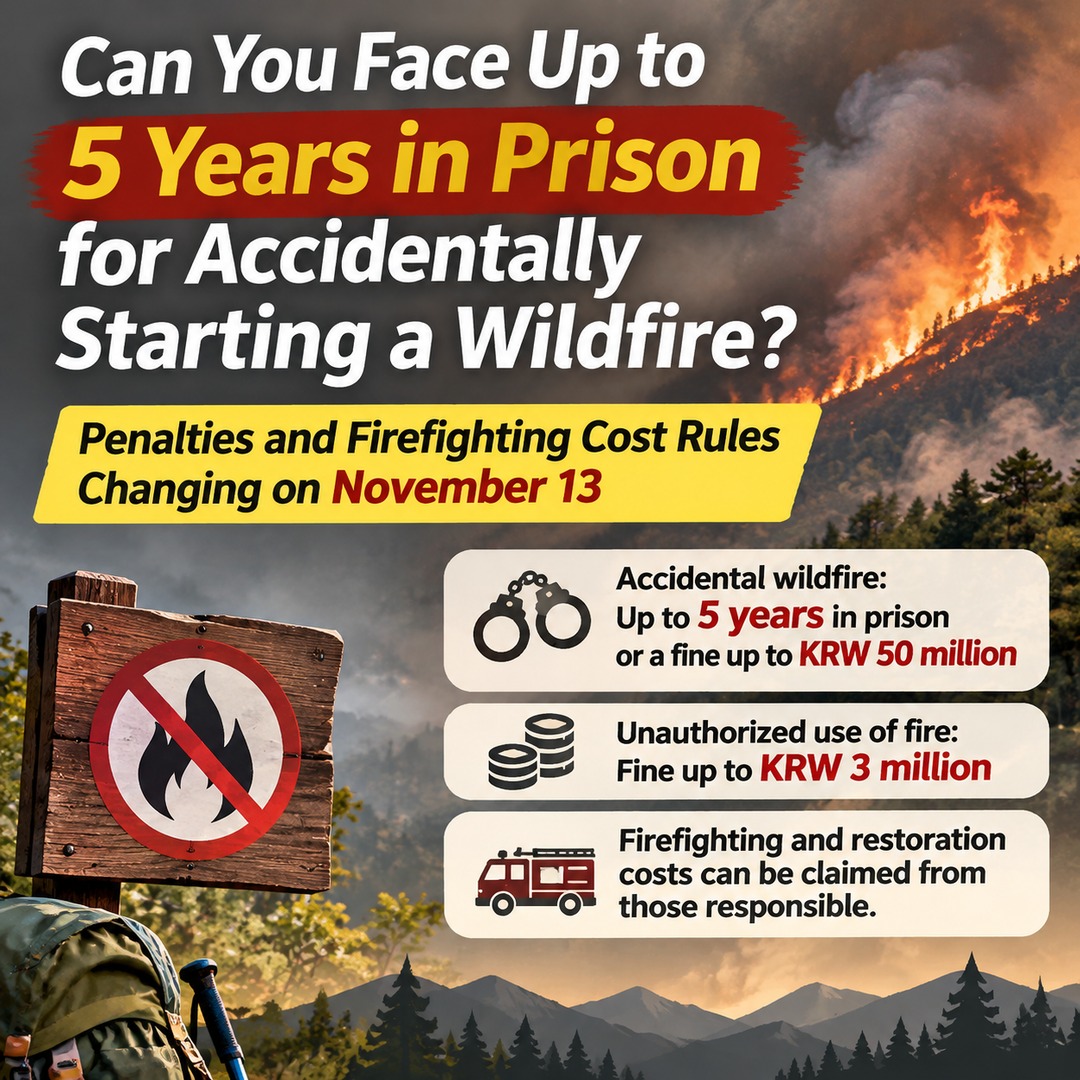
Starting November 13, 2026, the maximum penalty for accidentally starting a wildfire in South Korea will increase from up to three years in prison to up to five years in prison or a fine of up to KRW 50 million. The maximum administrative fine for starting a fire without authorization in forests or areas adjacent to forests will also rise from KRW 2 million to KRW 3 million. However, the system allowing firefighting and damage restoration costs to be claimed from those responsible for causing a wildfire has a different implementation date. These cost-recovery provisions have been in effect since May 12, 2026.
Even a small spark from a discarded cigarette butt in the mountains, burning field boundaries in rural areas, or burning household waste can lead to a wildfire and legal liability. It is important to distinguish criminal penalties, administrative fines, and firefighting and restoration costs because each is subject to different legal requirements.
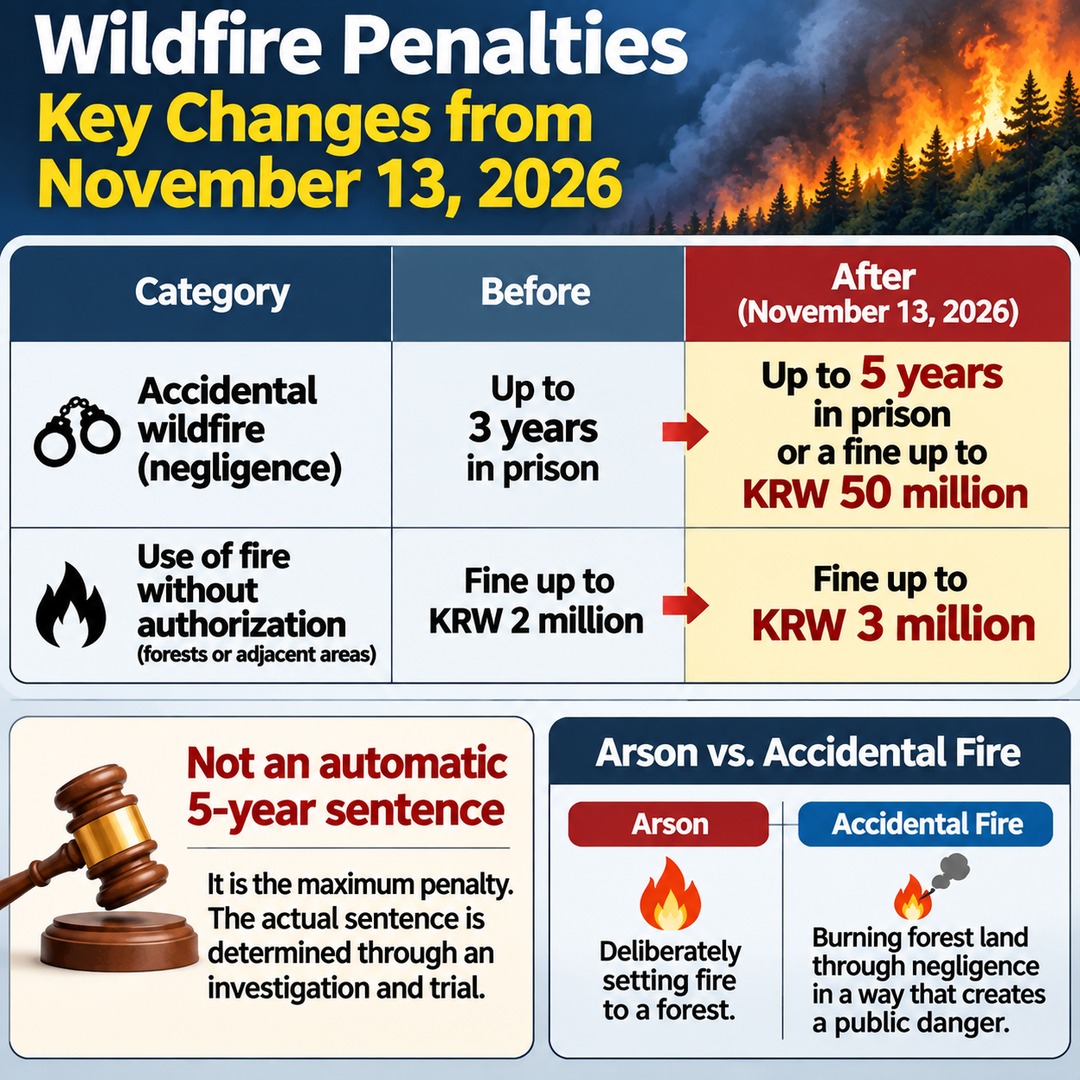
How Much Will Penalties for Accidentally Starting a Wildfire Increase on November 13?
When negligence causes a wildfire that creates a public danger, the maximum prison sentence will increase from three years to five years. The maximum fine will also rise from KRW 30 million to KRW 50 million.
The relevant provision is Article 76(4) of the Forest Disaster Prevention Act of South Korea.
| Category | Before the amendment | From November 13, 2026 |
|---|---|---|
| Wildfire caused by negligence | Up to 3 years in prison | Up to 5 years in prison |
| Maximum fine | KRW 30 million | KRW 50 million |
An important point is that a five-year prison sentence is not automatically imposed on everyone who accidentally causes a wildfire.
The law establishes the maximum available penalty. Actual criminal liability and sentencing are determined through an investigation and trial, taking the specific conduct and circumstances of the case into account.
It is also important to distinguish arson, which involves deliberately setting a forest on fire, from an accidental fire caused by negligence.
Arson: Deliberately setting fire to a forest.
Accidental fire: Burning forest land through negligence in a way that creates a public danger.
Therefore, the fact that a fire was accidental does not automatically exempt someone from criminal liability.
Will Starting a Fire Without Permission Result in a KRW 3 Million Fine?
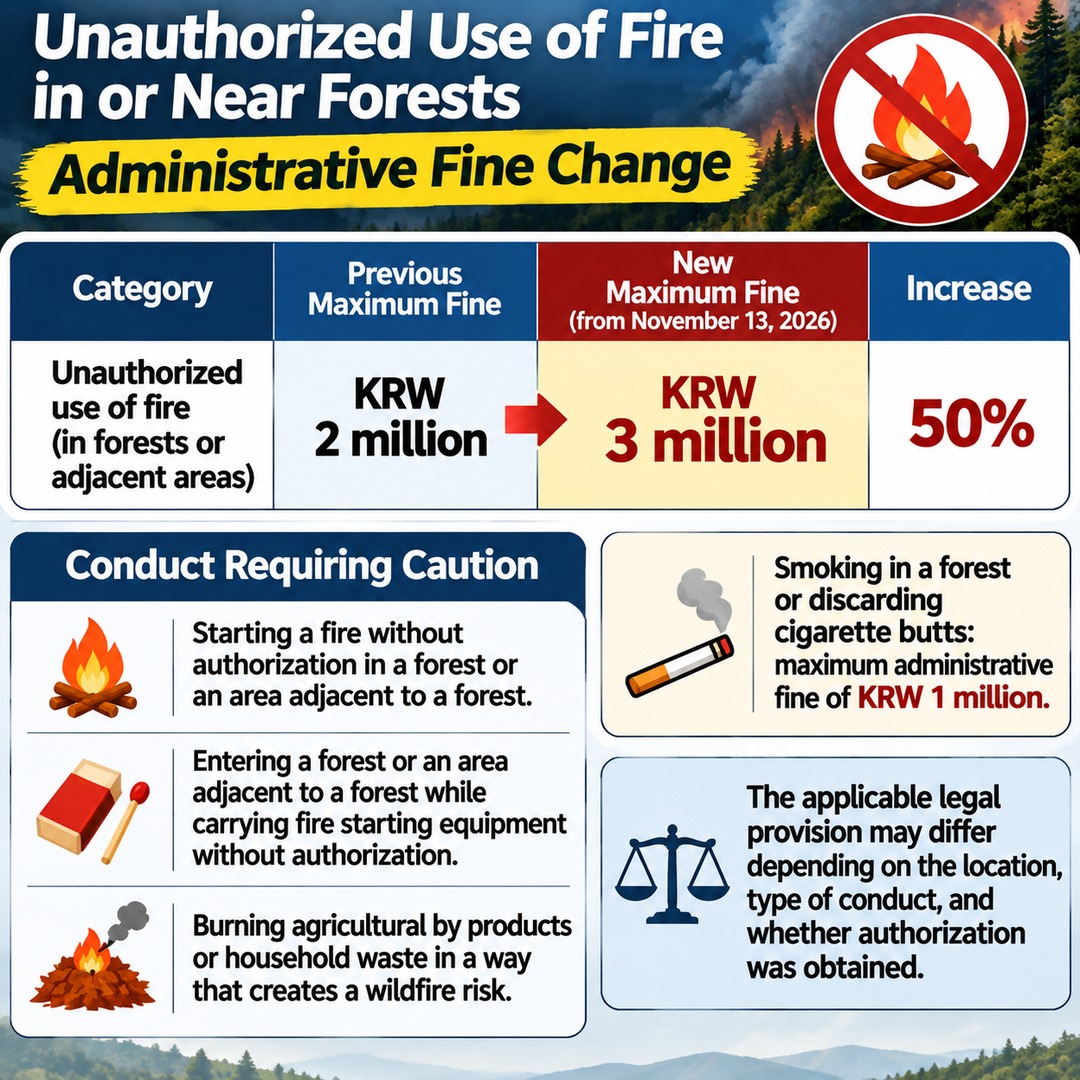
Starting November 13, 2026, the maximum administrative fine for starting a fire or carrying fire-starting equipment into a forest or an area adjacent to a forest without authorization will increase from KRW 2 million to KRW 3 million.
This change is provided for under Article 79(2) of the Forest Disaster Prevention Act of South Korea.
Changes to Administrative Fines for Unauthorized Use of Fire
Previous maximum fine
New maximum fine
Increase in the maximum administrative fine
KRW 1 million
Percentage increase compared with the previous maximum
50%
Author's calculation: (KRW 3 million - KRW 2 million) ÷ KRW 2 million × 100
The following are examples of conduct that require particular caution:
Starting a fire without authorization in a forest or an area adjacent to a forest.
Entering a forest or an area adjacent to a forest while carrying fire-starting equipment without authorization.
Burning agricultural by-products or household waste in a way that creates a wildfire risk.
However, not every type of outdoor burning is handled under the same administrative fine provision. The applicable legal provision may differ depending on the location, type of conduct, and whether authorization was obtained.
In particular, smoking in a forest or discarding cigarette butts is subject to a separate administrative fine provision. Under the amended law, the maximum administrative fine for this conduct is KRW 1 million.
Can Individuals Also Be Required to Pay Wildfire Suppression Costs?
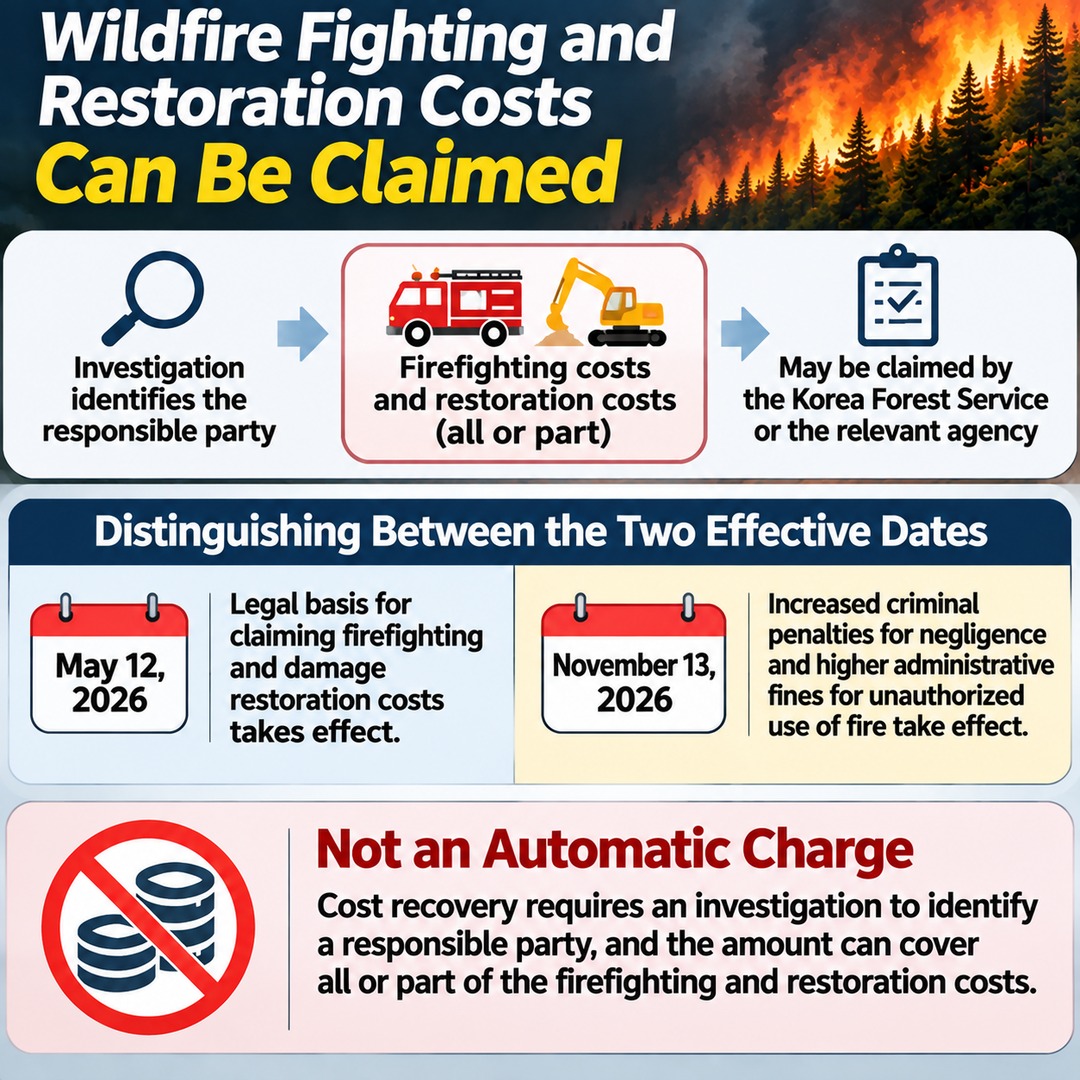
Yes. If an investigation identifies someone as having caused a wildfire, the Administrator of the Korea Forest Service or the head of the relevant forest disaster prevention agency may claim all or part of the costs of suppressing the fire and restoring the damage caused by it.
One point that must be understood is the effective date of the cost-recovery provisions.
The legal basis for claiming wildfire suppression costs is set out in Article 49(2) of the Forest Disaster Prevention Act. The amendment dated May 12, 2026, explicitly provides that the actual costs incurred in suppressing a wildfire can be claimed, in addition to the existing provision for damage restoration costs.
According to the transitional application provision, the amended rules apply to wildfires occurring after the Act takes effect.
In other words, the cost-recovery system is not being introduced for the first time on November 13.
Distinguishing Between the Two Effective Dates
1. May 12, 2026: The legal basis for claiming firefighting and damage restoration costs from those responsible for causing a wildfire takes effect.
2. November 13, 2026: Increased criminal penalties for wildfires caused by negligence, higher administrative fines for unauthorized use of fire, and related provisions take effect.
Cost recovery is not an automatic charge imposed simply because a wildfire has occurred.
The law requires the investigation to identify a separate party responsible for causing the wildfire. The amount that may be claimed can cover all or part of the firefighting and restoration costs.
Consequently, the actual amount payable may vary depending on the investigation findings and the details of the claim. The system should not be understood as imposing a fixed charge on every wildfire.
What Should Hikers and Rural Residents Be Careful About?
The most important wildfire prevention measure is to avoid activities that could produce sparks or flames in the first place.
In particular, anyone using fire on farmland or near a home close to a forest should first check the surrounding conditions and applicable authorization requirements.
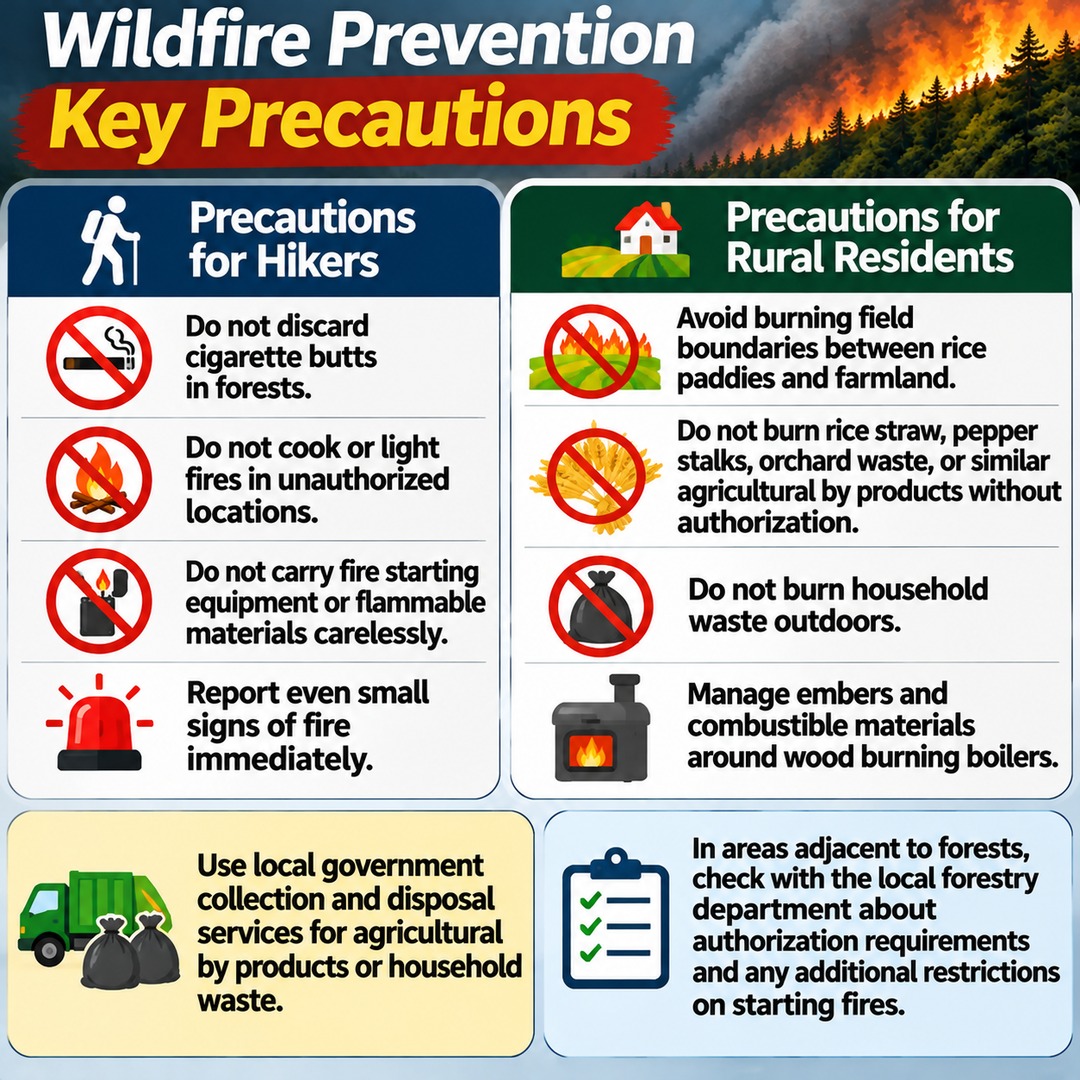
Precautions for Hikers
Do not discard cigarette butts in forests.
Do not cook or light fires in unauthorized locations.
Do not carry fire-starting equipment or flammable materials carelessly.
Report even small signs of fire immediately.
Precautions for Rural Residents
Avoid burning field boundaries between rice paddies and farmland.
Do not burn rice straw, pepper stalks, orchard waste, or similar agricultural by-products without authorization.
Do not burn household waste outdoors.
Manage embers and combustible materials around wood-burning boilers.
If agricultural by-products or household waste need to be disposed of, using collection and disposal services provided by the local government is safer than burning them independently.
In particular, in areas adjacent to forests, residents should check with the relevant local forestry department about authorization requirements and any additional restrictions on starting fires.
How Long Does the Fall 2026 Wildfire Prevention Period Last?
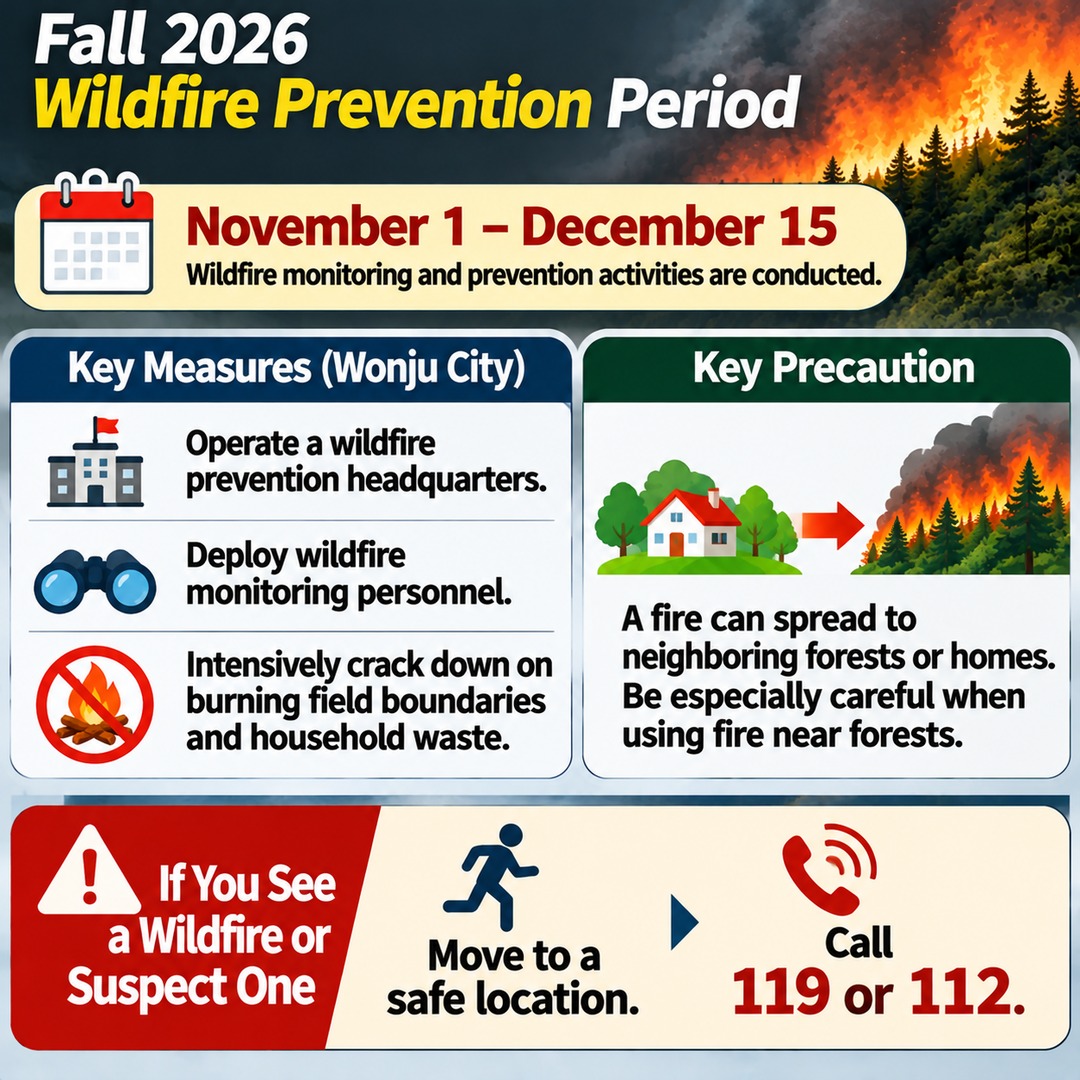
South Korea's fall 2026 wildfire prevention period runs from November 1 through December 15.
During this period, wildfire monitoring and prevention activities are conducted. Wonju City has also announced plans to operate a wildfire prevention headquarters during the same period, deploy wildfire monitoring personnel, and intensively crack down on practices such as burning field boundaries and household waste.
Even if a wildfire starts in one location, it can spread to neighboring forests or homes. Particular care is therefore necessary when using fire in areas close to forests.
If you see flames spreading into a forest or suspect that a wildfire has started, do not put yourself at risk by attempting to extinguish it yourself. Move to a safe location and call 119 or 112 in South Korea.
Frequently Asked Questions About Tougher Wildfire Penalties
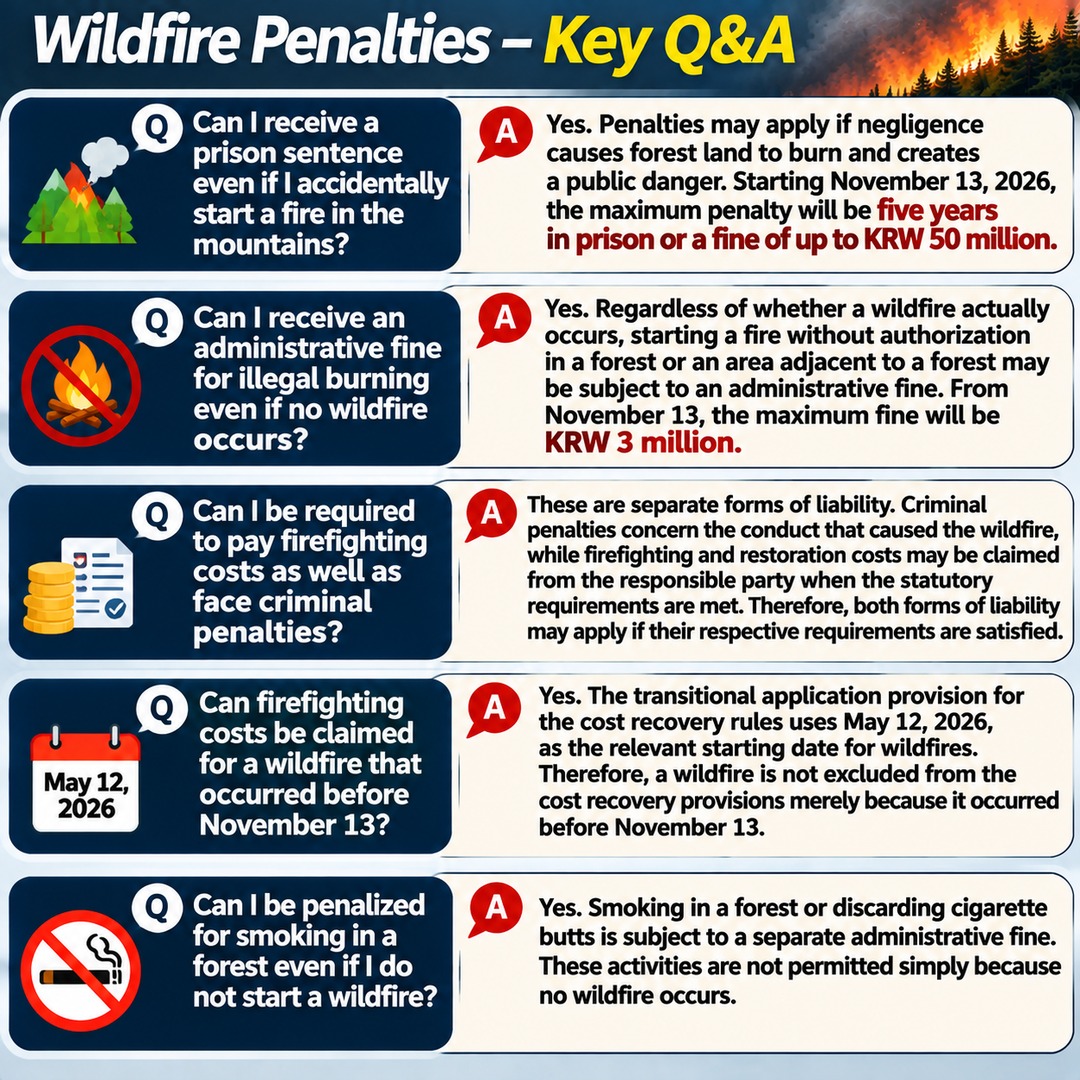
Q. Can I receive a prison sentence even if I accidentally start a fire in the mountains?
Yes. Penalties may apply if negligence causes forest land to burn and creates a public danger. Starting November 13, 2026, the maximum statutory penalty will increase to five years in prison or a fine of up to KRW 50 million.
Q. Can I receive an administrative fine for illegal burning even if no wildfire occurs?
Yes. Regardless of whether a wildfire actually occurs, starting a fire without authorization in a forest or an area adjacent to a forest may itself be subject to an administrative fine. From November 13, the maximum fine for the relevant conduct will be KRW 3 million.
Q. Can I be required to pay firefighting costs as well as face criminal penalties?
These are separate forms of liability. Criminal penalties concern the conduct that caused the wildfire, while firefighting and restoration costs may be claimed from the responsible party when the statutory requirements are met. Therefore, both forms of liability may apply if their respective requirements are satisfied.
Q. Can firefighting costs be claimed for a wildfire that occurred before November 13?
The transitional application provision for the cost-recovery rules uses May 12, 2026, as the relevant starting date for wildfires. Therefore, a wildfire is not excluded from the cost-recovery provisions merely because it occurred before November 13.
Q. Can I be penalized for smoking in a forest even if I do not start a wildfire?
Yes. Smoking in a forest or discarding cigarette butts is subject to a separate administrative fine. These activities are not permitted simply because no wildfire occurs.