Statutory infertility treatment leave in South Korea is not limited to the actual day of artificial insemination or in vitro fertilization (IVF). Hospital visits for essential preliminary procedures, including infertility tests and ovulation induction, can also fall within the scope of legally protected infertility treatment leave. If an employer recognizes leave only on the actual procedure date and tells employees to use annual paid leave for examinations or ovulation induction, employees may request a review based on the Ministry of Employment and Labor’s revised administrative interpretation.
It is particularly important to distinguish between the scope of infertility treatment leave and the supporting documents required to apply for government-funded leave benefits. Both employees applying for leave and human resources personnel processing applications should understand this distinction.
Can Statutory Leave Cover Infertility Tests and Ovulation Induction?
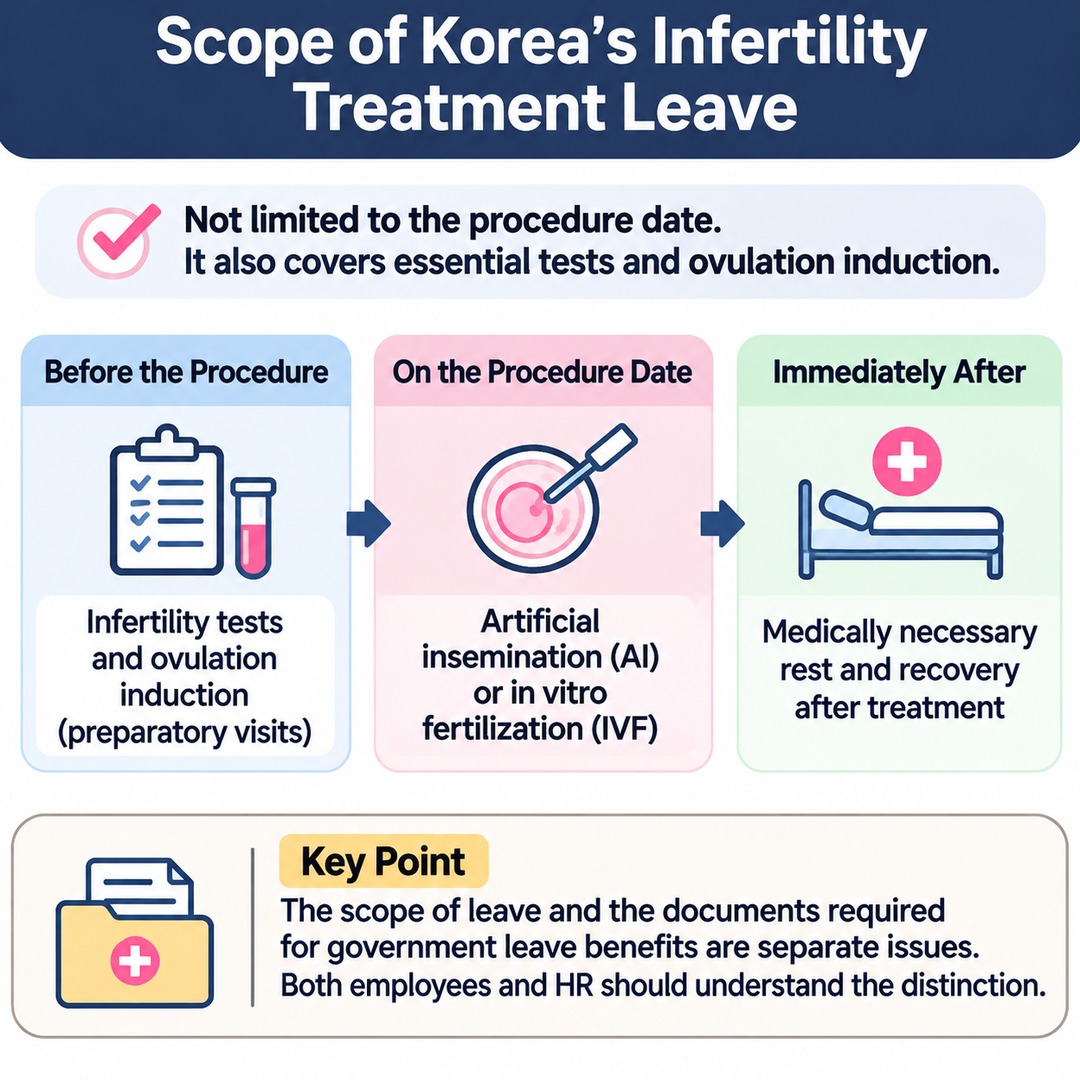
Yes. In South Korea, infertility treatment leave covers not only medical procedures performed as part of infertility treatment but also hospital visits for examinations and ovulation induction that are essential preparations for those procedures.
On August 29, 2025, the Ministry of Employment and Labor revised its previous administrative interpretation.
The revised scope of eligible leave includes the following:
Before the procedure: Hospital visits for essential preparatory procedures, including infertility tests and ovulation induction.
On the procedure date: The period during which medical procedures such as artificial insemination or in vitro fertilization are performed.
Immediately after the procedure: The period during which rest and recovery are medically necessary following treatment.
Accordingly, employees may apply for infertility treatment leave when visiting a hospital for examinations in preparation for egg retrieval during IVF treatment or for ovulation-induction injections.
Completion of embryo transfer is not a prerequisite for leave eligibility. Even if embryos cannot be transferred after egg retrieval, the hospital visit should still be assessed separately if it was an essential preparatory stage of infertility treatment.
What Should You Do If Your Employer Recognizes Only the Procedure Date?
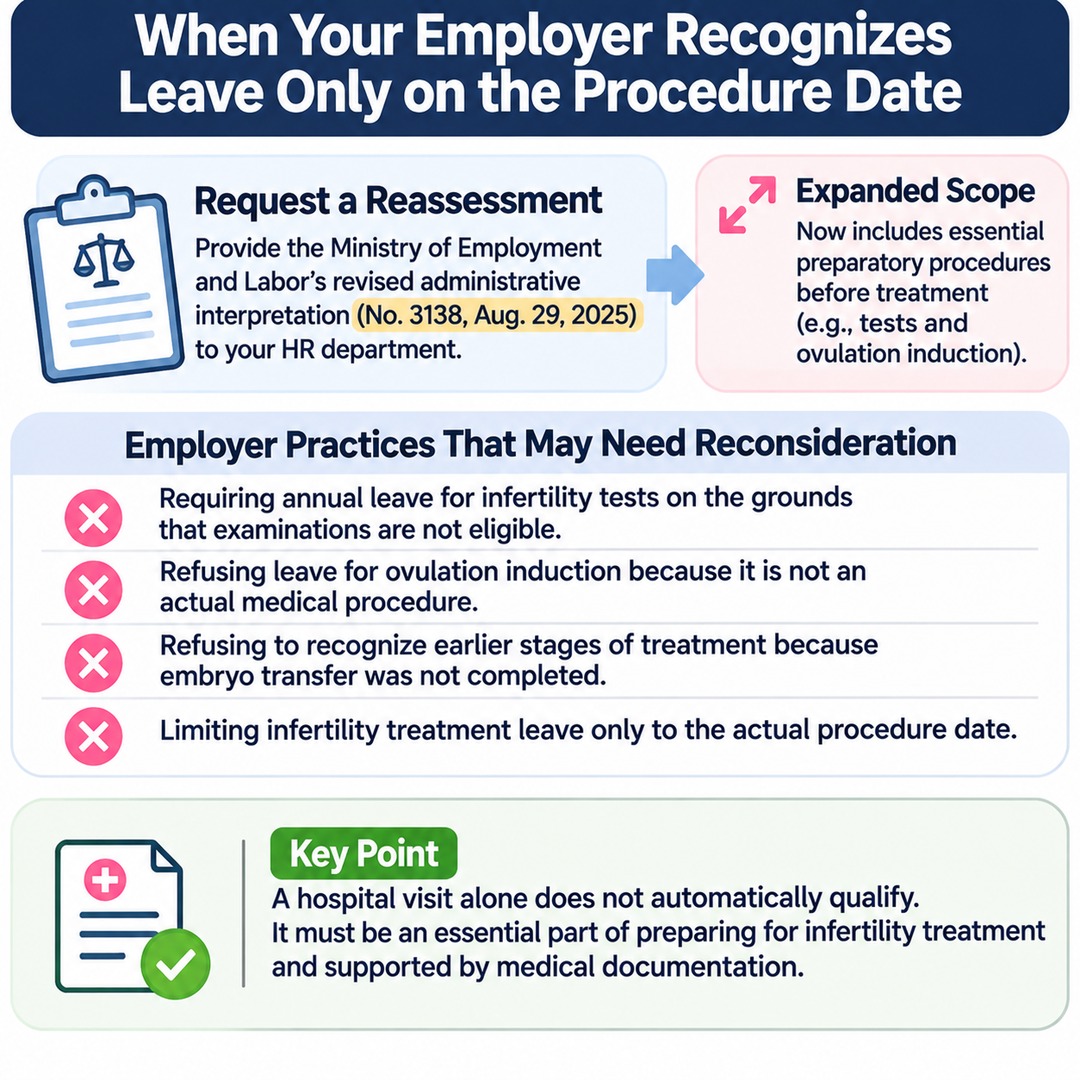
If your employer tells you that infertility treatment leave can only be used on the actual procedure date, you can provide the Ministry of Employment and Labor’s revised administrative interpretation to your human resources department and request a reassessment.
The previous interpretation primarily focused on the medical procedure itself and the necessary recovery period immediately afterward. However, the recognized scope was expanded to include essential preparatory procedures before treatment through administrative interpretation No. Women's Employment Policy Division-3138, dated August 29, 2025.
Under this interpretation, the following blanket employer practices may need to be reconsidered:
Telling employees to use annual leave for infertility tests because examinations are supposedly ineligible for infertility treatment leave.
Refusing leave for ovulation induction on the grounds that it is not an actual medical procedure.
Refusing to recognize earlier stages of infertility treatment because embryo transfer was not completed.
Restricting infertility treatment leave exclusively to the actual procedure date.
However, the fact that an employee visited a hospital does not automatically make every medical appointment eligible. The important questions are whether the visit was an essential part of preparing for infertility treatment and whether this can be established through documentation from the medical institution.
What Documents Should You Submit When Applying for Infertility Treatment Leave?
It is helpful to prepare the leave application separately from documents confirming the medical treatment.
Under Article 9-3 of the Enforcement Decree of South Korea’s Equal Employment Opportunity and Work-Family Balance Assistance Act, employees must submit a written or electronic application to their employer specifying the intended dates of infertility treatment leave and the application date, among other details.
Employers may additionally request documents verifying that the employee will receive infertility treatment.
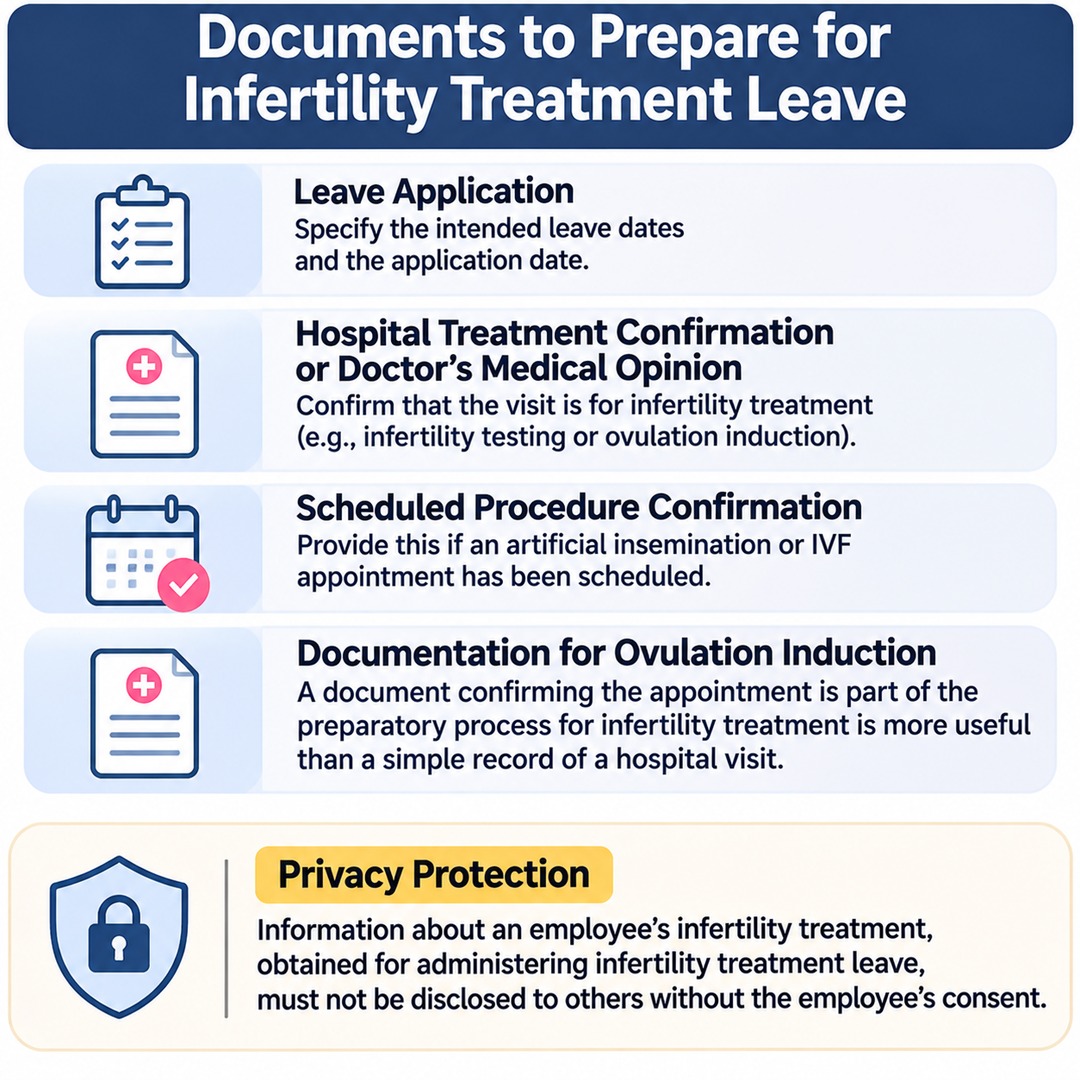
In practice, the following documents may be useful:
1. Infertility treatment leave application: Specify the intended leave dates and application date.
2. Hospital treatment confirmation or doctor's medical opinion: Confirm that the medical appointment is for infertility treatment, such as infertility testing or ovulation induction.
3. Scheduled procedure confirmation: Provide this if an artificial insemination or IVF appointment has been scheduled.
4. Documentation supporting post-procedure recovery: If a recovery period is medically necessary, submit documentation confirming the need for rest.
In particular, during ovulation induction, documentation that confirms the appointment is part of the preparatory process for infertility treatment is more useful than a document that merely records a hospital visit.
Privacy protection is also important. South Korean law imposes a confidentiality obligation prohibiting the disclosure of information about an employee's infertility treatment, obtained during the administration of infertility treatment leave, to other people against the employee's wishes.
Can You Use an Alternative to a Medical Certificate When Applying for Infertility Treatment Leave Benefits?
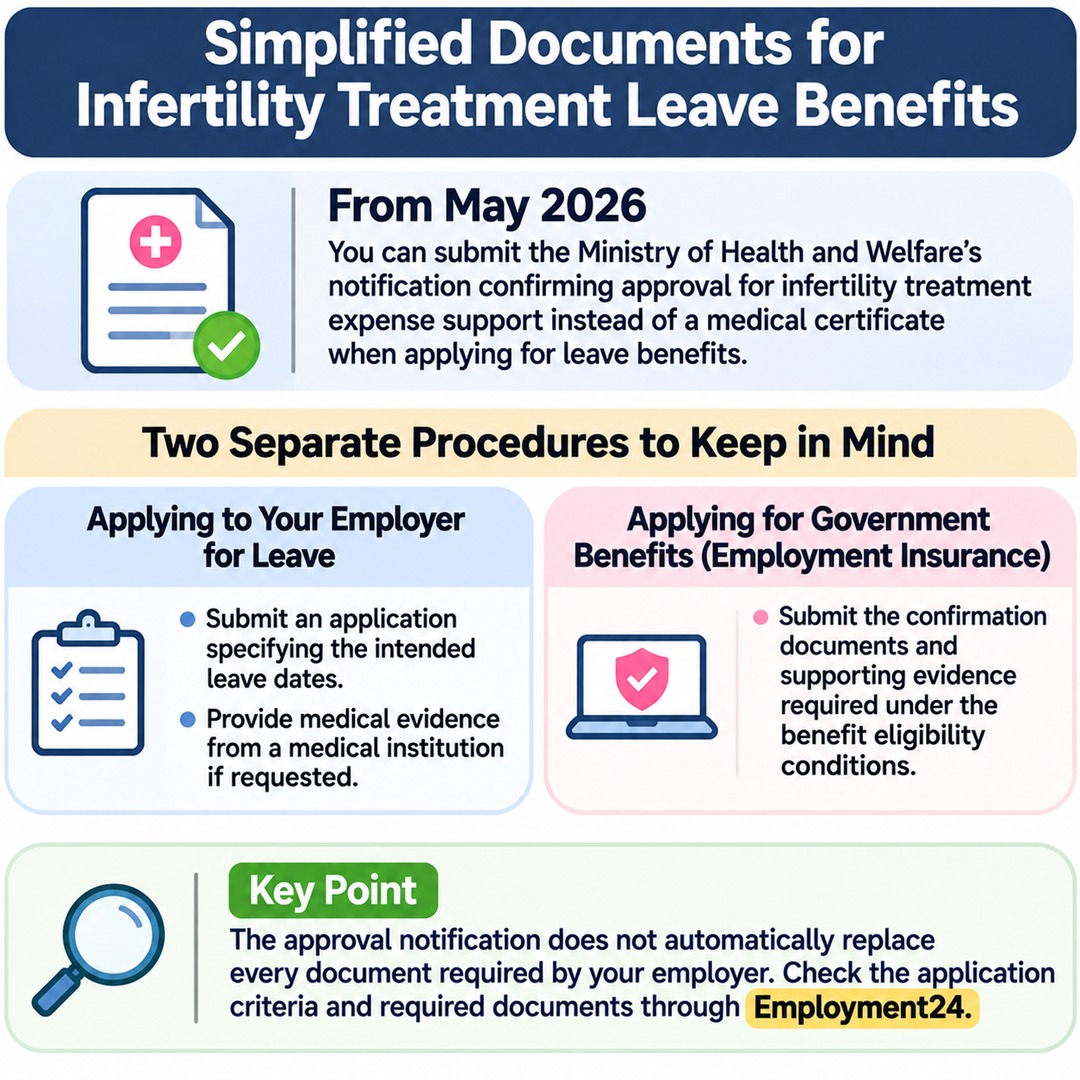
Yes. The Ministry of Employment and Labor has simplified the documentation requirements for applications for infertility treatment leave benefits. Applicants may submit the Ministry of Health and Welfare's notification confirming approval for infertility treatment expense support for infertile couples instead of a medical certificate.
This simplified procedure has been announced as applicable from May 2026.
One important distinction is that applying to an employer for leave and applying for leave benefits through South Korea's Employment Insurance system are separate procedures.
Applying to your employer for leave: Submit an application document specifying the intended leave dates and other required details.
Medical evidence requested by your employer: Provide documents from a medical institution that can verify the infertility treatment.
Applying for government benefits: Submit the confirmation documents and supporting evidence required under the benefit eligibility conditions.
Therefore, having a notification confirming approval for infertility treatment expense support does not automatically replace every document required by your employer when applying for leave.
Infertility treatment leave benefits are subject to separate payment eligibility requirements. Check the application criteria and required documents through South Korea's Employment24 service before applying.
How Many of the Six Annual Leave Days Are Paid, and When Will the Rules Change?
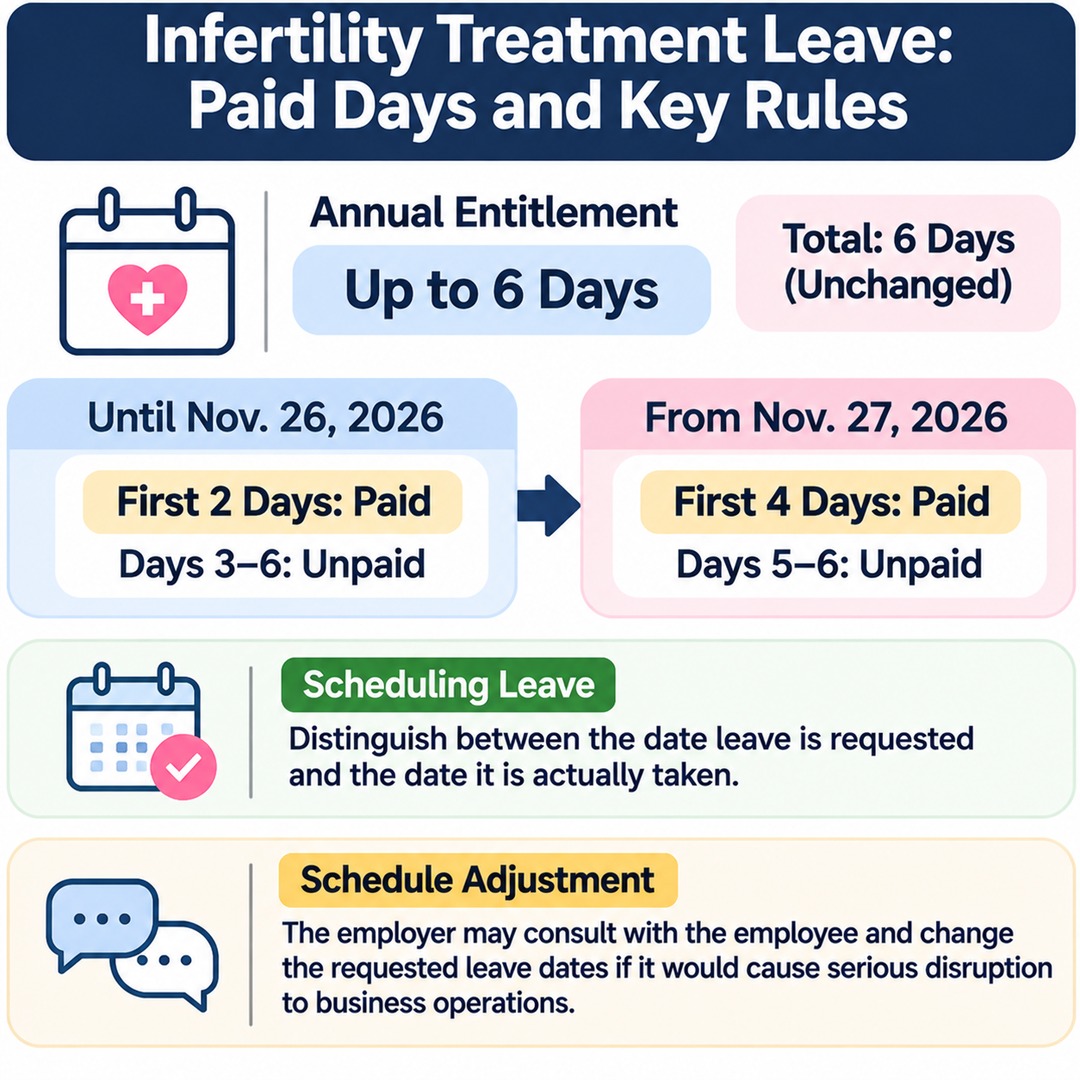
In South Korea, employees are entitled to up to six days of infertility treatment leave per year. Until November 26, 2026, the first two days are paid. From November 27, 2026, the paid portion will increase to the first four days. The total annual entitlement will remain six days.
| Category | Through November 26, 2026 | From November 27, 2026 |
|---|---|---|
| Total annual leave entitlement | 6 days | 6 days |
| Paid leave | First 2 days | First 4 days |
| Unpaid leave | Remaining 4 days | Remaining 2 days |
The amended provisions take effect on November 27, 2026. Employees and employers should therefore distinguish between the date leave is requested and the date it is actually taken.
An employer may consult with the employee and change the requested leave dates if granting leave at the requested time would cause serious disruption to normal business operations. However, this is a separate issue from an employer narrowing the legally recognized scope of leave simply because its internal company rules state that only the actual procedure date is eligible.
Can You Split Infertility Treatment Leave Into Separate Days? Can You Take Four Hours at a Time?
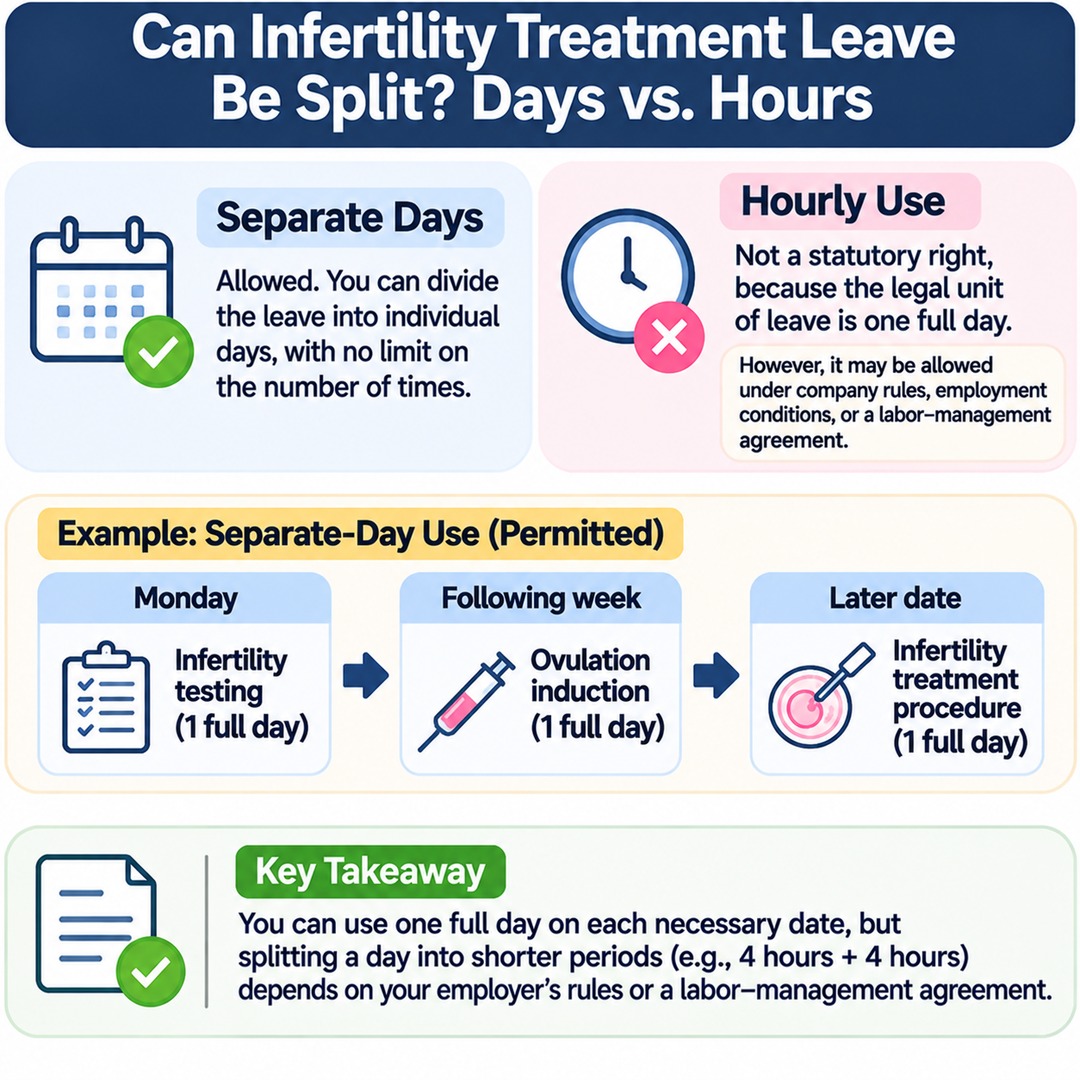
Infertility treatment leave can be divided into separate individual days. According to guidance provided through the Ministry of Employment and Labor's 1350 labor consultation service, there is also no limit on the number of times employees may divide their leave into separate days.
However, dividing leave into shorter hourly periods, such as four hours at a time, is a different matter.
The Ministry of Employment and Labor's consultation guidance explains that because the statutory unit of leave is one full day, employees cannot regard hourly leave as a right guaranteed under the law. Nevertheless, employers may permit hourly use under their internal employment rules, employment conditions, or agreements between labor and management.
The distinction can be illustrated as follows:
Monday: One full day for infertility testing.
The following week: One full day for a hospital visit related to ovulation induction.
A later date: One full day for the actual infertility treatment procedure.
Using one full day on each necessary date, as in these examples, is permitted.
By contrast, splitting a day into four hours in the morning and four hours in the afternoon depends on the employer's internal rules or an agreement between labor and management.
What Should You Say When Reapplying to Your Employer?
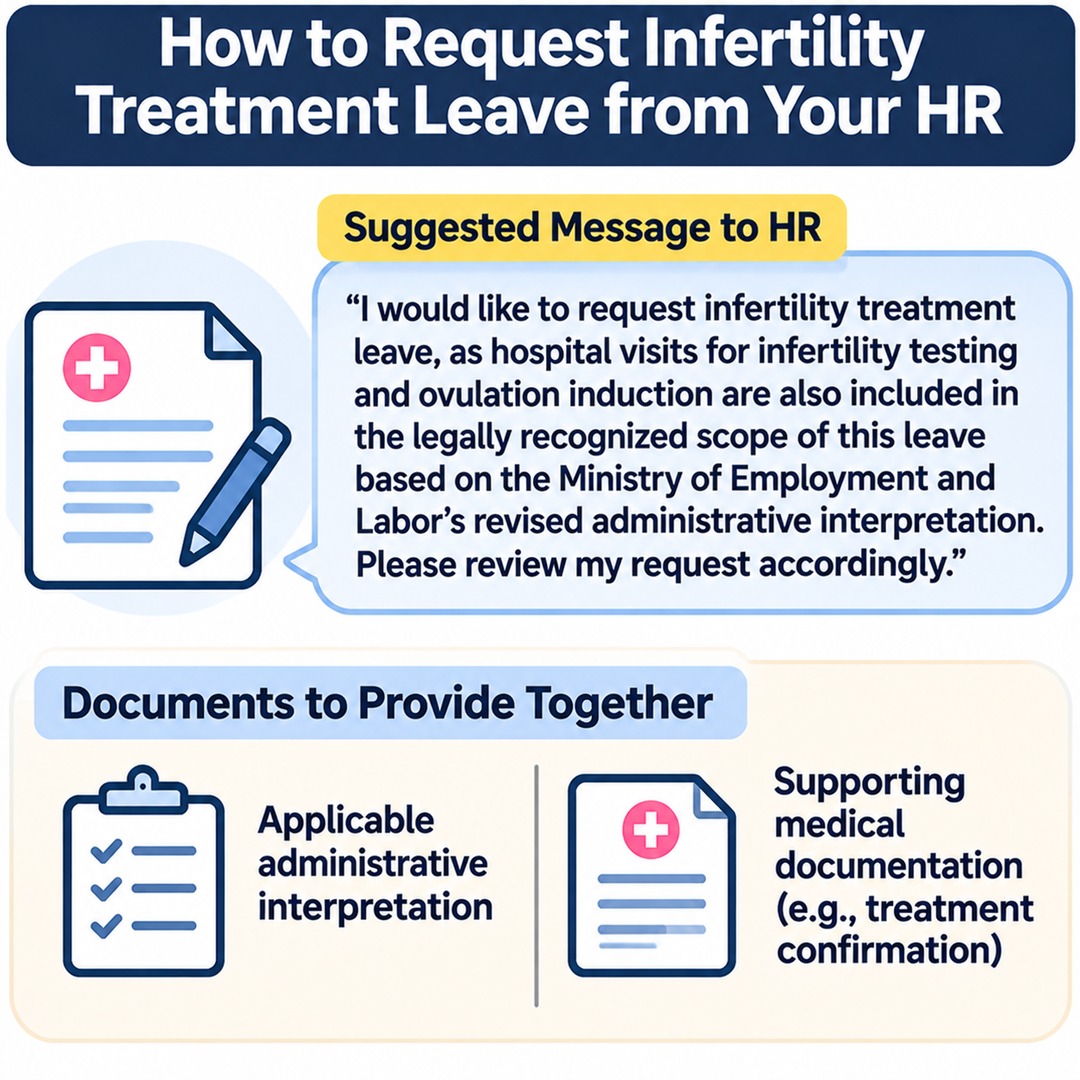
Rather than arguing with your employer, it is advisable to provide the applicable administrative interpretation together with supporting medical documentation.
You can send the following wording to your human resources department.