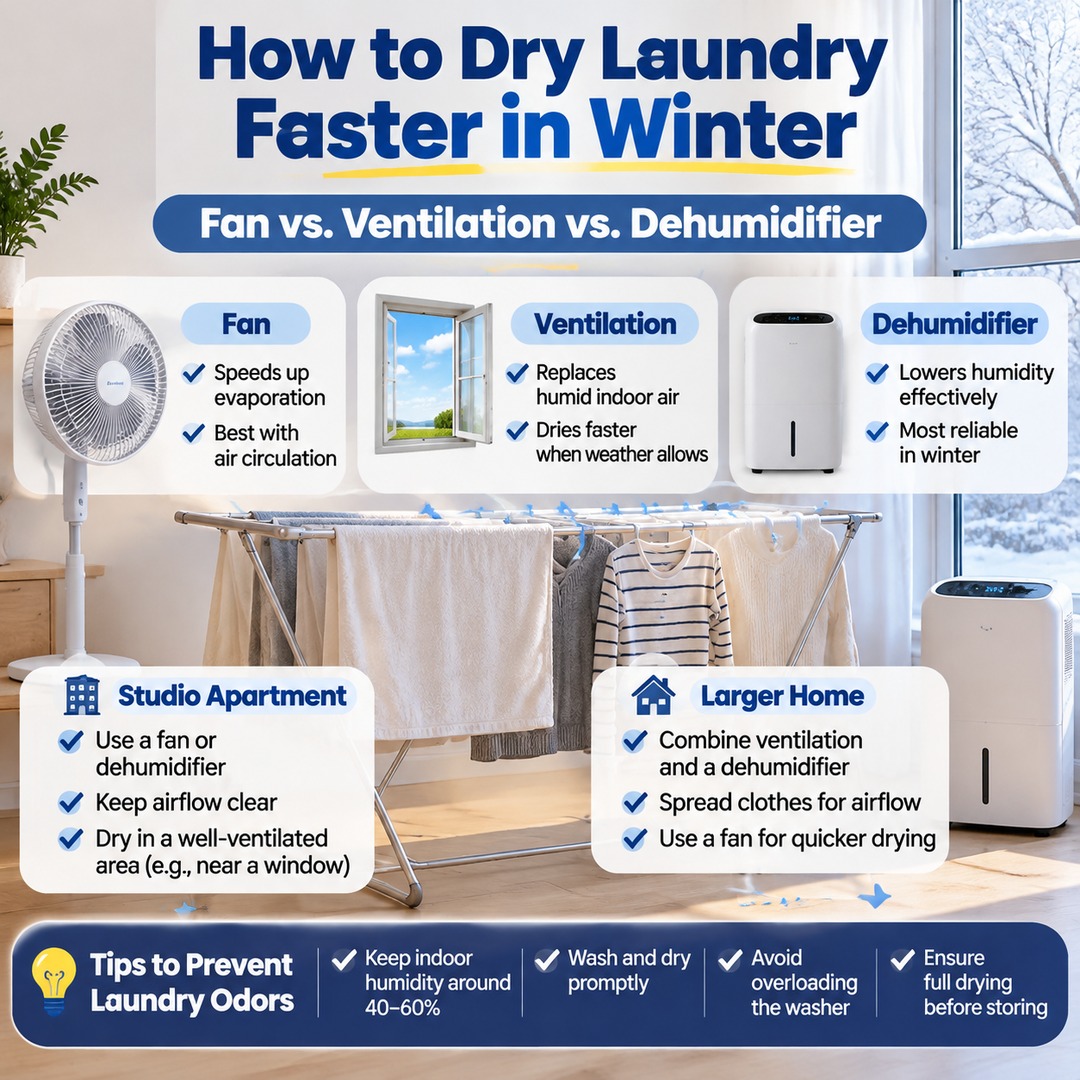
Indoor laundry that takes a long time to dry and develops a musty smell in winter cannot be explained by low temperatures alone. Residual moisture in clothes, indoor humidity, and stagnant air all contribute to the problem. A fan improves air circulation, ventilation removes humid indoor air, and a dehumidifier extracts moisture from the air. In a studio apartment with high humidity, using a dehumidifier together with a fan is a practical approach.
Why Does Laundry Take Longer to Dry in Winter?
Drying laundry involves water remaining in the fabric evaporating and moving into the surrounding air. When indoor air is already humid or the air around the clothes is not moving, moisture evaporates more slowly.
In winter, windows often remain closed for longer periods. Even when heating is running, moisture generated indoors may not be adequately removed. If laundry is packed tightly into a small space, humid air can become trapped between garments, further slowing the drying process.
Drying tends to take longer in environments such as:
Studio apartments where windows are rarely opened
Balconies where laundry is hung in several tightly packed layers
Situations where thick towels and hoodies are dried together
Clothes that retain excessive water because they have not been spun sufficiently
Drying racks surrounded by very little air movement
Simply turning up the heating is not a complete solution. Even if the indoor temperature rises, moisture released from wet laundry can remain indoors unless it is ventilated or removed.
Which Is Most Effective: A Fan, Ventilation, or a Dehumidifier?
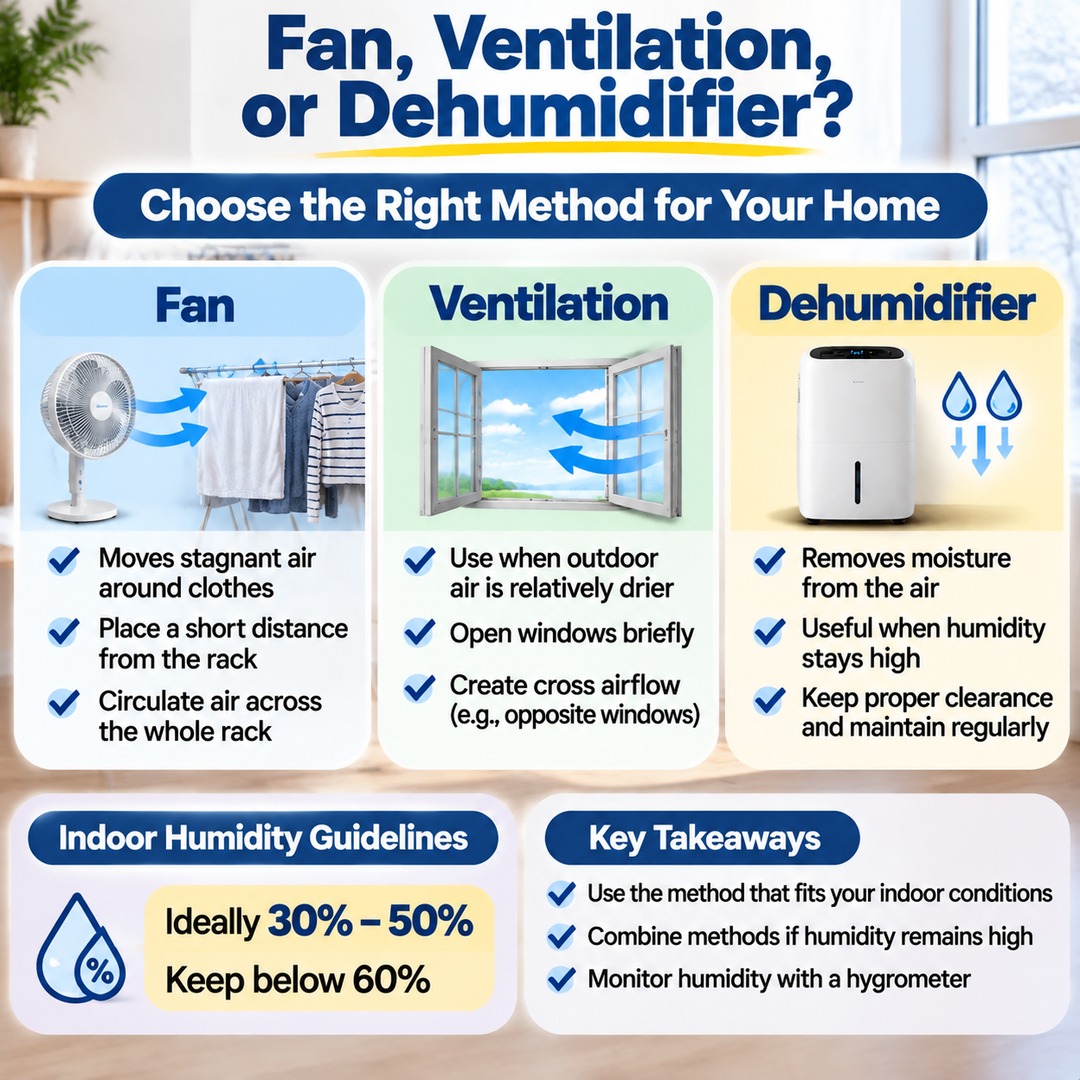
These three methods work differently, so the best choice depends on your indoor environment. If the air around the laundry is stagnant, a fan is a simple solution. If the humidity throughout the room is high, a dehumidifier is more useful. Ventilation can also be effective when the outdoor air is relatively drier than the indoor air.
| Method | Main Function | Most Effective When | Limitations |
|---|---|---|---|
| Fan or air circulator | Moves air around the clothes | Laundry is crowded or air is stagnant in the room | Does not remove moisture from the indoor environment itself |
| Opening windows for ventilation | Releases humid indoor air | Outdoor air is relatively dry | Effectiveness depends on outdoor humidity and weather |
| Dehumidifier | Removes moisture from indoor air | There is a lot of laundry and indoor humidity is high | Requires electricity, produces noise, and needs water tank maintenance |
| Clothes dryer | Removes moisture from laundry | Fast drying is necessary | Requires installation space and electricity, and drying options may be limited by fabric type |
Should You Direct a Fan Straight at Your Laundry?
A fan helps by moving stagnant air around wet clothes. Position it a short distance from the drying rack and adjust its direction so that air can flow between the garments.
Rather than directing a strong stream of air at just one item, arrange the fan so that air circulates around the entire drying rack. Spread towels out without overlapping them. Hang thick garments, such as trousers and hoodies, on hangers so that air can reach their inner surfaces.
A fan alone does not eliminate moisture accumulating indoors. If humidity continues to rise, additional ventilation or dehumidification is necessary.
Should You Open the Windows Even in Winter?
Ventilation is important in winter, but keeping windows open for long periods is not always beneficial. Its effectiveness depends on outdoor humidity and the temperature difference between indoors and outdoors.
If you are drying laundry indoors, consider the following:
Consider ventilating when indoor humidity rises or water droplets appear on the windows.
Open the windows briefly when the outdoor air is relatively dry.
If possible, use windows or doors on opposite sides to create an airflow path.
If humidity remains high after ventilation, use a dehumidifier.
Condensation on windows occurs when indoor moisture meets a cold surface. If window frames and nearby walls also become damp after hanging laundry, do not treat this as merely a laundry-drying issue. Indoor moisture management is important as well.
You can also check related guidance on this issue.
Should You Place a Dehumidifier Next to Your Laundry?
A dehumidifier removes moisture from the air, making it useful when you want to manage both indoor drying conditions and humidity. It can be particularly helpful in studio apartments where frequent ventilation is difficult, or in homes where laundry regularly needs to be dried indoors.
Follow these guidelines when using one:
1. Leave enough space around the drying rack for air to circulate.
2. Follow the manufacturer's instructions for clearance around the air intake and outlet, as well as installation requirements.
3. Do not cover the dehumidifier's air intake or outlet with clothes or fabric.
4. Adjust the target humidity and operating time according to indoor humidity levels.
5. Empty the water tank and maintain the filter regularly.
Whether the air discharged by a dehumidifier can be directed straight at laundry depends on the product's design. Do not block the outlet or hang laundry over the appliance.
The U.S. Environmental Protection Agency (EPA) recommends keeping indoor relative humidity below 60% if possible, ideally between 30% and 50%. The U.S. Centers for Disease Control and Prevention (CDC) also recommends maintaining indoor humidity at or below 50% to help prevent mold.
These are reference guidelines for indoor environmental management, not humidity levels that guarantee the fastest possible laundry drying. During drying, it is best to monitor changes with a hygrometer and adjust dehumidification accordingly.
Why Does Laundry Develop a Musty Smell?
A musty smell does not necessarily mean that the washing machine is malfunctioning. Odors can also develop when moisture remains in laundry for too long or when dirt and residue are not adequately removed during washing.
In particular, odors may persist if wet laundry is left in the washing machine for an extended period after the cycle ends, or if thick garments are hung overlapping so that their inner layers remain damp.
Distinguishing between the following three situations can help identify the cause:
The laundry smells immediately after washing: Check for washing machine drum contamination, detergent residue, and the condition of the laundry before washing.
The smell becomes stronger after hanging the laundry: Check for slow drying, spacing between garments, indoor humidity, and air circulation.
The outside feels dry, but thick areas still smell: Check for residual moisture in pockets, underarms, inside sleeves, and folded sections of towels.
Adding more strongly scented fabric softener does not solve a drying problem. If odors keep returning, start by checking the washing and drying processes themselves.
What Should You Do with Clothes That Already Smell Musty?
Rather than covering up the smell with fragrance, first consider washing the clothes again and drying them completely.
Use an appropriate washing cycle to remove detergent residue and dirt.
Do not leave wet laundry sitting in the washing machine for a long time.
Use a spin cycle appropriate for the fabric type.
Minimize overlapping sections when hanging clothes on the drying rack.
Check that thick garments are completely dry on the inside as well.
If the odor keeps returning, inspect the washing machine drum, detergent drawer, and drain filter as well. Follow the manufacturer's instructions for cleaning the washing machine. Never mix different cleaning products arbitrarily.
If musty odors keep recurring in your laundry, you can also refer to the related guidance on this problem.
Should Drying Methods Differ Between Studio Apartments and Larger Apartments?
In a studio apartment, drying racks are often close to the main living area, so moisture released by laundry can easily affect the humidity throughout the room. Larger apartments offer more opportunities to separate spaces, but drying can still be slow because of low temperatures on balconies or inadequate ventilation.
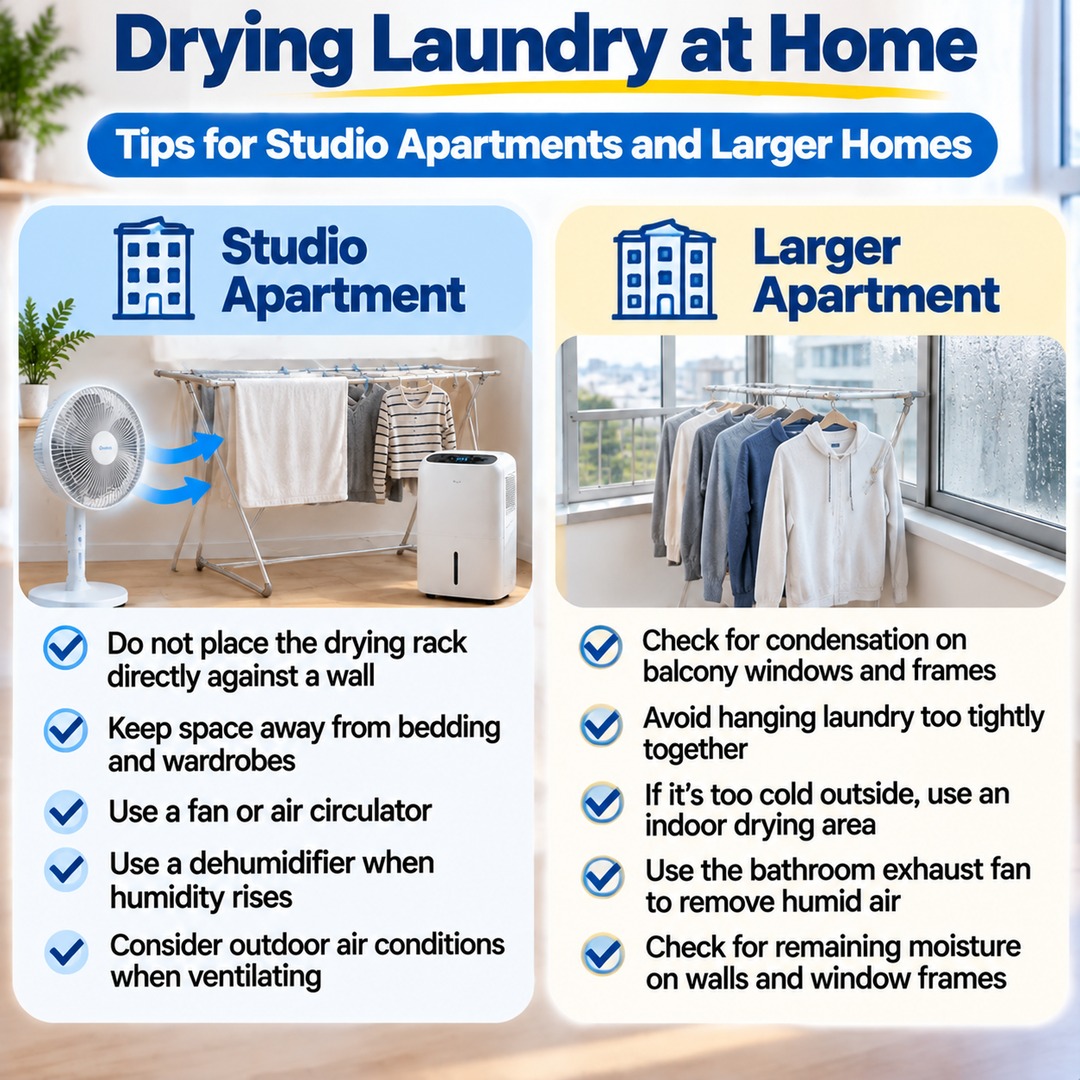
In a studio apartment, prioritize air circulation around the drying rack and dehumidification. In a larger apartment, also manage condensation and ventilation on the balcony.
Drying laundry in a studio apartment
Do not position the drying rack directly against a wall.
Leave enough space to prevent moisture from accumulating around bedding and wardrobes.
Use a fan or air circulator to keep air moving.
Use a dehumidifier when indoor humidity rises.
Consider outdoor air conditions when ventilating.
Drying laundry in a larger apartment
Check for condensation on balcony windows and window frames.
Avoid hanging laundry too tightly together on the balcony.
If low outdoor temperatures prevent clothes from drying properly, use an indoor drying area.
Use the bathroom exhaust fan to remove humid air from the home.
Check whether moisture remains on walls and window frames after hanging laundry.
If moisture is not being removed effectively when drying laundry in the bathroom or using an exhaust fan, additional guidance on this issue may also help.
Steps to Dry Indoor Laundry Faster in Winter
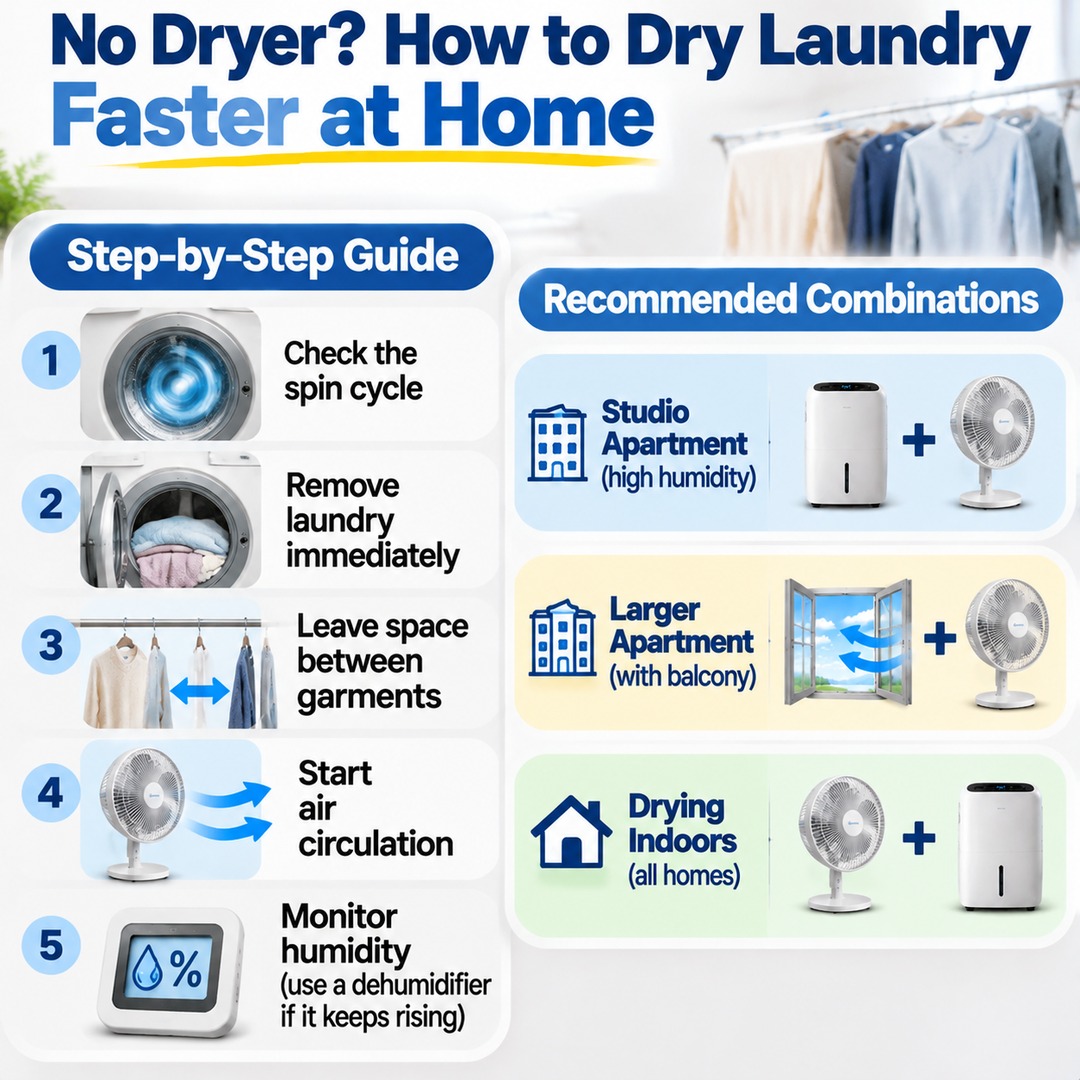
If you need to dry laundry without a clothes dryer, follow these steps:
1. Check the spin cycle: Spin clothes sufficiently within the limits allowed for each fabric.
2. Remove laundry immediately after washing: Do not leave wet clothes sitting in the washing machine.
3. Leave space between garments: Hang thick and thin items without overlapping them.
4. Start air circulation: Use a fan or air circulator to move air around the drying rack.
5. Monitor humidity: If humidity continues to rise, ventilate the room or turn on a dehumidifier.
6. Check for complete drying: Make sure the inside and folded sections of each garment are dry.
Recommended combinations for different situations
| Living Environment | Recommended Method |
|---|---|
| Studio apartment with a small amount of laundry | Drying rack + fan + ventilation |
| Studio apartment with high humidity | Drying rack + dehumidifier |
| Larger apartment with balcony drying | Drying rack + air circulation + ventilation |
| Thick blankets and towels | Clothes dryer or professional drying facility |
| Household with frequent laundry loads | Consider a dehumidifier or clothes dryer |
Frequently Asked Questions
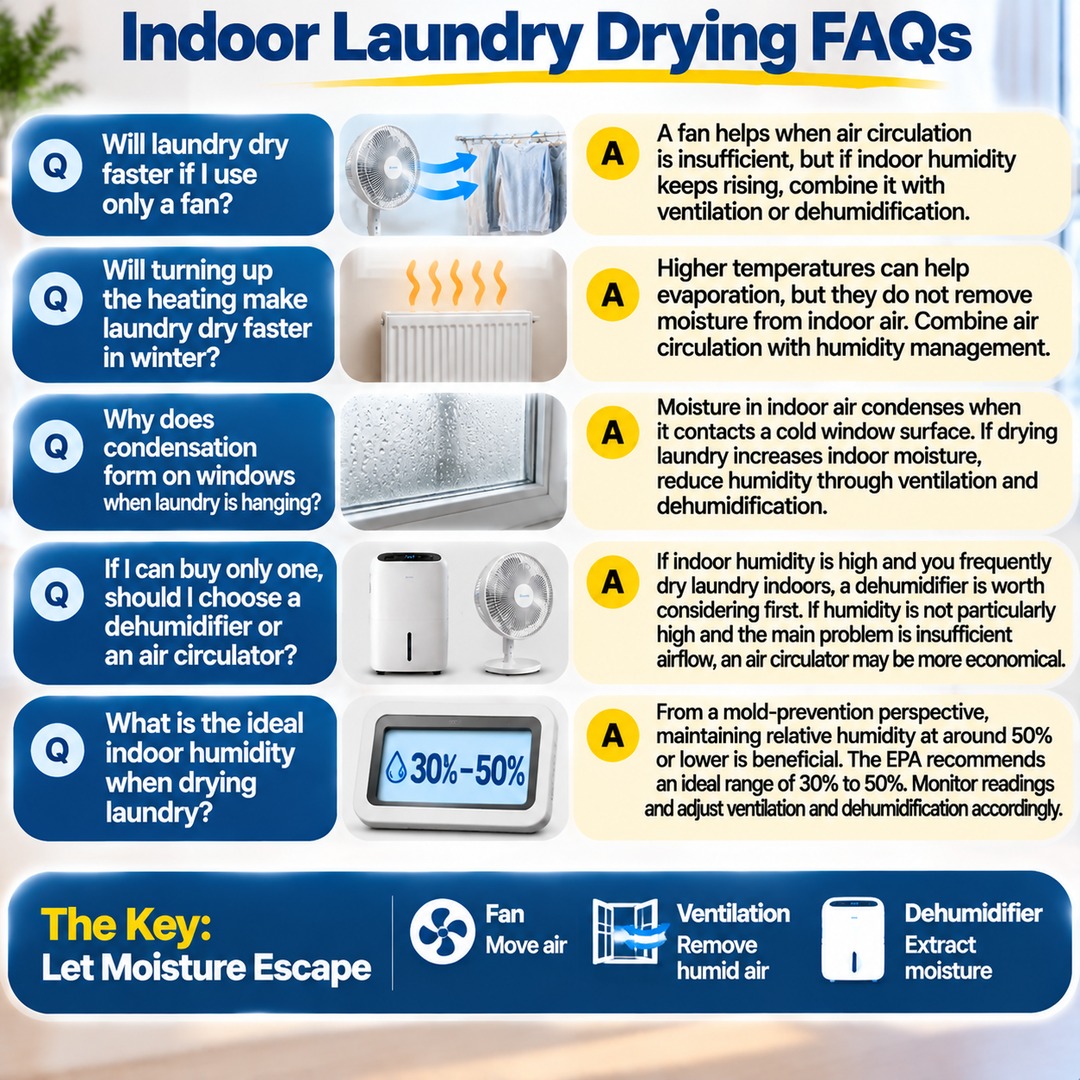
Q. Will laundry dry faster if I use only a fan?
A fan helps when air circulation is insufficient. However, if indoor humidity continues to rise, a fan alone has limitations. Combine it with ventilation or dehumidification when necessary.
Q. Will turning up the heating make laundry dry faster in winter?
Higher temperatures can help evaporation, but they do not remove moisture from indoor air. Rather than relying on excessive heating, combine air circulation with humidity management.
Q. Why does condensation form on windows when laundry is hanging indoors?
Moisture in indoor air condenses when it comes into contact with a cold window surface. If drying laundry increases indoor moisture, reduce humidity through ventilation and dehumidification.
Q. If I can buy only one, should I choose a dehumidifier or an air circulator?
If indoor humidity is high and you frequently dry laundry indoors, a dehumidifier is worth considering first. On the other hand, if humidity is not particularly high and the main problem is insufficient airflow, an air circulator may be a more economical choice.
Q. What is the ideal indoor humidity when drying laundry?
From the perspective of indoor mold prevention, maintaining relative humidity at around 50% or lower is beneficial. The EPA recommends an ideal indoor relative humidity range of 30% to 50%. However, humidity can fluctuate temporarily during drying, so monitor actual readings and adjust ventilation and dehumidification accordingly.
The most important factor when drying laundry indoors in winter is not turning up the heating, but creating an environment in which moisture can escape from the clothes. A fan moves the air, ventilation removes humid air, and a dehumidifier extracts moisture from the indoor environment. By understanding and combining these three functions, you can manage both laundry drying and indoor humidity.