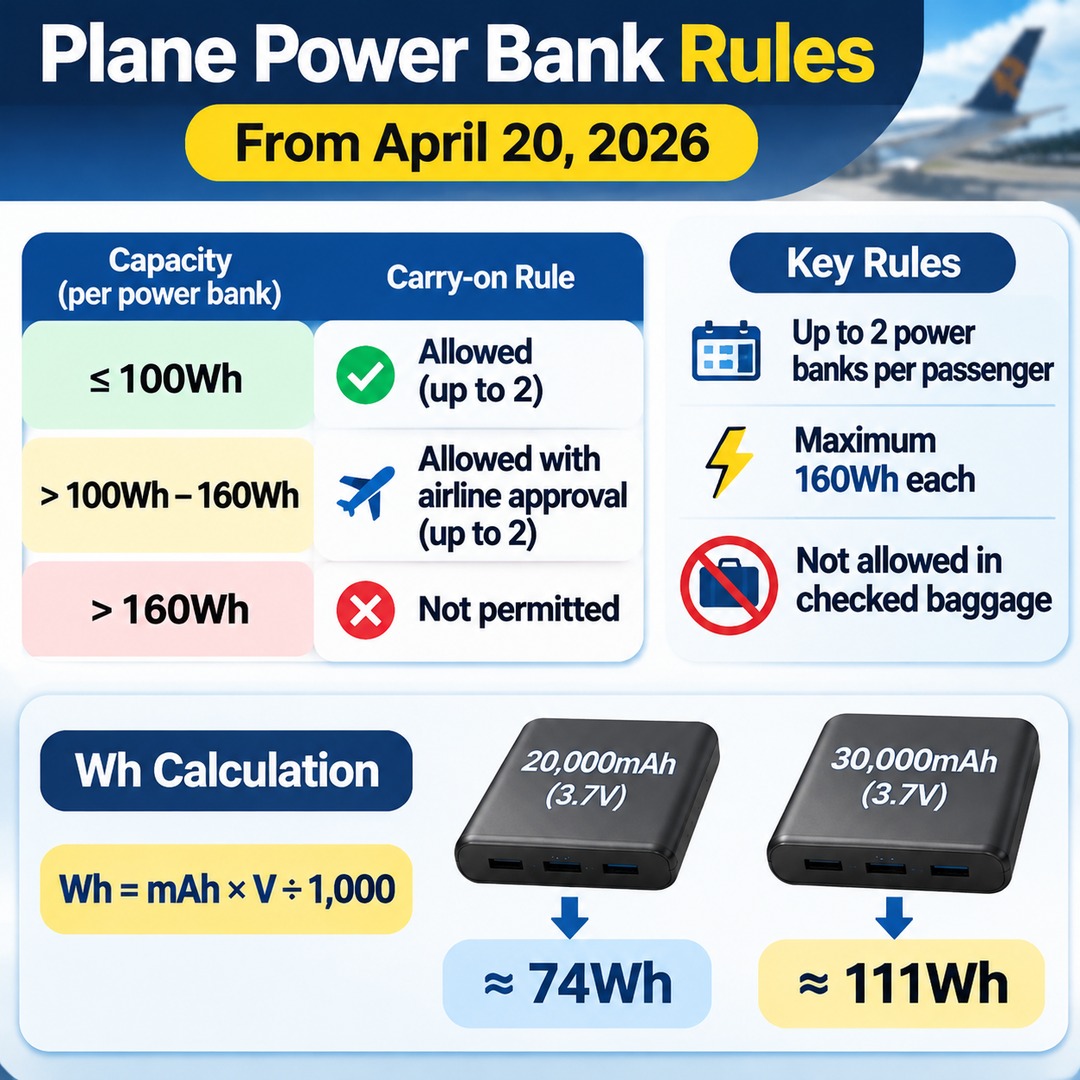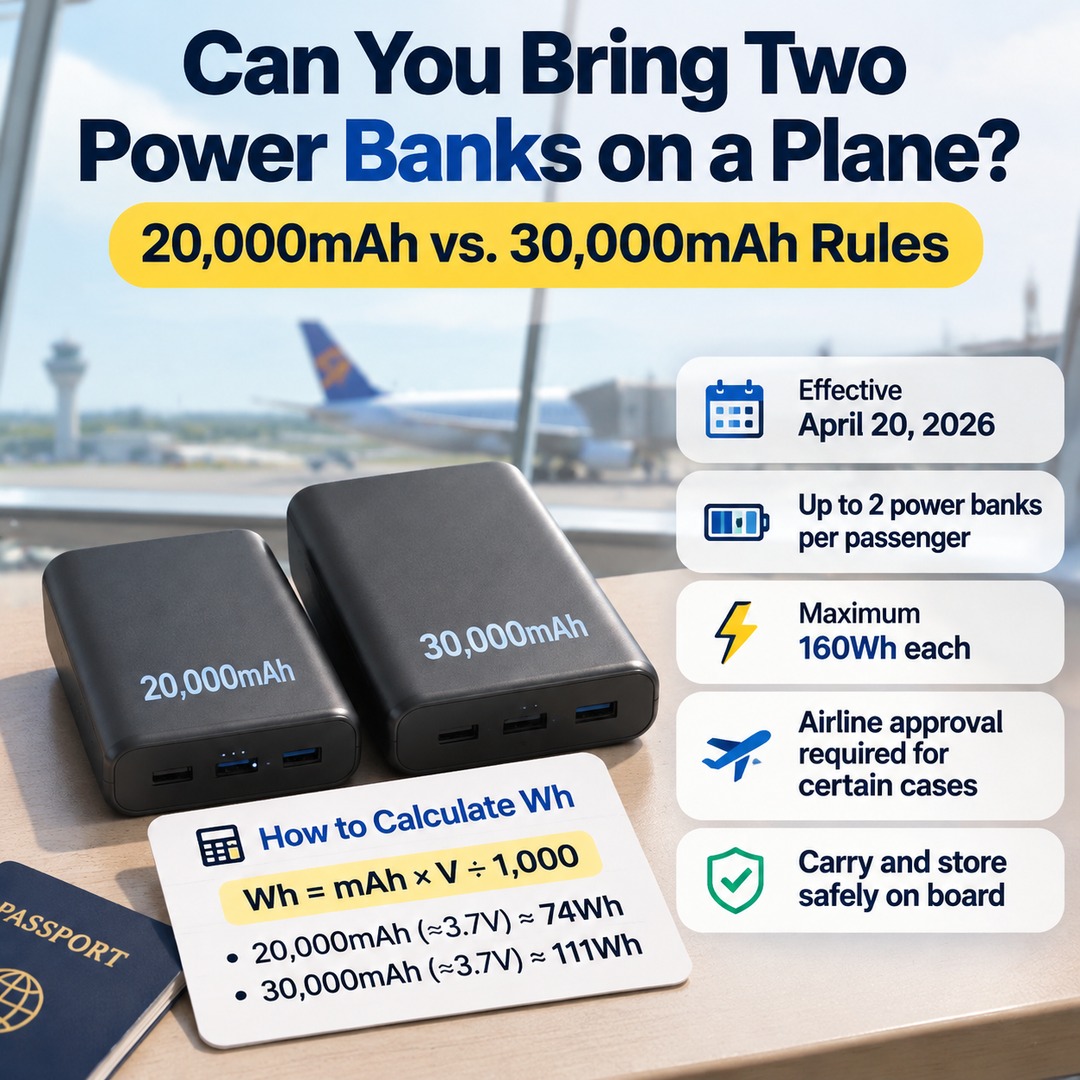
You can carry up to two power banks per passenger in the aircraft cabin from April 20, 2026. Each power bank must have a capacity of no more than 160Wh. Airline approval is required in advance for batteries exceeding 100Wh. A typical 20,000mAh power bank rated at 3.7V has a capacity of approximately 74Wh, while a 30,000mAh model has approximately 111Wh. Therefore, you need to check not only the mAh rating but also the rated voltage and whether your airline has approved the battery.
If you remember the previously published limit of five power banks, be careful. The rules effective from April 2026 have changed both the quantity limit and the conditions for using power banks on board. Power banks are also prohibited in checked baggage.
How Many Power Banks Can You Bring on a Plane?
Under the rules effective April 20, 2026, each passenger may carry a maximum of two power banks. Each individual power bank must have a capacity of 160Wh or less. Products exceeding 160Wh are not permitted in the aircraft cabin.
The capacity requirements are divided into three categories:
100Wh or less: Up to two power banks may be carried in the cabin.
Over 100Wh and up to 160Wh: Permitted with prior airline approval, subject to the overall limit of two power banks per passenger.
Over 160Wh: Not permitted in the aircraft cabin.
The two-unit limit is the maximum number of power banks one passenger may carry, regardless of their individual capacities. Even if you separately calculate the capacity of two 20,000mAh power banks or two 30,000mAh power banks, both the individual capacity requirements and the overall quantity limit must be satisfied.
The previously published domestic guidance allowing up to five power banks of 100Wh or less should be distinguished from the current international standard.
How Many Watt-Hours Are 20,000mAh and 30,000mAh Power Banks?
Wh (watt-hours) measures the amount of electrical energy stored in a power bank. The mAh (milliampere-hour) rating alone is not sufficient to determine its exact capacity. You must also use the rated voltage (V) printed on the product.
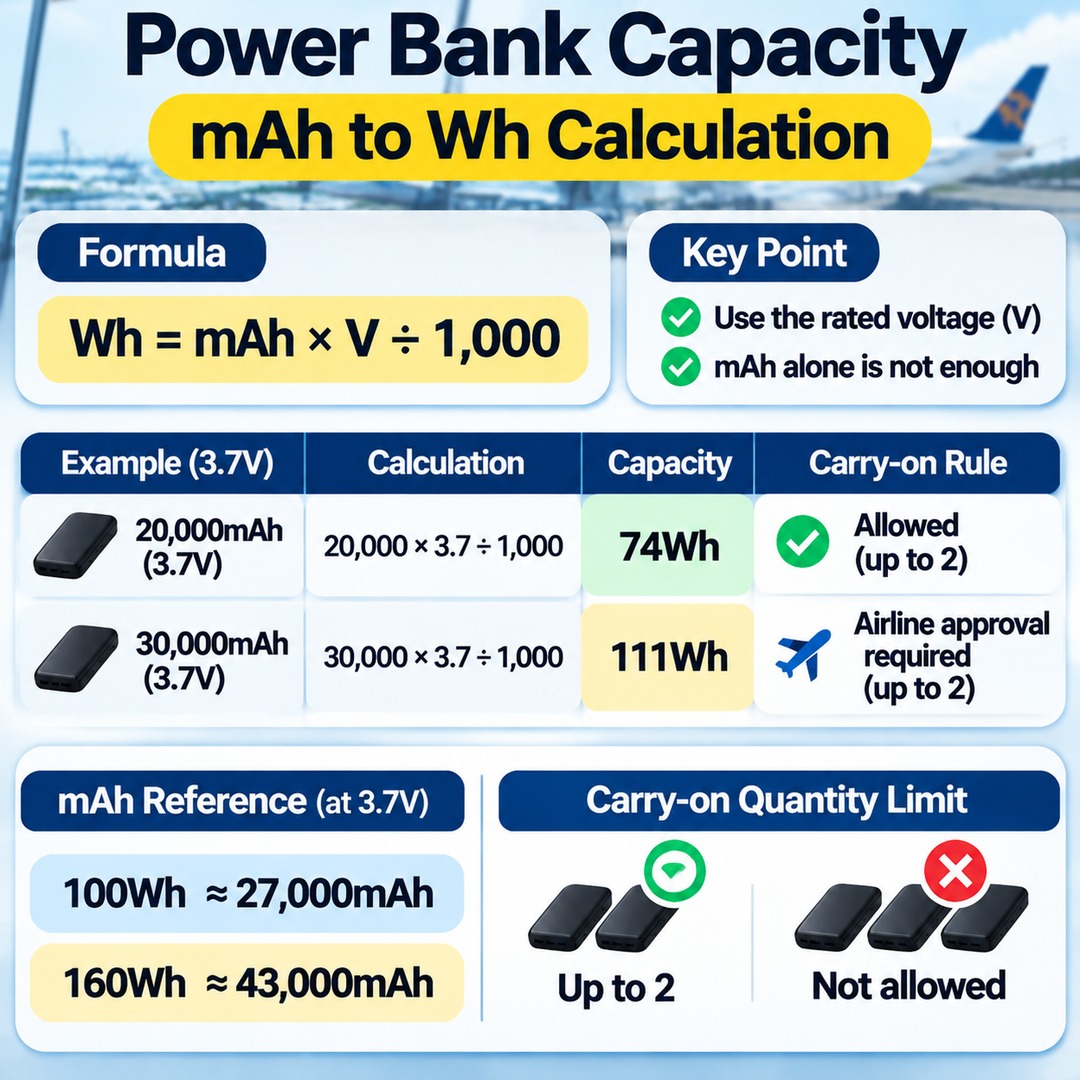
The calculation formula is:
\[
Wh = \frac{mAh \times V}{1,000}
\]
Using 3.7V, a common nominal voltage for lithium-ion power banks, gives the following results:
| Product capacity | Calculation | Energy capacity | Carry-on assessment |
|---|---|---|---|
| 10,000mAh | 10,000 × 3.7 ÷ 1,000 | 37Wh | Permitted |
| 20,000mAh | 20,000 × 3.7 ÷ 1,000 | 74Wh | Permitted |
| 30,000mAh | 30,000 × 3.7 ÷ 1,000 | 111Wh | Airline approval required |
| 40,000mAh | 40,000 × 3.7 ÷ 1,000 | 148Wh | Airline approval required |
| 50,000mAh | 50,000 × 3.7 ÷ 1,000 | 185Wh | Not permitted |
Author's calculations · Assumes a rated voltage of 3.7V · Actual results may vary depending on the values printed on each product.
Can You Bring Two 20,000mAh Power Banks?
A 20,000mAh power bank rated at 3.7V has a capacity of 74Wh. You can therefore carry two of these power banks under the standard conditions because they satisfy both the individual capacity limit and the passenger quantity limit.
However, carrying three is not permitted, even if each power bank is rated at 100Wh or less, because the maximum is two per passenger.
Why Does a 30,000mAh Power Bank Require Airline Approval?
Applying 3.7V to a 30,000mAh power bank gives a capacity of 111Wh. This exceeds 100Wh but remains below 160Wh, placing it in the category that requires prior airline approval.
If you plan to bring two, both power banks are subject to the approval requirement. The calculated result may also differ if the products display different Wh ratings or have a rated voltage other than 3.7V.
At 3.7V, the 100Wh and 160Wh thresholds correspond to approximately 27,000mAh and 43,000mAh, respectively. Therefore, a 30,000mAh power bank should not automatically be classified as prohibited. It belongs to the category for which airline approval must be confirmed.
Where Can You Find the Wh Rating on a Power Bank?
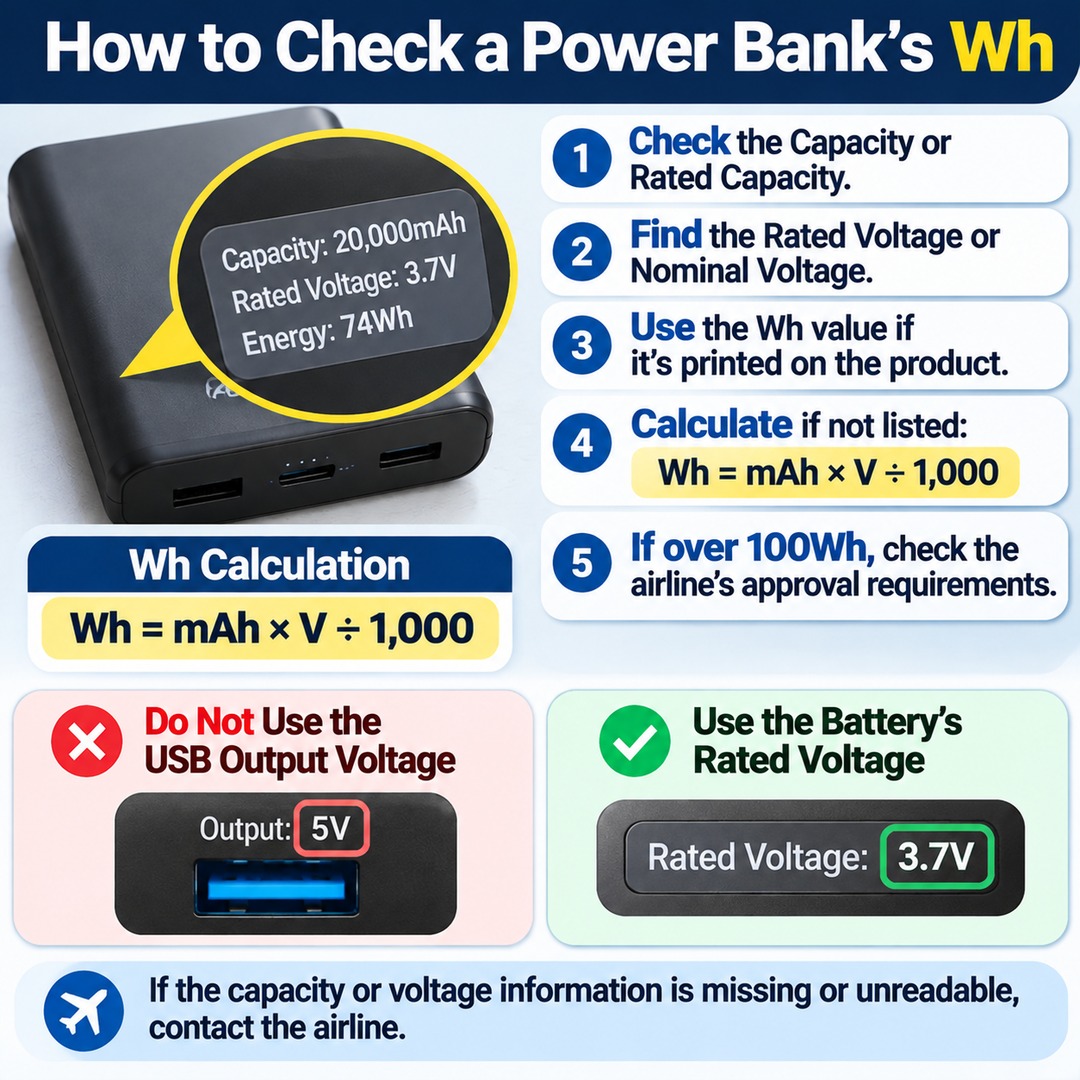
The most reliable method is to check the specification label on the back or side of the power bank. If both mAh and rated voltage are listed, you can use the formula above to calculate its Wh rating.
Follow these steps:
1. Check the product for the Capacity or Rated Capacity specification.
2. Find the Rated Voltage or Nominal Voltage.
3. If the Wh rating is printed directly on the product, use that value first.
4. If Wh is not listed, multiply mAh by the rated voltage and divide by 1,000.
5. If the result exceeds 100Wh, check the airline's approval requirements.
In particular, do not confuse the 5V printed next to the USB output with the rated voltage of the battery cells. Use the rated voltage required for calculating the battery's energy capacity, not the charging output voltage.
If the product has no capacity or voltage information, or the label is too damaged to read, do not estimate its capacity yourself. Contact the airline instead.
Where Should You Store a Power Bank on the Plane?
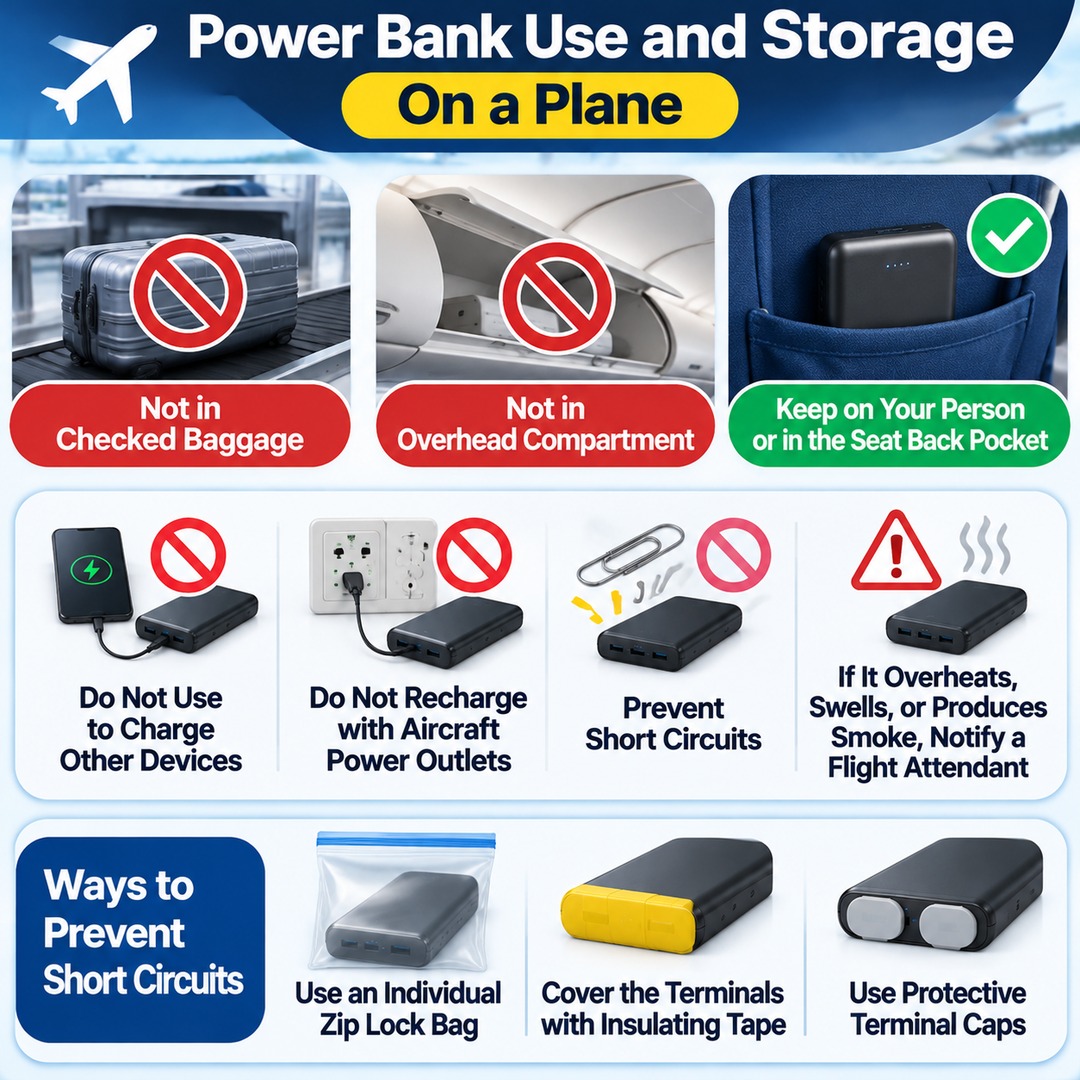
Power banks must be carried in the aircraft cabin rather than placed in checked baggage. After boarding, they must not be stored in the overhead compartment. Keep them on your person or in the seat-back pocket in front of you.
Guidance issued by Asiana Airlines and Jeju Air for implementation in April 2026 also outlines the following handling requirements:
Storage: Keep the power bank on your person or in the seat-back pocket.
Prohibited location: Overhead compartments.
Use on board: Do not use a power bank to charge other devices, such as mobile phones.
Charging the power bank: Do not recharge the power bank using aircraft power outlets.
Short-circuit prevention: Prevent the battery terminals from touching other metal objects.
A short circuit occurs when the positive and negative terminals of a battery become electrically connected, creating an unintended electrical path. It is important to keep each power bank separate so that its terminals cannot touch small metal objects or the terminals of another battery.
You can prevent short circuits by using one of the following methods:
Place each power bank in an individual zip-lock bag or protective pouch.
Cover the battery terminals with insulating tape.
Use protective terminal caps.
If a power bank overheats, swells, or produces smoke, do not attempt to handle it yourself or put it back in your bag. Notify a flight attendant immediately.
Do Domestic, International, and Connecting Flights Follow the Same Rules?
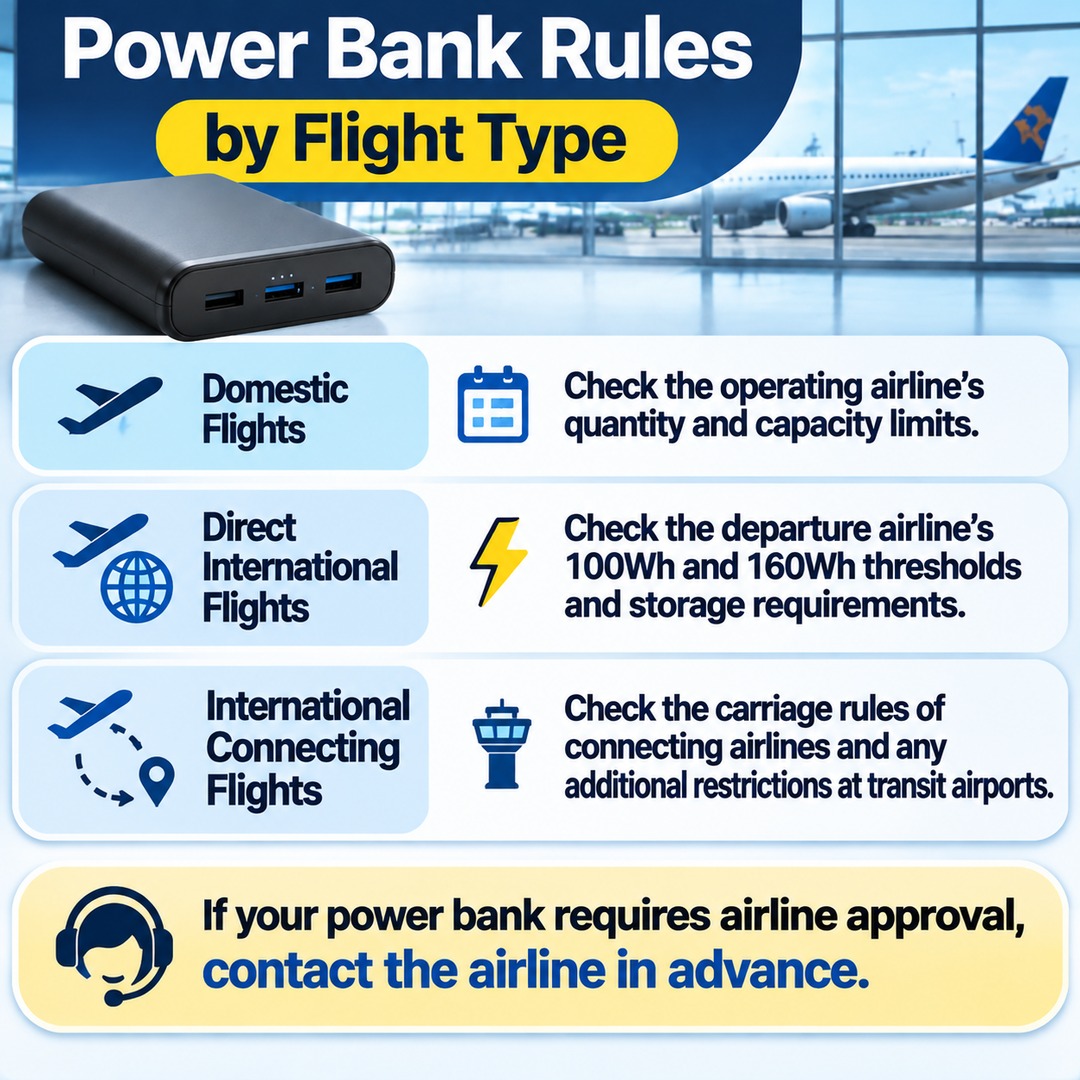
Checking the power bank rules applicable in South Korea does not automatically establish the requirements for every connecting flight. You should also check the operating airline's carriage rules and the security screening requirements at your transit airport.
In particular, distinguish between these three situations:
Domestic flights: Check the operating airline's quantity and capacity limits for power banks.
Direct international flights: Check the departure airline's 100Wh and 160Wh thresholds and its storage requirements.
International connecting flights: Check the carriage rules of connecting airlines and any additional restrictions at transit airports.
If your power bank requires airline approval, it is better to contact the airline in advance rather than trying to resolve the issue at the airport on the day of departure.
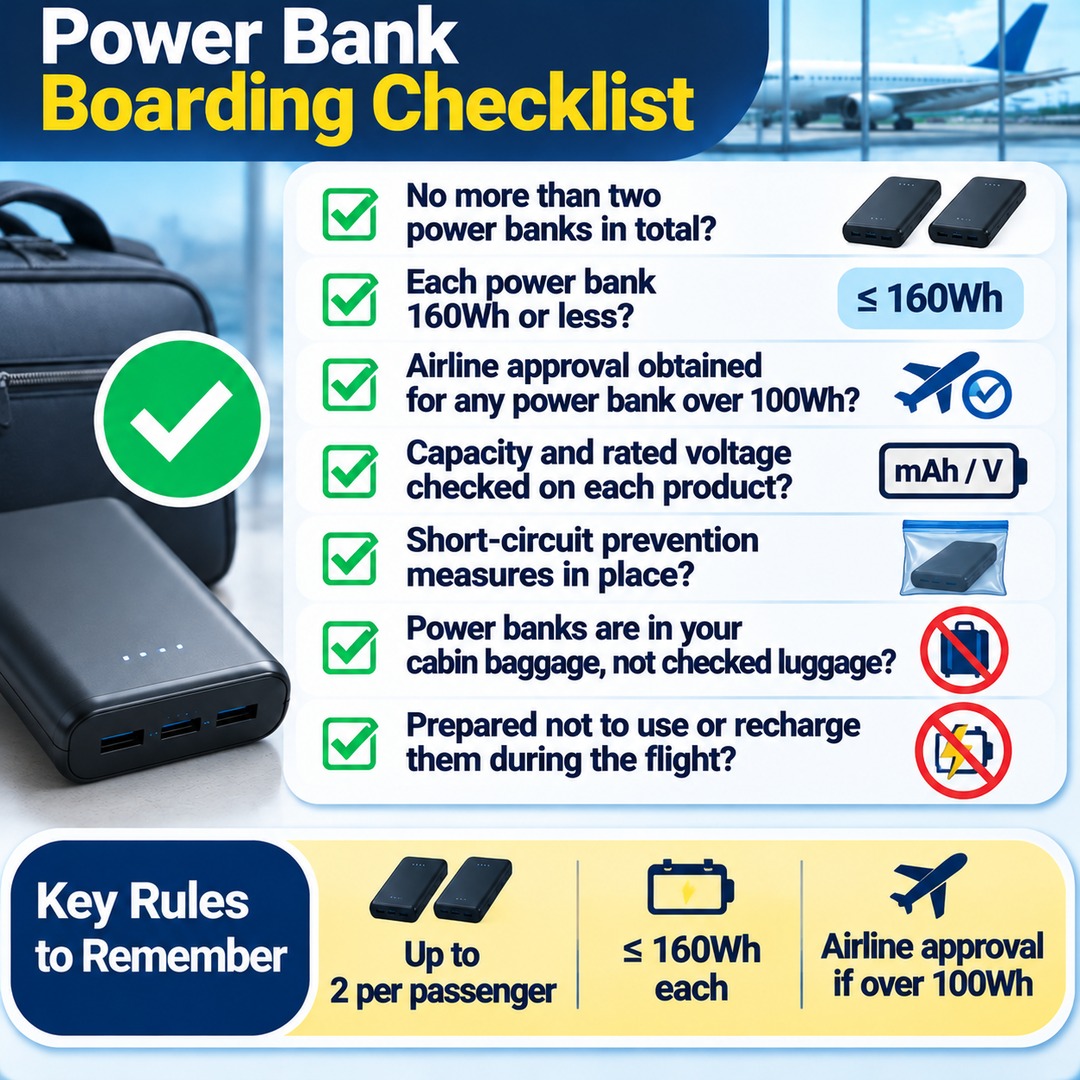
Power Bank Checklist Before Departure
Before boarding, prepare not only the battery capacity information but also the packaging and storage arrangements.
Are you carrying no more than two power banks in total?
Is each power bank rated at 160Wh or less?
Have you obtained airline approval for any power bank exceeding 100Wh?
Have you checked the capacity and rated voltage printed on each product?
Have you taken measures to prevent short circuits?
Are the power banks in your cabin baggage rather than your checked luggage?
Are you prepared not to use or recharge them during the flight?
Can you keep them on your person or in the seat-back pocket?
In particular, do not calculate the capacity of a 30,000mAh power bank and assume that this alone is sufficient before heading to the airport. You must first confirm airline approval. Contact the airline operating your actual flight to check whether approval has been granted and what procedure applies.
When choosing a power bank, remember that a higher mAh number does not automatically mean the product is permitted on a plane. Check all three requirements together: a maximum of two power banks per passenger, no more than 160Wh per power bank, and airline approval for products exceeding 100Wh.
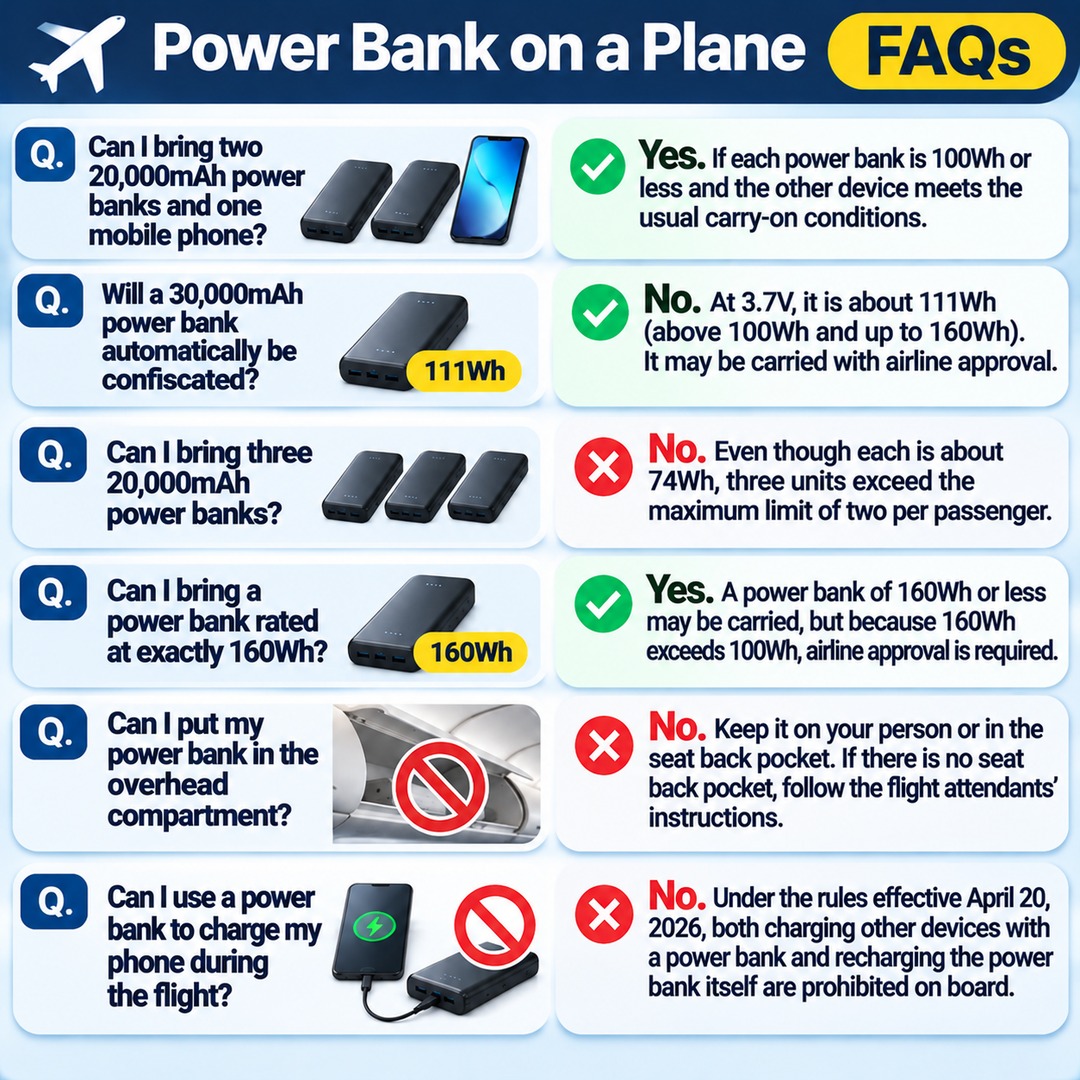
Frequently Asked Questions
Q. Can I bring two 20,000mAh power banks and one mobile phone?
Yes. If each power bank is rated at 100Wh or less and the other device satisfies the usual conditions for carrying personal electronic devices, the power bank quantity limit will not be exceeded.
Q. Will a 30,000mAh power bank automatically be confiscated?
No. At 3.7V, it has a capacity of approximately 111Wh, placing it in the category above 100Wh and up to 160Wh. It may be carried if you obtain airline approval.
Q. Can I bring three 20,000mAh power banks?
No. Even though each power bank has a capacity of approximately 74Wh, three units exceed the maximum limit of two per passenger.
Q. Can I bring a power bank rated at exactly 160Wh?
Under the capacity limit, a power bank rated at 160Wh or less may be carried subject to the applicable approval requirements. However, because 160Wh exceeds 100Wh, airline approval is required.
Q. Can I put my power bank in the overhead compartment?
No. Keep it on your person or in the seat-back pocket. If there is no seat-back pocket, follow the flight attendants' instructions.
Q. Can I use a power bank to charge my phone during the flight?
Under the rules effective April 20, 2026, both charging other devices with a power bank and recharging the power bank itself are prohibited on board.