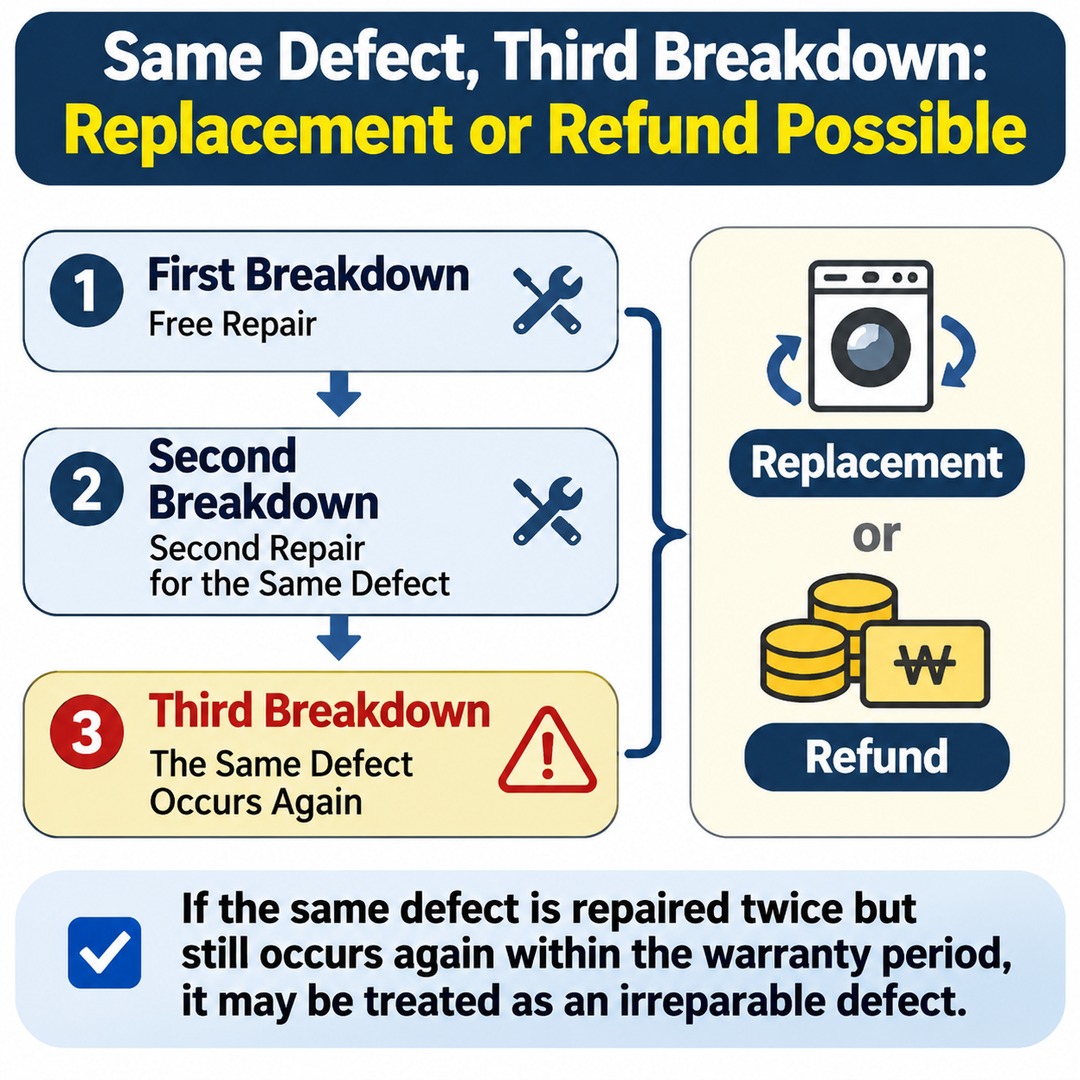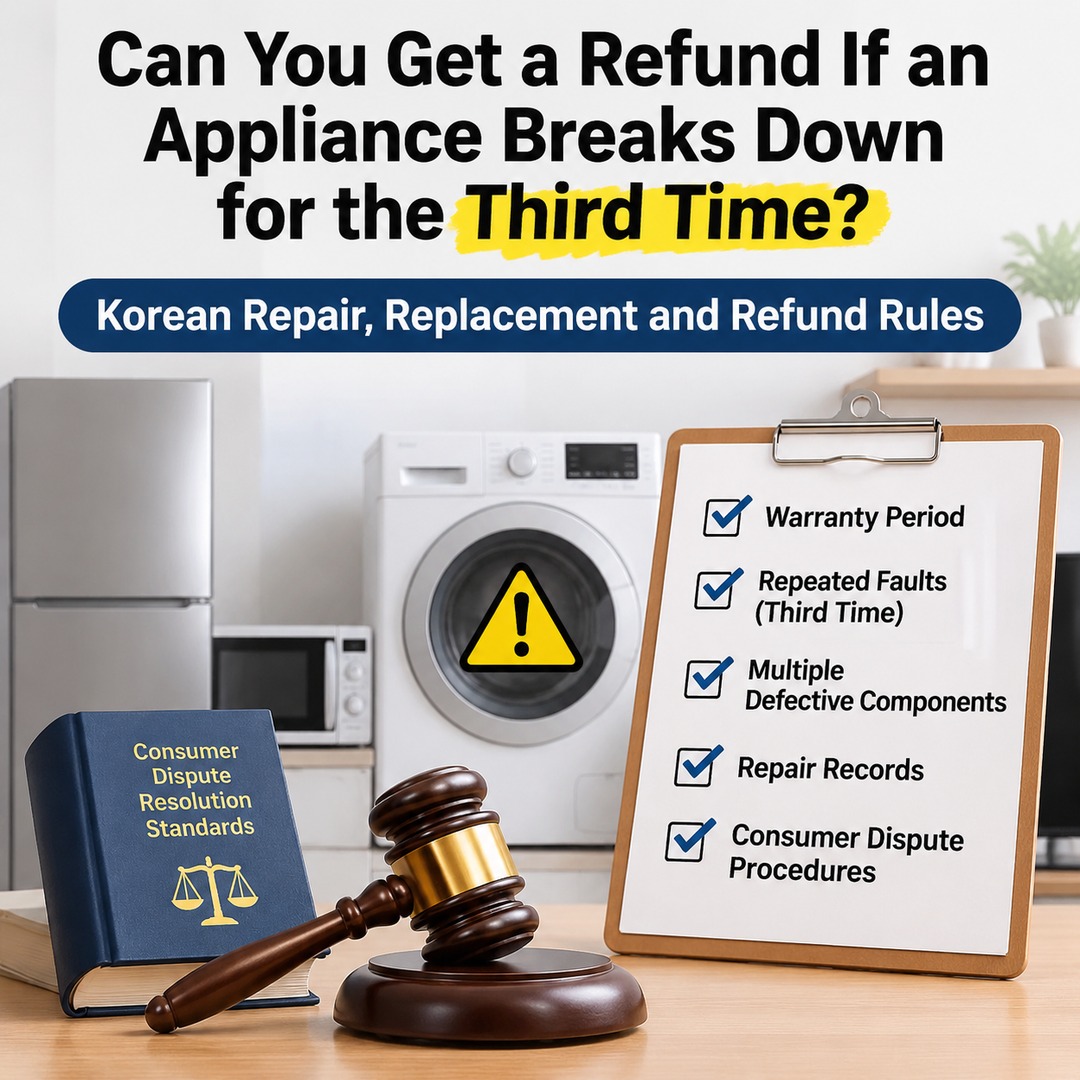
If an appliance has been repaired twice for the same fault and breaks down again for a third time, you may be able to request a replacement or a refund of the purchase price. Under South Korea's general Consumer Dispute Resolution Standards for electronic products, a defect that recurs after two repairs for the same fault within the warranty period may be treated as an irreparable defect. However, it is important to establish whether the problem occurred during normal use, whether the same component was actually repaired, and whether the repair history can be documented.
Can You Get a Refund If the Same Appliance Breaks Down for the Third Time?
Yes. If the specified requirements are met, you can request a product replacement or a refund of the purchase price.
The important distinction is between the number of breakdowns and the number of repairs.
First breakdown: Free repair
Second breakdown: Second repair for the same defect
Third breakdown: The same defect that was previously repaired occurs again
If these conditions are met, the applicable dispute resolution standards for general electronic products treat the appliance as being in a condition where repair is not possible.
This does not simply mean that the product has broken three times while being used. It must be established that the business repaired the same defect twice but failed to resolve the problem, which subsequently occurred again.
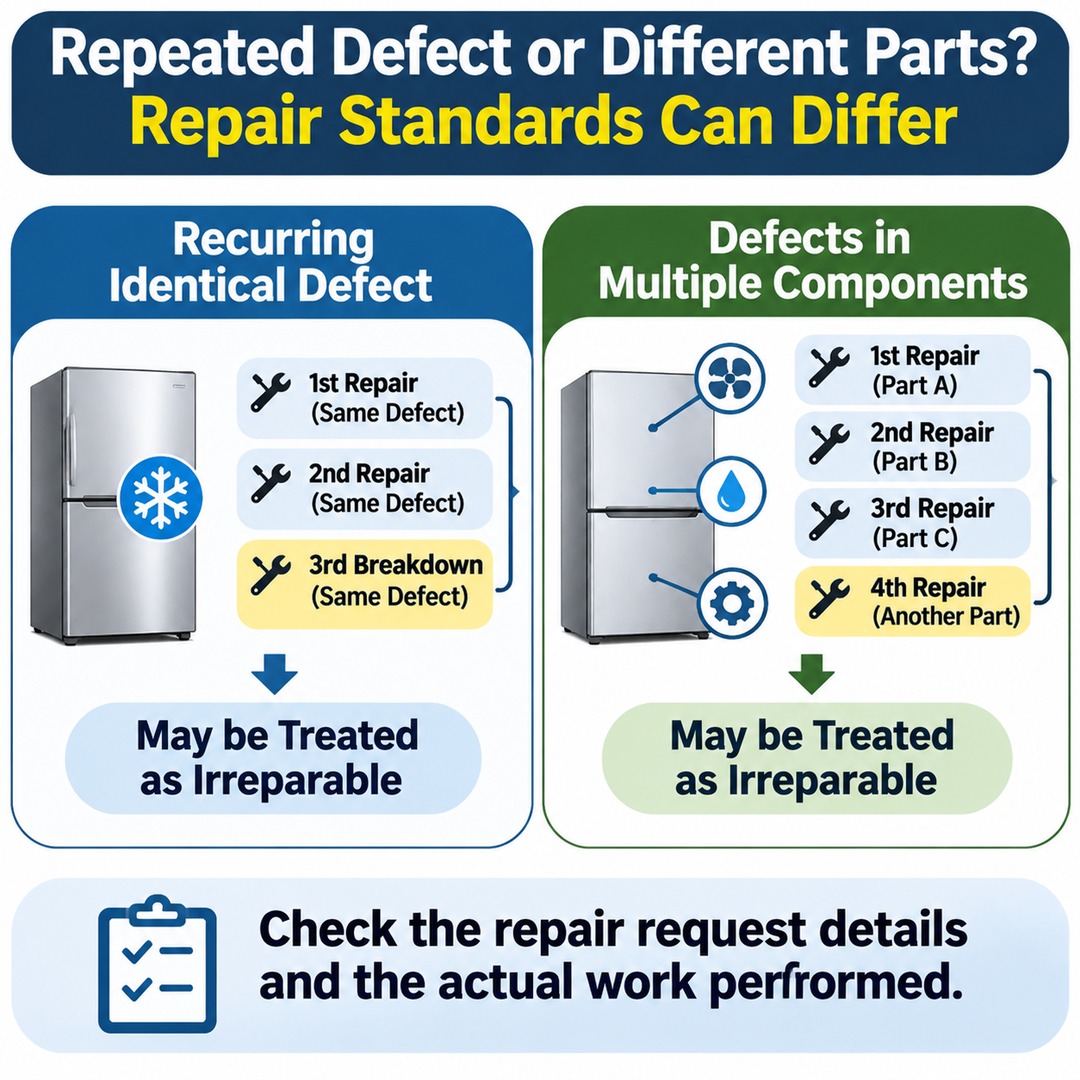
Two Repairs for the Same Defect vs. Four Repairs for Defects in Different Components
The number of repairs required for a replacement or refund can differ depending on whether the problem affects one component repeatedly or several different components. It is important to distinguish between a recurring identical defect and problems involving different parts of the product.
| Type of defect | Repair history | Subsequent breakdown |
|---|---|---|
| Same defect | 2 repairs | Recurs for the third time |
| Defects in multiple components | 4 repairs | Recurs for the fifth time |
In both situations, if the defects arise during normal use within the warranty period, the product may be considered irreparable, making the replacement or purchase-price refund standards applicable.
For example, if the same refrigerator cooling problem occurs again after two repairs, the standards for repeated identical defects may apply. By contrast, if problems arise in different parts of the refrigerator and it has undergone four repairs, the standards for defects in multiple components should be considered.
Simply visiting a service center three times does not automatically establish three occurrences of the same defect. The repair request details and the actual work performed are important.
Can You Still Get a Refund If the Warranty Period Has Expired?
For replacement or refund claims involving repeated defects, an important consideration is whether the defect occurred within the product's warranty period. Therefore, do not look only at how long ago you purchased the appliance. Check the applicable warranty period and the dates when repair requests were submitted.
Warranty periods are not identical for all household appliances. They can vary depending on the product category and the specific components involved.
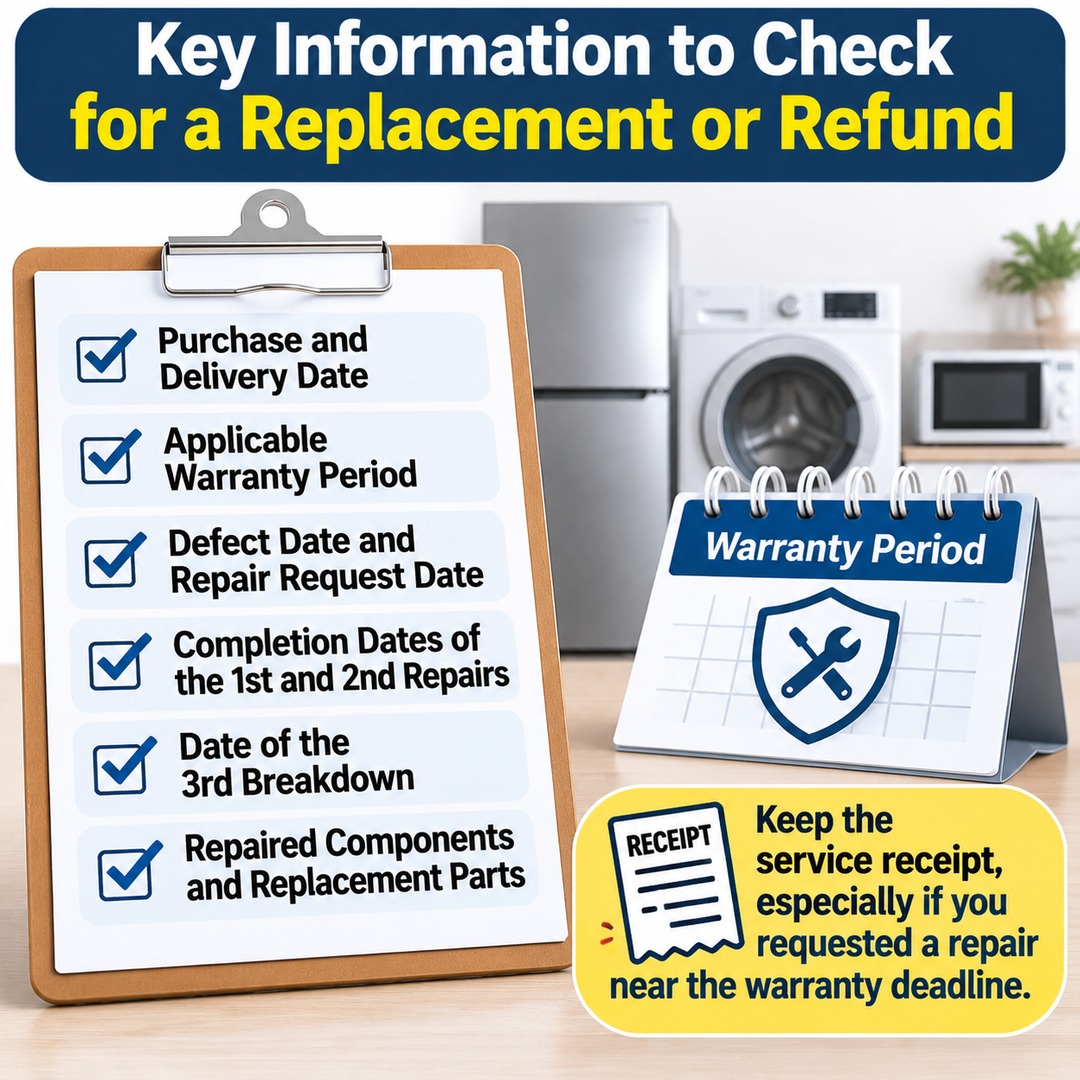
Check the following information:
Product purchase date and delivery date
Warranty period applicable to the product
Date the defect occurred and date the service center received the repair request
Completion dates of the first and second repairs
Date of the third breakdown
Components repaired and replacement parts installed
In particular, if you submitted a repair request shortly before the warranty expired, keep the service receipt. The relationship between the actual submission date and the warranty period may become important evidence in a dispute.
Do Paid and Free Repairs Both Count Toward the Repair History?
To claim a replacement or refund for repeated defects, it must be possible to establish that the problem arose during normal use and to verify the repair history.
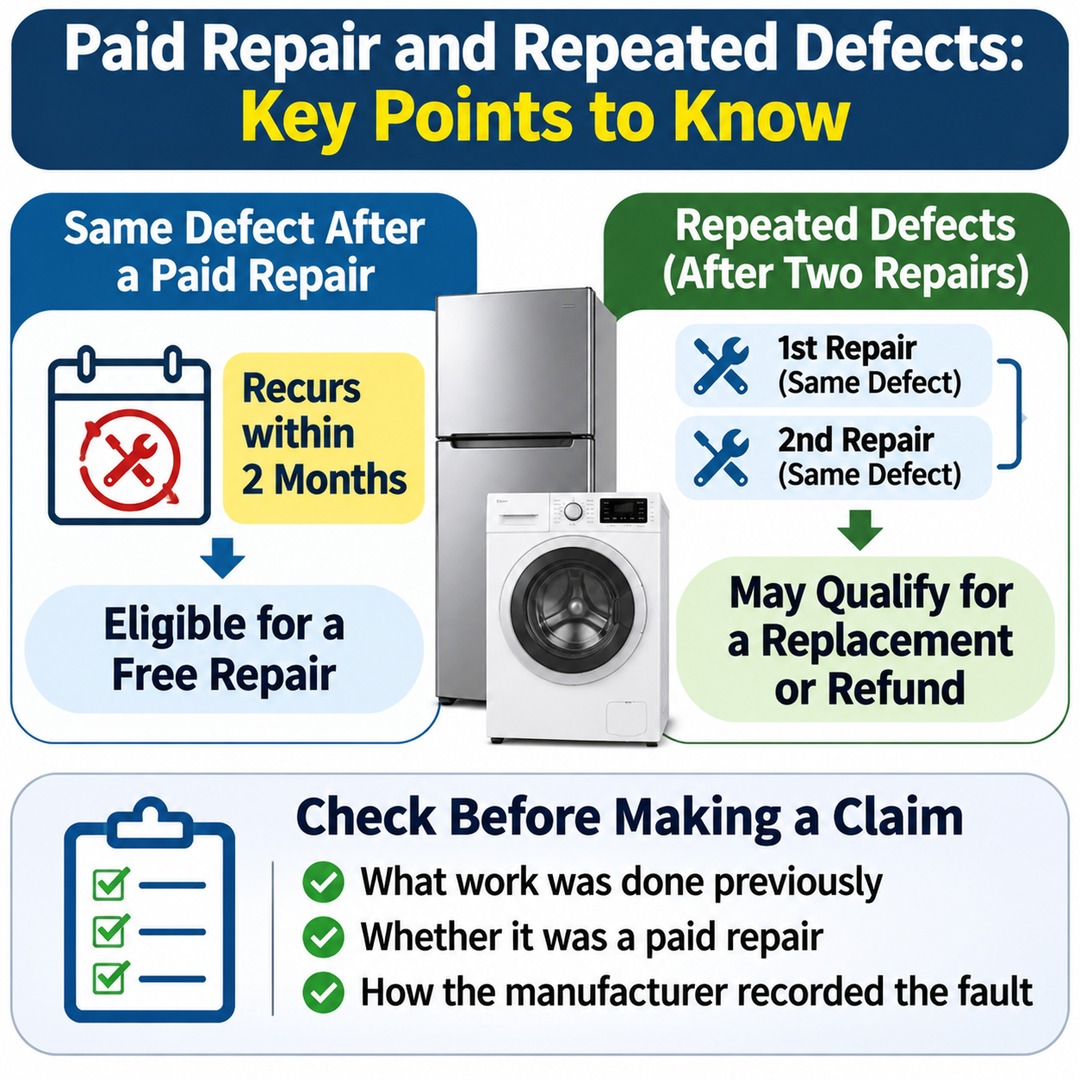
A situation in which the same fault recurs after a paid repair requires separate consideration. Under the general Consumer Dispute Resolution Standards, if the same defect recurs within two months of a paid repair, the free-repair standard applies.
However, this rule and the replacement or refund standard for a defect that recurs after two repairs are separate issues. Receiving one paid repair does not automatically mean that you meet the requirements for a refund based on repeated defects.
It is advisable to check what work was performed previously, whether the work was carried out at the consumer's expense, and how the manufacturer recorded the fault.
What Documents Do You Need to Request a Refund?
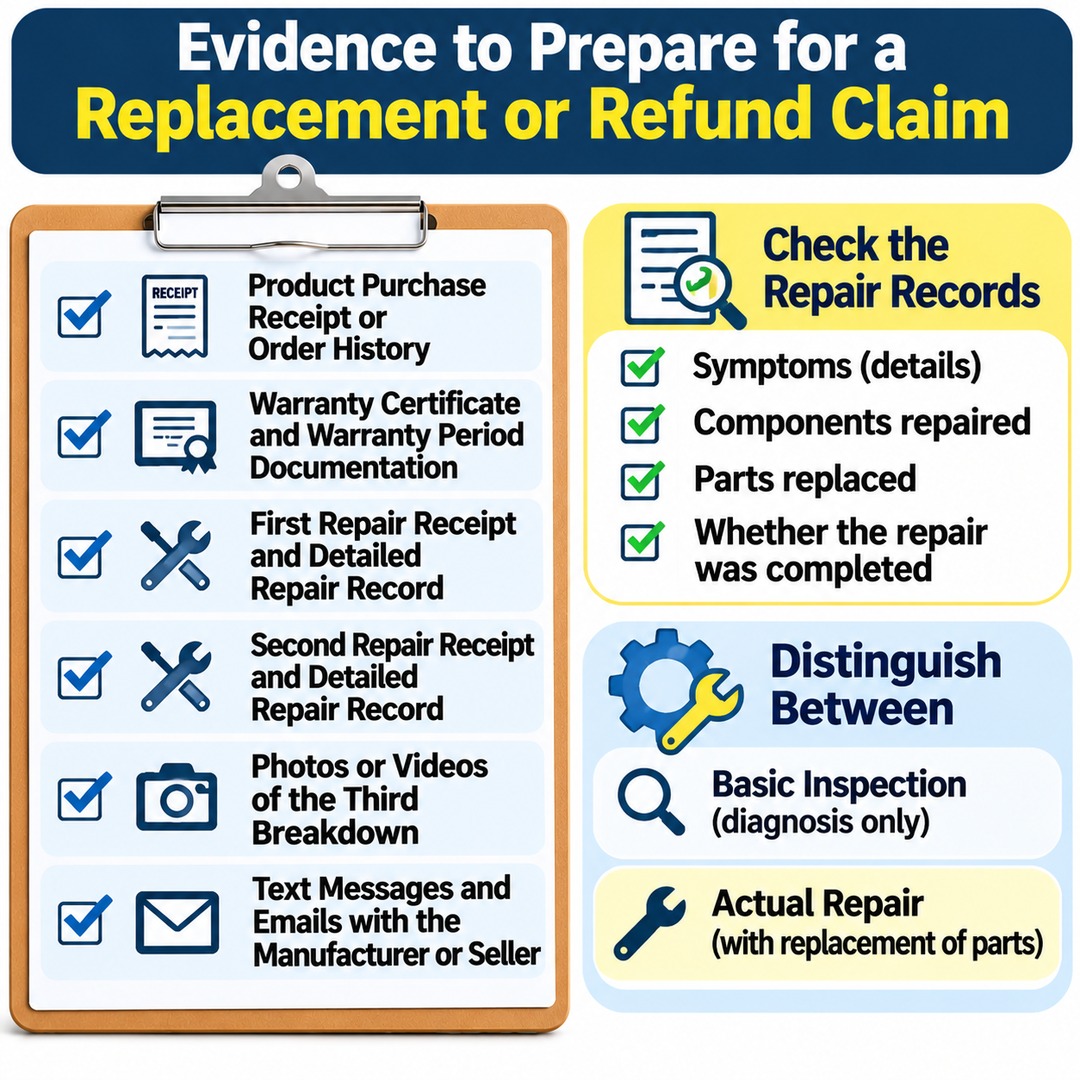
The most important documents are the service center's repair receipts and detailed repair records. A consumer's statement that the same symptoms have occurred repeatedly may not be enough to determine whether the underlying defect was actually identical.
It is advisable to keep the following evidence:
1. Product purchase receipt or order history
2. Product warranty certificate and documentation confirming the warranty period
3. Repair receipt and detailed repair record for the first repair
4. Repair receipt and detailed repair record for the second repair
5. Photos or videos showing the symptoms of the third breakdown
6. Text messages and emails exchanged with the manufacturer or seller
In particular, check whether the repair records clearly describe the symptoms, the components repaired, the parts replaced and whether the repair was completed.
You should also distinguish between a basic inspection performed by the service center and an actual repair involving replacement of parts. If a dispute arises over the number of repairs, records of the work performed can be just as important as the service receipts.
What Should You Do If the Manufacturer Refuses to Issue a Refund?
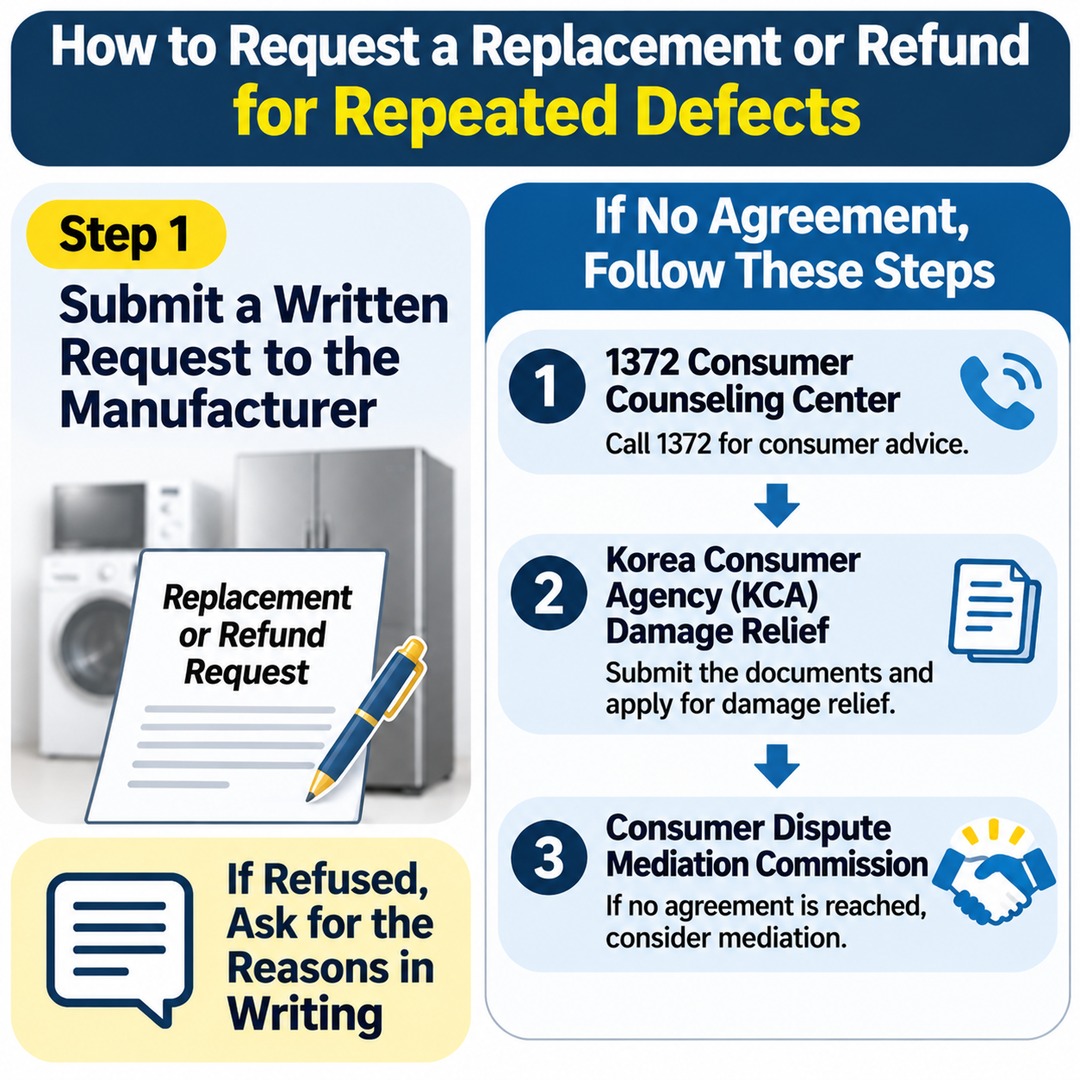
First, it is advisable to submit a written request to the manufacturer's customer service department for a product replacement or a refund of the purchase price on the grounds that the same defect has repeatedly occurred.
When making your request, you can explain the situation as follows.
If the manufacturer or seller refuses, ask them to provide their reasons in writing as well.
If you cannot reach an agreement with the business, you can proceed in the following order:
1372 Consumer Counseling Center: Call 1372 without an area code for consumer advice.
Korea Consumer Agency (KCA) Damage Relief: After receiving counseling, submit the relevant documents and apply for damage relief.
Consumer Dispute Mediation Commission: If an agreement cannot be reached during the damage relief process, consider proceeding with mediation.
The Korea Consumer Agency also publishes actual consumer cases involving refund requests after repeated repairs.
Although the example is not specifically about a household appliance, it can help explain how dispute resolution standards concerning recurring identical defects are applied in actual consumer disputes.
What If You Have Not Received Your Appliance Even One Month After Sending It for Repair?
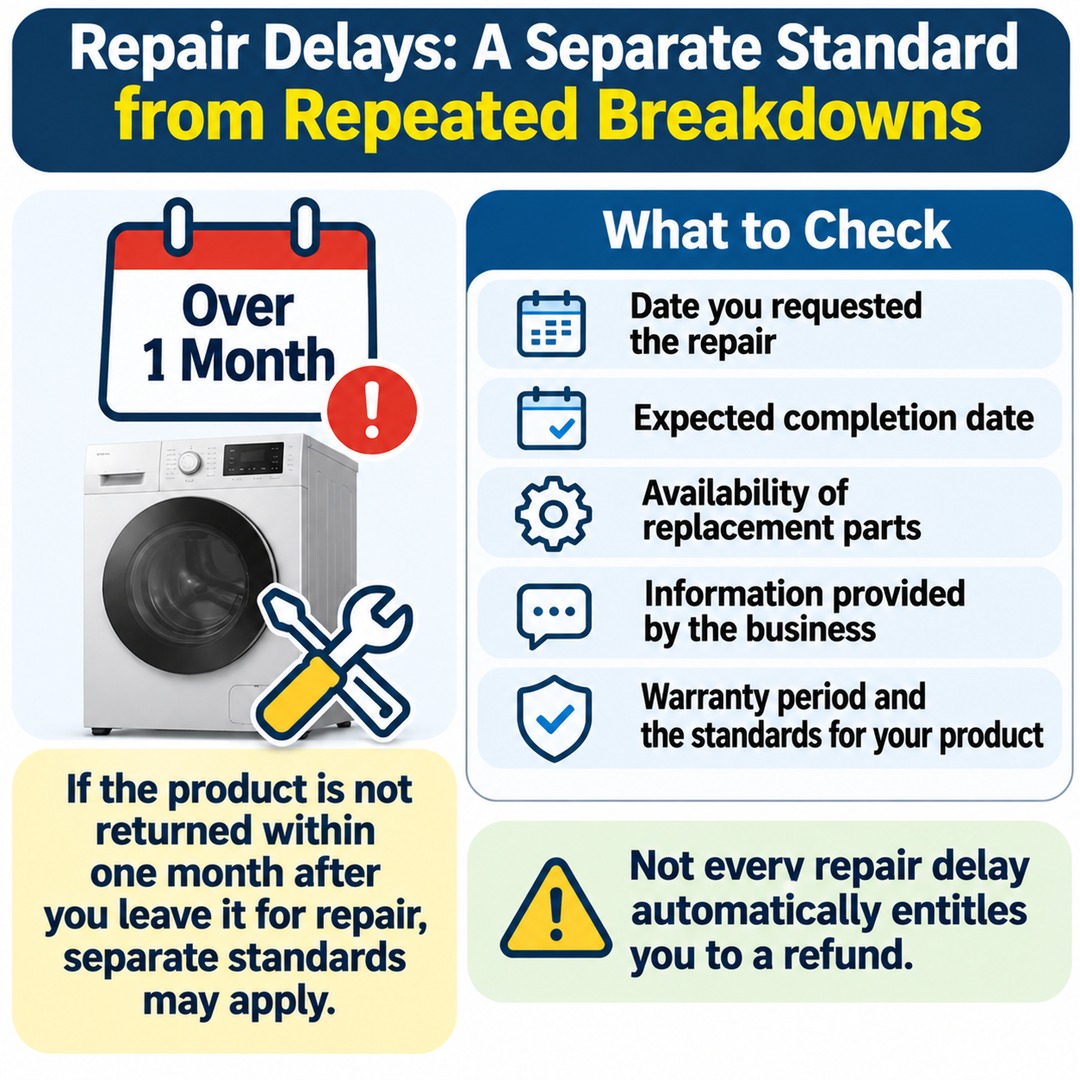
Separate standards concerning repair delays may also be relevant, independently of repeated breakdowns.
If you leave a product with a business for repair and the business fails to return it within one month, this is a different type of dispute from a situation involving repeated occurrences of the same defect.
In this situation, check the date you requested the repair, the expected completion date, the availability of replacement parts and the information provided by the business. Even if the required number of repeated breakdowns has not been reached, there may be separate standards applicable to repair delays.
However, not every repair delay automatically entitles you to a refund. You should also check the warranty period and the standards applicable to the specific product.
What to Check Before Requesting a Refund
An appliance does not automatically qualify for a refund simply because it has broken down for the third time. However, if it has undergone two repairs for the same defect and the same problem occurs again within the warranty period, it is worth reviewing whether you should request more than another free repair.
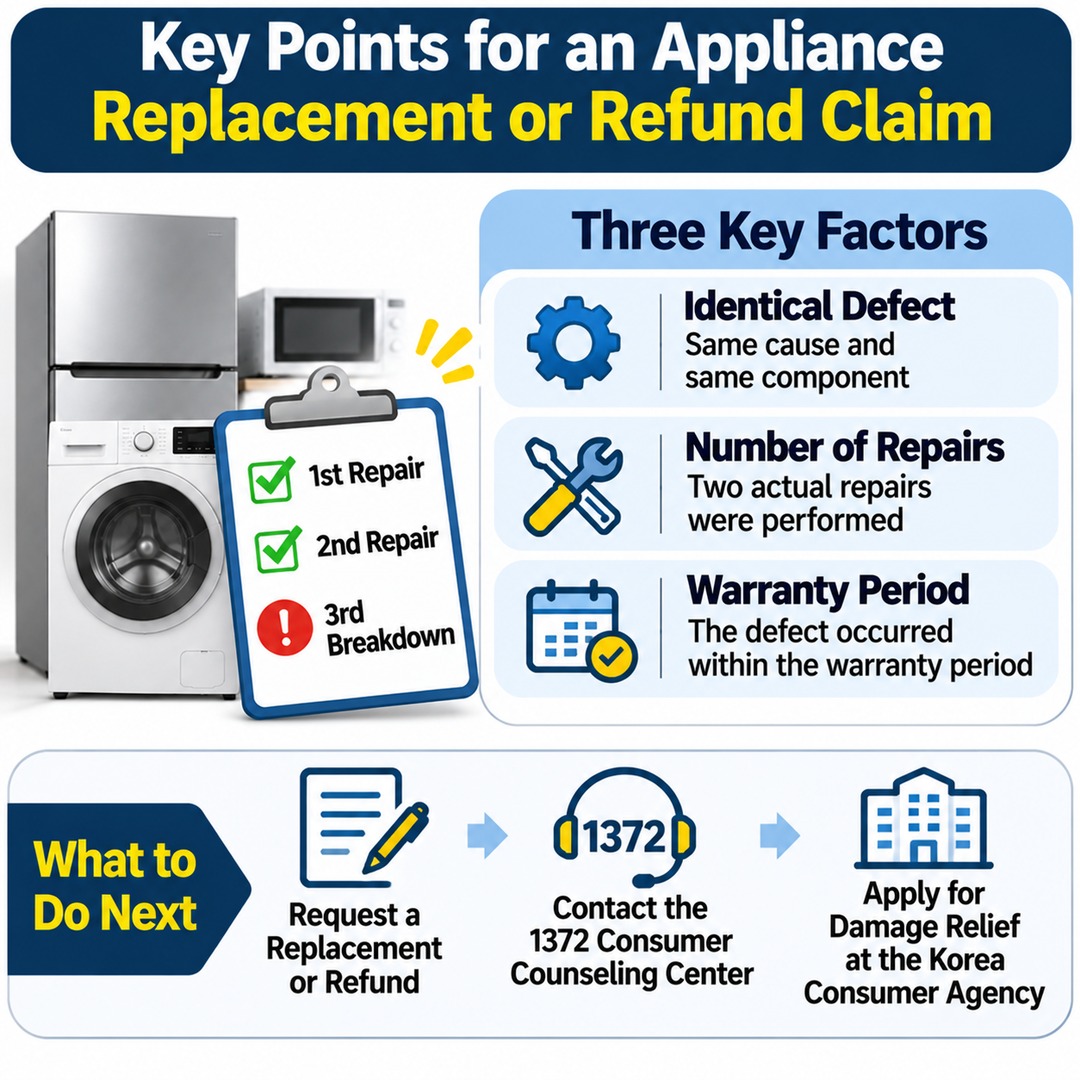
Three factors are particularly important when assessing your claim:
Whether the defect is identical: Whether the cause and affected component are the same as in the previous repairs.
The number of repairs: Whether two actual repairs were performed.
The warranty period: Whether the defect occurred within the applicable warranty period.
Once you have obtained the detailed repair records, formally request a replacement or refund from the manufacturer. If the request is rejected, you can seek assistance through the 1372 Consumer Counseling Center and the Korea Consumer Agency's damage relief procedure.