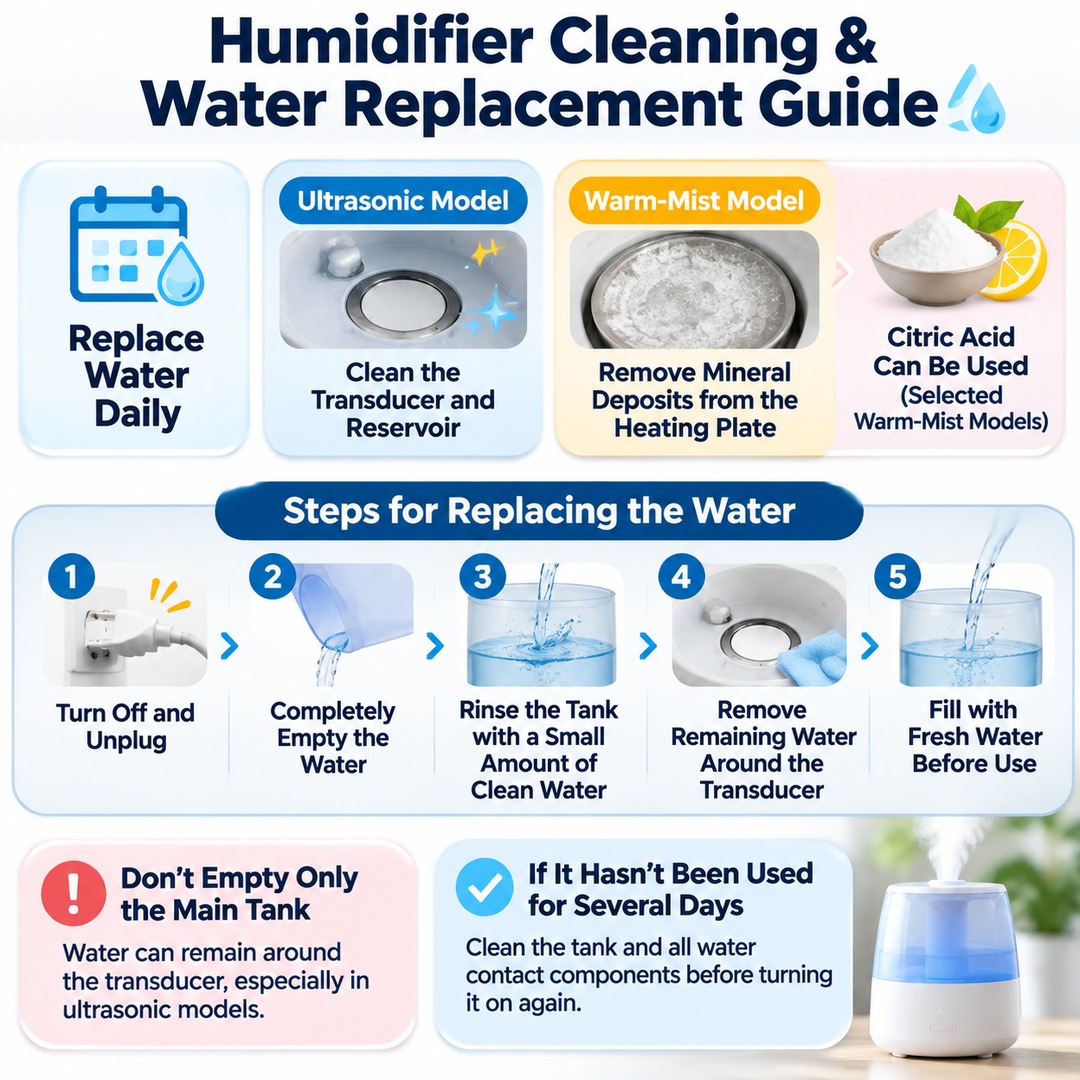
If your humidifier's water tank has developed a slippery film or unpleasant odor, emptying the remaining water is not enough. You also need to clean the tank and every component that comes into contact with water. Replace the water daily, clean the transducer and reservoir in ultrasonic models, and remove mineral deposits from the heating plate in warm-mist models. Citric acid can be used with certain warm-mist humidifiers, but it is not a universal cleaning solution for all humidifiers.
Should You Replace Humidifier Water Every Day?
Yes. If you use your humidifier daily, empty the remaining water in the tank and refill it with fresh water. Avoid simply adding fresh water to water that has been sitting in the tank since the previous day.
Follow these steps when replacing the water:
1. Turn off the humidifier and unplug it from the power outlet.
2. Completely empty the remaining water from the tank and reservoir.
3. Add a small amount of clean water and rinse the inside of the tank.
4. Remove any remaining water around the transducer and other areas where water collects.
5. Fill the tank with fresh water before use.
One common mistake is emptying only the main tank while leaving water around the transducer. Ultrasonic humidifiers can retain water around this component, so make sure that area is emptied as well.
If the humidifier has not been used for several days, clean the tank and all water-contact components before turning it on again.
Ultrasonic and Warm-Mist Humidifiers Require Different Cleaning Methods
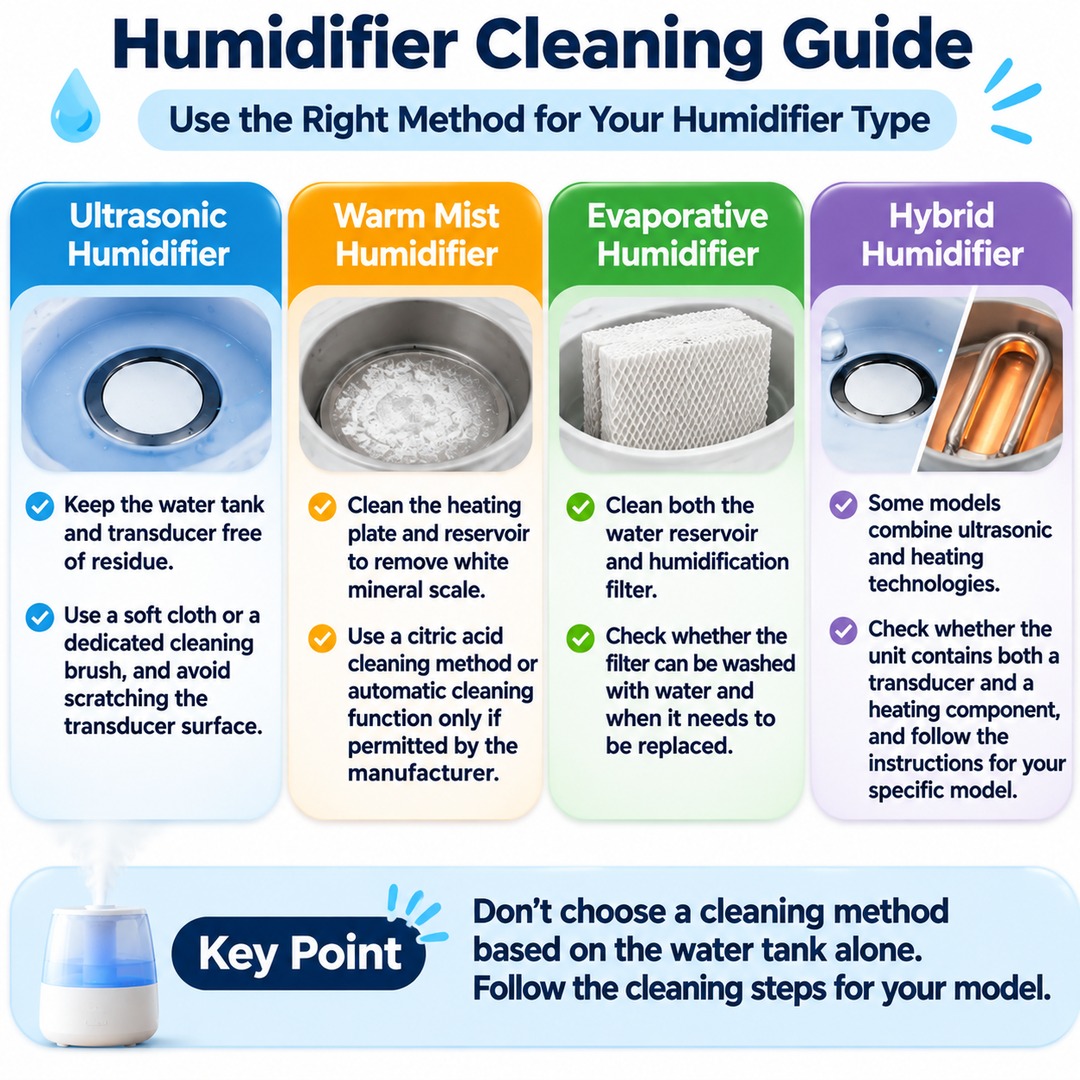
The correct cleaning method depends on how your humidifier operates. Ultrasonic models produce a fine mist using a vibrating transducer, making transducer maintenance especially important. Warm-mist models heat water, which can leave mineral deposits that need to be removed.
Ultrasonic humidifiers
Keep the water tank and transducer free of residue. Use a soft cloth or a dedicated cleaning brush, and avoid scratching the transducer surface.
Warm-mist humidifiers
Clean the heating plate and reservoir to remove white mineral scale. Use a citric acid cleaning method or automatic cleaning function only if the manufacturer permits it.
Evaporative humidifiers
Clean both the water reservoir and humidification filter. Check whether the filter can be washed with water and when it needs to be replaced.
Some hybrid humidifiers combine ultrasonic and heating technologies. Do not determine the cleaning method by looking at the water tank alone. Check whether the unit contains both a transducer and a heating component, and follow the instructions for the specific model.
How to Remove Buildup and Odors from an Ultrasonic Humidifier
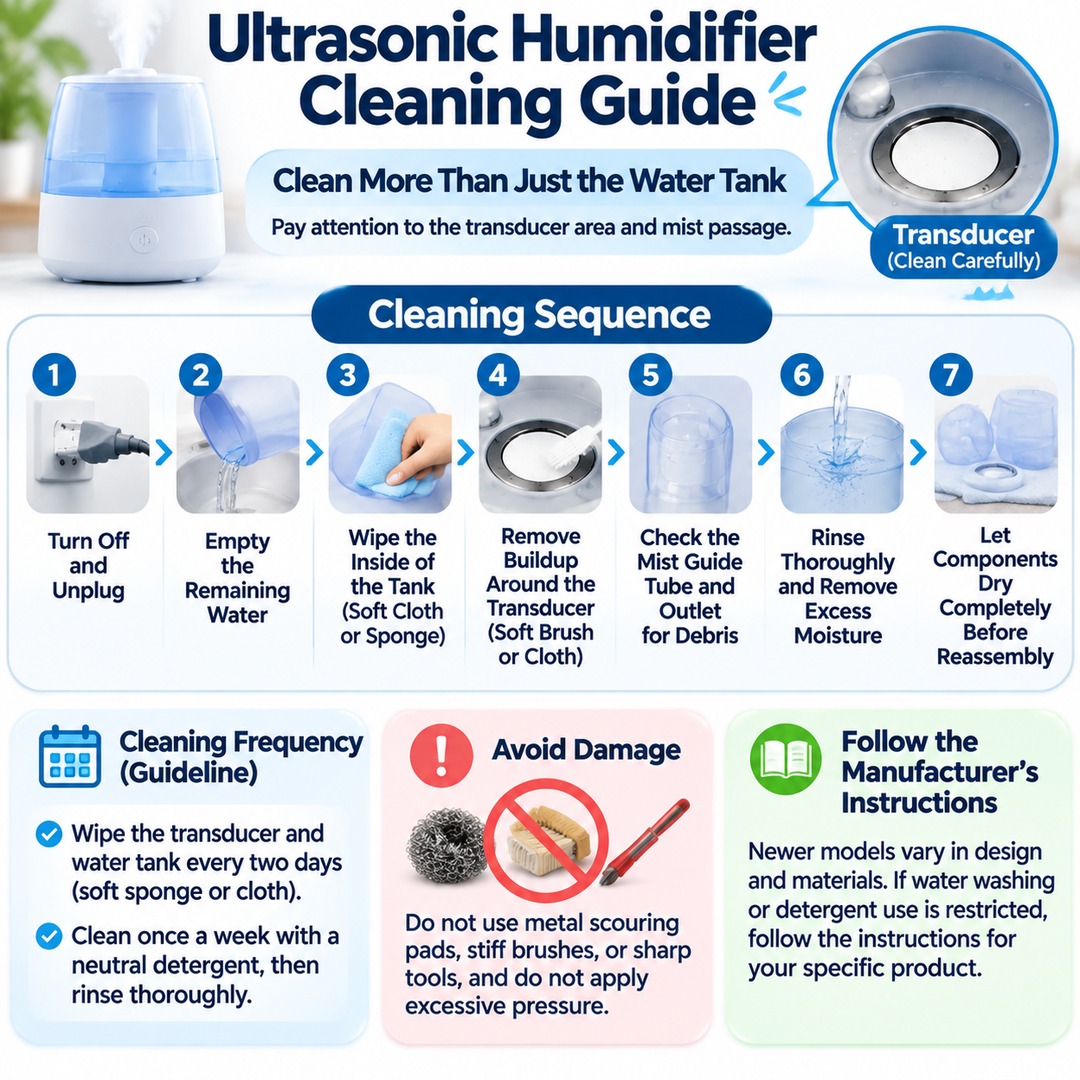
An ultrasonic humidifier needs cleaning beyond the water tank. Pay attention to the area around the transducer and the mist passage. If the tank is clean but an unpleasant smell remains, check whether residue is present on other water-contact components.
babygearlab.com
Follow this cleaning sequence:
1. Turn off the humidifier and unplug it.
2. Empty the remaining water from the tank.
3. Wipe the inside of the tank with a soft cloth or sponge.
4. Remove buildup around the transducer using a dedicated cleaning brush or soft cloth.
5. Check the mist guide tube and outlet for debris.
6. Rinse thoroughly with clean water and remove excess moisture.
7. Allow removable components to dry completely before reassembling them.
Avoid applying excessive pressure to the transducer surface. Metal scouring pads, stiff brushes, and sharp tools can damage the component.
In its earlier guidance on ultrasonic humidifier maintenance, the Korea Consumer Agency recommended wiping the transducer and water tank every two days with a soft sponge or cloth, and cleaning them once a week with a neutral detergent. If you use a neutral detergent, rinse thoroughly to remove all residue.
However, newer humidifiers vary in design and materials. If the manufacturer restricts water washing or detergent use, the instructions for your specific product take priority.
Can Citric Acid Remove White Mineral Deposits from a Warm-Mist Humidifier?
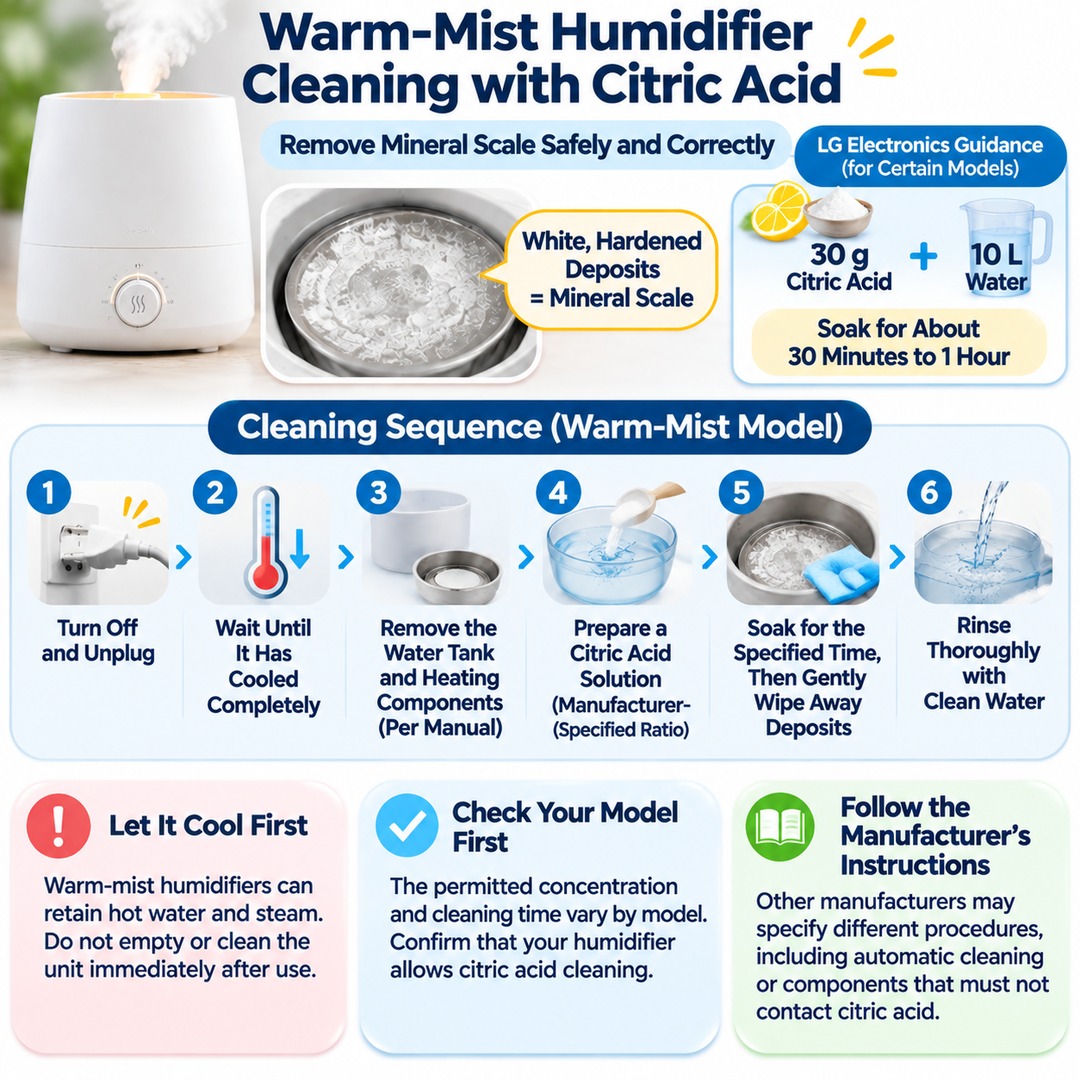
Some warm-mist humidifiers allow citric acid to be used to remove mineral scale from the heating plate and reservoir. However, the permitted concentration and cleaning time vary by model. Never assume that the amount recommended for another humidifier is suitable for yours.
ebook4989.com
White, hardened deposits may be mineral scale left behind by minerals in the water. In warm-mist humidifiers, these deposits can accumulate on the heating component and inside the reservoir as water is heated.
LG Electronics' humidifier maintenance guidance specifies a cleaning method for certain warm-mist models: soak the water tank and reservoir in a solution containing 30 g of citric acid per 10 L of water for approximately 30 minutes to 1 hour.
Citric acid dilution ratio specified in LG Electronics' guidance
Values converted directly from the specified dilution ratio:
| Amount of water | Amount of citric acid |
|---|---|
| 1 L | 3 g |
| 3 L | 9 g |
| 5 L | 15 g |
| 10 L | 30 g |
This is not a universal dosage for all humidifiers.
This guidance applies to LG Electronics product maintenance. First confirm that your own humidifier permits citric acid cleaning.
Other manufacturers may specify completely different procedures. Some models have an automatic cleaning function that uses citric acid, while others identify specific components or tanks that must not come into contact with it.
For a warm-mist humidifier, follow this cleaning sequence:
1. Turn off the humidifier and unplug it.
2. Wait until the unit has cooled completely.
3. Remove the water tank and heating components as instructed in the manual.
4. If citric acid is permitted, prepare the solution at the concentration specified by the manufacturer.
5. Soak the components for the specified amount of time, then gently wipe away the deposits with a soft sponge.
6. Rinse thoroughly with clean water.
7. Allow the components to dry completely before reassembling the unit.
Warm-mist humidifiers can retain hot water and steam immediately after operation. Do not empty or clean the unit as soon as you switch it off. Wait until it has cooled sufficiently before handling it.
Citric Acid, Vinegar, or Baking Soda: Which Should You Use?
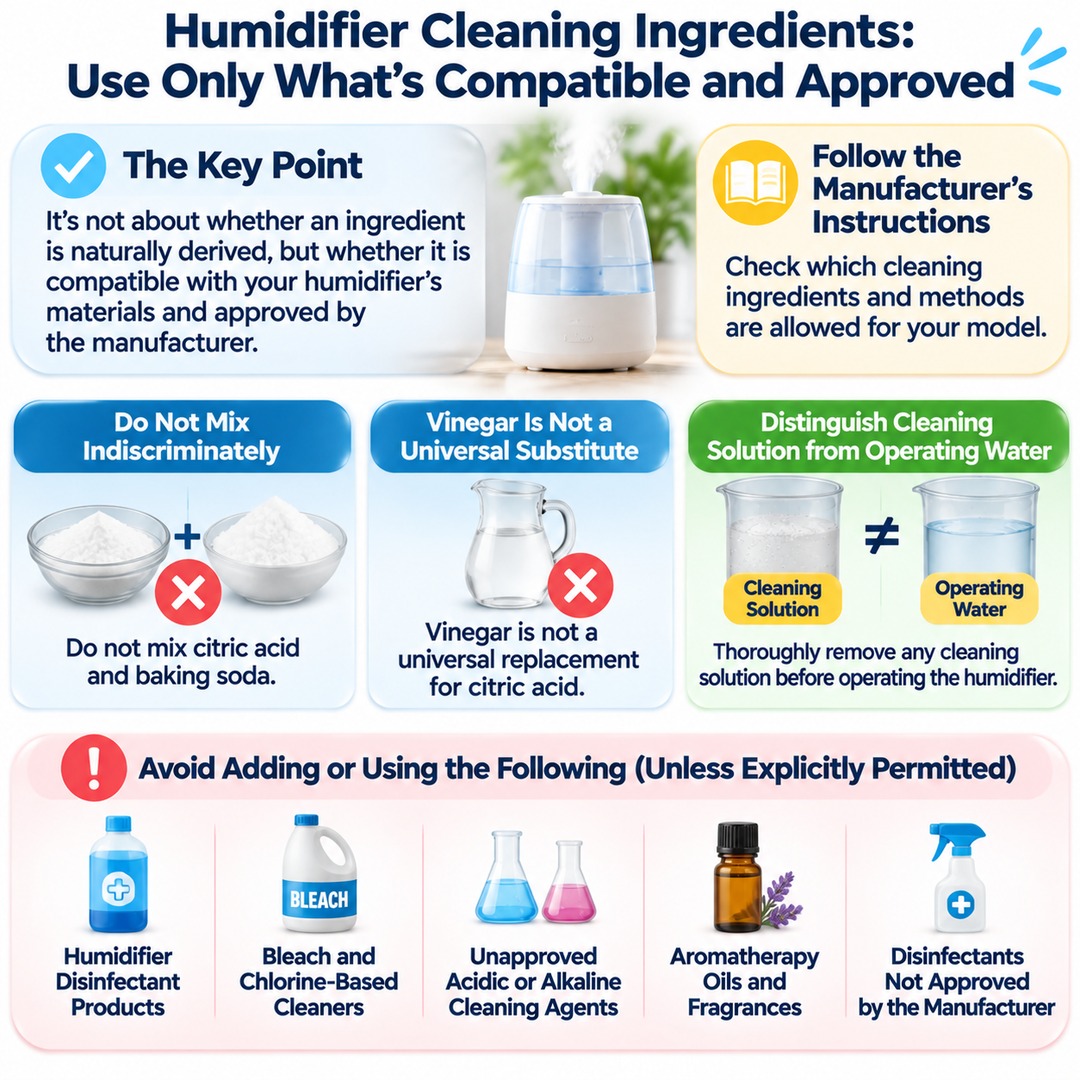
The most important consideration is not whether a cleaning ingredient is naturally derived, but whether it is compatible with the humidifier's materials and approved by the manufacturer.
| Cleaning agent | Typical intended use | Precautions |
|---|---|---|
| Citric acid | Removing mineral scale from approved heating components | Check the permitted concentration and cleaning time |
| Vinegar | Mineral scale maintenance in certain approved products | Confirm whether the manufacturer permits its use |
| Neutral detergent | Cleaning approved tanks and components | Rinse thoroughly to remove detergent residue |
| Baking soda | General cleaning assistance | Check whether it is suitable for humidifier components |
Mixing citric acid and baking soda indiscriminately is not recommended. Combining the two does not automatically make it safer or more effective to remove buildup and odors from every humidifier.
Vinegar is also not a universal substitute for citric acid. Permission to use citric acid does not mean that vinegar can be used in the same amount or in the same way.
Avoid adding or using the following products unless the manufacturer explicitly permits them:
Humidifier disinfectant products
Bleach and chlorine-based cleaners
Unapproved acidic or alkaline cleaning agents
Aromatherapy oils and fragrances
Disinfectants not approved by the manufacturer
Water used during normal humidifier operation must be distinguished from solutions used for cleaning. Never operate the humidifier without first thoroughly removing the cleaning solution.
How to Tell Pink Buildup from White Mineral Scale
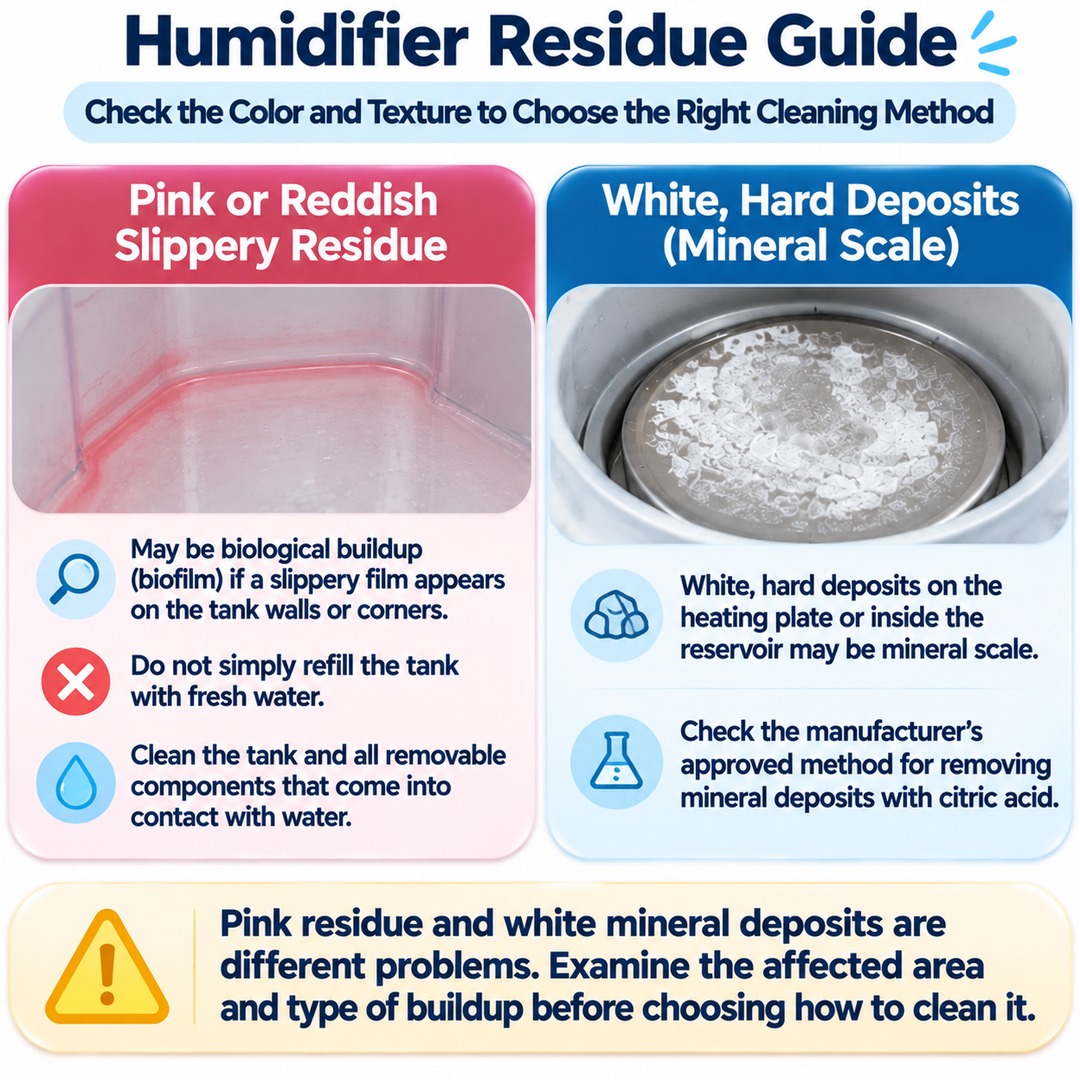
Residue inside a humidifier can be assessed by looking at its color and texture.
dalab.tistory.com
Pink or reddish slippery residue
If a slippery film appears on the walls or corners of the water tank, it may be biological buildup in the form of a biofilm. Color alone cannot identify the exact microorganism involved.
Do not simply refill the tank with fresh water. Clean the tank and all removable components that come into contact with water.
rakuten.co.jp
Hard white deposits
If white, hard deposits have accumulated on the heating plate or inside the reservoir, they may be mineral scale. In this situation, check the manufacturer's approved method for removing mineral deposits with citric acid.
Pink residue and white mineral deposits are different problems and should not automatically be treated with the same cleaning method. Examine the affected area and the type of buildup before choosing how to clean it.
How Often Should You Clean a Humidifier?
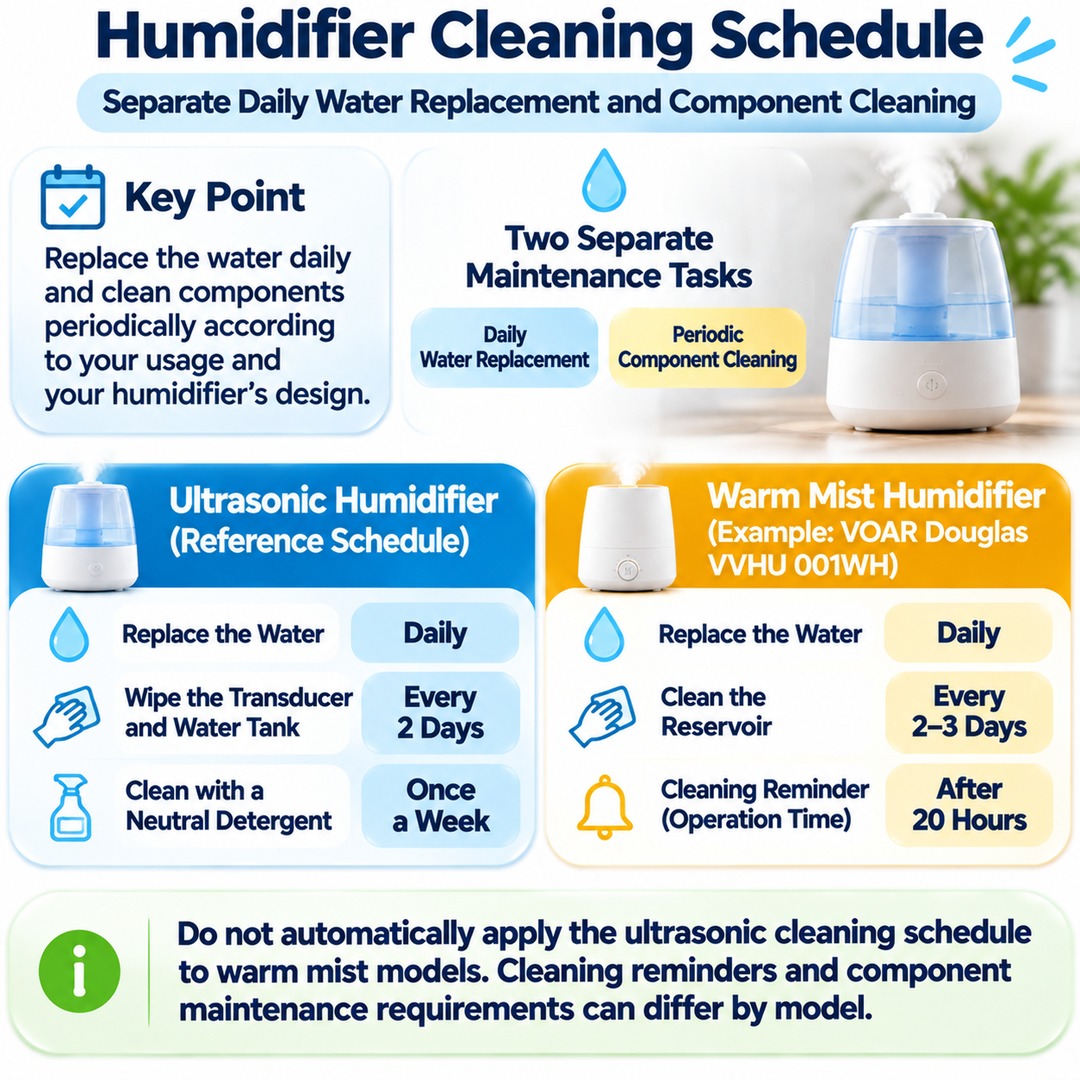
Replacing the water every day and periodically cleaning the components are two separate maintenance tasks. Rather than trying to do everything at once, follow a schedule appropriate for your usage and the design of your humidifier.
For ultrasonic models, the earlier maintenance recommendations from the Korea Consumer Agency provide the following reference schedule:
| Maintenance interval | What to do |
|---|---|
| Daily | Empty remaining water, refill with fresh water, and rinse the tank |
| Every two days | Gently wipe the tank and transducer |
| Once a week | Clean with an approved neutral detergent and rinse thoroughly |
| After 2–3 days or more without use | Clean the tank and transducer before using the humidifier again |
| Before long-term storage | Remove all water, clean the interior, and allow it to dry completely |
Do not automatically apply the ultrasonic cleaning schedule to warm-mist models. Replace the water daily, but follow the manufacturer's recommended interval for cleaning the heating plate and removing mineral scale from the reservoir.
For example, the user manual for the VOAR Douglas Warm-Mist Humidifier VVHU-001WH recommends replacing the water daily and cleaning the reservoir every 2–3 days. This model also displays a cleaning reminder after 20 hours of operation.
As this example shows, cleaning reminders and component maintenance requirements can differ even among warm-mist humidifiers.
What If Your Humidifier Still Smells After Cleaning?
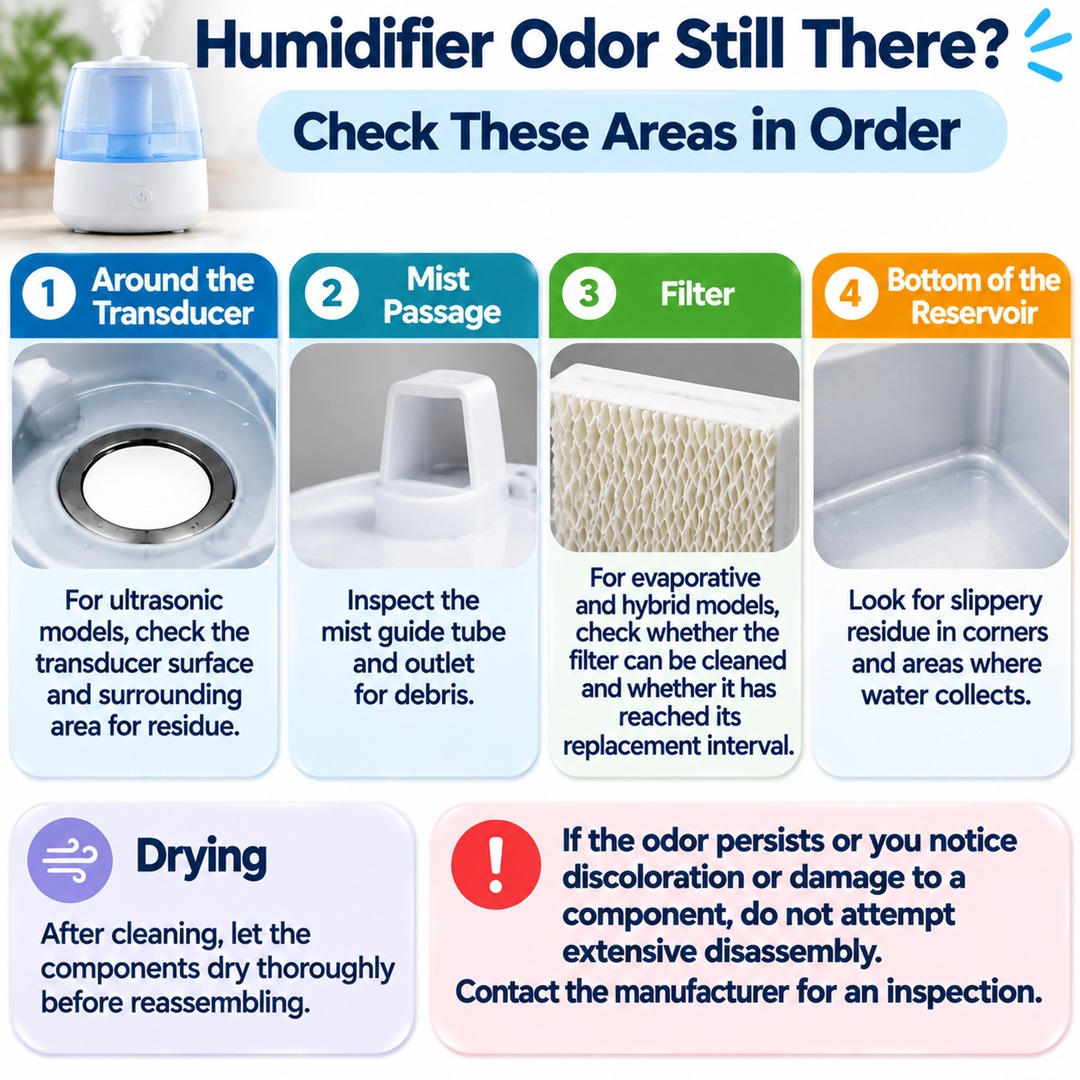
If an unpleasant odor remains after washing the water tank, inspect the other components rather than cleaning the tank repeatedly.
Check the following areas in order:
Around the transducer: For ultrasonic models, check the transducer surface and surrounding area for remaining residue.
Mist passage: Inspect the mist guide tube and outlet for debris.
Filter: For evaporative and hybrid models, check whether the filter can be cleaned and whether it has reached its replacement interval.
Bottom of the reservoir: Look for slippery residue in corners and areas where water collects.
Drying condition: Check whether the interior was left damp and sealed for an extended period after cleaning.
If the odor persists or you notice discoloration or damage to a component, do not attempt extensive disassembly. Contact the manufacturer for an inspection instead.
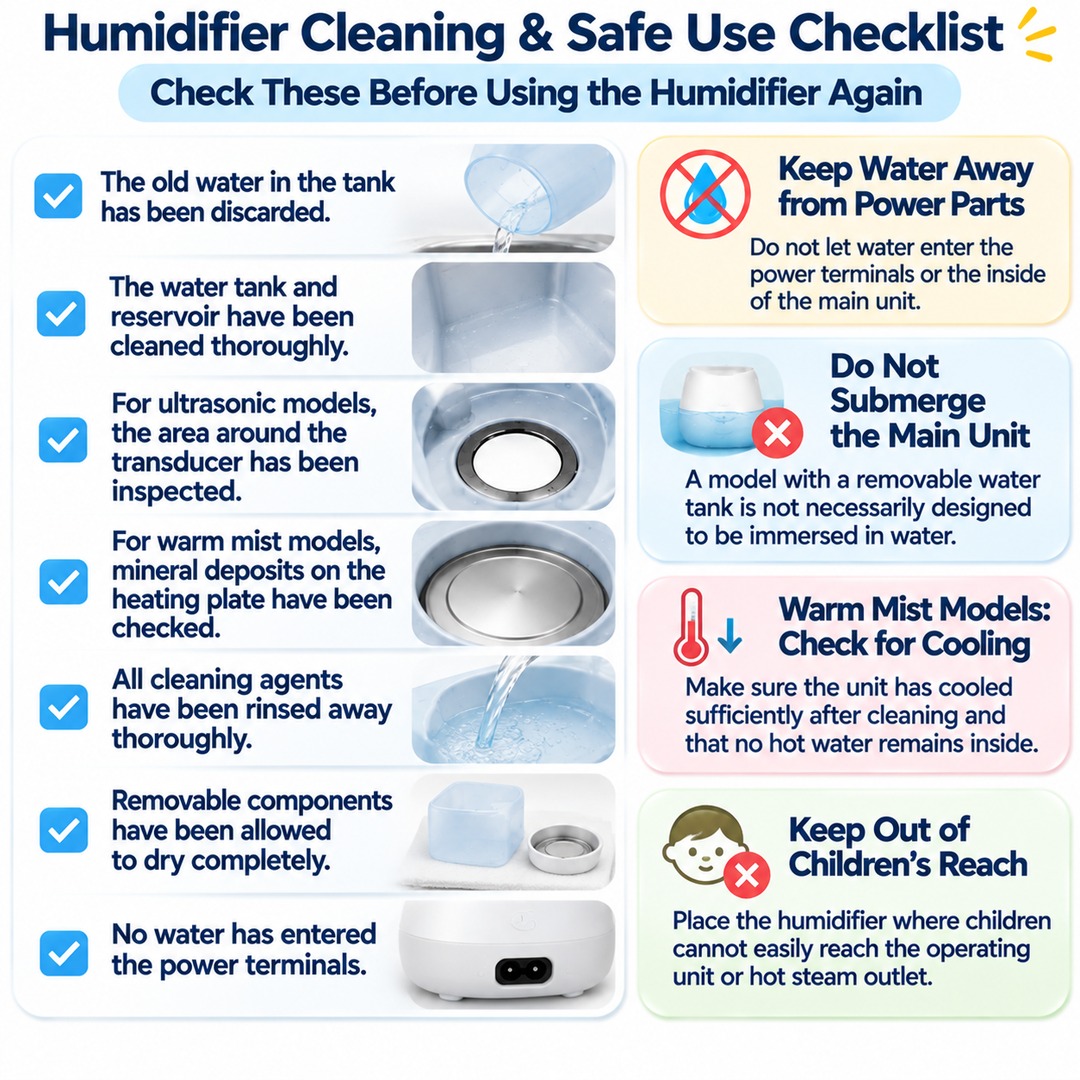
What to Check Before Using Your Humidifier Again
Pre-use checklist
0 / 8 completed
0%
The old water remaining in the tank has been discarded.
The water tank and reservoir have been cleaned thoroughly.
For ultrasonic models, the area around the transducer has been inspected.
For warm-mist models, mineral deposits on the heating plate have been checked.
All cleaning agents have been rinsed away thoroughly.
Removable components have been allowed to dry completely.
No water has entered the power terminals or the inside of the main unit.
The assembly and power cable have been checked.
Take particular care to prevent water from entering the power terminals or the inside of the main unit. A humidifier with a removable water tank is not necessarily designed to have its entire body immersed in water.
For warm-mist models, also make sure the unit has cooled sufficiently after cleaning and that no hot water remains inside. In homes with children, pay attention to where the humidifier is placed so they cannot easily reach the operating unit or hot steam outlet.
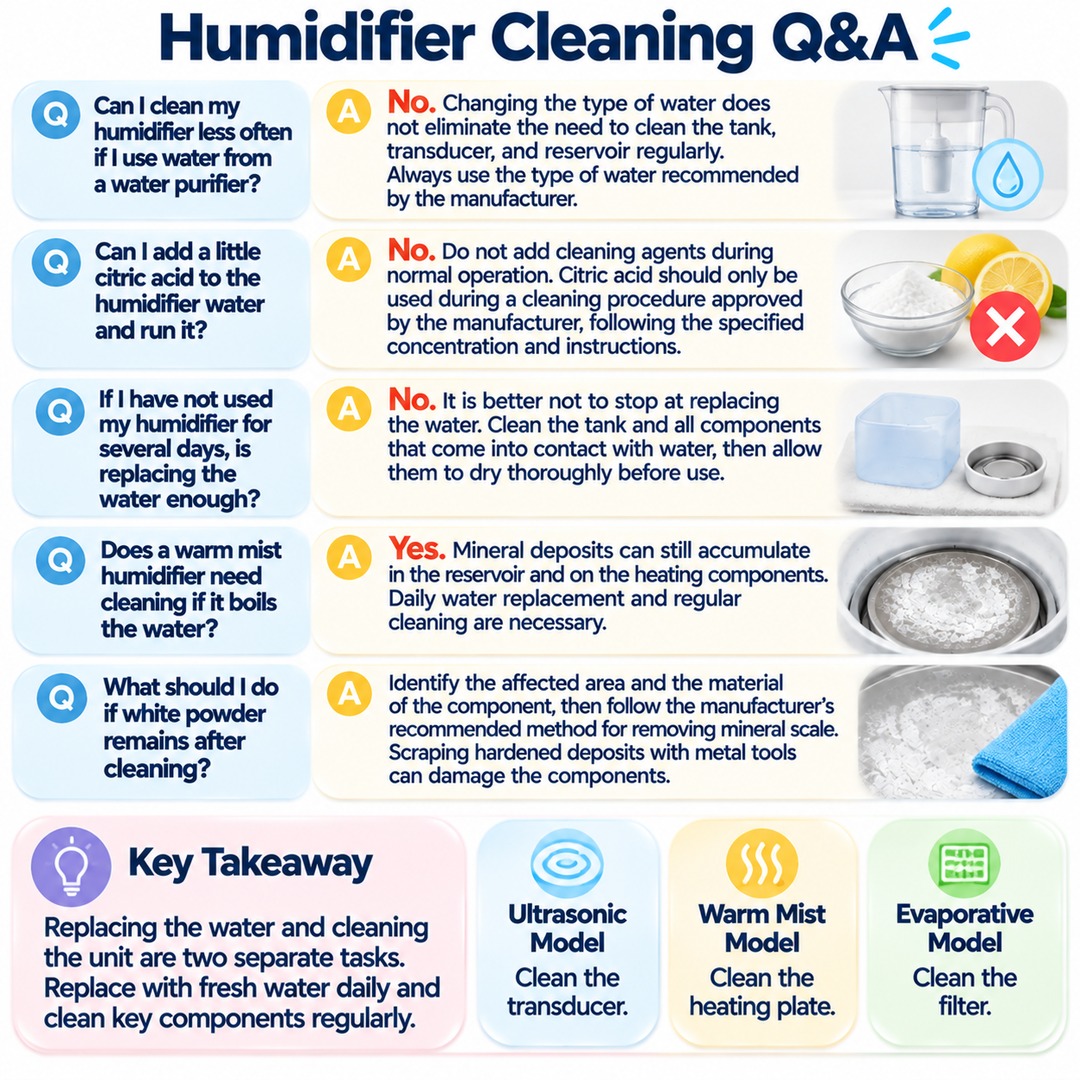
Frequently Asked Questions
Q. Can I clean my humidifier less often if I use water from a water purifier?
No. Changing the type of water does not eliminate the need to clean the tank, transducer, and reservoir regularly. Always use the type of water recommended by the manufacturer.
Q. Can I add a little citric acid to the humidifier water and run it?
Do not add cleaning agents during normal humidifier operation. Citric acid should only be used during a cleaning procedure approved by the manufacturer, following the specified concentration and instructions.
Q. If I have not used my humidifier for several days, is replacing the water enough?
It is better not to stop at replacing the water. Clean the tank and all components that come into contact with water, then allow them to dry thoroughly before use.
Q. Does a warm-mist humidifier need cleaning if it boils the water?
Yes. Mineral deposits can still accumulate in the reservoir and on the heating components. Daily water replacement and regular cleaning are necessary.
Q. What should I do if white powder remains after cleaning?
Identify the affected area and the material of the component, then follow the manufacturer's recommended method for removing mineral scale. Scraping hardened deposits with metal tools can damage the components.
Because humidifiers operate with water, replacing the water and cleaning the unit should be treated as two separate maintenance tasks. Refill the tank with fresh water every day, and clean the transducer in ultrasonic models, the heating plate in warm-mist models, and the filter in evaporative models. These steps can help reduce recurring buildup and unpleasant odors.