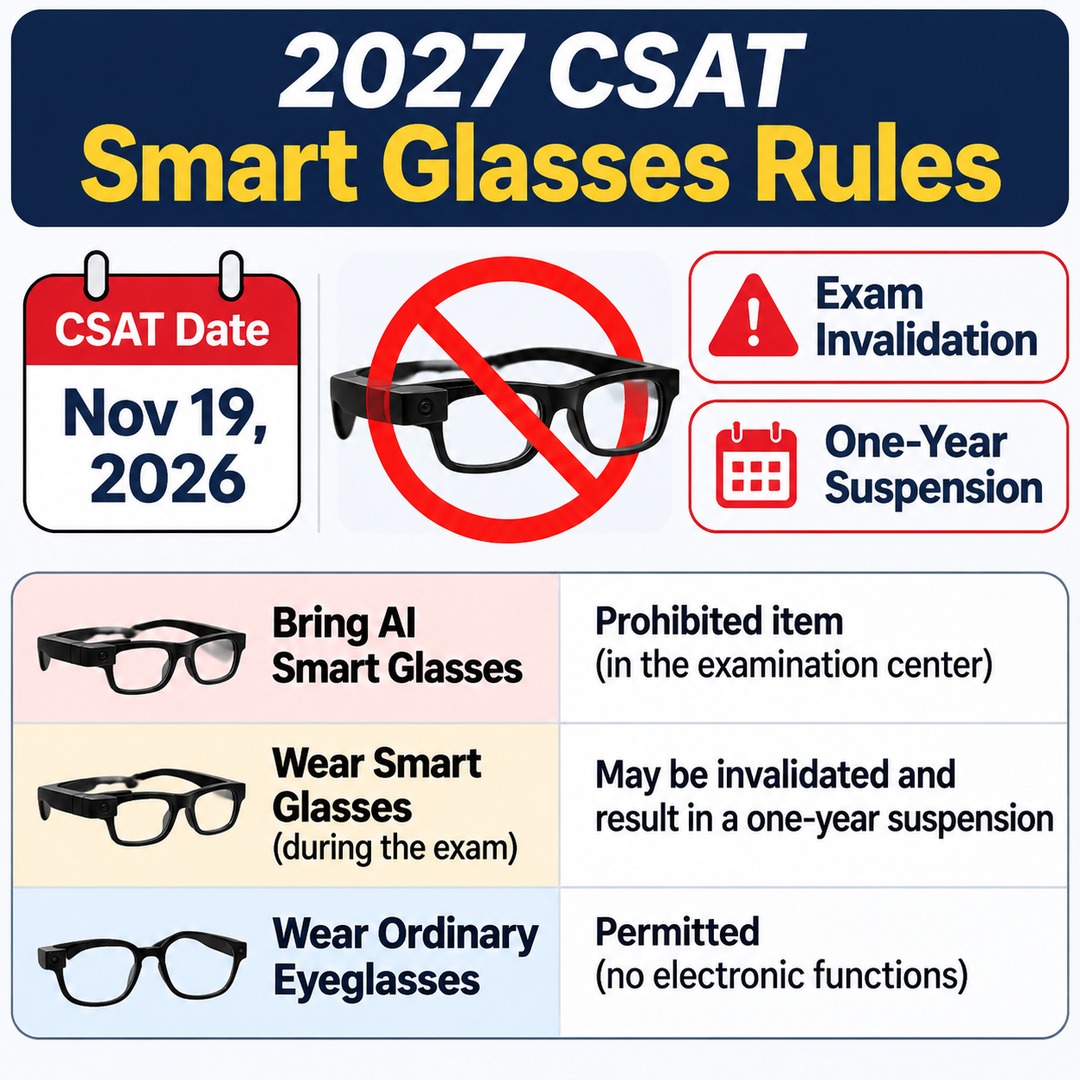
For the 2027 Korean College Scholastic Ability Test (CSAT), AI smart glasses are prohibited inside examination centers. Wearing them during the exam can invalidate the current examination and result in a one-year suspension of eligibility to take the following year's CSAT. Candidates who accidentally bring ordinary electronic devices must submit them to an invigilator before the first examination session begins. However, smart glasses are subject to particularly serious penalties when worn during the examination, so these situations must be distinguished.
The 2027 CSAT will take place on November 19, 2026. The important distinction for candidates is that merely possessing an electronic device and actually wearing or using it during the examination are not treated as identical situations.
Can Wearing Smart Glasses During the CSAT Prevent You from Taking Next Year's Exam?
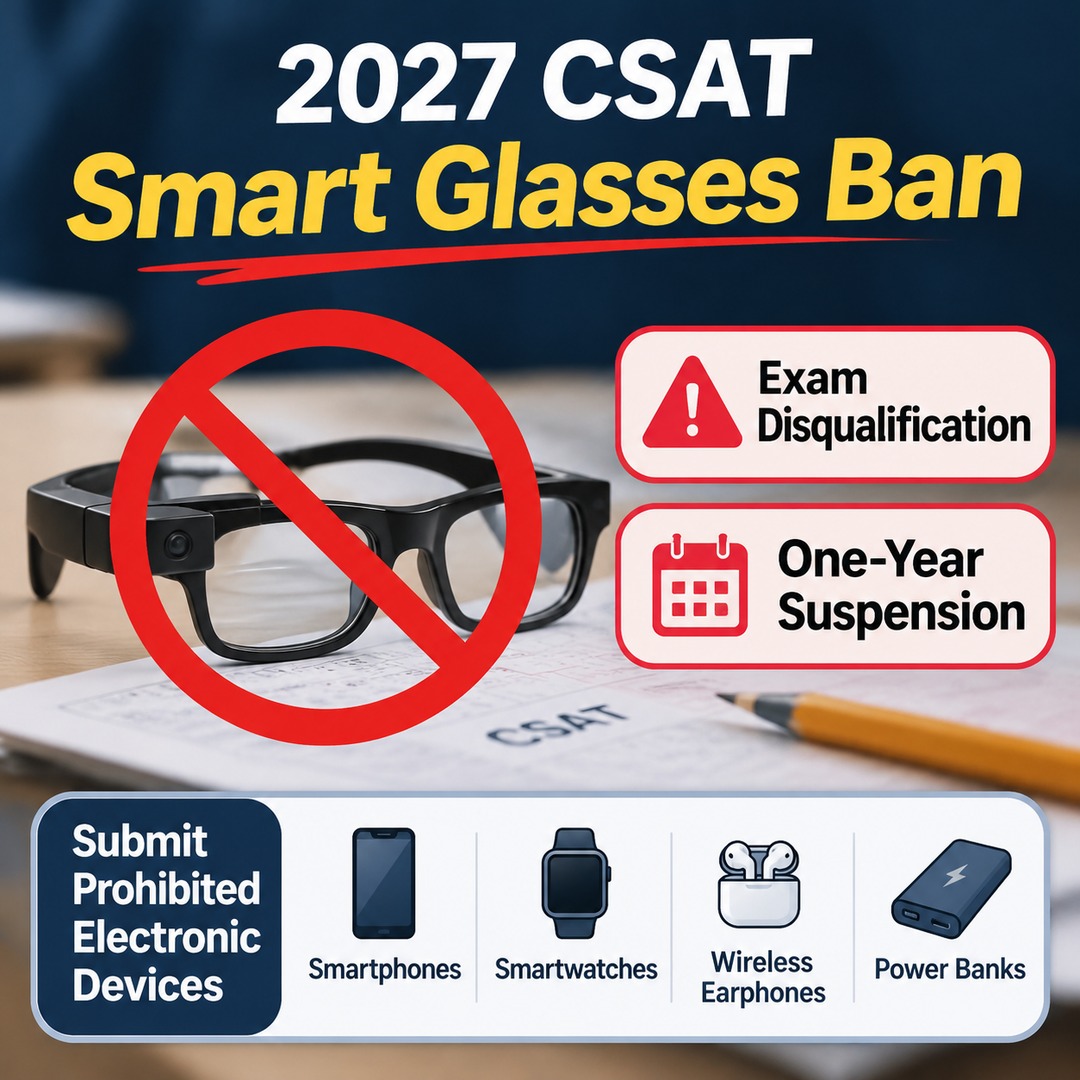
Yes. Wearing AI smart glasses during the examination can result in the current exam being invalidated and the candidate losing eligibility to take the following year's CSAT.
Even if AI smart glasses look like ordinary eyeglasses, they are treated differently because they are electronic devices. Products equipped with electronic functions such as cameras, audio recording, or wireless communication must not be considered equivalent to conventional vision-correction glasses.
The following situations must be distinguished:
Bringing AI smart glasses into the examination center: They are classified as prohibited items.
Wearing smart glasses during the examination: This is subject to serious penalties that may include losing eligibility to take the following year's CSAT.
Wearing ordinary eyeglasses: Conventional vision-correction glasses without electronic functions are treated differently.
Therefore, candidates should not assume that smart glasses are permitted if they are switched off or their camera functions are not used. The safest approach is not to bring them to the examination center at all.
Which Electronic Devices Are Prohibited in CSAT Examination Centers?
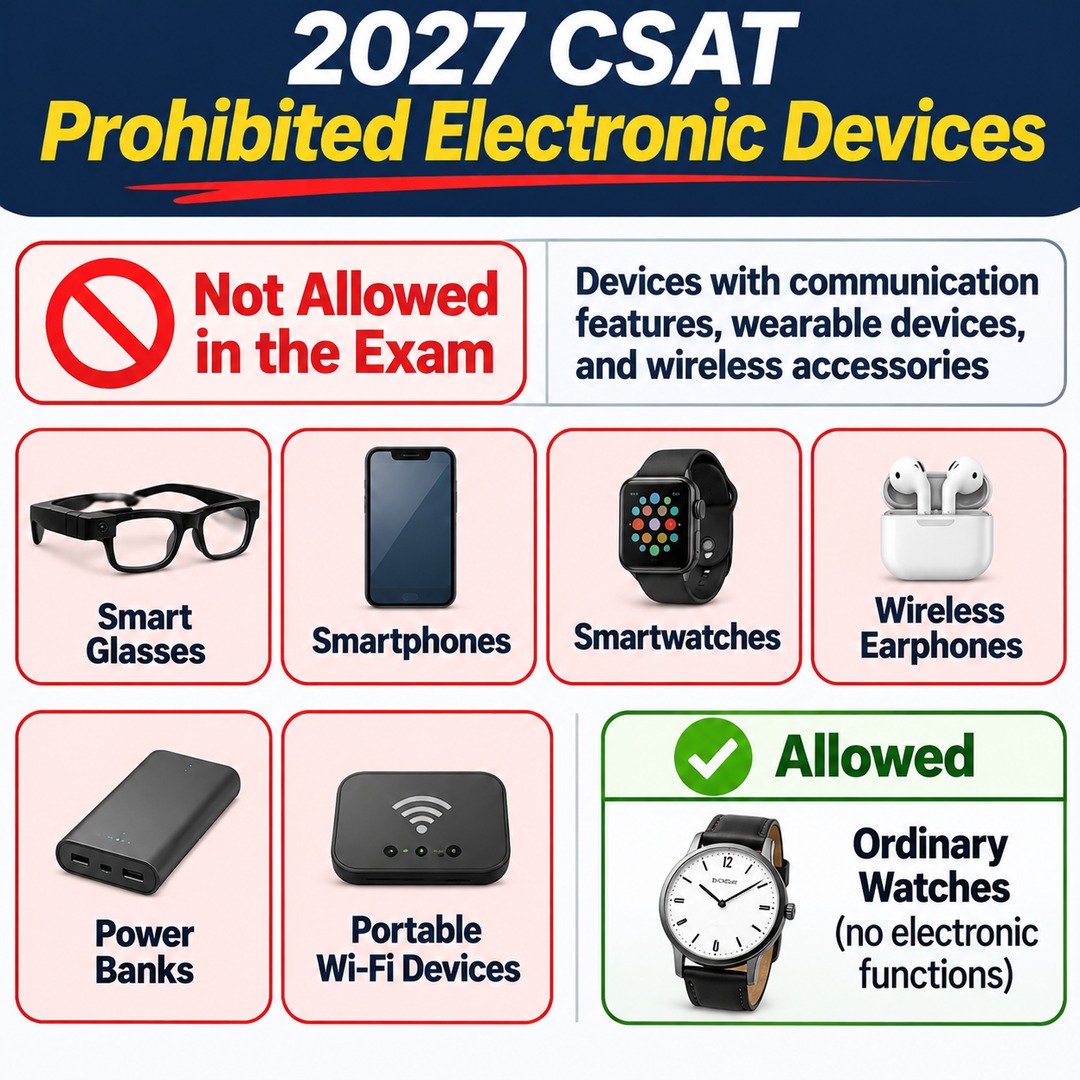
For the 2027 CSAT, various electronic devices are prohibited, not just smart glasses. Candidates must be careful with devices that have communication capabilities, as well as wearable technology and wireless accessories.
| Category | Main prohibited items |
|---|---|
| Communication devices | Mobile phones |
| Wearable devices | Smartwatches, smart bands |
| AI devices | AI smart glasses |
| Audio devices | Bluetooth earphones |
| Other electronic devices | Electronic cigarettes, tablets, etc. |
Candidates should not judge whether an item is permitted based solely on its appearance. Products primarily used as watches, such as smartwatches, may still qualify as electronic devices. Small, inconspicuous accessories such as Bluetooth earphones are also prohibited.
It is important to distinguish ordinary watches permitted during the examination from smartwatches with electronic functions. A device does not become permissible simply because the candidate wears it regularly outside the examination center.
What Should You Do If You Accidentally Bring an Electronic Device?
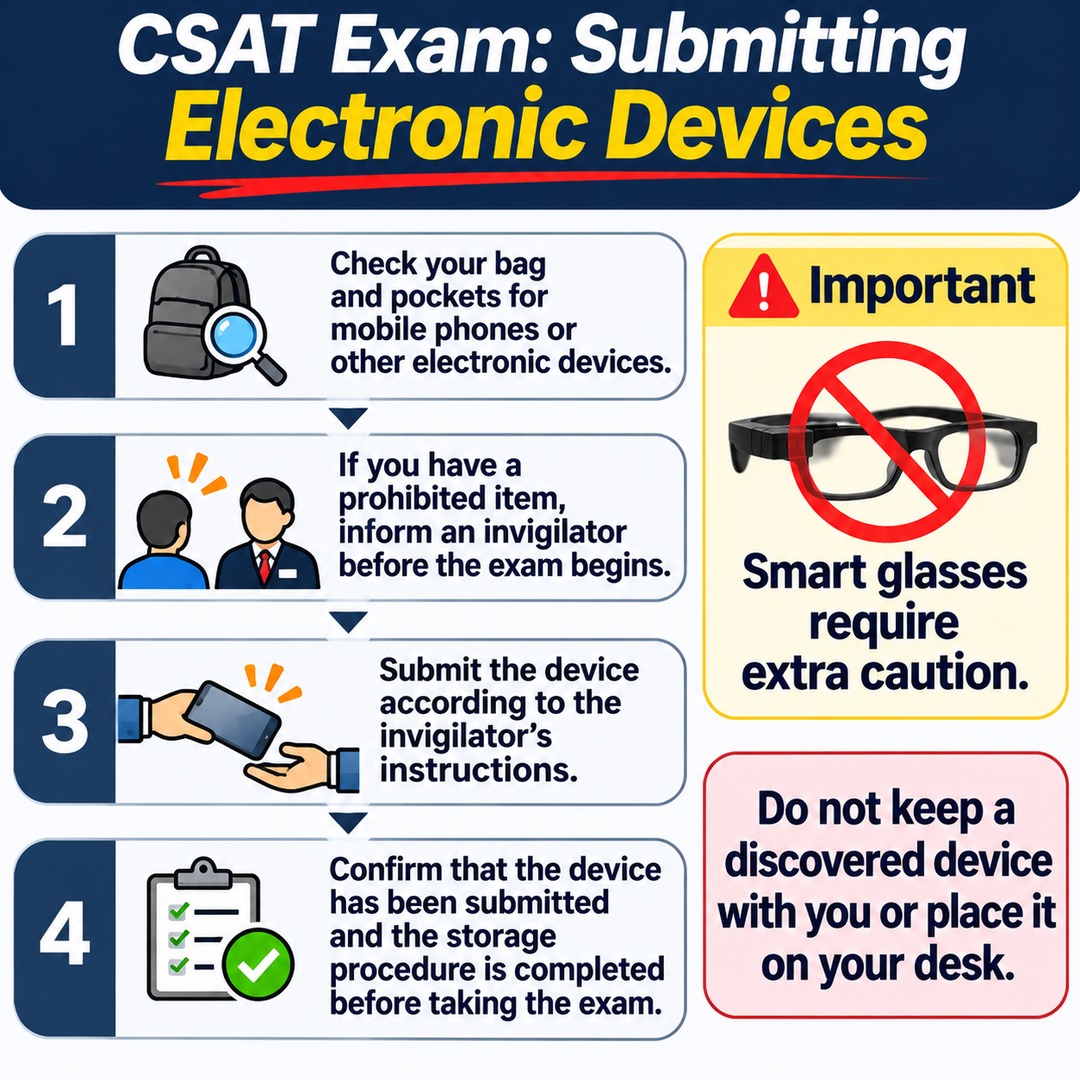
If you accidentally bring an ordinary electronic device, you must submit it to an invigilator before the examination begins. The 2027 CSAT instructions require candidates to follow the submission procedure before the first examination session starts.
If you discover a mobile phone in your bag or pocket after arriving at the examination center, do not keep it with you or put it inside your desk. Instead, immediately inform an invigilator.
Follow these steps:
1. After arriving at the examination center, check whether you have any mobile phones or other electronic devices.
2. If you have brought a prohibited item, inform an invigilator before the first examination session begins.
3. Submit the device according to the invigilator's instructions.
4. Confirm that the device has been submitted and that the storage procedure has been completed before taking the examination.
The consequences are not necessarily identical in every situation simply because a candidate has brought an electronic device. The decision may depend on the type of prohibited item, whether it was submitted, and whether it was possessed or used during the examination.
Smart glasses require particular attention. Because specific penalties apply to wearing them during the examination, candidates must not rely solely on the standard electronic-device submission procedure and enter the examination room wearing them.
What Is the Difference Between Bringing a Prohibited Item and Having an Exam Invalidated?
The prohibition on bringing electronic devices into the examination center does not mean that every device automatically carries the same penalty. The Ministry of Education's guidance distinguishes between the submission procedure for ordinary electronic devices and the penalties associated with wearing smart glasses during the examination.
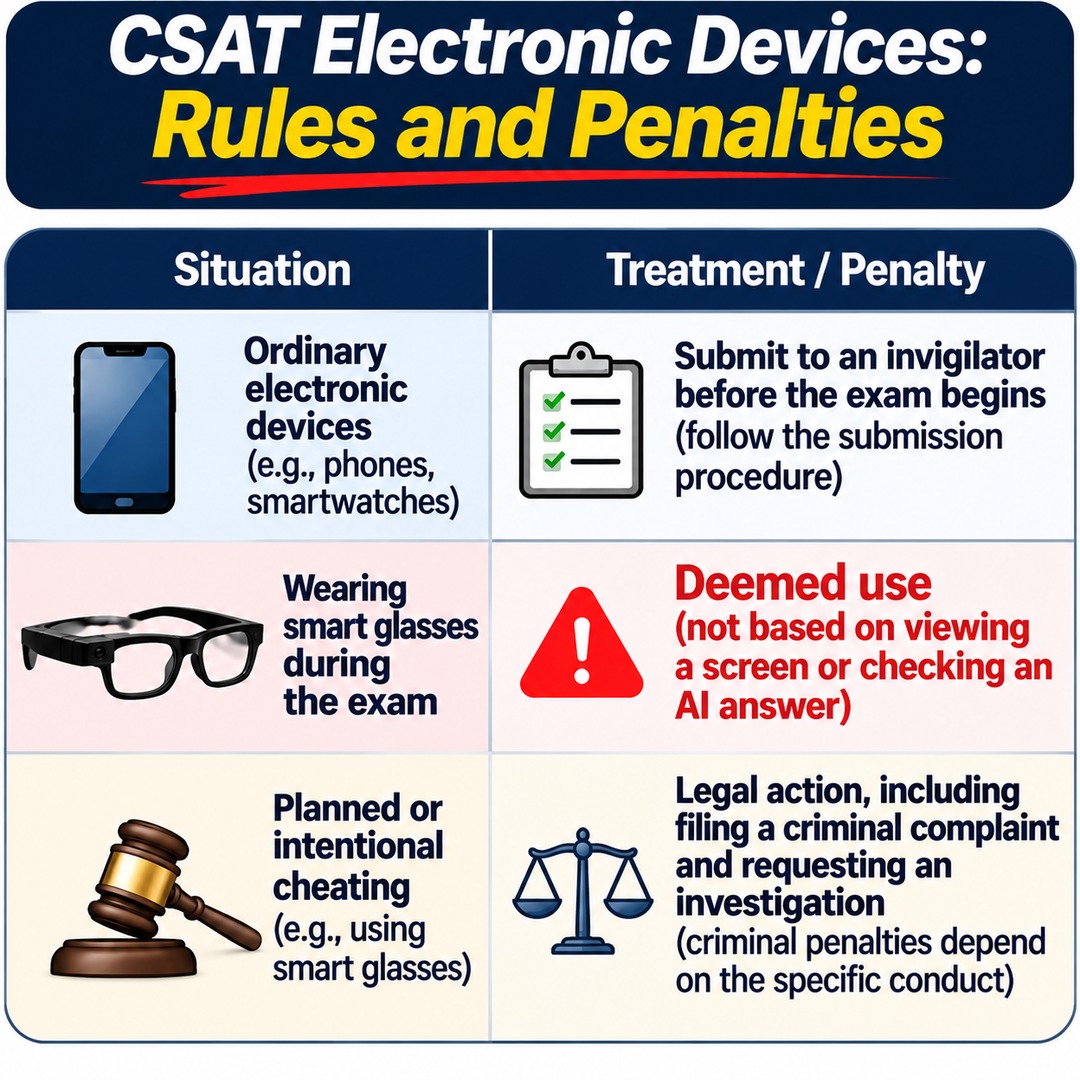
| Situation | Stated treatment |
|---|---|
| Electronic device submitted before the first examination session | Returned after all examination subjects and sessions have ended |
| Candidate fails to submit the device and is caught continuing to possess it | Treated as cheating; the examination is invalidated |
| Smart glasses worn during the examination | Deemed to have been used; the current examination is invalidated and eligibility for the following year's CSAT is revoked for one year |
| Planned or intentional cheating involving smart glasses or similar devices | Legal action, including filing a criminal complaint or requesting an investigation |
|---|
In particular, smart glasses are not judged solely on whether the candidate actually viewed a screen or checked an AI-generated answer. This is because separate guidance specifies that wearing them during the examination is itself deemed use.
The Ministry of Education stated that it would pursue legal action, including filing criminal complaints and requesting investigations, to enable criminal penalties in cases of planned or intentional cheating involving smart glasses and similar devices. However, criminal punishment depends on the specific conduct and applicable legal determinations. This does not mean that every person found possessing smart glasses automatically faces criminal prosecution.
Do Ordinary Eyeglasses or Medical Devices Also Have to Be Submitted?
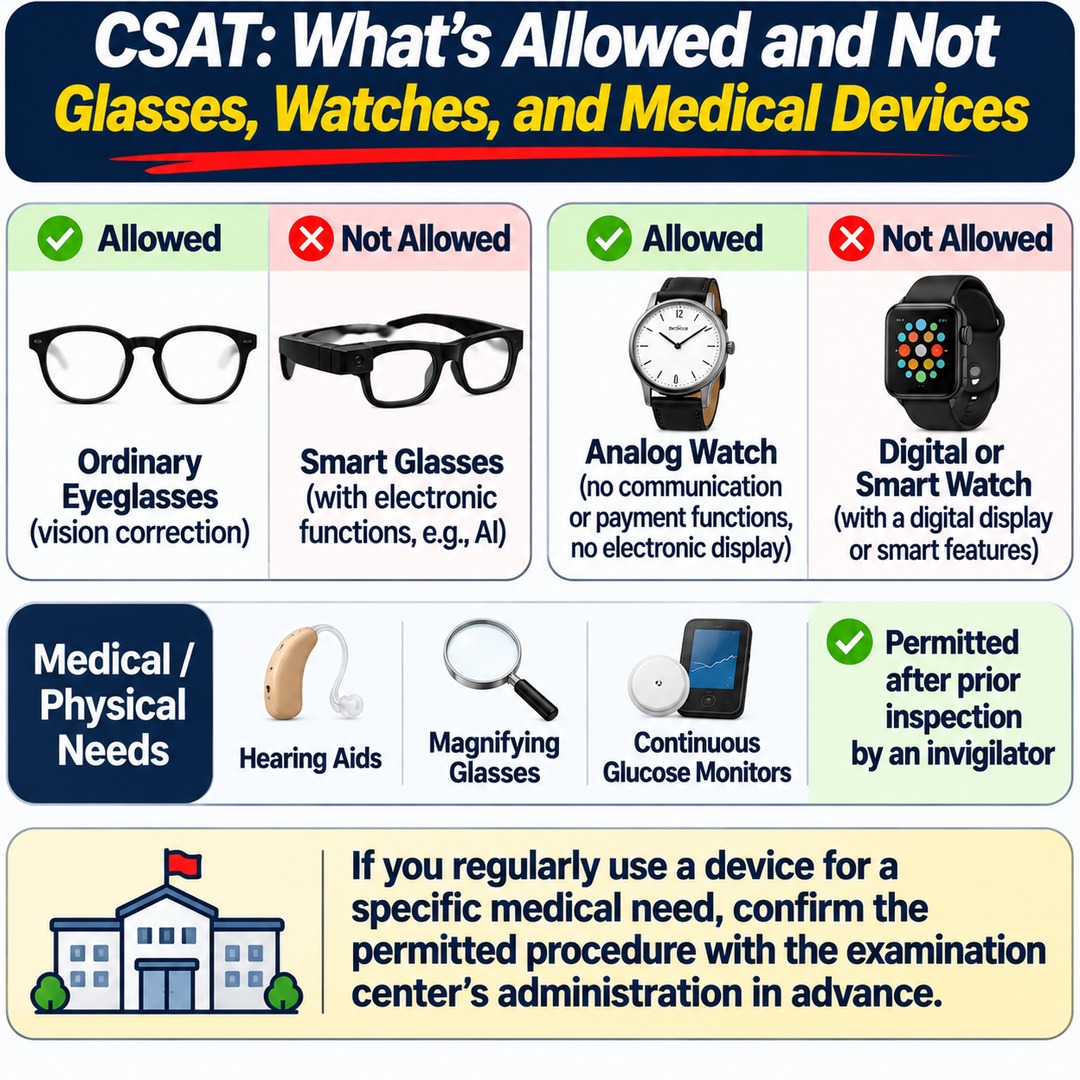
Conventional analog eyeglasses must be distinguished from smart glasses with electronic functions. Wearing ordinary glasses for vision correction is not the same as wearing glasses equipped with AI capabilities.
Separate procedures apply to items required for medical or physical needs. Devices such as hearing aids, magnifying glasses, and continuous glucose monitors may be carried during the examination after prior inspection by an invigilator.
The same distinction applies to watches. The watches permitted during the examination are analog watches without communication or payment functions and without electronic displays. Products with digital displays or smart features should not be treated as ordinary watches.
If a candidate regularly uses a device for a specific medical need, it is safer to confirm the permitted procedure with the examination center's administration before the examination rather than making an independent decision on the day.
What Should You Check the Day Before and on the Day of the CSAT?
It is advisable to check both your bag and your clothing pockets the day before the examination. Items you routinely carry without thinking, such as smartwatches, wireless earphones, and power banks, may be prohibited inside the examination center.
Separate your examination-day belongings into the following categories.
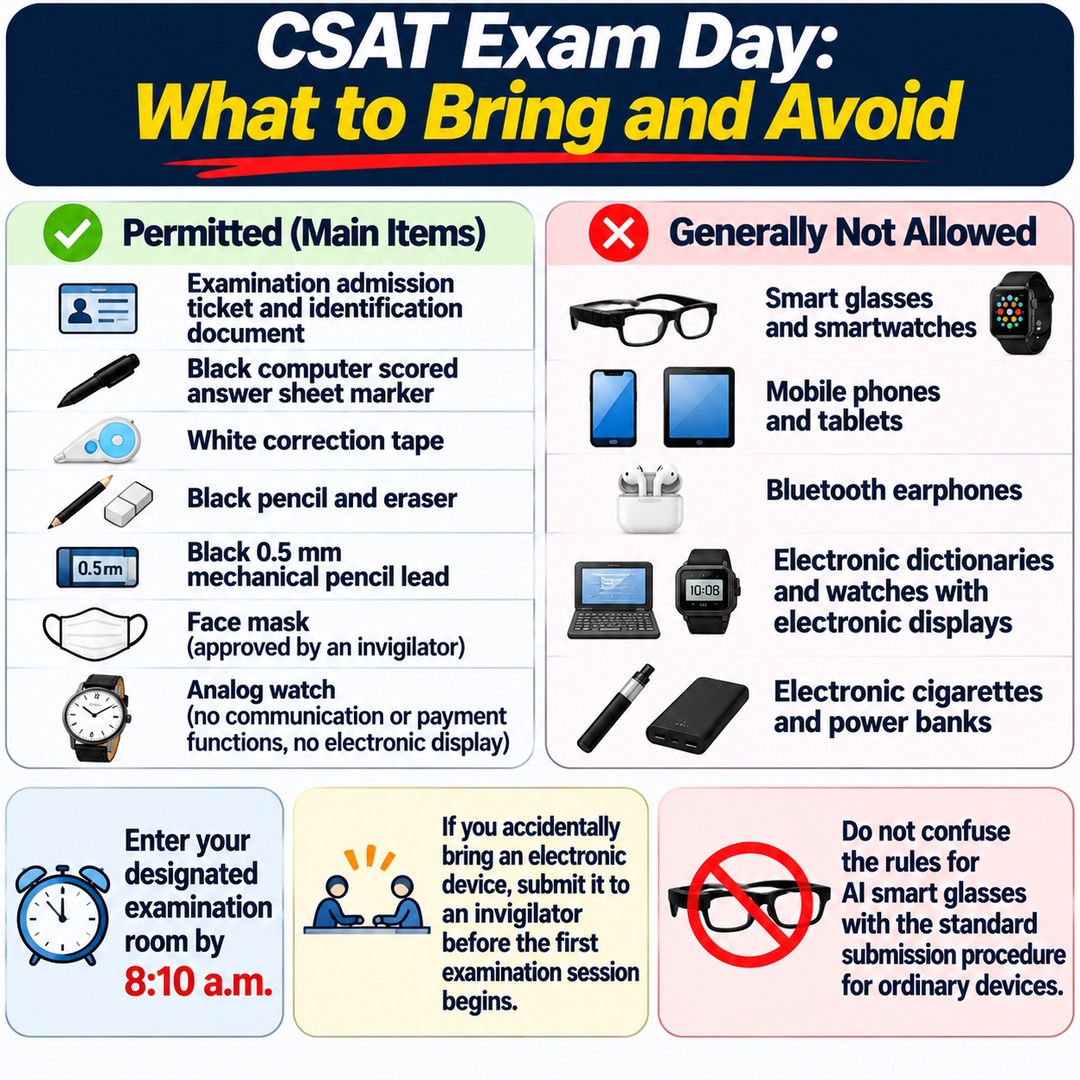
Main items permitted during the examination:
Examination admission ticket and identification document
Black computer-scored answer sheet marker
White correction tape
Black pencil and eraser
Black 0.5 mm mechanical pencil lead
Face mask approved by an invigilator
Analog watch without communication or payment functions or an electronic display
Items that should generally not be brought into the examination center:
Smart glasses and smartwatches
Mobile phones and tablets
Bluetooth earphones
Electronic dictionaries and watches with electronic displays
Electronic cigarettes and power banks
Candidates must enter their designated examination rooms by 8:10 a.m. If they accidentally bring an electronic device, they must submit it to an invigilator before the first examination session begins. If they continue to possess a prohibited device without submitting it and are caught, they may be treated as having committed an act of cheating.
If you are unsure whether an item is permitted, it is better to leave it at home rather than bring it for convenience. In particular, do not confuse the rules for AI smart glasses with the standard submission procedure for ordinary electronic devices.
Exactly How Long Does the Suspension of Eligibility for the Following Year's CSAT Last?
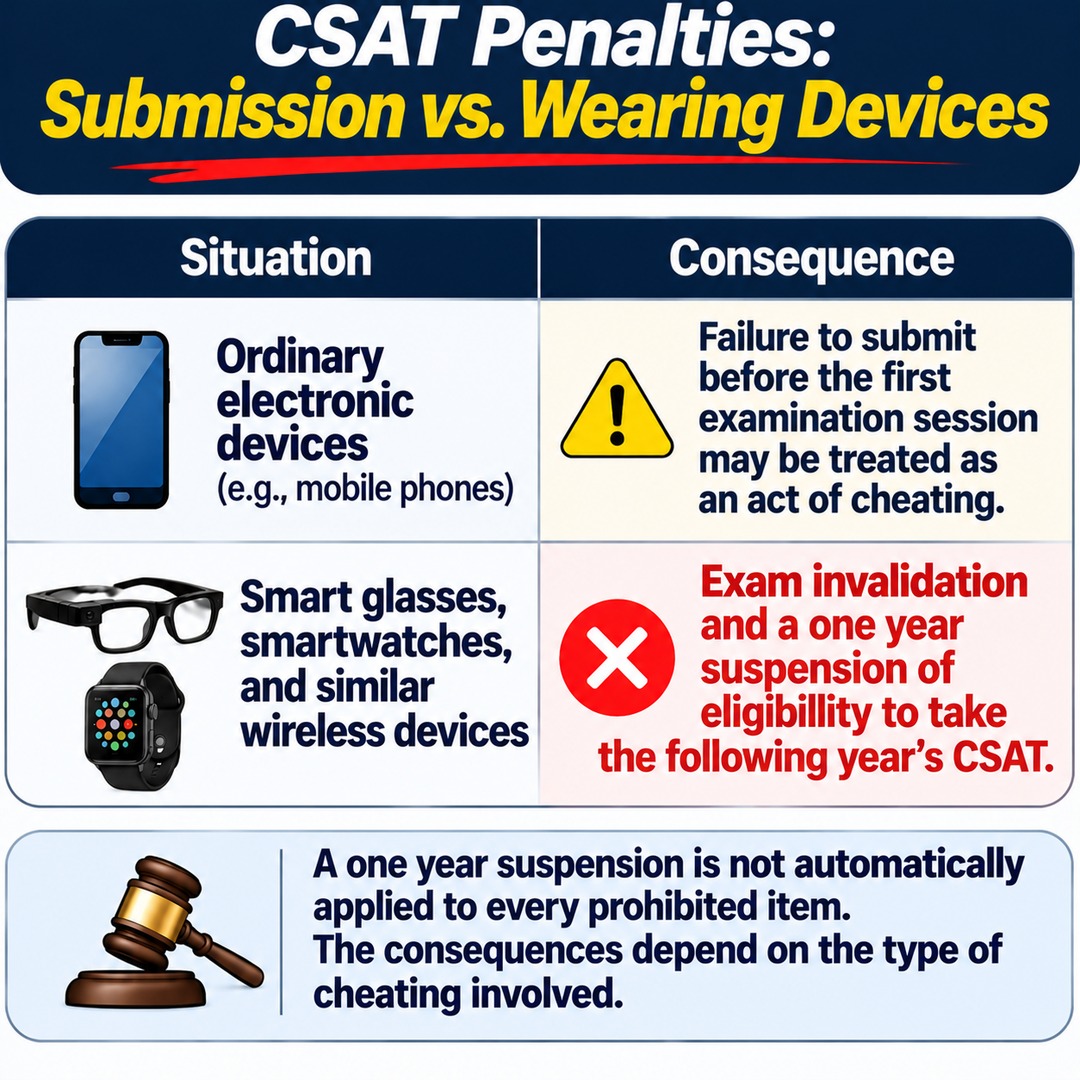
Wearing smart glasses or similar wireless devices during the examination is subject to invalidation of the current examination and a one-year suspension of eligibility to take the following year's CSAT.
An important distinction applies here. The penalties differ between accidentally bringing an electronic device and submitting it before the first examination session, and failing to submit it and wearing smart glasses or a smartwatch during the examination.
Ordinary electronic devices: Failure to submit them before the first examination session may result in treatment as an act of cheating.
Smart glasses, smartwatches, and similar wireless devices: Wearing them during the examination without submitting them is subject to invalidation of the current examination and a one-year suspension of eligibility for the following year's CSAT.
Planned or intentional cheating involving smart devices: This may also be subject to separate legal action, including criminal complaints and requests for investigation.
A suspension of eligibility for the following year's CSAT is not a penalty automatically applied to every prohibited item. The consequences depend on the type of cheating involved, so ordinary possession of an electronic device must be distinguished from cheating involving wireless devices.