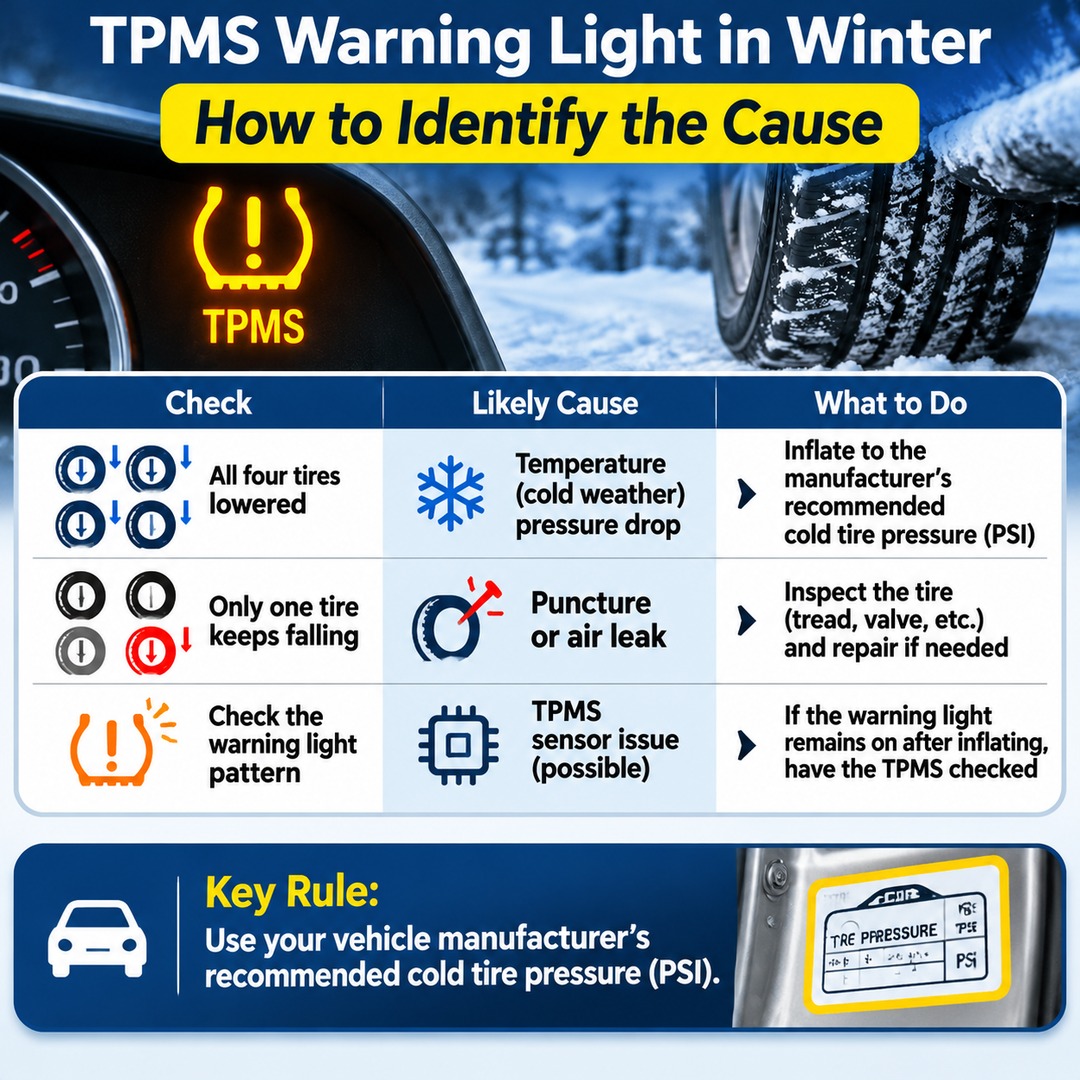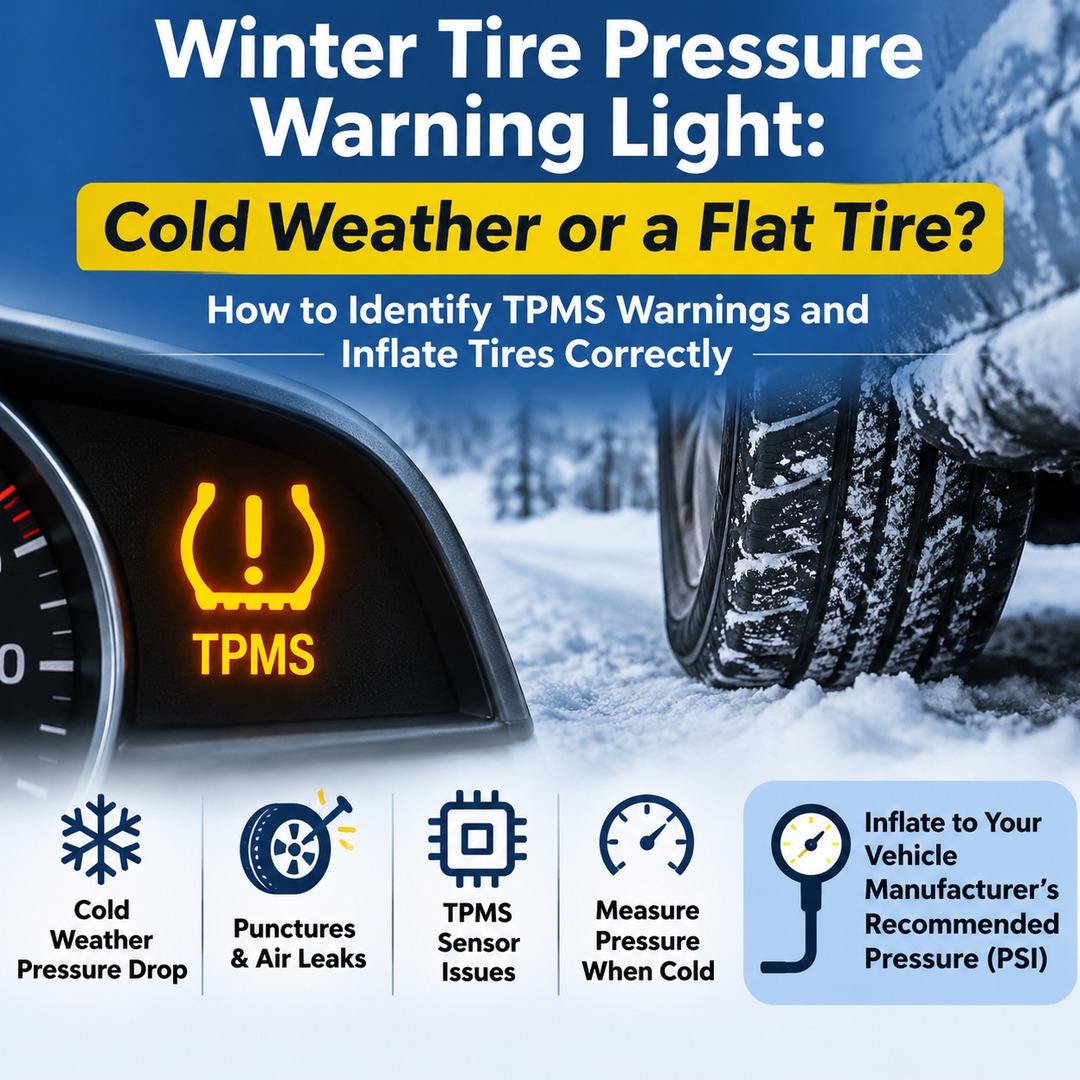
If your tire pressure warning light comes on during a winter morning, the drop in temperature may have caused your tire pressure to decrease. However, if the pressure in just one tire keeps falling, you should also suspect a puncture or air leak. Inflate your tires according to the cold tire pressure recommended by your vehicle manufacturer, and check the warning light's behavior to identify the likely cause accurately.
A warning light that appears in cold weather should not automatically be considered normal. Checking the pressure changes across all four tires, the individual readings, and the warning light's illumination pattern can help you determine what to do next.
Why Does the Tire Pressure Warning Light Come On When Temperatures Drop?
When temperatures fall, the temperature and pressure of the air inside your tires also decrease. Even tires that were properly inflated during summer or autumn may fall below the recommended pressure on a cold winter morning.
This is where the TPMS (Tire Pressure Monitoring System) comes in. Sensors installed at the wheels monitor tire pressure and display a warning on the instrument panel when the pressure falls below a specified threshold.
The 2026 Hyundai owner's manual also explains that the low tire pressure warning light may come on again when temperatures drop, even after the tires have been adjusted to the recommended pressure. This can happen because of temperature-related pressure loss and does not, by itself, indicate a TPMS malfunction.
The important distinction is between temperature-related pressure changes and actual air leakage. If all four tires have lost pressure in a similar pattern, temperature may be a contributing factor. However, if one tire is significantly lower than the others or repeatedly loses pressure after inflation, it needs further inspection.
If All Four Tires Lose Pressure, Is It Just a Normal Temperature Change?
If all four tires show similarly reduced pressure, the change may be related to falling temperatures. By contrast, if only one tire has significantly lower pressure, check for damage caused by nails or screws, as well as air leaks around the valve.
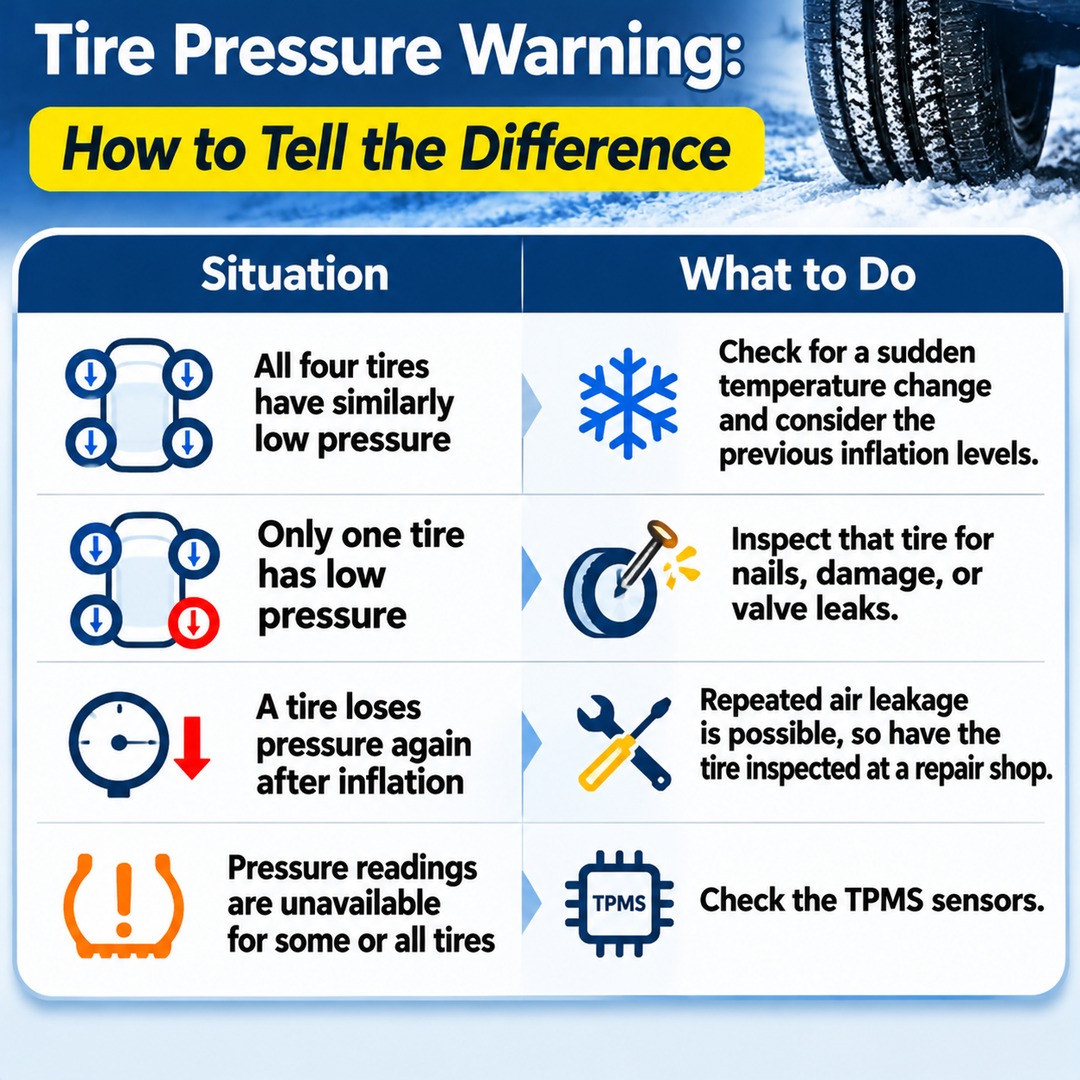
The following distinctions can help:
All four tires have similarly low pressure: Check for a sudden temperature change and consider the previous inflation levels.
Only one tire has low pressure: Inspect that tire for nails, damage, or valve leaks.
One tire loses pressure again after inflation: Repeated air leakage is possible, so have the tire inspected at a repair shop.
Pressure readings are unavailable for some or all tires: Check the TPMS sensors and communication status.
Tires can also lose air naturally over time. Therefore, the fact that all four tires have similar pressure readings does not automatically mean they are all in good condition.
In particular, sudden damage caused by nails or road debris may not be detected immediately by the TPMS. If the vehicle feels unstable or the steering behaves differently while driving, do not rely solely on the pressure readings. Stop in a safe location and inspect the tires.
How Many PSI Should You Put in Your Tires During Winter?
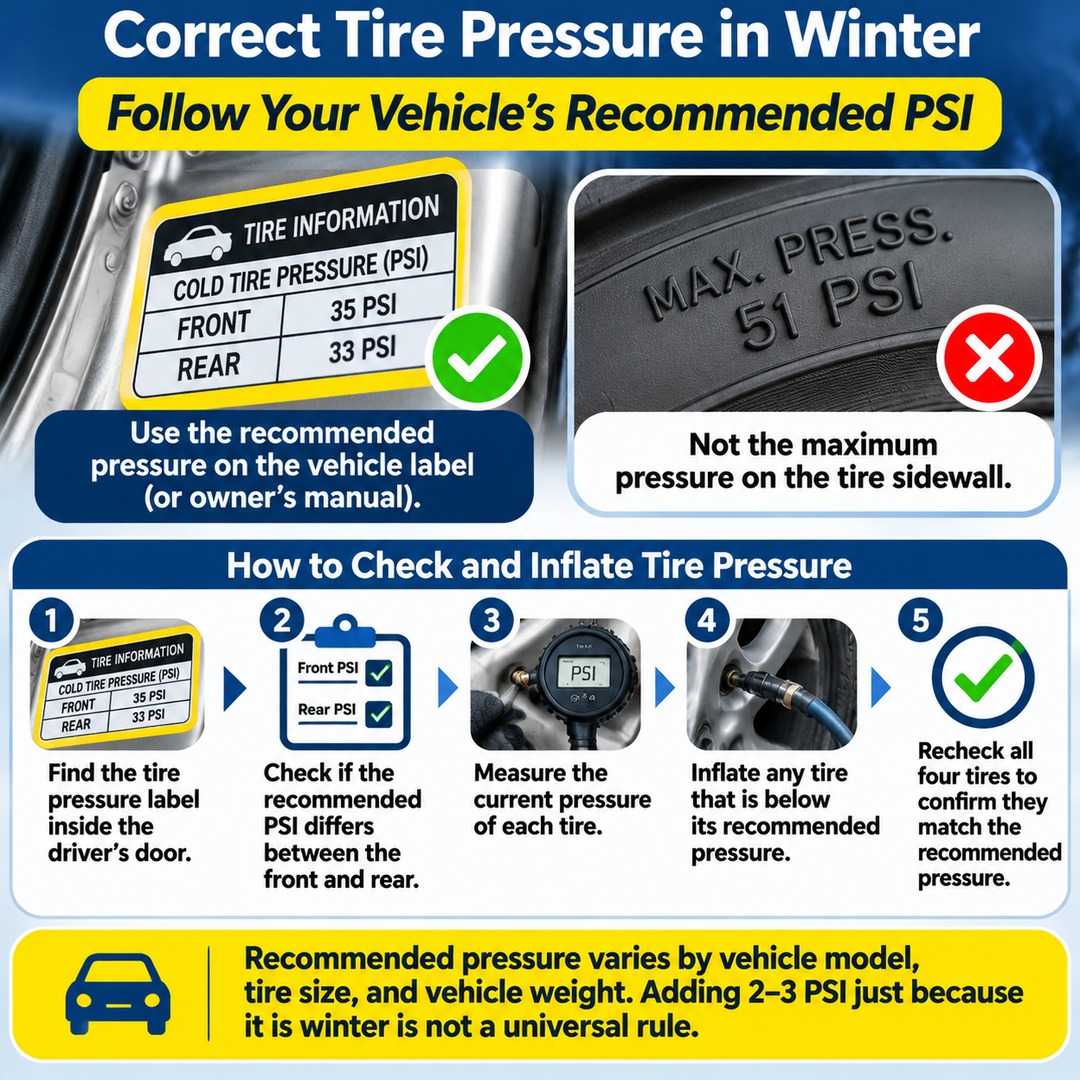
The correct pressure depends on the vehicle. Use the cold tire pressure specified on the tire information label, usually located inside the driver's door, or in the vehicle owner's manual.
Recommended pressure varies according to the vehicle model, tire size, and vehicle weight. Therefore, adding an extra 2–3 PSI to every vehicle simply because it is winter is not an appropriate universal rule.
Follow these steps when checking tire pressure:
1. Find the tire pressure label inside the driver's door.
2. Check whether the recommended PSI differs between the front and rear tires.
3. Measure the current pressure of each tire.
4. Inflate any tire that is below its recommended pressure.
5. Recheck all four tires to confirm that each one matches its recommended pressure.
Be careful not to confuse the maximum pressure printed on the tire sidewall with the vehicle's recommended tire pressure. The actual inflation target is the pressure specified by the vehicle manufacturer.
When Should You Measure Tire Pressure for an Accurate Reading?
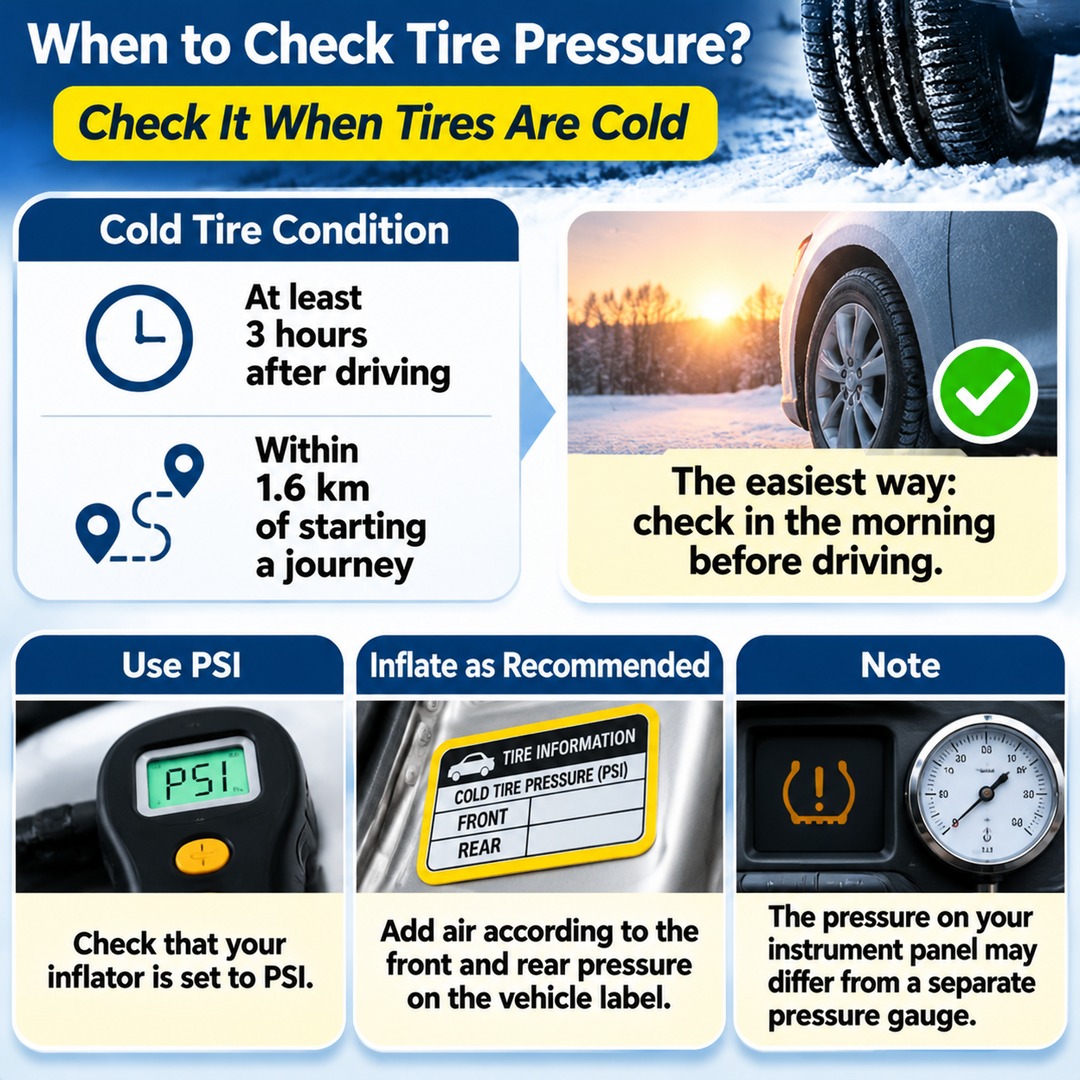
Measure tire pressure when the tires are sufficiently cool, a condition known as cold tire status. Immediately after driving, the temperature inside the tires rises, changing the pressure reading. If you release air based on this reading, the pressure may become too low once the tires cool down.
Hyundai's 2026 owner's manual describes cold tire conditions as follows:
At least three hours after driving has ended.
Within 1.6 km of starting a journey.
Therefore, the simplest approach is to check your tire pressure in the morning before moving the vehicle.
Check that your inflator is set to PSI, then add air according to the front and rear pressure recommendations on the vehicle label. If you measure the pressure immediately after driving, avoid releasing air based solely on that reading.
Another point to remember is that the pressure displayed on the vehicle's instrument panel may differ from the reading obtained with a separate pressure gauge. Hyundai's owner's manual also notes that differences between these measurements can occur.
How Can You Distinguish a Tire Pressure Warning from a TPMS Malfunction?
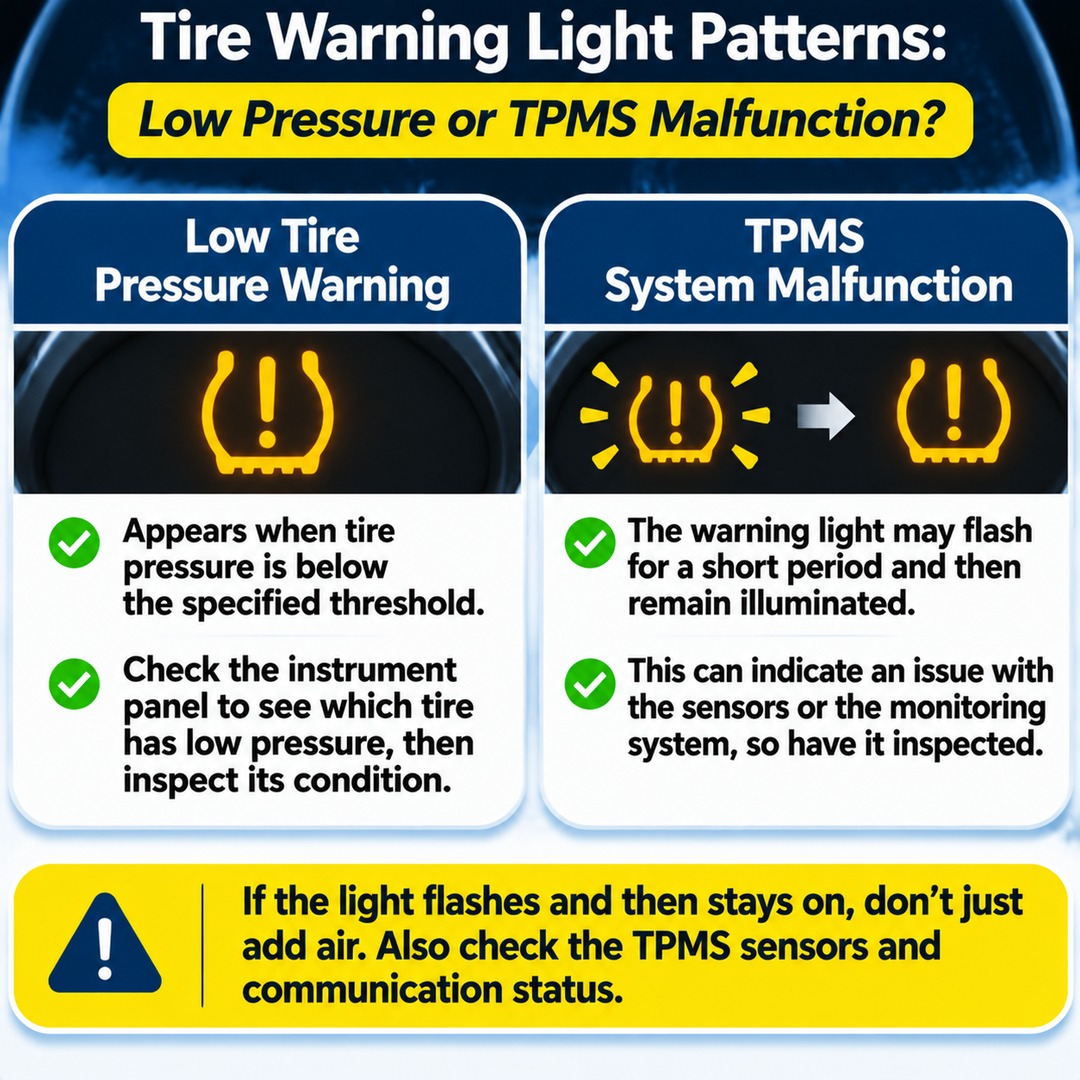
The two situations may be indicated by different warning light patterns on the instrument panel. A normal low-pressure warning generally appears as an illuminated warning light, while a TPMS system malfunction may be indicated by a light that flashes for a certain period before remaining illuminated.
Low Tire Pressure Warning
This warning appears when tire pressure falls below the specified threshold. Check the instrument panel to identify which tire has low pressure, then inspect its condition.
TPMS System Malfunction
In some vehicles, the warning light flashes for approximately one minute before remaining illuminated. This may indicate that the sensors or the monitoring system need inspection.
The warning duration varies by vehicle. Some Kia owner's manuals describe a warning light that flashes for approximately one minute before staying on, while KG Mobility's owner's manuals describe a pattern in which the light flashes for approximately 70 seconds before remaining illuminated.
These timings should not be treated as universal rules for every vehicle.
Kia's owner's manual also explains that if one sensor has failed and the pressure in another tire becomes low, the system may not correctly display which tire has low pressure.
If the warning light flashes and then stays on, do not simply add air and assume the problem is solved. The sensors and communication status should also be checked.
What If the Warning Light Stays On After Inflating the Tires?
If the warning light does not turn off immediately after inflation, that does not necessarily mean the sensor is faulty. Depending on the vehicle, the system may need to detect the updated pressure readings while driving or complete a display refresh process.
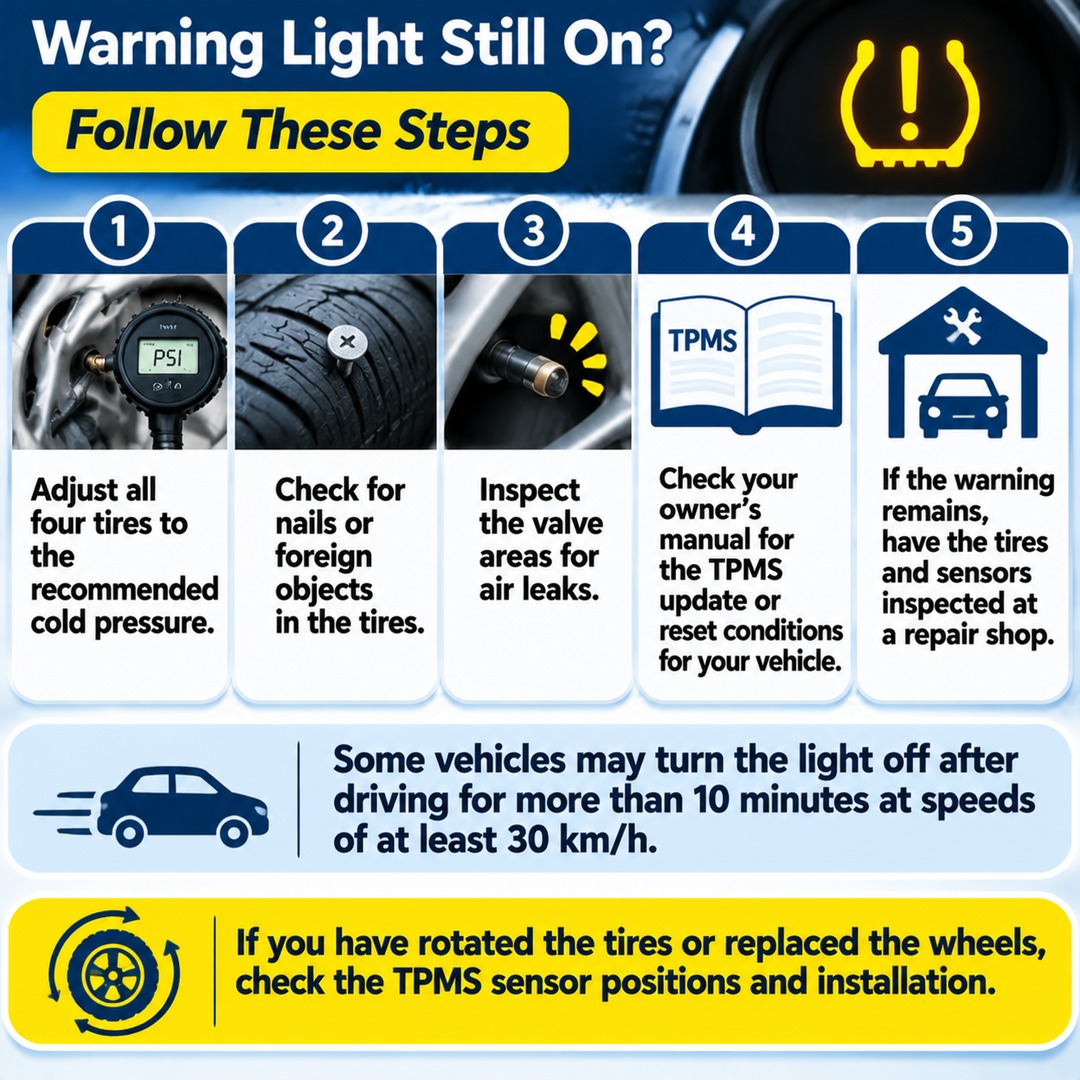
Follow these steps:
1. Adjust all four tires to the recommended cold pressure.
2. Check whether any nails or foreign objects are embedded in the tires.
3. Inspect the valve areas for air leaks.
4. Check the owner's manual for the TPMS update or reset conditions specified for your vehicle.
5. If the warning remains, have the tires and sensors inspected at a repair shop.
The owner's manuals for some KG Mobility vehicles advise drivers to visit a service center if the warning light remains on after checking tire pressure, starting the engine, and driving for more than 10 minutes at speeds of at least 30 km/h.
These time and speed requirements apply to the vehicles covered by those manuals and should not automatically be applied to other models.
If you have recently rotated the tires or replaced the wheels, the TPMS sensor positions and installation should also be checked. Installing wheels without sensors or damaging an existing sensor can also trigger a system malfunction warning.
Is It Safe to Keep Driving When the Tire Pressure Warning Light Is On?
Avoid driving for extended periods with underinflated tires. Insufficient tire pressure can cause overheating and tire damage, and may also affect vehicle handling and braking.
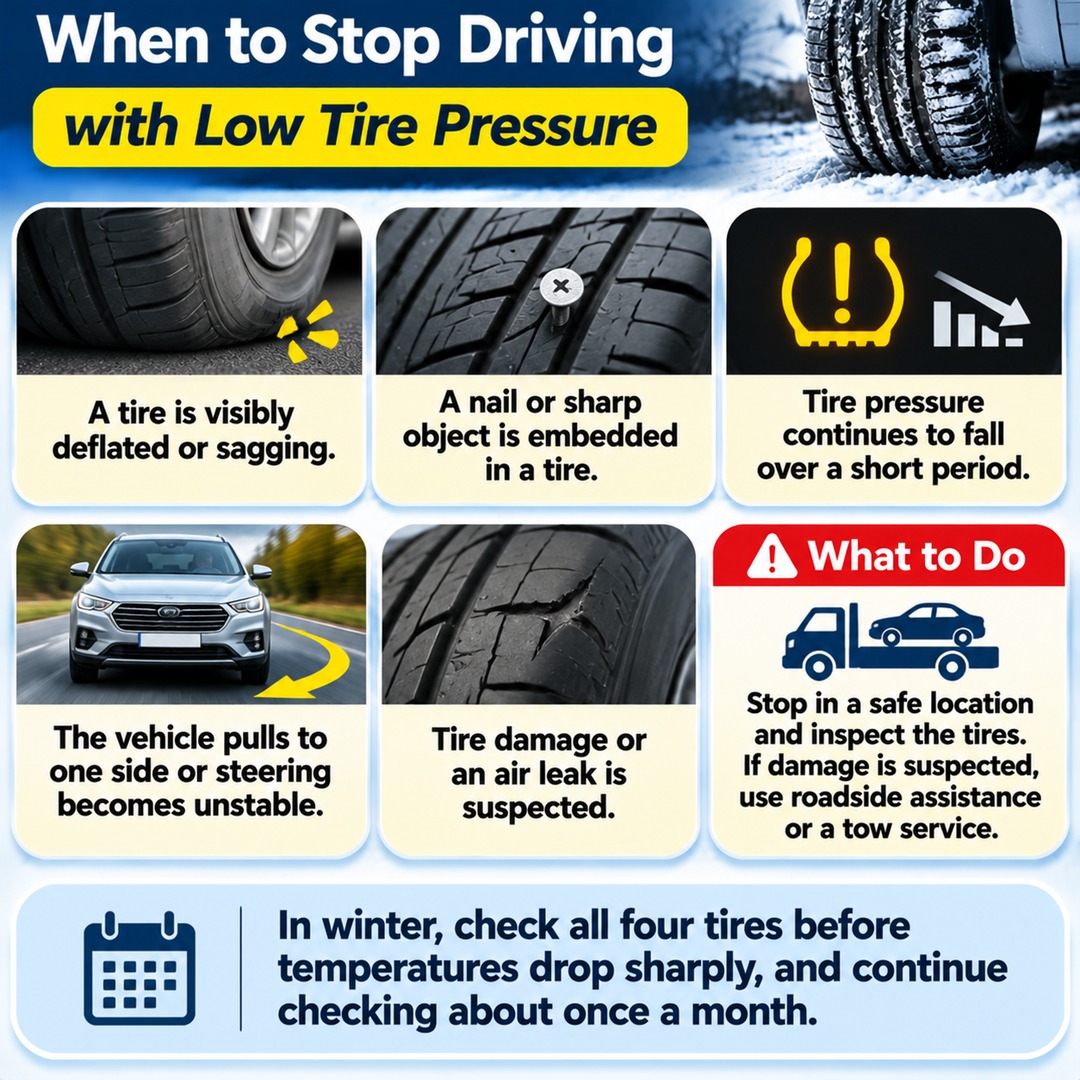
It is particularly important to avoid continuing your journey in the following situations:
A tire is visibly deflated or sagging.
A nail or sharp object is embedded in a tire.
Tire pressure continues to fall over a short period.
The vehicle pulls to one side or steering becomes unstable while driving.
Tire damage or an air leak is suspected.
In these situations, stop in a safe location and inspect the tires. If damage is suspected, do not attempt to drive all the way to a repair shop. It is safer to use roadside assistance or a towing service.
During winter, it is helpful to check the pressure in all four tires before temperatures drop sharply and continue checking it regularly, approximately once a month.
Frequently Asked Questions About Winter Tire Pressure
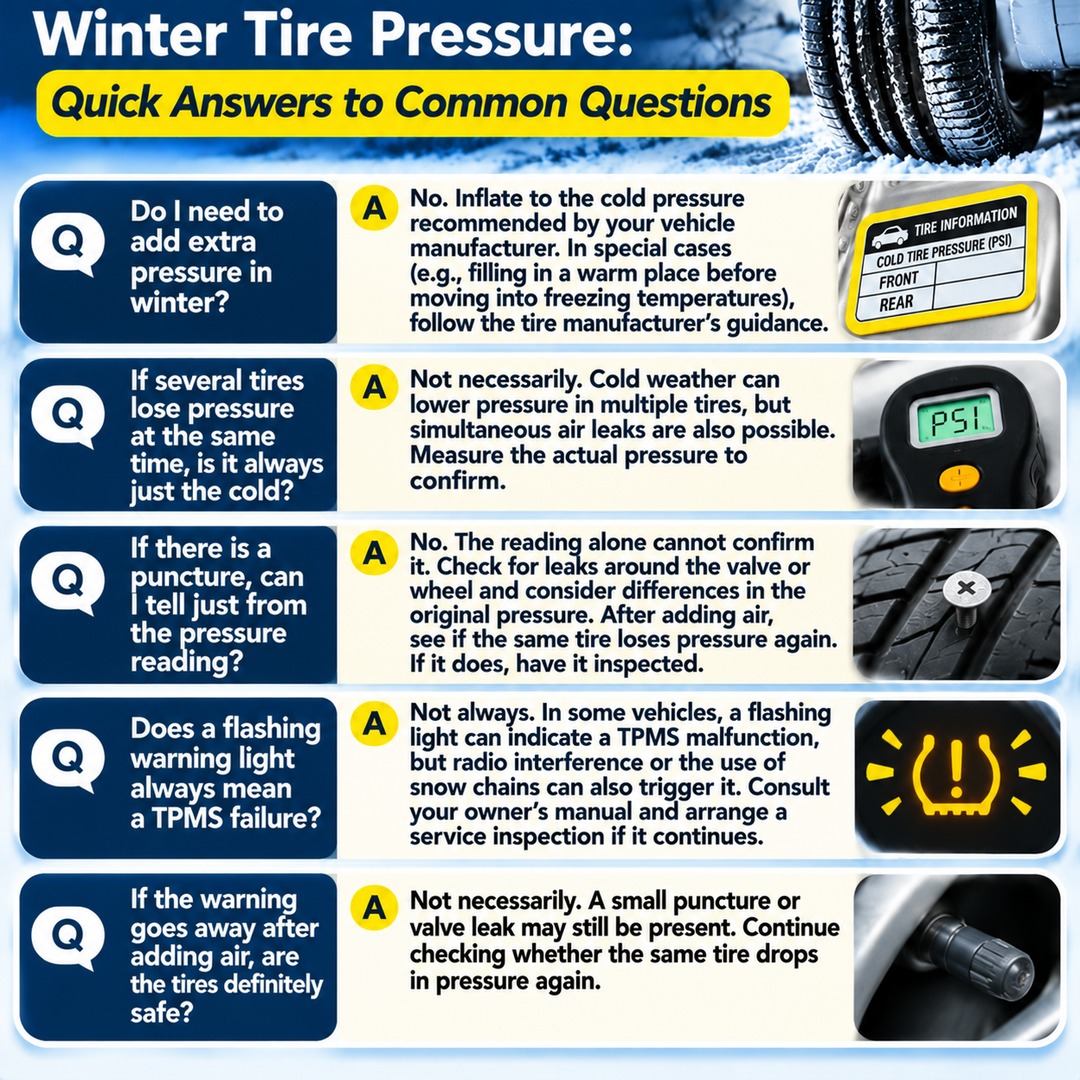
Should I Inflate My Tires More in Winter Than in Summer?
You do not need to add a predetermined amount of extra pressure simply because it is winter. Inflate your tires according to the cold pressure recommended by your vehicle manufacturer. In special situations, such as inflating tires in a warm indoor environment before moving the vehicle outside into freezing temperatures, separate temperature-adjustment guidance may apply. Check the relevant tire manufacturer's instructions as well.
If All Four Tires Trigger a Warning, Does That Mean There Is No Puncture?
Not necessarily. Falling temperatures can reduce the pressure in several tires simultaneously, but simultaneous air leaks in multiple tires cannot be ruled out. Measure the actual pressure to determine what is happening.
Does Low Pressure in Just One Tire Mean It Has a Puncture?
A puncture is possible, but the pressure reading alone cannot confirm it. Check for leaks around the valve or wheel as well as differences in the original inflation levels. After adding air, monitor whether the same tire loses pressure again. If it does, have it inspected.
Does a Flashing TPMS Warning Light Always Mean a Sensor Is Faulty?
In some vehicles, a flashing warning light indicates a TPMS system malfunction. However, radio interference or the installation of snow chains may also cause the warning. Consult your vehicle's owner's manual, and arrange a service inspection if the warning persists.
If the Tire Pressure Warning Light Turns Off, Does That Mean There Is No Puncture?
No. Even if the warning disappears after you add air, a small puncture or valve leak may still be present. Continue checking whether the pressure in the same tire drops again.
A winter tire pressure warning light may come on because of falling temperatures, but the disappearance of the warning alone does not establish that the tires are safe. The most important steps are to check the actual PSI in all four tires when they are cold in the morning and monitor whether one particular tire repeatedly loses pressure.