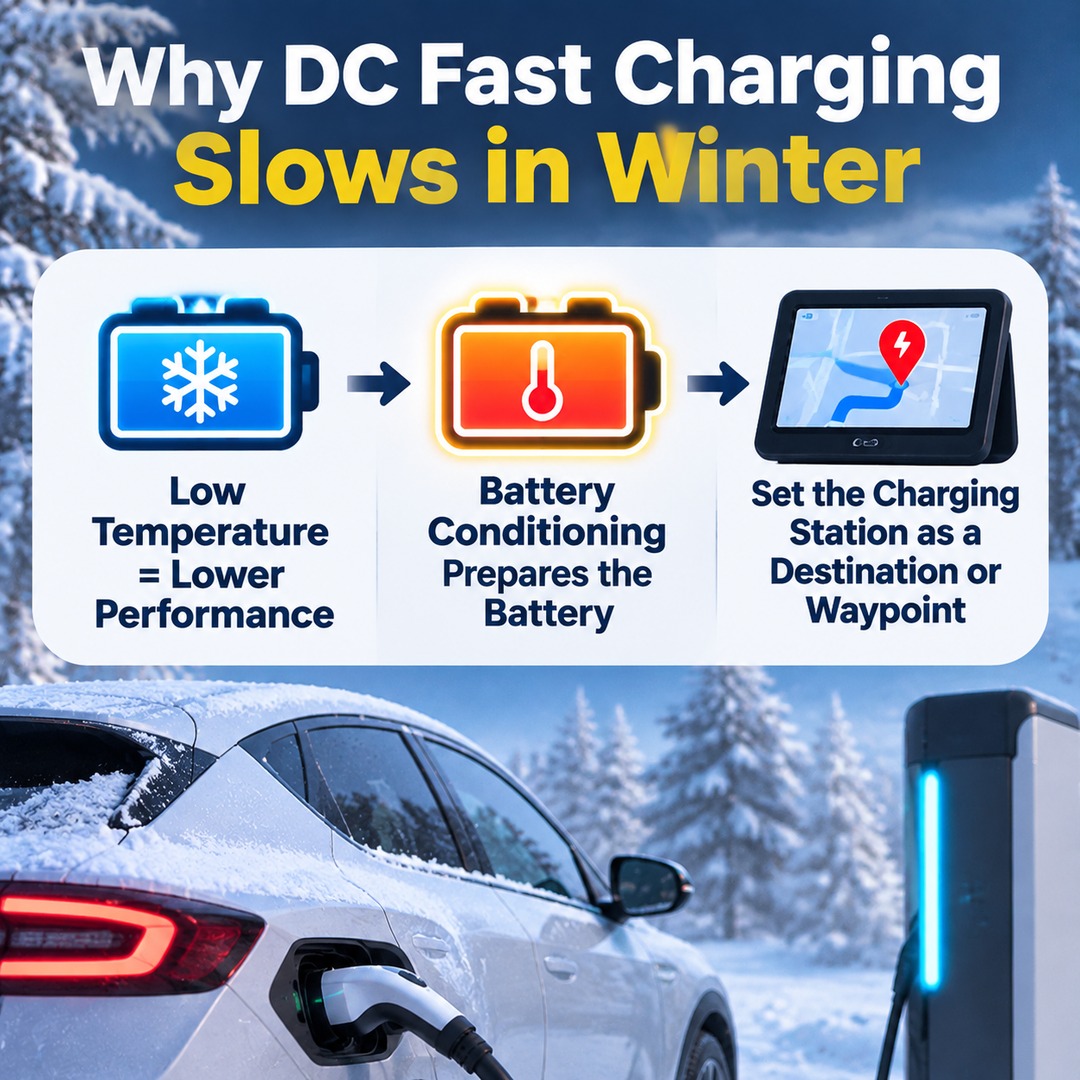
One of the main reasons DC fast charging slows down in winter is that low temperatures reduce battery performance. Vehicles equipped with battery conditioning, including Hyundai IONIQ models and the Kia EV6, can prepare the battery to reach a suitable temperature before arriving at a fast-charging station. The recommended approach is to set the charging station as a destination or waypoint in the vehicle's navigation system before departure. However, the feature may not operate depending on whether the vehicle has a battery heater and how much charge remains.
Why Does DC Fast Charging Take Longer in Winter?
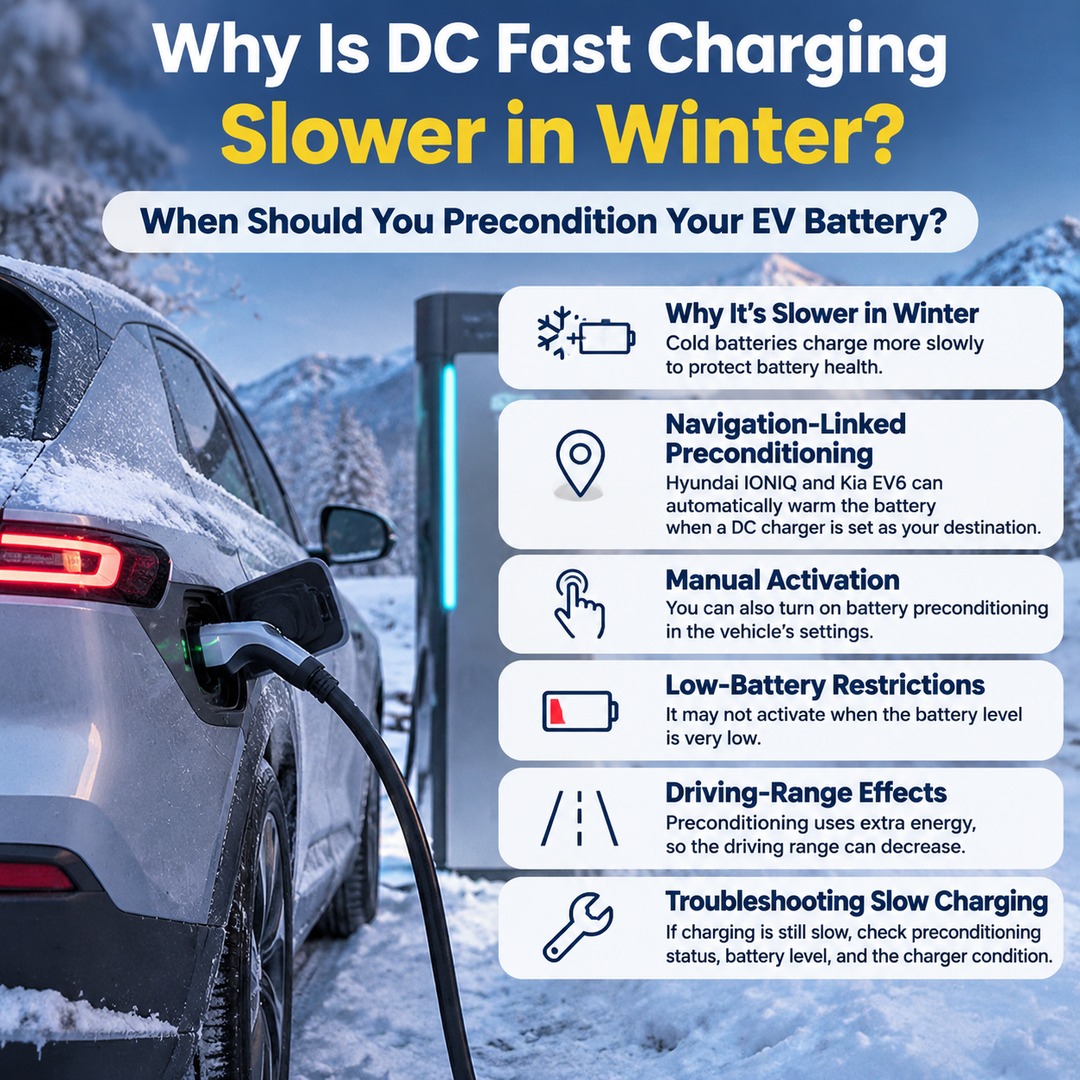
When battery temperatures drop in winter, DC fast-charging performance can decrease. Electric vehicles adjust charging power according to battery temperature and condition, so the maximum output displayed on a charging station is not necessarily the power the vehicle will receive.
Battery conditioning is a feature that regulates the temperature of the high-voltage traction battery to prepare it for these conditions.
You may notice a significant difference in charging speed, particularly after leaving a vehicle parked outdoors for an extended period or arriving at a highway rest-stop fast charger with a cold battery.
An important distinction is that a charger's rated output and the actual charging power accepted by a vehicle are not the same.
For example, even when using a 350 kW charger, actual charging speed varies depending on the vehicle's battery temperature and condition, as well as the charger's specifications.
Kia's EV owner's manuals also explain that charging times can vary depending on battery condition and age, charger specifications, and ambient temperature.
Therefore, slow charging in winter does not automatically indicate a faulty charger or a battery problem.
How Long Before DC Fast Charging Should You Precondition the Battery?
It is better to prepare the battery when planning a fast-charging stop rather than waiting until you arrive at the charger. However, there is no single preconditioning time that applies to every vehicle.
Hyundai and Kia owner's manuals describe using navigation-linked battery conditioning to adjust battery temperature in preparation for arrival at a charging station.
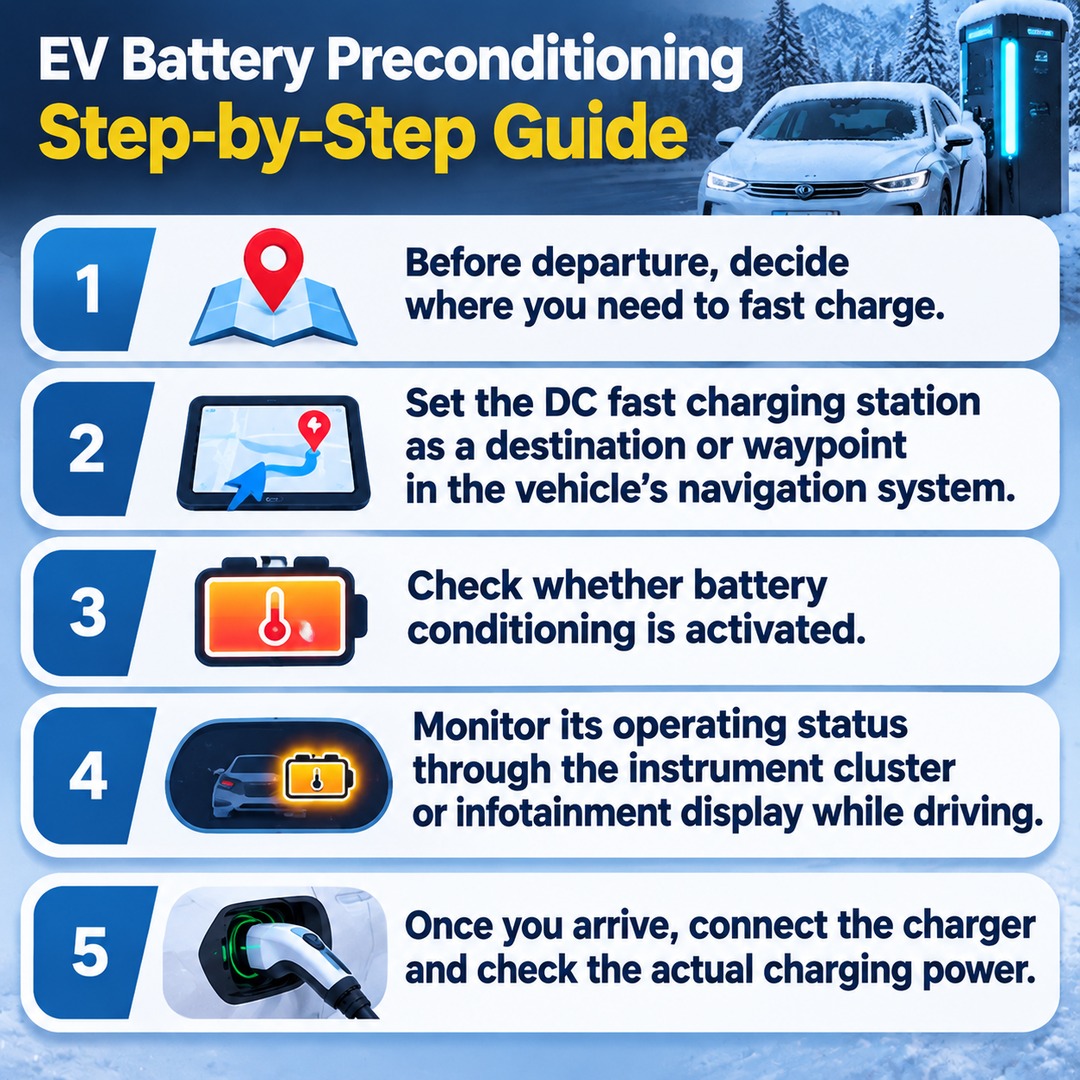
In practice, follow these steps:
1. Before departure, decide where you need to fast-charge.
2. Set the DC fast-charging station as a destination or waypoint in the vehicle's navigation system.
3. Check whether battery conditioning is activated.
4. Monitor its operating status through the instrument cluster or infotainment display while driving.
5. Once you arrive, connect the charger and check the actual charging power.
One important distinction is that searching for a charging station on a map is not necessarily the same as setting it as a destination in the vehicle's navigation system.
If the vehicle's battery conditioning is linked to navigation, you need to use the vehicle's own route-planning system.
Also, if the charging station is only a short drive away, the vehicle may arrive before the battery reaches its target temperature. The time required for preconditioning depends on the battery's initial temperature and the vehicle's condition.
How Do Hyundai IONIQ and Kia EV6 Models Precondition Their Batteries?
Both Hyundai and Kia offer battery conditioning, but the available menus and operating conditions vary depending on the model year and vehicle specifications.
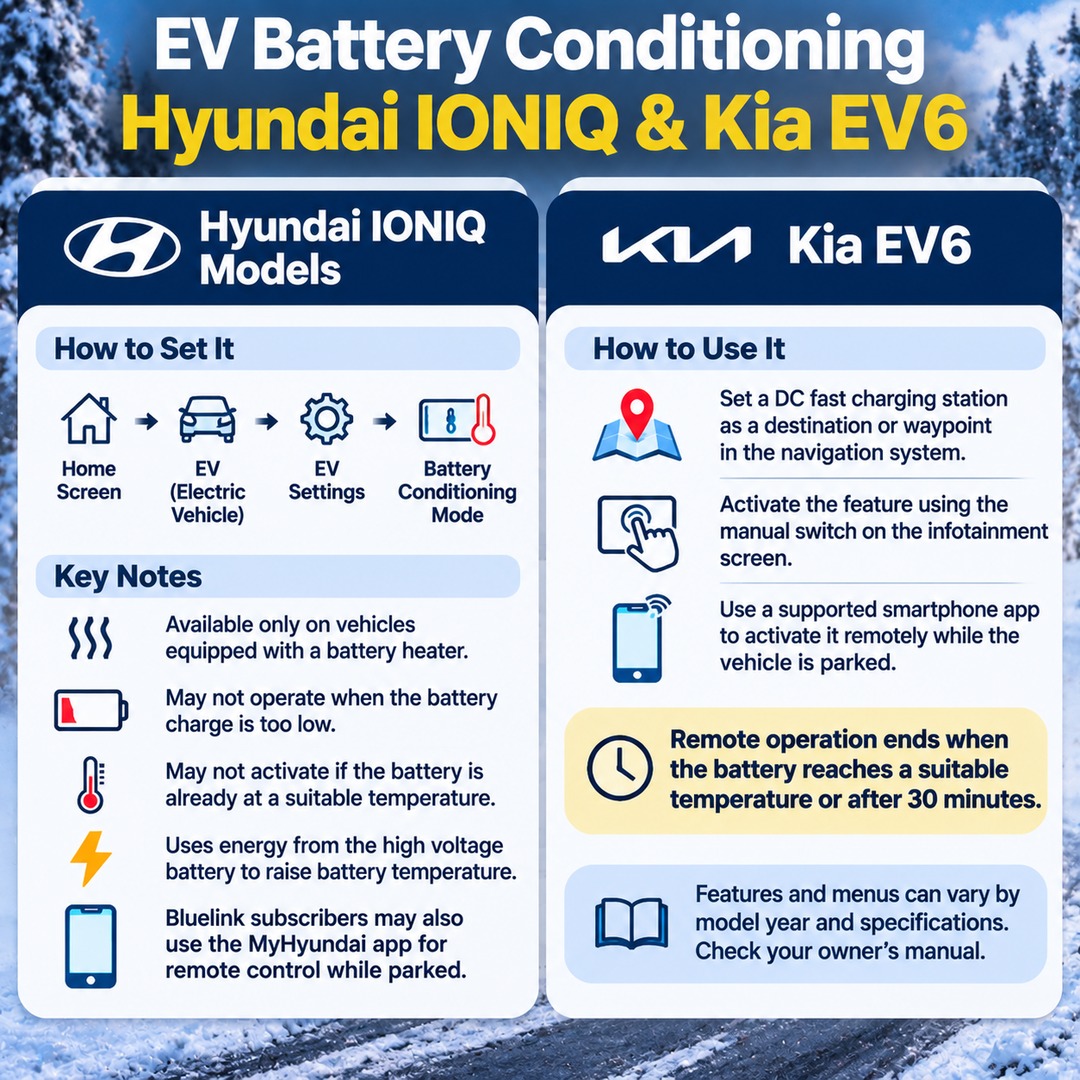
Hyundai IONIQ Models
The Hyundai owner's manual describes the following settings path:
Infotainment home screen
EV (Electric Vehicle)
EV Settings
Battery Conditioning Mode
After enabling the feature, set a DC fast-charging or ultra-fast-charging station as a destination or waypoint in the vehicle's navigation system. The vehicle then adjusts the battery temperature in preparation for arrival.
Hyundai's manual also specifies several important limitations:
The feature is available only on vehicles equipped with a battery heater.
It may not operate when the battery charge is too low, as the vehicle prioritizes preserving driving range.
It may not activate if the battery is already at a suitable temperature.
It uses energy from the high-voltage battery to raise battery temperature.
Vehicles subscribed to Hyundai's Bluelink service may also support remote control while parked through the MyHyundai app.
Kia EV6 Models
Kia also allows drivers to configure Battery Conditioning Mode through the EV settings.
The 2026 model-year owner's manual describes the following methods:
Set a DC fast-charging station as a destination or waypoint in the vehicle's navigation system.
Activate the feature using the manual switch on the infotainment screen.
Use a supported smartphone app to activate it remotely while the vehicle is parked.
According to the relevant Kia owner's manual, remote operation ends when the battery reaches a suitable temperature or after 30 minutes.
The 30-minute period is the automatic termination condition for remote battery conditioning. It does not mean that fast-charging time is reduced by 30 minutes.
Because equipment and available features vary between vehicles, check the owner's manual for your specific model year.
Why Doesn't Battery Preconditioning Work Even When It's Turned On?
If you have configured battery conditioning but do not notice any activity, that does not necessarily mean the feature is faulty.
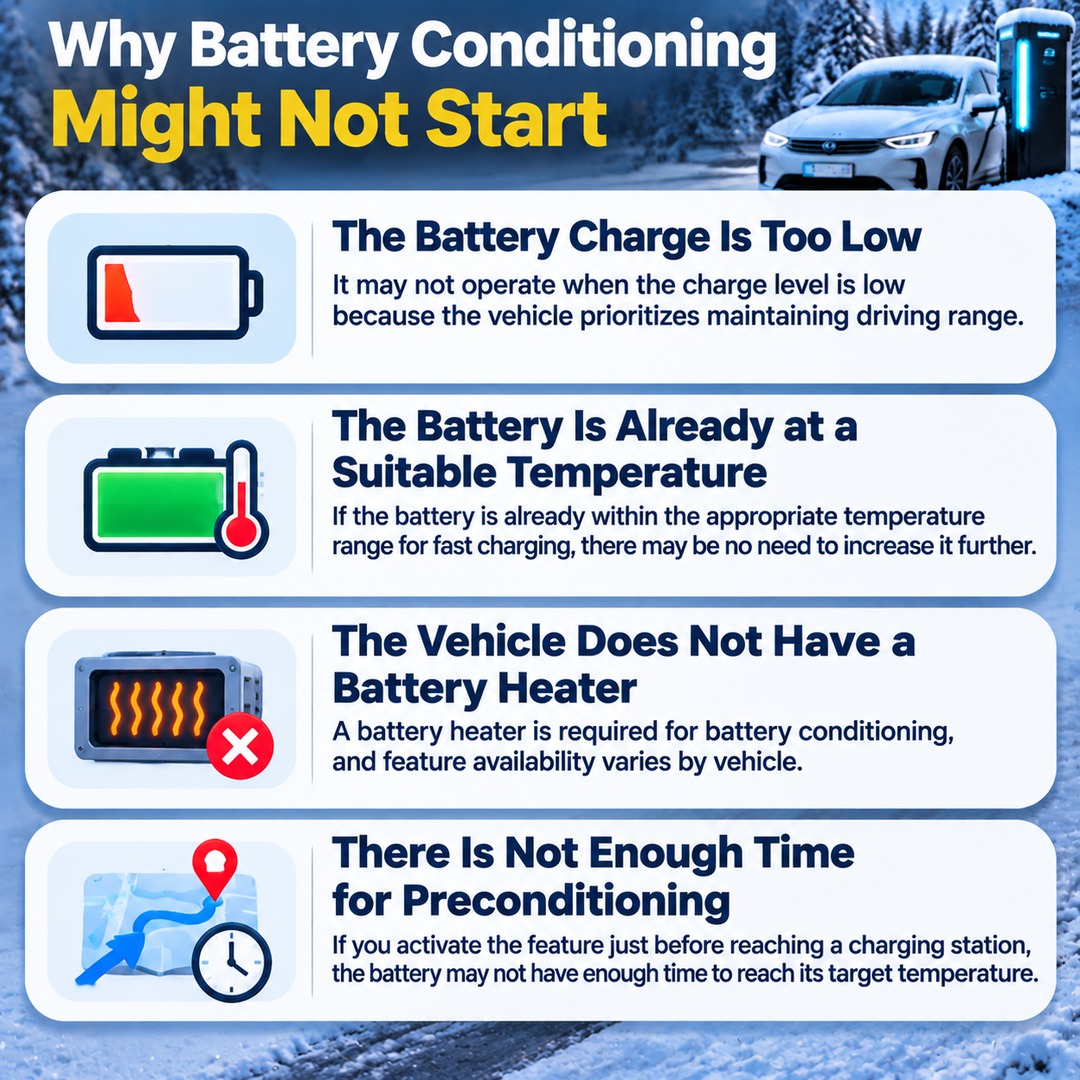
Common reasons include the following.
1. The Battery Charge Is Too Low
Hyundai and Kia owner's manuals explain that battery conditioning may not operate when the charge level is low because the vehicle prioritizes maintaining sufficient driving range.
This is because battery preconditioning consumes energy that would otherwise be available for driving.
2. The Battery Is Already at a Suitable Temperature
If the battery is already within the appropriate temperature range for fast charging, there may be no need to increase its temperature further.
Therefore, the absence of an activation indicator after enabling the feature does not necessarily indicate a problem.
3. The Vehicle Does Not Have a Battery Heater
The relevant Hyundai owner's manual specifically identifies the presence of a battery heater as a requirement for using battery conditioning.
Feature availability varies by vehicle. Do not assume that every model year and trim level supports identical functionality simply because they share the IONIQ name.
4. There Is Not Enough Time for Preconditioning
If you activate the feature just before reaching a charging station, the battery may not have enough time to reach its target temperature.
Consider both the remaining driving time and the battery's initial temperature.
Does Battery Preconditioning Reduce Driving Range?
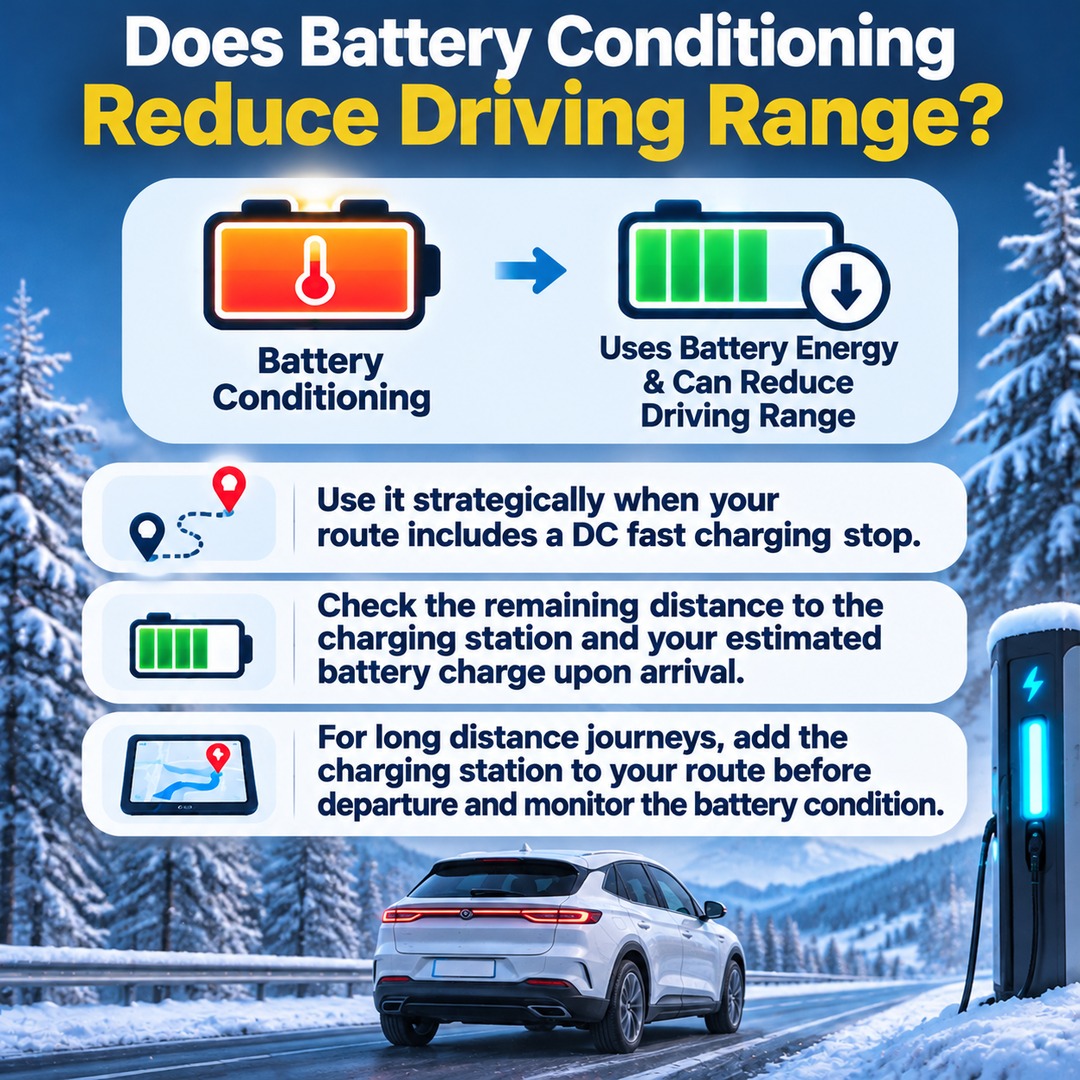
Yes. Battery conditioning uses energy from the traction battery to regulate its temperature, which can reduce the vehicle's available driving range.
This is particularly important when the battery charge is already low. Extended preconditioning under these conditions can affect your travel plans.
Rather than leaving the feature on for as long as possible, use it strategically when your route includes a DC fast-charging stop.
Check the remaining distance to the charging station and your estimated battery charge upon arrival.
For long-distance journeys, it helps to add the charging station to your route before departure and monitor the battery condition as you travel.
What Should You Check If Charging Power Is Still Low After Arrival?
If charging remains slower than expected despite using battery preconditioning, check the following items in order.
| Check | What to Look For |
|---|---|
| Battery condition | Whether the battery is at a suitable temperature |
| State of charge | Current battery charge and charging target |
| Charging station | Rated output and actual operating condition |
| Vehicle status | Battery conditioning indicator and charging notifications |
| Charger malfunction | Whether the same issue occurs with another charger |
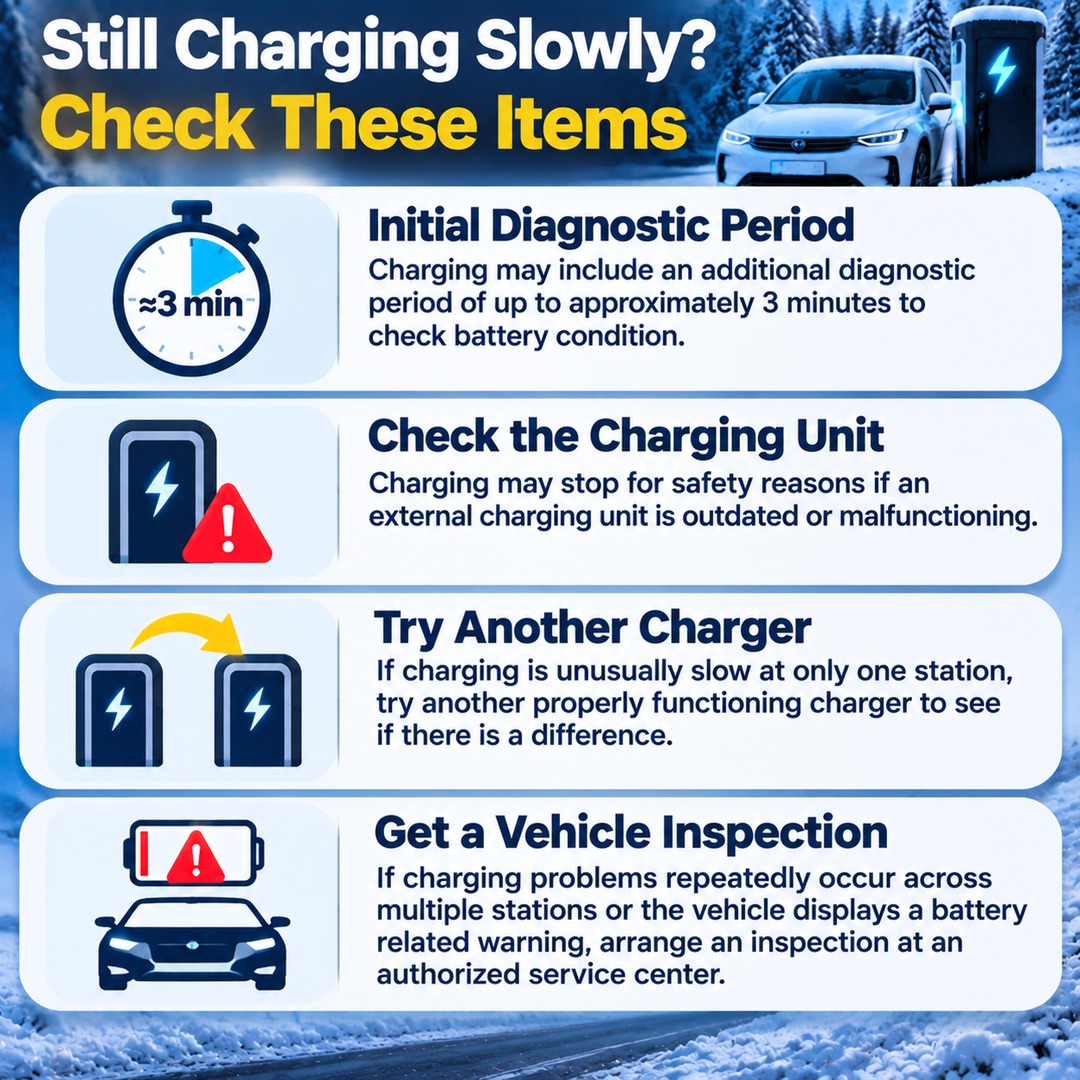
Kia's 2026 model-year owner's manual explains that the charging process may include an additional diagnostic period of up to approximately 3 minutes to check battery condition.
Charging may also stop for safety reasons if an external charging unit is outdated or malfunctioning.
If charging is unusually slow at only one station, try another properly functioning charger to determine whether there is a difference.
Conversely, if charging problems repeatedly occur across multiple stations or the vehicle displays a battery-related warning, arrange an inspection at an authorized service center.
Three Things to Remember About EV Fast Charging in Winter
For winter EV charging, preparing the battery before connecting the charger is just as important as the charging process itself.
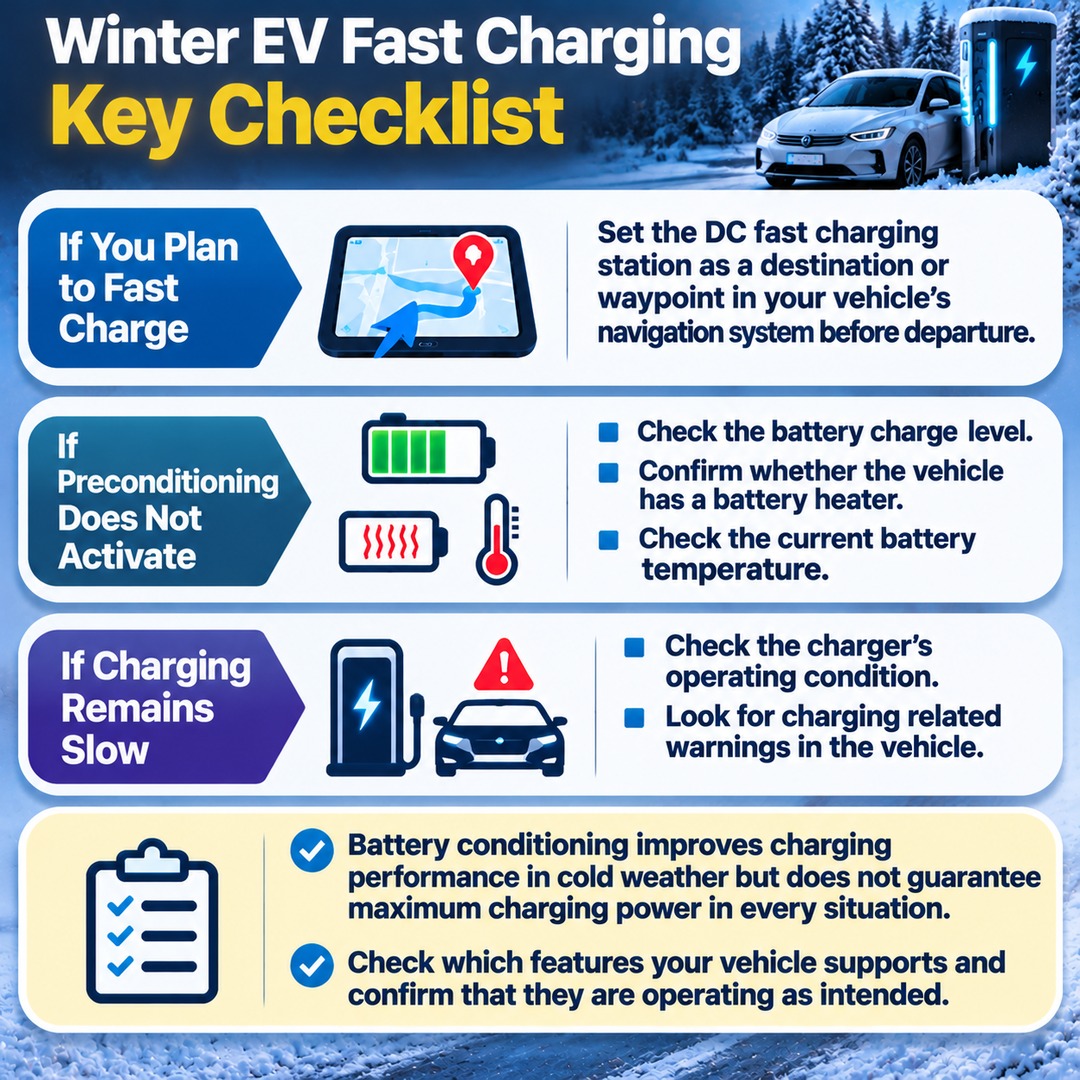
If you plan to fast-charge: Set the DC fast-charging station as a destination or waypoint in your vehicle's navigation system before departure.
If preconditioning does not activate: Check the battery charge level, whether the vehicle has a battery heater, and the current battery temperature.
If charging remains slow: Check the charger's operating condition and look for charging-related warnings in the vehicle.
Battery conditioning is designed to improve charging performance in cold weather. It does not guarantee maximum charging power under every charging condition.
The most reliable starting point is to check which features your vehicle supports and confirm that they are operating as intended.